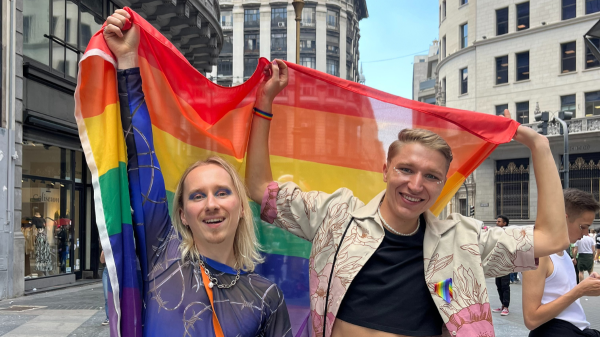
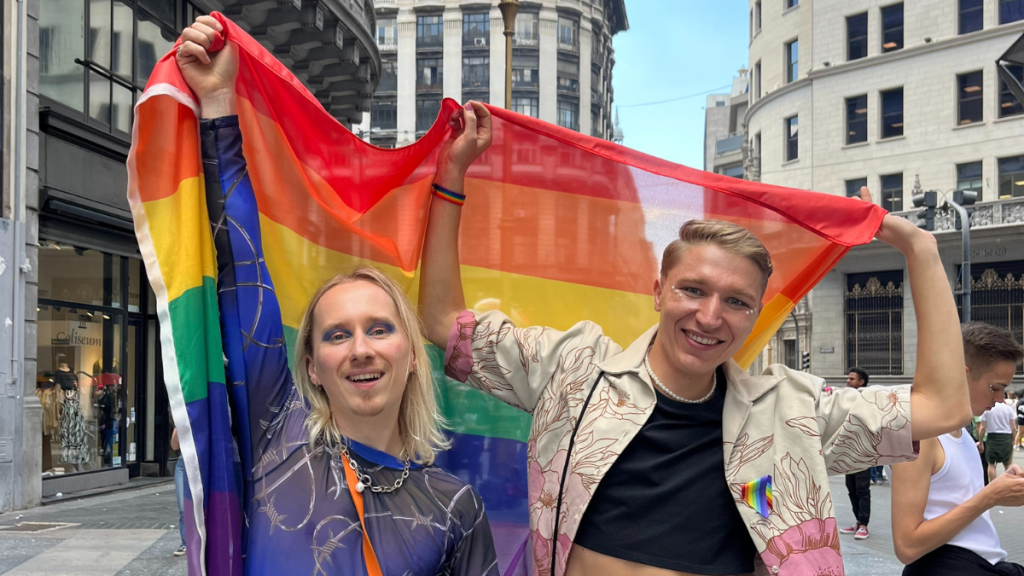
The streets of Buenos Aires were filled with sounds of celebration and protest on Saturday as Argentina’s largest Pride march rolled from the city’s central Plaza de Mayo to the National Congress building.
Hundreds of thousands turned out in support of the LGBTQ+ community and against right-wing Argentine President Javier Milei’s public attacks on it.
The political backdrop for the march was a resounding victory last week for Milei’s party, La Libertad Avanza (LLA), in legislative elections. Low voter turnout may have contributed to a strong showing that took pollsters and the opposition by surprise.
LLA won more than 40 percent of the vote nationwide and 15 of 24 districts, providing the Trump-aligned leader with a veto-proof number of votes in the legislature. It also promised delivery of Trump’s $20 billion bailout for Milei to address Argentina’s ailing economy.
Attendees on Saturday marched under the slogan “Against hate and violence: more pride and unity,” as they navigated packed downtown streets and boulevards toward the capital building.
“These days, with the current government, there is a lot of hate. You can see it in the streets and on social media,” Nahuel Vassallo, a 22-year-old university student, told the Buenos Aires Times. “That’s why standing here to defend our rights and who we are is so key.”
Milei has charted a course of division and blame similar to Trump’s.
Earlier this year, he took the international far-right’s “war on woke” to the World Economic Forum in Davos, Switzerland, with a fiery speech declaring that LGBTQ+ “gender ideology constitutes plain and simple child abuse.”
“They are pedophiles,” he said of the LGBTQ+ community.
“The mental virus of woke ideology” is “the great epidemic of our time that must be cured,” he added. “This is the cancer we need to get rid of,” along with “feminism, diversity, inclusion, abortion, environmentalism, and gender ideology.”
Milei responded by amending the country’s Gender Identity Law by decree. The groundbreaking measure, passed in 2012, dropped requirements for any diagnosis or treatment for someone to prove their gender identity, depathologizing transgender identity. The amended legislation banned gender-affirming hormone treatments and surgeries for trans people under 18.
Argentina has a history of pro-LGBTQ+ legislation that is under attack by Milei and his far-right supporters. The country was the first in Latin America to legalize same-sex marriage in 2012.
According to the latest report from the National Observatory on LGBT+ Hate Crimes, hate crime incidence is up 70 percent in the first six months of 2025 vs. the same period last year. Perhaps more worrying, security forces perpetrated more than half, double the number last year.
Viviana Cardano, from the ATE state-workers union, said the LGBT+ community had suffered under Milei’s divisive politics.
“Today we are all here to reject the policies of this new government and the persecution that the LGBTQ+ community has been suffering since Milei’s statements in Davos,” she said on Saturday.
Among the thousands of signs at the march, one read: “There is no pride without justice.”
Alexei was married to a woman in Russia before fleeing both his marriage and the country for the safe haven of Argentina.
“[In Russia] there’s a lot of pressure to be in a relationship at a young age,” the 24-year-old dental student told the Herald. “I thought that being in a heterosexual marriage would stop people from asking so many questions.”
In recent years, Russians have emigrated to Argentina in droves to avoid conscription in the Russia-Ukraine war. Others, meanwhile, have fled a country that has grown increasingly hostile to its LGBTQ community under the authoritarian rule of President Vladimir Putin.
Over a period of weeks, the Herald spoke with several such emigrés about their experiences in Buenos Aires — and why they ultimately decided to abandon their native Russia. Because their sexual preferences and political views could violate Russian law against “illegal propaganda,” several asked to be identified exclusively by their first names.
“I’ve been dreaming of living in a gay-friendly country since I learned I was gay,” said Sergei Vakhrushev, a blogger based in Buenos Aires.
Vakhrushev was bullied relentlessly as a teenager in the small port city of Vladivostok and finally came out after moving to Moscow. Even then, he was only willing to tell a few close friends, as an adult.
Pride celebrations criminalized
As recently as 2010, conditions for the LGBTQ community in Russia were not significantly worse than in most western countries. But in 2013, Vladimir Putin signed into law a ban on the distribution of “propaganda” depicting “non-traditional sexual relationships” to minors. The ban’s definition of “propaganda” was purposefully ambiguous, which left a range of activities, from pride celebrations to public displays of affection, subject to criminal penalty.
In the years after the law went into effect, the government increased its attacks on LGBTQ representation in media and public affairs. As a result, hate crimes against queer people in Russia jumped drastically, with one study finding that attacks had tripled. For many in the LGBTQ community, going to the police was often not an option, as doing so was tantamount to confessing to a crime.
Like in other hostile societies, these persecuted groups have developed strategies to navigate Russia’s social and political pressures. But after Putin invaded Ukraine in February 2022, many in the queer community felt a new urgency to leave the country.
One such Russian was Nika, 29. She was able to access hormone replacement therapy in Russia when she began her transition in 2019, legally changing her name to reflect her gender identity.
When the Russian government criminalized all gender-affirming healthcare in July 2023, Nika had been living in Argentina for over a year. And by the time Russia expanded its propaganda law to apply to anyone, regardless of age, she had already made a new life for herself in Buenos Aires. “They decided to search for new targets,” Nika said. Under the new law, “existing is propaganda.”
Like many queer Russian immigrants, Nika applied for asylum when she first arrived in Argentina. During the application process, which she described as “chaotic,” she knew few Russians with whom she could compare her experience. As more emigrés arrived and shared their stories, however, she found — and helped build — a community of her own.
‘I just wanted to hold hands’
Many queer Russian immigrants expressed surprise at the extent to which members of the LGBTQ community in Argentina could openly express themselves.
“I just wanted to hold hands with a man and not feel judged,” said Vitalii Panferov, a psychologist based in Buenos Aires. “Even in Moscow, I would only do that at night, where no one could see in the dark. When I got to Argentina, I saw so many gay couples holding hands freely.”
Vitalii initially moved to South Africa in October 2022 to get legally married. He and his partner moved to Buenos Aires the following January. They ended up initiating divorce proceedings later that year.
As he was going through this difficult process, Vitalii found a not-for-profit support group for LGBTQ people in abusive relationships run by a Russian psychologist. In Russia, such a service would be considered illegal.
In Vitalii’s telling, the group not only helped him get back on his feet but inspired him in his own psychological practice, which primarily consists of counseling gay men and couples.
Vakhrushev hopes to get married and raise a family — something that would have been impossible in Russia. In November 2023, he came out to his mother and sister, who still live in Vladivostok, after attending his first Pride march in Argentina.
“I knew I was safe here,” he said.
‘I feel good for the first time’
Kirill Dolgov found it impossible to be openly gay in Russia. A former employee of the Russian government, he told the Herald that he was forced to change careers after being repeatedly questioned about his sexuality. In 2022, Dolgov finally moved to Argentina, where he co-founded a marketing firm with a fellow Russian emigré.
“I feel good for the first time,” he said.
After living a “closed life” in Russia, Dolgov works to foster opportunities and social spaces for other queer Russian immigrants in Argentina by collaborating with fellow emigrés and hosting events.
He also manages a wine company, Bodegas Arte, which hires immigrant artists from Russia to design its labels, each drawing inspiration from Argentine culture. It doesn’t make much money, but he claims it has helped familiarize him with Latin American markets while supporting the Russian community.
In October, Bodegas Artes co-sponsored the queer film festival Side to Side at the LGBTQ cultural center Casa Brandon in the Villa Crespo neighborhood of Buenos Aires. The festival was first held in St. Petersburg but has been barred from showing films in Russia since 2021.
Last year’s event marked the first of its kind held outside of Europe and offered films with Russian, English, and Spanish subtitles — as well as an opportunity for queer Russians to mingle with Argentina’s LGBTQ community.
“Queer expats will often turn to other queer expats because both have the experiences of being sexual dissidents and foreigners, in common,” explained Ryan Centner, a professor of urban geography at the London School of Economics who studies LGBTQ expatriate populations. “Queer expatriates often feel the most ease and trust with other queer people. You don’t have to explain or strategize in the same way that you likely would when engaging with someone who is not queer.”
Last year, Jeny, a 44-year-old art teacher, launched Feria DA! — a bazaar at the LGBTQ bar and social club Feliza in Almagro where queer Russian artists and small business owners can advertise and sell their products. As she told the Herald, many of its vendors are struggling to make ends meet amid the rising cost of living.
Jeny hopes to educate people not just about Russian arts and culture but about the diversity within the Russian immigrant population.
“There’s a problematic stereotype that all Russians in Argentina are rich,” she said.
Recent events at Feria DA! have included lesbian speed dating and queer tango, as well as sales of everything from Russian food to artisanal jewelry and ceramics.
‘I don’t want to go back into the closet’
On February 1, thousands took part in anti-fascist pride marches across Argentina and the West to protest Javier Milei’s attacks on the “LGBT agenda” at the 2025 World Economic Forum. While some Russian immigrants considered the comments harmless compared to the oppression they experienced in Russia, others expressed concern that the country that had provided them sanctuary was regressing.
When Max, 29, sought asylum in Argentina in January 2023, they discovered that they were able to indicate “other” on their application form. It was the first time that they had been able to identify as nonbinary in an official capacity.
Although they acknowledged that the 2023 elections in Argentina were democratic, Max admitted to the Herald that they sometimes feel as though they’ve left “one dictatorship for another.”
“We are not the kinds of refugees this government wants,” Max said. “Do we have the luxury of tolerating what’s happening in Argentina?”
Nika likewise noted that after escaping a ruthlessly anti-LGBTQ regime, “it feels like Groundhog Day. We are used to preparing for the worst. I don’t want to go back into the closet.”
“I see people scared or skeptical [about Milei’s comments], but we already lived it,” she added. “I want to share our experience.”
Here to stay
The LGBTQ Russian community in Buenos Aires largely organizes on Telegram, a messaging application commonly used in the Russian-speaking world. A single queer channel has well over 1,000 members.
Kirill described the group as one “big family” comprising people from many different backgrounds. Not everyone gets along all of the time — what community does? — but its members generally “want to help people with their troubles.”
Not long after his divorce, Panferov joined a Russian-Argentine choir in the hopes of making new friends. It was the first time he said that he didn’t feel judged by his fellow Russians for his sexuality.
“After living in Argentina for a while, you start to realize that it’s actually less normal to be judgmental,” he told the Herald. “That kind of judgment is not okay here.”
After escaping Russia a little over two years ago, Alexei started learning Spanish and immersing himself in his new home. “I never considered staying in my bubble,” he said, referring to the Russian immigrant community.
Even so, he is grateful for the support he received from fellow Russians in navigating the asylum process and finding work early on. He told the Herald that he invites fellow Russian queer people to his clinic for dental work as a way to practice and pay it forward.
“99% of the Russians I know [here] are gay,” he laughed. “We help each other however we can.”
Argentina has undergone significant changes in its economic and social policies since President Javier Milei’s inauguration in December 2023. These changes have had a significant impact on various sectors of society, especially retirees and the LGBTQ community.
Mercedes Caracciolo, a 79-year-old sociologist and lesbian activist, shared her experience with the Washington Blade on how the new measures have affected her quality of life.
“Since Milei’s arrival in government, which began with a brutal devaluation, I am more careful in my spending than I was before,” she said.
Although Caracciolo has additional income from rental properties, she recognizes the situation is much more critical for those who exclusively depend on a pension.
With more than 7 million people receiving pensions, many find themselves “scratching the poverty line” due to the loss of purchasing power. The libertarian government’s economic policies have drastically affected their welfare, leading to a wave of protests across the country.
The reduction of social programs and the lack of LGBTQ-specific public policies have deepened the difficulties that seniors already face. The loss of economic stability particularly affects those who have historically lived on the margins, with fewer job opportunities and limited access to a decent retirement. Many older LGBTQ people, who have spent their lives unable to form traditional families, now find themselves without a support network and with an increasingly less present State.
The advance of conservative discourses has also generated a climate of insecurity and fear.
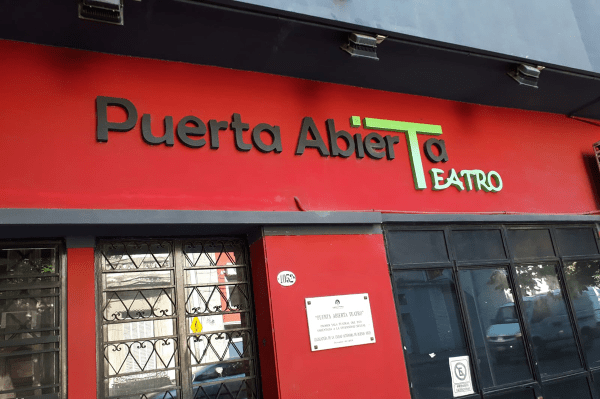
“There is no more sense of security and stability in old age,” Graciela Balestra, a psychologist who is the president of Puerta Abierta a la Diversidad, the first home for LGBTQ seniors in Argentina, explained. “Many LGBTQ+ retirees fear that there are fewer and fewer rights. They see what is happening in Argentina and globally with the advance of the right wing, and they feel that what they worked so hard to achieve is in jeopardy.”
In addition to economic difficulties, the LGBTQ community has faced additional challenges.
Caracciolo noted many supportive spaces have had their government subsidies reduced or eliminated, weakening community networks essential to the well-being of LGBTQ seniors.
“Community networks are also weakened because many of them require state support for certain types of expenses,” she noted.
Balestra warned about the psychological impact.
“Obviously it impacted mental health. There is much more anxiety, there is fear. People who say ‘I’m afraid they’ll kill me’ or ‘I’m afraid to show myself,’” she said. “Before, they used to walk down the street holding hands with their partner, and now they don’t do it anymore. A lot of hopelessness.”
For Balestra, the concern goes beyond the LGBTQ community.
“The economic issue, the rights issue, the fear that something similar to the dictatorship will return. All of this is very scary. And besides, the hopelessness of believing that this is going to continue, that it is not going to change even in the next elections,” she said.
Civil society organizations have denounced an “adjustment” in policies related to gender and diversity that Milei’s government has undertaken. Pride marches in Argentina have become a stage for protests against the president’s policies, especially over his speeches that activists consider hateful towards the LGBTQ community.
Balestra stresses the fear is not only individual, but collective.
“Human rights no longer exist anywhere, women no longer have the place they used to have, they are once again objectified, machismo is on the rise again,” she said. “This brings a lot of despair to older people.”
Despite the climate of uncertainty, Balestra emphasizes resistence forces are still in force.
“We continue working, as always,” she said. “For 25 years at Puerta Abierta we have been doing reflection groups, cultural workshops, social meetings, all with respect to being able to make LGBT people aware of their rights. We never stop meeting, but lately we are talking more and more about these things that we had already left a little behind. The issue of coming out, fear, visibility. Now we have to talk about it again.”
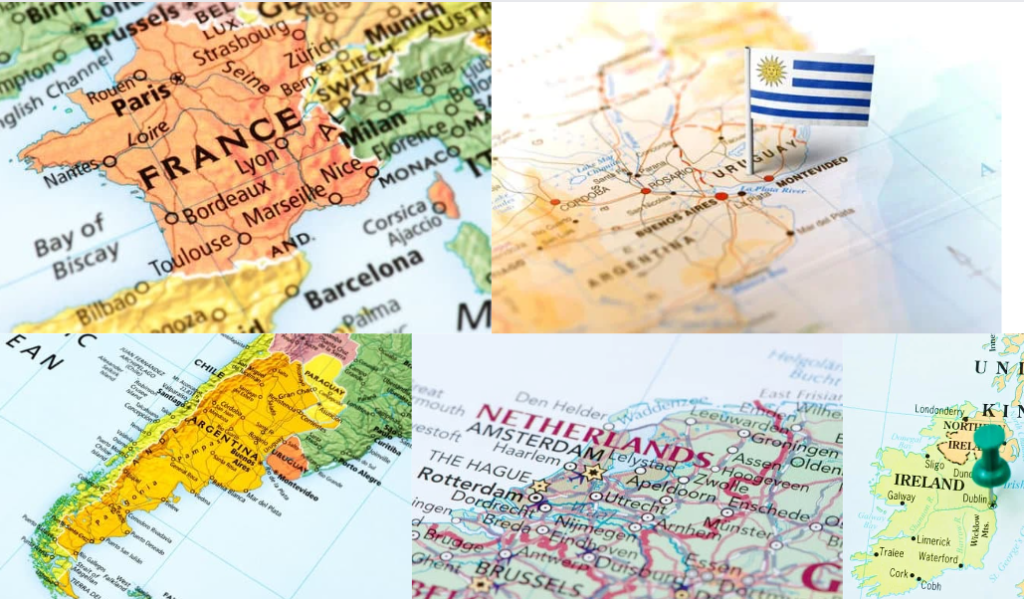
Prior to this week’s stunning presidential election results, a number of LGBTQ advocates and celebrities threatened to leave the U.S. should Donald Trump be elected. Now that the real estate mogul and reality TV star is America’s president-elect, NBC OUT has compiled a handy list of LGBTQ-friendly countries for U.S. expatriates.


 fleeredstates.blog
You must be logged in to post a comment.