Canada has a proud history of providing protection to and helping resettle those most in need. That includes those in the lesbian, gay, bisexual, transgender, queer, intersex, and additional sexually and gender diverse (LGBTQI+) community.
The Trump administration has set a cap of just 7,500 refugee admissions for 2026, a 94% reduction from the Biden administration’s 125,000-person target, according to a Presidential Determination published Oct. 31 in the Federal Register. A new report from UCLA’s Williams Institute warns the cuts will disproportionately harm LGBTQ refugees worldwide.
At least 62 countries currently maintain laws criminalizing consensual same-sex activity. Thousands of vulnerable individuals face extended waits in dangerous transit countries, according to the report.
LGBTQ refugees encounter unique obstacles under the reduced cap. Many are single adults who fled family persecution and lack reunification pathways that prioritize other refugees. Officials sometimes fail to recognize persecution based on sexual orientation or gender identity, while refugees may fear disclosing their status. Extended waits create economic vulnerability, forcing many into exploitative work situations.
“The lack of reliable data on LGBTQI+ refugees makes the impact of this new cap even harder to measure,” Ari Shaw, director of international programs at the Williams Institute, said in a news release. “Without accurate data, policymakers and service providers cannot fully assess or respond to the needs of LGBTQI+ refugees.”
The Trump administration has not yet appointed a special envoy for LGBTQ rights, eliminating a key referral pathway established under Biden for at-risk individuals, according to the report.
In the midst of the Trump administration’s attacks on both the LGBTQ community and immigrants, the non-profit organization Immigration Equality is working to ensure that queer asylum seekers and refugees have access to legal services.
Immigration Equality, which has represented LGBTQ immigrants since it was founded in 1994, has been a haven for individuals who come from countries where they are persecuted for their identity. They offer both direct representation and a program where asylum seekers’ cases are vetted and matched with pro-bono lawyers.
But since the Trump administration’s recent attacks on immigrants, the process of filing these individuals’ cases and fighting for their safety has become significantly more difficult. Immigration Equality’s director of law and policy, Bridget Crawford, noted in an interview with Gay City News that Trump has been attacking all cases, not just a certain few.
“A lot of what the Trump administration seems to be focused on is not efficient, fair adjudication of claims,” she said. “It seems to be focused on eliminating the claims altogether and preventing people from making them, or quickly dispensing with them without due process.”
Alongside blocking initial claims from being made and removing more than one-third of immigration judges, the appellate courts are also shifting their decisions to move less favorably toward immigrants, despite many of these cases having overwhelming evidence that they meet the requirements for refugee status and protection.
All of these obstacles have resulted in an uptick in Immigration Equality’s cases being denied, and these issues are being further inflamed after Trump recently announced the pause of many immigrant cases, following the shooting of two West Virginia National Guard members.
But Crawford made sure to note that despite these hardships, Immigration Equality is still winning cases.
“We still have many people, both trans and LGB, who are successful in their claims,” she said. “The reality is that under the law, as it is written, and the precedent as it’s been established for decades, these are very strong claims — people continue to win because they meet the definition of asylum under our law.”
These policies have invoked fear in immigrants pursuing a case, as they are scared of not having their case heard and fear showing up for their case and being put into detention centers, despite following all the correct procedures. Being LGBTQ amplifies this fear.
“As an LGBTQ+ advocacy organization, we have long witnessed mistreatment of our population in the immigration detention system,” Crawford said. A 2024 report published by Immigration Equality revealed that under both Democratic and Republican administrations, there were consistent reports of “sexual harassment, verbal and sexual abuse, physical abuse, prolonged solitary confinement, and inadequate medical care.”
The few protections that were in place to prevent this abuse have gradually been gutted, according to Crawford. These included internal watchdog agencies like the Civil Rights Civil Liberties (CRCL). In the past, if someone filed a complaint of mistreatment, it would be investigated by these internal agencies. Recently, though, these complaints have not been looked into.
Against the backdrop of the Trump administration’s restrictive immigration policies, the work of Immigration Equality is their clients find hope in them, Immigration Equality finds hope in its clients.
“They are the reason we all went into this work in the first place,” said Crawford. “We have these incredible stories of bravery and perseverance that serve as a source of inspiration for all of us. So many of our clients have survived so much worse, and we look to them for a sense of perspective.”
A Dutch court has upheld the decision to reject an American trans woman’s application for asylum after the 28-year-old challenged the decision earlier this year.
Veronica Clifford-Carlos, a visual artist from California, applied for asylum in the Netherlands in the wake of the president’s continued targeting of trans rights and villainization of the trans community.
With the support of Dutch advocacy group LGBT Asylum Support – which is working with about 20 other trans Americans on asylum claims as well – Clifford-Carlos said the anti-trans administration has made her feel unsafe remaining in the United States.
The court, however, disagreed that Clifford-Carlos personally faces a legitimate risk of persecution, Reuters reported. The judge also said she did not prove she systemically lacks protection or access to essential services.
The court sent her case back to immigration authorities to review again due to a procedural error the first time around.
A statement from LGBT Asylum Support in August explained that the Netherlands’ Immigration and Naturalisation Service (IND) “generally states that discrimination by authorities and fellow citizens can be considered an act of persecution if it is so severe that victims can no longer function socially and societally” but that it “maintains that there are no grounds for exceptional treatment of transgender and queer refugees from the U.S.”
Clifford-Carlos was the first trans American to legally challenge an asylum rejection in the Netherlands. In September, she toldReuters how bad it had become in the States for her since the new administration took office.
“I have people screaming f**got at me in the street… I have people threatening my life, threatening to assault me, threatening to follow me home and kill my family.”
She spoke to The World in September from a Dutch refugee camp, where she explained, “It feels like the U.S. doesn’t see me as human. I am not seen as a woman in the eyes of the government, and because of my transition, I am technically not a man either.”
She said the thought of returning to the U.S. gives her “more dread than I have ever experienced in my entire life.”
The Netherlands has long been considered a refuge for LGBTQ+ acceptance. In 1981, it was the first country in the world to grant refugee status to someone due to their sexual orientation, and in 2001, it became the first country to grant marriage equality.
But Marlou Schrover, an economic and social history professor in the country, told The World that reality has not lived up to the reputation. She said it is extremely rare for someone to be given refugee status based solely on LGBTQ+ identity, and that one must not only prove they have experienced physical violence, but that the police refused to help when it was reported.
Schrover explained that Dutch immigration authorities still view the United States as mostly safe for trans people because there are many other states they can move to if they don’t feel safe in their own.
The administration’s anti-trans policies may also not be enough, she said. “Exclusion from the military or exclusion from sports may be unpleasant and horrible, but it’s not seen as persecution in the eyes of Dutch immigration officials.”
She added that granting asylum to trans people from the U.S. is a risky decision because it makes a big statement about the U.S. and could affect relations between the two countries.
In 1980, Cuban police detained Fidel Armando Toboso-Alfonso without charge, encouraged co-workers to publicly shame him, and warned he faced four years in prison unless he fled the country. His “crime” was being gay. Having previously faced 60 days in a labor camp, Toboso-Alfonso chose exile. When he reached the United States, an immigration judge made a historic ruling: He granted Toboso-Alfonso refuge. That decision became a lifeline for countless LGBTQ people.
The United States was once considered a place where LGBTQ people could claim asylum. Today, under a harsher immigration system shaped by Trump-era judges, this image is slipping away.
In June, U.S. Citizenship and Immigration Services issued an alert reminding officers that marriages must be legally valid where celebrated to qualify for immigration benefits. For queer couples from countries that criminalize or refuse to recognize same-sex marriage, that’s an impossible standard. They must present a marriage certificate that, in their home country, they could be jailed or killed for attempting to obtain.
This is just one part of the Trump Administration’s broader rollback of protections for immigrants and LGBTQ people.
Under Presidents Barack Obama and Joe Biden, the United States resettled tens of thousands of refugees annually, including LGBTQ people fleeing persecution, arrest, torture, or death. Today, that number has been slashed to just 7,500—a fraction of its former scale and overwhelmingly skewed toward white applicants from South Africa.
The Trump Administration has also ordered federal agencies to remove recognition of transgender and nonbinary identities from official documents. Because the asylum process demands consistency across forms, nonbinary refugees now face an impossible choice: misrepresent themselves on paper or risk rejection for “inconsistency.”
These bureaucratic changes to passports, marriage certificates, and federal forms carry devastating consequences. By narrowing who counts as married or whose gender “exists” on paper, the White House has effectively barred countless queer individuals from asylum protections. Bureaucracy has become a new border wall, keeping the most vulnerable people out.
The United States does not jail or execute people for being LGBTQ. But the government is asking queer people to erase themselves to remain here—a quieter, procedural form of violence. A nation cannot call itself a refuge while demanding that those seeking safety deny who they are.
Last week, the Supreme Court allowed the Trump Administration to require that U.S. passports list only the sex assigned at birth. The decision halts lower-court efforts to block the policy, meaning the State Department may now refuse to process passports reflecting a person’s self-identified gender. The change may seem technical, but it signals something larger: When combined with other anti-LGBTQ measures, it threatens not only the rights of citizens, but also the safety of queer immigrants and refugees.
Meanwhile, some lawmakers are pushing to overturn Obergefell v. Hodges, the 2015 Supreme Court decision that recognized same-sex marriage as a constitutional right. The Court recently declined to hear one such challenge, but its mere consideration shows how precarious equality has become.
For queer asylum seekers already in the United States, the situation remains perilous. Claims based on sexual orientation or gender identity are often met with skepticism, as adjudicators demand “proof” of identity—an impossible expectation when visibility itself can be a death sentence. Instead of offering protection, the system pressures applicants to conform to stereotypes of what being “gay enough” looks like.
Worse still, immigration judges may now deny asylum applications without hearings, silencing stories that could save lives. Bureaucracy, once again, has become a weapon.
The next generation must do more than defend LGBTQ people—they must reclaim the promise of this country. A true refuge is defined not by paperwork or policy, but by the belief that every person deserves to live in truth and safety.
President Donald Trump’s second term has especially targeted two groups in particular: immigrants and LGBTQ people. On his first day in office, he ended the U.S. Refugee Admissions Program, which left thousands of refugees who had already been approved to live in the United States stranded. He also drastically lowered the cap on the number of refugees allowed to enter the U.S. from 125,000 to 7,500. Thankfully, Immigration Equality is here to help.
“For many decades, we’ve seen clients arrive with nothing but hope and fear, and walk out with safety and freedom,” Anto Chavez, Immigration Equality’s communications director, told LGBTQ Nation. “It’s just becoming harder to fight, but we’re still here with them. We still hold their hand every step of the way. We have more than 700 active legal cases, our legal staff trains thousands of lawyers nationwide to represent queer immigrants pro bono, and we fight in the courts and Congress to expand protections.”
Founded in 1994, Immigration Equality provides free legal help for immigrants and asylum seekers who are LGBTQ+ or HIV-positive. The group is fighting Trump’s seemingly arbitrary executive orders on immigration in courts — and winning.
Chavez spoke with LGBTQ Nation about how the sociocultural landscape around immigration has changed now that Trump is back in office and what average citizens can do to fight for the rights of queer immigrants in our community.
For forever, immigrant communities have learned how to take care of each other without relying on systems that have failed us. We have to continue to do that. We have to continue to fight. Anto Chavez, Immigration Equality communications director
LGBTQ Nation: What has changed under Trump’s second term for immigrants applying for asylum to escape anti-LGBTQ persecution in their home countries?
Anto Chavez: The anti-immigrant rhetoric has shaped the culture and the cultural shift in our country; this happened during Trump’s term as well. But it really changes how queer immigrants even envision themselves in the U.S.
At the beginning of this administration, some of our clients were refugees. We have an asylum program and a refugee program. Historically, we have worked with ICE (Immigration and Customs Enforcement), but we opened up our refugee program a few years ago. After we launched it, some folks were really scared to even just decide to come to the U.S. I think there was a lot of misinformation, [but] this is still a place that’s safer for many folks.
But when it comes to policy — I mean, if we talk about refugee work, every avenue has been blocked for us. The refugee resettlement program went from thousands a year to zero, and so we’ve had to really look into other options.
How has Donald Trump’s executive order drastically lowering the refugee cap affected refugees who were already approved?
Since January 20, after the executive order suspending the refugee resettlement program and halting the process for many folks, we had people who were ready to travel and had to cancel. So for queer and trans asylum seekers, this means just fewer pathways for relocation or protection from persecution.
The U.S. has historically been a place where queer immigrants have been able to come and live freely. It’s scary to think it’s starting to change.
There are increased barriers for asylum seekers who are already here as well. Policies like what was called “Remain in Mexico,” were reinstated. The CBP (Customs and Border Patrol) One app, which allowed those migrating for humanitarian reasons to schedule asylum interviews at ports of entry, was ended, and existing appointments were canceled.
There has been increased deportation, including of multiple LGBTQ asylum seekers. There’s also the abuse that happens in detention, particularly to queer and trans immigrants. It’s just out of this world. We have some reports that queer immigrants are more likely to be assaulted and abused in ICE detention and put into solitary confinement.
LGBTQ Nation spoke with Rainbow Railroad, an international not-for-profit organization that helps LGBTQ+ people escape state-sponsored violence, and two refugees that the group has helped to better understand the plight of queer asylum seekers looking to settle in the United States amid the president’s xenophobic attacks on immigrants.
It was a bracingly cold night a year ago last December when Javi (not his real name) found himself exiting the jetway at O’Hare International Airport in Chicago. After a five-hour flight from the Salvadoran capital of San Salvador, he literally had no idea where he was going.
Described by those who know him as a good-looking guy — about 5’9″, with dark hair and a beautiful smile — Javi, 30, grew up in a small town in El Salvador among a religious and “very conservative” family, including an uncle who had a problem with him.
“He said, ‘I’m gonna kill you, because in my family, it’s not allowed to have a fa**ot,’” Javi recounted well enough in English, his second language.
His uncle was a cop assigned to El Salvador’s Supreme Court.
“The police in El Salvador are very, very corrupt,” Javi explained. But when Javi shared the threat with his family, they did nothing to support him. They already suspected Javi’s uncle of shooting his brother in an incident the year before, and were powerless to help, even if they wanted to.
“My family never supported me because I’m gay,” Javi said.
There had been other threats when he was growing up, but this time was different, more overt.
Javi decided to leave. It was the first of several moves that took Javi around the country as terror gripped El Salvador under the authoritarian regime of President Nayib Bukele.
The charismatic leader, first elected in 2019 at the age of 38, unleashed police and the army across the country to address gang crime, sent troops into the legislature to force votes, and enabled his own indefinite reelection after ending a historic ban on consecutive presidential terms.
Despite aligning with the LGBTQ+ community early in his political career, Bukele broke a pledge supporting marriage equality and vowed to remove “all traces” of “gender ideologies in schools and colleges.” He purged workers from the government, promoting policies that were “incompatible” with his “patriotic and family values” agenda.
LGBTQ+ people were now officially under threat in El Salvador, in a terror campaign sanctioned by the government and carried out by foot soldiers like Javi’s uncle.
Paranoia ran rampant in the community. Javi saw suspicious men surveilling one building he lived in, “Secret Service agents or something like that.” Police and military officers appeared in the building’s hallways, taking photographs.
“That was not normal, having somebody in a mask for surveillance in your building,” he said.
People are forcibly displaced from their home, whether it’s for climate disaster reasons, or geopolitical crises, or in the case of LGBTQ+ people, it’s because of their identity or because of who they love, or because of who they are.Jamaican queer refugee, Latoya Nugent
Javi was detained on the way to lunch from work one day by a dozen police officers who accused him of stealing a phone. They asked, “‘Why are you shaking?’ Because I was very nervous. Why did they choose me to detain and not somebody else?”
When they saw his identification, “the narrative changed,” Javi said.
They said the town on his ID was a “dangerous place” and “then they accused me of being a gangster, not stealing the phone.”
“I was detained for like 45 minutes on the street while they were doing the investigation, and it was a horrible experience, because they hit me, and they threatened me, saying, ‘You are going to the jail,’ and this kind of stuff.”
They didn’t discover he was gay, Javi said. Whether or not they had, Javi could have been detained indefinitely under legislation passed by Bukele’s government, suspending due process in service of his anti-gang crusade.
“All of your constitutional rights are cut off, because that is the law now,” Javi said.
It’s one reason the Trump administration accepted Bukele’s offer earlier this year to house U.S. detainees in El Salvador’s notorious CECOT prison.
Other incidents followed, Javi said: more masked officers sighted, neighbors screaming then suddenly silenced, cars and apartments inspected and photographed.
None of it “was normal,” Javi said.
Javi’s detention on the street two years ago ended with his release and a warning — and his own determination that life in El Salvador was no longer tenable for him.
Refugees may need a helping hand and support in the beginning, because they’re often relocating with limited or no resources. But the minute they get that support, they start to integrate, and they go on to live very self-sufficient lives and make significant contributions to their communities.Jamaican queer refugee, Latoya Nugent
Latoya Nugent came to the same conclusion in Jamaica three years ago.
“People do not become refugees by choice,” said the engagement director for Rainbow Railroad, a non-governmental organization (NGO) that helps relocate and resettle LGBTQ+ refugees in the United States and Canada.
Nugent spoke with the lilting accent she brought to Toronto in 2022.
“People are forcibly displaced from their home, whether it’s for climate disaster reasons, or geopolitical crises, or in the case of LGBTQ+ people, it’s because of their identity or because of who they love, or because of who they are, right?”
Nugent has watched with dismay as the second Trump administration shuts down refugee admissions to the United States.
Trump issued an executive order on his very first day in office suspending all refugee admissions to the U.S., and a presidential determination on September 30 lowered the ceiling on refugees from a cap of 125,000 set by the Biden administration last year to just 7,500 in 2025.
The downsized and refocused U.S. program will almost entirely benefit just one group of asylum seekers: white South Africans.
It’s a mindset “steeped in anti-immigrant sentiment and xenophobia,” Nugent said of Trump’s nativist immigration goals.
The idea that refugees are criminals waiting to prey on American “suckers”, to use a favored Trump description, or “just looking for handouts” in Nugent’s words, misses the point of refugee relocation and assistance, she says.
“Yes, I appreciate and I accept that refugees may need a helping hand and support in the beginning, because they’re often relocating with limited or no resources. But the minute they get that support, they start to integrate, and they go on to live very self-sufficient lives and make significant contributions to their communities,” she said.
Supporting refugees to the U.S. is an investment in communities, she says, not an invitation to do crime in them.
“I tell people — I mean, I’m very open about this, like, this has been my own experience, too. Yes, I live in Canada, but when I was forced to flee my home country, I needed support in the first few months to help me to restart and to rebuild. And this is what happens to a lot of LGBTQ+ refugees.”
It’s also the kind of assistance Rainbow Railroad is expanding after nearly 20 years helping them.
Named for the Underground Railroad of secret routes and safe houses that led fugitive slaves to freedom in the United States in the late 18th and 19th centuries, the NGO was founded in 2006 with a similar purpose: to help relocate LGBTQ+ people experiencing violence in their home countries to more affirming nations free from the same kinds of persecution.
The group has assisted nearly 40,000 individuals since their founding, including over 2200 refugees supported through emergency relocation assistance in crisis situations like the anti-gay purges in Chechnya in 2017 and 2018 and the fall of Kabul to the Taliban in 2021.
In 2024 alone, Rainbow Railroad received 13,402 requests for help, supported 5,886 people, and relocated 302 LGBTQ+ individuals from 36 countries.
While dislocation due to war, famine and persecution of all kinds roils the planet in ever-greater numbers — 1 in every 69 people globally is forcibly displaced, or about 115 million people — only about 5% of those in need of resettlement received it last year.
Integrating refugees has become a key element in an expanded remit for Rainbow Railroad, as they look to both broaden their mission and grapple with the U.S government slamming the door on new LGBTQ+ arrivals.
Rainbow Railroad’s Nugent says the initial support that refugees may need has been “weaponized against them” and “used in a lot of spaces to demonize refugees.”
The same executive order that halted refugee admissions in January slashed a State Department program designed specifically to help integrate refugees into U.S. communities.
It was called Welcome Corps.
“What the Welcome Corps program did was it allowed groups of volunteers of five-plus people to sponsor a refugee from overseas, and they would work with the refugee when they arrived for a three-month period to help to connect them with resources,” Nugent said.
The Biden administration initiative went live in 2023, and Rainbow Railroad became a partner, sponsoring travel to the U.S. and welcoming LGBTQ+ refugees to the country.
One of the first Welcome Corps arrivals: Javi from El Salvador.
“I never knew I was traveling from El Salvador to Chicago,” he said. “When I was in the airport was the moment when I realized I was traveling here.”
Javi spent close to a year speaking with different organizations about how to escape El Salvador, and came to the attention of the International Organization for Migration (IOM), a United Nations-affiliated group. They brought Javi together with Welcome Corps and Rainbow Railroad.
“For security reasons, they only told me, basically, just the important information, but nothing about the place, nothing about who will be your sponsors, or who or where to go,” Javi says with a note of incredulity.
You can hear in his voice a kind of astonishment that he was now entrusting his life and future to a group of people he didn’t know in a place he’d never been, wherever that turned out to be.
At least life in El Salvador was the devil he knew.
“And it was very cold here,” Javi adds with a laugh.
He didn’t look happy, says one of his sponsors.
Bruce Koff, a longtime board member for Rainbow Railroad, organized what the org called a Community of Care group for Javi as part of their Welcome Corps partnership.
A therapist by trade, Koff brought together four gay men, including a Colombian social worker, two emigres from Uzbekistan and Kyrgyzstan, and his own husband. They were tasked with settling Javi into his new community.
“We didn’t want to all go out to the airport at once and kind of overwhelm him,” Koff recounted. “We had no idea what that might be, what his state was.”
Mauricio, the Spanish speaker in the group, and David, one of the emigres, welcomed Javi at the airport.
“Two people were waiting for me, and in that moment I realized, these are from Rainbow Railroad,” Javi said, recalling a sense of relief.
“There are so many different opportunities to do good in the world…. But to actually have the experience of seeing one individual life transformed from one of fear and desperation to one of hope and stability is magical.Bruce Koff, a longtime board member for Rainbow Railroad
Still, it was an awkward first few hours for the refugee as he took in his new surroundings and literally acclimated to Chicago in December.
David and Mauricio took Javi to a restaurant to meet the other members of the group before heading to the apartment he’d be sharing with a friend of Bruce and his husband Mitchell.
“He spoke maybe about three or four words of English at the time, but we made sure he had a good, warm meal, and that he met us and knew who we were and what we were there to do,” Koff said.
“Mauricio spoke fluent Spanish, so there was that comfort, as well, that we could communicate with Javi from the very beginning.”
But it was a big meal and Javi wasn’t eating that much, Koff recalled.
“So I turned to him, and I said in my just okay Spanish, ‘You have to finish your meal, because you now have five mothers’ — cinco madres.” And he understood that, and he laughed. And it was such a relief to see him laugh, you know, in that first hour or two with us. And he’s been amazing ever since.”
Javi’s sponsors settled him in over their allotted three months with a small stipend from Rainbow Railroad and a GoFundMe campaign that raised enough to cover his expenses and bank a little more. The group helped with his work authorization, obtaining a Social Security number, applying for a green card, opening a bank account, and finding healthcare. His roommate plastered their apartment with Post-It notes that showed the English word for practically every object in it.
Javi found two food service jobs to get on his feet — “He’s very good with a budget,” Koff says — and now he’s working at a nonprofit doing community outreach with the Latin community. He already has a degree in social work earned in El Salvador; now he wants to pursue his master’s.
It’s just the kind of refugee success story Rainbow Railroad’s Nugent described.
“Honestly, he’s everything you want in someone coming to this country,” Koff said. “I mean, without exaggeration, he is such a fine person with a good mind who wants to contribute to the common good, and just make a good life for himself.”
“The only caveat to that,” Koff adds, “is the times that we live in, right? And the concerns that even though his status is completely legal, we have no idea what sort of risk he may still be facing.”
With Welcome Corps eliminated and refugee admissions now slashed, Rainbow Railroad is focused on resettlement efforts for refugees and asylum seekers already in the U.S.
They’re recruiting volunteers for a revived sponsor program with the same responsibilities, and launched a Community Access Fund to distribute money to service providers, community activists, and grassroots organizations supporting LGBTQ+ asylum seekers and other displaced migrants. A new Rainbow Housing Drive connects volunteer hosts with LGBTQ+ newcomers.
Contributing to the common good is a common theme among the refugees Nugent and Koff have worked with.
There was the very first person Rainbow Railroad relocated with Welcome Corps — to Washington DC — wide-eyed at his married sponsors walking hand-in-hand on the street and vowing to start his own support team to pay the support he was given forward.
There was the refugee relocated to San Francisco whose volunteer group helped land him a job. After he got his first paycheck, he asked, “Which organization in my community works with LGBTQI youth, because I want to donate to that organization.”
And there’s Javi, who’s shared his refugee experience with others contemplating an escape from persecution. He recently spoke with a young man in Uganda.
“It’s great to share the experience with other people about how they can change their life,” he said. “In those kinds of countries, it’s illegal to be gay. For gay people it’s very complicated even to have a good conversation with somebody, because all the time they are afraid to share their experience. I can help with that.”
It’s a virtuous cycle for refugees and volunteers alike.
“There are so many different opportunities to do good in the world,” says Koff. “This was just one, but to actually have the experience of seeing one individual life transformed from one of fear and desperation to one of hope and stability is magical. And it just helped me to realize that I don’t have to spend the day worrying about what’s the best way to respond to adversity in this world. There’s always a way to help.”
“They build community so quickly,” Nugent says of refugees. “They finally find that sense of home, and it makes them feel human. That’s it. It makes them feel human. And they show up in the world differently.”
In this episode, we sit down with Help Me Leave (www.helpmeleave.us ) — an organization dedicated to creating pathways to safety for LGBTQ people in the United States.
Help Me Leave works to:
🌍 Support amnesty and refuge visas for LGBTQ Americans facing discrimination and hostility
✈️ Provide emergency relocation assistance to those in urgent need
🤝 Build a global network of allies, advocates, and skilled volunteers who can help
The conversation explores: Why LGBTQ people in the U.S. are increasingly seeking refuge abroad
How the group is building momentum toward meaningful immigration solutions
Ways YOU can get involved, contribute, or share your skills to support this mission
“Help Me Leave! is continuing to build momentum. Follow for further updates and get in touch if you have skills that can help.”
In a world and at a point where LGBTQ rights are under increasing threat, organizations like Rainbow Railroad are delivering life-saving action and offering hope as they do. Founded in 2006 as a grassroots response to the grave needs of LGBTQ individuals facing persecution, Rainbow Railroad has evolved into a global leader in queer humanitarian response. Their mission is clear and critical — to help LGBTQ people escape life-threatening situations and access the safety and freedom they deserve.
The Washington Blade was honored to speak with Latoya Nugent, head of engagement at Rainbow Railroad, a determined advocate and strategist who brings lived experience, passion, and vision to this work. In our conversation, Latoya sheds much-needed light on the evolution of the LGBTQ refugee crisis, the organization’s global impact, and how everyday people can get proactive in supporting LGBTQ asylum seekers and those displaced.
Can you share with us a little bit about Rainbow Railroad and how it was formed?
Rainbow Railroad is a global non-profit organization with offices in New York and Toronto. We were founded in 2006 as a volunteer-led initiative focused on helping LGBTQI+ people at risk find safety. Our primary work supports individuals living in what we call “countries of criminalization” – places where it’s illegal to be LGBTQI+.
We officially registered as a charity in Canada in 2013 and received 501(c)(3) status in the U.S. in 2015. Since then, we’ve grown to a team of about 60 staff working across direct service and advocacy. Our mission is to ensure LGBTQI+ people in danger can access safety and support, while also driving global advocacy to improve conditions on the ground.
Largely because there simply weren’t many organizations doing this work. While humanitarian protection has existed for decades, very few have focused specifically on how forced displacement affects LGBTQI+ people. The persecution faced by our community is often deeply personal and not adequately understood or addressed in global protection systems.
Rainbow Railroad was founded by a group of lawyers in Toronto who witnessed extreme anti-LGBTQI+ violence in Jamaica and the broader Caribbean. They knew a solution was needed to create safe passage for those fleeing persecution. What started as a small initiative has now become a global force, responding to crises like the fall of Kabul, the Chechnya purge in 2017, and the Anti-Homosexuality Act in Uganda.
Because we’ve worked so closely with governments, especially the Canadian government, and have deepened our involvement in global coalitions, our ability to respond at scale has expanded. In 2023, we secured a historic partnership with the Canadian government to provide comprehensive, end-to-end relocation support for LGBTQI+ people. That had never existed before within the humanitarian protection framework.
How has anti-LGBTQ and anti-transgender persecution evolved or intensified in recent years?
We’re seeing a rising, coordinated global movement against LGBTQI+ rights, heavily influenced by some religious and political groups. Alarmingly, some countries that had previously decriminalized LGBTQI+ identities are now reversing progress. Take Trinidad and Tobago, for example.
In 2023, Russia labeled the LGBTQI+ movement as “extremist.” In the U.S., under the current administration, we’ve seen federal resources for LGBTQI+ individuals and organizations stripped away. Websites have removed key information, and funding has been cut.
Globally, trans people are often the first targets, whether through state violence or community aggression. While we saw real progress for a while, a lot of that is now under threat. The movement today is focused on holding the line and preventing further erosion of rights.
What are some of the biggest misconceptions the public holds about LGBTQ refugees and asylum seekers?
A major one is the misunderstanding of how deeply personal the persecution is. Even people working in humanitarian spaces sometimes don’t grasp how intimate and life-threatening the experience is for LGBTQI+ people.
Unlike those fleeing war or natural disasters, circumstances that the world is more conditioned to understand, LGBTQI+ asylum seekers are often met with disbelief. People question their identity, their trauma, and even their right to seek protection.
And because the system isn’t designed with us in mind, many are retraumatized throughout the process. There’s also a lack of data. No one is formally tracking how many displaced people identify as LGBTQI+. So we’re forced to estimate based on global population models, but we believe there are upwards of 11 million LGBTQI+ individuals affected by displacement.
Also, the growing anti-immigrant sentiment worldwide paints refugees as threats, and LGBTQI+ asylum seekers get caught in that same narrative. Many wrongly believe that people choose to be refugees, but no one chooses this. It’s called forced displacement for a reason.
Here in the US, how does misinformation shape asylum policy?
Misinformation leads to policies that don’t reflect reality. If you start by distrusting asylum seekers, you miss their humanity. You see them as burdens or threats, not as people fleeing unimaginable violence.
As federal support gets cut, civil society organizations like Rainbow Railroad have to fill the gaps. But we’re not replacing a government system — we’re trying to patch a sinking ship.
And here’s the truth: LGBTQI+ asylum seekers will continue to arrive in the U.S. because it’s still safer than many of the countries they’re fleeing. Even with rising hostility here, they’re not being chased with machetes, like in parts of Nigeria, Jamaica, or Egypt. That’s the level of danger we’re talking about. And that needs to be understood.
In what ways does the US resettlement system fall short for LGBTQ refugees?
Before the federal program we partnered with was suspended in January 2025, we saw firsthand how the system wasn’t built with LGBTQI+ people in mind.
Most LGBTQI+ individuals relocate alone, often fleeing their own families. Yet the resettlement system assumes people arrive with built-in support networks, which they don’t. That leaves them vulnerable to social isolation and instability from day one.
Making an asylum claim also requires proving you deserve protection, which can be incredibly retraumatizing. You’re forced to provide evidence of your identity and persecution — even when you’ve had to hide both for survival. If you can’t “prove” it, your claim may be denied.
Add language barriers, lack of culturally competent translators, and complex paperwork, and you’ve got a system that’s often inaccessible to the very people it’s meant to help.
Can you tell us about the Communities of Care program? What prompted its creation?
The program launched in 2023 as part of a federal initiative to support LGBTQI+ refugee resettlement in the U.S. We mobilized small groups of volunteers, five or more LGBTQI+ individuals or allies, to support refugees as they settled into their new communities. They helped with housing, employment, education, transportation, and creating a sense of belonging.
When the program was suspended in January, we transformed it. Now, it focuses on supporting asylum seekers already in the U.S., many of whom are struggling without federal support.
We call on three or more volunteers to form a Community Support Team and work with an LGBTQI+ asylum seeker for six months. We train these teams to offer trauma-informed, competent care. It’s a way to create chosen family and rebuild community.
Can you tell us about the Community Access Fund?
That fund directly responds to the reduction in U.S. federal support for displaced LGBTQI+ individuals. We realized that many small, grassroots organizations doing vital work are severely underfunded or entirely volunteer-run.
So we created a pool of funds that these organizations can apply to. The first grantee was actually founded by someone we helped relocate to New York a few years ago. He saw that there were countless LGBTQI+ asylum seekers in NYC without access to community or services and decided to create that support himself.
We’ve supported groups in cities like New York, LA, and D.C., and the impact has been powerful. The fund is all about redistributing resources to the people who need them and who are already doing the work on the ground.
What can the average US citizen do to make a difference for LGBTQ asylum seekers and refugees?
So much! First, consider opening your home. Through our Rainbow Housing Drive, we ask people to offer a spare room or apartment at no cost, below-market, or even market rate, to someone in need.
You can also volunteer to form a Community Support Team with just two other people. Or donate to Rainbow Railroad. Honestly, even $5 helps. If everyone did that, the scale of what we could accomplish would be phenomenal.
We also encourage people to contact their elected officials at the city, state, or federal level. Let them know these issues matter to you. Support campaigns that uplift LGBTQI+ immigrants. Solidarity is powerful, and when we act together, we create real change.
This work can be heavy. As the Head of Engagement, how do you stay motivated?
Self-care is essential. Every morning, I wake up early and walk to work. It clears my mind. I take recovery seriously — emotional, physical, social, creative. Some evenings I turn my bathroom into a mini spa — candles, music, and a long bath. It grounds me.
But what really fuels me is my own journey. I’ve personally benefited from the work Rainbow Railroad does. I know how life-saving it is to be lifted from trauma and relocated somewhere you can truly live. Being part of gifting that to others drives me every day.
Our team is incredible. Resilient, dedicated, and deeply committed. And despite the challenges, we celebrate every win, no matter how small. Every life we help change matters.
Finally, what message of hope would you share with LGBTQ people who are fleeing persecution right now?
Hope is real, and it’s on the other side. There’s an entire global community, an army of people, who may not necessarily know your story, but who are bound together by our identities, understanding the persecution and discrimination that we as a community face. that knowledge makes us committed to doing everything in our power to ensure that everyone, every LGBTQI+ person, can live with not only dignity but also safety.
Trust that army to keep doing the work and to show up in solidarity. It may be difficult tomorrow or even next month, but there’s hope on the other side.
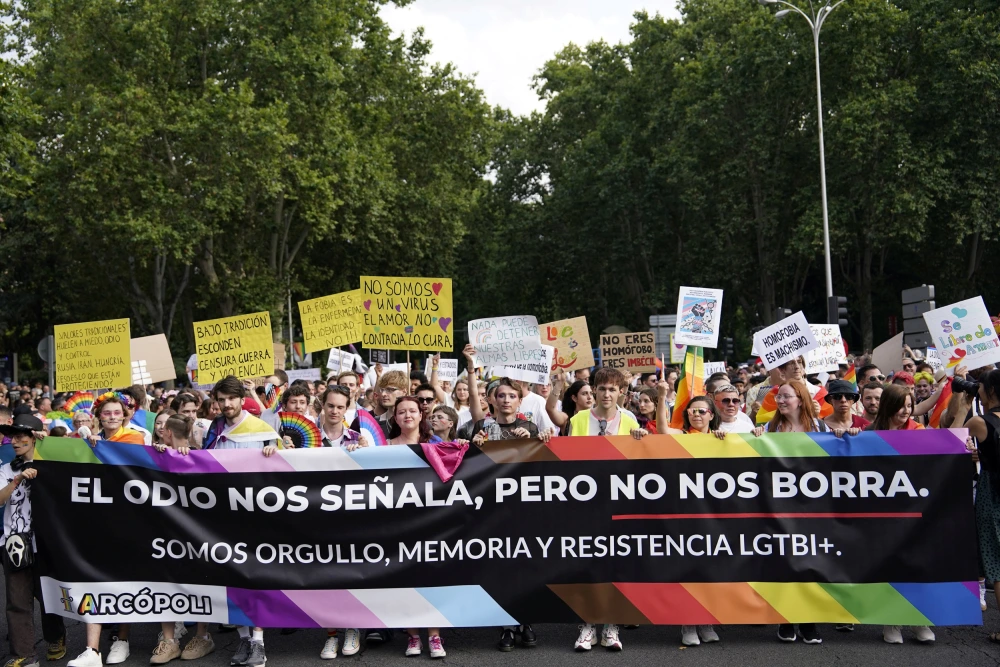
When Diana, a bisexual Russian asylum seeker, took part in her first Madrid Pride festival last year, she was delighted to see people waving the white-blue-white flag that has become a symbol of Russian opposition to its war on Ukraine.
She was also ecstatic to be among around 100 Russians who were waving LGBTQ flags and chanting, “Russia without Putin.” It felt surreal, said the 24-year-old, who did not want to give her last name for fear of retaliation.
“I couldn’t believe I would not be sent to prison. Everyone around was so happy,” she recalled as she marched again for Pride in the Spanish capital in July.
Also taking part was Ilia Andreev, who was vigorously waving a bright pink Mr Gay contest flag as the float he was perched on crept slowly through the crowds. For the 23-year-old, who fled Russia’s anti-LGBTQ laws in 2023, it was a moment to savour.
“I can be proud,” he said in Spanish.
The occasion was a far cry from the repression that drove him and other LGBTQ Russians out of their homeland in recent years, with many seeking refuge in Spain, which ranks fifth in the 2025 ILGA-Europe Rainbow Index, which ranks countries’ legal and policy practices.
“Spain is internationally recognized as a country that respects human rights and in particular the rights and freedoms of the LGBTQI+ community,” said Elma Saiz, the minister for Inclusion, Social Security and Migration, on International LGBTQI+ Pride Day in June.
Asylum applications from Russians more than doubled to 1,694 in 2023 from 684 in 2022, with Russia becoming one of the top 10 origin countries for applications in Spain, according to the Spanish Commission for Refugees (CEAR).
Of those processed, 59.7% received refugee status.
Elena Munoz, coordinator of the legal team at CEAR, said there had been a rise in Russian LGBTQ-related applications, although data on specific motives for asylum applications are not yet being collected.
The main reasons Russians gave for leaving their home included forced recruitment into the armed forces and the deteriorating human rights situation, including regarding gender identity and sexual orientation.
As well as introducing a raft of anti-LGBTQ laws, Russian President Vladimir Putin has been using the LGBTQ community as a political scapegoat, said Marc Marginedas, a journalist and expert in Russian affairs.
“Propaganda has fostered a climate comparable to Nazi Germany,” Marginedas said, saying Putin was using an “external enemy” to rally society and distract from military failures.
Legal crackdown in Russia
In 2013, Russian lawmakers passed a government-sponsored ban on distributing “propaganda of nontraditional sexual relationships” among minors.
In December 2022, after Russia launched its invasion of Ukraine, Putin signed an amendment to the law, extending the prohibition to all age groups.
The crackdown has led to the arrest of journalists, lawyers and human rights activists, with many others leaving the country.
Andreev, who worked as a TV journalist in the city of Kazan in southwestern Russia, said he had to hide his identity after he was accused of spreading “LGBTQ+ propaganda.”
“When I once wore earrings on air, I was called in by the news director and the executive program producer. She told me they had received many calls complaining about so-called gay propaganda because of the earrings,” he said.
He decided to come to Spain in 2023 on the recommendation of a friend, who had also moved.
Diana said she was fired after her boss saw her kiss her partner. She did not want to give details of her job or where she lived for fear of retribution.
While on holiday in Georgia in 2022, her home in Russia was visited by authorities because of her volunteer work with Ukrainians in Russian-occupied areas, and she decided she could not return. Growing anti-LGBTQ rhetoric in Georgia pushed her to move to Spain two years later.
Red tape and barriers
Andreev and Diana both applied for asylum and are still waiting for a ruling.
The legally mandated six-month process often stretches much longer, even up to two years. After six months, asylum seekers are allowed to seek work.
But it can take months to get an initial appointment with immigration authorities, and without this, asylum applicants cannot access state aid or support from organizations like CEAR.
Delays are also driving an illegal black market.
According to NGOs, Spanish police and officials, criminals collect immigration appointments using bots and then sell these so-called “mafia de citas,” or mafia appointments, for hundreds of euros on WhatsApp or Telegram to desperate asylum seekers.
And now things are getting for Russians hoping to submit asylum claims in Spain.
From July 12, Spain requires Russian citizens to obtain transit visas to pass through the country.
In the past, Russians would buy a ticket with a layover in Spain and then seek asylum during their stopover.
“It makes it difficult to reach safe territory, in this case Spain, because they no longer have a legal and safe route,” said Munoz, adding that reforms were needed to make the system more efficient.
The Ministry of Foreign Affairs, which is responsible for visa policy, did not respond to requests for comment.
While they await their asylum decisions, Diana and Andreev are rebuilding their lives.
Andreev, who volunteers in an LGBTQ rights group, has found a home in a small town near Madrid and is working on his Spanish — he hopes to return to journalism one day. But he has struggled to build new relationships.
The stress of job hunting and trying to get all the documents he needs, plus the time it takes up make it hard to focus on building connections, he said.
Diana now has stable online work and says she has found her chosen family in Madrid, mainly thanks to online networks of LGBTQ+ Russians who offer each other support.
She feels free, even if she still fears Russian retaliation.
“If I want, I can date women, I can date men, I can date whoever. I’m not in a hurry. Why would you be in a hurry? The Spanish lifestyle relaxes you a little bit.”




 fleeredstates.blog
You must be logged in to post a comment.