
Nearly a decade after North Carolina passed its controversial “bathroom ban,” sparking nationwide backlash and corporate boycotts of the state, transgender bathroom restrictions have made a resurgence.
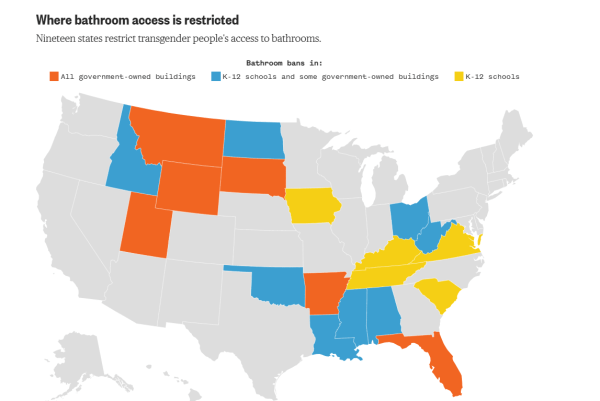
Nineteen states have laws that prohibit trans people from using the bathrooms that align with their gender identities in K-12 schools, and in many of those states the restrictions apply to other government-owned buildings as well. As a result, more than 1 in 4 trans people live in states with policies that restrict their bathroom use, according to the Movement Advancement Project, an LGBTQ think tank.
These measures are similar to North Carolina’s HB 2, a law enacted in 2016 that was widely referred to as the “bathroom bill.” The law sparked nationwide protests and corporate boycotts, most notably from the NCAA, which moved seven championship sporting events out of the state that year. The General Assembly repealed HB 2 with a compromise bill in 2017 that placed a statewide moratorium on municipalities passing nondiscrimination ordinances until 2020, and the state hasn’t passed a similar law since.
Though North Carolina’s law generated widespread protests, the bathroom policies passed over the last few years have received little national or corporate response, despite many of them being far broader than HB 2. That could be due, in part, to the dozens of other bills states have considered and passed targeting trans people.
Logan Casey, director of policy research at the Movement Advancement Project, said part of why there was more backlash to HB 2 was because it was among the first “bathroom bills.” In 2016, the year the bill became law, state lawmakers had introduced about 250 bills targeting LGBTQ rights, and many of those were bathroom restrictions and “religious freedom” bills, which are intended to protect people and businesses who say abiding by state and local nondiscrimination laws would violate their religious beliefs.
This year, Casey said, he’s tracking more than 700 anti-LGBTQ bills, up from nearly 600 last year, and they affect everything from trans people’s access to bathrooms, sports and health care to what LGBTQ materials students can be exposed to in schools.
“Just the sheer volume of attacks made it a lot harder for even just the general public to really track everything that’s been happening,” Casey said. “That’s been a big part of what has allowed so much to happen at once, is that they’re sort of flooding the zone with all these anti-LGBTQ attacks.”
‘I feel singled out’
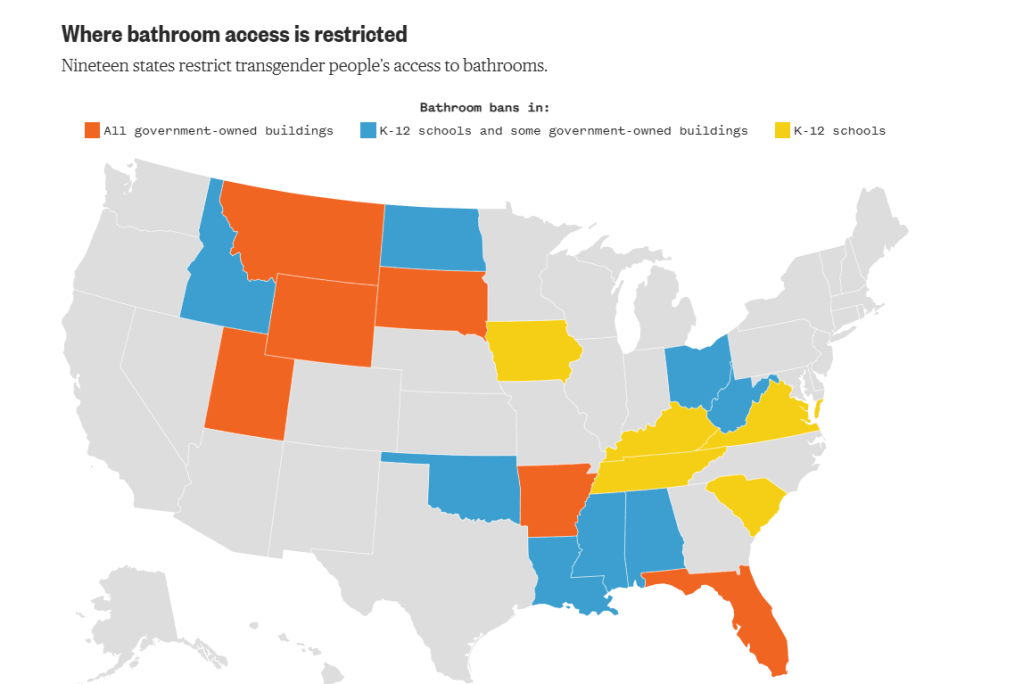
Of the 19 states that subject trans people to bathroom restrictions, six have bans that apply to all government-owned spaces, including K-12 schools and colleges; eight states restrict bathroom use in K-12 schools and at least some government-owned buildings; and five states restrict bathroom use in K-12 schools only, according to MAP.
Most of those states also have a law or policy that legally defines “sex” in a way that could impact trans people’s access to bathrooms. Four additional states — Indiana, Nebraska, Kansas and Texas — define sex in a way that could affect trans people’s access to restrooms but don’t have official “bathroom bans” on the books.
Proponents of measures that restrict access to bathrooms and other sex-segregated facilities argue that allowing trans women to use women’s bathrooms could threaten women’s safety and privacy. However, a 2018 study from the Williams Institute at UCLA School of Law found that allowing trans people to use facilities that align with their gender identities does not increase safety risks.
Some states have expanded the scope of their bathroom restrictions in recent years. Arkansas, for example, passed a law in 2023 requiring trans people to use the bathroom of their birth sex in K-12 public schools and public charter schools. Earlier this year, the state passed another law expanding that measure to apply to shelters, correctional facilities and all public buildings, which include public colleges and universities.
A trans woman working at a university in Arkansas, who asked to be anonymous because she fears how speaking to the press could affect her current and future employment in the state, said the bathroom restriction, for her, “means segregation.” The day after the expanded law was enacted, the woman said her boss told her she would need to walk across the building to use a single-occupancy bathroom. If that bathroom is occupied, which she said it often is, she has to walk across campus to the only other single-occupancy bathroom.
“I feel singled out for something I don’t have any control over,” she said. “I’m not being treated equally to any of my cisgender colleagues. It makes me feel dehumanized.”
She added that some of her colleagues’ reactions have been upsetting, because “they’ve reacted as if I should be happy, like I have a private bathroom, and I don’t understand how they could come to that conclusion.”
As a direct result of the law, she said, she has accepted another job outside of the public university system that she’ll start next month. In the meantime, she said, more of her colleagues have started to misgender her.
“At this point, I really wish I just hadn’t come out at work,” she said.
Bathroom restrictions, Casey said, can contribute to more hostile workplaces and schools for trans people because they can be interpreted as the government “green-lighting” discrimination.
Many of the bills, like Arkansas’, also use vague language, which Casey said is intentional, because it can “provide cover” for the law to be applied more broadly.
“Because of the confusion and the fear around these bills, as well as the hostile climate that they contribute to, there can often be misperceptions that they also apply to private spaces,” Casey said. “That makes it much harder for trans people to actually know in those states what their rights are and aren’t, and can lead to far more reaching bans than the letter of the law actually calls for.”
Casey noted that there have been an increasing number of cases in which even cisgender women, who are not trans, have been questioned in restrooms. For example, in May, two women filed a discrimination complaint against a Boston hotel where they say a security guard followed them into the bathroom and accused one of them of being a man. Neither Massachusetts nor Boston has measures restricting trans people’s bathroom use.
A different environment now from in 2016
North Carolina’s General Assembly passed HB 2 in response to a 2016 Charlotte ordinance that expanded the city’s existing nondiscrimination protections to include LGBTQ people. The expansion specifically protected trans people’s right to use the bathrooms that aligned with their gender identities.
When HB 2 passed that same year, the backlash was swift and far-reaching. As a direct result of the law, PayPal announced that it would no longer open a new operations center in Charlotte, which would have included investing $3.6 million in the state. The NCAA announced that it would not hold championship events in the state, and prominent musicians including Bruce Springsteen, Ringo Starr, Demi Lovato, Nick Jonas and Maroon 5 all canceled performances, citing the law.
Michael Walden, a retired economics professor at North Carolina State University who gave interviews about the boycotts when they happened, said North Carolina’s status as one of the first states to pass such a law triggered more protest and attention on the issue, and, as a result, businesses had to quickly figure out how to respond.
“When a lot of businesses saw there was a huge backlash, they didn’t want to be associated with that at all, which is understandable,” Walden said.
Recently, however, businesses have likely “assessed that the environment is different,” he said.
“They do observe some protests. They do observe some rallies and marches, etc., but nothing like we saw 10 years ago,” Walden said.
Trans rights have also become increasingly politicized and painted as controversial. Walden noted that in the last few years North Carolina has joined the more than two dozen states that have enacted laws prohibiting certain transition-related medical care for minors and banning trans students from playing on school sports teams that align with their gender identities. Neither of those laws generated national backlash or a response from the business community in the way HB 2 did.
“My analysis would be that the average business doesn’t want to take a position on any of this, either pro or con, unless they think they really have to, to satisfy their customer base or investor base,” Walden said.
The landscape for LGBTQ rights was also much different in 2016, the year after same-sex marriage became legal nationwide, Casey said.
“Opponents of LGBTQ equality were really sort of casting around and looking for some new way to continue to use LGBTQ issues as a wedge issue for a broader radical agenda, and bathroom bans and religious exemptions were really the two things they were focused on at that time, and both of those were relatively unsuccessful,” Casey said.
He pointed both to HB 2 and Indiana’s Religious Freedom Restoration Act, which passed in 2015 and led to criticism from tech giants like Apple and Yelp. As a result of the potential business effects Indiana’s law could have on the state, lawmakers quickly amended the measure to explicitly prohibit it from being used to justify discrimination.
More bathroom bans are likely on the horizon. Fifteen states have considered them so far this year, including three that successfully expanded their existing bans, according to the American Civil Liberties Union. A judge blocked Montana’s law in May while a lawsuit against it proceeds.
A new, broader version of North Carolina’s defunct ban could also be resurrected. Earlier this month, Gov. Josh Stein, a Democrat, vetoed a far-reaching bill that would redefine sex in the state to only recognize birth sex and would prohibit trans North Carolinians from changing the sex on their birth certificates and driver’s licenses. The law explicitly requires sleeping quarters on public school trips to be separated based on birth sex and could affect what bathrooms trans people can use in schools and public buildings. Though Stein vetoed the bill, Republicans in the state’s General Assembly could override his vetoes and plan to try to do so when they reconvene on Tuesday 29.

 fleeredstates.blog
You must be logged in to post a comment.