
Read more at WHYY.
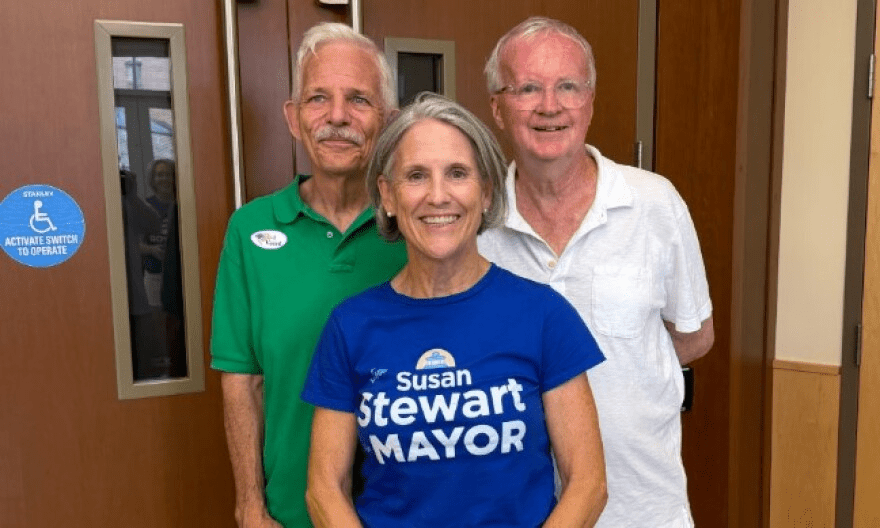
Residents of Rehoboth Beach chose a new mayor last weekend. Susan Stewart was elected by a wide margin, winning more than 60% of the vote out of four mayoral candidates.
Stewart’s win is significant; she will be the first openly gay mayor of Rehoboth Beach, and the first woman elected mayor in decades.
The win comes only a year after Stewart was elected to the city’s Board of Commissioners.
“I went knocking on all these doors for the second summer in a row, because I ran last year for commissioner,” Stewart told WHYY News. “Every commissioner should have to do it because it’s such an enlightening experience to sit down and hear people.”
She said she didn’t have plans to run for mayor after that election, but was encouraged to campaign by local residents, leaders and organizations. Stewart said it took her a long time to think about running again, but decided to start campaigning as she felt she was the only person right for the position.
Preserving Rehoboth Beach’s charm
Stewart started her professional career as an attorney, but spent most of it in financial services. She is originally from Bucks County, Pennsylvania, and lived in Washington, D.C., prior to Rehoboth Beach. She had a vacation home in the city since 2013, but moved to the beach full time during the COVID-19 pandemic.
During her campaign, Stewart emphasized her desire to preserve the character of Rehoboth Beach. She told WHYY News there is a physical charm to the city, showcased through old buildings, outdoor spaces and the beach itself.
Stewart also said there is a fun atmosphere to the area, pointing to specific traditions like the Mrs. Roper Romp, where crowds of people dress up like the character Mrs. Roper from the 1970s sitcom “Three’s Company,” and walk through the city.
“I don’t have the skill set to articulate what I like about it, but I know I like it,” Stewart said.
Before her term as an elected official, she served on the city’s Planning Commission, as well as the Mixed-Use Zoning Ordinance Task Force and Stormwater Utility Task Force.
While serving in these groups, Stewart said she learned about zoning codes, challenges in the commercial district and the city’s comprehensive development plan. It outlines goals and policies for how the city’s land is used. That includes increasing mixed-use developments, workforce housing, walkability and how bicycle-friendly the city is. When Stewart decided to run, she said the city was at a tipping point with expanding growth, business and tourism.
“We really needed to be very thoughtful and purposeful about what we see as the future of Rehoboth Beach, and that it needed a leader that would help us articulate that in a way that preserves our quality of life and our charm that was getting away from us,” Stewart said.
Stewart said that more than 60% of the city’s revenue is tourism related, including parking, the hotel accommodations tax and the short-term rental tax, while about 10% comes from property taxes. According to Stewart, the majority of the voting population in town are property owners, while “revenue generators are a different cohort.”
“What we need to do as a community of engaged residents is to figure out how we preserve that revenue stream, but perhaps more importantly, how we find a way to preserve our quality of life, because some of the tourism is what causes tension,” she said.
Stewart said that she plans to continue having the city consult with experts ranging in topics from urban planning to business development to traffic, as well as gather community input on what the city should look like over the next decade. Their input will help form a city master plan.
“I believe all our interests are aligned, residents and business owners and commercial property owners and developers. It’s just never been considered holistically before,” she said. Rehoboth Beach adopted its first five-year strategic plan in May 2025, and is currently in the process of rewriting its zoning code. Stewart said this is foundational to creating a master plan.
“Harmonizing our code will be important, because there are gaps in our existing code that lead to tensions,” she said. “If a zoning code or building code doesn’t address something clearly, then that leaves it subject to interpretation.”
Last month, the city hosted a week’s worth of events and public meetings with the urban planning group Dover Kohl & Partners to gather community feedback on zoning changes.
The city reported that some of the top concerns from residents involved downtown revitalization, increasing mixed-use development and workforce housing, reducing parking requirements and traffic, and supporting local business and cultural and art programs.
Stewart said the events during the week, like a walking tour of the city, helped visualize some of these ideas.
“When you turn onto Rehoboth Avenue, it’s our boulevard, and it’s the boulevard to our beautiful nature and our boardwalk, but it’s filled with cars,” she said. “Our forebears did a great job of laying out the city, but it was done decades and decades ago.”
To Stewart, the event was valuable to the city and she believes it’s important to keep engaging in consistent dialogue with residents.
Mike Venanzi is a business owner and board member for Rehoboth Beach Main Street, a nonprofit designed to promote the downtown area of the city. He said he supports Stewart as mayor, and believes her election will benefit the city as a whole. “I think having a commissioner and a mayor that welcome the business owners, speak with them, invite them to have conversations, are good for business, good for the residents of Rehoboth and good for the tourists,” Venanzi said. “That’s really [what] Susan and the entire crew there are focused on that.”
He said he hopes that during her term, Stewart is able to encourage growth as well through policy.
“Some of the growth that should have happened here in town — that was really stalled — because of rules, regulations that don’t make sense anymore,” Venanzi said.
Stewart said she also wants to make the city government more efficient. She said that after she was elected commissioner, she realized that the governing body can keep city staff from getting work done by being too involved in daily operations.
“I’ve been trying to work on a set of rules for us as a governing body that will help us get back to the point where we can concentrate on strategy and vision and let the professionals execute that vision,” she said. A historic election
Robin Brennan is the executive director for CAMP Rehoboth, a nonprofit focused on cultivating an inclusive environment for LGBTQ+ individuals. She described the election as “incredible.”
“My first thought was really about representation and how much it matters,” Brennan said. “When people see themselves reflected in leadership positions, it sends a powerful message about who belongs and that our voices matter, that we’re heard.”
Rehoboth Beach has had a strong LGBTQ+ presence for decades, and Brennan said having an openly gay mayor reflects an important population that has shaped the city’s history.
The Human Rights Campaign’s Municipal Equality Index, which rates cities based on how their policies serve LGBTQ+ residents, issued Rehoboth Beach a perfect score last year. It was an increase from the 61 out of 100 the city received in 2024. City officials cited a stronger partnership with CAMP Rehoboth as the reason the score improved.
Stewart said she believes community members and organizations like CAMP Rehoboth have helped the city become more welcoming. Though she acknowledges that there are still struggles for LGBTQ+ people, she said she feels there is less division in Rehoboth Beach.
“This is just a place where everyone are people, and that’s the aspiration for everything,” Stewart said.
Brennan said she hopes that partnership can continue to grow under Stewart’s leadership.
Stewart will be sworn into office on Sept. 18.



You must be logged in to post a comment.