Ohio Governor Approves Ban on Transgender Students Using Preferred Bathrooms
Texas Transgender Community Fights Back After Capitol Bathroom Ban
Residents of Odessa, Texas, are speaking out after the city council amended a local ordinance to ban transgender individuals from using public restrooms that align with their gender identity. Meanwhile, in Ohio, Republican Governor Mike DeWine has signed a law banning transgender students from using bathrooms that correspond to their gender identity. The new legislation mandates that students in K-12 schools, as well as colleges and universities, must use the restroom or facility designated for their sex assigned at birth.
The law clarifies that it does not prohibit schools from constructing single-occupancy restrooms and allows individuals of the opposite gender to enter a bathroom to assist someone else, if necessary.
MORE: Congressional Bathroom Ban Adds to Growing Transgender Policy Debate
Ohio now joins at least 14 other states in restricting transgender individuals from using bathrooms that match their gender identity, according to the Human Rights Campaign.
Supporters argue that the ban addresses concerns about student privacy and safety, while critics contend that it fuels baseless fears about transgender students and could put them at greater risk of discrimination or harm.
Governor DeWine’s office did not respond to ABC News’ request for comment prior to the bill’s signing. However, in the summer, he told reporters that he was reviewing the “specific language” of the legislation.
“I’m supportive of kids being able to use bathrooms that align with their gender assigned at birth for their protection, but I’ll need to review the specific language of the bill,” DeWine told reporters.
Transgender healthcare, bathroom access, sports participation, and other related issues have become central to the Republican legislative agenda across the country in recent years. This trend has led to a surge in anti-LGBTQ bills, with hundreds introduced during the 2024 legislative session alone, according to the American Civil Liberties Union.
DeWine has occasionally bucked the state’s Republican leadership on transgender matters. In December 2023, he vetoed a bill that would have banned gender-affirming care for transgender youth, including restrictions on puberty blockers, hormone therapy, and surgeries.
She had to slog through deep snow to remove them herself.
Hateful flyers circulated in Billings, Montana, falsely accusing local trans activist Adria Jawort of “grooming children,” according to local news outlet KTVQ. The flyers, which perpetuate the false narrative from the anti-trans right that all trans people are pedophiles, were posted near schools in Jawort’s neighborhood just days before Thanksgiving.
Jawort had to travel across town in heavy snow to remove the flyers herself.
“I was annoyed about it,” she told KTVQ, describing how the flyers misgendered her and made hateful claims about her life and sexuality. “I was just thinking, why am I doing this? Why do I have to do this? Why do people think this is okay?”
“The thing the flyer said, calling me a groomer and stuff, and basically labeling me as a danger to the community,” Jawort added. “It’s like one of the most awful things you can say. How does that become normalized?”
Billings police are currently investigating the incident. Lt. Matthew Lennick spoke on what constitutes hate speech: “Once someone transitions from making a general statement about their beliefs or another group to a targeted attack on an individual… a victim could take civil action against someone attempting to defame them.”
Possible criminal charges could include disorderly conduct, stalking, intimidation, or harassment, among others.
While Jawort knows the group responsible, she says she’s more frustrated by the ongoing attacks on state Rep. Zooey Zephyr (D-MT). Recently, Republicans unsuccessfully attempted to ban her from women’s bathrooms.
Jawort has been targeted before. Last year, a lecture she was set to give at a library was canceled after a drag ban, with staff citing concerns that hosting a transgender person posed “too much of a legal risk.” This led her to file a lawsuit against the state.
Why Allies Must Act: Defending Trans Rights Protects Everyone’s Freedoms
As the election dust settles, the focus shifts to practical realities. For transgender people like me, a pressing question looms: What actions will this new Trump administration take?
It’s tempting to jump to extreme conclusions—like the idea of being rounded up and placed in camps. But it likely won’t look like that. There won’t be “camps,” nor will there be overt “rounding up.” Instead, the approach will be more subtle, and that subtlety is precisely what makes it so dangerous.
The quiet nature of these changes will make them easier for cisgender people to overlook. However, their awareness is vital—not only for our survival but for their own protection, as the erosion of trans rights often signals broader attacks on freedoms that could ultimately affect everyone.
The groundwork for trans oppression is already being laid. In recent years, Republicans have pursued anti-trans legislation with alarming intensity, proposing over 1,000 laws targeting everything from medical care and bathroom usage to IDs, sports, and even how we dress. Trump has vowed to push similar policies at the federal level, and Project 2025 outlines an even more expansive agenda.
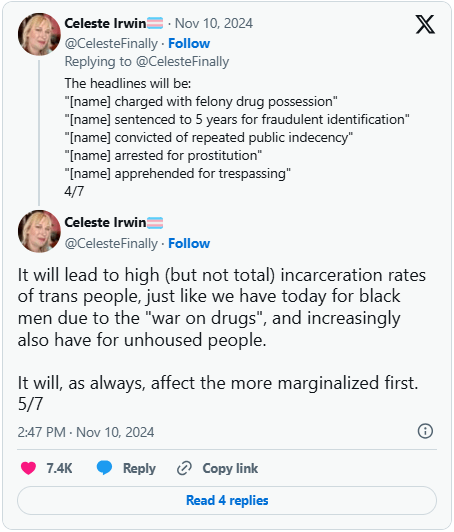
To understand what trans oppression under Trump might look like, we can look to other marginalized groups. For instance, the mass incarceration of Black men wasn’t achieved through blatant decrees like “round them up” but through systemic oppression: harsh laws with disproportionate penalties, over-policing, and economic barriers that strip away basic human needs. Trans people have already faced similar tactics, such as laws criminalizing “cross-dressing” to police our existence.
Under another Trump administration, this oppression might escalate. It could involve banning hormone replacement therapy and criminalizing those who seek it out. Policies might mandate that gender markers on IDs match sex assigned at birth, penalizing those of us who continue to live authentically with fraud or perjury charges. Involuntary commitment to mental institutions could even be a reality.
These measures, even if sporadically enforced, create an ever-present climate of fear—a psychological toll that leaves us constantly bracing for the next law, the next crackdown, the next violation of our humanity. And in this hostile environment, the silence or complacency of cisgender allies would make it all the easier for these oppressive systems to thrive.
The coming years will likely see escalating attacks on trans people, particularly the most marginalized among us—trans women of color, disabled trans people, and others who already face significant barriers. These policies will make it harder for them to access stable employment and lead precarious lives, amplifying systemic inequities.
We cannot wait for something as blatant as a “lock up all the trans people” decree. The oppression will come in quieter, more insidious forms: laws and policies that restrict our rights to healthcare, employment, and basic expression. Even if trans people comply with these laws, the result will still be a kind of prison—a life stripped of autonomy and dignity.
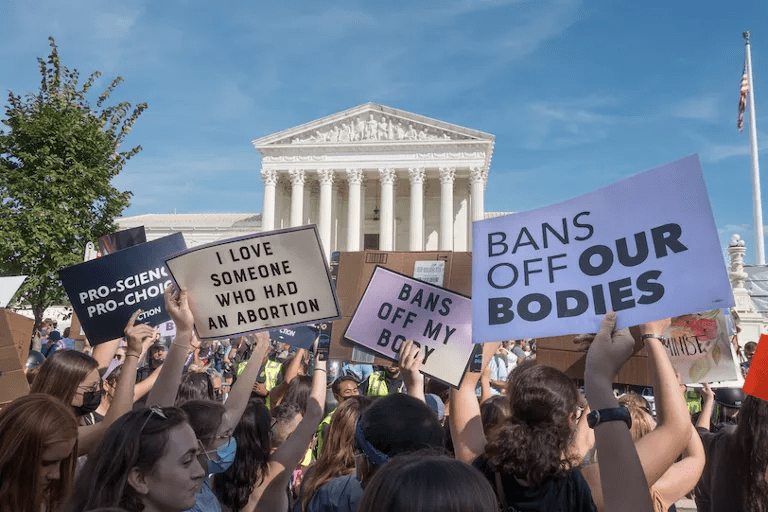
If you are cisgender, we need your help. Not just because it’s the right thing to do, but because these attacks on trans rights will eventually pave the way for attacks on your rights. Consider abortion access: for decades, conservatives framed their arguments around “protecting life” to avoid addressing bodily autonomy directly. But the fight against gender-affirming care removes that pretense altogether. By banning medically supported, evidence-based care simply because they don’t like it, lawmakers set a dangerous precedent that could extend to other healthcare decisions.
Your body could be next.
Employment and education are also at risk. Imagine a national “Don’t Say Gay/Trans” policy that bars teachers like me—who are openly transgender—from the profession. Policies like these won’t stop at targeting trans people. Deadnaming and misgendering trans students could morph into strict gendered dress codes for everyone, eroding freedom of expression for all students. What starts as an attack on trans rights often metastasizes into broader assaults on personal liberties.
As we approach January 20th, now is the time to act:
Get involved: Connect with your local LGBTQ+ center and see how you can support their efforts.
Stay informed: Follow trans journalists and activists to keep up with the latest developments.
Advocate: Write to your representatives in both parties, showing them that you stand with trans people.
Speak out: Use your voice, wear supportive messages, and engage your cisgender friends to build awareness.
Support trans people directly: Check in with your trans friends, especially now, as they navigate a political climate fueled by over $200 million of anti-trans rhetoric during the election. Let them know you’re there for them.
This isn’t just about protecting trans people—it’s about preserving freedom and dignity for everyone. Together, we can resist these threats and build a future where everyone has the right to live authentically.
This is the first instance of a city allowing individuals to sue transgender people for using public restrooms.
The city of Odessa, Texas, has implemented a $10,000 bounty on any transgender individual who uses a restroom that corresponds with their gender identity, according to independent journalist Erin Reed.
The ordinance allows individuals—excluding local and state government officials—to sue transgender people for using bathrooms that align with their gender. The rewards for successful lawsuits include “injunctive relief sufficient to prevent the defendant from violating the provisions of this ordinance,” along with potential “nominal and compensatory damages” if the plaintiff claims to have suffered harm. The law also stipulates statutory damages of at least $10,000 for each violation, as well as court costs and reasonable attorney’s fees.
While the bounty is set at a minimum of $10,000, there is no maximum limit on how much the reward could ultimately be.
In addition to the $10,000 bounty, the ordinance imposes criminal penalties on individuals who use restrooms that align with their gender identity. According to the provision, anyone violating the ordinance will be guilty of a Class C misdemeanor, subject to a fine of up to $500. If a person refuses to leave a restroom after being asked by a building owner, they could also face charges of misdemeanor trespassing.
The law defines “biological sex” based on the gender listed on birth certificates—either at birth or corrected in the case of clerical errors. This means that even if a transgender individual updates their birth certificate to reflect their gender identity, they would still be in violation of the law if they use a restroom that matches their gender.
The ordinance makes no exceptions for disabled individuals who may be accompanied by a person of a different gender, and it could open the door to lawsuits targeting anyone who appears gender non-conforming.
While bathroom bans with criminal penalties have been enacted in states like Utah and Florida, other states, such as North Dakota, have passed similar bans without clear penalties or enforcement mechanisms. Erin Reed has drawn comparisons between the Odessa bounty and Texas’ anti-abortion bounties, which allow private citizens to sue anyone who aids someone seeking an abortion. Both strategies rely on private individuals to enforce the law, bypassing government enforcement mechanisms.
Johnathan Gooch, communications director for Equality Texas, criticized the measure in an interview with the Texas Tribune: “It’s a very aggressive way to alienate trans people from public life, and I think it is counter to the spirit of friendship that most Texans embody.”
He continued, “It enables vigilantes to target anyone they don’t think matches the type of gender expression they expect to see in the bathroom, and that is truly insane.”
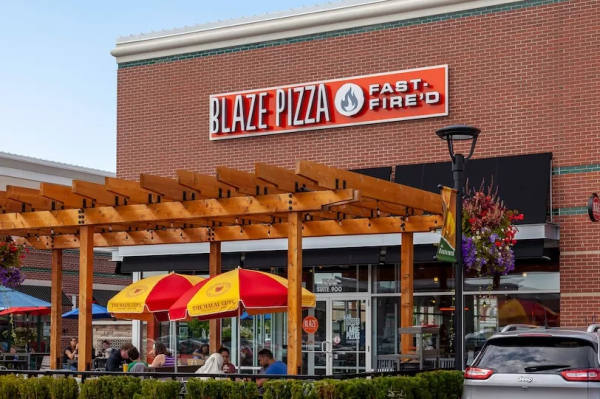
Police in Roseville, California, are searching for three suspects in connection with a hate crime at a Blaze Pizza restaurant, where workers were assaulted after one suspect tore down a Pride flag on display. The assault was captured on a smartphone video.
The incident took place at 10:50 p.m. on a Thursday when a food delivery driver entered the restaurant, noticed the Pride flag near the register, and threw it to the ground. When the store manager and employees confronted him, the man allegedly used a homophobic slur before leaving. He later returned with two other men, who then attacked the restaurant staff.
Haters yelled obscenties, sent a threatening letter, and vandalized their Pride flag and political signs. But the reaction has emboldened the targeted men.
A witness named Chance Chacon told KCRA that the manager and employee had defended the flag’s display, but then, when the three assailants returned, “It was like a mob. They were just kind of swinging at him.”
A video captured inside the restaurant shows one worker repeatedly shouting at the assailants, “Get the f**k out of here!” while another employee urges a co-worker to “Call the cops.”
The three men fled the scene before police arrived, but an ambulance later transported one employee on a stretcher. This worker was taken to the hospital, where he was briefly treated for a concussion and head trauma but has since been released.
A still image from the footage shows a shoeless, light-skinned suspect wearing a torn dark-colored t-shirt and hand wraps commonly used in mixed martial arts.
Police have asked for the public’s help in identifying the assailants involved in the September 20 incident. Anyone with information can submit an anonymous tip online or contact their non-emergency line at 916-774-5000.
Ruby Shields, a lesbian who owns a restaurant in the nearby town of Granite Bay, told The SacramentoBee that she doesn’t consider the area LGBTQ+ friendly. She has been too scared to display a rainbow flag at her own restaurant, and is often mistaken as the wife of her male business partner, even though she has a wife.
“We’ve been looked at with respect, but it’s always on the back of your mind, you know, ‘Should I be saying this?’” Shields said of not knowing whether to come out to restaurant patrons. “It’s not even something that I really even want to put out there because you never know. I mean, it’s horrible that it’s so close to home. Roseville is right down the street from where we’re at.”
This wouldn’t be the first time that an anti-LGBTQ+ person has committed violence in California after tearing down a Pride flag. Last August, Travis Ikeguchi — a 27-year-old man who posted anti-LGBTQ+, antisemitic, anti-vaccination Christian Nationalist content online — murdered Laura Ann Carleton, a 66-year-old LGBTQ+ ally and mother of nine, complained about the Pride flag hanging in front of her Cedar Glen, California business.
Police killed Ikeguchi shortly afterward.
Paul Feig — the director of Bridesmaids, Ghostbusters (2016), and other films — wrote, “We are all devastated for her husband Bort and her family and the LGBTQ+ community, for whom Lauri was such a true ally…. This intolerance has to end. Anyone using hateful language against the LGBTQ+ community has to realize their words matter, that their words can inspire violence against innocent loving people. Let’s all keep moving forward with tolerance and love. Let’s not let Lauri’s tragic death be in vain.”
Carleton’s friend, director Paul Feig, wrote of the incident, “Lauri Carleton was my friend. She was a wonderful person who did so much for the LGBTQ+ community as well as the community at large. What happened to her is an absolute tragedy. If people don’t think anti-gay & trans rhetoric isn’t dangerous, think again.”
Subscribe to the LGBTQ Nationnewsletter and be the first to know about the latest headlines shaping LGBTQ+ communities worldwide.
During the traffic stop, an officer documented that Republican state Rep. Nico Rios became “verbally abusive, displaying homophobic, racially discriminatory behavior.
Recently, North Dakota state Rep. Nico Rios, a member of the Republican party, was arrested for DUI, and during the arrest, he reportedly made homophobic and xenophobic comments to the police.
On December 15, authorities arrested Nico Rios and issued citations for DUI, DUI refusal, and an open container, according to a Williston Police Department report.
The representative was pulled over around 11:30 p.m. after reportedly swerving between lanes, as stated in the report.
The police officers who initiated the stop then administered a Horizontal Gaze Nystagmus test, Walk and Turn test, and One-Leg-Stand test. During these tests, Rios allegedly exhibited “slurred speech and difficulty constructing sentences,” as outlined in the report.
In the report, one of the police officers noted that during the testing, Rios became.
An officer reported that Rios became “verbally abusive, homophobic, racially abusive, and discriminatory” during the tests, leading to his arrest when he refused to undergo a screening test.
“Irrespective of my state of inebriation, my conduct and words toward law enforcement that night were entirely unacceptable,” Rios stated in a comment to CNN. “Just two officers doing their job to keep the community safe when they encountered me on a night when I chose to act foolishly. They did nothing to warrant any form of disrespect. I owe it to myself, my district, and everyone, and I vow to ensure this never happens again.”
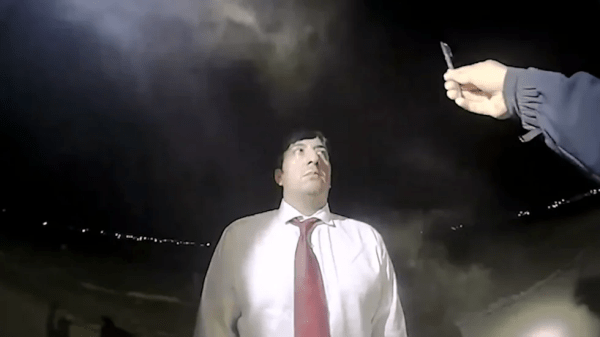
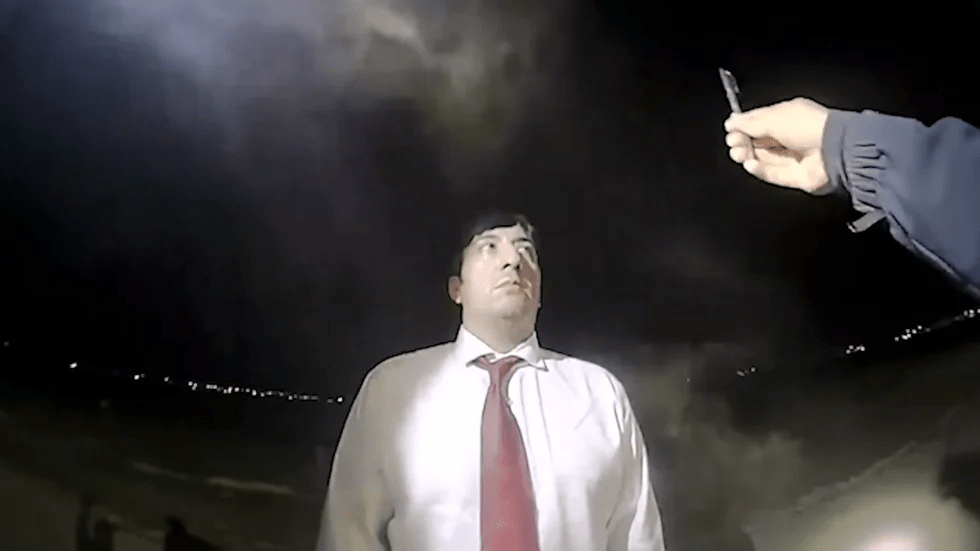
In the body camera footage released of the incident, Rios can be seen making the remarks while being transported to jail.
At the traffic stop, Rios can be heard using a homophobic slur and asking the officer about his accent. The officer responds that he is originally from England.
“You’re arresting me for driving home while people come into your country and rape your women? And I’m the bad guy?” Rios says after mentioning that the U.K. is being “taken over” by migrants.
Rios stated to the Associated Press that he was leaving a Christmas party before he was stopped and has “only received support from my colleagues, although a few have yelled at me, for sure I deserved it.”
The legislator was elected last year and currently serves on the House Judiciary Committee, a panel overseeing legislation related to law enforcement.
“Moving forward after this incident, I want to emphasize my complete and total commitment to supporting law enforcement,” Rios stated. “I messed up big time, and I am truly sorry.”
Republican House Majority Leader Mike Lefor stated to the AP that he hadn’t watched the video but had heard sufficient details about it.
He mentioned that he is assessing the available options and plans to have a discussion with Rios before providing further comments on the incident. Lefor didn’t disclose whether he had already requested Rios’s resignation.
“We are profoundly concerned about Rep. Rios’ reckless choice to drive under the influence and his comments to law enforcement officers,” stated North Dakota Republican Party Chairwoman Sandi Sanford in a text message to the news wire. “His actions do not reflect the values of the NDGOP.”
Rios is scheduled for a pretrial conference in municipal court on February 5th.




 fleeredstates.blog
You must be logged in to post a comment.