A surge of grant cancellations hit researchers focused on the health of gay, lesbian and transgender people last week, as the Trump administration continues to target what it describes as ideologically driven science.
Last week the U.S. government terminated at least 68 grants to 46 institutions totaling nearly $40 million when awarded, according to a government website. Some of the grant money has already been spent, but at least $1.36 million in future support was yanked as a result of the cuts, a significant undercount because estimates were available for less than a third of grants.
Most were in some way related to sexual minorities, including research focused on HIV prevention. Other canceled studies centered on cancer, youth suicide and bone health.
Health and Human Services spokesman Andrew Nixon said the agency is “dedicated to restoring our agencies to their tradition of upholding gold-standard, evidence-based science.” The grants were awarded by the National Institutes of Health, an agency under HHS.
One canceled project at Vanderbilt University had been following the overall health of more than 1,200 LGBTQ people age 50 and older. Most of the money has been spent from the grant funding the project, but it was up for renewal in April, said Tara McKay, who leads Vanderbilt’s LGBTQ+ Policy Lab.
She said the grant won’t be renewed because of the termination, which jeopardizes any long-term results. Still, the Vanderbilt project had already generated two dozen published papers, including work used to train doctors to provide better care to LGBTQ people, increasing the likelihood of cancer screenings and other preventive care.
“That saves us a lot of money in health care and saves lives,” McKay said.
Insights from minority populations can increase knowledge that affects everyone, said Simon Rosser, who studies cancer in gay and bisexual men at the University of Minnesota.
“We now no longer have anywhere studying LGBT cancer in the United States,” said Rosser, who saw his grants canceled on Friday.
“When you decide to cancel all the grants on sexual minorities, you really slow down scientific discovery, for everyone,” Rosser said. Young researchers will lose their jobs, and the field as a whole will suffer, he added.
“It’s a loss of a whole generation of science,” Rosser said.
Termination letters seen by The Associated Press gave as reasons that the research was “unscientific” or did “nothing to enhance the health of many Americans.”
That language felt personal and stinging, McKay said.
“My project’s been accused of having no benefit to the American people. And, you know, queer and trans folks are Americans also,” McKay said.
Denmark is advising its transgender and nonbinary citizens to proceed with caution when traveling to the U.S., according to a new advisory.
An update made Thursday to the Danish foreign ministry’s webpage on travel to the U.S. recommends trans people contact the U.S. embassy in Copenhagen before visiting the country, which under the new Trump administration has enacted several policies targeting transgender rights.
The advisory does not explicitly mention President Trump or his administration but comes as the State Department suspended a policy allowing trans, nonbinary and intersex Americans to update the sex designations on their passports, causing confusion and concern among travelers over whether it is safe for them to fly. The department previously allowed U.S. passport holders to self-select their sex designations, including an “unspecified” gender marker denoted by the letter X.
Seven trans and nonbinary Americans are challenging the new policy, which stems from a Jan. 20 executive order declaring the U.S. recognizes only two sexes — male and female — in federal court.
“If your passport has the gender designation X or you have changed gender, it is recommended to contact the U.S. embassy prior to travel for guidance on how to proceed,” reads the advisory from the Danish foreign ministry.
The addition comes one week after Finland issued a similar advisory for transgender residents seeking visas to the U.S.
“If the gender listed on the applicant’s passport does not match the gender assigned at birth, the US authorities may deny the application for a travel permit or visa,” Finland’s Ministry of Foreign Affairs said, citing Trump’s executive order. “Please check the entry requirements with the US authorities in advance.”
Other countries, including Germany and the United Kingdom, recently issued travel advisories to the U.S. after reports of citizens being detained at the border.
A federal judge on Tuesday indefinitely blocked implementation of President Trump’s executive order effectively barring transgender people from serving openly in the military, a stark blow to the administration’s efforts to curb transgender rights.
U.S. District Judge Ana Reyes, an appointee of former President Biden, barred Defense Secretary Pete Hegseth and other military officials from implementing Trump’s order or otherwise putting new policy into place effectuating it. She also said the plaintiffs’ military statuses must remain unchanged until further order of the court.
The judge said her order intends to “maintain the status quo” of military policy regarding transgender service that existed before Trump signed the order titled “Prioritizing Military Excellence and Readiness.” She stayed her order until Friday to give the administration time to appeal.
“The Court knows that this opinion will lead to heated public debate and appeals,” Reyes wrote in her opinion. “In a healthy democracy, both are positive outcomes.”
Six active service members and two individuals seeking to enlist in the military sued the Trump administration soon after the Jan. 27 order was signed, asserting it violates their constitutional rights. Two similar lawsuits are moving through the courts.
Trump’s order suggests that transgender people cannot “satisfy the rigorous standards necessary for military service” because they threaten the lethality of the armed forces and undermine unit cohesion, an argument long used to keep marginalized communities from serving.
“A man’s assertion that he is a woman, and his requirement that others honor this falsehood, is not consistent with the humility and selflessness required of a service member,” the executive order states.
Reyes wrote in her opinion that the president has both the power and obligation to ensure military readiness but noted that leaders of the armed forces have long used that justification to “deny marginalized persons the privilege of serving.”
“‘[Fill in the blank] is not fully capable and will hinder combat effectiveness; [fill in the blank] will disrupt unit cohesion and so diminish military effectiveness; allowing [fill in the blank] to serve will undermine training, make it impossible to recruit successfully, and disrupt military order,’” Reyes wrote.
“First minorities, then women in combat, then gays filled in that blank,” she continued. “Today, however, our military is stronger and our Nation is safer for the millions of such blanks (and all other persons) who serve.”
A 2016 RAND Corp. study commissioned by the Pentagon found that allowing trans individuals to serve in the military had no negative impact on unit cohesion, operational effectiveness or readiness.
During several hearings across multiple weeks, Reyes tore into Justice Department lawyers over Trump’s order and Hegseth’s policy effectuating it, which was set to go into effect on March 26.
A Department of Defense memo dated Feb. 26 said individuals with a “current diagnosis or history of, or exhibit symptoms consistent with, gender dysphoria” are not fit for military service. It added that the Pentagon recognizes only two sexes, male and female, in compliance with another Trump executive order, and requires service members to “only serve in accordance with their sex.”
Reyes noted that symptoms of gender dysphoria could “mean anything,” from “cross-dressing” to mental health conditions like depression, which are also common among members of the military who do not identify as transgender.
“How can I say that a policy is limited, when on its own terms, it could include almost any transgender person?” the judge asked Justice Department lawyers during a March 13 hearing.
Department of Justice (DOJ) lawyer Jason Manion argued that judges must accede to the “current” military, not those under the leadership of past administrations.
“You defer to the military,” he said. “You do not reassess the evidence they are doing.”
Nonetheless, the judge questioned the Defense Department’s use of “cherry-picked” studies to back up its new policy, which she said were “totally, grossly” misrepresented by Hegseth.
In her ruling Tuesday, Reyes pointed to that lack of evidence as reason to take a different course.
“Yes, the Court must defer,” the judge wrote. “But not blindly.”
At an earlier hearing last month before Hegseth’s policy was announced, Reyes sparred with DOJ lawyer Jason Lynch over the breadth of Trump’s order, suggesting it amounted to “unadulterated animus” backed up by little evidence.
She directed Lynch to sit down and purported she would ban all graduates of the University of Virginia School of Law — his alma mater — from appearing before her because they’re “liars” and “lack integrity,” terms mimicking Trump’s executive order.
“Is that animus?” she asked, calling Lynch back to the podium.
Following that hearing, the Justice Department filed a complaint against Reyes accusing her of misconduct. Attorney General Pam Bondi’s chief of staff, Chad Mizelle, claimed the judge sought to “embarrass” Lynch with her hypothetical scenario.
Another seven transgender service members, backed by two LGBTQ civil rights organizations, are challenging Trump’s order on transgender troops in a separate lawsuit filed earlier this month in Washington state. Two more active-duty members challenged the order in a suit filed Monday in New Jersey.
In a statement, Jennifer Levi, senior director of transgender and queer rights at GLBTQ Legal Advocates & Defenders, one of the groups representing the plaintiffs at the center of Reyes’s ruling, said Tuesday’s decision “speaks volumes.”
“The Court’s unambiguous factual findings lay bare how this ban specifically targets and undermines our courageous service members who have committed themselves to defending our nation. Given the Court’s clear-eyed assessment, we are confident this ruling will stand strong on appeal,” Levi said.
Musk, who is said to have spent over $130 million supporting Trump’s election campaign, misgendered his daughter on X and attributed her transition to the “woke mind virus.”
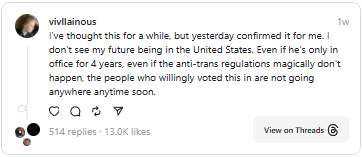
Vivian Jenna Wilson, the estranged trans daughter of billionaire Elon Musk, has opened up about her consideration of leaving the U.S. following Donald Trump’s election victory. She also set the record straight once more after Musk falsely claimed she had been “killed by the woke mind virus” due to her transition.
On November 6, the day after the U.S. presidential election, Wilson took to the Meta-owned platform Threads, writing, “I’ve thought this for a while, but yesterday confirmed it for me. I don’t see my future being in the United States.”
She continued, “Even if [Trump] is only in office for 4 years, even if the anti-trans regulations magically don’t happen, the people who willingly voted for this are not going anywhere anytime soon.”
A second Trump presidency could have a devastating impact on LGBTQ+ Americans. On his 2024 campaign website, Trump pledged to enact a federal ban on gender-affirming care for minors and to redefine gender at the federal level, recognizing only male and female as assigned at birth. These promises come amid the Republican party’s ongoing use of anti-trans rhetoric. According to data from Ad Impact, cited by Washington Post reporter Casey Parks on November 5, Republicans spent nearly $215 million on anti-trans TV ads during the 2024 election cycle.
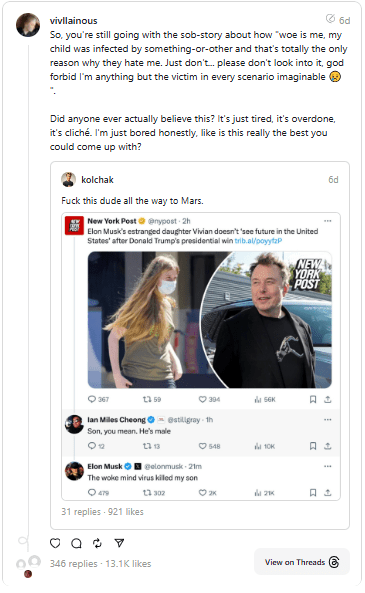
Meanwhile, Musk’s post-election comments included a response to a New York Post tweet about Wilson’s desire to leave the U.S., where he misgendered her and wrote, “The woke mind virus killed my son.”
The billionaire has spent much of this year aligning himself with Trump. According to CNBC, Musk has invested at least $130 million in pro-Trump campaign efforts, in addition to his frequent endorsements of the convicted felon on X. In his personal time, Musk has become notorious for lashing out against the existence of trans people, often dragging his daughter, Wilson, into his recent anti-trans rants.
Musk previously revived the claim that Wilson was “killed by the woke mind virus” during a July 22 appearance on Jordan B. Peterson’s podcast (and in subsequent X posts), attributing her transition to the so-called virus.
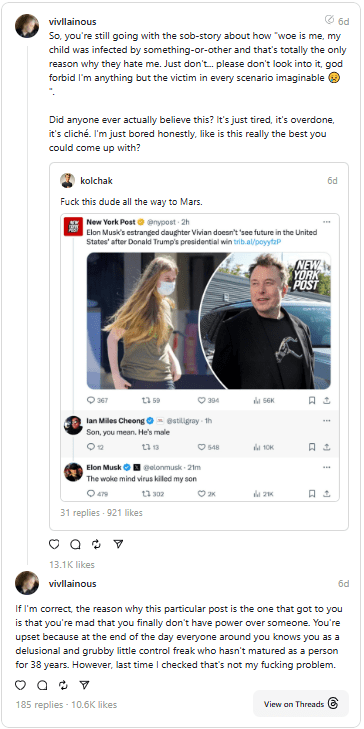
Wilson responded to Musk’s latest claim on November 8 via Threads, writing, “So you’re still going with the sob-story about how ‘woe is me, my child was infected by something-or-other and that’s totally the only reason why they hate me. Just don’t… please don’t look into it, god forbid I’m anything but the victim in every scenario imaginable 😥.”
She continued, “Did anyone actually believe this? It’s just tired, it’s overdone, it’s cliché. I’m just bored, honestly, like is this really the best you could come up with?”
Wilson went on to theorize that the reason Musk’s post struck a nerve was that “you’re mad that you finally don’t have power over someone.”
“You’re just upset because at the end of the day everyone around you knows you as a delusional and grubby little control freak who hasn’t matured as a person for 38 years,” she added. “However, last time I checked that’s not my fucking problem.”
Wilson previously filed a name and gender change petition in 2022, citing both her gender identity and the fact that she “no longer live[d] or wish[ed] to be related to [her] biological father in any way, shape, or form.” In a July interview with NBC News, she described Musk as an absent father who harassed her as a child for being feminine.
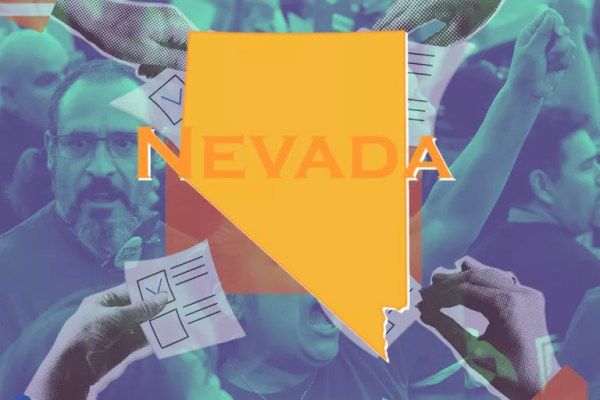
On a scorching hot day in Las Vegas, George Escarero was on a water break from knocking on doors in one of the city’s sprawling gated communities.
The gay, longtime banquet server at the Mirage, whose first language is Spanish, estimated the temperature at 105 but said, “That’s how we go, just walk and walk and walk and sweat and drink water, and if they cuss us out, kind of ignore it. We’re just there to open up, you know, so people can open up their eyes and just see it.”
“In Michigan, it really does feel like democracy is on the line,” says Progress Michigan’s Denzel McCampbell.
Escarero is one of an “army” of canvassers deployed by the Culinary Workers Union in Nevada and was adamant that “it’s time for a big change.”
Your LGBTQ+ guide to Election 2024
Stay ahead of the 2024 Election with our newsletter that covers candidates, issues, and perspectives that matter.DailyWeeklyGood News
“Instead of taking stuff away and making the rich richer,” Escarero shared from his pitch, “Kamala is there to help out, and she knows what we’re going through because she was one of us.”
“Kamala Harris was middle class, like all of us,” he said. “She was a hard worker, started from the bottom, worked her way up. They cannot, like, say, ‘Well, you know what, Kamala, you got juiced in.’ No, she worked from the bottom.”
Escarero said his experience meeting with voters was “probably like 50% are really nice, and 50%” the ones who cuss him out.
Culinary UnionGeorge Escarero, banquet server at The Mirage, canvasses on a hot summer day in Las Vegas. | Culinary Union
Those numbers track with election polls in Nevada, which show an electorate evenly divided between Vice President Kamala Harris and former President Donald Trump supporters in a swing state that could determine the outcome of a dead-heat presidential election.
Nevadans have an unpredictable history at the polls. Out of the last 12 national elections, the state split six to six voting for a Democratic or Republican presidential candidate, while the margin for Democrats has narrowed in every election since Obama won in 2008. President Joe Biden carried the state by just 2 points in 2020.
Share Your Opinion
What are you feeling as we approach Election Day?
Anxiety
Excitement
Sadness
Relief
JoyResultsVote
While Democrats hold majorities in the State House and Senate, Nevadans chose conservative Republican Joe Lombardo for governor over Democratic incumbent Sisolak in 2022. However, U.S. Sen. Jackie Rosen, a Democrat running for her second term this year, holds a narrow lead over Trump-endorsed Republican Sam Brown.
Adding to the voter volatility: an electorate where unaffiliated voters outnumber both Democrats and Republicans in the state.
In 2018, Nevada voters approved a new Automatic Voter Registration system, mandating the Department of Motor Vehicles register new voters or those with lapsed party registration as “unaffiliated” unless they opt out or choose a party.
AVR created 142,484 new Nevada voters in 2020; less than a third chose to call themselves Democrats or Republicans.
It’s a new, mostly young pool of voters open to persuasion and put off by the status quo, said Nevada state Rep. Cecelia González (D), who identifies as queer and bisexual and is running for a second term in the Nevada Assembly.
“Younger voters and people of color really feel alienated by this two-party system, and they really connect with candidates that meet voters on a more personal level, right?” she said. “The shift reflects a growing frustration with traditional party politics and a desire for candidates who speak to the real issues, and not just these partisan talking points.”
The 32-year-old, of Mexican and Thai descent, says she feels the same frustrations. ” Because I’m younger, that’s where I focus on to try to get out the vote.”
Cecelia GonzálezNevada State Rep. Cecelia González (D) speaks with a student in her district in Las Vegas | Cecelia González
18 to 34 year olds make up a whopping 30% of registered voters in Nevada and are the largest block after those over 55, who are historically less persuadable but more inclined to vote than their younger peers. Less than half of the youngest cohort claim Democratic or Republican party allegiance.
While she’s running as a Democrat, González says she knows where those voters are coming from when they meet on the campaign trail.
“They identify with me not just because I’m a woman, not just because I’m Mexican or Latino or Asian. It’s the fact that I resonate with these lived experiences because I come from the same backgrounds.”
“Young people, Latinos, and Asian communities are really what’s going to get the vice president and Walz across the finish line,” she said.
As for canvassing the day we spoke, González said door-knocking was off the table.
“It’s so hot. It’s literally 114 today,” she gasped.
Even before the large influx of unaffiliated voters, party loyalty was on the decline in Nevada. The state’s libertarian “live and let live” ethos has further blurred the distinction between Democrats and Republicans.
That’s reflected in some of the most progressive LGBTQ+ policies and legislation in the country, and it’s one reason the Human Rights Campaign, the country’s largest LGBTQ+ advocacy group, is targeting “equality voters” in Nevada, hoping to appeal to Democrats, Republicans and unaffiliated voters alike in their swing state efforts to get voters to the polls.
But no constituency is a monolith, including the fast-growing Latino population, whose rapid growth has helped transform Nevada into a majority-minority swing state.
The minority share of the population in Nevada rose to just over 54% with the last U.S. Census. Meanwhile, the percentage of the non-Hispanic white population in the state continues its historical decline, dropping from over 83% in 1980 to just 46.4% in 2022.
Those facts haven’t translated, however, to guaranteed loyalty to Democrats, who in years past — as defenders of civil rights and the working class — could count on Latino voters. Their once-uniform support has narrowed and fractured.
The shift is even greater among young Latino men in Nevada: 53% of male Latino voters ages 18 to 34 support Trump while just 40% support Harris. Similar numbers among Latino men ages 35 to 49 add up to a major deficit in a key constituency that could tip the election.
It’s why getting face-to-face with those voters before Election Day is the “number one priority” for both González and George Pappageorge, Secretary-Treasurer of the Culinary Union and lead organizer of what he proudly calls “the largest walk program in the state of Nevada.”
“They come and work for the union,” Pappageorge said of the hundreds of canvassers on leave of absence from their day and night jobs, including guest room attendants, cocktail and food servers, porters, bellmen, cooks, bartenders, and laundry and kitchen workers from the union’s membership.
“They work six days a week. They have Friday off and they’re out in the heat, getting chased by dogs and knocking on doors to turn out the vote,” he said.
The Culinary Union and its affiliates represent more than 60,000 workers in the state, with members from 178 countries. Estimates put the number of LGBTQ+ hospitality workers at one in five, and the union is one of the largest healthcare consumers in the state, with coverage provided for more than 145,000 Nevadans.
Who is elected in any election — locally, statewide, or nationally — has a direct bearing on the union’s ability to thrive, or survive.
A second Trump administration, Pappageorge said, would be “a threat to our existence.”
“This is a guy that jokes with his billionaire buddies about firing striking workers, who brags about crossing picket lines and really has a lot of promises, a lot of promises. But the problem with Trump is that he lies, and he lies a lot.”
Ted Pappageorge, Secretary-Treasurer of the Culinary Union, speaks with a fellow member at a get-out-the-vote meeting in Las Vegas.
“Look, if the election was today, we think Trump would win,” Pappageorge said, “but the election is not today, and our job is to make sure that here in Las Vegas we are contesting every single vote. We’re knocking on every single door. We’re talking to every single person in that household, to union members and their family members, and we’re driving the votes.”
“When you have those kinds of conversations” with voters, Pappageorge said, “you have an opportunity to drive votes and persuade folks. And we think these votes are winnable.”
“But we’ve got to do the work,” he added. “It’s going to be extremely close.”
Escarero, the banquet worker, agreed, sharing, “I even get goosebumps. But I feel, even though it’s going to be a tight, I know she’s going to win.”
Asked what Harris’ pledge to fight for “the freedom to love who you love” meant to him, the longtime union member paused and asked, “To me?”
Then he started to cry.
“I was living the life that it wasn’t,” Escarero said through tears. “I had to fake — I had to fake who I was, and now we have a freedom. Now we can get married. No discrimination. Do the military.”
“That’s why I get very emotional, because I had a tough life, because I had to act like somebody that I wasn’t. You know what I mean?”
With people cursing and dogs chasing him, Escarero shared what kept him going through the hot days canvassing.
He remembered “a knock not too long ago” when he asked a middle-aged white woman, “‘If you don’t mind,’ I said, ‘What side are you on?’ I said, ‘Do you have a plan? Are you on the Trump side or…?”
“‘Oh no, no, no, no, honey,’” she interrupted, pointing to a small Harris-Walz sign in her car. “‘You see my sign out there in the window?’ She goes, ‘Give me a big one and I’ll put it in the front yard.’”
“Let’s fight for our rights,” Escarero said, before heading back out into the heat.
Subscribe to the LGBTQ Nation newsletter and be the first to know about the latest headlines shaping LGBTQ+ communities worldwide.
A recent mailer from the Texas GOP is facing backlash for misrepresenting the story of a trans man and former high school wrestler, Mack Beggs.
The mailer targets Rep. Colin Allred (D-TX), who is challenging Ted Cruz (R-TX) for his Senate seat. It features a blurred image of Beggs when he was an out trans boy competing in girls’ sports, with the text: “Colin Allred failed to protect women’s sports, supporting boys competing with girls.”
At the time, the Texas University Interscholastic League (UIL), which governs public school sports, had prohibited Beggs from joining boys’ teams due to the gender marker on his birth certificate. While transitioning and taking testosterone, Beggs wrestled on the girls’ teams, becoming the center of controversy, particularly after winning state championships in 2017 and 2018.
Rep. Allred has consistently supported trans inclusion in sports, voting against bills that would have barred trans women from participating in women’s sports.
Beggs, now speaking out, expressed concern for his and his family’s safety due to the mailer’s misleading use of his image. “How they’re using my photo, it’s just very misleading. It’s not OK,” he told the Houston Chronicle. He is now seeking legal advice from the American Civil Liberties Union.
On Instagram, Beggs condemned the Texas GOP’s use of his story. “The Republican State of Texas Government has decided to USE my image for yet again one of their political campaigns,” he wrote. “I have already had a few people let me know about this campaign ad paid for and by the Republican Party in TX. NOT COOL. 🚫”
He added: “The fact they are STILL using my story and FACE for their political agendas. It’s sickening at this point.”
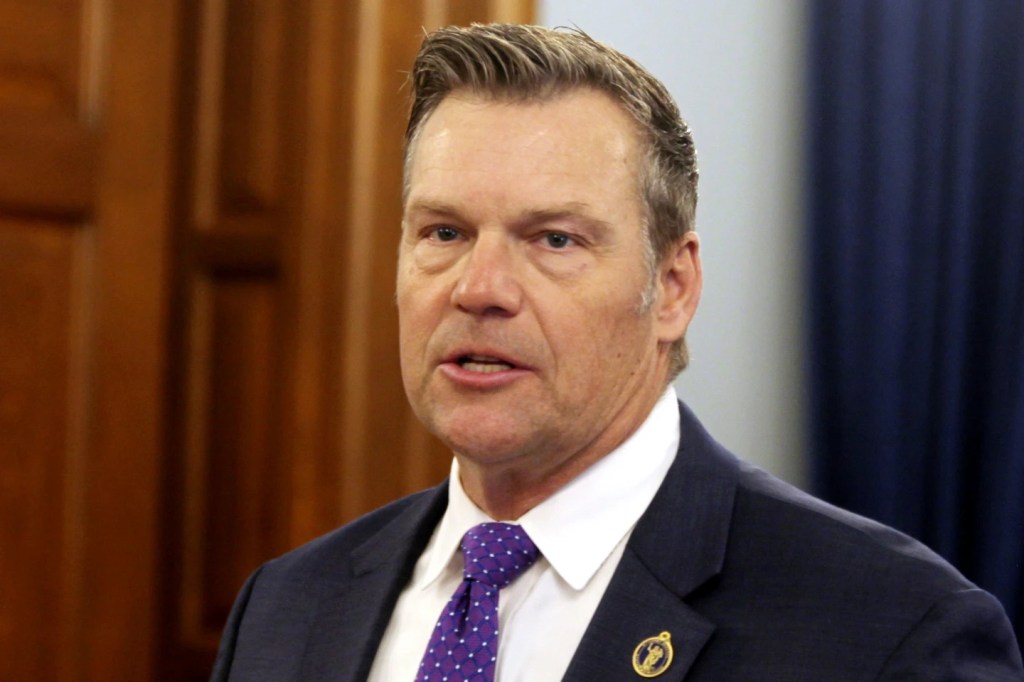
The Kansas Supreme Court delivered a mixed ruling on Friday regarding multiple challenges to a 2021 election law. The court sided with state officials on one provision, revived challenges to others, and suggested that at least one challenge could be resolved before this year’s general election.
However, the most contentious part of the ruling was the majority opinion on the ballot signature verification measure, which stated that the Kansas Constitution’s Bill of Rights does not guarantee the right to vote. This opinion sparked strong dissent from three of the court’s seven justices.
The ballot signature verification measure mandates that election officials compare the signatures on advance mail ballots with those in voter registration records. While the state Supreme Court overturned a lower court’s dismissal of the lawsuit challenging this measure, the majority rejected arguments from voting rights groups that it violates state constitutional voting rights.
In fact, Justice Caleb Stegall, writing for the majority, said that the dissenting justices wrongly accused the majority of ignoring past precedent, holding that the court has not identified a “fundamental right to vote” within the state constitution.
Justice Eric Rosen, one of the three who dissented, shot back: “It staggers my imagination to conclude Kansas citizens have no fundamental right to vote under their state constitution.”
“I cannot and will not condone this betrayal of our constitutional duty to safeguard the foundational rights of Kansans,” Rosen added.
Conversely, the high court unanimously sided with the challengers of a different provision that makes it a crime for someone to give the appearance of being an election official. Voting rights groups, including Kansas League of Women Voters and the nonprofit Loud Light, argued the measure suppresses free speech and their ability to register voters as some might wrongly assume volunteers are election workers, putting them at risk of criminal prosecution.







 fleeredstates.blog
You must be logged in to post a comment.