Texas State Board of Education advisers signal push to the right in social studies overhaul

Read more at Texas Tribune.

The Texas State Board of Education is reshaping how public schools will teach social studies for years to come, but its recent selection of the panelists who will advise members during the process is causing concern among educators, historians and both Democrats and Republicans, who say the panel’s composition is further indication that the state wants to prioritize hard-right conservative viewpoints.

The Republican-dominated education board earlier this year officially launched the process of redesigning Texas’ social studies standards, which outline in detail what students should know by the time of graduation. The group, which will meet again in mid-November, is aiming to finalize the standards by next summer, with classroom implementation expected in 2030.

The 15 members in September agreed on the instructional framework schools will use in each grade to teach social studies, already marking a drastic shift away from Texas’ current approach. The board settled on a plan with a heavy focus on Texas and U.S. history and less emphasis on world history, geography and cultures. Conservative groups like Texas Public Policy Foundation and the Heritage Foundation championed the framework, while educators largely opposed it. 

In the weeks that followed, the board selected a panel of nine advisers who will offer feedback and recommendations during the process. The panel appears to include only one person currently working in a Texas public school district and has at least three people associated with far-right conservative activism. That includes individuals who have criticized diversity efforts, questioned school lessons highlighting the historical contributions of people of color, and promoted beliefs debunked by historians that America was founded as a Christian nation. 

That group includes David Barton, a far-right conservative Christian activist who gained national prominence arguing against common interpretations of the First Amendment’s establishment clause, which prevents the government from endorsing or promoting a religion. Barton believes that America was founded as a Christian nation, which many historians have disproven. 

Critics of Barton’s work have pointed to his lack of formal historical training and a book he authored over a decade ago, “The Jefferson Lies,” that was pulled from the shelves due to historical details “that were not adequately supported.” Brandon Hall, an Aledo Republican who co-appointed Barton, has defended the decision, saying it reflected the perspectives and priorities of his district. 

Another panelist is Jordan Adams, a self-described independent education consultant who holds degrees from Hillsdale College, a Michigan-based campus known nationally for its hard-right political advocacy and efforts to shape classroom instruction in a conservative Christian vision. Adams’ desire to flip school boards and overhaul social studies instruction in other states has drawn community backlash over recommendations on books and curriculum that many felt reflected his political bias. 

Adams has proclaimed that “there is no such thing” as expertise, describing it as a label to “shut down any type of dialogue and pretend that you can’t use your own brain to figure things out.” He has called on school boards to craft policies to eliminate student surveys, diversity efforts and what he considers “critical race theory,” a college-level academic and legal framework examining how racism is embedded in laws, policies and institutions. Critical race theory is not taught in K-12 public schools but has become a shorthand for conservative criticism of how schools teach children about race.

In an emailed response to questions from The Texas Tribune, Adams pointed to his earlier career experience as a teacher and said he understands “what constitutes quality teaching.” Adams also said he wants to ensure “Texan students are taught using the best history and civics standards in America” and that he views the purpose of social studies as forming “wise and virtuous citizens who know and love their country.”

“Every teacher in America falls somewhere along the political spectrum, and all are expected to set their personal views aside when teaching. The same goes for myself and my fellow content advisors,” Adams said. “Of course, given that this is public education, any efforts must support the U.S. Constitution and Texas Constitution, principles of the American founding, and the perpetuation of the American experiment in free self-government.” 

Republicans Aaron Kinsey and LJ Francis, who co-appointed Adams, could not be reached for interviews. 

David Randall, executive director of the Civics Alliance and research director of the National Association of Scholars, was also appointed a content adviser. He has criticized standards he felt were “animated by a radical identity-politics ideology” and hostile to America and “groups such as whites, men, and Christians.” Randall has written that vocabulary emphasizing “systemic racism, power, bias, and diversity” cannot coexist with “inquiry into truth — much less affection for America.” He has called the exclusion of the Bible and Christianity in social studies instruction “bizarre,” adding that no one “should find anything controversial” about teaching the role of “Judeo-Christian values” in colonial North America. 

Randall told the Tribune in an email that his goal is to advise Texas “as best I can.” He did not respond to questions about his expertise and how he would work to ensure his personal beliefs do not bleed into the social studies revisions. 

Randall was appointed by Republican board members Evelyn Brooks and Audrey Young, both of whom told the Tribune that they chose him not because of his political views but because of his national expertise in history and civics, which they think can help Texas improve social studies instruction. 

“I really can’t sit here and say that I agree with everything he has said. I don’t even know everything that he has said.” Brooks said. “What I can say is that I can refer to his work. I can say that he emphasizes integrating civics.” 

The advisory panel also consists of a social studies curriculum coordinator in the Prosper school district and university professors with expertise ranging from philosophy to military studies. The group notably includes Kate Rogers, former president of the Alamo Trust, who recently resigned from her San Antonio post after Lt. Gov. Dan Patrick criticized her over views she expressed in a doctoral dissertation suggesting she disagreed with state laws restricting classroom instruction on race and slavery. 

Seven of the content advisers were selected by two State Board of Education members each, while Texas’ Commissioner of Higher Education Wynn Rosser chose the two other panelists. Board member Tiffany Clark, a Democrat, did not appoint an adviser, and she told the Tribune that she plans to hold a press conference during the board’s November meeting to address what happened. 

Staci Childs, a Democrat from Houston serving on the State Board of Education, said she had anticipated that the content advisory group would include “extremely conservative people.” But her colleagues’ choices, she said, make her feel like “kids are not at the forefront right now.” 

Pam Little, who is the board’s vice chair, is one of two members who appear to have chosen the only content adviser with active experience working in a Texas K-12 public school district. The Fairview Republican called the makeup of the advisory panel “disappointing.” 

“I think it signals that we’re going in a direction where we teach students what we want them to know, rather than what really happened,” Little said. 

The board’s recent decisions show that some members are more focused “on promoting political agendas rather than teaching the truth,” said Rocío Fierro-Pérez, political director of the Texas Freedom Network, a progressive advocacy organization that monitors the State Board of Education’s decisions.

“Whether your political beliefs are conservative, liberal, or middle of the road really shouldn’t disqualify you from participating in the process to overhaul these social studies standards,” Fierro-Pérez said. “But it’s wildly inappropriate to appoint unqualified political activists and professional advocates with their own agendas, in leading roles and guiding what millions of Texas kids are going to be learning in classrooms.” 

Other board members and content advisers insist that it is too early in the process to make such judgments. They say those discussions should wait until the actual writing of the standards takes place, which is when the board can directly address concerns about the new framework. 

They also note that while content advisers play an integral role in offering guidance, the process will include groups of educators who help write the standards. State Board of Education members will then make final decisions. Recent years have shown that even those within the board’s 10-member Republican majority often disagree with one another, making the final result of the social studies revisions difficult to predict. 

Donald Frazier, a Texas historian at Schreiner University in Kerrville and chair of Texas’ 1836 Project advisory committee, who was also appointed a content adviser, said that based on the panelists’ conversations so far, “I think that there’s a lot more there than may meet the eye.” 

“There’s people that have thought about things like pedagogy and how children learn and educational theory, all the way through this panel,” Frazier said. “There’s always going to be hand-wringing and pearl-clutching and double-guessing and second-guessing. We’ve got to keep our eye on the students of Texas and what we want these kids to be able to do when they graduate to become functioning members of our society.” 

The makeup of the advisory panel and the Texas-heavy instructional framework approved in September is the latest sign of frustration among conservative Republicans who often criticize how public schools approach topics like race and gender. They have passed laws in recent years placing restrictions on how educators can discuss those topics and pushed for instruction to more heavily emphasize American patriotism and exceptionalism. 

Under the new framework, kindergarteners through second graders will learn about the key people, places and events throughout Texas and U.S. history. The plan will weave together in chronological order lessons on the development of Western civilization, the U.S., and Texas during grades 3-8, with significant attention on Texas and the U.S. after fifth grade. Eighth-grade instruction will prioritize Texas, as opposed to the broader focus on national history that currently exists. The framework also eliminates the sixth-grade world cultures course. 

When lessons across all grades are combined, Texas will by far receive the most attention, while world history will receive the least. 

During a public comment period for the plan, educators criticized its lack of attention to geography and cultures outside of America. They opposed how it divides instruction on Texas, U.S. and world history into percentages every school year, as opposed to providing students an entire grade to fully grasp one or two social studies concepts at a time. They said the plan’s strict chronological structure could disrupt how kids identify historical trends and cause-and-effect relationships, which can happen more effectively through a thematic instructional approach.  

But that criticism did not travel far with some Republicans, who argue that drastic changes in education will almost always prompt negative responses from educators accustomed to teaching a certain way. They point to standardized test results showing less than half of Texas students performing at grade level in social studies as evidence that the current instructional approach is not working. They also believe the politicization of education began long before the social studies overhaul, but in a way that prioritizes left-leaning perspectives. 

“Unfortunately, I think it boils down to this: What’s the alternative?” said Matthew McCormick, education director of the conservative Texas Public Policy Foundation. “It always seems to come down to, if it’s not maximally left-wing, then it’s conservative indoctrination. That’s my perspective. What is the alternative to the political and policymaking process? Is it to let teachers do whatever they want? Is it to let the side that lost the elections do what they want? I’m not sure. There’s going to be judgments about these sorts of things.” 

This is not the first time the board has garnered attention for its efforts to reshape social studies instruction. The group in 2022 delayed revisions to the standards after pressure from Republican lawmakers who complained that they downplayed Texan and American exceptionalism and amounted to far-left indoctrination. Texas was also in the national spotlight roughly a dozen years prior for the board’s approval of standards that reflected conservative viewpoints on topics like religion and economics. 

Social studies teachers share the sentiment that Texas can do a better job equipping students with knowledge about history, geography, economics and civics, but many push back on the notion that they’re training children to adhere to a particular belief system. With challenges like budget shortfalls and increased class sizes, they say it is shortsighted to blame Texas’ academic shortcomings on educators or the current learning standards — not to mention that social studies instruction often takes a backseat to subjects like reading and math. 

“I think we’re giving a lot more credit to this idea that we’re using some sort of political motivation to teach. We teach the standards. The standards are there. That’s what we teach,” said Courtney Williamson, an eighth-grade social studies teacher at a school district northwest of Austin. 

When students graduate, some will compete for global jobs. Others may go to colleges across the U.S. or even internationally. That highlights the importance, educators say, of providing students with a broad understanding of the world around them and teaching them how to think critically. 

But with the recent moves requiring a significant overhaul of current instruction — a process that will likely prove labor-intensive and costly — some educators suspect that Texas leaders’ end goal is to establish a public education system heavily reliant on state-developed curricula and training. That’s the only way some can make sense of the new teaching framework or the makeup of the content advisory panel. 

“I’m really starting to notice an atmosphere of fear from a lot of people in education, both teachers and, I think, people higher up in districts,” said Amy Ceritelli-Plouff, a sixth-grade world cultures teacher in North Texas. “When you study history, you look at prior conflicts and times in our history when there has been extremism and maybe too much government control or involvement in things; it starts with censoring and controlling education.” 

Texas A&M System to vote on requiring prior approval for lessons on “race and gender ideology”

Read more at Texas Tribune.

The Texas A&M University System’s board of regents will vote on Thursday on whether to prohibit faculty at its 12 universities from teaching “race or gender ideology” unless those lessons are pre-approved by each campus president or a delegate.

The proposal appears to be the first time that a Texas public university system offers definitions of what kind of instruction related to race and gender should not be permitted. 

“Race ideology,” the draft of the proposal says, would encompass any concept that “attempts to shame a particular race or ethnicity” or “promotes activism on issues related to race or ethnicity rather than academic instruction.” The proposal would define “gender ideology” as “a concept of self-assessed gender identity replacing, and disconnected from, the biological category of sex.” 

The policy does not say how the university would decide what constitutes “race ideology” or “gender ideology,” or what would happen if a faculty member is accused of violating the rule. A Texas A&M University System spokesperson did not respond to a request for comment.

The regents’ Committee on Academic and Student Affairs will hear presentations and consider the proposed policy on Thursday morning, according to the agenda for the meeting. The full board of regents will take public testimony on the proposal and vote on it later that day. The meeting will be livestreamed and the public is invited to testify.


Leonard Bright, president of the Texas A&M Chapter of the American Association of University Professors, said faculty were not consulted on the proposed changes, which he called “a direct violation” of their expertise and freedom to teach. 

“And if that’s the case, there’s just going to be a further black eye on higher education here in Texas,” he said.

Robert Shilby, special counsel for campus advocacy at the Foundation for Individual Rights and Expression, said the proposal would “invite unlawful censorship, chill academic freedom, and undermine the core purpose of a university,”

“Hiring professors with PhDs is meaningless if administrators are the ones deciding what gets taught,” he said. “Faculty will start asking not, ‘Is this accurate?’ but ‘Will this get me in trouble?’ That’s not education, it’s risk management.”

In a Monday email to faculty, Simon North, interim dean of Texas A&M’s College of Arts and Sciences, acknowledged that the proposal raised many questions about its implementation, “such as the criteria that will determine when course content is considered relevant, controversial, or inconsistent with a syllabus; the mechanisms by which course material would be approved and compliance evaluated; and the timing of implementation.” He added that he is working with the provost’s office to answer those questions and that he will seek input on the proposal from other leaders in the college and department heads. 

“Approval of these revisions could have far-reaching implications for undergraduate education, and the scope of the implications will depend on the answers to these questions,” North said.

Faculty are already signaling they will show up in force to the regents’ meeting to push back against the proposal. Bright, a professor at Texas A&M’s Bush School of Government and Public Service, said professors are organizing testimony, drafting statements and coordinating with colleagues across Texas to oppose the revisions. 

He said the policy would affect disciplines across the university — from political science and history to public service and biology — and that some faculty fear it would shift control over classroom content from faculty to administrators. He added that some of his colleagues believe the revisions are an attempt to “institutionalize indoctrination” and that if the proposed changes are approved, they will likely be challenged in court.

The proposed prohibition comes two months after the system’s College Station flagship fired Professor Melissa McCoul, whose discussion of gender identity in a children’s literature class was secretly recorded by a student and later circulated online, drawing fire from Republican lawmakers and ultimately toppling the university’s former president

Since McCoul’s firing, other university systems have begun imposing their own restrictions on classroom content. 

On Sept. 25, the Texas Tech University System instructed its faculty to ensure their courses comply with a federal executive order, a letter from Gov. Greg Abbott and a new state law that recognizes only two sexes. In the weeks that followed, Texas’ other public university systems — including the University of Texas, University of North Texas, Texas State and Texas Woman’s University — announced or began internal audits of their course offerings. All said they were acting to ensure compliance with state or federal law, though few detailed what they were looking for or what changes might follow. 

No state or federal law prohibits instruction on race, gender or sexual orientation in universities. However, recent state legislation has put direct and indirect pressure on how universities implement policies related to race and gender. 

In 2023, the Texas Legislature approved Senate Bill 17, which banned diversity, equity and inclusion offices and initiatives at the state’s public universities. Earlier this year, lawmakers approved Senate Bill 37, which gave governor-appointed university regents the final say on whether to approve new courses and prohibited lessons that “advocate or promote the idea that any race, sex, or ethnicity or any religious belief is inherently superior to any other.” An earlier version of the legislation would have required that college courses “not endorse specific public policies, ideologies or legislation,” but the proposal was narrowed down after pushback from professors who said such a restriction would lead to self-censorship and infringe on academic freedom. 

The Texas A&M Board of Regents will also consider on Thursday a new policy that would bar faculty from teaching material “inconsistent with the approved syllabus for the course.” The clause mirrors the reason university officials gave McCoul for firing her. They said she refused to change her course content to match the catalog description, but McCoul and other faculty have countered that course descriptions are often broad and that professors are expected to design their own syllabi and teach according to their expertise.

McCoul has appealed her termination through the university’s Committee on Academic Freedom, Responsibility and Tenure, which concluded its hearing last week. The committee is expected to share a recommendation with interim university President Tommy Williams in the coming weeks on how to respond to McCoul’s appeal, but Williams is not obligated to follow it.

Trump’s DOE will make LGBTQ+ nonprofit workers ineligible for student loan forgiveness

Read more at Yahoo/The Advocate.

Donald Trump‘s Department of Education has unveiled a new policy that will make workers of LGBTQ+ nonprofits ineligible for student loan forgiveness.

The department will publish a rule tomorrow in the Federal Register that would allow the Secretary of Education, Linda McMahon, to disqualify government and nonprofit employers that do not align the Trump administration’s agenda from participating in the Public Service Loan Forgiveness (PSLF) program.

While no specific organizations have yet been named publicly as ineligible for PSLF under the rule, LGBTQ+ organizations operating as 501(c)(3) nonprofits are likely to be targeted. Even large legal groups like the American Civil Liberties Union or Lambda Legal working to legally protect gender-affirming care could be misconstrued as the “subsidization of illegal activities.”

“This is a direct and unlawful attack on nurses, teachers, first responders, and public service workers across the country,” Democracy Forward and Protect Borrowers said in a joint statement. “Congress created the Public Service Loan Forgiveness (PSLF) program because it is important for our democracy that we support the people who do the hard work to serve our communities.”

“This new rule is a craven attempt to usurp the legislature’s authority in an unconstitutional power grab aimed at punishing people with political views different than the administration’s,” it continued. “In our democracy, the president does not have the authority to overrule Congress. That’s why we will soon see the Trump-Vance administration in court.”

The Public Service Loan Forgiveness (PSLF) program forgives the student loans of those who work for federal, state, tribal, or local government, or for non-profit organizations, after they’ve made payments for ten years (120 payments). The program was created as part of the 2007 College Cost Reduction and Access Act and signed into law by President George W. Bush as a way to encourage students to pursue careers in public service.

Trump signed an executive order in March that drastically limits who qualifies for PSLF, preventing forgiveness for people who work at organizations that engage in the supposed “subsidization of illegal activities, including illegal immigration, human smuggling, child trafficking, pervasive damage to public property, and disruption of the public order.”

The order directly singled out organizations that assist trans people, including with gender-affirming care, which it falsely refers to as “child abuse, including the chemical and surgical castration or mutilation of children.”

More than one-third (35 percent) of LGBTQ+ adults ages 18 to 40 — an estimated 2.9 million — held more than $93.2 billion in federal student loans at the beginning of the Biden Administration, according to a March report from the Williams Institute and the Point Foundation, including over half (51 percent) of trans adults, 36 percent of cisgender LBQ women, and 28 percent of cisgender GBQ men.

Luis Vasquez, Senior Legal Writer for the Human Rights Campaign, told The Advocate that “this rule is simply about bullying LGBTQ+ people and nonprofits and other progressive groups and making life more difficult for those who Donald Trump dislikes.”

“The result is that it would keep talented people from pursuing careers in public service, fearing that they may suddenly lose eligibility for this program on a whim,” Vasquez said. “The administration is once again going beyond what Congress has authorized, pursuing a discriminatory policy without legal basis. This hurts innocent people and should be rescinded immediately.”

Only 0.03% Opt Out Of LGBTQ+ Education In Maryland After SCOTUS Gives Them A Right To

Read more at Erin in the Morning.

In June 2025, the Supreme Court issued a landmark ruling allowing parents to opt out of classes that teach material conflicting with their religious beliefs. The decision, which could affect lessons on everything from evolution to cultural diversity, was driven primarily by challenges to classroom instruction about LGBTQ+ people. The case, Mahmoud v. Taylor, originated in Maryland’s Montgomery County School District—the state’s largest—which had previously required lessons on LGBTQ+ inclusion without permitting opt-outs. The ruling was celebrated by far-right activists as a major victory in a deep-blue state. But months later, the results are in: of more than 160,000 students enrolled, only 43 families chose to opt out of LGBTQ+ education districtwide.

In a report released on October 2, the Montgomery County School District approved just 58 opt-out requests from 43 families—under 0.03 percent of the district’s 160,000 students. In other words, 99.97 percent of families, even when given the option, chose to let their children learn about LGBTQ+ people.

The books targeted by the handful of families include Uncle Bobby’s Wedding, about the marriage of two gay men; Intersectional Allies: We Make Room for All, which features a genderfluid character; and Planting the Rainbow: Places of LGBTQ+ History in Maryland, which teaches about key moments in the state’s queer history.

For the families choosing to opt out, their children will be placed in separate classrooms or given alternate assignments when LGBTQ+ topics arise. The arrangement underscores a point the school district made during the court fight: creating entirely new materials for such a vanishingly small group is disruptive to classrooms and burdens teachers with unnecessary extra work—all to accommodate the religious beliefs of a tiny minority. Still, because of the Supreme Court’s ruling, those accommodations will now have to be made.

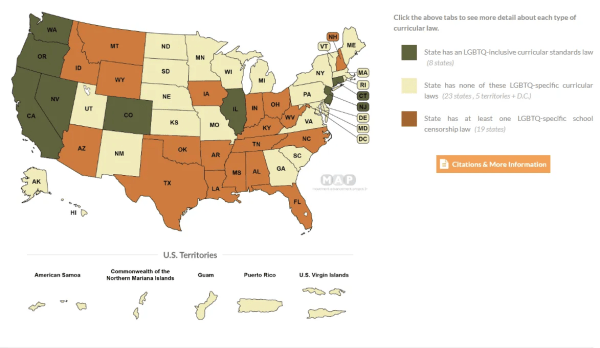
Meanwhile, in Republican-controlled states, officials have taken a far more oppressive approach to LGBTQ+ education. Rather than offering families the option to opt out, many states simply ban the material outright. Under “Don’t Say Gay or Trans” laws—first popularized in Florida and now enacted in 19 states—teachers are prohibited from acknowledging LGBTQ+ people in class instruction at various grade levels. In Texas, several colleges have gone even further, barring professors from recognizing that transgender people exist at all. When contrasted with the minuscule number of families opting out when given the choice, these policies look less like a reflection of public will and more like a top-down morality ban—one that would almost certainly be rejected if parents actually had the freedom to decide for themselves.

Anti-LGBTQ+ school policies remain among the most unpopular measures pushed by Republicans in red states and by the Trump administration. A Navigator Research poll published in August 2023 found that fewer than 25 percent of Democrats and independents—and only half of Republicans—named “protecting children from being exposed to woke ideologies about race and gender in school” as a major priority. Book bans ranked even lower: 92 percent of respondents said such bans were concerning. A more recent Knight Foundation poll echoed those findings, with two-thirds of Americans opposing efforts to restrict books in public schools.

Respondents from Montgomery County, Maryland expressed frustration and vindication after hearing the results of the opt-out process. “Every single one of these ‘anti-woke’ lawsuits and headlines comes from one or a few people making a stink,” said one commenter in a local subreddit dedicated to the county. “Imagine living in Montgomery County and thinking you can opt out of cultural diversity,” said another.

“It looks like most were from elementary schools, but there’s a few from middle schools and two from a high school. Can you imagine what these students’ classmates will think of them?” added a third.

The Supreme Court’s decision is just the latest example of how religious exemptions are being weaponized to roll back civil rights under the guise of “freedom.” Each new ruling gives a single person the power to disrupt an entire classroom, claiming that their beliefs are incompatible with learning about LGBTQ+ people, racial diversity, or any worldview outside their own. These carve-outs have already spread far beyond schools—empowering business owners to deny service to queer customers and pharmacists to refuse medication. But the data out of Montgomery County, Maryland makes one thing unmistakably clear: this crusade is not a mass movement. It’s the obsession of a vanishingly small minority, inflated by a Republican Party that has turned resentment of diversity—and especially of LGBTQ+ people—into the centerpiece of its politics.

Library director fired over LGBTQ+ books gets $700,000 from Wyoming county

Read more at the Washington Post.

Librarian Terri Lesley said she endured years of “pure hell” fighting to keep embattled books on the public library shelves of Gillette, a deeply conservative coal town in northeastern Wyoming.

After getting fired, Lesley fought two more years alleging public officials wrongfully terminated her for refusing to bow to their demands for censorship — all while being threatened, failing to find another librarian job and suffering so much stress she lost sleep and hair.

Now, the 62-year-old’s legal fight is over. On Wednesday, Lesley, who worked for Campbell County Public Library System for 27 years, including 11 as executive director, agreed to settle her federal lawsuit against Campbell County, the county’s library board and several officials for $700,000. In a 78-page complaint filed in April in the U.S. District Court for Wyoming, she accused them of helping to wage a years-long campaign to bully her into removing books about race and LGBTQ+ people from the library. After she refused, she said they fired her, which led to her lawsuit.

“I wanted to take a stand on it and try to put up a barrier from it happening to other librarians,” Lesley said Thursday in an interview. “I thought, ‘If I don’t do this thing, it’s just going to keep happening.’”

Campbell County, the county’s public library board, county commissioners and the lawyers who defended them against Lesley’s suit did not respond to requests for comment from The Washington Post. In court filings, they denied Lesley’s allegations and said she was fired because of “concerns with her performance,” not in retaliation for engaging in constitutionally protected activity. They described her lawsuit as “an improper run-on narrative combining fact, fable, self-praise, and a self-heroic, tale.”

The controversy in Campbell County happened amid a larger movement to target content available in public libraries around the country, particularly those aimed at children and having to do with race, gender or sexual identity. For years, the number of “book challenges” — efforts to remove or restrict access to books — remained flat. But in 2021, challenges spiked 1,300 percent to more than 3,900, according to American Library Association data. They increased each of the next two years to more than 9,000 in 2023 before falling to about 5,800 last year.

School libraries experienced the same thing during that stretch, leading the free-speech nonprofit PEN America to declare book censorship in the United States “rampant and common” and “unprecedented in modern times.”

“Not since the 1950s McCarthy era of the Red Scare has censorship become so entrenched in schools,” the group said Wednesday in a news release, referring to the period when anti-Communist paranoia intensified to a fever pitch.

Campbell County was part of the first wave of the “book-banning craze engulfing the country” in 2021 when several residents demanded county commissioners and library board trustees censor young adult and children’s books with LGBTQ+ content, according to Lesley’s lawsuit.

Those critics denounced books such as “This Book Is Gay” and “Not My Idea: A Book About Whiteness” as pornographic, obscene or racist. When Lesley resisted pressure to transfer such books out of the young adult and children’s sections or remove them from the library altogether, they targeted her for roughly two years, threatening her and accusing of criminal activity and endangering children, according to her lawsuit.

Instead of defending Lesley from that “campaign of fear and hate,” two county commissioners and four library board trustees allegedly joined it. In doing so, commissioners and trustees alienated LGBTQ+ people and propagated the hateful ideology that they are “dangers, abnormal, unwelcome, and their voices should be suppressed,” the suit states.

Over the next two years, Lesley kept resisting attempts to remove or restrict various books with LGBTQ+ themes, saying at library board meetings that doing so constituted censorship and violated the First Amendment, the suit states. Several lawyers agreed with that legal interpretation, which they shared with board trustees and county commissioners, according to the suit.

At one library board meeting, one of Lesley’s critics held up a sign that read “[Campbell County Public Library] Knowingly Encourages SEX for Minors and that’s a crime,” the suit alleges.

Amid the controversy, the American Library Association in March 2022 announced Lesley had won the John Phillip Immroth Memorial Award that recognizes “notable contributions to intellectual freedom and demonstrations of personal courage in defense of freedom of expression.”

Over the next five months, four of five library board members were replaced by county commissioners with ones more inclined to remove or restrict LGBTQ+ books, the suit states.

In July 2023, the library board voted to terminate Lesley.

“Their actions not only devastated Ms. Lesley professionally and personally, but also undermined the very mission of [the library system] and inflicted harm on the broader community,” the suit states. “For this, they must be held responsible.”

Lesley said she continues to be harmed by officials’ actions. More than two years after being fired, she hasn’t gotten a job in her field. A resident of Gillette since the second grade, she’s unwilling to move. She sought remote work in the field that wouldn’t require face-to-face interactions with patrons, but none of her efforts panned out.

Still, Lesley said she doesn’t regret standing up for what she believes was right, even if she’s paid a heavy price. She said she hopes the $700,000 settlement — more than five times what the county paid her annually — deters officials elsewhere from meddling with which books go on library shelves and where.

“They’ll see what happened here and maybe reconsider going down that road,” she said, with a pause, “is what I’m hoping for.”

Loudoun (VA) School Board approves LGBTQ proclamation despite opposition

Read more at Loundon Times-Mirror.

Loudoun County School Board proclamations are typically noncontroversial, but a proclamation recognizing October as LGBTQ+ History Month drew three no votes at the board’s Sept. 30 meeting.

Language in the proclamation says it honors the “history, achievements, and contributions of lesbian, gay, bisexual, transgender, and queer people” and celebrates “the strength, resilience, and impact of the LGBTQ+ community, whose contributions have enriched the cultural, educational, and civic life of Virginia and the world.”

The proclamation — whose approval comes as some 600 Republican-sponsored, anti-LGBTQ billsincluding 17 in Virginia, have been proposed around the nation — includes a repudiation of discrimination.

“We reject discrimination based on gender identity, sexual orientation, and gender expression, and instead affirm kindness, acceptance, and respect as the foundation of our learning community,” the proclamation states. “Our school division is stronger when every student and staff member can live authentically and feels a true sense of belonging, and when we embrace the full diversity of our community.”

April Chandler, Algonkian; Linda W. Deans, Broad Run; board Vice Chair Anne P. Donohue, At Large; Arben Istrefi, Sterling; board Chair Melinda M. Mansfield, Dulles; and Sumera Rashid, Little River, voted yes.

Deana L. Griffiths, Ashburn; Karen “Kari” LaBell, Catoctin; and Lauren E. Shernoff, Leesburg, voted no.

The proclamation was initially included in the board’s consent agenda, which has items that are approved en masse.

However, Griffiths, who typically has abstained from voting on proclamations since taking office in 2024, wrote in an email that she moved the proclamation to the regular agenda, so she could speak about why she was voting against it.

“There is a meaningful difference between formally recognizing a group in history and promoting that group for its lifestyle to our students,” Griffiths said at the meeting. “It crosses the line into advocacy and raises serious concerns under the (Trump) executive order protecting our children from inappropriate content in our schools.

“Our communications must remain age appropriate and leave conversations about sensitive information to parents. Schools exist to teach children how to read, write, and think critically. Not engage them in conversations about sexuality at any age where they are far too young to process it.”

The January executive order from President Donald J. Trump that Griffiths referred to says people cannot identify as the opposite sex they were born as. It says the administration will “enforce all sex-protective laws to promote this reality,” including cutting federal funding used to “promote gender ideology.”

The Trump administration said in August it was suspending or terminating funding to Loudoun County Public Schools over its policy allowing transgender students to choose which bathroom or locker room they use. Federal money accounts for about $47 million of the current $2 billion LCPS budget.

Shernoff wrote in an email that some constituents complained to her after she voted for the proclamation last year about the way LGBTQ+ History Month was celebrated in schools. Specifically, their complaints were about how “certain spirit days” were celebrated and the effect on young students.

“I did some research into it and that in conjunction with knowing that LCPS also proclaims LGBTQ+ Pride Month in June, I decided to not support this,” Shernoff said. “I did however support the anti-bullying proclamation which specifically names and protects students based on their gender identity. I remain committed to ensuring all students are protected, safe, and can achieve to their fullest potential.”

LaBell said in an interview that she supported the proclamation last year because it was on the consent agenda and voting against it would’ve meant voting against everything on the agenda.

She said she opposed the proclamation because some of the issues it raises are “too political”  to promote in school and might be inappropriate for young students to discuss.

Like Shernoff, LaBell said she voted for the Pride Month and anti-bullying proclamations, but believes one proclamation related to LGBTQ issues annually is enough.

“You want history? Put it in Pride Month,” she said. “It just seems to me it’s being pushed more so than anything else in our school system at this point in time. And it’s a family issue. It shouldn’t be a political issue in our schools.”

Two groups that support LGBTQ rights criticized the rationale of Griffiths, LaBell and Shernoff.

Candice Tuck, an Equality Loudoun board member, said the proclamation isn’t about promoting sexuality.

“There have been many brave queer pioneers throughout history who have fought for civil rights, who have been inventors, and who have moved our democracy forward,” Tuck said in an interview. “There is no reason that the queer community cannot be recognized for those accomplishments without individuals in our community perverting their history.”

Meredith Ray, the head of Loudoun4All, noted in an email that Griffiths previously said she wouldn’t vote for any proclamations, but chose to single out the LGTBQ+ proclamation for criticism.

Ray called Griffiths’ decision “malicious” and said her remarks were “ignorant commentary” on the issue.

“Recognition of history is not ‘promotion of a lifestyle.’ LGBTQ+ students, staff, and families exist in Loudoun and deserve the same dignity as everyone else. Griffiths’ attempt to frame recognition as ‘inappropriate content’ is harmful, especially to young people who already face higher rates of bullying and mental health struggles when leaders stigmatize them,” Ray said. “In fact, decades of research show that inclusive education that teaches respect and representation is one of the most effective ways to prevent bullying and improve school climate.”

Appeals court rules for Colorado and LGBTQ rights and against Catholic parishes in state preschool case

Read more at KUNC.

Preschoolers with LGBTQ parents or who identify as LGBTQ can’t be shut out of religious preschools that are part of Colorado’s state-funded preschool program, a federal appeals court ruled Tuesday.

The decision, which upholds a key part of a lower court decision, represents a major win for the state and a defeat for the two Denver-area Catholic preschools at the center of the case.

Tuesday’s decision provides the latest answer to a question being asked in several cases percolating in state and federal courts: Can private religious schools that accept public education dollars refuse to enroll certain kids based on religious principles?

Along with the 10th Circuit Court of Appeal, a Maine federal district court and a Utah state court are among those who have said no.

It’s possible the U.S. Supreme Court could eventually weigh in, though it’s not clear which case will advance to the high court.

In its 54-page ruling, the 10th Circuit Court of Appeals wrote that it found no proof that the Colorado Department of Early Childhood took actions that “evidence religious hostility” as the two Catholic preschools claimed.

The state’s universal preschool program “went to great effort to be welcoming and inclusive of faith-based preschools’ participation,” the decision said.

The three-judge panel also found that the early childhood department, which runs the preschool program, had applied its nondiscrimination policy in a neutral way to both religious and non-religious preschools.

The policy bars preschools from discriminating based on a variety of factors, including sexual orientation and gender identity. State officials cited the policy in denying the Catholic preschools a waiver that would have allowed them to keep LGBTQ children or children from LGBTQ families from enrolling.

In a statement Tuesday, Gov. Jared Polis said, “We are building a Colorado for all, where every student is free from discrimination and this voter-approved initiative continues to enroll approximately 70% of all eligible four-year-olds each school year and many faith based and secular providers are operating terrific preschools that serve parents and children well.”

Tuesday’s ruling essentially upholds the status quo in the universal preschool program, meaning that participating preschools can’t shut out LGBTQ children or children with LGBTQ parents.

The three appeals court judges who ruled Tuesday were Gregory Phillips, Veronica Rossman, and Richard Federico. Phillips was appointed by President Barack Obama, and Rossman and Federico were appointed by President Joe Biden.

Nick Reaves, senior counsel at The Becket Fund for Religious Liberty, which is representing the Catholic preschools in the case, sent Chalkbeat a short statement about the ruling.

“Colorado is punishing religious schools and the families they serve for following their faith. The Tenth Circuit’s decision allows the state’s anti-religious gamesmanship to continue. We will keep fighting to ensure that every preschooler in Colorado can access quality, affordable education.”

Conflict arose as state preschool program rolled out

The Colorado case began in 2023 as the state was launching its new universal preschool program, which provides tuition-free preschool to 4-year-olds statewide. The $349 million program serves more than 40,000 children and allows families to choose from public, private, or religious preschools.

Of more than 2,000 preschools participating in the program this year, about 40 are religious.

St. Mary Catholic Virtue School in Littleton and Wellspring Catholic Academy in Lakewood wanted to join the program when it started, but didn’t want to admit LGBTQ children or children from LGBTQ families.

They asked for an exemption from state rules banning discrimination based on sexual orientation and gender identity, but the Colorado Department of Early Childhood refused. The two preschools never joined the program, and in August 2023, the parishes that ran the preschools sued the state. (Wellspring Catholic Academy closed in December 2024.)

In June 2024, a federal district court judge appointed by President Jimmy Carter largely ruled in the state’s favor.

He wrote of Colorado’s non-discrimination rules: “The purpose of the requirement is not to invade religious freedom but to further the implementation of a strongly embraced public value.”

The parishes quickly appealed.

Unfolding alongside the Catholic preschool case is a separate lawsuit over universal preschool brought by an evangelical Christian preschool in southern Colorado. Unlike the Catholic preschools, that school, Darren Patterson Christian Academy, joined the universal preschool program when it launched.

While officials there never sought to keep LGBTQ children or families out, their lawsuit said state non-discrimination rules could force the preschool to hire employees who don’t share its faith or to change school policies related to restrooms, pronouns, and dress codes.

In February, a federal judge appointed by Donald Trump ruled in favor of Darren Patterson Christian Academy.

The state appealed the ruling in March. The case is ongoing.

Texas A&M President resigns over controversy in LGBTQ teachings

Read more at Yahoo.

The President of Texas A&M University, Mark Welsh, resigned last week amid controversy over a viral video between a professor and a student debating gender ideology.

Welsh stepped down officially on Friday, September 19, according to a press release where the Chancellor Glenn Hegar thanked Welsh for his service to the university and the nation.

“President Welsh is a man of honor who has led Texas A&M with selfless dedication,” said Hegar. “We are grateful for his service and contributions. At the same time, we agree that now is the right moment to make a change and to position Texas A&M for continued excellence in the years ahead.”

The former president resigned while the university faces heated backlash after a video was posted of a student calling out a professor for teaching gender ideology in the classroom.

Professor Melissa McCoul was sharing an image of a “gender unicorn” that demonstrates concepts of gender expressions, identity and sexuality while reading “Jude Saves the World,” a novel about a 12-year-old who comes out as nonbinary, according to The Texas Tribune.

The student said it was illegal according to an executive order signed by President Trump and went against her religious beliefs.

“[M]y Administration will defend women’s rights and protect freedom of conscience by using clear and accurate language and policies that recognize women are biologically female, and men are biologically male,” Trump wrote in the executive order.

State Rep. Brian Harrison, R-Texas, reposted the video on X.

“The governor and lieutenant governor and speaker have been telling everybody for two years now that we passed bans on DEI and transgender indoctrination in public universities,” Harrison wrote on his X account. “The only little problem with that? It’s a complete lie. … The state of Texas — despite what the governor said in his tweet yesterday, that this is a violation of law — there is no state law that we passed.”

Professor McCoul was later fired, according to press reports.

Former A&M President Welsh allegedly defended the inclusion of LGBTQ content in the classroom.

“Those people don’t get to pick who their clients are, what citizens they serve and they want to understand the issues affecting the people that they’re going to treat,” Welsh said in an audio recording posted by Harrison on X. “So there is a professional reason to teach some of these courses.”

In the past few years, Texas has been one of many states fighting LGBTQ and diversity, equity and inclusion efforts in schools.

LGBTQ clubs, teachers’ union sue to block parts of Texas DEI ban in public schools

Read more at the Dallas Morning News.

A Plano teacher, a Houston high schooler, the Texas teachers’ union and a network of LGBTQ clubs filed a federal lawsuit in August to block parts of a new Texas law that bans certain student groups from public schools.

The law, which took effect Sept. 1, bars schools from sponsoring a “student club based on sexual orientation or gender identity.” It also forbids schools from providing instruction, guidance or programming on sexual orientation or gender identity. Schools are barred from helping in the social transitioning of a transgender child, which can include using new names or pronouns.

A former faculty sponsor for a Gender and Sexuality Alliance in Plano ISD; a Houston high schooler; the Gender and Sexuality Alliances Network, a nonprofit that represents GSA clubs in Texas schools; and advocacy group Students Engaged in Advancing Texas say their freedom of speech and expressive association “will be irreparably suppressed” under the new law.

Texas AFT, the teachers’ union, joined the lawsuit as a plaintiff Sept. 15.

“S.B. 12 is one of the most extreme education censorship laws in the country, undermining the free speech rights of Texas students, parents, and educators,” said Brian Klosterboer, senior staff attorney at the ACLU of Texas, who filed the suitin the U.S. District Court for the Southern District of Texas.“We’re challenging this law in court because our schools should be places of truth, inclusion, and opportunity — not fear and erasure.”

The lawsuit names Texas Education Commissioner Mike Morath as a defendant, as well as Plano, Katy and Houston ISDs.

“Plano ISD is obligated to comply with the law as written unless or until the courts provide further direction,” said Zoheb Hassanali, the district’s assistant director of communications, public relations and social media.

He said district staff have received training to ensure compliance with the law.

“Our focus continues to be on educating and supporting our students, and we will not allow external litigation to distract us from that responsibility,” he added.

Houston ISD’s press office said the district does not comment on pending litigation.

Representatives from Katy ISD and the Texas Education Agency did not respond to emailed requests for comment.

The legal action comes as school districts across Texas are adopting policies to comply with the state law, which prohibits diversity, equity and inclusion efforts in K-12 schools.

Rep. Jeff Leach, R-Allen, who introduced the legislation, said it ensures parents are at the “head of the table when it comes to their kids’ education.”

In addition to the ban on LGBTQ clubs, the legislation requires schools to get a parent’s permission before a child can join any school club.

“Our schools should be about teaching history and reading, writing and math and civic responsibility,” Leach said as he advocated for the bill in the Legislature. “We need to get away from some of the more toxic social issues.”

If the law is not blocked, all 22 student-run Gender and Sexuality Alliance clubs registered with the GSA Network will likely shut down, according to the filing.

Leach criticized the organizations during legislative discussions, calling them “school-sponsored and school-sanctioned sex clubs.” Supporters and members of the clubs say they provide safe and welcoming spaces for students.

The groups in the lawsuit say the ban “ostracizes” students “who have a sexual orientation or gender identity that differs from other students.” It also “harms allies of LGBTQ+ students who seek to learn about issues impacting their friends and advocate for a safer and more inclusive school environment,” according to the filing.

At least one Gender and Sexuality Alliance in Plano ISD disbanded ahead of the law’s implementation date, according to court documents. Students tried to start a new club, but school administrators said it would not be allowed.

One student decided to be homeschooled because the club shut down “and the fact that their affirming name and pronouns will no longer be respected by teachers and staff,” court documents read.

The law has created “a climate of fear and discrimination” in the Plano ISD school, “where the voices of LGBTQ+ students and educators are suppressed.” The school is not identified in the lawsuit, and the teacher and student plaintiffs go by pseudonyms to protect them from retaliation.

The Plano ISD teacher, who was also the faculty sponsor of the now-disbanded Gender and Sexuality Alliance, said the law’s “vague and broad” requirements create “a massive gray area about how and whether she can support her transgender students.”

Texas AFT, the teachers’ union, said it has already received a “high volume of inquiries” from members on its grievance hotline about what the law means, its “harsh professional consequences and the harm it is causing their relationships with their students and concerned parents.”

For a Houston high schooler at Kinder High School for the Performing and Visual Arts, the law could mean she can’t join or start a Gender and Sexuality Alliance at her new school.

The high schooler participated in GSA in middle school, where she “found community and support in her own experience of coming out as an LGBTQ+ student and felt safer and happier,” the filing reads.

Under the law, she worries she won’t have that same experience. She already feels the law “is suppressing her ability to speak with teachers” about certain topics, including social transitioning.

NC Dems’ defection fuels the passage of several harmful Republican bills

Read more at NC Voices.

Four North Carolina Democratic lawmakers broke with their party in voting to override Governor Josh Stein’s veto of eight bills, a move that helped push several harmful measures into law.

The four Democrats who voted with state Republican lawmakers on one or more of the override votes were:

  • Cecil Brockman (D-Guilford) – Helped override 2 bills
  • Carla Cunningham (D-Mecklenburg) – Helped override 5 bills
  • Nasif Majeed (D-Mecklenburg) – Helped override 2 bills
  • Shelly Willingham (D-Edgecombe) – Helped override 6 bills

In both of the state’s legislative chambers, a 60% threshold is required to override a governor’s veto of a bill. Due to the four democratic lawmakers going against their party, House Democrats were unable to sustain Governor Stein’s vetoes on eight bills, including House Bill 805, House Bill 318, Senate Bill 266, and House Bill 193.

Here is a breakdown of the bills and how the four lawmakers voted:

Senate Bill 266 is a harmful bill that will raise utility bills for North Carolinians, roll back clean energy progress, and shift costs onto working families so that large corporations pay less. 

The veto override passed 74-46, with Cunningham, Majeed, and Willingham being the deciding votes.

House Bill 193 is a dangerous policy that allows nearly anyone with minimal training to carry a concealed firearm at a private school, creating a serious safety risk for students, teachers, and school support staff. 

The Republican veto override passed 72-48, with Willingham being the deciding vote.

In an interview with Bryan Anderson, Willingham stated that Governor Stein personally called him on Monday night to ask him to sustain his vetoes of several harmful bills. 

Willingham declined, saying, “Governor Stein, he’s just getting to know me. I think now he knows that whatever I say I’m going to do, that’s what I’m going to do. So he could take that to the bank.”

“They say, ‘Well, we want you to sustain the governor’s veto,’” Willingham said. “My thing is I sustain my vote.”

House Bill 805 was originally a bipartisan bill that would have helped people who appeared in sexually explicit photos and videos online to have them removed. However, state Republicans changed the bill to attack transgender North Carolinians along with other controversial provisions. 

In his veto statement, Governor Stein said that while he agreed with the portions of House Bill 805 protecting women and minors  from sexual exploitation on websites, the attacks towards transgender North Carolinians are “mean-spirited.”

Governor Stein wrote, “My faith teaches me that we are all children of God no matter our differences and that it is wrong to target vulnerable people, as this legislation does.”

Ultimately, state Republicans overrode Governor Stein’s veto, 72-48, with Majeed being the deciding vote.

House Bill 318 is an anti-immigration measure that will force sheriffs to cooperate with Immigration and Customs Enforcement (ICE). 

In a statement following his veto of HB 318, Governor Stein stated, “My oath of office requires that I uphold the Constitution of the United States. Therefore, I cannot sign this bill because it would require sheriffs to unconstitutionally detain people for up to 48 hours after they would otherwise be released. The Fourth Circuit is clear that local law enforcement officers cannot keep people in custody solely based on a suspected immigration violation. But let me be clear: anyone who commits a serious crime in North Carolina must be prosecuted and held accountable regardless of their immigration status.”

Despite the bill setting up a dangerous precedent, state Republicans overrode Stein’s veto, 72-48.

Rep. Carla Cunningham, who was the deciding vote, gave a speech on the House floor defending her action to help Republicans override Gov. Josh Stein’s veto of the anti-immigration bill. 

In what Rep. Cunningham referred to as sharing her “unapologetic truth”, the Mecklenburg lawmaker went on to state, “First, as a people, we need to recognize that it’s not just the numbers that matter, but also where the immigrants come from and the culture they bring with them to another country. As the social scientists report, all cultures are not equal.”

 “Some immigrants come and believe they can function in isolation, refusing to adapt,” Cunningham stated. “They have come to our country for many reasons, but I suggest they must assimilate, adapt to the culture of the country they wish to live in.”

She added, “It’s time to turn the conveyor belt off.”

North Carolina Democratic Leaders Push Back

Several Democrats decried the override vetoes on the eight bills, including the Duke Energy bill, attacks towards transgender North Carolinians, and allowing concealed carry on private school grounds. 

On the floor, Rep. Marcia Morey, D-Durham, a former judge, pushed back against Cunningham’s remarks, stating, “We all agree we want safe communities. That’s no longer the issue with this bill — it is scapegoating. It is scapegoating immigrants.”

“Research has shown us that the immigrant community is less likely to commit crimes than the US citizen. That is a fact. We need to work towards finding solutions, not creating divisiveness and ignoring community concerns. This is furthering an anti-immigrant agenda no matter the cost. And when police act as immigration agents, witnesses or victims of crime are going to be less likely to report crime.”

According to the News & Observer, Senate Democratic Leader Sydney Batch called Cunningham’s remarks “absolutely uncalled for.”

“The very fact that you would say that not all people, or not all immigrants, are equal, is just – one, it’s contrary to our Constitution. It’s contrary to how this country was formed. This country was formed because of Native Americans, Blacks that were enslaved, and immigrants, including every single person that was here other than Native Americans,” Batch told reporters

“To say that we are not equal goes and flies in the face of anything that a Democrat, in my opinion, believes and holds, near and dear.”

In a statement last week, the Young Democrats of North Carolina joined Democratic members in condemning Cunningham’s remarks, saying that the lawmaker “disgraced her office with a hate-filled speech attacking the very immigrant communities she was elected to serve.”

“You will be held accountable by your community,” the group stated. “Good luck.”

Blog at WordPress.com.

Up ↑