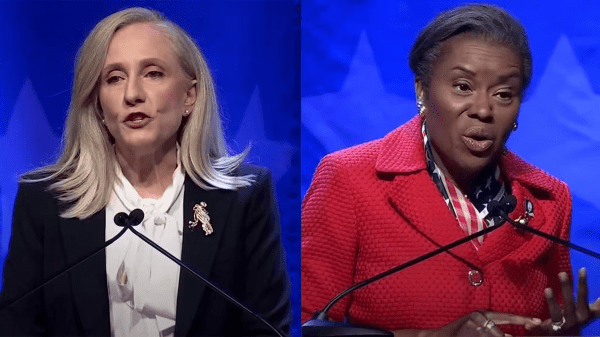
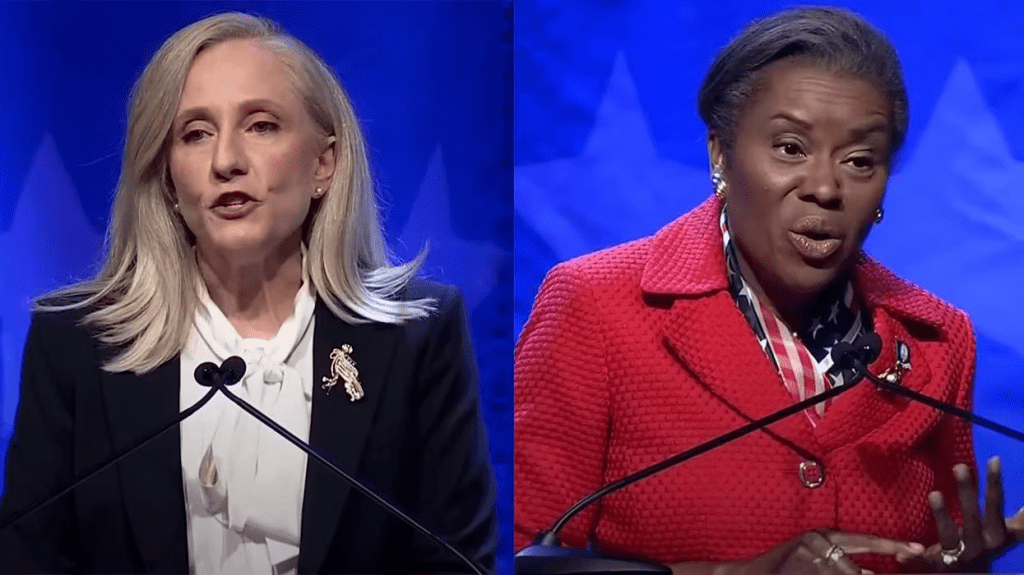
In a combative and chaotic debate Thursday nigh, in Norfolk, Virginia, Lt. Gov. Winsome Earle-Sears, the Republican candidate for governor, declared that opposing marriage equality and allowing employers to fire people for being gay “is not discrimination,” igniting a firestorm that has reverberated through Virginia politics and beyond.
The statement came during the only scheduled debate between Earle-Sears and Democratic nominee Abigail Spanberger, a former CIA officer and three-term member of Congress. The event, held at Norfolk State University and broadcast by TV station WAVY, was frequently interrupted by Earle-Sears’s outbursts, prompting moderators to repeatedly ask her to stop speaking over her opponent. “Please don’t interrupt,” one moderator said after Earle-Sears cut into Spanberger’s answer. Another warned, “Ms. Earle-Sears, we’re not going to be able to get to as many topics if we keep having to give Ms. Spanberger time.”
Spanberger, who leads in most polls, calmly cited Earle-Sears’s long record of opposing LGBTQ+ rights, including her refusal to support marriage equality or workplace protections for queer Virginians. “My opponent has previously said that she does not think gay couples should be allowed to marry,” Spanberger said. “She’s also said she thinks it’s OK for someone to be fired from their job for being gay.”
Before Spanberger could finish, Earle-Sears interjected, “That’s not discrimination.”
The remark drew immediate backlash online. The Human Rights Campaign, the nation’s largest LGBTQ+ civil rights organization, condemned the comment. Sam Lau, one of the organization’s spokespersons, said, “Yes, Lt. Gov. Earle-Sears, that is indeed discrimination. Vote for Abigail Spanberger.”
The Democratic Party of Virginia called the debate performance “atrocious,” and state Sen. Louise Lucas, who attended the event, wrote that Earle-Sears “took a page out of Donald Trump’s debate playbook — interrupt, interrupt, interrupt — anything to avoid real answers or substance.”
Even some Republicans criticized the lieutenant governor’s behavior. Former GOP U.S. Rep. Barbara Comstock said Earle-Sears “demonstrates her bigotry once again,” noting that she “wouldn’t stop babbling and talking over everyone when it wasn’t her time.”
Following the debate, the Spanberger campaign released a statement emphasizing Earle-Sears’s “decades-long, extreme record of opposing marriage equality and equal rights for all Virginians.” The campaign cited her opposition to bipartisan legislation protecting marriage equality that even Republican Gov. Glenn Youngkin signed, noting that she left a handwritten note on the bill stating she was “morally opposed.”
“Virginia families deserve better than a leader who refuses to protect their rights under the law,” Spanberger said in a statement. “The Lieutenant Governor last night showed Virginians that she is more focused on dividing people than solving problems. No company wants to grow in a state where the Governor excuses discrimination and supports firing workers because of who they are. Her comments tell businesses and families that Virginia is closed to the talent, investment, and innovation that keeps our economy strong.”
Democratic National Committee spokesperson Albert Fujii released this statement: “Winsome Earle-Sears is too extreme for Virginia. Her homophobic comments at last night’s debate are disqualifying and prove once again how out of step she is with Virginians. Virginians deserve a leader who will ensure Virginia is welcoming and affordable to everyone — and that champion is Abigail Spanberger. The DNC will keep fighting tooth and nail to ensure Abigail Spanberger wins big in November — the stakes could not be higher.”
On Sunday, Texas Democrats denied House Republicans a quorum to approve a new Congressional map redrawn to add GOP seats to the slim majority Republicans hold in the U.S. House of Representatives.
They did it by fleeing the state.
While the Republicans’ gerrymandering power grab was top of mind for Texas Dems, another piece of legislation will also die without a vote if the lawmakers make good on their promise to stay absent from a special session called by Gov. Greg Abbott (R) to push the redistricting plan through the Republican-dominated House.
On Monday, Texas Senate Republicans passed a draconian new anti-trans “bathroom bill” through committee that provides a rigid penalty system for any facility that does not comply. A first offense would trigger a $5,000 fine, while subsequent violations would earn $25,000 fines for each infraction, the Dallas Observer reports.
Sponsors added S.B. 7 to the special session agenda at the request of Abbott, who called the discriminatory legislation a priority.
If Democrats remain out of state for the next two weeks, the quorum break-up would last through the session’s expiration. That means that even if S.B. 7 passes the Senate, it would be dead on arrival in the Texas House of Representatives.
Out state Sen. Venton Jones (D), who made news earlier this year when he proposed to his boyfriend on the Texas House floor, urged the public to testify against the bill regardless of its poor prospects in the Democrats’ absence, as he stood on a tarmac about to leave the state.
“Texas, it’s time to stand up against harmful legislation targeting the LGBTQ community,” Jones posted to Instagram. S.B. 7 “aims to erase transgender, non-binary, and intersex Texans from public life spaces. We encourage Texans to show up and testify against this bill, and to follow organizations like Equality Texas to stay informed and get involved in the defense of this special session.”
“Venton makes clear that at least for him, and it would seem to be the LGBTQ caucus as well, the quorum break was not only about ending the redistricting plan, but also cutting short these discriminatory bills like SB 7,” said a spokesperson for the LGBTQ+ advocacy group Equality Texas.
“While the maneuver might have been about redistricting, I think the timing considered what other legislation was still on the table.”
Over 100 people signed up to testify for and against S.B. 7 at Monday’s hearing.
“I was born female and I continue to identify as a woman, but I get mistaken for a man or a teenage boy when I go to the bathroom. I am who this bill claims to protect, but in execution, I will only be harmed,” said Caroline Green, an Austin resident.
While the extraordinary, mid-decade redistricting plan won’t affect state lawmakers like Jones, it does put the seat of Texas’ only out member of Congress, Rep. Julie Johnson (D), in jeopardy.
The new map would turn Johnson’s district from 68% Democratic to 60% Republican, the Dallas Voice reports. Texas’ 32nd Congressional District currently includes parts of Plano and Dallas. The new district would only include a portion of Dallas and more rural parts of eastern Texas.
Johnson called the proposed map a “disaster” and a “desperate move from a party losing its grip on a changing state.”
In 2021, when Johnson represented Dallas as a state representative, she and her Texas House Democratic colleagues fled the state in another walkout, denying Republicans a quorum, slowing down a right-wing, so-called voting rights bill from passage.
Rep. Chris Pappas (D-NH) launched his campaign for the open U.S. Senate seat from New Hampshire this morning. The seat is open after Sen. Jeanne Shaheen (D-NH) said that she would not seek reelection in 2026.
“I’m running for Senate because our economy, our democracy, and our way of life are on the line, and New Hampshire deserves a Senator who is grounded in the people, places, and values of this state,” he said in a statement. “You can count on me to lead the charge to confront this administration, self-dealing billionaires, and extreme politicians who threaten our future and our ability to get things done for New Hampshire.”
His Senate campaign released a video today to announce his candidacy called “Taking on the big fights.” The video mentions billionaire Elon Musk without naming the president.
Pappas considers himself a pragmatic member of Congress, and his political positions can be described as moderate for his party. He regularly touts his independence from the Democratic party, bragging last year about being one of the Democrats in the House to cross party lines the most when voting.
He is the only out LGBTQ+ member of Congress to vote in favor of the 2025 NDAA, which contained a provision banning the children of U.S. servicemembers from accessing gender-affirming care if they’re trans.
“No political party has a monopoly on good ideas, and policies that put the needs of everyday people first are found on the left and the right,” he said in February 2024.
Pappas is the first Democrat to announce that he’s running for the Senate seat. The other congressmember from New Hampshire, Rep. Maggie Goodlander (D-NH), is also expected to announce a Senate bid this year.
“He’s had a very successful track record running for the 1st District, which is kind of a difficult swing district,” University of New Hampshire political science professor Dante Scala told the New Hampshire Bulletin last month. “Pappas is very much, even in these days, not a polarizing figure. He’s squarely in the Democratic camp but will occasionally make an effort to reach across the aisle.”
“On paper at least, he’s the most logical successor.”
Pappas could be the first out gay man to win an election to the Senate. There is currently only one out U.S. senator: Sen. Tammy Baldwin (D-WI).
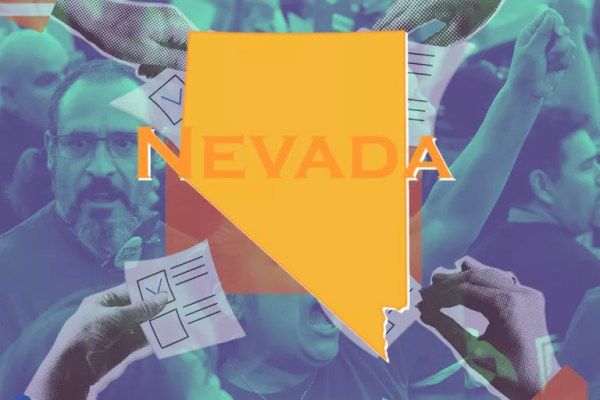
On a scorching hot day in Las Vegas, George Escarero was on a water break from knocking on doors in one of the city’s sprawling gated communities.
The gay, longtime banquet server at the Mirage, whose first language is Spanish, estimated the temperature at 105 but said, “That’s how we go, just walk and walk and walk and sweat and drink water, and if they cuss us out, kind of ignore it. We’re just there to open up, you know, so people can open up their eyes and just see it.”
“In Michigan, it really does feel like democracy is on the line,” says Progress Michigan’s Denzel McCampbell.
Escarero is one of an “army” of canvassers deployed by the Culinary Workers Union in Nevada and was adamant that “it’s time for a big change.”
Your LGBTQ+ guide to Election 2024
Stay ahead of the 2024 Election with our newsletter that covers candidates, issues, and perspectives that matter.DailyWeeklyGood News
“Instead of taking stuff away and making the rich richer,” Escarero shared from his pitch, “Kamala is there to help out, and she knows what we’re going through because she was one of us.”
“Kamala Harris was middle class, like all of us,” he said. “She was a hard worker, started from the bottom, worked her way up. They cannot, like, say, ‘Well, you know what, Kamala, you got juiced in.’ No, she worked from the bottom.”
Escarero said his experience meeting with voters was “probably like 50% are really nice, and 50%” the ones who cuss him out.
Culinary UnionGeorge Escarero, banquet server at The Mirage, canvasses on a hot summer day in Las Vegas. | Culinary Union
Those numbers track with election polls in Nevada, which show an electorate evenly divided between Vice President Kamala Harris and former President Donald Trump supporters in a swing state that could determine the outcome of a dead-heat presidential election.
Nevadans have an unpredictable history at the polls. Out of the last 12 national elections, the state split six to six voting for a Democratic or Republican presidential candidate, while the margin for Democrats has narrowed in every election since Obama won in 2008. President Joe Biden carried the state by just 2 points in 2020.
Share Your Opinion
What are you feeling as we approach Election Day?
Anxiety
Excitement
Sadness
Relief
JoyResultsVote
While Democrats hold majorities in the State House and Senate, Nevadans chose conservative Republican Joe Lombardo for governor over Democratic incumbent Sisolak in 2022. However, U.S. Sen. Jackie Rosen, a Democrat running for her second term this year, holds a narrow lead over Trump-endorsed Republican Sam Brown.
Adding to the voter volatility: an electorate where unaffiliated voters outnumber both Democrats and Republicans in the state.
In 2018, Nevada voters approved a new Automatic Voter Registration system, mandating the Department of Motor Vehicles register new voters or those with lapsed party registration as “unaffiliated” unless they opt out or choose a party.
AVR created 142,484 new Nevada voters in 2020; less than a third chose to call themselves Democrats or Republicans.
It’s a new, mostly young pool of voters open to persuasion and put off by the status quo, said Nevada state Rep. Cecelia González (D), who identifies as queer and bisexual and is running for a second term in the Nevada Assembly.
“Younger voters and people of color really feel alienated by this two-party system, and they really connect with candidates that meet voters on a more personal level, right?” she said. “The shift reflects a growing frustration with traditional party politics and a desire for candidates who speak to the real issues, and not just these partisan talking points.”
The 32-year-old, of Mexican and Thai descent, says she feels the same frustrations. ” Because I’m younger, that’s where I focus on to try to get out the vote.”
Cecelia GonzálezNevada State Rep. Cecelia González (D) speaks with a student in her district in Las Vegas | Cecelia González
18 to 34 year olds make up a whopping 30% of registered voters in Nevada and are the largest block after those over 55, who are historically less persuadable but more inclined to vote than their younger peers. Less than half of the youngest cohort claim Democratic or Republican party allegiance.
While she’s running as a Democrat, González says she knows where those voters are coming from when they meet on the campaign trail.
“They identify with me not just because I’m a woman, not just because I’m Mexican or Latino or Asian. It’s the fact that I resonate with these lived experiences because I come from the same backgrounds.”
“Young people, Latinos, and Asian communities are really what’s going to get the vice president and Walz across the finish line,” she said.
As for canvassing the day we spoke, González said door-knocking was off the table.
“It’s so hot. It’s literally 114 today,” she gasped.
Even before the large influx of unaffiliated voters, party loyalty was on the decline in Nevada. The state’s libertarian “live and let live” ethos has further blurred the distinction between Democrats and Republicans.
That’s reflected in some of the most progressive LGBTQ+ policies and legislation in the country, and it’s one reason the Human Rights Campaign, the country’s largest LGBTQ+ advocacy group, is targeting “equality voters” in Nevada, hoping to appeal to Democrats, Republicans and unaffiliated voters alike in their swing state efforts to get voters to the polls.
But no constituency is a monolith, including the fast-growing Latino population, whose rapid growth has helped transform Nevada into a majority-minority swing state.
The minority share of the population in Nevada rose to just over 54% with the last U.S. Census. Meanwhile, the percentage of the non-Hispanic white population in the state continues its historical decline, dropping from over 83% in 1980 to just 46.4% in 2022.
Those facts haven’t translated, however, to guaranteed loyalty to Democrats, who in years past — as defenders of civil rights and the working class — could count on Latino voters. Their once-uniform support has narrowed and fractured.
The shift is even greater among young Latino men in Nevada: 53% of male Latino voters ages 18 to 34 support Trump while just 40% support Harris. Similar numbers among Latino men ages 35 to 49 add up to a major deficit in a key constituency that could tip the election.
It’s why getting face-to-face with those voters before Election Day is the “number one priority” for both González and George Pappageorge, Secretary-Treasurer of the Culinary Union and lead organizer of what he proudly calls “the largest walk program in the state of Nevada.”
“They come and work for the union,” Pappageorge said of the hundreds of canvassers on leave of absence from their day and night jobs, including guest room attendants, cocktail and food servers, porters, bellmen, cooks, bartenders, and laundry and kitchen workers from the union’s membership.
“They work six days a week. They have Friday off and they’re out in the heat, getting chased by dogs and knocking on doors to turn out the vote,” he said.
The Culinary Union and its affiliates represent more than 60,000 workers in the state, with members from 178 countries. Estimates put the number of LGBTQ+ hospitality workers at one in five, and the union is one of the largest healthcare consumers in the state, with coverage provided for more than 145,000 Nevadans.
Who is elected in any election — locally, statewide, or nationally — has a direct bearing on the union’s ability to thrive, or survive.
A second Trump administration, Pappageorge said, would be “a threat to our existence.”
“This is a guy that jokes with his billionaire buddies about firing striking workers, who brags about crossing picket lines and really has a lot of promises, a lot of promises. But the problem with Trump is that he lies, and he lies a lot.”
Ted Pappageorge, Secretary-Treasurer of the Culinary Union, speaks with a fellow member at a get-out-the-vote meeting in Las Vegas.
“Look, if the election was today, we think Trump would win,” Pappageorge said, “but the election is not today, and our job is to make sure that here in Las Vegas we are contesting every single vote. We’re knocking on every single door. We’re talking to every single person in that household, to union members and their family members, and we’re driving the votes.”
“When you have those kinds of conversations” with voters, Pappageorge said, “you have an opportunity to drive votes and persuade folks. And we think these votes are winnable.”
“But we’ve got to do the work,” he added. “It’s going to be extremely close.”
Escarero, the banquet worker, agreed, sharing, “I even get goosebumps. But I feel, even though it’s going to be a tight, I know she’s going to win.”
Asked what Harris’ pledge to fight for “the freedom to love who you love” meant to him, the longtime union member paused and asked, “To me?”
Then he started to cry.
“I was living the life that it wasn’t,” Escarero said through tears. “I had to fake — I had to fake who I was, and now we have a freedom. Now we can get married. No discrimination. Do the military.”
“That’s why I get very emotional, because I had a tough life, because I had to act like somebody that I wasn’t. You know what I mean?”
With people cursing and dogs chasing him, Escarero shared what kept him going through the hot days canvassing.
He remembered “a knock not too long ago” when he asked a middle-aged white woman, “‘If you don’t mind,’ I said, ‘What side are you on?’ I said, ‘Do you have a plan? Are you on the Trump side or…?”
“‘Oh no, no, no, no, honey,’” she interrupted, pointing to a small Harris-Walz sign in her car. “‘You see my sign out there in the window?’ She goes, ‘Give me a big one and I’ll put it in the front yard.’”
“Let’s fight for our rights,” Escarero said, before heading back out into the heat.
Subscribe to the LGBTQ Nation newsletter and be the first to know about the latest headlines shaping LGBTQ+ communities worldwide.
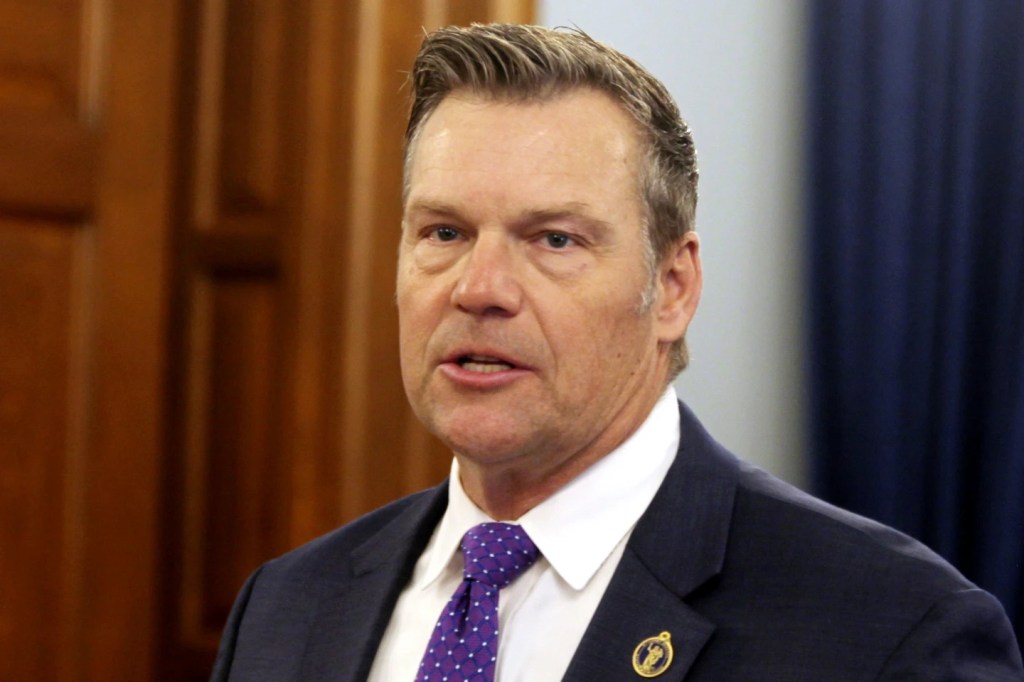
The Kansas Supreme Court delivered a mixed ruling on Friday regarding multiple challenges to a 2021 election law. The court sided with state officials on one provision, revived challenges to others, and suggested that at least one challenge could be resolved before this year’s general election.
However, the most contentious part of the ruling was the majority opinion on the ballot signature verification measure, which stated that the Kansas Constitution’s Bill of Rights does not guarantee the right to vote. This opinion sparked strong dissent from three of the court’s seven justices.
The ballot signature verification measure mandates that election officials compare the signatures on advance mail ballots with those in voter registration records. While the state Supreme Court overturned a lower court’s dismissal of the lawsuit challenging this measure, the majority rejected arguments from voting rights groups that it violates state constitutional voting rights.
In fact, Justice Caleb Stegall, writing for the majority, said that the dissenting justices wrongly accused the majority of ignoring past precedent, holding that the court has not identified a “fundamental right to vote” within the state constitution.
Justice Eric Rosen, one of the three who dissented, shot back: “It staggers my imagination to conclude Kansas citizens have no fundamental right to vote under their state constitution.”
“I cannot and will not condone this betrayal of our constitutional duty to safeguard the foundational rights of Kansans,” Rosen added.
Conversely, the high court unanimously sided with the challengers of a different provision that makes it a crime for someone to give the appearance of being an election official. Voting rights groups, including Kansas League of Women Voters and the nonprofit Loud Light, argued the measure suppresses free speech and their ability to register voters as some might wrongly assume volunteers are election workers, putting them at risk of criminal prosecution.





 fleeredstates.blog
You must be logged in to post a comment.