Lawmakers Are Rising to Defend Trans Kids Following Trump’s Election Victory

This blog is originally appeared at Them.

“‘I will always stand with trans people and the entire LGBTQ+ community. This Congresswoman sees you and loves you,’ said Rep. Ayanna Pressley.”

It’s clear that a potential second term for Donald Trump would have devastating consequences for queer and trans Americans.

The accused rapist and his party have been outspoken in their opposition to trans rights. According to data from Ad Impact, reported by Washington Post’s Casey Parks on November 5, Republicans spent nearly $215 million on anti-trans ads during the 2024 election cycle. On Trump’s 2024 campaign website, he pledged to redefine gender at the federal level, recognizing only male and female as assigned at birth, and to push for a nationwide ban on gender-affirming care for minors.

To make matters worse, Democrats like New York Rep. Tom Suozzi and Massachusetts Rep. Seth Moulton chose to scapegoat trans people for their party’s failure to win the presidency, House, or Senate.

Despite the troubling implications of the 2024 elections, many Democratic politicians have made it clear that supporting the trans community is a top priority, regardless of what the next four years bring.

From calling out transphobia within their own party to working to enshrine LGBTQ+ protections at the state level, these leaders are standing up for trans rights.

Gov. JB Pritzker and State Rep. Kelly Cassidy (Illinois)
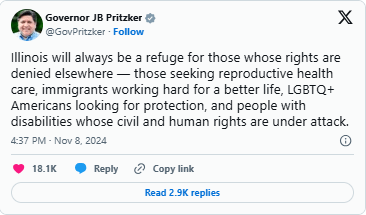
Illinois Gov. JB Pritzker reaffirmed his commitment to LGBTQ+ Americans in a tweet, declaring that Illinois would remain “a refuge for those whose rights are denied elsewhere.”

Pritzker went on to specifically highlight the communities he’s standing with, including “those seeking reproductive healthcare, immigrants working hard for a better life, LGBTQ+ Americans looking for protection, and people with disabilities whose civil and human rights are under attack.
Meanwhile, Illinois State Rep. Kelly Cassidy recently told the Chicago Sun-Times that a coalition of state lawmakers has been working to protect access to trans and reproductive healthcare since the Supreme Court’s decision to overturn Roe v. Wade in 2022. Now, this coalition is examining Project 2025 to assess what additional protections they can put in place in the near future.

Cassidy mentioned that one key issue the coalition hopes to address before the fall legislative session concludes is the use of geolocators to track individuals who access healthcare facilities.

Gov. Gavin Newsom (California)
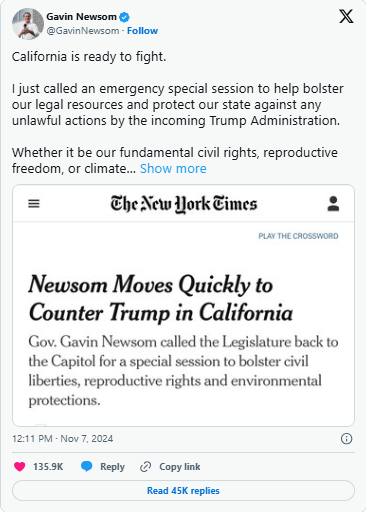
On November 7, California Gov. Gavin Newsom announced a special session of the California Legislature, set to begin on December 2. This session will focus on strengthening California’s legal resources to safeguard climate action, civil rights, immigrant families, and reproductive freedom in response to Trump’s reelection.

According to a release from Newsom’s office, this special session is a direct response to the public statements and proposals made by President-elect Trump and his advisors, as well as actions taken during his first term. These efforts, Newsom’s office warns, could threaten essential freedoms and individual rights, including women’s rights and LGBTQ+ rights.

In 2023, Gov. Gavin Newsom signed nine LGBTQ+ rights bills into law in just a few days, despite vetoing a bill that would have provided stronger protections for trans children in custody and visitation cases. Earlier this year, he also signed the Support Academic Future and Educators for Today’s Youth Act (SAFETY Act), which prohibits schools from implementing policies that require staff to out students to their parents. The law also mandates the California Department of Education to create resources for LGBTQ+ students and their families.

Salem City Councilor Kyle Davis (Massachusetts)
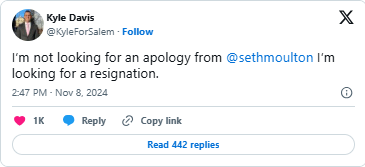
Salem, Massachusetts City Councilor Kyle Davis called out Massachusetts Rep. Seth Moulton in a series of X posts after Moulton made transphobic remarks to the New York Times.

In an interview with the Times on November 7, Moulton stated, “I have two little girls, I don’t want them getting run over on a playing field by a male or formerly male athlete. But as a Democrat, I’m supposed to be afraid to say that.”

The following day, Davis responded strongly on X, not holding back in his critique.
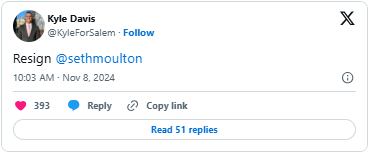
‘Resign @sethmoulton,’” he tweeted on November 8. Shortly after, he followed up with a second post, stating, “I’m not looking for an apology from @sethmoulton, I’m looking for a resignation.
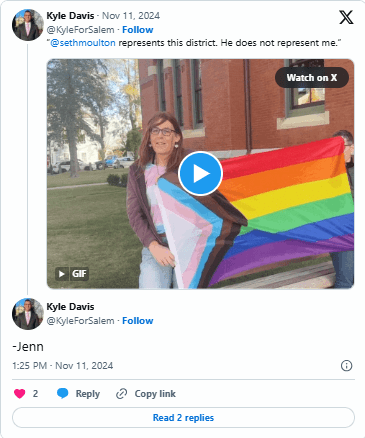
On November 11, Davis posted a gif of a woman named Jenn holding the progress Pride flag, with the caption, ‘@Sethmoulton represents this district. He does not represent me.’

The city councilor went on to question the timing of Moulton’s remarks in an interview with the Boston Globe last week.

“With all the things Trump has said about trans people, this is a time when the trans community is feeling a lot of fear,” Davis said.

State Senator Jamie Eldridge (Massachusetts)
Massachusetts Senator Jamie Eldridge also spoke out against Moulton’s transphobic comments. On November 8, Eldridge took to X to share a link to a Boston Globe article highlighting local Democrats who were condemning Moulton’s remarks.
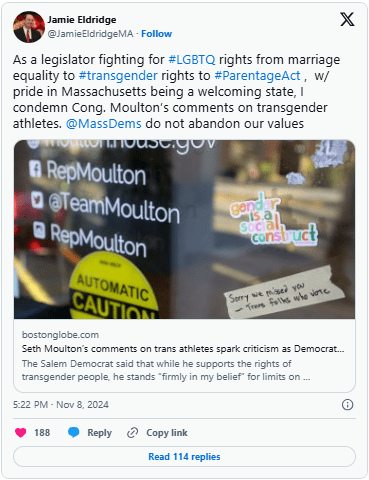
As a legislator fighting for #LGBTQ rights—from marriage equality to #transgender rights to the #ParentageAct—and with pride in Massachusetts being a welcoming state, I condemn Cong. Moulton’s comments on transgender athletes,” Eldridge wrote. “@MassDems do not abandon our values.”

Rep. Becca Balint (Vermont)
Vermont Rep. Becca Balint succinctly summed up the sentiment in a November 9 X post, writing, “Leave trans kids alone.
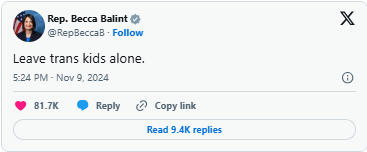
When Balint was elected in 2022, she made history as the first openly LGBTQ+ person and the first woman elected to Congress from Vermont.

Rep. Ayanna Pressley (Massachusetts)
Massachusetts Rep. Ayanna Pressley reinforced her commitment to the trans and LGBTQ+ communities in a November 10 X post, reaffirming her unwavering support.
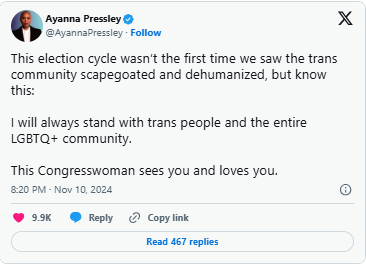
This election wasn’t the first time we’ve seen the trans community scapegoated and dehumanized, but know this: I will always stand with trans people and the entire LGBTQ+ community,” she wrote. “This Congresswoman sees you and loves you.

Attorney General Rob Bonta (California)
On November 5, California Attorney General Rob Bonta—who, last year, sued a school district in his state to block a policy requiring teachers to out trans students to their parents—told Cal Matters that his office is already preparing legal challenges to the incoming Trump administration. Bonta’s team has preemptively drafted briefs and tested arguments to counter policies they anticipate Trump will push during his second term, including those that could undermine civil rights for trans youth.

“Unfortunately, it’s a long list [of issues],” the attorney general said. “We are and have been for months developing strategies for all of those things.”

LGBTQ+ rights have long been at the mercy of public opinion. This November will be no different.

This blog is originally appeared at LGBTQ Nation.

LGBTQ+ ballot initiatives have long served as a wedge issue, mobilizing conservative voters and influencing the rights and freedoms typically protected by law. The 2024 election follows this tradition, with LGBTQ+ civil rights once again being subjected to public debate.

In New York, voters will decide whether to include sexual orientation, gender identity, and gender expression in the state’s anti-discrimination amendment. Meanwhile, reproductive rights will also be up for a vote in 10 other states.

California, Colorado, and Hawaii voters will decide this November whether to repeal their states’ constitutional bans on same-sex marriage.

Since 1998, same-sex unions have consistently been the top issue on state referendums. In that time, 34 states have put the question to voters, with many passing constitutional amendments that prohibited same-sex marriage. These amendments were often used as a political tool to mobilize conservative voters, particularly in the 2004 election when 11 states approved such bans, helping to boost George W. Bush’s campaign.

Marriage equality consistently lost at the ballot box until 2012, when voters in Maine, Maryland, Minnesota, and Washington approved same-sex marriage, signaling a shift in public opinion that had been building since around 2009, when support for same-sex marriage crossed the 50% threshold in national polls.

In 2015, the Supreme Court’s landmark Obergefell v. Hodges decision struck down all state constitutional amendments banning same-sex marriage, declaring such bans unconstitutional. However, these amendments remain in place in several state constitutions. Activists are now pushing to repeal them, especially in light of concerns that the conservative-leaning Supreme Court could overturn Obergefell, as Justice Clarence Thomas hinted after the court struck down Roe v. Wade.

The Origins of Ballot Initiatives on LGBTQ+ Rights

California’s 1978 election introduced the first state ballot initiative related to LGBTQ+ rights—Proposition 6, also known as the Briggs Initiative. Sponsored by Orange County legislator John Briggs, the initiative sought to ban anyone who engaged in “public homosexual activity” from working in California public schools. The proposal was part of a broader wave of anti-gay activism spurred by Anita Bryant’s 1977 “Save Our Children” campaign in Florida, which successfully repealed Dade County’s anti-discrimination ordinance based on sexual orientation. Harvey Milk played a pivotal role in organizing the opposition to Prop 6, which was defeated by a 16-point margin.

Since then, other states have introduced ballot initiatives aimed at legalizing or banning discrimination based on sexual orientation or gender identity. Over time, voters have increasingly supported anti-discrimination measures. In 1988, Oregon voters overturned the governor’s authority to ban discrimination based on sexual orientation. In 2018, Massachusetts voters upheld a law prohibiting discrimination based on gender identity.

Maine and Oregon: Key States in the Fight for LGBTQ+ Rights

Maine and Oregon have consistently put LGBTQ+ rights to a vote. In Maine, voters initially blocked same-sex marriage in 2009, but then approved it by the same 53% margin in 2012. Maine also rejected anti-LGBTQ+ discrimination protections in 1998 and 2000, only to approve them in 2005. In Oregon, voters defeated a “don’t say gay” measure in 2000 by a narrow 5.7% margin.

Many states also used ballot measures to resist the inclusion of sexual orientation as a protected identity in anti-discrimination laws. In the 1990s, voters in Oregon, Idaho, and Maine approved such measures, protecting sexual orientation as a legally recognized identity.

The Impact of Other Ballot Measures on LGBTQ+ Rights

It’s not just LGBTQ+-specific ballot measures that impact the community. Other laws, such as voter ID requirements in Arkansas and North Carolina, disproportionately affect trans individuals and other marginalized LGBTQ+ people, limiting their ability to vote.

In addition to these referendums, the candidates voters elect at the state level will play a critical role in shaping LGBTQ+ rights. Republican-led legislatures have introduced or passed hundreds of bills targeting LGBTQ+ individuals, particularly in areas such as gender-affirming health care, bathroom access, inclusive education, and sports participation. Supporting state-level and local candidates who champion LGBTQ+ rights will have long-term implications, even if certain issues are not directly decided by referendum.

Civil Rights and Public Opinion

The fight for civil rights has a long history of being put to public referendum. Since 1868, issues related to race, sex, and disability have often been decided by voters, with initial support for discrimination gradually giving way to support for equality. While women’s rights gained public approval in the 1970s, LGBTQ+ rights did not see widespread support until the 2000s.

The question of whether civil rights should be determined by public opinion, rather than by courts or legislatures, has allowed forms of discrimination—such as racism, sexism, and homophobia—to become entrenched in law. Although public opinion on LGBTQ+ rights is often divided and fluid, most polls now show a majority in favor of anti-discrimination laws for LGBTQ+ individuals.

The Importance of Voting

With LGBTQ+ rights on the ballot this November, it’s more crucial than ever to vote. In addition to ballot measures, the elected officials who hold office at the state and local levels will have the power to pass or block pro-equality legislation, impacting LGBTQ+ rights for years to come. Whether through referendums or legislative action, LGBTQ+ rights remain at stake, and your vote matters.

Make your voice heard—not just on ballot measures, but by choosing candidates who will protect and advance equality for all.

Trans trailblazer Leigh Finke is currently under intense national attack from right-wing groups

This blog originally appeared at LGBTQ NATION.

She has been falsely accused of supporting pedophilia due to her efforts to protect LGBTQ+ individuals from such harmful accusations.

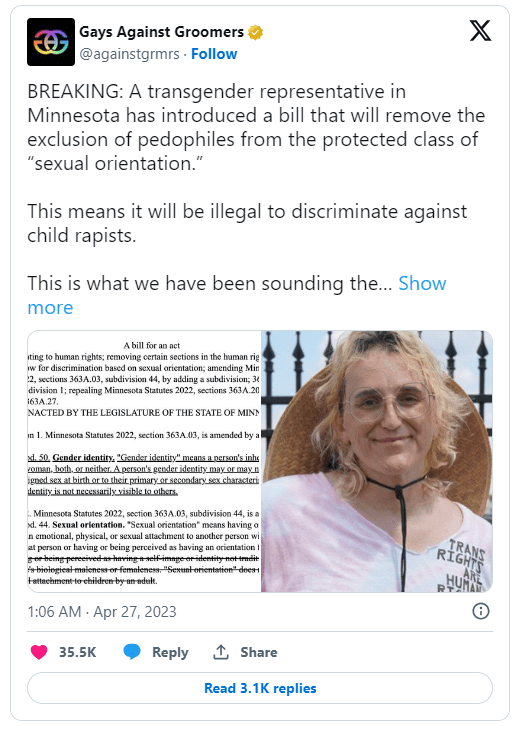
Minnesota State Rep. Leigh Finke (D) describes the relentless right-wing campaign against her, including attacks from within the House and a national hate group, Gays Against Groomers. “There were attacks from inside the House, with some members using their time on the floor to target me. Gays Against Groomers also joined in, fueling a nationwide campaign against me that has never really slowed down,” Finke tells LGBTQ Nation.

Finke has been falsely accused of supporting pedophilia, a claim with no evidence to back it up. She reports receiving death threats and having to increase her security measures, including regular meetings with the Sergeant at Arms and state troopers, as well as changes to her email and voicemail protocols.

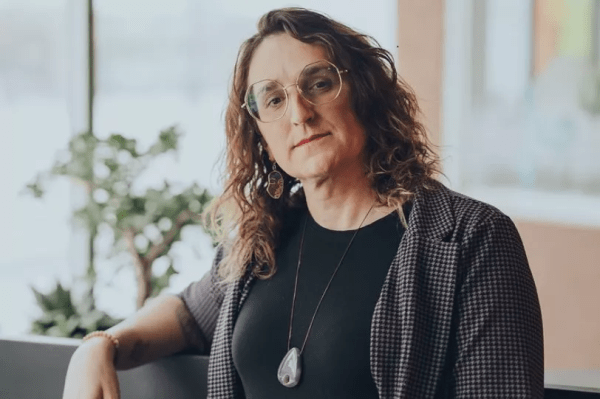
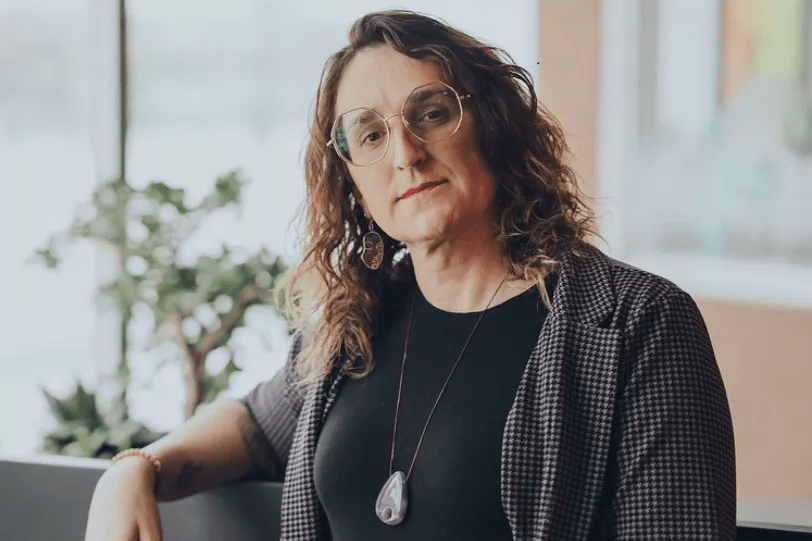
Since her election to the Minnesota House of Representatives in 2022, Finke has been in the spotlight. Representing District 66A in northern St. Paul, an area with a vibrant queer community, she stands as the first openly trans state legislator in Minnesota. Finke has made history by serving as a representative who authentically connects with and represents her constituency.

Finke’s distinct presence in the Minnesota House of Representatives is evident in both her policies and personal style. Known for her dyed pink or purple hair, tattooed arms, and black leather jackets over skirts and dresses, she consciously stands out to ensure queer individuals see themselves represented in a legislator capable of enacting meaningful change.

With a background in activism, including work with the state’s ACLU chapter and as a documentarian, Finke has made significant strides in office. Her achievements include passing the landmark trans refuge bill, which ensures safe passage for those seeking gender-affirming care from other states, codifying trans rights under the Minnesota Human Rights Act, securing millions in HIV care funding, and advocating for more inclusive shelters for homeless LGBTQ+ individuals.

While her political prominence has garnered her accolades, such as being named one of USA Today’s Women of the Year in 2023, it has also attracted considerable backlash. Finke faces intense vitriol, particularly from a segment of the Republican party in Minnesota that exploits her advocacy for trans protections as a liability against supporters. This mirrors national attacks, including dehumanizing language, misgendering, and targeted harassment.

One of her most controversial actions involved revising the outdated wording in the 1993 Human Rights Act, which previously stated, “sexual orientation does not include a physical or sexual attachment to children by an adult.” While this wording aimed to exclude pedophilia, Finke and LGBTQ+ rights advocates were concerned it could be used to unjustly label queer individuals as pedophiles. Her attempt to remove this language drew fierce criticism from right-wing groups, including Gays Against Groomers and figures like Rep. Marjorie Taylor Greene (R-GA), despite a PolitiFact fact check debunking the false claims that she was trying to “make pedophilia a protected class.”

Read more about this photo.

The right-wing Daily Caller and Fox News intensified their attacks on Finke, contributing to a surge in online harassment directed at her from right-wing circles.

LGBTQ Nation has confirmed that Finke indeed received death threats, a fact supported by public documentation from civil rights attorney Alejandra Caraballo on X.

Read more about this photo.

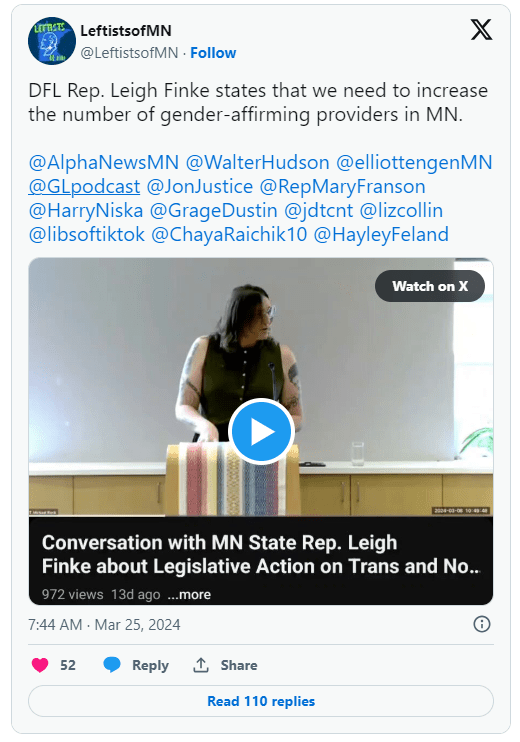
Minnesota conservatives often spotlight Finke, especially when she speaks positively about gender-affirming care. Both large and small accounts launch attacks against her. LGBTQ Nation has identified several of these accounts, including “@LeftistsofMN,” a prominent right-wing account that monitors notable left-wing figures in the state, and “Action 4 Liberty,” a right-wing activist organization.

The attacks on Finke weren’t confined to the right-wing outrage machine; they also came from within the state House.

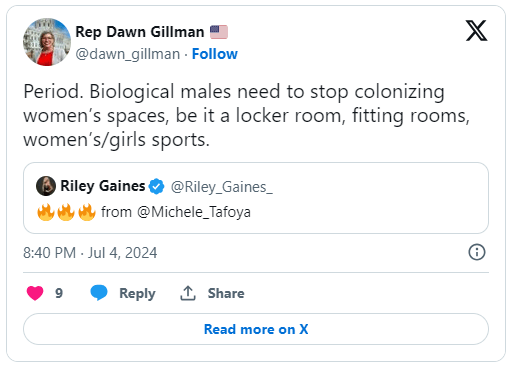
Finke has pointed to social media attacks from Minnesota right-wing lawmakers, describing them as just a fraction of the vitriol she endures from some of her colleagues. One notable example came from state Rep. Dawn Gillman (R), who remarked, “Period. Biological males need to stop colonizing women’s spaces, be it a locker room, fitting rooms, women’s/girls sports,” which Finke interpreted as a direct attack on her.

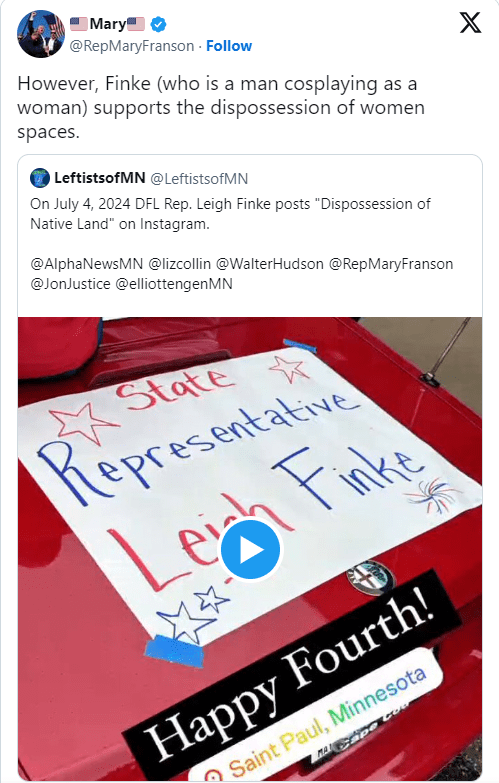
Another instance came from state Rep. Mary Franson (R), who publicly stated, “However, Finke (who is a man cosplaying as a woman) supports the dispossession of women [sic] spaces.”

Finke’s colleagues have not faced the same level of attacks. While some allies experience a degree of criticism, the majority of the focus has been on her.

These relentless attacks have taken a toll on Finke’s health, but she remains committed to serving the people of Minnesota despite the challenges. “I continue to do the work I was brought to do. It has become a very heavy toll [on me] personally. It’s obviously hard to be attacked, but I have good support from my community, my family, and my colleagues at the House. There’s a faction of the Minnesota GOP that is not hesitant to use me as a political weapon, and that’s likely to continue,” she says.

Finke acknowledges the impact of these attacks but is determined not to let them deter her. “I’m getting a bit better at not letting it affect me personally, but you never know what’s next,” she notes. Her resolve is unwavering; she plans to push back by continuing her work and winning elections. “I will do what I’ve always done—ignore the specific attacks and advocate for what I believe is right. Trans people have always existed and deserve basic dignities, human rights, freedom, safety, and security. That will remain my message.”

Finke’s strategy includes focusing on legislative achievements and building a strong connection with her constituents. She engages directly with her community through door-to-door outreach, supporting fundraisers, and helping colleagues with their campaigns. Her goal is to maintain the Democratic trifecta in Minnesota, which facilitates the passage of progressive legislation and addresses constituents’ needs effectively.

In addition to her work on queer rights, Finke is interested in expanding her focus to issues of incarceration and justice. “The needs of the trans community are urgent, and I’ll concentrate on that until we reach a place where I don’t need to. When the time comes, I’d like to broaden my efforts to include other areas.”

Her actionable steps include advancing the Equal Rights Amendment to enshrine LGBTQ+ rights in the state constitution and improving support for queer youth in schools. Finke’s overarching aim is to strengthen her role as an advocate for both the LGBTQ+ community and marginalized groups more broadly. “I’ve been an activist for many years, involved in LGBTQ rights, the Black Lives Matter movement, and reproductive justice. My commitment to advocating for full human and civil rights will continue, whether it’s for incarcerated individuals, Black and brown communities, those with disabilities, or any group impacted by white supremacy and patriarchy.”

Read more.

Blog at WordPress.com.

Up ↑