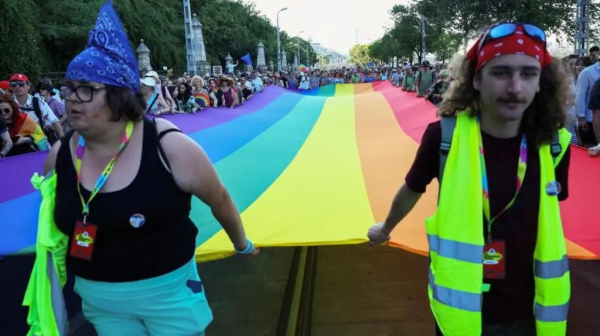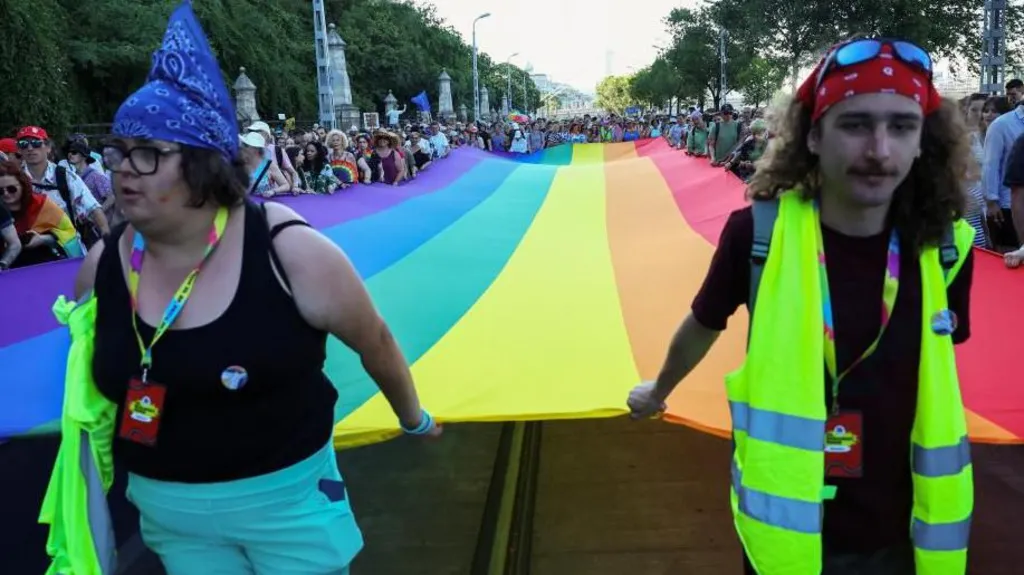
Over a million people petitioned Europe to ban conversion therapy. It just rejected the call.

Read more at LGBTQ Nation.

The European Union rejected a call to ban conversion therapy on Wednesday, even after over a million people petitioned for the ban in its 27 member states.

Last month, the European Parliament voted in favor of a ban on conversion therapy. The vote came after the European Citizens’ Initiative petitioned the European Parliament to take up the matter after 1.2 million people signed a petition.

The matter was then sent to the European Commission, the only body that can introduce binding legislation in the EU. But the European Commission has rejected the call, saying that the EU does not have the authority to force member states to ban the harmful practice.

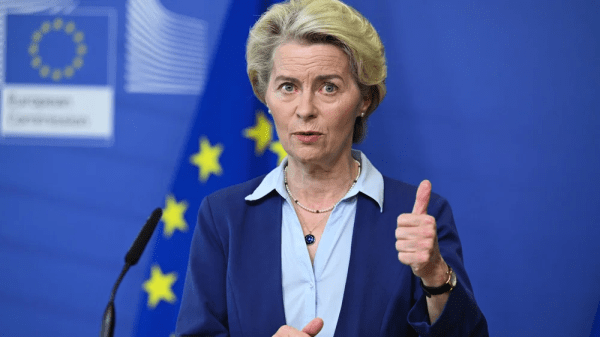
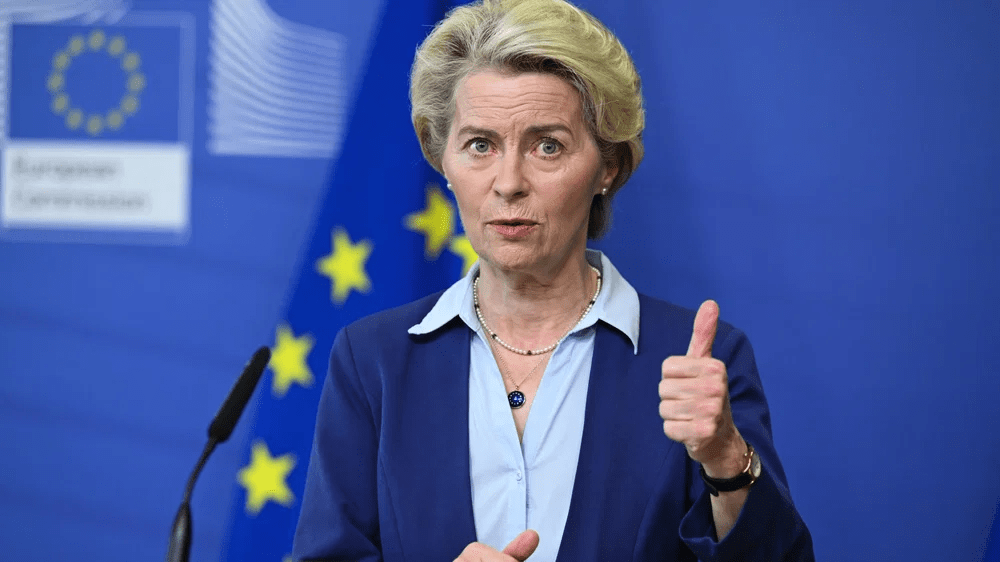
European Commission President Ursula von der Leyen said that conversion therapy has “no place in our union” and that the EU will push each individual member state to ban the practice in a recommendation to be published next year. That recommendation will be non-binding.

The European Commission flew the rainbow flag outside its headquarters in Brussels, Belgium, yesterday, Le Monde reports.

The EU’s Agency for Fundamental Rights said in 2024 that one in four LGBTQ+ European citizens is the victim of conversion therapy practices, which have been linked to depression, low self-esteem, substance abuse issues, anxiety, suicidality, and other mental health issues. Ten of the 27 EU member states already ban the practice.

The group Against Conversion Therapy, which launched the original petition, called the decision a “missed opportunity” in a statement.

“In an international political context where the rise of reactionary ideas is affecting the entire world, it is urgent the European Union acts,” the group said.

European Commissioner for Equality Hadja Lahbib hailed the decision to encourage member states to ban the practice as “historic,” the LA Times reports.

“Conversion practices are built on a lie, the lie that LGBTQ+ people need to be fixed, that there is something wrong with who they are,” Lahbib said after listening to victim testimony. “And there is, of course, nothing to fix, there is nothing to cure, and there is no one to change.”

“You cannot torture away a person’s identity, and you cannot legislate it away. And yet these practices continue, unfortunately.”

Last month, the European Economic and Social Committee (EESC) held a debate on conversion therapy before it voted to recommend that Europe ban the practice.

“These so-called conversion practices or therapies are not only harmful, they are a profound violation of human dignity and fundamental rights,” said EESC President Séamus Boland during the debate, according to an EESC release. “Let us be absolutely clear: there is nothing to fix or cure. What needs to change is not people, but the systems, attitudes, and structures that deny them their dignity.”

Graeme Reid, the United Nations independent expert on sexual orientation and gender identity, also spoke during the debate, saying that banning conversion therapy is key to the EU meeting its human rights obligations and that “every person has the right to live free from coercion, fear and shame.”

The United Nations has called for conversion therapy to be banned worldwide. Last month, the U.S. Supreme Court ruled that conversion therapy practices are protected by the First Amendment and can only be banned if states can meet the high legal requirements involved in curtailing religious free exercise.

Brussels is set to celebrate Pride this weekend.
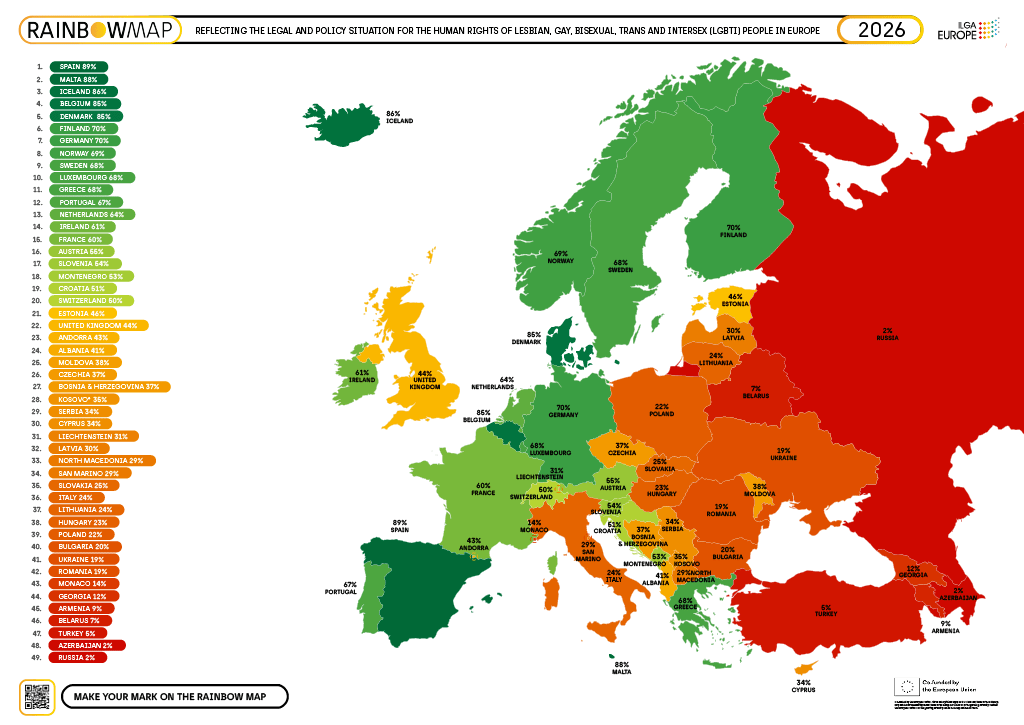
Spain replaces Malta as #1 for LGBTQ rights in Europe

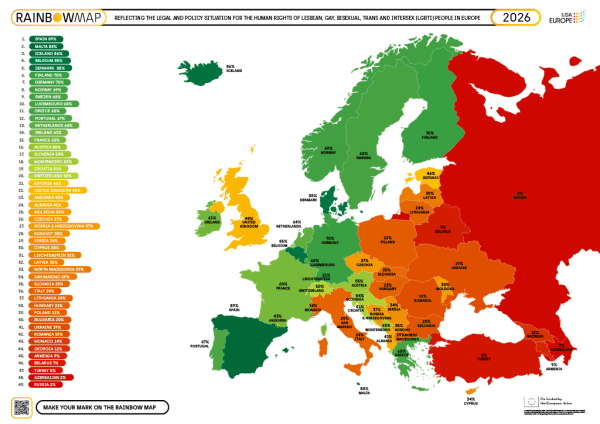
The ILGA Rainbow Map for 2026 was just released. Spain jumps ahead of Malta for the first time in a decade to lead Europe in LGBTQ legal rights. You can check out the map here and see the rankings below.

  1. Spain 89%
  2. Malta 88%
  3. Iceland 86%
  4. Belgium 85%
  5. Denmark 85%
  6. Finland  70%
  7. Germany 70%
  8. Norway 69%
  9. Sweden 68%
  10. Luxembourg 68%
  11. Greece  68%
  12. Portugal 67%
  13. Netherlands 64%
  14. Ireland 61%
  15. France 60%
  16. Austria  55%
  17. Slovenia 54%
  18. Montenegro 53%
  19. Croatia 51%
  20. Switzerland 50%
  21. Estonia  46%
  22. United Kingdom 44%
  23. Andorra 43%
  24. Albania  41%
  25. Moldova 38%
  26. Czechia 37%
  27. Bosnia & Herzegovina 37%
  28. Kosovo 35%
  29. Serbia 34%
  30. Cyprus 34%
  31. Liechtenstein 31%
  32. Latvia 30%
  33. North Macedonia 29%
  34. San Marino 29%
  35. Slovakia 25%
  36. Italy 24%
  37. Lithuania 24%
  38. Hungary 23%
  39. Poland 22%
  40. Bulgaria 20%
  41. Ukraine 19%
  42. Romania 19%
  43. Monaco 14%
  44. Georgia 12%
  45. Armenia 9%
  46. Belarus  7%
  47. Turkey 5%
  48. Azerbaijan 2%
  49. Russia 2%

Poland’s leader promises to start recognizing foreign same-sex marriages, after EU court ruling

Read more at LGBTQ Nation.

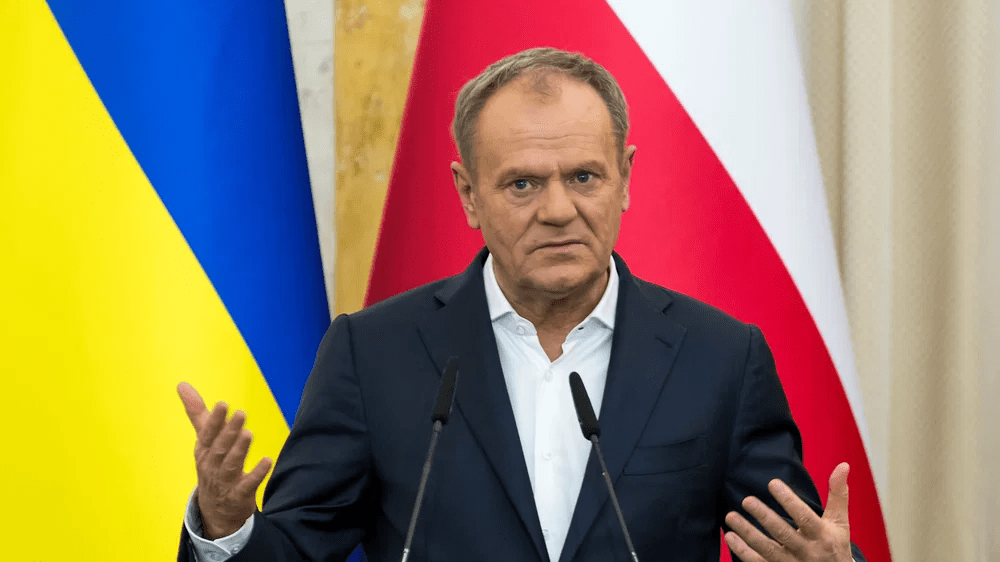
Poland’s Prime Minister Donald Tusk said on Tuesday that his government would quickly work to follow recent court rulings requiring Poland to legally recognize same-sex marriages conducted in other European Union (EU) member nations.

Recent rulings by the Court of Justice of the European Union (CJEU) and Poland’s Supreme Administrative Court (NSA) both require Poland to recognize foreign same-sex marriages, after a married same-sex couple (including a Polish citizen) weren’t allowed to have their 2018 German marriage certificate entered into the Polish civil registry.

The men challenged the denial at the NSA, which then referred the case to the CJEU. The CJEU ruled in November 2025 that the couple’s marriage was valid throughout the EU’s 27-member bloc, and that Poland could recognize their union without also altering its laws to start offering same-sex marriages.

Then, last March, the NSA ordered the government to transcribe the men’s same-sex marriage certificate into the Polish system, resulting in de facto government recognition of a same-sex couple’s marriage in the country; a historic first for Poland.

In comments to the media before a closed cabinet meeting on Tuesday, Tusk apologized for the “years of rejection and humiliation” that same-sex couples have experienced due to Poland not legally recognizing their marriages, Notes from Poland reported.

“[This is] a matter of human dignity: the right to happiness, the right to equal treatment by the state,” Tusk said. “I would like to apologize to all those who, for many, many years, felt rejected and humiliated. For many years, the [Polish] state has failed the test.”

Tusk also said that Poland currently “lacks statutory regulations” that would ensure that same-sex couples receive the same legal and social protections as different-sex couples.

However, he said, “We have committed to – and I will personally ensure this – abiding by the rulings as a priority,” adding that any changes must be conducted in compliance with existing Polish law. He also urged government members “to respect the dignity of every human being” while figuring out and implementing new policies, some of which may require parliamentary or executive approval.

Tusk also said any legal recognition is “no way a path to the possibility of adoption.”

Karolina Gierdal, a lawyer with the Polish LGBTQ+ advocacy organization Lambda Warszawa, told TVP World, “It is sad that the LGBT community is once again presented as a threat, as if society needs reassurance that adoption rights ‘won’t happen.’ The reality is that children are already being raised in same-sex families in Poland, and maintaining the current legal situation means reducing the level of legal protection available to those children.”

Separately, Warsaw Mayor Rafał Trzaskowski, who is a senior figure in Tusk’s Civic Platform party (Platforma Obywatelska, PO), announced that his city would begin legally recognizing foreign same-sex marriages immediately on a municipal level, long before the national government updates its own policies.

Last month, a group of over 100 non-governmental organizations urged Poland to take action to abide by the CJEU and NSA’s rulings. The groups noted that Tusk and his party were elected to power in 2023 on promises to restore Poland’s rule of law, after 10 years of corrupt, anti-democratic rule by the country’s far-right, anti-LGBTQ+ Law and Justice Party.

“Right-wing governments have distorted what we understand by the rule of law, treating it as an empty slogan rather than a real principle of state operation,” the groups wrote. “In a democratic state governed by the rule of law, the government has no authority to decide which judgments merit enforcement.”

So far, 18 countries in the EU offer legalized same-sex marriages, though all member countries are required to legally recognize them, even if they don’t offer them to their own citizens.

While Tusk’s political party promised to work to offer national same-sex civil partnerships, the initiative died due to opposition from Poland’s center-right Polish People’s Party (PSL). A parliamentary coalition considered offering some rights to same-sex couples and unmarried partners instead, but without actually offering civil unions nationwide.

However, neither proposal has come up for a parliamentary vote.

European Parliament adopts measure to ban conversion therapy

Read more at LGBTQ Nation.

The European Parliament voted in favor of a ban on conversion therapy this Wednesday. The demand is now being sent to the European Commission for a response.

The move comes after the European Citizens’ Initiative successfully petitioned the European Parliament to take up the issue. Starting in 2024, the ECI gathered over 1.2 million signatures from EU citizens to ban conversion therapy.

The European Economic and Social Committee (EESC) held a debate on the matter earlier this week, which resulted in the committee adopting two opinions, one calling for stronger enforcement of the EU’s LGBTIQ+ Equality Strategy 2026–2030 and the other calling for a ban on conversion therapy throughout the EU.

While seven member states ban conversion therapy, including France, Portugal, and Spain, speakers at the EESC pointed out that conversion therapy is still practiced in parts of the EU.

“These so-called conversion practices or therapies are not only harmful, they are a profound violation of human dignity and fundamental rights,” said EESC President Séamus Boland during the debate, according to an EESC release. “Let us be absolutely clear: there is nothing to fix or cure. What needs to change is not people, but the systems, attitudes, and structures that deny them their dignity.”

Graeme Reid, the United Nations independent expert on sexual orientation and gender identity, also spoke during the debate, saying that banning conversion therapy is key to the EU meeting its human rights obligations and that “every person has the right to live free from coercion, fear and shame.”

Then, in a vote on Wednesday, the European Parliament adopted an opinion demanding a ban on conversion therapy practices.

The demand will be sent to the European Commission, the only body that can introduce binding legislation, which will then send it back to Parliament.

Unprecedented ruling finds Hungary’s anti-LGBTQ laws in breach of EU values

Read more at BBC.

The European Union’s top court has ruled that Hungarian anti-LGBTQ laws violate EU rules and infringe its values of equality and minority rights.

The laws were brought in by Viktor Orbán’s government in 2021 and banned so-called promotion of homosexuality or gender change to under-18s, arguing it violated child protection laws.

The European Court of Justice ruled that the Orbán reforms breached EU rules on a number of levels, and significantly that it also broke the founding values of Article 2 of the EU Treaty – an unprecedented finding.

The ruling comes nine days after Hungarians voted to end Orbán’s 16-year era of continuous rule.

The ECJ ruled that the Hungarian law interfered with rights such as a ban on discrimination based on sex and sexual orientation, respect for private and family life and freedom of expression and information.

The law also stigmatised and marginalised people who were transgender or not heterosexual and associated them with people convicted of paedophilia, the court found.

The Hungarian law was “contrary to the very identity of the Union as a common legal order in a society in which pluralism prevails”, it ruled.

John Morijn, professor of law and politics in international relations at the University of Groningen in the Netherlands, said the Court’s ruling was historic in its symbolism, in that it meant the rights of a group in society could not be negotiated away.

“You cannot equate what is totally natural – that 10% of the population loves the same sex – with egregious crime,” he told the BBC.

Orbán’s Fidesz party was able to push through the legislation with the help of a supermajority – with control of two-thirds of parliament.

Last year, it passed a further amendment that enabled a ban on public events involving the LGBTQ community such as Budapest’s popular Pride march, which went ahead despite the ban, prompting prosecutors to file charges against Mayor Gergely Karácsony.

The European Commission said the anti-LGBTQ law would be one of the issues it would be taking up with the new government once it was in place.

“It’s up to the… Hungarian government to abide by the ruling and once that is done the issue is solved,” said spokeswoman Paula Pinho.

The man whose Tisza party defeated Orbán on 12 April, Péter Magyar, has not said much about the laws related to Hungary’s LGBTQ community.

However, in his victory speech, he spelt out his vision for Hungary as a country “where no-one is stigmatised for thinking differently than the majority, or loving differently than the majority”.

Magyar has promised to adopt a far more pro-European approach to Hungary’s relations with the EU and it will be the responsibility of his government to reverse the legislation. His Tisza party has a two-thirds majority of 141 seats in the 199-seat National Assembly.

He has also promised to unlock billions of euros in EU funding for Hungary, part of which was blocked because of issues surrounding the rule of law.

Katja Štefanec Gärtner of LGBTQ rights group Ilga-Europe said there was now no excuse for the European Commission not to require Hungary to scrap its law fast.

“If Péter Magyar truly aims to be pro-EU, he must place this at the top of his agenda for his first 100 days in office,” Štefanec Gärtner said.

Prof Morijn told the BBC the ECJ ruling could have wider legal implications regarding other EU member states, as it meant that the Commission could in future go to a member state over the rule of law with a similar warning.

“You are basically violating EU law in such a fundamental way we are not only holding you to account for violating the letter of the law but also violating the spirit of that law, laid down in Article 2, which lists all the values of pluralism, equality and rule of law,” Morijn said.

Romania recognizes man’s gender identity in landmark victory for trans Europeans

Read more at LGBTQ Nation.

After refusing years earlier to acknowledge the gender of a Romanian citizen who transitioned in another European Union (EU) country, Romanian courts ruled on Tuesday that the government must recognize the man’s identity, reported Romanian news outlet Spot.

Advocates say it’s a landmark victory for transgender Europeans.

The case concerned Arian Mirzarafie-Ahi, a transgender man with Romanian and British citizenship. He was born in Romania and moved to the United Kingdom in 2008, where he began his transition several years later. After obtaining legal documentation in the UK in 2020, the Romanian government declined to recognize Mirzarafie-Ahi’s gender identity, citing a disparity with documents he used earlier in Romania.

“This put him in the position of having two sets of documents with two different identities,” said ACCEPT, the Romanian advocacy group that helped shepherd Mirzarafie-Ahi’s case through the courts. In the UK, he was recognized “as a man, in Romania, as a ‘woman’.”

Mirzarafie-Ahi sued, and the Romanian court that heard his case advanced it to the Court of Justice of the European Union (CJEU) to settle the interstate argument. That court said in 2024 that the effect of Romania’s refusal to recognize Mirzarafie-Ahi’s gender identity impeded his freedom of movement among member states and was, effectively, a fundamental form of discrimination.

The court ruled, therefore, that all EU member states are obligated to recognize the identity documents of transgender individuals who have earned legal gender recognition in another EU state. (The UK left the EU in 2020.)

However, Romania, one of the most illiberal members in the EU when it comes to LGBTQ+ rights — it sits at the bottom of ILGA’s EU state rankings — resisted the order, with two different government agencies refusing to recognize Mirzarafie-Ahi’s identity.

Once again, Mirzarafie-Ahi took the Romanian government to court, but this time he won in his home country, with the same Romanian courts that sent his case to the CJEU now bound by its decision.

“Today, March 31, we celebrate Trans Visibility Day, and I am happy to use this opportunity to turn to the people in my community with good news,” Mirzarafie-Ahi said in a statement after his victory. “I have finally won in the courts of Romania! It is not only my victory, but also ours — of those who are still waiting to be seen, heard and recognized.”

Mirzarafie-Ahi’s case mirrors a similar one decide in March in Poland and Germany.

An administrative court in Poland found itself in a nearly identical situation, addressing the marriage of two men who had wed in Berlin years earlier. Government officials in Poland refused to recognize the marriage. That court, too, sent the interstate dispute to the CJEU, which decided in the men’s favor based on their right to freedom of movement throughout the European Union.

Blog at WordPress.com.

Up ↑