

Read more at Euro News.
Is France less safe than Rwanda and Bangladesh? The new World Safety Index has raised questions on security across Europe.
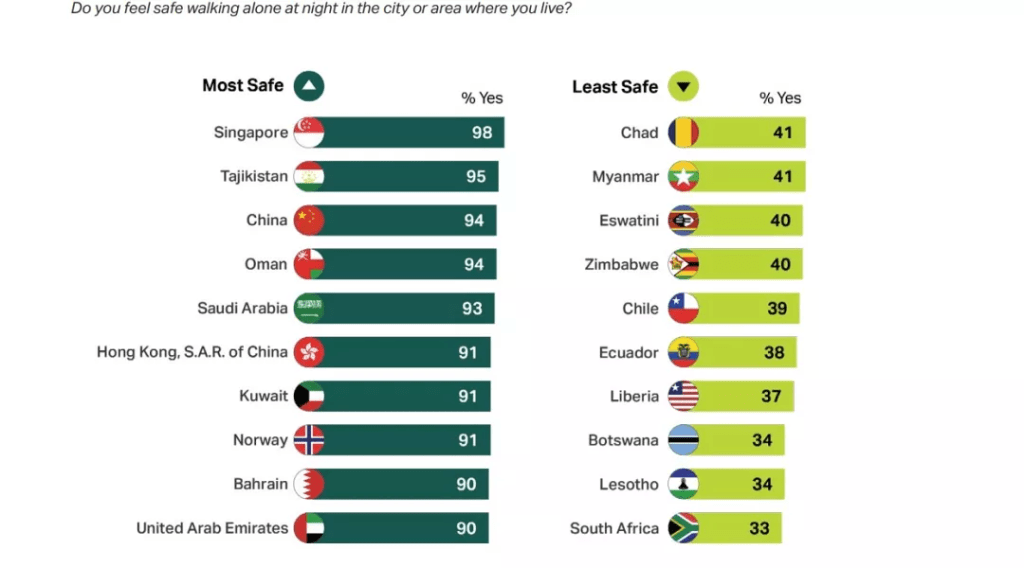
People feel less safe walking alone at night in Italy and France than in dozens of other countries, including Iraq, Rwanda, and Bangladesh, according to a new report.
In fact, the 2025 edition of The Global Safety Report features only one European nation in the top 10 countries with the highest sense of security: Norway (91%).
Denmark and Kosovo, both with 89%, are the second-highest ranking European countries, respectively 11th and 12th worldwide.
Italians feel least safe in Europe, France 56th worldwide
With 60%, the perception of security among Italians is the lowest in Europe, and the 95th in the world, behind war-torn Ukraine (62%), Nicaragua (63%), Mauritania (64%) and Niger (67%).
France, ranked in 56th place with 73%, fared higher than Italy but placed behind similar European economies such as Spain (81%), Germany (78%) and the UK (76%), as well as non-European nations like Egypt (82%), Bangladesh (74%) and Belize (74%).
The Gallup report surveyed 145,170 adults aged 15 and older across 144 countries and territories.
How does Europe compare to the rest of the world?
Globally, 73% of adults worldwide said they feel safe walking alone at night in the city or area where they live.
It’s the highest level on Gallup’s record (which began in 2006) and a 13% increase over the past decade.
“The paradox is striking,” the researchers said in the report. “We are living through more armed conflicts than at any time since the Second World War. And yet, Gallup finds that more people than ever say they feel safe in their communities.”
The world region with the highest sense of security is Asia-Pacific (79%).
Western Europe follows in second place (77%), ahead of the Middle East and North Africa (74%).
Security perception: Post-Soviet Europe nearly overtakes America
With a 34-point jump over the past two decades, the former Soviet bloc has experienced the greatest growth in safety perceptions across all macroregions, reaching 71%.
If the trend continues, the former USSR countries — Russia excluded — could surpass North America, which now stands at 72%.
Along with sub-Saharan Africa, North America has been the only world region to see a decline in security perception since 2006 (-4%).
Overall, the region where people feel the least safe globally is Latin America and the Caribbean (50%).
Gender gap: Many more women feel unsafe than men
The Gallup report also highlights a stark gender gap: 32% of women, globally, claim they don’t feel safe compared to 21% of men.
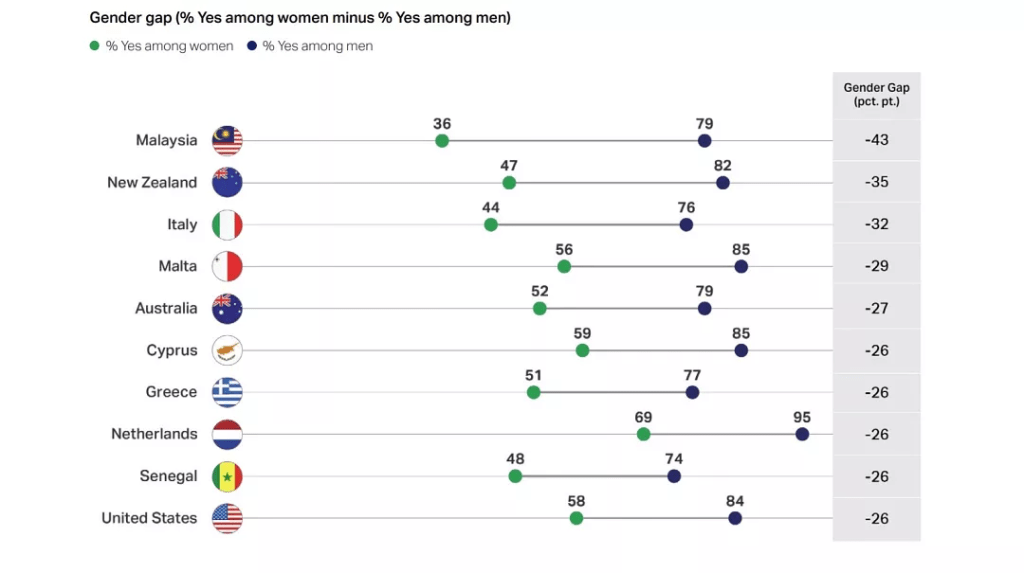
Five of the world’s 10 countries with the highest gender gap in this sense are EU member states.
Again, Italy’s performance here is the worst in Europe, with a 32-point gap between the security perception of Italian men versus that of Italian women — 76% of men feel safe walking alone at night versus 44% of women.
The report says that “56% of intentional homicides where the victim is a woman or girl are perpetrated by an intimate partner or family member, compared to 11% when the victim is male.”
“While men are more likely to be victims of lethal violence in public, rates of reported non-lethal violence are much closer between genders,” it adds.
Perception vs reality: Which countrie see themselves better — or worse — than they really are?
A low sense of safety doesn’t always mean a country is actually unsafe and vice versa.
The Global Peace Index — which factors in Gallup’s safety perception along with other, more pragmatic data like homicide rates, violent crime, access to firearms, terrorism and political instability — often paints a more nuanced picture.
Across Europe, many nations turn out to be safer than they think.
Germany, for instance, ranks 20th worldwide in the Global Peace Index, yet only 34th when it comes to their citizens’ perception.
Italians and Brits also seem to underestimate their safety levels, with a gap of 62 and 15 positions, respectively, between perception and estimated reality.
France, on the other hand, tends to perceive itself as more secure than it might be — ranking 56th by its own perception but 74th in the Global Peace Index.
Still, it remains more secure than several non-European nations, including the aforementioned Rwanda (91st) and Bangladesh (123rd).
Spain seems to have a more grounded perception of reality. The country placed 25th in the Global Peace Index and 29th in Gallup’s safety perception table.

 fleeredstates.blog
You must be logged in to post a comment.