LGBTQ+ adults are not okay & red states could pay a financial price

*This was originally published on LGBTQNation.

With increasing attacks on LGBTQ+ rights over the past few years, it is no surprise that LGBTQ+ adults are struggling with their mental health. A new study from the Human Rights Campaign (HRC) Foundation details how these struggles can adversely affect state economies and serves to remind lawmakers that when LGBTQ+ people suffer, the country follows.

In the HRC Foundation’s 2024 LGBTQ+ Climate Survey, 71.5% of adults reported that anti-LGBTQ+ legislation has negatively impacted their health or well-being in the past year.

44.3% of LGBTQ+ adults and 63.5% of trans adults also said anti-LGBTQ+ legislation has harmed their mental health or the mental health of their loved ones, and 66.1% of LGBTQ+ adults, along with 83.4% of trans adults, said anti-LGBTQ+ legislation has made them feel less safe.

The report found that as a result of these fears, one in five LGBTQ+ adults are considering moving to a new state and one in 20 are trying to change jobs. Half of LGBTQ+ adults said anti-LGBTQ+ legislation has already impacted their choices of where to live and work in the last year, and one in five said they’ve refused a job or home in states with anti-LGBTQ+ legislation. 4% say they have already left their state or have taken steps to leave, and one in 20 are trying to change jobs due to anti-LGBTQ+ legislation.

“It is mentally exhausting to live in a state where the legislature and governor bully communities of color and LGBTQ+ communities,” said one cisgender lesbian woman who participated in the study. “It takes a toll. We will be moving from this state.”

A gender-questioning person from New York added, “I purposely turned down a dream job in a state where these laws were passed. Also, the laws affect my work, as I am a physician and cannot practice the full spectrum medicine I would like to.”

One cis queer woman stated that the laws “have radically impacted my queer & trans household” and that they are “actively shopping to relocate to MI or ME, leaving behind a business, a gorgeous home & property, a high-income career, and a non-profit we run in the queer community.”

Shoshana Goldberg, public education and research program director at the HRC Foundation, told The Advocate that this will no doubt hurt the economics of the states and businesses being abandoned.

“I think states stand to lose economically by continuing to support these laws. They risk losing the tourism and business travel dollars, such as those from the 30 percent of LGBTQ+ adults, in the last year alone, who have avoided, canceled, and/or refused to travel to states with anti-LGBTQ+ legislation,” she says. “They risk losing the taxable income from LGBTQ+ adults, and families of LGBTQ+ youth, who are looking to move to a new state where they and their children can live openly and freely … and companies headquartered in these states risk losing customers.”

She added, “The LGBTQ+ Community holds $1.4 trillion in purchasing power, and unsupportive companies stand to lose us as customers — as well as lose allies, particularly Millennials and Gen Z, who data shows are looking to spend their money on those companies that support their values of equality.”

She also warned that companies who halt DEI practices risk not only losing customers but also top talent.
Study: LGBTQ youth, family relocate amid increasing anxiety over laws directed at them

*This was published on USA Today

More than a quarter million LGBTQ+ young people and family members in the U.S. have relocated to other states because of LGBTQ+-related politics or laws, according to estimates outlined in a new report exploring the population’s response to hostile policy environments.

According to the brief compiled by The Trevor Project and Movement Advancement Project, 9 in 10 LGBTQ+ young people say politics have impacted their well-being, while 4 in 10 say they’ve thought about moving to another state because of unfriendly LGBTQ+ politics or laws at home.

The portion was even higher for transgender and nonbinary youth, 94% of whom said politics had affected their well-being and nearly half (45%) who said they’d considered relocating.

“For many LGBTQ+ young people in the U.S., the steady stream of anti-LGBTQ+ news may feel overwhelming right now,” said Steven Hobaica, a research scientist for the Trevor Project, a national LGBTQ+ youth advocacy group focused on suicide prevention. “It’s heartbreaking to see that nearly half of transgender and nonbinary youth have considered moving due to anti-LGBTQ+ policies.”

While just 4% of LGBTQ+ young people ages 13 to 24 reported uprooting because of anti-LGBTQ+ policies, that translates to roughly 266,000 young people and family members based on LGBTQ+ youth population estimates, the groups said.

Trump administration presents new threats

The report comes as President Donald Trump returns to the White House after making gender identity issues a focal point of his campaign. On Monday, after being sworn in, Trump issued a spate of executive orders that included seeking to remove legal protections for transgender people in federal spaces, laying the groundwork to potentially bar transgender individuals from military service and declaring that the U.S. government will only recognize two sexes, male and female.

“No matter a person’s political beliefs, we know, from our research and from what LGBTQ+ young people tell us, that policies like these take a damaging toll on LGBTQ+ young people’s mental health,” said Janson Wu, The Trevor Project’s senior director of state advocacy and government affairs. 

The organization said its crisis services saw a 33% increase on Inauguration Day compared to typical volume. But that still paled, it noted, to the sevenfold increase in crisis services experienced the day after the 2024 election.

“No matter your political beliefs or how you feel about the current administration, one thing must be made clear to all of us living in the United States: Real young people’s lives are at risk,” said Trevor Project CEO Jaymes Black.

Recent years have already seen increasing numbers of state laws and proposed legislation targeting the LGBTQ+ community, especially measures aimed at curbing the rights of transgender youth.

“It’s critical that we not only call attention to the negative impact of these divisive political attacks but also highlight that this research supports the idea that more inclusive policy environments lead to better outcomes for LGBTQ young people across a range of measures,” said Logan Casey, director of policy research for Movement Advancement Project.

Hostile climates raise mental, emotional health risk

The organizations said they compiled the report given a lack of research into how LGBTQ+ young people respond to hostile policy environments, despite studies showing that those youths experience greater mental health challenges and higher suicide risk in such environments.

“By gaining more knowledge of how LGBTQ+ young people respond to their policy environment, advocates and policymakers can create or modify policy to better support LGBTQ+ young people and their families,” the report said.

Their joint report is based on data gleaned from The Trevor Project’s 2024 U.S. National Survey on the Mental Health of LGBTQ+ Young People, which collected responses from more than 18,600 LGBTQ+ individuals between the ages of 13 and 24. It also incorporates data from Movement Advancement Project, a Boulder, Colorado-based group that tracks LGBTQ+-related laws and policies throughout the U.S. and its territories and assigns each a negative or positive policy index.

More than a quarter (27%) of respondents lived in states with negative policy indexes, the report said. Those individuals were more likely than their counterparts to consider moving to other states and also likelier to travel to other states to receive health care.

The report noted that not all LGBTQ+ young people and their families desiring to relocate have the resources to do so.

“Notably, the same factors that might preclude the ability of LGBTQ+ young people and their families from moving, such as poverty, housing discrimination, and employment access, are the same ones that disproportionately affect LGBTQ+ people of color and increase their risk of mental health and suicide,” the report said.

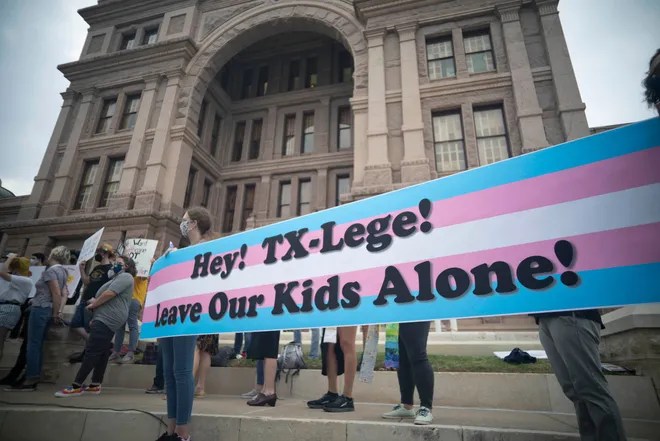
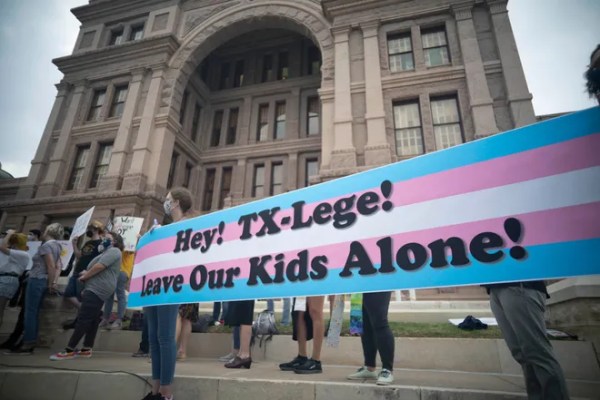
Bob Daemmrich, USA TODAY NETWORK

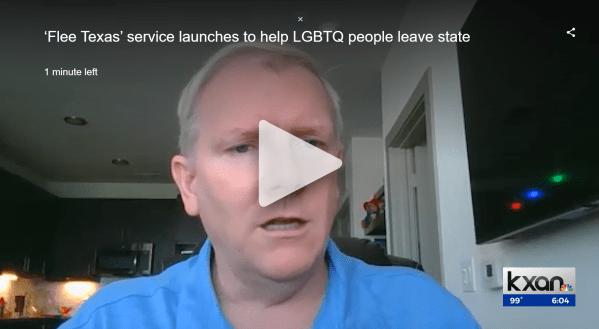
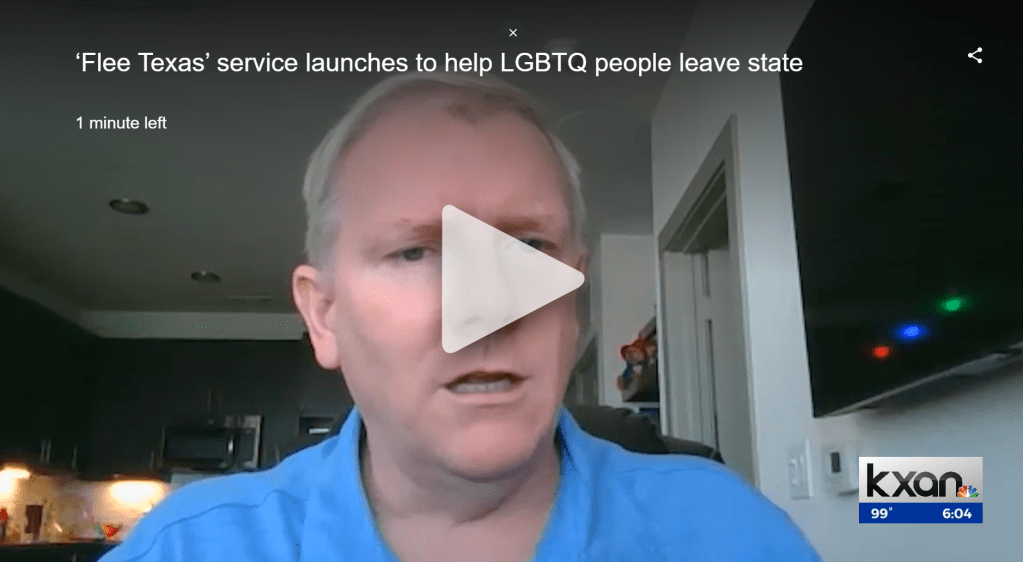
‘Flee Texas’ service launches to help LGBTQ people leave state

This blog originally appeared at Kxan In-Depth Investigative.

This blog originally appeared at

by: Will DuPree– KXAN
Posted: Aug 8, 2022 / 04:24 PM CDT
Updated: Aug 11, 2022 / 04:33 PM CDT

AUSTIN (KXAN) — A for sale sign went up recently in front of the house that Lauren Rodriguez called her dream home. Even though she only moved in two years ago, her plan now is to sell it so that she and her family can not only leave the Austin area, but the country entirely.

woman stands next to her son in graduation regalia
Lauren Rodriguez posts next to her 18-year-old son Greyson at his high school graduation last year. (Courtesy Lauren Rodriguez)

“We’re definitely not staying in Texas,” Rodriguez said. “The goal is to hopefully leave the country, but I have to see if we can get that worked out. If not, we’ll try to go to a safer state, but it makes me nervous because I don’t know how long a state will be safe for.”

She credits the political climate in Texas and restrictions pursued by the state legislature related to the transgender community for cementing her decision to seek a life outside the U.S. She and her 18-year-old transgender son Greyson spent the 2019 and 2021 legislative sessions going to the Capitol multiple times to testify against bills like the one that ultimately passed last year requiring Texas public school athletes to play sports based on their biological sex at birth. At least 18 states have now approved legislation banning trans athletes from participating in sports, according to the LGBTQ advocacy organization Athlete Ally.

Flee Texas service

After hearing stories similar to Rodriguez’s, Bob McCranie, a gay Dallas-based realtor, created a new real estate service online called Flee Texas to help LGBTQ Texans. The website reads, “If you feel the need to leave the jurisdiction of Texas, let us help you sell your property here and connect you with an LGBTQIA or ally agent in a better location of your choice.”
“Almost every LGBTQ person I’m having dinner with or talking to or whatever has in the back of their mind, ‘What’s my plan B? How do I get out of here?’” McCranie said. “This is turning, and some of the people are responding, ‘Well, we should all just stay in fight.’ A lot of us have fought for — for me, 17 years. It’s just everybody’s thinking about, ‘Where do I go next?’”

Since the Flee Texas website went live, McCranie said it’s gotten at least 500 hits a month. However, no homes have been sold yet through this effort. He admits it’s perhaps too early for that now, but he said the upcoming legislative session or future Supreme Court cases may lead some to seek out assistance to find a new place to call home.

People recently expressed concerns about how the high court’s conservative majority might eventually rule on LGBTQ rights based on a separate opinion that Justice Clarence Thomas wrote in support of the reversal of Roe v. Wade. According to our news partners at The Hill, he called for the overturning of previous decisions based on that same precedent that created protections for access to contraception, same-sex intimacy and marriage equality.

“I’m an ambassador for Texas. I’m an ambassador for our cities to say, ‘Here’s a great place where you can live near parks, near whatever. Here’s a great house. Here’s all the excitement about being here,’” McCranie said. “I now have to shift that into: all this great stuff is tainted by the idea that you won’t be equal here. You may actually be threatened here, and your children may actually be taken away from you.”

Blog at WordPress.com.

Up ↑