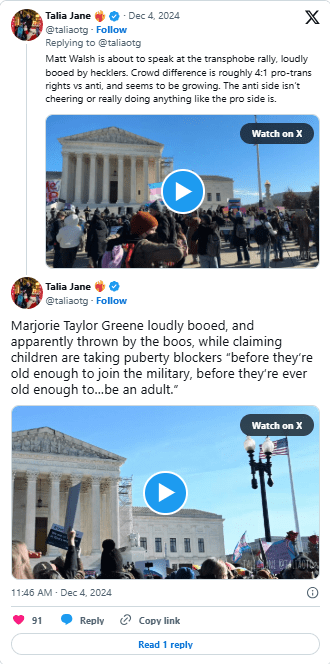
She argued that transgender youth should be denied medical care, claiming, “God created male and female in His image.” However, the crowd reacted with clear disapproval.
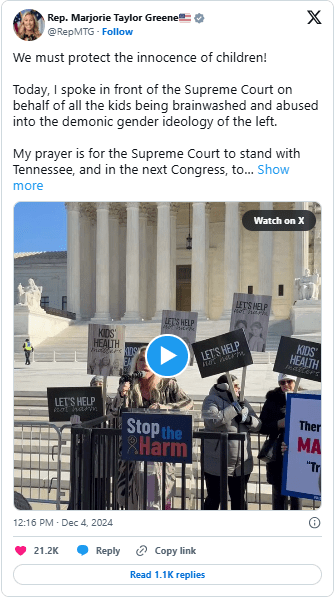
Rep. Marjorie Taylor Greene (R-GA), a leading voice against transgender rights in the U.S., delivered a speech yesterday in front of the Supreme Court as oral arguments were underway regarding Tennessee’s ban on gender-affirming care.
Her remarks were met with resounding boos from the crowd.
A viral video captures Marjorie Taylor Greene passionately condemning gender-affirming care for trans youth, claiming it involves a “…chemical castration pill to destroy their bodies before they’re ever old enough to vote…” The crowd’s boos grew so loud that much of her speech was drowned out.
Greene shared the full video of her speech on X, where she began by declaring, “God created male and female, in His image, He created us,” emphasizing that her opposition to trans rights is rooted in her religious beliefs rather than concerns about children’s health.
The boos from the crowd were audible in her video as well, and she addressed them directly.
“What you’re hearing is the outcry from the demons and those that worship evil, who are abusing our children, brainwashing our children to believe the lies that come directly from Satan!” she proclaimed as the crowd continued to jeer.
Undeterred, Greene returned to her prepared remarks, touting her federal bill to ban gender-affirming care and highlighting its support from figures like Donald Trump and J.D. Vance.
Yesterday, the Supreme Court heard oral arguments in a case challenging Tennessee’s ban on gender-affirming care for transgender youth. The law, which has been contested by several trans families, is argued to be unconstitutionally sexist. Plaintiffs claim it discriminates by allowing some individuals to access specific medical treatments while denying them to others based solely on their sex assigned at birth.
Outside the courthouse, both pro- and anti-trans protestors gathered. According to The New Republic, the pro-trans contingent significantly outnumbered their opponents, with approximately four times as many supporters advocating for transgender rights.
The Supreme Court has adjourned early, bringing an end to the oral argument session. A ruling in the case of US v. Skrmetti is expected to be issued by June 2025.
Tennessee Attorney Compares Trans Care to Lobotomies
Tennessee’s Solicitor General, Matthew Rice, in response to a question from Justice Brett Kavanaugh about why laws regulating gender-affirming care shouldn’t be left to the states, compared gender-affirming care to the discredited medical practice of lobotomies—removing part of the brain to treat mental illnesses.
He falsely claimed that lobotomies were widely supported by the medical community in the early 1900s, suggesting that gender-affirming care should be regulated in a similar manner. However, as Alejandra Caraballo, an attorney and instructor at Harvard Law CyberLaw Clinic, points out on BlueSky, leading medical organizations at the time opposed lobotomies, making Rice’s comparison highly inaccurate.
Sotomayor Asks How Banning Gender-Affirming Care Protects the Public
Justice Sonia Sotomayor questions how Tennessee Solicitor General Matthew Rice’s claims about banning gender-affirming care protect the public, emphasizing that “when you’re 1% of the population, it’s very hard to see how the democratic process will protect you.”
The Court’s decision could have broader implications, potentially affecting gender-affirming care for adults as well. If the Court accepts Tennessee’s argument about the possible medical risks, this reasoning could be used in future cases to restrict all forms of care.
Justice Amy Coney Barrett asks how Rice’s policies would apply to issues like bathrooms or sports. Rice attempts to distinguish transgender-based challenges from sex-based challenges, arguing that this case is about the medical risks of transgender healthcare, while bathroom and sports cases focus on gender rights and equity. However, he provides minimal rationale for how this distinction would work.
Justice Ketanji Brown Jackson raises concerns about how the gender-affirming care ban mirrors past racist laws, noting that both seek to deny access to public services based on personal characteristics.
Rice tries to differentiate gender-affirming treatments like hormone replacement therapy and puberty blockers, arguing that the medical justification differs when these treatments are administered to transgender children versus cisgender ones. Jackson counters, pointing out that the treatments affect the body similarly, and suggests that Rice is contradicting his own argument about the dangers of these treatments by claiming they have different effects based on gender identity.
Tennessee’s Lawyer Begins Arguments Against Gender-Affirming Care and Immediately Confuses Everyone
Tennessee Solicitor General Matthew Rice takes the floor, arguing in favor of restricting gender-affirming care and allowing Tennessee’s ban to take effect. He asserts that gender-affirming care for minors offers no benefits, a position that contradicts the views of leading medical organizations such as the Endocrine Society, the American Academy of Pediatrics, and the American Psychological Association.
Justice Sonia Sotomayor challenges this, noting that “every medical treatment has risks, even Aspirin,” and emphasizing that there is no valid reason to restrict gender-affirming care on those grounds. She also points out that halting the development of sex-based characteristics is inherently sex-based and therefore discriminatory. Justice Ketanji Brown Jackson echoes this argument, pushing back against Rice’s claims that the issue is not sex-based, highlighting that attempting to restrict breast growth, for example, is inherently sex-based.
The Court’s confusion deepens when Rice argues that boys with gynecomastia—a condition causing enlarged breast tissue—who take puberty blockers lack a “medical purpose” for doing so, further muddling his argument and drawing continued pushback from the Justices.
“6th Circuit Got It Wrong,” Strangio Says, Citing Flawed Reasoning for Upholding Health Care Ban
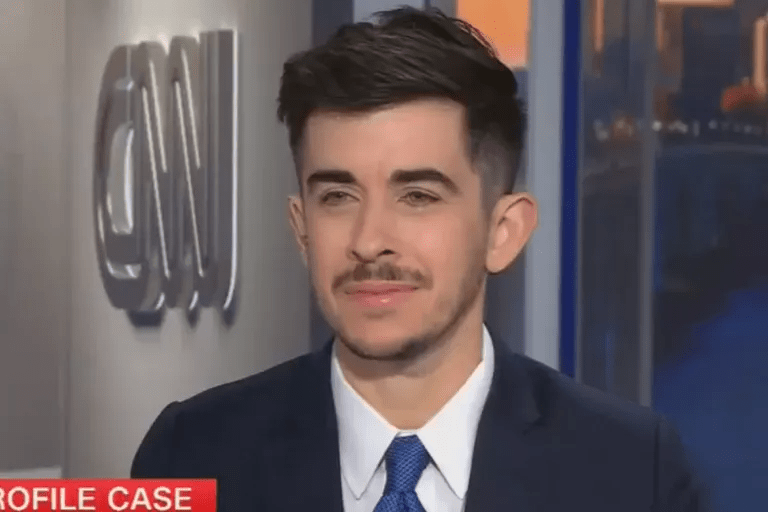
ACLU attorney Chase Strangio argues that the 6th Circuit Court of Appeals “got it wrong” in reinstating Tennessee’s S.B. 1 ban on gender-affirming care, asserting that the court incorrectly applied rational basis review to the case. He argues that intermediate scrutiny should have been applied instead.
Rational basis review is a type of judicial review used to assess whether governments are acting in accordance with regulations. In contrast, intermediate scrutiny involves a more rigorous constitutional review to determine if a legal action aligns with the U.S. Constitution, specifically the Equal Protection Clause of the 14th Amendment, which prohibits sex-based discrimination.
In response to Justice Amy Coney Barrett, Strangio also emphasizes that these issues are deeply intertwined with advocacy for gay rights, referencing historical bans on cross-dressing and transgender people entering the military—issues that have also impacted gay individuals.
Strangio further addressed Justice Brett Kavanaugh’s attempt to shift the discussion to transgender people in sports, briefly arguing that anti-discrimination measures could be used to support the inclusion of trans women athletes, while clarifying that this is not the central focus of the current case.
Justice Samuel Alito questioned ACLU lawyer Chase Strangio, asking whether gender identity is immutable, citing detransitioners and gender fluidity as reasons to suggest it might not be. Strangio responded by emphasizing that there is strong evidence supporting the idea that the underlying basis of gender is immutable. He explained that while individuals may experience changes in their conception of their gender identity, their gender itself is not something that can be willingly altered. What remains constant, he said, is that their gender is different from the sex assigned at birth.
Alito then compared trans people to individuals with schizophrenia, suggesting that both could have different treatments. Strangio rejected this comparison, arguing that these are fundamentally different issues. He clarified that, regardless of any variations in how trans people experience their identities, being trans is an immutable status that does not shift in the same way mental illnesses do.
Chase Strangio Draws from Court’s Role in Pandemic Regulations & Says Transition Regret is Rare
ACLU lawyer Chase Strangio drew parallels between the Court’s involvement in pandemic regulations and its role in evaluating gender-affirming care, emphasizing that the Court should respect expert medical opinions in both contexts. He also addressed concerns about transition regret, pointing out that it is rare and that the overwhelming majority of individuals who pursue gender-affirming care report positive outcomes. Strangio argued that this underscores the importance of allowing access to such care, as it is supported by medical evidence and expertise. ACLU lawyer Chase Strangio, the first openly trans person to argue before the Supreme Court, drew from the Court’s role in regulating public health during the COVID-19 pandemic to argue against Tennessee’s S.B. 1, asserting that SCOTUS should rule against the ban in the interest of the common good. He used the same rationale the Court applied in reviewing public health policies during the pandemic to advocate for the preservation of gender-affirming care.
Strangio also addressed claims about high regret and detransition rates, arguing that such figures are often misrepresented to serve a particular agenda. He referenced the ACLU’s reply brief submitted to SCOTUS, which details the organization’s response to these mischaracterizations.
In response to questioning from Justice Alito, Strangio maintained that gender-affirming care for minors is life-saving, noting that it significantly reduces the risk of suicide. He also pointed out that, contrary to claims in the Cass Review, numerous studies show improved mental health outcomes for transgender individuals following gender-affirming care.
Justice Ketanji Brown Jackson argued that the ban on gender-affirming care is discriminatory, highlighting how it targets a specific group based on their gender identity. She pointed out that such policies are a direct violation of equal protection principles.
ACLU lawyer Chase Strangio then spoke, making history as one of the leading voices in the case. Strangio reiterated the importance of respecting expert medical opinions and legal protections for transgender individuals, advocating for the right to gender-affirming care. His powerful arguments further cemented his role in the ongoing fight for transgender rights.
In response to a line of questioning from Justices Elena Kagan and Amy Coney Barrett, Justice Ketanji Brown Jackson illustrates how denying transgender people medical care is discriminatory, highlighting that such care is often granted to cisgender individuals. Jackson compares these discriminatory policies to those implemented in the 1950s and 1960s on the basis of race, referencing Loving v. Virginia, which overturned bans on interracial marriage.
U.S. Solicitor General Elizabeth Prelogar echoes this argument, drawing parallels between the logic used in Loving and the current case.
Shortly thereafter, Chase Strangio, the first openly trans lawyer to speak before the Supreme Court, argues in favor of overturning S.B. 1. Strangio, representing the American Civil Liberties Union and the plaintiffs, responds to Justice Clarence Thomas’s question about his proposed solution, stating that he would want to ensure gender-affirming care for minors is authorized, particularly for his plaintiffs.
Kavanaugh Presses Lawyer on Constitutionality & Veers into Asking About Sports
Justice Brett Kavanaugh presses ACLU lawyer Chase Strangio on the constitutionality of gender-affirming care bans, questioning whether such regulations are in line with constitutional protections. Kavanaugh’s line of questioning shifts when he asks about the implications for transgender athletes in sports, seeking to understand how anti-discrimination measures in this case could apply to sports-related issues. Strangio responds, emphasizing that while the inclusion of trans athletes is an important issue, it is distinct from the core question at hand, which focuses on the legality and necessity of gender-affirming care.
Supreme Court Justice Brett Kavanaugh asks U.S. Solicitor General Elizabeth Prelogar why SCOTUS should apply intermediate scrutiny (a type of judicial review to assess constitutionality) to Tennessee’s S.B. 1. Prelogar argues that by imposing restrictions based on assigned sex at birth, the law violates the Equal Protection Clause of the Constitution, which inherently calls for additional scrutiny.
Kavanaugh then shifts to a separate line of questioning, bringing up the issue of trans women in women’s sports. This leads Prelogar to admit that she believes there should be restrictions on trans women in sports. However, she tries to pivot back to arguing that such restrictions on gender-affirming care should not be in place.
Research indicates that trans women do not have an inherent advantage in sports after transitioning for the prescribed amount of time. Studies have shown their performance to be on par with cisgender women, and there is no evidence of trans women disproportionately dominating women’s sports.
Fertility Issues Don’t Just Affect Trans People, But Intersex People Too, Lawyer Argues at SCOTUS
During arguments at the Supreme Court, a lawyer emphasized that fertility issues are not exclusive to transgender individuals but also affect intersex people. The lawyer argued that restrictions on gender-affirming care could have broader implications, including for intersex individuals who may face similar challenges in accessing reproductive healthcare. This point was raised to highlight the intersection of medical and legal issues affecting both trans and intersex communities.
In response to a line of questioning from Supreme Court Justice Brett Kavanaugh about how gender-affirming care could impact fertility—one of the arguments for banning such care being that trans kids might face fertility issues later in life—U.S. Solicitor General Elizabeth Prelogar argues that while fertility issues are indeed a concern in transgender care, they are not unique to trans individuals. Prelogar points out that there are solutions available for these issues, which are also found in treatments allowed under S.B. 1, such as invasive surgeries on intersex infants.
Intersex individuals, whose genitalia do not align with typical male or female expectations, are often subjected to invasive surgeries in infancy, which can permanently restrict their ability to have children due to forced conformity to societal norms. Despite these concerns, many anti-transgender policies, including S.B. 1, allow for gender-affirming care for intersex minors, even though advocates call for restrictions on mandatory conforming surgeries and treatments.
Additionally, many intersex individuals identify as transgender, linking these issues inextricably in discussions about gender-affirming care and reproductive rights.
Sam Alito Brings Up Restrictions on Women’s Rights to Oppose Trans Care
Justice Samuel Alito raised concerns about restrictions on women’s rights while arguing against the case for gender-affirming care. He suggested that limiting certain aspects of gender-affirming care could be justified by broader discussions around women’s rights. In his questioning, Alito implied that policies restricting transgender care could be seen as part of a larger debate about the rights of women, sparking further discussions about the intersection of gender, rights, and healthcare.
Supreme Court Justice Samuel Alito argued that previous SCOTUS rulings, particularly Dobbs v. Jackson Women’s Health Organization (which overturned Roe v. Wade) and Geduldig v. Aiello (which allowed the denial of insurance benefits for work loss due to pregnancy), do not support the claim that Tennessee’s S.B. 1 constitutes sex-based discrimination. He pointed out that both rulings suggested that restrictions on pregnancy-related insurance coverage and abortion do not qualify as sex-based discrimination.
U.S. Solicitor General Elizabeth Prelogar countered, asserting that neither of these rulings applies to the current case. She argued that the previous decisions refer to more individualized healthcare concerns, which are unrelated to the broader, sex-based characteristics addressed by hormone replacement therapy and puberty blockers. These treatments, Prelogar emphasized, are inherently sex-based and therefore should not be governed by the same arguments made in those earlier rulings.
Justice Sonia Sotomayor joined the conversation, echoing Prelogar’s points that the issue at hand is fundamentally about sex classification. She also reiterated her criticisms of the Cass Review and responded to Alito’s claims about European countries restricting care, pointing out the inaccuracies in those statements. Sotomayor pressed for further clarity, helping to illuminate key aspects of Prelogar’s arguments.
U.S. Solicitor General States Her Case as Conservative Justices Bring Up Cass Review
U.S. Solicitor General Elizabeth Prelogar presented her case before the Supreme Court, defending the constitutionality of gender-affirming care and challenging the restrictions posed by Tennessee’s S.B. 1. As she argued, conservative justices, including Justices Samuel Alito and Brett Kavanaugh, raised concerns about the findings in the Cass Review, which suggests that gender-affirming care for minors may lead to negative psychological and medical outcomes.
Prelogar countered these claims by stressing that the Cass Review’s conclusions are not representative of the broader medical consensus. She pointed out that numerous studies and expert medical organizations, including the American Medical Association and the American Academy of Pediatrics, strongly support gender-affirming care as effective and essential for the well-being of transgender minors.
Her responses focused on the scientific evidence and medical expertise backing gender-affirming care, challenging the use of the Cass Review as a central argument for limiting such care.
U.S. Solicitor General Elizabeth Prelogar began outlining her case that Tennessee’s S.B. 1 constitutes discrimination based on biological sex. She argued that because testosterone and estrogen affect individuals differently depending on whether they were assigned male or female at birth, and because these medications vary based on assigned sex, the restriction of gender-affirming care amounts to sex-based discrimination.
Supreme Court Justices Clarence Thomas, Samuel Alito, and Chief Justice John Roberts then began their questioning. Alito referenced the controversial Cass Review, a report from the United Kingdom that has been used to justify restricting puberty blockers. The report has faced criticism from the World Professional Association for Transgender Health and Yale researchers for its unscientific approach.
Justice Thomas sought clarification on the specific effects of hormone treatments on youth, while Chief Justice Roberts asked about the Court’s role in regulating individualized care and whether such decisions should be left to the states.
Prelogar maintained that, regardless of the specific details or arguments presented, S.B. 1 is fundamentally discriminatory, emphasizing that no other medications are subject to such broad restrictions in other countries.
All three justices who questioned Prelogar were appointed by Republican presidents.
Supreme Court Hearing on Oral Arguments Begins; Protesters on Both Sides Outside Court
The Supreme Court hearing on the challenge to Tennessee’s S.B. 1 began, with oral arguments being presented inside the Court. Outside the building, protesters gathered on both sides of the issue, with supporters of transgender rights advocating for the protection of gender-affirming care, while opponents of the policy voiced their support for the restrictions. The atmosphere outside was charged with emotion as both sides made their voices heard in what is expected to be a pivotal case for transgender rights and healthcare access.
Live coverage of the oral arguments presented to SCOTUS is beginning on C-SPAN, with the session set to last until approximately 2 p.m. Eastern, when the oral arguments will conclude.
As the courthouse prepares for cameras inside, reporters outside the building are focusing on protests from both sides of the debate. While advocates for transgender care are present, they are scarcely featured in media coverage. In contrast, disproportionate attention is given to opponents of transgender care, including pseudoscience activist groups like Do No Harm and Gays Against Groomers, as well as anti-trans politicians such as Rep. Gary Palmer (R-AL).
People’s Lives Have Been Turned Upside-Down by Gender-Affirming Care Bans
The ongoing gender-affirming care bans have had a profound impact on many individuals, turning their lives upside-down. For transgender youth and their families, these bans have created uncertainty and fear, as they are now faced with limited access to essential healthcare. Many are grappling with the emotional and physical toll of losing access to treatments that are crucial for their well-being, while others are forced to relocate or seek care in more supportive states. The broader consequences of these bans are reshaping lives, highlighting the personal struggles tied to the political and legal battles surrounding transgender rights.
One family from Texas shared their experience of living out of their van in a truck stop in Connecticut, driven by the increased cost of living after relocating to escape Texas’ anti-trans laws. Another parent who made a similar move from Texas to Connecticut remarked that while Connecticut launched a campaign inviting families from anti-trans states to relocate, the state did little to address the issue of affordability. These families are facing significant financial and emotional challenges as they seek safety and access to gender-affirming care in a more supportive environment.
The Trans Rights Supreme Court Case Is Also About Whether Sexism Is Now Legally Allowed in America
The ongoing Supreme Court case challenging gender-affirming care is not just about healthcare access for transgender individuals—it also raises broader questions about whether sexism is now legally permissible in the United States. At the heart of the case is the argument that restricting gender-affirming care based on assigned sex at birth constitutes sex-based discrimination, which may set a dangerous legal precedent. If the Court rules in favor of such bans, it could embolden future policies that discriminate on the basis of sex, further entrenching harmful gender stereotypes and limiting the rights of transgender individuals and other marginalized groups.
Slate’s legal writer Mark Joseph Stern explained in an article the critical stakes in U.S. v. Skrmetti, the challenge to Tennessee’s gender-affirming care ban currently being heard by the Supreme Court. Stern outlines how this case goes beyond the rights of transgender individuals, addressing broader questions about gender equality and the legal protections against sexism.
Stern notes that the pro-trans side argues that banning a trans boy from receiving testosterone therapy while allowing a cisgender boy to receive the same treatment is blatantly sexist. The only difference between the two is their assigned sex at birth, which makes the restriction inherently discriminatory. However, the appeals court disagreed, creating a new “biological difference” exception and arguing that the ban hurts both trans boys and trans girls equally, thereby making it not a violation of sex-based discrimination.
According to Stern, Skrmetti isn’t just about transgender rights—it’s a case that questions the future of gender equality under the law. The key legal issue is whether laws that deny medical care based on sex should trigger heightened scrutiny by the courts. Stern emphasizes that, according to long-established legal precedent, the answer should be yes. If the Court rules otherwise, it could undermine constitutional protections against sex discrimination and pave the way for laws enforcing harmful gender stereotypes. While transgender Americans would be most immediately affected, Stern argues that the case has broader implications for everyone’s ability to reject rigid gender roles without facing state-enforced oppression.
LIVE UPDATES: Supreme Court Hears Arguments in Challenge to Gender-Affirming Care Ban By Mira Lazine
Today, the United States Supreme Court is hearing oral arguments in the case United States v. Skrmetti, which centers on Tennessee’s 2023 bill, S.B. 1, that bans gender-affirming care for minors. While no decision will be made today, the arguments presented are expected to have far-reaching implications for transgender rights across the nation, particularly concerning access to gender-affirming care for minors.
The case involves three families of transgender youth in Tennessee who are challenging the state’s ban on providing their children with life-saving healthcare. The ban also impacts several doctors who seek to provide care to consenting patients. The U.S. District Court for the Middle District of Tennessee initially ruled to overturn the ban, but the 6th Circuit Court of Appeals allowed it to go back into effect, prompting the case to be brought before the Supreme Court for a final ruling.
The plaintiffs in this case are supported by the Biden-Harris administration and the Department of Justice, which challenge the legality of such a broad ban on gender-affirming care. They are represented by the American Civil Liberties Union (ACLU) and attorney Chase Strangio, along with Lambda Legal and Akin Gump Strauss Hauer & Feld LLP. On the opposing side, Tennessee Attorney General Jonathan Skrmetti, along with Tennessee Solicitor General Matthew Rice, represents the state of Tennessee. The United States government is also involved as a third party and is represented by U.S. Solicitor General Elizabeth Prelogar.
Although Rep. Jerry Schillinger’s measure didn’t explicitly name Zephyr, she is the only legislator to whom the rule would apply.
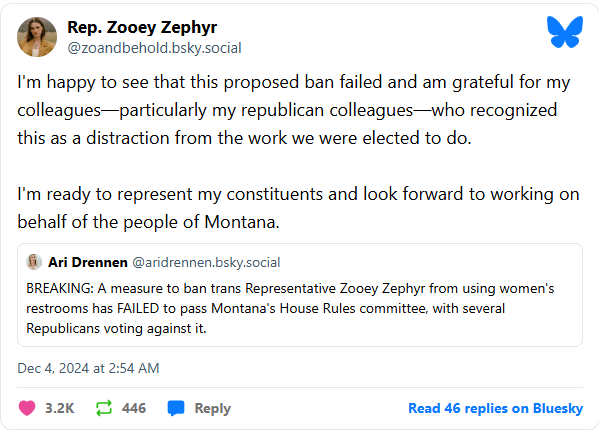
An attempt to bar Montana lawmaker Zooey Zephyr and other transgender women from using the women’s restroom in the State Capitol has failed, with several Republicans voting against the measure.
The Montana legislature’s joint rules committee voted down the proposal on Tuesday, according to the New York Times. The measure, introduced by Republican Rep. Jerry Schillinger, was unanimously opposed by Democrats, and some Republican lawmakers also joined in rejecting it. Although Zephyr was not specifically named in the measure, she is the only legislator to whom it would apply, as the rule would have required lawmakers to use restrooms corresponding to their sex assigned at birth, per CNN. Zephyr is also Montana’s first openly transgender woman to serve in the state legislature.
In a post on Bluesky Tuesday, Zephyr expressed relief, writing, “I’m happy to see that this proposed ban failed and am grateful for my colleagues, particularly my Republican colleagues, who recognized this as a distraction from the work we were elected to do.” She also told the New York Times via email that she plans to focus on issues like “housing and health care” in her legislative work moving forward.
According to the Times, Republican Rep. David Bedey argued during the committee meeting that such a rule would “have the effect of making people famous in the national news, and will not contribute to the effective conduct of our business.” Previous efforts to remove Zephyr from the legislature have indeed attracted significant national attention. In April 2023, Montana Republicans voted to censure Zephyr after she delivered an impassioned speech opposing a bill that would ban gender-affirming care for youth. As a result, she was barred from speaking in the legislature for the remainder of the session, although she retained her right to vote. Zephyr subsequently filed a lawsuit against the state, seeking to overturn the censure ruling, but a judge denied her petition, ruling that he lacked the authority to reverse the vote.Despite Republican efforts to censor her, Zephyr was re-elected to the legislature in November, securing 80% of the vote in her district. When she returns to the Capitol in 2025, Zephyr will finally be allowed to speak during floor debates for the first time in nearly two years.
The nine-day trial featured witnesses with varying levels of credibility.
A Missouri county judge has upheld the state’s ban on gender-affirming care for minors.
In a 74-page ruling issued on Monday, Wright County Circuit Court Judge Craig Carter stated, “If we don’t let a 16-year-old buy a six-pack of beer and a pack of cigarettes, or allow an adult to purchase them for the teen, should we permit the same child and parent to decide to permanently alter the teenager’s sex?”
The restrictions on gender-affirming care, passed by Missouri lawmakers in 2023, prohibit minors from using hormones, puberty blockers, and undergoing gender-affirming surgeries. The law also blocks state funding for gender-affirming care for adults through Medicaid and for incarcerated individuals in state prisons.
The ACLU of Missouri and Lambda Legal have promised to appeal the ruling.
Judge Craig Carter acknowledged the “ethical minefield” of the case, writing that “the medical profession stands in the middle” with “scant evidence to lead it out.”
The nine-day trial featured witnesses of varying credibility, with the state’s Solicitor General Joshua Divine introducing partisan politics into the proceedings. Some experts presented research that had been retracted, which the plaintiffs argued was problematic. Divine maintained that the scientific community had dismissed the research due to “cancel culture.”
Carter’s ruling was partly based on testimony from Jamie Reed, a whistleblower who previously worked at the Washington University Transgender Center at St. Louis Children’s Hospital. Reed’s affidavit helped inspire the gender-affirming care ban. She testified that the hospital treated many patients with mental health issues without comprehensive psychological evaluations. There was disagreement at trial over whether a licensed therapist’s evaluation was sufficient for gender-affirming care, or if a psychologist or psychiatrist was required.
The judge found Reed’s testimony credible, noting, “Her testimony does not arise from any ideological or other bias.” He also pointed out that Reed is married to a transgender individual.
Reed is now the executive director of the LGBT Courage Coalition, an advocacy group that opposes gender-affirming care for minors. The day before she testified, her partner announced he was discontinuing testosterone treatments and “detransitioning.”
While Carter accepted Reed’s credibility, he was less convinced by some of the plaintiffs’ witnesses. He expressed concerns about deferring to organizations like WPATH, which the plaintiffs relied on. WPATH, the World Professional Association for Transgender Health, is a professional group that sets standards for gender-affirming care, but Carter noted that it self-describes as being “committed to advocacy.”
Ultimately, Carter’s ruling emphasized U.S. Supreme Court precedent that grants lawmakers broad discretion in areas “fraught with medical and scientific uncertainty.” He concluded that there is “an almost total lack of consensus as to the medical ethics of adolescent gender dysphoria treatment,” and therefore, the state legislature has the authority to ban the care.
Why Allies Must Act: Defending Trans Rights Protects Everyone’s Freedoms
As the election dust settles, the focus shifts to practical realities. For transgender people like me, a pressing question looms: What actions will this new Trump administration take?
It’s tempting to jump to extreme conclusions—like the idea of being rounded up and placed in camps. But it likely won’t look like that. There won’t be “camps,” nor will there be overt “rounding up.” Instead, the approach will be more subtle, and that subtlety is precisely what makes it so dangerous.
The quiet nature of these changes will make them easier for cisgender people to overlook. However, their awareness is vital—not only for our survival but for their own protection, as the erosion of trans rights often signals broader attacks on freedoms that could ultimately affect everyone.
The groundwork for trans oppression is already being laid. In recent years, Republicans have pursued anti-trans legislation with alarming intensity, proposing over 1,000 laws targeting everything from medical care and bathroom usage to IDs, sports, and even how we dress. Trump has vowed to push similar policies at the federal level, and Project 2025 outlines an even more expansive agenda.
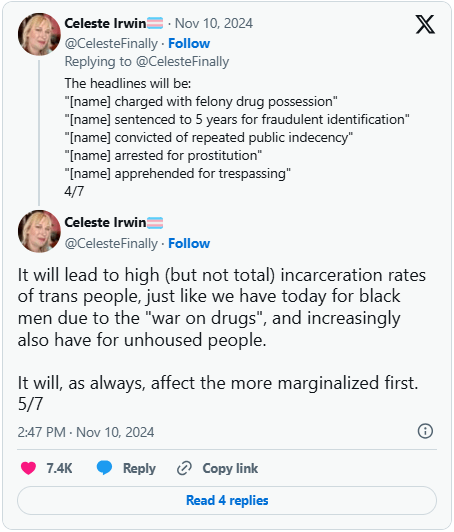
To understand what trans oppression under Trump might look like, we can look to other marginalized groups. For instance, the mass incarceration of Black men wasn’t achieved through blatant decrees like “round them up” but through systemic oppression: harsh laws with disproportionate penalties, over-policing, and economic barriers that strip away basic human needs. Trans people have already faced similar tactics, such as laws criminalizing “cross-dressing” to police our existence.
Under another Trump administration, this oppression might escalate. It could involve banning hormone replacement therapy and criminalizing those who seek it out. Policies might mandate that gender markers on IDs match sex assigned at birth, penalizing those of us who continue to live authentically with fraud or perjury charges. Involuntary commitment to mental institutions could even be a reality.
These measures, even if sporadically enforced, create an ever-present climate of fear—a psychological toll that leaves us constantly bracing for the next law, the next crackdown, the next violation of our humanity. And in this hostile environment, the silence or complacency of cisgender allies would make it all the easier for these oppressive systems to thrive.
The coming years will likely see escalating attacks on trans people, particularly the most marginalized among us—trans women of color, disabled trans people, and others who already face significant barriers. These policies will make it harder for them to access stable employment and lead precarious lives, amplifying systemic inequities.
We cannot wait for something as blatant as a “lock up all the trans people” decree. The oppression will come in quieter, more insidious forms: laws and policies that restrict our rights to healthcare, employment, and basic expression. Even if trans people comply with these laws, the result will still be a kind of prison—a life stripped of autonomy and dignity.
If you are cisgender, we need your help. Not just because it’s the right thing to do, but because these attacks on trans rights will eventually pave the way for attacks on your rights. Consider abortion access: for decades, conservatives framed their arguments around “protecting life” to avoid addressing bodily autonomy directly. But the fight against gender-affirming care removes that pretense altogether. By banning medically supported, evidence-based care simply because they don’t like it, lawmakers set a dangerous precedent that could extend to other healthcare decisions.
Your body could be next.
Employment and education are also at risk. Imagine a national “Don’t Say Gay/Trans” policy that bars teachers like me—who are openly transgender—from the profession. Policies like these won’t stop at targeting trans people. Deadnaming and misgendering trans students could morph into strict gendered dress codes for everyone, eroding freedom of expression for all students. What starts as an attack on trans rights often metastasizes into broader assaults on personal liberties.
As we approach January 20th, now is the time to act:
Get involved: Connect with your local LGBTQ+ center and see how you can support their efforts.
Stay informed: Follow trans journalists and activists to keep up with the latest developments.
Advocate: Write to your representatives in both parties, showing them that you stand with trans people.
Speak out: Use your voice, wear supportive messages, and engage your cisgender friends to build awareness.
Support trans people directly: Check in with your trans friends, especially now, as they navigate a political climate fueled by over $200 million of anti-trans rhetoric during the election. Let them know you’re there for them.
This isn’t just about protecting trans people—it’s about preserving freedom and dignity for everyone. Together, we can resist these threats and build a future where everyone has the right to live authentically.
The Trump-appointed judge argued that trans youth can still access talk therapy, suggesting that treatment options remain available to them.
A three-judge panel from the United States Court of Appeals for the Seventh Circuit has approved the implementation of Indiana’s ban on gender-affirming care for minors.
The law, signed by Governor Eric Holcomb (R) in April 2023, prohibits doctors from prescribing puberty blockers and hormone therapy to transgender minors. Despite acknowledging that the bill was “clear as mud,” Holcomb still signed it into law. The bill passed with overwhelming support in both chambers of the state legislature, giving lawmakers the ability to override a potential veto.
The ACLU of Indiana filed a lawsuit on behalf of four families to prevent the law from taking effect, and a district court judge issued a preliminary injunction to halt its implementation while the case proceeded through the legal system.
The state appealed this injunction to the Seventh Circuit, which lifted it in February and has now issued its final ruling against it. The judges concluded that the district court was wrong to claim that the law would cause “irreparable harm” to transgender youth forced to detransition, arguing that “psychotherapy and parasocial support” could serve as alternatives to gender-affirming care for treating gender dysphoria.
Judge Michael Brennan, appointed by Donald Trump, wrote, “It might be different if Indiana barred all treatment for gender dysphoria, but SEA 480 does no such thing.”
All major medical organizations in the U.S. endorse gender-affirming care as safe and effective.
The majority of the panel also ruled that the state law does not violate the due process or equal protection rights of transgender youth, noting that both transgender boys and girls are prohibited from accessing gender-affirming care.
Brennan wrote, “So, sex does not indicate on what basis treatment is prohibited. The law does not create a class of one sex and a class of another and deny treatment to just one of those classes.”
This argument hinges on not recognizing transgender people as a distinct class. Cisgender youth are still permitted to access gender-affirming care under the law, which specifically bans certain treatments only when used to alter someone’s appearance to “resemble a sex different from the individual’s sex” assigned at birth.
Judge Candace Jackson-Akiwumi, appointed by President Joe Biden, dissented from Brennan’s decision, while Judge Kenneth Ripple, appointed by Ronald Reagan, joined Brennan in the 2-1 ruling.
“We are disappointed and are considering our options,” said Kenneth Faulk of the ACLU of Indiana.
Indiana Attorney General Todd Rokita (R) praised the decision, citing God in his statement.
“The Seventh District Court of Appeal’s decision today is a huge win for Hoosiers and will help protect our most precious gift from God — our children,” he said.
A judge has overturned a state law that prohibited gender-affirming care in prisons and other settings.
On Tuesday, a federal judge issued a preliminary injunction halting an Idaho bill that banned gender-affirming care in state prisons. This decision allows incarcerated transgender individuals in Idaho to access hormone therapy once again.
In the ruling for Robinson v. Labrador, Judge David Nye of the U.S. District Court for the District of Idaho wrote, “Plaintiffs’ Motion for Temporary Restraining Order, Provisional Class Certification, and Preliminary Injunction is hereby GRANTED. The court certifies the protected class of all incarcerated persons in custody of the [Idaho Department of Corrections] who are, or will be diagnosed with Gender Dysphoria, and are receiving, or would receive hormone therapy. The Court enjoins enforcement of [H.B. 668]’s prohibition on the use of state funds for purposes of providing hormone therapy as against the class while this lawsuit is pending.”
H.B. 668, the bill in question, prohibited the use of public funds for any gender-affirming procedures, including hormone therapy and surgeries. Sponsored by Republican lawmakers in the House State Affairs Committee, the bill was signed into law in March of this year by Governor Brad Little (R).
The injunction applies only to the use of public funds for gender-affirming care in prisons and does not extend to non-incarcerated transgender individuals or gender-affirming surgeries.
In his ruling, Judge Nye supported the injunction by highlighting the plaintiffs’ strong arguments regarding the importance of gender-affirming care, the societal impact of such restrictions, and the consequences for transgender people across the state. Although he acknowledged areas where the plaintiffs’ case was lacking, he ultimately determined that the evidence justified the injunction.
Initially, Nye had denied the request to make the lawsuit a class action. However, after receiving data showing that 54 incarcerated individuals were receiving gender-affirming care and 70 had been diagnosed with gender dysphoria, he changed his stance.
The lawsuit involves two transgender women in prison, Katie Heredia and Rose Mills, both diagnosed with gender dysphoria and undergoing hormone replacement therapy. Their care was put at risk due to H.B. 668. The case was expanded into a class action lawsuit representing all known transgender prisoners in Idaho, with the ACLU of Idaho arguing that the ban constituted an Eighth Amendment violation.
The defendants in the case include Attorney General Raul Labrador, Governor Brad Little, Idaho Department of Corrections (IDOC) director Josh Tewalt, IDOC Chief of Staff Bree Derrick, and Centurion Health of Idaho.
Paul Carlos Southwick, legal director for the ACLU of Idaho, stated, “We are grateful that this class action lawsuit will protect the rights of both our plaintiffs and all incarcerated people diagnosed with gender dysphoria. People who are serving time have a right to access health care, adequate food, and housing conditions while in the state’s care, and we are grateful those rights were upheld today.”
LGBTQ Nation reached out to both the ACLU of Idaho and the Attorney General’s office for comment but had not received a response by the time of publication. This article will be updated as necessary.






















 fleeredstates.blog
You must be logged in to post a comment.