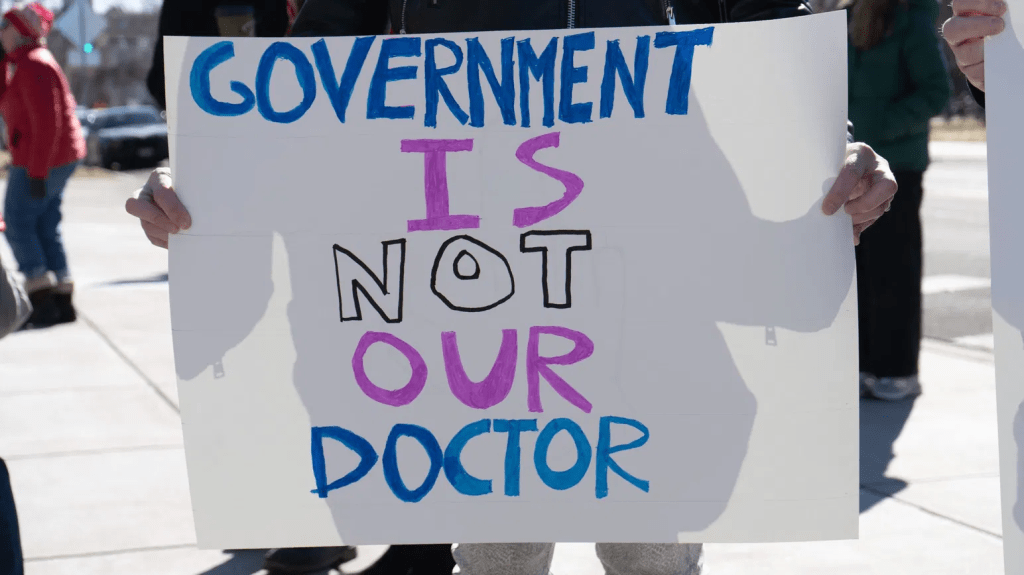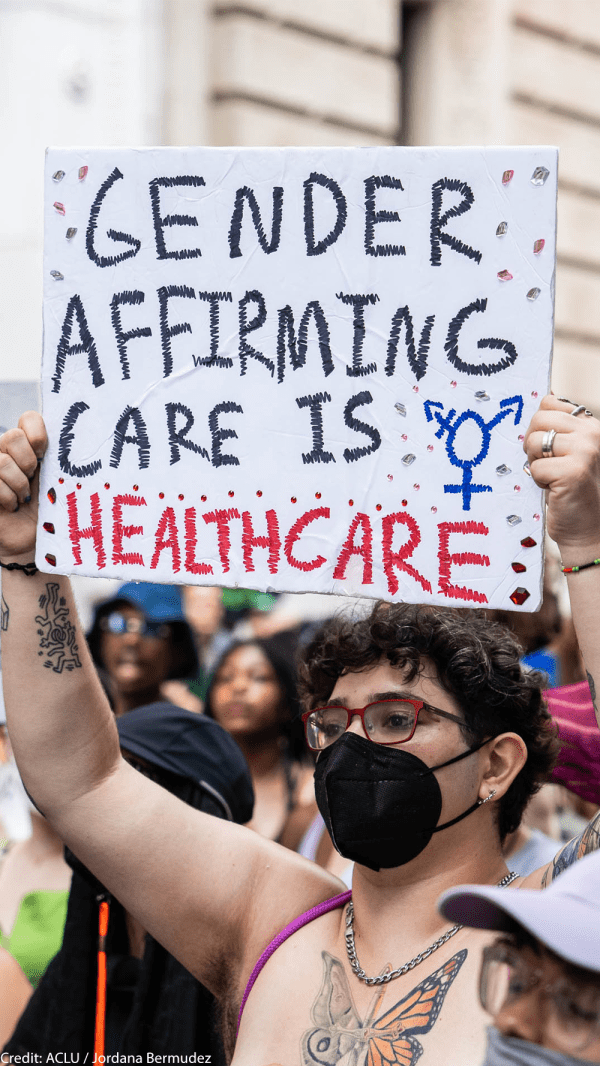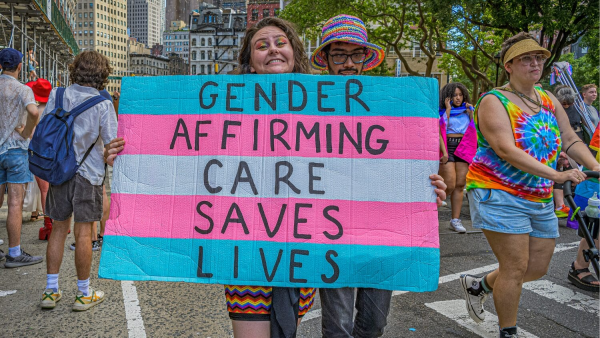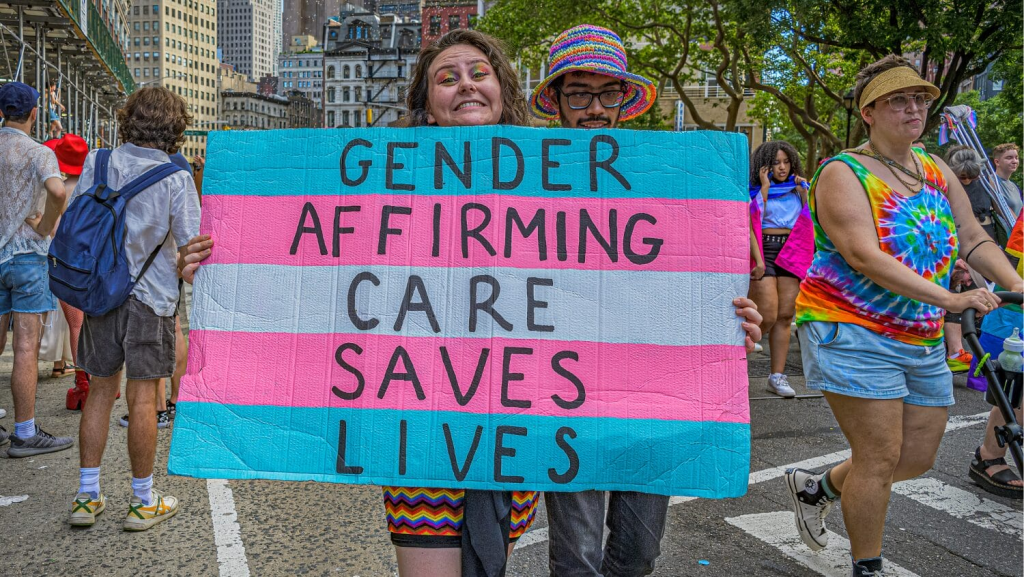
At least 21 hospitals and health systems have suspended or reduced health services for transgender minors and young adults in 2025, according to an NBC News analysis. Many providers cited fears of federal investigations and the potential loss of government funding.
This rollback comes against a backdrop of escalating legal attacks on transgender health care. In recent years, 26 states have passed bans restricting gender-affirming care for minors, with six making it a felony to provide certain treatments. Roughly 40% of trans youth ages 13 to 17 now live in states where access to care is restricted, according to KFF. In June, the Supreme Court upheld Tennessee’s gender-affirming care ban, effectively green-lighting similar laws nationwide.
At the federal level, restricting access to transition-related care has become a main policy objective of the administration. In January, the president signed an executive order directing federal agencies to cut off funding for gender-affirming care for minors and instructing the Department of Justice (DOJ) to investigate and criminalize providers and health centers that offer such care. In April, Attorney General Pam Bondi ordered the DOJ to investigate providers, hospitals, and clinics that provide gender-affirming care to trans youth.
The crackdown escalated earlier this summer when federal prosecutors issued subpoenas to more than 20 hospitals and clinics. In August, sixteen states and the District of Columbia filed suit in an attempt to block the administration’s investigations. However, several providers that received subpoenas chose to suspend offering gender-affirming care instead of waiting for the outcome of the lawsuit.
The chilling effect has extended even into Democratic-led “sanctuary” states, where lawmakers have promised protections for transgender people. While attorneys general in those states initially reminded hospitals that scaling back gender-affirming care could violate state anti-discrimination laws, none have pursued enforcement actions. In practice, this has allowed hospitals to quietly eliminate or reduce programs without consequence.
The presidential administration has quietly ended federal employees’ insurance coverage for gender-affirming care. An LGBTQ+ legal advocacy organization called the policy “not only cruel, [but] illegal.”
A letter sent last Friday from the U.S. Office of Personnel Management Healthcare and Insurance to insurance companies said that the Federal Employees Health Benefits (FEHB) and Postal Service Health Benefits (PSHB) Programs will no longer cover “gender transition” services for people of all ages starting in 2026. The letter says that insurance companies can develop an exemption process for patients currently receiving gender-affirming care “on a case-by-case basis,” though it doesn’t specify how.
However, the programs will still cover “counseling services for possible or diagnosed gender dysphoria,” including “faith-based counseling,” which might be a euphemism for conversion therapy, a widely debunked pseudoscientific practice that purports to change a person’s gender identity or sexual orientation.
The letter also directs insurance companies not to “list or otherwise recognize” providers of gender-affirming care in directories of medical professionals and clinics covered by insurance, Them reported.
In a statement condemning the letter, the LGBTQ+ legal advocacy group Lambda Legal wrote that the “policy violates constitutional protections and multiple federal anti-discrimination laws.”
“This discriminatory policy… is not only cruel—it is illegal,” wrote Lambda Legal Counsel and Health Care Strategist Omar Gonzalez-Pagan.
“The federal government cannot simply strip away essential healthcare coverage from transgender employees while providing comprehensive medical care to all other federal workers,” Gonzalez-Pagan added. “Beyond the fundamental equal protection guarantees enshrined in our Constitution, which prohibit such animus-laden actions, multiple federal laws also prohibit this type of discrimination.”
Lambda Legal pledged to explore all options to respond to the discriminatory policy and asked federal employees harmed by the policy to contact their organization.
While the current presidential administration has sought to eradicate gender-affirming care for trans youth, something the administration calls “chemical or surgical mutilation,” this policy change is one of many that show the administration’s interest in ending gender-affirming care for trans people of all ages.
In January, the president issued an executive order (that has since been blocked by several courts) instructing the Department of Justice to use laws against false advertising to prosecute any entity that may be misleading the public about the long-term effects of gender-affirming care.
On February 7, the Department of Defense issued a memo halting gender-affirming medical procedures for adult military service members. In June, the administration finalized a rule modifying the Affordable Care Act to remove requirements that insurance providers cover gender-affirming care as an essential health benefit.
Gender-affirming care is supported by all major medical associations in the U.S., including the American Medical Association, the Endocrine Society, and the American Academy of Pediatrics, as safe and life-saving for young people with gender dysphoria.
The Department of Justice (DOJ) has issued subpoenas to medical providers who offer gender-affirming care to transgender youth, demanding that they provide private information on their young patients. The subpoenas demand “billing documents, communication with drug manufacturers, patient’s Social Security numbers, addresses, emails, Zoom recordings, voicemails, encrypted text messages, as well as every writing or record of whatever type” doctors have made from January 2020 to the current day, The Washington Post reported.
While Attorney General Pam Bondi admitted last month to sending 20 subpoenas to hold “medical professionals and organizations that mutilated children in the service of a warped ideology” accountable, she didn’t specify which organizations and individuals received the subpoenas. Anonymous informants told the aforementioned publication that some of the subpoena recipients (who got the subpoenas in June) operate in states with laws protecting gender-affirming care for youth. One trans civil rights activist called the incident an “unprecedented and disgusting violation of medical privacy.”
“[The government] is using its investigative powers to target medical providers based on a disagreement about medical treatment rather than violations of the law,” Jacob T. Elberg, a former federal prosecutor specializing in health care fraud, told The Washington Post. He added that the DOJ must show that the information it demanded is “relevant to a legitimate law enforcement probe.”
The publication contacted numerous clinics and professionals offering gender-affirming care for youth, but none would say whether they had received a subpoena, citing fears of violent threats or government retaliation. Other hospitals have been closing their trans youth clinics and erasing any mention of gender-affirming care from their web pages to avoid federal threats to cut funding or pursue prosecutorial charges.
“The subpoena is a breathtakingly invasive government overreach,” said Jennifer L. Levi, senior director of transgender and queer rights at the LGBTQ+ legal advocacy group GLAD Law. “It’s specifically and strategically designed to intimidate health care providers and health care institutions into abandoning their patients.”
Fewer than 3,000 teens nationwide receive puberty blockers or hormone replacement therapy, according to a 2025 JAMA analysis of private insurance data, The Post noted.
Responding to the news, transgender civil rights lawyer Alejandra Caraballo wrote via Bluesky, “This is an unprecedented and disgusting violation of medical privacy,” adding, “The fact that no lawsuit has been commenced challenging these subpoenas in court is ominous. My best guess is that many of the providers have complied and now DOJ is potentially sitting on the records of thousands of trans youth covering everything from therapy notes to pre- and post-op photos.”
Though there is no federal law banning gender-affirming care, the current presidential administration has sought to eradicate the practice through a January executive order (that has since been blocked by several courts). The order instructed the DOJ to extend the time that patients and parents can sue gender-affirming doctors and to use laws against false advertising to prosecute any entity that may be misleading the public about the long-term effects of gender-affirming care.
In April, Bondi issued a memo to DOJ employees, telling them to investigate and prosecute cases of minors accessing gender-affirming care as female genital mutilation (FGM); even though hospitals don’t conduct such female genital surgeries. The memo threatened to jail doctors for 10 years if they provide gender-affirming care to young people.
Gender-affirming care is supported by all major medical associations in the U.S., including the American Medical Association, the Endocrine Society, and the American Academy of Pediatrics, as safe and life-saving for young people with gender dysphoria.
One doctor interviewed by The Washington Post called the federal government’s crusade against gender-affirming care a “toxic plan” that will force some patients to detransition, potentially forcing them into adverse psychological and physical effects, including increased anxiety, depression, and the development of unwanted physical changes.
“This goes way beyond any degree of moral or ethical dilemma that any of us have ever experienced,” the doctor said. “It is completely scientifically and medically unfounded.”
Republican attorneys general in Texas and Tennessee have demanded similar patient information from providers of youth-centered gender-affirming care outside of their states, but they dropped their demands after courts blocked their efforts.
Atrium Health recently stopped providing gender-affirming medication for people 18 and younger, a move that transgender rights and other LGBTQ organizations around the Charlotte region immediately decried. They claimed that the Charlotte area’s largest health care provider buckled under political pressure.
Four LGBTQ rights groups issued a blistering statement on Facebook late last week condemning the move. The statement was on the page for Time Out Youth, a Charlotte nonprofit providing resources for LGBTQ+ people ages 13 to 24. The group was joined by Charlotte Trans Health, the Gender Education Network, and PFLAG Charlotte. The groups said Atrium and its parent company, Advocate Health, are making a decision “based on fear of retaliation by hostile federal agencies or funding cuts.”
Atrium refused to make anyone available for an interview with The Charlotte Observer. Instead, it emailed a statement from parent company Advocate Health confirming it no longer provides or prescribes gender-affirming care medications for patients younger than 19. That’s a departure from a 2023 state law, which restricted gender-affirming care for minors, defined as people younger than 18. In January, President Donald Trump issued an executive order limiting youth access to gender-affirming care nationwide. It defines individuals under 19 as “children” and directs federal agencies to take action to restrict care. Advocate Health said it has been closely following the evolving health care regulatory environment, and acknowledged a “changing federal environment.”
“We recognize that this is a deeply complex issue, and this decision was made after a multi-disciplinary team spent numerous hours carefully considering the options and outcomes,” Advocate Health stated. “This new policy allows our hospitals, clinics and pharmacies to continue caring for all patients’ health needs in the changing federal environment.” Advocate leaders announced the policy change to Atrium-affiliated clinicians and pharmacists during what they called a “difficult” Microsoft Teams meeting on July 31. A doctor associated with Atrium Health who was in that meeting provided an audio recording of it to The Charlotte Observer, and asked not to be named because they were not authorized to share the recording. “We understand the complexity of this, we understand the emotion, the real concern around it. We share it, which is why there has been so much time and so many people weighing in on this,” Dr. Scott Rissmiller, chief clinical officer of Advocate, said on the recording. “And at the end of the day, ultimately, it is to protect our clinicians, our patients and our organization as we move forward.” The Justice Department also issued a new policy memo that could have significant implications for healthcare professionals, Advocate leaders said during the meeting.
It suggested that doctors and other clinicians who provide specific types of gender-affirming care, both medical and surgical, to individuals under 19 may face criminal charges. The memo also includes provisions that encourage and protect whistleblowers who report violations within their healthcare organizations. Atrium Health had not previously provided surgical gender transition procedures for minors under age 18, the company told the Observer. About gender-affirming care Advocate Health defines gender-affirming care as services including social, psychological, behavioral or medical interventions (including hormonal treatment or surgery) designed to support and affirm an individual’s gender identity. That’s according to the draft of a policy shared with physicians in July and provided to the Observer by the doctor associated with Atrium Health. Advocate reviewed protocols for gender-affirming care and considered the potential impacts of federal actions on patients, clinics and employees before deciding to end the medications for people younger than 19, according to the draft policy. “Gender-affirming care is medical care,” the advocacy groups stated. “It is endorsed by every major medical and behavioral health association. It saves lives.”
Gender-affirming care is a supportive form of health care, according to the U.S. Department of Health and Human Services. That may include medical, surgical and mental health services as well as non-medical services for transgender and nonbinary people. Atrium’s policy change wasn’t just about Trump’s executive order, but also took into consideration actions coming from the Federal Trade Commission, the Centers for Medicaid and Medicare, and other “elements,” according to Advocate officials on the audio recording. While health care companies may face regulatory threats, executive actions and other risks, the LGBTQ groups said “the real harm will fall on young people who already face disproportionate rates of depression, anxiety and suicidality when affirming care is withheld.” Advocate Health physicians have been reaching out to patients affected by the policy change so they are aware of what it means for their care and to provide support, according to the company. In its statement to the Observer, Advocate said it recognized “that this will be difficult news” for patients affected by the policy change, and created a 24/7 hotline to assist them, focusing on providing personalized counseling that might be needed.
‘Operating out of fear’ Dr. Holly Savoy, executive director for Charlotte Trans Health, an advocacy group for transgender people, expressed concern and disappointment over Atrium’s decision.
“One of the biggest challenges for trans people is stigma and discrimination,” Savoy said. “(Atrium) is operating out of fear, rather than standing up for evidence-based care,” Savoy said. “It’s not standing behind the science of gender-affirming care and their values of being an organization that says that they support health care for all.” Advocate Health will focus on alternative, non-invasive care, such as behavioral health and peer support for patients, health care officials said at the July meeting. The company is the third-largest nonprofit health system in the U.S. It serves about 6 million patients. More than 155,000 employees work in 68 hospitals and more than 1,000 locations. Novant Health is the second largest health care provider in the Charlotte region. The Winston-Salem-based company did not respond to an Observer request about the status of gender-affirming care for youths.
Concerns over resources LGBTQ advocates feared that Atrium’s decision could make it harder for patients to find new care in the area. “Our kids are now having to suffer because they are struggling now to find care that they’ve had at Atrium, some of them for a couple of years now,” said Joshua Jernigan, founder of the Gender Education Network, a nonprofit providing support and resources to transgender and gender-diverse children. “And it’s just very, very sad to us.”
The state law enacted in 2023, N.C. House Bill 808, prohibits puberty blockers and surgical gender transition procedures for minors who had not already started treatment as of Aug. 1, 2023. And it created penalties for doctors who perform those procedures or who prescribe, provide or dispense puberty-blocking drugs or cross-sex hormones to a minor. Atrium Health hasn’t provided surgical gender transition procedures for minors under 18 since the law passed and has followed the law, Advocate Health told The Charlotte Observer. Advocate’s medication changes went into effect Aug. 4, and also impacts patients previously grandfathered in to receive gender-affirming care services under the N.C. law, according to the draft policy. Gender-affirming care medications can still be prescribed for patients 19 and older, according to the policy. For patients under 19, these same medications can be prescribed for other medical reasons, such as post-chemotherapy needs, tumor removal surgery or to treat precocious puberty (when a child goes through puberty too early). Jernigan said transgender patients deserve access to care, regardless of age. “I would hope that major medical systems would treat their patients first and not act like the patient’s medical needs are not important,” Jernigan said.
Joshua Dumas, a board member of PFLAG Charlotte, said Advocate Health’s decision to cut gender-affirming care medication is a business decision based on the current political climate. The four advocacy groups want Atrium to rescind its decision. “To every trans and gender-diverse young person and their families: You are not alone,” they said. “We are fighting for you. And we will not stop.”
Democratic Gov. Maura Healey, the first out lesbian governor in the U.S., signed the Shield Act 2.0 into law Thursday. The bill further strengthens protections for patients and providers of reproductive healthcare, while explicitly mandating that abortions be performed when deemed medically necessary.
“Massachusetts will always be a state where patients can access high-quality health care and providers are able to do their jobs without government interference,” Healey said in a statement. “From the moment Roe was overturned, we stepped up to pass strong protections for patients and providers, and with President Trump and his allies continuing their assaults on health care, we’re taking those protections to the next level. No one is going to prevent the people of Massachusetts from getting the health care they need.”
The state’s original shield law, enacted by Democratic Gov. Charlie Baker in July, 2022, prohibits states that have banned the life-saving treatment from punishing those who travel to Massachusetts to receive it by preventing the release of information or the arrest and extradition of someone based on another state’s court orders.
The new law further prevents the disclosure of sensitive data, such as a physician’s name, and prohibits local law enforcement from cooperating with other jurisdictions in their investigations. It also directs the Department of Public Health to create an advisory group to help guide businesses as they implement privacy protections for storing or managing electronic medical records.
“Massachusetts is home to the best health care providers in the country, and we aren’t going to let them be intimidated or punished for providing lifesaving care,” said Lieutenant Governor Kim Driscoll. “Together with the Legislature, we are reminding the entire country yet again that Massachusetts is a place where everyone can safely access the health care they need and deserve.”
New Hampshire Gov. Kelly Ayotte (R) signed a gender-affirming care ban into law on Friday that bans anyone under 18 from using puberty blockers or hormone treatments for gender transition care.
H.B. 377 – the first of its kind in New England – also prohibits minors from receiving gender-affirming surgery, despite the fact that it is already almost never performed on trans kids under 18.
Starting January 1, 2026, providers are barred from providing hormone care and puberty blockers only “if the performance or administration of the procedure or medication is for the purpose of altering or attempting to alter the appearance of or affirm the minor’s perception of his or her gender or sex, if that perception is inconsistent with the minor’s biological sex.”
The ban does not hold medical providers criminally liable for violations, but rather subjects them to administrative disciplinary action by the state board of medicine. It also allows minors already receiving treatment to continue doing so. Minors and their parents can also sue medical providers for violating the law.
Ayotte also signed a second bill specially preventing minors from having top surgery except for “procedures needed to treat malignancy, injury, infection, or malformation and those needed to reconstruct the breasts after such procedures.”
“Medical decisions made at a young age can carry lifelong consequences,” Ayotte said in a statement, “and these bills represent a balanced, bipartisan effort to protect children.”
Despite Ayotte calling the legislation bipartisan, the bills passed overwhelmingly along party lines. Only two Democrats voted for H.B. 377, and only one voted for the top surgery bill.
While expressing support for the bill, State Sen. Kevin Avard (R) called trans identity a “craze” that “seems almost a cult-like following.”
“I do believe biology speaks volumes,” he said, according to NBC Boston.
Courtney Reed, policy advocate at the American Civil Liberties Union of New Hampshire, called the laws “merciless, cruel, and painful for transgender young people, their families, and their doctors.”
Chris Erchull, senior staff attorney at GLBTQ Legal Advocates & Defenders, said the legislation “epitomizes extreme government intrusion into the private lives and personal decisions of New Hampshire families.”
“The best way to protect the health and well-being of young transgender people is to ensure they have continued access to necessary, age-appropriate medical care provided by licensed physicians practicing in accordance with established standards of medical care,” he said.
Ayotte signed the bills despite the fact that earlier this Month, she vetoed several anti-LGBTQ+ bills, including an anti-trans bathroom bill, a book-banning bill, and a ban on teachers giving students “get to know you” questionnaires without parental permission. State Republicans lack the two-thirds majority needed in both the House and Senate to override the governor’s vetoes.
The island nation of Cuba will now allow transgender people to change the gender markers on their government-issued identity cards without having to undergo “bottom surgery,” a legal change long sought by the country’s trans and nonbinary communities.
On July 18, the country’s National Assembly of People’s Power (NAPP) approved a law allowing people to change their gender markers without first requiring a court-approved document proving that applicants had undergone genital affirming surgeries.
This new law is one of several recently approved by the NAPP to update the technology and policies of the nation’s record-keeping system. Cuba’s new Civil Registry code will now recognize unmarried couples’ emotional unions or cohabitation agreements, providing some legal recognition of various domestic partnerships.
In 2008, Cuba became the first Latin American country to provide comprehensive coverage for gender-affirming surgeries and related medical care. However, despite the country having the highest per capita population of medical doctors in the world, years-long U.S. trade embargo against the nation has prevented many doctors from accessing the hormone replacement medications and surgical supplies they need, according to a 2024 report from Teen Vogue.
Additionally, years worth of budget cuts by the Cuban government have forced many medical professionals to leave the island nation in search of higher-paying work abroad. As a result, trans Cubans must self-medicate using hormones purchased on the internet, something that can present risks since patients must then undergo the physical and psychological side effects without medical consultation.
CENESEX, the government-funded LGBTQ+ rights organization, ostensibly schedules trans-related healthcare for citizens. But one trans person told the aforementioned publication that the organization never contacted them back when they tried to schedule such care. CENESEX didn’t respond to the publication’s request for comment, and a security guard at the organization’s office said that CENESEX was closed and was only seeing patients “on an as-needed basis.”
Same-sex marriage is legal in Cuba. It was legalized on September 27, 2022, following a national referendum where a majority of Cubans voted in favor of a new family code that includes the legalization of same-sex marriage. The new family code also included provisions for same-sex adoption and surrogacy.
Although Cuban law currently prohibits “discrimination based on sexual orientation in employment, housing, statelessness, or access to education or health care,” the international LGBTQ rights site Alturi.com said, “Nonetheless, societal discrimination based on sexual orientation or gender identity persists.”
The US Supreme Court’s decision to uphold Tennessee’s ban on gender identity care for transgender minors earlier this summer has fueled ongoing polarization around LGBTQ issues and controversial policies across the nation. The high court has also agreed to take on more cases dealing with trans rights in its next session that begins in October.
Twenty-seven states have passed lawslimiting access to gender identity health care for transgender children and teenagers, according to KFF, a nonpartisan health policy think tank. An estimated 40% of trans youth ages 13 to 17 live in these states.
There have already been more anti-LGBTQ bills introduced in state legislatures so far this year than in any full year since at least 2020, a CNN analysis of American Civil Liberties Union data found. These bills span various aspects of everyday life, including bathroom access, school sports and identification documents.
CNN is tracking where these laws are being passed and where these bills are being introduced. This story will be updated.
Gender identity care includes medically necessary, evidence-based care that uses a multidisciplinary approach to help a person transition from their assigned sex— the one the person was designated at birth — to their affirmed gender, the gender by which one wants to be known.
Most of the states limiting gender identity care for trans minors adopted their bans in 2023, a record-breaking year for such laws. So far this year, one state — Kansas — has passed a ban, prohibiting the use of state funds to provide or subsidize health care for transgender youth.
Not all laws are currently being enforced, however. The ban in Arkansas has been permanently blocked by a federal court, though the state said it would appeal the ruling. Montana’s ban is also permanently blocked, according to KFF. Though Arizona has a 2022 law on the books banning surgical care for transgender minors, Democratic Gov. Katie Hobbs signed an executive order in 2023 ensuring access to gender identity health care.
Nearly 600 anti-LGBTQ bills have been introduced into state legislatures as of July 11, which is already more than any other year on record, according to the ACLU.
Education and health care continue to be key targets. There were more bills restricting student and educator rights — enforcing school sports bans and targeting students’ access to facilities consistent with their gender identities, for example — than any other category of bills, according to a CNN analysis of ACLU data.
Legislators in Texas have introduced 88 anti-LGBTQ bills so far this year, more than double the number of bills being considered in any other state. Four of those — including one that limits changes to gender markers on state medical records — have been passed into law.
Lawmakers in every state, except for Vermont, have filed at least one anti-LGBTQ bill in 2025, according to a CNN analysis. Twenty-two states have signed those bills into law.
Puerto Rico’sRepublican Gov. Jenniffer González-Colón signed into law Wednesday a far-reaching ban on gender-affirming medical care for transgender people under 21, enacting one of the harshest measures of its kind in the United States and its territories and prompting swift condemnation from medical experts and LGBTQ+ advocates.
The law received the governor’s approval late in the day, according to the Associated Press.
The law, Senate Bill 350, prohibits the use of puberty blockers, hormone therapy, and gender-affirming surgeries for anyone under 21, threatening doctors and other health professionals with up to 15 years in prison, a $50,000 fine, and the permanent loss of their licenses and permits. Public funds are also barred from being used for such care.
In recent days, the College of Physicians and Surgeons, the Association of Psychology, the College of Social Work Professionals, the Puerto Rican Association of Professional Counseling, and the Bar Association, among other organizations, had urged that the bill be vetoed.
The Advocate previously reported that González-Colón had asked for amendments to protect access to puberty blockers and allow minors already undergoing treatment to continue care, but lawmakers did not adopt those changes. Last month, the U.S. Supreme Court ruled in Skrmetti that a Tennessee ban on gender-affirming care for minors could be enacted, which allowed other states and territories to continue to ban such care.
“What a disgrace! Jenniffer González, through her actions, declares herself the most anti-equality governor in history. She ignored her own Secretary of Health and the medical associations that support treatment for trans minors. By signing Senate Bill 350 into law, she has just endangered trans youth and their families and criminalized health professionals for doing their job,” Pedro Julio Serrano, president of the Puerto Rico LGBTQ+ Federation, said in a statement to The Advocate.
Harvard Law Instructor Alejandra Caraballo reacted to the law’s signing on Bluesky. “A twenty-year-old trans person can go drink themselves to death but can’t legally get hormones,” she wrote, noting that the drinking age in Puerto Rico is 18.
The Federation, a coalition representing hundreds of individuals and more than 100 organizations, said it would pursue legal action against the new law.
Ohio Gov. Mike DeWine (R) vetoed three anti-LGBTQ+ provisions in the state’s latest budget bill yesterday, in a partial victory for civil rights that still leaves several assaults on LGBTQ+ identity signed into law.
The budget passed by Republicans over Democrats’ objections included a raft of measures targeting the LGBTQ+ community, including a prohibition on flying the Pride flag on state property; defunding shelters that welcome trans youth; language defining sex in the state as binary; removing library books related to sexual orientation or gender identity from areas accessed by minors; and denying Medicaid funding for mental health services for transgender people.
DeWine vetoed the prohibition on the Pride flag, the defunding of youth shelters, and the mandate on library materials.
“The budget is supposed to be a reflection of Ohio’s shared values,” Equality Ohio said in a statement shared with the Columbus Dispatch after the governor vetoed the provisions. The group said lawmakers tried to make the bill “a vehicle for cruelty.”
“But because of community action—because we showed up, we sent emails, we made calls, and we told your stories — some of that cruelty was stopped in its tracks,” the organization said.
DeWine, a lifelong conservative and former United States senator, was circumspect in explaining the reasoning behind his vetoes.
On the subject of youth shelters, DeWine told reporters, “We want homeless shelters to be open for everyone. That’s kind of it.”
Of the library provision, which ordered books addressing LGBTQ+ identity kept “out of sight” of minors, the governor said, “As parents or grandparents, no one wants their child to have a book or something that is inappropriate, something that is obscene. But I just felt that the language did not work.”
The provision banning the Pride flag would have limited flags flown on state properties to the American flag, the Ohio flag, the POW/MIA flag, and flags of official state agencies.
Wins for MAGA Republicans in the GOP-dominated Ohio House and Senate included copycat language from the president’s “gender ideology” executive order mandating the government recognize only two biological sexes, male and female, as well as a ban on Medicaid funding for mental health services for transgender people.
How the latter would be enforced in a mental health setting has yet to be tested and will likely be challenged in court.
DeWine also let stand a prohibition on distributing menstrual products in men’s public restrooms.
Republican leaders can override any of DeWine’s line-item vetoes between now and the end of the two-year legislative session in December 2026. The GOP holds overwhelming and veto-proof majorities in both the House and Senate.
In January 2024, Republicans overrode DeWine’s veto of a bill banning gender-affirming care for minors and trans women and girls from participating in school sports in the state.
You must be logged in to post a comment.