A federal judge has quashed the Department of Justice’s subpoena for the records of QueerDoc, a telehealth service that prescribes medications and offers consulting for gender-affirming care in 10 states.
The DOJ subpoenaed QueerDoc June 11, requesting personnel information, documents identifying patients, patients’ medical records, billing records, insurance claims, communications with drugmakers, and more. It was among more than 20 such subpoenas issued.
The same day, the DOJ’s Civil Division issued a memo saying it would “prioritize investigations of doctors, hospitals, pharmaceutical companies, and other appropriate entities” for “possible violations of the Food, Drug, and Cosmetic Act and other laws” regarding medications used in gender-affirming care and False Claims Act violations by health care providers who “evade state bans on gender dysphoria treatments by knowingly submitting claims to Medicaid with false diagnosis codes.”
These investigations derived from Donald Trump’s executive order recognizing only male and female sexes as assigned at birth and another denouncing gender-affirming care for minors as “a stain on our Nation’s history” that “must end” and threatening federal funding that provide such care. He also directed the DOJ to investigate providers. In April, Attorney General Pam Bondi released a memo saying the DOJ would “act decisively to protect our children and hold accountable those who mutilate them under the guise of care.” She used the same language about mutilation in a later press release. That a day after QueerDoc filed motions with a U.S. District Court in Washington State to quash the subpoena and seal the court proceedings, according to the court.
“DOJ issued its inflammatory press release declaring that medical professionals have ‘mutilated children in the service of a warped ideology,’ one day after QueerDoc filed these motions, effectively destroying any claim to investigative confidentiality while attempting to sway public sentiment against healthcare providers like QueerDoc,” Judge Jamal Whitehead wrote in his ruling, which came out Monday. “Such conduct appears calculated to intimidate rather than investigate.”
“The question before the Court is whether DOJ may use its administrative subpoena power to achieve what the Administration cannot accomplish through legislation: the elimination of medical care that Washington and other states explicitly protect. The answer is no,” he continued. He noted that gender-affirming care is supported by major medical groups and many courts.
Whitehead added, “When a federal agency issues a subpoena not to investigate legal violations but to intimidate and coerce providers into abandoning lawful medical care, it exceeds its legitimate authority and abuses the judicial process.”
He denied the motion to seal the proceedings “because, despite legitimate safety concerns, transparency in judicial proceedings remains paramount when challenging executive power,” he wrote.
QueerDoc welcomed the ruling. “The court affirmed that government power cannot be used to intimidate providers or breach the confidentiality of patients seeking medically necessary care,” the organization said in a statement on its website. “This is a win not just for QueerDoc, but for every clinician and patient fighting for the right to safe, private healthcare.”
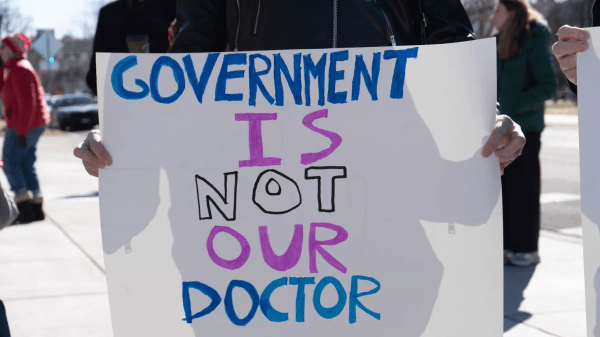
The subpoena was “a calculated attempt by the Trump administration and Attorney General Pam Bondi to weaponize the Department of Justice against transgender people and the clinicians who care for them,” the statement noted. QueerDoc did not surrender any patient information to the DOJ, and care was not disrupted, the group said.
Asked by Politico for comment on the QueerDoc ruling, the DOJ issued this statement: “As Attorney General Bondi has made clear, this Department of Justice will use every legal and law enforcement tool available to protect innocent children from being mutilated under the guise of ‘care.’”
Trump’s Department of Health and Human Services (HHS) seeks to end all Medicaid and Medicare funding for young people’s gender-affirming care (GAC), according to newly proposed rules shared by NPR. A trans activist said the rules would amount to a “de facto national ban” on GAC.
The proposed rules would prohibit all federal Medicaid and Medicare funding — as well as funding through the federal Children’s Health Insurance Program (CHIP) — for any services at hospitals that provide GAC for trans youth.
“These would be proposals that would go out for public comment, it would take months for the Trump administration to issue a final rule, and then, if past is prologue, we would see litigation over whatever the final rules are,” Katie Keith, director of the Center for Health Policy and the Law at Georgetown University, told NPR.
Terry Schilling, president of the American Principles Project, a right-wing think tank that has pushed national transphobia as an effective Republican political strategy, said of the proposed rules, “I think these restrictions are very good. It’s going to change the entire transgender industry, and it’s going to take away a lot of their funding streams.”
“This would be a de facto national ban,” wrote trans activist and civil rights attorney Alejandra Caraballo via Bluesky. “There would still be providers in blue states that don’t take federal funding but the large interdisciplinary teams of just a few years ago would be nearly impossible to maintain. The result is that the care that remains would largely be underground with worse support and likely outcomes.”
“They’ll never be able to fully ban this care,” Caraballo added. “There will always be providers willing to provide it like abortion. Even without access to providers, many trans youth will simply go DIY [do-it-yourself] like trans folks have done for decades. They’re not actually banning this care, they’re making it less safe.”
The administration’s “toxic” war on gender-affirming care
Though there is no federal law banning gender-affirming care, the current presidential administration has sought to eradicate the practice through a January executive order (that has since been blocked by several courts). The order instructed the DOJ to extend the time that patients and parents can sue gender-affirming doctors and to use laws against false advertising to prosecute any entity that may be misleading the public about the long-term effects of gender-affirming care (GAC).
In April, Bondi issued a memo to DOJ employees, telling them to investigate and prosecute cases of minors accessing gender-affirming care as female genital mutilation (FGM), even though hospitals don’t conduct such female genital surgeries. The memo threatened to jail doctors for 10 years if they provide gender-affirming care to young trans people.
The following June, the DOJ sent subpoenas to 20 medical providers who offer GAC to trans youth, demanding patients’ Social Security numbers, emails, home addresses, and information on the care they received, as well as other sensitive information dating back to January 2020. A federal judge blocked the subpoena in one instance and accused the DOJ of going on a “bad faith” “fishing expedition” to interfere with states’ rights to protect GAC within its borders, to harass and intimidate providers from offering such care, and to dissuade patients from seeking such care.
Fewer than 3,000 teens nationwide receive puberty blockers or hormone replacement therapy, according to a 2025 JAMA analysis of private insurance data. Gender-affirming care is supported by all major medical associations in the U.S., including the American Medical Association, the Endocrine Society, and the American Academy of Pediatrics, as safe and life-saving for young people with gender dysphoria.
One doctor interviewed by The Washington Post called the federal government’s crusade against gender-affirming care a “toxic plan” that will force some patients to detransition, potentially forcing them into adverse psychological and physical effects, including increased anxiety, depression, and the development of unwanted physical changes.
A Dallas pediatrician who became the first doctor to be sued under a Texas law banning gender-affirming care for minors has given up her license to practice in the state.
According to TownFlex, the Texas Medical Board confirmed that Dr. May Lau voluntarily surrendered her medical license. In a statement, Lau’s attorney, Craig Smyser, said that she has decided to move her practice to Oregon and sees no reason to maintain her license to practice in Texas.
Last year, Texas Attorney General Ken Paxton (R) filed a first-of-its-kind lawsuit against Lau for allegedly providing gender-affirming care to minors in violation of S.B. 14. The state law, which went into effect in September 2023, bans doctors from prescribing hormone replacement therapy and puberty blockers to minors, and from performing gender-affirming surgery on minors.
Paxton’s suit accused Lau of prescribing hormone replacement therapy to at least 21 minors between October 2023 and August 2024. It further alleged that Lau “used false diagnoses and billing codes to mask these unlawful prescriptions.”
Notably, Paxton’s suit falsely referred to gender-affirming care as “dangerous and experimental” and a press release from his office claimed that there is “no scientific evidence” to support the benefits of gender-affirming medication.
In fact, puberty blockers and hormone replacement drugs have for decades been used safely for the purposes of gender transition in trans minors and to treat other medical issues in cisgender children. Gender-affirming care, which encompasses a range of both surgical and nonsurgical treatments, has been endorsed by every major American medical association and leading world health authority as evidence-based, safe, and in some cases lifesaving for transgender minors. Gender-affirming surgical intervention is rarely performed on minors.
In his statement, Smyser said that Lau “continues to deny the Texas Attorney General’s politically- and ideologically-driven allegations,” according to TownFlex.
Paxton, meanwhile, said that Lau’s surrender of her medical license was “a major victory for our state.”
“Doctors who permanently hurt kids by giving them experimental drugs are nothing more than disturbed left-wing activists who have no business being in the medical field. We will not relent in holding anyone who tries to ‘transition’ kids accountable,” he said in a statement, according to TownFlex.
As the outlet notes, Paxton has filed similar lawsuits against two other Texas doctors. Last month, the Texas AG withdrew the state’s suit against Hector Granados after finding no evidence that he violated S.B. 14. However, a lawsuit brought against M. Brett Cooper is ongoing and expected to go to trial in May.
Equality Texas noted that the enforcement of S.B. 14 has led many doctors who provide gender-affirming care to leave the state — making it harder for trans adults to access care.
A federal judge on Wednesday struck down a former President Biden-era rule that extended federal health antidiscrimination protections to transgender health care.
Judge Louis Guirola Jr. of the U.S. District Court for the Southern District of Mississippi ruled in favor of a coalition of 15 GOP-led states that sued over the rule, which broadened sex discrimination by adding sexual orientation and gender identity to the list of protected characteristics in certain health programs and activities.
The Department of Health and Human Services “exceeded its authority by implementing regulations redefining sex discrimination and prohibiting gender identity discrimination,” Guirola ruled.
The decision is a significant loss for the transgender community, which is has faced a wave of state and federal policies and court decisions rolling back previously established rights.
The complaint centered on provisions in Section 1557 of the Affordable Care Act, which the Biden administration interpreted to bolster health care protections against discrimination for LGBTQ people.
The rule prevented covered entities from discriminating against certain protected groups in providing health care services, insurance coverage and program participation.
The challenged provision added gender identity to Title IX’s definition of discrimination “on the basis of sex,” which previously included discrimination based on sex characteristics, pregnancy and sex stereotypes.
The Biden administration’s final rule, which was released in 2024, said organizations receiving federal health funding and health insurers that do business through government plans cannot refuse to provide health care services, particularly for gender-affirming care, that would be provided to a person for other purposes.
The rule was first created under former President Obama in 2016. President Trump then reversed it during his first term before the Biden administration turned it back again.
The first Trump policy kept protections against discrimination based on race, color, national origin, sex, age or disability. But the administration narrowed the definition of sex to only mean “biological sex,” cutting out transgender people from the protections.
Guiroloa ruled that a statute “cannot be divorced from the circumstances existing at the time it was passed.”
The word “sex” is not defined in the statute, so the court said it must interpret the term according to its meaning in or around 1972, when the statute was enacted. At that time, the definition focused on the reproductive distinctions between males and females.
Guirola vacated the rule universally, meaning it’s not limited to the 15 red state plaintiffs. But the impact is likely limited because the rule had not taken effect.
In a statement, Tennessee Attorney General Jonathan Skrmetti celebrated the decision.
“Our fifteen-State coalition worked together to protect the right of health care providers across America to make decisions based on evidence, reason, and conscience. This decision restores not just common sense but also constitutional limits on federal overreach, and I am proud of the team of excellent attorneys who fought this through to the finish,” he said in a statement.
California lawmakers passed legislation this week to prevent health providers from releasing transgender patients’ confidential medical records in investigations of gender-affirming care in states that ban treatment for minors.
Senate Bill 497, introduced in February by Sen. Scott Wiener, a Democrat representing San Francisco, builds upon a 2022 state law that established California as a state of refuge for transgender people. That law, also authored by Wiener, prevents states that have banned gender-affirming care for minors from taking legal action against trans youth, their families and their doctors over treatment administered in California.
The latest bill would require law enforcement requesting health information about transgender people in California to provide a warrant, according to Wiener’s office. It would also bar medical providers from complying with out-of-state requests, including subpoenas, for information related to gender-affirming care.
“California must do everything in our power to protect the transgender community, and I’m confident that the Governor will continue his longstanding leadership on trans issues,” Wiener said in a statement on Thursday after the bill passed.
The California Senate voted 30-10 on Wednesday to pass Wiener’s bill, which the state Assembly passed earlier this week. A spokesperson for California Gov. Gavin Newsom (D) declined to comment, saying the governor’s office does not typically remark on pending legislation.
Newsom must sign or veto the measure by Oct. 13.
The vote on Wiener’s bill comes after the Justice Department announced in June that it had sent more than 20 subpoenas to doctors and clinics “involved in performing transgender medical procedures on children” in investigations of alleged health care fraud and false statements. A subpoena sent to the Children’s Hospital of Philadelphia that was made public in a court filing last month requested patients’ birth dates, Social Security numbers and home addresses, as well as “every writing or record of whatever type” from doctors related to the provision of gender-affirming care to adolescents younger than 19 years.
The subpoena requested information dating back to January 2020, more than a year before transition-related care was banned anywhere in the U.S.
On Tuesday, a federal judge blocked an effort by the Trump administration to subpoena medical records of transgender patients who received gender-affirming care at Boston Children’s Hospital, calling the Justice Department’s investigation improper and “motivated only by bad faith.”
In an email on Friday, a spokesperson for Wiener said Senate Bill 497, if signed, would “strengthen the case for any medical provider who wishes to fight Trump’s vicious assault on the transgender community.”
President Trump and administration officials have broadly sought to ban gender-affirming care for minors. A Jan. 28 executive order states that the U.S. “will rigorously enforce” laws that ban transition-related care for anyone younger than 19.
Laws adopted by more than half the nation since 2021 ban gender-affirming care for minors, which major professional medical groups say is medically necessary and often lifesaving for transgender youth and adults. In June, the Supreme Court ruled that states can ban treatment for minors, finding that Tennessee’s prohibition on puberty blockers, hormones and rare surgeries for adolescents does not constitute sex discrimination.
Texas Attorney General Ken Paxton withdrew the state’s lawsuit against pediatric endocrinologist Dr. Hector Granados on Thursday after finding no evidence that he violated the state’s ban on gender affirming care for trans youth.
Paxton sued Granados in October 2024, accusing him of providing puberty blockers and hormones to patients as young as 12 in treatment for gender dysphoria. Paxton accused Granados of falsifying medical and billing records to mislead pharmacies and insurance providers into covering the care.
Paxton initially called Granados a “scofflaw who is harming the health and safety of Texas children,” and Granados wasn’t notified before the lawsuit’s filing, in worries that he might try to destroy relevant records, The Hill reported.
However, Granados said he stopped providing gender-affirming care in May 2023, after the state’s legislature passed the law. Now that Paxton’s office has dropped its charges against him, Paxton’s office will now “focus on other ongoing cases against doctors who illegally provided harmful ‘transition’ treatments and drugs to children,” an attorney general spokesperson said, according to The Hill.
The state has also sued May Lau and M. Brett Cooper, two medical providers from the University of Texas’ Southwestern Medical Center in Dallas. If found guilty, both could possibly lose their medical licenses and face hundreds of thousands of dollars in fines.
Despite Paxton’s claim about gender-affirming care being “harmful,” the medications used in such care have been used safely in children for decades for the purposes of gender transition and to treat other medical issues in cisgender children as well. In fact, Texas’ law stands in opposition to the best care practices for treating gender dysphoria recommended by every major American medical association. These associations agree that such care is safe, effective, and essential for the overall well-being of trans people.
At least 21 hospitals and health systems have suspended or reduced health services for transgender minors and young adults in 2025, according to an NBC News analysis. Many providers cited fears of federal investigations and the potential loss of government funding.
This rollback comes against a backdrop of escalating legal attacks on transgender health care. In recent years, 26 states have passed bans restricting gender-affirming care for minors, with six making it a felony to provide certain treatments. Roughly 40% of trans youth ages 13 to 17 now live in states where access to care is restricted, according to KFF. In June, the Supreme Court upheld Tennessee’s gender-affirming care ban, effectively green-lighting similar laws nationwide.
At the federal level, restricting access to transition-related care has become a main policy objective of the administration. In January, the president signed an executive order directing federal agencies to cut off funding for gender-affirming care for minors and instructing the Department of Justice (DOJ) to investigate and criminalize providers and health centers that offer such care. In April, Attorney General Pam Bondi ordered the DOJ to investigate providers, hospitals, and clinics that provide gender-affirming care to trans youth.
The crackdown escalated earlier this summer when federal prosecutors issued subpoenas to more than 20 hospitals and clinics. In August, sixteen states and the District of Columbia filed suit in an attempt to block the administration’s investigations. However, several providers that received subpoenas chose to suspend offering gender-affirming care instead of waiting for the outcome of the lawsuit.
The chilling effect has extended even into Democratic-led “sanctuary” states, where lawmakers have promised protections for transgender people. While attorneys general in those states initially reminded hospitals that scaling back gender-affirming care could violate state anti-discrimination laws, none have pursued enforcement actions. In practice, this has allowed hospitals to quietly eliminate or reduce programs without consequence.
The presidential administration has quietly ended federal employees’ insurance coverage for gender-affirming care. An LGBTQ+ legal advocacy organization called the policy “not only cruel, [but] illegal.”
A letter sent last Friday from the U.S. Office of Personnel Management Healthcare and Insurance to insurance companies said that the Federal Employees Health Benefits (FEHB) and Postal Service Health Benefits (PSHB) Programs will no longer cover “gender transition” services for people of all ages starting in 2026. The letter says that insurance companies can develop an exemption process for patients currently receiving gender-affirming care “on a case-by-case basis,” though it doesn’t specify how.
However, the programs will still cover “counseling services for possible or diagnosed gender dysphoria,” including “faith-based counseling,” which might be a euphemism for conversion therapy, a widely debunked pseudoscientific practice that purports to change a person’s gender identity or sexual orientation.
The letter also directs insurance companies not to “list or otherwise recognize” providers of gender-affirming care in directories of medical professionals and clinics covered by insurance, Them reported.
In a statement condemning the letter, the LGBTQ+ legal advocacy group Lambda Legal wrote that the “policy violates constitutional protections and multiple federal anti-discrimination laws.”
“This discriminatory policy… is not only cruel—it is illegal,” wrote Lambda Legal Counsel and Health Care Strategist Omar Gonzalez-Pagan.
“The federal government cannot simply strip away essential healthcare coverage from transgender employees while providing comprehensive medical care to all other federal workers,” Gonzalez-Pagan added. “Beyond the fundamental equal protection guarantees enshrined in our Constitution, which prohibit such animus-laden actions, multiple federal laws also prohibit this type of discrimination.”
Lambda Legal pledged to explore all options to respond to the discriminatory policy and asked federal employees harmed by the policy to contact their organization.
While the current presidential administration has sought to eradicate gender-affirming care for trans youth, something the administration calls “chemical or surgical mutilation,” this policy change is one of many that show the administration’s interest in ending gender-affirming care for trans people of all ages.
In January, the president issued an executive order (that has since been blocked by several courts) instructing the Department of Justice to use laws against false advertising to prosecute any entity that may be misleading the public about the long-term effects of gender-affirming care.
On February 7, the Department of Defense issued a memo halting gender-affirming medical procedures for adult military service members. In June, the administration finalized a rule modifying the Affordable Care Act to remove requirements that insurance providers cover gender-affirming care as an essential health benefit.
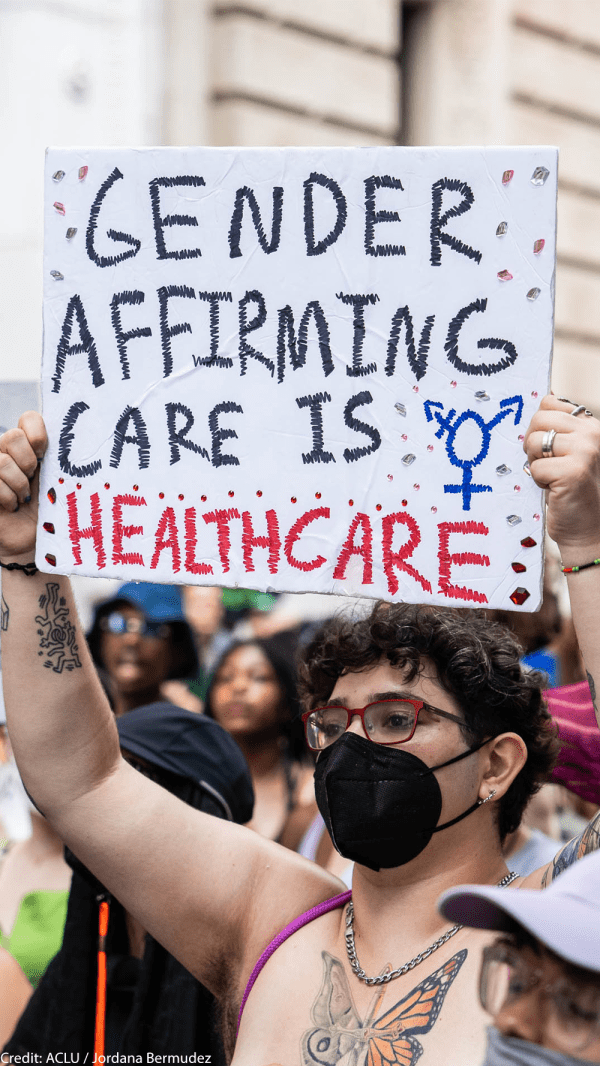
Gender-affirming care is supported by all major medical associations in the U.S., including the American Medical Association, the Endocrine Society, and the American Academy of Pediatrics, as safe and life-saving for young people with gender dysphoria.
The Department of Justice (DOJ) has issued subpoenas to medical providers who offer gender-affirming care to transgender youth, demanding that they provide private information on their young patients. The subpoenas demand “billing documents, communication with drug manufacturers, patient’s Social Security numbers, addresses, emails, Zoom recordings, voicemails, encrypted text messages, as well as every writing or record of whatever type” doctors have made from January 2020 to the current day, The Washington Post reported.
While Attorney General Pam Bondi admitted last month to sending 20 subpoenas to hold “medical professionals and organizations that mutilated children in the service of a warped ideology” accountable, she didn’t specify which organizations and individuals received the subpoenas. Anonymous informants told the aforementioned publication that some of the subpoena recipients (who got the subpoenas in June) operate in states with laws protecting gender-affirming care for youth. One trans civil rights activist called the incident an “unprecedented and disgusting violation of medical privacy.”
“[The government] is using its investigative powers to target medical providers based on a disagreement about medical treatment rather than violations of the law,” Jacob T. Elberg, a former federal prosecutor specializing in health care fraud, told The Washington Post. He added that the DOJ must show that the information it demanded is “relevant to a legitimate law enforcement probe.”
The publication contacted numerous clinics and professionals offering gender-affirming care for youth, but none would say whether they had received a subpoena, citing fears of violent threats or government retaliation. Other hospitals have been closing their trans youth clinics and erasing any mention of gender-affirming care from their web pages to avoid federal threats to cut funding or pursue prosecutorial charges.
“The subpoena is a breathtakingly invasive government overreach,” said Jennifer L. Levi, senior director of transgender and queer rights at the LGBTQ+ legal advocacy group GLAD Law. “It’s specifically and strategically designed to intimidate health care providers and health care institutions into abandoning their patients.”
Fewer than 3,000 teens nationwide receive puberty blockers or hormone replacement therapy, according to a 2025 JAMA analysis of private insurance data, The Post noted.
Responding to the news, transgender civil rights lawyer Alejandra Caraballo wrote via Bluesky, “This is an unprecedented and disgusting violation of medical privacy,” adding, “The fact that no lawsuit has been commenced challenging these subpoenas in court is ominous. My best guess is that many of the providers have complied and now DOJ is potentially sitting on the records of thousands of trans youth covering everything from therapy notes to pre- and post-op photos.”
Though there is no federal law banning gender-affirming care, the current presidential administration has sought to eradicate the practice through a January executive order (that has since been blocked by several courts). The order instructed the DOJ to extend the time that patients and parents can sue gender-affirming doctors and to use laws against false advertising to prosecute any entity that may be misleading the public about the long-term effects of gender-affirming care.
In April, Bondi issued a memo to DOJ employees, telling them to investigate and prosecute cases of minors accessing gender-affirming care as female genital mutilation (FGM); even though hospitals don’t conduct such female genital surgeries. The memo threatened to jail doctors for 10 years if they provide gender-affirming care to young people.
Gender-affirming care is supported by all major medical associations in the U.S., including the American Medical Association, the Endocrine Society, and the American Academy of Pediatrics, as safe and life-saving for young people with gender dysphoria.
One doctor interviewed by The Washington Post called the federal government’s crusade against gender-affirming care a “toxic plan” that will force some patients to detransition, potentially forcing them into adverse psychological and physical effects, including increased anxiety, depression, and the development of unwanted physical changes.
“This goes way beyond any degree of moral or ethical dilemma that any of us have ever experienced,” the doctor said. “It is completely scientifically and medically unfounded.”
Republican attorneys general in Texas and Tennessee have demanded similar patient information from providers of youth-centered gender-affirming care outside of their states, but they dropped their demands after courts blocked their efforts.
Atrium Health recently stopped providing gender-affirming medication for people 18 and younger, a move that transgender rights and other LGBTQ organizations around the Charlotte region immediately decried. They claimed that the Charlotte area’s largest health care provider buckled under political pressure.
Four LGBTQ rights groups issued a blistering statement on Facebook late last week condemning the move. The statement was on the page for Time Out Youth, a Charlotte nonprofit providing resources for LGBTQ+ people ages 13 to 24. The group was joined by Charlotte Trans Health, the Gender Education Network, and PFLAG Charlotte. The groups said Atrium and its parent company, Advocate Health, are making a decision “based on fear of retaliation by hostile federal agencies or funding cuts.”
Atrium refused to make anyone available for an interview with The Charlotte Observer. Instead, it emailed a statement from parent company Advocate Health confirming it no longer provides or prescribes gender-affirming care medications for patients younger than 19. That’s a departure from a 2023 state law, which restricted gender-affirming care for minors, defined as people younger than 18. In January, President Donald Trump issued an executive order limiting youth access to gender-affirming care nationwide. It defines individuals under 19 as “children” and directs federal agencies to take action to restrict care. Advocate Health said it has been closely following the evolving health care regulatory environment, and acknowledged a “changing federal environment.”
“We recognize that this is a deeply complex issue, and this decision was made after a multi-disciplinary team spent numerous hours carefully considering the options and outcomes,” Advocate Health stated. “This new policy allows our hospitals, clinics and pharmacies to continue caring for all patients’ health needs in the changing federal environment.” Advocate leaders announced the policy change to Atrium-affiliated clinicians and pharmacists during what they called a “difficult” Microsoft Teams meeting on July 31. A doctor associated with Atrium Health who was in that meeting provided an audio recording of it to The Charlotte Observer, and asked not to be named because they were not authorized to share the recording. “We understand the complexity of this, we understand the emotion, the real concern around it. We share it, which is why there has been so much time and so many people weighing in on this,” Dr. Scott Rissmiller, chief clinical officer of Advocate, said on the recording. “And at the end of the day, ultimately, it is to protect our clinicians, our patients and our organization as we move forward.” The Justice Department also issued a new policy memo that could have significant implications for healthcare professionals, Advocate leaders said during the meeting.
It suggested that doctors and other clinicians who provide specific types of gender-affirming care, both medical and surgical, to individuals under 19 may face criminal charges. The memo also includes provisions that encourage and protect whistleblowers who report violations within their healthcare organizations. Atrium Health had not previously provided surgical gender transition procedures for minors under age 18, the company told the Observer. About gender-affirming care Advocate Health defines gender-affirming care as services including social, psychological, behavioral or medical interventions (including hormonal treatment or surgery) designed to support and affirm an individual’s gender identity. That’s according to the draft of a policy shared with physicians in July and provided to the Observer by the doctor associated with Atrium Health. Advocate reviewed protocols for gender-affirming care and considered the potential impacts of federal actions on patients, clinics and employees before deciding to end the medications for people younger than 19, according to the draft policy. “Gender-affirming care is medical care,” the advocacy groups stated. “It is endorsed by every major medical and behavioral health association. It saves lives.”
Gender-affirming care is a supportive form of health care, according to the U.S. Department of Health and Human Services. That may include medical, surgical and mental health services as well as non-medical services for transgender and nonbinary people. Atrium’s policy change wasn’t just about Trump’s executive order, but also took into consideration actions coming from the Federal Trade Commission, the Centers for Medicaid and Medicare, and other “elements,” according to Advocate officials on the audio recording. While health care companies may face regulatory threats, executive actions and other risks, the LGBTQ groups said “the real harm will fall on young people who already face disproportionate rates of depression, anxiety and suicidality when affirming care is withheld.” Advocate Health physicians have been reaching out to patients affected by the policy change so they are aware of what it means for their care and to provide support, according to the company. In its statement to the Observer, Advocate said it recognized “that this will be difficult news” for patients affected by the policy change, and created a 24/7 hotline to assist them, focusing on providing personalized counseling that might be needed.
‘Operating out of fear’ Dr. Holly Savoy, executive director for Charlotte Trans Health, an advocacy group for transgender people, expressed concern and disappointment over Atrium’s decision.
“One of the biggest challenges for trans people is stigma and discrimination,” Savoy said. “(Atrium) is operating out of fear, rather than standing up for evidence-based care,” Savoy said. “It’s not standing behind the science of gender-affirming care and their values of being an organization that says that they support health care for all.” Advocate Health will focus on alternative, non-invasive care, such as behavioral health and peer support for patients, health care officials said at the July meeting. The company is the third-largest nonprofit health system in the U.S. It serves about 6 million patients. More than 155,000 employees work in 68 hospitals and more than 1,000 locations. Novant Health is the second largest health care provider in the Charlotte region. The Winston-Salem-based company did not respond to an Observer request about the status of gender-affirming care for youths.
Concerns over resources LGBTQ advocates feared that Atrium’s decision could make it harder for patients to find new care in the area. “Our kids are now having to suffer because they are struggling now to find care that they’ve had at Atrium, some of them for a couple of years now,” said Joshua Jernigan, founder of the Gender Education Network, a nonprofit providing support and resources to transgender and gender-diverse children. “And it’s just very, very sad to us.”
The state law enacted in 2023, N.C. House Bill 808, prohibits puberty blockers and surgical gender transition procedures for minors who had not already started treatment as of Aug. 1, 2023. And it created penalties for doctors who perform those procedures or who prescribe, provide or dispense puberty-blocking drugs or cross-sex hormones to a minor. Atrium Health hasn’t provided surgical gender transition procedures for minors under 18 since the law passed and has followed the law, Advocate Health told The Charlotte Observer. Advocate’s medication changes went into effect Aug. 4, and also impacts patients previously grandfathered in to receive gender-affirming care services under the N.C. law, according to the draft policy. Gender-affirming care medications can still be prescribed for patients 19 and older, according to the policy. For patients under 19, these same medications can be prescribed for other medical reasons, such as post-chemotherapy needs, tumor removal surgery or to treat precocious puberty (when a child goes through puberty too early). Jernigan said transgender patients deserve access to care, regardless of age. “I would hope that major medical systems would treat their patients first and not act like the patient’s medical needs are not important,” Jernigan said.
Joshua Dumas, a board member of PFLAG Charlotte, said Advocate Health’s decision to cut gender-affirming care medication is a business decision based on the current political climate. The four advocacy groups want Atrium to rescind its decision. “To every trans and gender-diverse young person and their families: You are not alone,” they said. “We are fighting for you. And we will not stop.”



















You must be logged in to post a comment.