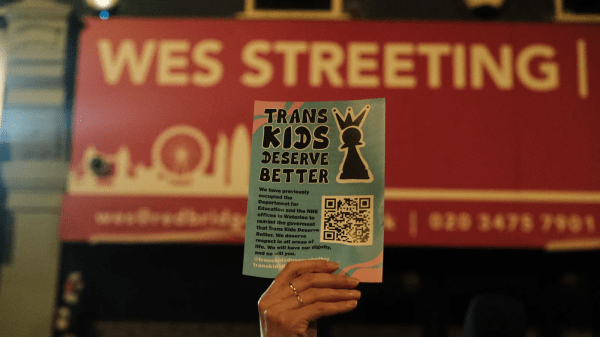
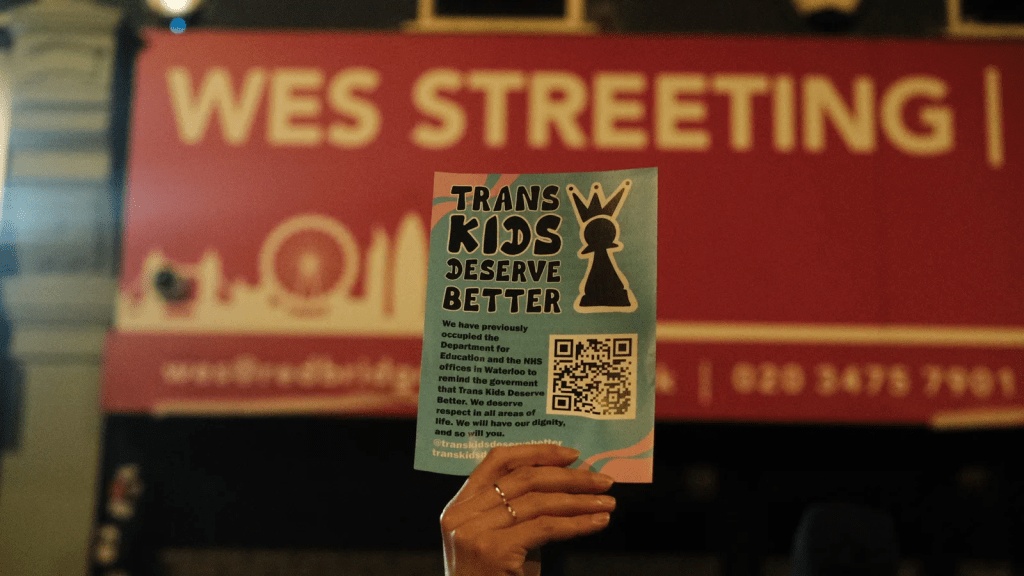
The activists, part of the group Trans Kids Deserve Better, staged an overnight protest outside the Department of Health and Social Care offices.
In response to the announcement by Health Secretary Wes Streeting and the Department of Health and Social Care that puberty blockers for treating gender dysphoria in trans youth would be banned “indefinitely,” a group of trans youth activists set up a temporary encampment outside Streeting’s office. On December 11, Trans Kids Deserve Better and their supporters set up camp outside Wes Streeting’s office, remaining there overnight until the following day, according to an Instagram post from the group. While puberty blockers have effectively been banned in the U.K. since May, when the Department of Health and Social Care imposed an “emergency ban” on the medication for trans youth, Streeting’s recent announcement on Wednesday further extended the ban. He stated that the National Health Service (NHS) and private doctors are prohibited from prescribing or supplying puberty blockers to trans youth for gender dysphoria treatment until 2027. However, existing prescriptions for trans youth will continue to be honored. In contrast, cisgender youth experiencing precocious puberty are still permitted to receive prescriptions for the blockers.
In an article for Huck Magazine, one of the group’s activists, known as Grin, wrote that “while today isn’t a big change, it is a sign that the denial of our healthcare is now institutionalized.” Gender clinics in the U.K. have faced criticism for notoriously long waiting times, with an August study revealing that trans youth wait an average of two years to begin receiving gender-affirming care.
Grin wrote that Streeting “has promised ‘clinical trials’ on the effects of hormone blockers.” However, many clinical studies on the subject already exist, and the overwhelming majority conclude that hormone blockers are beneficial to the well-being of trans youth.
“But we already know what happens when we get them. We get to live happier, healthier lives because our bodies won’t be permanently altered in ways we don’t want,” Grin continued. “The real trial or experiment he has now created is to keep us from our healthcare and see what happens when an entire generation of trans people grows up knowing the trauma they’ve gone through was avoidable. I’ve not consented to be part of that experiment — I just wanted healthcare.”
The group has been targeting Streeting since August as part of a separate campaign called Trans Kids Are Dying, Wes Streeting. According to Grin’s article in Huck Magazine, the group has visited the secretary’s office daily since July, delivering “handmade paper coffins” to symbolize the lives of trans people already lost and those still at risk. Grin also mentioned that the group had received an invitation to meet with Streeting, but that it “never happened,” despite “constant emails to follow up on his invitation.”
On this occasion, the activists left a life-sized cardboard coffin outside Streeting’s office, as detailed in an Instagram post by Jude Guitamacchi, who participated in the overnight protest.
In their Instagram caption, they wrote, “This healthcare ban starts with trans+ kids but won’t end with them. This is about all of us. We must work together and do everything we can to challenge the ban and fight for the human rights of the trans+ community in the UK.”
Military Veterans, Families, and Service Members with Transgender Children Decry NDAA Provision as a ‘Slap in the Face’
Military veterans, active-duty service members, and families with transgender children are condemning a provision in Congress’s annual defense policy bill that targets certain medical treatments for transgender minors, calling it a “slap in the face” based on misinformation and a lack of understanding about the transgender community.
The provision, included in the compromised version of the National Defense Authorization Act (NDAA) negotiated by the House and Senate, would block TRICARE, the military’s health insurance program, from covering gender dysphoria treatments for minors that could potentially lead to sterilization, applying to individuals under the age of 18.
Senate Provision Would Have Explicitly Banned Coverage for Gender-Affirming Hormone Therapy and Puberty Blockers for Minors
A more specific provision, adopted by the Senate Armed Services Committee in its defense bill in July, sought to explicitly prohibit coverage for “affirming hormone therapy” and puberty blockers, as well as other medical treatments for gender dysphoria—distress stemming from a mismatch between an individual’s gender identity and sex assigned at birth—if they “could result in sterilization” for minors.
Hormone treatments, which typically involve doses of testosterone or estrogen, can have mixed effects on fertility, while puberty blockers, used to delay physical changes like breast development or voice deepening, are not known to significantly affect fertility on their own.
Branden Marty, a Navy veteran with a transgender daughter, criticized such policies, noting that they reflect a broader failure to listen to medical experts. “With policies like this, and we’ve seen them in states and at the federal level, legislators and politicians and leaders within our system of government are not listening to experts,” Marty said.
He emphasized that gender-affirming care is about working with healthcare professionals to provide support to families, helping transgender and nonbinary children understand their identities, and ensuring they can live healthy, fulfilling lives at school and home. “It’s about helping a child understand themselves and develop a positive self-appreciation,” he added.
Major Medical Groups Affirm Gender-Affirming Care as Medically Necessary, Lifesaving, and Essential
Leading medical organizations have consistently stated that gender-affirming healthcare for both transgender adults and minors is medically necessary and can be lifesaving. These groups strongly oppose efforts by state and federal governments to restrict access to such treatments, arguing that they are essential for the well-being and mental health of transgender individuals.
Other GOP-backed proposals to reverse the Pentagon’s abortion travel policy and prohibit TRICARE from covering gender-affirming care for transgender service members were removed from the final version of the bill. This suggests that Republicans believe the ban on care for transgender minors will be sufficient to secure broader support for the measure, even if other contentious provisions are excluded.
Democrats Push Back Against NDAA Over Transgender Care Prohibition; White House Remains Silent on Veto
At least one Democrat, House Armed Services Committee Ranking Member Adam Smith (D-Wash.), has announced he will vote against the NDAA over its prohibition on gender-affirming care for transgender minors. Other Democrats, including Rep. Seth Moulton (D-Mass.), also refused to advance the bill on Tuesday, citing the “ideological riders” attached to the legislation, which typically enjoys bipartisan support.
On Tuesday, House Armed Services Committee Chair Mike Rogers (R-Ala.) stated that he disagreed with the inclusion of the healthcare provision in the final NDAA and was not involved in its decision. However, he stopped short of opposing the overall $883.7 billion defense package.
The White House has not yet indicated whether President Biden, who has previously pledged to veto legislation that discriminates against transgender people, would sign the bill in its current form.
Speaker Mike Johnson Defends NDAA Provision as Victory for Troops; Air Force Chief Disagrees on “Lethality” Impact
During a news conference on Tuesday, Speaker Mike Johnson (R-La.) hailed the provision barring TRICARE coverage for gender-affirming care for minors as a victory “for our troops and for our country.”
“We spent a lot of time and effort working on it,” Johnson said of the negotiated NDAA text, emphasizing that service members and their families deserve the best support possible. In a statement on Sunday, Johnson argued that “woke ideology” had infiltrated the military, and that permanently banning transgender medical treatment for minors would help refocus the military on “lethality.”
However, an Air Force chief, who requested anonymity due to his active-duty status, expressed disagreement with Johnson’s characterization, stating that he saw no connection between the provision and improving the “lethality” of the U.S. armed services.
Air Force Chief and Spouse Criticize NDAA Provision, Argue It Undermines Military Readiness
“As someone who has served for over 20 years and is involved in high-level decision-making on the morale, health, welfare, training, readiness, and equipping of service members, I cannot link those things,” said an Air Force chief, identified only as “J,” in an interview with The Hill.
“I don’t understand how he [Speaker Johnson] comes to that conclusion, because, in my mind, it doesn’t make sense at all. Taking away something that families are relying on distracts us from the mission and the task at hand to remain as lethal as we are,” said J, whose teenage daughter is transgender and currently receives medical care covered by TRICARE.
J’s spouse, referred to only as “H,” also weighed in, criticizing the provision’s potential impact on military families. “You can’t say this is going to help our military when you’re scaring military families,” H said, expressing concern about the stress and uncertainty the provision could create for service members and their loved ones.
Military Families Weigh Impact of NDAA Provision on Health Care and Future Service
If the NDAA passes in its current form, “J” and “H,” who live on the West Coast, are considering supplemental health insurance or paying out-of-pocket for their child’s care—options that could put significant strain on the family’s finances. With more than two decades of military service and just two-and-a-half years remaining on his commitment, “J” is also rethinking his future in the military.
“I have a strong desire and propensity to continue to serve, but this will definitely weigh on my and my family’s decision to continue serving,” said “J.” “It’s difficult, but my family’s got to come first.”
Ann, a military veteran and spouse of a senior Pentagon officer, echoed similar concerns. Her teenage son is transgender, and she explained that the latest NDAA adds another layer of complexity to their family’s ability to relocate and maintain stability. Ann, who requested to be identified only by her middle name due to her husband’s active duty status, expressed frustration with the uncertainty the provision creates for families like hers.
Military Families Feel Increasing Pressure as Gender-Affirming Care Restrictions Spread
“The country is kind of closing in on us, like we’re running out of places to go,” Ann said, reflecting on the growing restrictions surrounding gender-affirming care. “Especially with something like the NDAA and just seeing the writing on the wall about a national ban on gender-affirming care.” She referenced one of President-elect Trump’s campaign promises, adding, “The little safety bubbles are getting smaller and smaller.”
Since 2021, more than half of the U.S. states have either heavily restricted or outright banned some forms of transition-related care for minors—and, in some cases, adults. The Supreme Court also appears poised to uphold a Tennessee law that bans gender-affirming care for youth, further escalating concerns among families in similar situations.
Ann, a military veteran who served eight years, including a 15-month combat tour in Iraq, and her husband, a four-time combat deployer who served in Iraq and Afghanistan, have spent roughly five years apart due to their service. The couple now faces the additional strain of navigating an increasingly hostile landscape for transgender care while managing the demands of military life.
Transgender Child Thriving with Gender-Affirming Care, but Family Faces Uncertainty with NDAA Provision
Now relocated to Virginia, Ann shared that her transgender child is “thriving” with the support of gender-affirming care provided through TRICARE. He enjoys fencing, watching sports, and playing in his school’s band. Academically, he has excelled, though Ann noted that his geometry class this year has been a bit “humbling.”
“Trans kids are kids. They are, the overwhelming majority, thriving and doing well and contributing to their community,” Ann said. “They’re happy and they’re healthy, and that’s like all that parents want, right?”
However, while Ann’s husband is not yet ready to retire, the potential loss of coverage for their son’s care would force the family to rethink their future. “If coverage for our son’s healthcare is taken away, that’s pretty much marking the end of the road,” Ann said, expressing the deep uncertainty and frustration many military families like hers are grappling with in light of the proposed policy changes.
Military Spouses Express Concern Over NDAA Provision and Its Impact on Transgender Service Members and Their Families
“If that’s the way we’re going to be treated … if that’s the tone that Congress and the government wants to set, then that’s pretty unfortunate,” said Ann, reflecting on the potential consequences of the NDAA provision. “You’re going to lose combat experience; you’re going to lose leaders with decades of valuable experience that the military needs.” She continued, “It’s a scary world out there, so it’s a pretty sad state of affairs for our national security that you’re going to ask folks to make that decision and not support their families.”
“C,” a veteran spouse whose husband served in the military for 26 years, described the NDAA’s gender-affirming care provision as “an enormous slap in the face.” She, too, has concerns about the direction the military is taking. “C” requested that she be identified only by her first initial because her transgender child, now an adult, is not publicly out as trans.
“C” and her husband both come from military families, and their child had plans to follow in their footsteps with a military career. But with the ban on TRICARE coverage for transgender healthcare and the looming possibility that President-elect Trump may reinstate a policy barring transgender people from serving openly, “C” worries about whether the military will remain a safe place for her child. “It’s all they’ve ever wanted — to be like their dad, to carry on a family tradition of service to the country,” she said. “I don’t think I can truly even express how devastating it would be for them to not be able to fulfill those dreams.”
Similarly, “B,” a military spouse from the Southwest, expressed concern about the long-term implications of the NDAA provision. While the measure doesn’t directly affect her own daughter, an 18-year-old college student, she fears it could set a troubling precedent. “This is kind of a slippery slope,” said “B,” who requested anonymity because her husband, an airman, is actively serving. “If this becomes the first federal law to prevent transgender youth from getting this healthcare, what’s to stop [Congress] from removing TRICARE coverage for trans people of all ages?”
“B” continued, “I do get concerned about that moving forward, that this could impact my daughter, this could impact older trans adults. I don’t know where this ends, so I think it’s a really dangerous road to start down.”
Her daughter, who has been accessing gender-affirming care through TRICARE, came out to “B” and her husband when she was just 12. “It was a very steep learning curve for us … I had never even heard the word ‘cisgender’ before,” said “B.” They sought advice from medical professionals, mental health providers, and other parents before making the decision to support their daughter’s medical transition. “This wasn’t something that we went into blindly or quickly,” she emphasized.
In 2021, while living in Texas, the family was forced to split up after the state began investigating parents who provided their children with gender-affirming medical treatments, with Republican Gov. Greg Abbott calling it “abusive.” “B” fled Texas with their daughter, who had to restart her senior year of high school, while “B”’s husband, unable to leave his post, stayed behind. The family has since reunited, but “B” declined to disclose their current location, citing privacy and safety concerns.
“My spouse is active-duty military. If these lawmakers saw him in the hallway in Congress, they would shake his hand and thank him for his service,” said “B.” “They trust him with sensitive information, and they trust him with the security of the nation, but somehow they can’t trust him with making informed medical decisions for his own child?”
The Nebraska Supreme Court has upheld a law that restricts access to both medical care for transgender youth and abortion.
OMAHA, Neb. — The Nebraska Supreme Court has ruled that a state law combining abortion restrictions with measures limiting gender-affirming health care for minors does not breach a state constitutional amendment requiring bills to address only one subject.
The court acknowledged that abortion and gender-affirming care are distinct types of medical care but concluded that the law falls under the broad category of medical care, thus complying with Nebraska’s single-subject rule. Chief Justice Mike Heavican, writing for the majority, referred to an 1895 ruling, emphasizing that a bill with a general object and a title that fairly expresses the subject does not violate the single-subject rule.
The ruling came in response to a lawsuit filed by the American Civil Liberties Union (ACLU) on behalf of Planned Parenthood of the Heartland. The lawsuit challenged the law, which restricts abortion to 12 weeks of pregnancy, bans gender-confirming surgery, and limits hormone treatments for transgender minors. The ACLU’s arguments that the hybrid law violated Nebraska’s single-subject rule were rejected by the high court.
Originally, Nebraska lawmakers proposed separate bills: one banning abortion at around six weeks of pregnancy and another restricting gender-affirming treatments for minors. The Legislature combined these measures into a single bill after the six-week abortion ban faced a filibuster. This combination was one of the most controversial pieces of legislation in the 2023 session, leading to an extended filibuster by some lawmakers.
A district judge had previously dismissed the lawsuit, prompting the ACLU to appeal. During the high court arguments, state attorneys argued that combining the measures under health care did not breach the single-subject rule, while Planned Parenthood contended that the Legislature had recognized abortion and transgender care as separate issues by introducing them as distinct bills.
Justice Lindsey Miller-Lerman’s dissent criticized the majority for applying inconsistent standards, accusing the court of giving undue leeway to the Legislature. She argued that the bill should have adhered strictly to the constitutional requirement for a single subject.
Opponents of the ruling expressed disappointment. ACLU Nebraska Executive Director Mindy Rush Chipman and Planned Parenthood North Central States President and CEO Ruth Richardson criticized the decision, emphasizing its potential negative impacts on Nebraskans, particularly in rural areas and among marginalized communities.
Nebraska Governor Jim Pillen and the state’s attorney general praised the ruling. Pillen highlighted his role in advocating for the bill’s passage.
Since the U.S. Supreme Court overturned Roe v. Wade in 2022, many Republican-controlled states have enacted abortion bans. Currently, 14 states have bans at all pregnancy stages, while Nebraska and North Carolina have implemented 12-week bans. Similarly, many GOP-controlled states have restricted gender-affirming care for minors, with 22 states enforcing such measures.
In contrast, several Democratic-controlled states have adopted policies to protect abortion and gender-affirming care access, including efforts to shield healthcare providers from out-of-state investigations.
Nebraska voters may have the final say on abortion access with two potential ballot questions in November: one proposing to add a right to abortion to the state constitution and another to enshrine the 12-week ban in the state constitution.
In Austin, the Texas Supreme Court has upheld the state’s ban on gender-affirming care for minors, dismissing arguments from parents that it infringes on their rights to seek medical care for their transgender children.
In a decisive 8-1 ruling issued Friday, the all-Republican court upheld a law effective since September 1, 2023, making Texas the largest of over 25 states to enact laws restricting or banning gender-affirming medical care for transgender minors. Many of these states are facing legal challenges, with the U.S. Supreme Court recently agreeing to hear an appeal concerning similar bans in Tennessee.
The Texas law prohibits transgender minors from accessing hormone therapies, puberty blockers, and transition surgeries, despite medical experts’ consensus that such surgeries are rarely performed on children. Children already undergoing banned treatments must cease them in a medically appropriate manner.
“The Legislature made a permissible, rational policy choice to limit available medical procedures for children, given the nascent understanding of gender dysphoria and its treatments,” the ruling stated, defending the legislative authority to regulate medical practice.
Lambda Legal, a civil rights organization for LGBTQ+ individuals, criticized the decision, asserting that it undermines parental and medical decision-making in favor of political interference.
The lawsuit against the Texas law argued it severely harms transgender teens by denying them crucial medical care recommended by physicians and parents. While a lower court had deemed the law unconstitutional, it remained in effect pending the state Supreme Court’s decision.
This legislative trend reflects broader challenges to transgender rights, extending from healthcare to participation in sports and access to public facilities. As restrictions increase, families often face the burden of seeking necessary care out of state due to local shortages.
The Texas law, signed by Republican Governor Greg Abbott, has sparked significant controversy and activism, including protests during legislative sessions by transgender rights advocates.
Medical organizations such as the American Medical Association and the American Academy of Pediatrics support gender-affirming care for youths, emphasizing its role in alleviating gender dysphoria and promoting mental well-being. Despite opposition citing concerns about irreversible decisions, medical experts emphasize the benefits supported by research and clinical experience.







 fleeredstates.blog
You must be logged in to post a comment.