Malaysia’s LGBTQ Community Lives In Fear As Raids Drive Them Underground

Read more at South China Morning Post.

In Chow Kit, a crowded district of Kuala Lumpur forever caught between progress and prejudice, Amy* moves quietly through narrow alleys – a transgender outreach worker tending to lives the city prefers not to see.

Her evenings begin with small rituals: a backpack filled with condoms, test kits and pamphlets; a quick text to let her friends know that she is safe.

Then, when she steps out, much of her work happens in passing conversations – careful not to draw too much attention.

“The girls know they’re high-risk,” Amy said of the transgender sex workers she visits. “They want to stay healthy. But also … they just want to live.”

Yet even basic healthcare work can feel dangerous when you’re constantly looking over your shoulder. And furtiveness comes naturally if your very existence can be construed as a crime. Some of the women worry about being seen entering clinics for fear of who might recognise them.

“When people are scared to be seen, they stop showing up,” Amy told This Week in Asia. “Fear doesn’t just affect our lives; it affects public health.”

Malaysia does not legally recognise LGBTQ identities. Same-sex relations are federally banned under colonial-era anti-sodomy legislation, while parallel Islamic laws in Muslim-majority states prohibit cross-dressing and “posing” as another gender.

Such laws are often used not to intimidate as much as to prosecute. Over the years, Amy has watched how enforcement ebbs and flows – and how it always seemingly comes back stronger.

Few know that cycle better than Erina*, 55, a transwoman who spent decades performing in Kuala Lumpur’s drag circuit. She remembers when the scene was small but defiant, when glitter and high heels meant joy instead of danger.

“There was a time when we could perform without constantly looking over our shoulders,” she said. “It wasn’t easy, but there was space. That space has shrunk.”

The contraction feels literal now. Venues where she once worked have closed. Others stopped booking drag performers, terrified of raids. The most recent ones, on November 28 and 29, still ripple through the LGBTQ community. Police and religious officers stormed two men-only spas in Chow Kit and Penang, detaining hundreds.

It was the largest crackdown on queer spaces since a Halloween-themed party raid in 2022, activists say.

‘Shells of people’

Police later released the men who were rounded up in Kuala Lumpur, saying they had found no evidence of exploitation, coercion or “abnormal sexual activity”. Muslim detainees remained under investigation by Islamic authorities, however.

In Penang, the spa owner was fined 8,000 ringgit (US$1,960) after pleading guilty to owning obscene material and exposing others to HIV. Several other men were charged with offences ranging from gross indecency to possessing pornography.

For the community, the raids came as a shock. “People are now more afraid to go out,” Erina said. “Honestly, we’re not asking for special treatment … we’re asking to live without fear.”

Community groups rallied in support of the detainees. Members of Jejaka – a network supporting gay and bisexual men in Malaysia – gathered outside the police station in Kuala Lumpur where the men were being held, joined by volunteers, lawyers and family members calling for their release. They also pooled resources to provide legal aid, food and temporary housing.

In a statement, the group condemned the raids, arguing that the law used to justify them was “a relic of colonial morality” wielded to “target, stigmatise and endanger LGBTQ communities”.

“People are hiding,” said Pang Khee Teik, co-founder of LGBTQ organisation Seksualiti Merdeka (Sexuality Independence). Discriminatory laws had reduced members of the community to “shells” of people who “are navigating life with constant vigilance”, he said.

“It’s very sad to see that this is what we have done to our fellow Malaysians in the name of protecting ‘morality’.”

Amir*, a gay man in his twenties, remembers the brief sense of liberation he felt dancing in a club before what he called “the infamous raid”.

“It felt empowering,” he told This Week in Asia. “For a moment, I forgot I was in Malaysia. That’s how free it felt.”

Now, such gatherings are invite-only, with locations shared selectively through personal networks, often at the last minute. Amir says he has stopped going after the raids.

“This is Malaysia,” he said. “Hatred towards the LGBTQ community isn’t just normalised, it’s encouraged.”

Upholding morality

Authorities insist enforcement actions are necessary to uphold public morality. Days after the raids, members of the Malay nationalist group Pekida gathered outside one spa, plastering stickers and planting banners describing the venues as “immoral”.

Home Minister Saifuddin Nasution Ismail later said Malaysia might “revisit” certain provisions of its Penal Code, but only in ways consistent with “religious and moral values”.

Prime Minister Anwar Ibrahim has ruled out legal recognition of LGBTQ rights during his tenure.

Advocates say the result of the crackdown has been a deepening atmosphere of fear. In June, police raided what NGOs said was an HIV awareness event in Kelantan, calling it a “gay sex party”. Authorities have also cracked down on cultural symbols, seizing rainbow-themed Swatch watches and banning books deemed to “promote” LGBTQ lifestyles.

Through it all, Amy keeps walking her route through Chow Kit, never knowing when the next knock on a clinic door might provoke suspicion, or when a familiar face might vanish for weeks.

*Name changed to protect interviewee’s identity

Court’s ruling against same-sex marriage sets up a Japan Supreme Court decision

Read more at AP News.

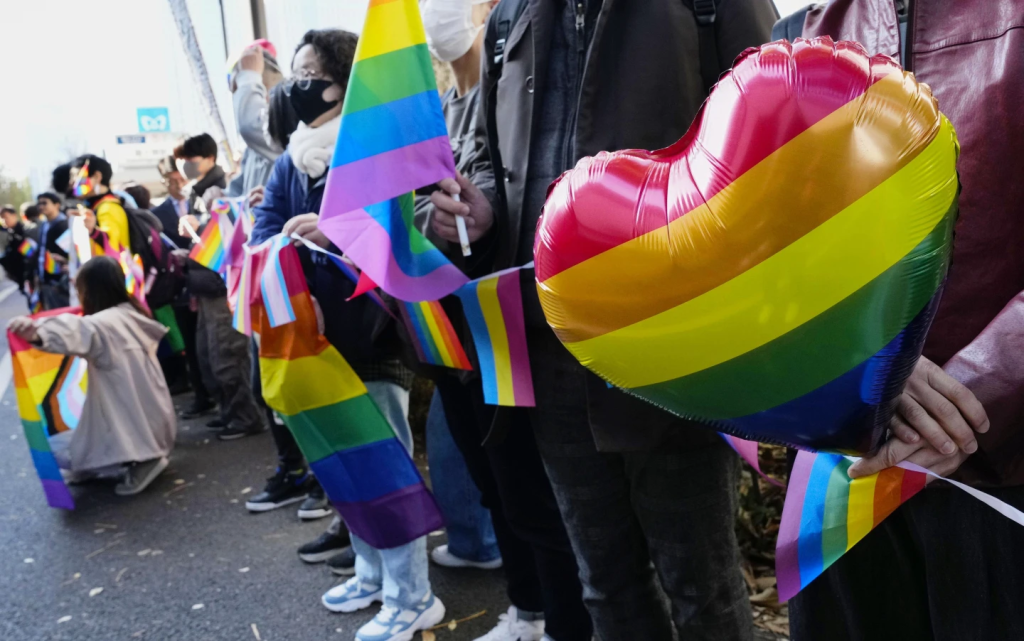
A court found Japan’s refusal to legalize same-sex marriage was constitutional Friday in the last of six cases that are expected to be brought to the Supreme Court for a final and definitive ruling, possibly next year.

The Tokyo High Court said marriage under the law is largely expected to be a union between men and women in a decision that reversed a lower court ruling last year and was the first loss at high courts in the six cases brought by those seeking equal marriage rights.

Judge Ayumi Higashi said a legal definition of a family as a unit between a couple and their children is rational and that exclusion of same-sex marriage is valid. The court also dismissed damages of 1 million yen ($6,400) each sought by eight sexual minorities seeking equal marital rights.

Plaintiffs and their lawyers said the decision was unjust but they were determined to keep fighting through the Supreme Court.

“I’m so disappointed,” plaintiff Hiromi Hatogai told reporters outside the court. “Rather than sorrow, I’m outraged and appalled by the decision. Were the judges listening to us?”

“We only want to be able to marry and be happy, just like anyone else,” said another plaintiff, Rie Fukuda. “I believe the society is changing. We won’t give up.”

With all six high court cases done, the Supreme Court is expected to handle all appeals and make a decision.

Though discrimination still exists at school, work and elsewhere, public backing for legalizing same-sex marriage and support in the business community have rapidly increased in recent years.

Japan is the only member of the Group of Seven industrialized countries that does not recognize same-sex marriage or provide any other form of legally binding protection for LGBTQ+ couples.

Prime Minister Sanae Takaichi ‘s conservative ruling Liberal Democratic Party is the main opponent of same-sex marital rights in Japan. The government has argued that marriage under civil law does not cover same-sex couples and places importance on natural reproduction.

More than 30 plaintiffs have joined the lawsuits on marriage equality filed across Japan since 2019. They argue that civil law provisions barring same-sex marriage violate the Constitutional right to equality and freedom of marriage.

Friday’s ruling was only the second that found the current government policy constitutional after the 2022 Osaka District Court decision.

Court grants big victory for same-sex marriage rights in European Union

Read more at LGBTQ Nation.

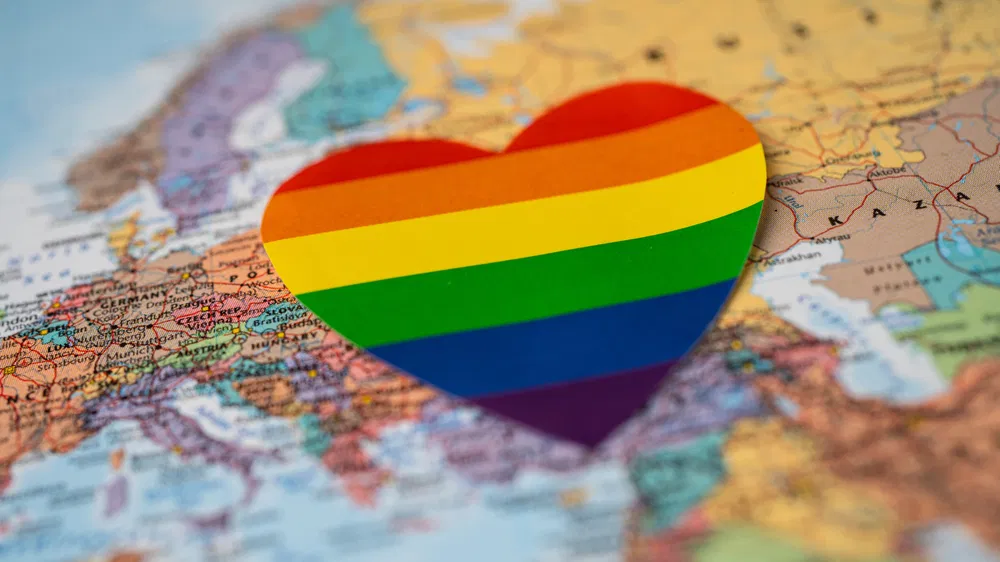
The European Court of Justice has issued a ruling that all nations in the European Union (EU) must recognize lawful same-sex marriages that were performed in other EU countries. Previously, a country could refuse to recognize a marriage if it had taken place in another country and did not align with its own laws.

The court declared that EU citizens have a right to “a normal family life” regardless of borders. “When they create a family life in a host member state,” they said, “in particular by virtue of marriage, they must have the certainty to be able to pursue that family life upon returning to their member state of origin.”

Citizens of the European Union have the right to freedom of movement between the different nations within the union. The court suggested that this right, as well as the right to “respect for private and family life,” would be breached if one country could refuse to acknowledge a lawful marriage from another country.

The court added in a press release, “Member States are therefore required to recognize, for the purpose of the exercise of the rights conferred by EU law, the marital status lawfully acquired in another Member State.”

The case was brought to the Luxembourg-based court on behalf of a Polish couple who had been married in Berlin, Germany, where same-sex marriage is recognized. When, years later, they returned to their home country, they submitted their marriage certificate, which was in German, to the Polish government to be transcribed and recognized in the Polish civil register.

The Polish government denied their request, as the country does not recognize same-sex marriages. With this new ruling, they will no longer be able to refuse legally.

The decision does not require that same-sex marriage be legalized by all EU nations, only that the marriages conducted in other EU countries be recognized, regardless of the citizenship of the people involved.

Of the 27 EU member states, only 18 have legalized same-sex marriage.

LGBTQ+ rights have taken some big hits in Poland in recent years. The far-right Law and Justice Party held power from 2015 to 2023 and enacted a range of anti-LGBTQ+ policies during that time. It was only in April of this year that the last “LGBT-free” zone created by the party was finally repealed.

Poland is currently led by a coalition government. The prime minister, Donald Tusk, campaigned on introducing same-sex civil unions and has pushed for such legislation to be passed. However, Poland’s president, Karol Nawrocki of the Law and Justice Party, has said that he would veto any legislation that would legalize same-sex marriage.

US Supreme Court backs parents’ right to opt out of LGBTQ-themed school books

Read more at MSN.

The United States Supreme Court has ruled in favour of a group of parents seeking to exempt their children from public school instruction that conflicts with their religious beliefs, in a 6-3 decision that reinforces constitutional protections for religious freedom.

The case was brought by Christian, Muslim, and Jewish parents in Montgomery County, Maryland, who objected to the use of LGBTQ-themed storybooks in elementary school classrooms, particularly books addressing same-sex marriage and gender identity.

Justice Samuel Alito, delivering the majority opinion, wrote that refusing to permit parents to opt their children out of such instruction “poses a very real threat of undermining their religious beliefs and practices” and violates the First Amendment’s guarantee of the free exercise of religion.

“The Montgomery County Board of Education’s introduction of the ‘LGBTQ+-inclusive’ storybooks, along with its decision to withhold opt outs, places an unconstitutional burden on the parents’ rights to the free exercise of their religion,” Alito wrote.

The justices found that the parents were likely to succeed in their legal challenge and should be granted a preliminary injunction while the case continues, meaning the school board must temporarily accommodate their request to be notified in advance of any related instruction and allow their children to be excused.

“In her dissent, Sotomayor accused the court of inventing a ‘constitutional right to avoid exposure to subtle themes contrary to the religious principles that parents wish to instill in their children.’” She was joined in dissent by Justices Elena Kagan and Ketanji Brown Jackson.

The dispute stems from a 2022 policy change when the school district introduced several LGBTQ-themed books into its language arts curriculum and initially allowed parents to opt out. A year later, the board reversed that decision, arguing the opt-out system was unmanageable and conflicted with the district’s commitment to inclusion.

The parents argued that mandatory exposure to the material, without an option to decline, amounted to “government-led indoctrination about sensitive matters of sexuality.” School officials, however, maintained that the books are intended to introduce children to “diverse viewpoints and ideas.”

During oral arguments in April, the court’s conservative majority signaled strong support for parental rights in such cases, indicating that allowing families to opt out of instruction on sensitive subjects should be “common sense.”

Legalizing same-sex marriage is still unpopular in South Korea. But does it need to be popular?

Read more at the Korea Herald.

South Korea made a quiet but meaningful policy change in October. For the first time, the national census now allows same-sex couples living together to identify each other as “spouse” in official records.

While this adjustment does not confer any legal rights, it marks a symbolic step in recognizing LGBTQ+ households in the state’s demographic data.

But as same-sex couples slowly appear in national statistics, legal marriage still remains out of reach. And public support for it is not growing. In fact, it is recently shrinking.

Two major opinion surveys in 2025 have confirmed the trend. In a Hankook Research poll, 31 percent of South Koreans said they supported the legalization of same-sex marriage, down from 36 percent in 2021. In a separate survey by Gallup Korea, 34 percent backed legalization while 58 percent opposed it, a reversal that returns the numbers to where they stood nearly a decade ago.

Although many advocates have long assumed that rising visibility and generational change would drive progress, the latest data presents a different picture. The Korea Herald consulted two advocates who argue that it may be time to ask a different question: Does same-sex marriage need broad public support to move forward, or can the law lead the way?

Public may seem unsure until ‘law decides for them’

Yi Ho-rim, executive director of Marriage for All Korea, a leading local LGBTQ+ advocacy group, sees this moment as a reminder that legal change is not always a popularity contest. “The support for legalization has declined somewhat, but that doesn’t mean the conversation is stagnant,” Yi said.

“In fact, we see the current moment as a result of political polarization, not public apathy.”

Yi links the decline to the broader social climate. “Far-right mobilization earlier this year, combined with heightened political tension and increased online radicalization among young men, likely influenced the shift,” she noted. “When public discourse is overwhelmed by noise and fear, minority issues like same-sex marriage naturally become sidelined.”

Yi has argued that laws can reshape public perception. “In Taiwan, support for same-sex marriage was limited before legalization in 2019. But once the law passed, social attitudes evolved quickly. That pattern is not unique to Taiwan. We’ve seen similar changes in many countries.”

This pattern is not just anecdotal. Yi points to a notable case in South Korea’s own polling history. “There’s no way to prove causality,” she said, “but it’s hard to see it as a coincidence that Gallup Korea’s support numbers jumped by 10 percentage points between 2013 and 2014, exactly when countries like New Zealand, France and several US states made headlines by legalizing same-sex marriage.”

Park Dae-seung, a political philosopher at Seoul National University and director of the Institute for Inequality and Citizenship in Seoul, agrees. “Constitutional democracies are designed to protect minority rights, even when those rights are unpopular,” Park said.

“Laws that affirm dignity and equality are rarely embraced by a majority at first. But they send a powerful social signal. They tell people what is ‘normal’. In other words, it’s the law that decides for them what’s acceptable.”

“Korean politicians routinely cite ‘lack of public consensus’ as a reason to delay bills like the Life Partnership Act or Marriage Equality Act, both of which remain stalled in the National Assembly for years,” he added. “But it’s an excuse.”

While younger South Koreans have historically been more supportive of LGBTQ+ rights, the generational divide is showing unexpected shifts. The latest Gallup Korea poll revealed that support for same-sex marriage among people in their 20s dropped by 15 percentage points between 2023 and 2025. At the same time, support among those over 70 nearly doubled, from 10 percent to 19 percent.

Yi sees this as a sign that older generations are not immovable. “These are people who still get most of their information from legacy media. When the 2024 Supreme Court ruling recognized same-sex cohabiting partners as eligible for health insurance benefits, it was widely reported. That may have helped normalize the issue.”

Groups like the Coalition Against Homosexuality and Same-Sex Marriage, backed by conservative Christian organizations, have actively resisted even symbolic shifts. In October, the group filed a criminal complaint against government officials who authorized same-sex partner recognition in the 2025 census. They claimed it violated the law by creating “false public records” and warned of a wider moral collapse.

Yi has contended that public discomfort should not be used to delay basic rights. “Many of these objections rely on the idea that LGBTQ+ people do not value love, care or long-term commitment,” she said.

“But that is only because most people have never met a same-sex couple in their daily lives. We are still largely invisible, and the numbers show it. In the 2025 Hankook Research survey, people who personally know an LGBTQ+ person were nearly twice as likely to support same-sex marriage. Visibility alone makes a real difference.”

While no one was watching: Belmont NC removes LGBTQ employee protections

Read more at QNotes Carolinas.

Karen Hinkley, an attorney in Belmont, filed a lawsuit in Gaston County on October 30 claiming the city of Belmont violated North Carolina’s open-government laws when the city council removed workplace protections for LGBTQ employees in March.

The City of Belmont, a suburban community with a population around 15,000, is generally viewed as more politically moderate than the rest of Gaston County, where Donald Trump received about 62% of the vote in 2024.

In June 2020 Belmont added protections based on sexual orientation and gender identity for its employees after a statewide moratorium on local nondiscrimination ordinances was due to expire. Several other cities such as Asheville, Charlotte, and Durham also added protections for LGBTQ residents and employees around this time.

The lawsuit centers on a March 3 vote in which the city council unanimously approved a new personnel policy that no longer includes explicit nondiscrimination protections based on sexual orientation and gender identity. The Gaston Gazette reported that “After several unsuccessful public records requests for documentation of behind-the-scenes conversations among City council members, Hinkley filed a lawsuit.”

North Carolina’s Open Meetings Law states that it “is the public policy of North Carolina that the hearings, deliberations, and actions of public bodies be conducted openly.”

According to the suit, city officials discussed the policy change outside of public meetings and used private text messages to coordinate the decision, violating North Carolina’s Open Meetings Law and Public Records Law. Hinkley argues that these private exchanges and the lack of transparency denied residents their legal right to witness how local policies are made.

The Gazette also reported that Hinckley “spoke about the policy change during public comment at a meeting on April 7. The video recording of that meeting began late and lacked audio for about 30 minutes, she said in the lawsuit, and minutes of the meeting misrepresented her comments. To Hinkley, the paraphrased notes about her comments in the official minutes of that meeting make it sound like she was supporting the removal of the protective language when the opposite is true,” she said.

Belmont city officials have not publicly commented on the lawsuit.

If the lawsuit is successful, the case could require Belmont to revisit its decision and restore LGBTQ protections, while also serving as a reminder that local governments must conduct business openly and transparently, and that secret policymaking, even on sensitive issues, can carry legal repercussions.

Russia Finds LGBTQ Travel Agent Guilty Of Extremism After Suicide

Read more at Barron’s.

A Moscow court Friday found an LGBTQ travel agent who had killed himself in custody a year ago guilty of extremism, as Russia increasingly targets individuals it says undermine “traditional” values.

The posthumous ruling came a year after 48-year-old Andrei Kotov was found dead in his cell in a Moscow pre-trial detention centre.

Russia has heavily targeted the LGBTQ community under President Vladimir Putin, and Friday’s ruling against somebody who had died a year earlier is seen as a particularly symbolic example of how zealous the crackdown is.

Kotov, who ran a travel company called Men Travel, had said he was beaten by 15 men when he was arrested in November 2024.

The Moscow Golovinsky court found him guilty of taking part in “extremist activity” as well as using underage people for pornography, the independent Mediazona website reported from inside the court.

His lawyer had said in December 2024 that Kotov’s body was found in his cell and that investigators told her he died by suicide.

Rights groups have accused authorities of using the case as a show trial — not dropping it after his death to scare LGBTQ people.

In November 2024, Kotov described his arrest in court: “Fifteen people came to me at night, beat me, were punching me in the face.”

Putin has for years denounced anything that goes against what he calls “traditional family values” as un-Russian and influenced by the West.

In 2023, Russia’s Supreme Court banned what it called the “international social LGBT movement” as an “extremist organisation”.

Human Rights Watch has said that the ruling “opened the floodgates for arbitrary prosecutions of individuals who are LGBT or perceived to be, along with anyone who defends their rights or expresses solidarity with them”.

Russia has never been a hospitable environment for LGBTQ people, but has become far more dangerous since Moscow’s Ukraine offensive, which massively accelerated the country’s hardline conservative turn.

Supreme Court rejects bid to overturn same-sex marriage ruling

Read more at The Hill.

The Supreme Court rejected a longshot effort Monday to overturn its ruling guaranteeing same-sex marriage nationwide. 

Former Kentucky county clerk Kim Davis directly asked the justices to overrule the 2015 landmark decision after a jury awarded damages to a couple whom Davis refused to issue a marriage license. 

“The Court can and should fix this mistake,” her attorneys wrote in court filings. 

In a brief order, the justices declined to take up Davis’s appeal alongside dozens of other petitions up for consideration at the justices’ weekly closed-door conference. There were no noted dissents.

Court watchers viewed Davis’s appeal as a longshot effort, but it sparked trepidation among LGBTQ rights groups since several conservative justices who dissented in the decade-old case remain on the court. 

Davis gained national attention after she raised religious objections to issuing marriage licenses to same-sex couples despite the Supreme Court’s decision in Obergefell v. Hodges. 

Among the refused couples was David Ermold and David Moore, who sued. Davis was found to have violated a judge’s order in another case, which required her to keep issuing licenses. 

Davis was jailed for five days, the couple obtained their license and Kentucky later passed a law enabling clerks to keep their signatures off marriage certificates. 

But Davis kept fighting in court after the couple won $100,000 in emotional distress damages from a jury plus $260,000 in attorneys’ fees. 

Primarily, Davis’s appeal concerned arguments that she has a private First Amendment religious defense against the award, despite acting as a government official.  

She tacked onto it a request to overturn Obergefell outright, insisting the whole lawsuit would fall if the justices do so. 

Texas will now let judges refuse to marry same-sex couples if it goes against their religion

Read more at LGBTQ Nation.

The Texas Supreme Court on Friday gave judges in the state a pass if they don’t want to marry same-sex couples, unilaterally granting public officials the right to discriminate against queer couples.

In an end run around equal protection concerns, the high court amended the Texas Code of Judicial Conduct to read, “It is not a violation of these canons for a judge to publicly refrain from performing a wedding ceremony based upon a sincerely held religious belief.”

The change follows years of litigation that inspired a lawsuit by a county judge in Texas asking federal courts to declare that Texas law does not and cannot punish him for his practice of officiating opposite-sex, but not same-sex, marriages in the state.

Jack County Judge Brian Umphress, who sued in 2020 because he only wanted to perform weddings for opposite-sex couples, argued that his conduct would run afoul of the Texas State Commission on Judicial Conduct, despite protections he believed he enjoyed consistent with his religious freedom rights under the First and Fourteenth Amendments, Houston Public Media reports.

In response, the U.S. Court of Appeals for the Fifth Circuit put the lower federal-court proceedings on hold and asked the Texas Supreme Court to answer the question, “Does Canon 4A(1) of the Texas Code of Judicial Conduct prohibit judges from publicly refusing, for moral or religious reasons, to perform same-sex weddings while continuing to perform opposite-sex weddings?” That part of the code requires judges to refrain from behavior that would “cast reasonable doubt on the judge’s capacity to act impartially as a judge.”

The high court’s answer came with the amended code of conduct, bypassing public argument.  

Judge Umphress’ fear of sanction for his discriminatory conduct was based on the case of McLennan County Justice of the Peace Dianne Hensley in Waco, who spent years in court arguing she had a right to refuse to marry gay couples.

Hensley replied to requests from gay couples with a statement that read, “I’m sorry, but Judge Hensley has a sincerely held religious belief as a Christian, and will not be able to perform any same-sex weddings.”

That conduct earned a public warning from the Judicial Conduct Commission, which said Hensley was violating a requirement that justices of the peace be impartial, even in extrajudicial duties like officiating weddings.

Her refusal to treat LGBTQ+ people equally cast “doubt on her capacity to act impartially to persons appearing before her as a judge due to the person’s sexual orientation,” the commission wrote.

Hensley claimed that no one’s rights were denied since a same-sex couple could have found another judge to marry them, despite the fact that she was the only justice of the peace performing marriages in Waco at the time.

Hensley filed a lawsuit against the commission with help from the First Liberty Institute, a Texas-based anti-LGBTQ+ legal organization, arguing for protections under the Texas Religious Freedom Restoration Act. The commission eventually dismissed its sanction a few months after the Texas Supreme Court allowed Hensley’s case to proceed.

That decision from the Texas high court earned Hensley a supportive concurring opinion from the chief justice, who publicly supported the Waco judge before his appointment.

“Judge Hensley treated them respectfully,” Chief Justice Jimmy Blacklock wrote of the couples she refused to marry. “They got married nearby. They went about their lives. Judge Hensley went back to work, her Christian conscience clean, her knees bent only to her God. Sounds like a win-win.”

Jason Mazzone, a law professor at the University of Illinois at Urbana-Champaign who’s familiar with both cases, said the Texas Supreme Court’s code of conduct workaround still leaves open the possibility for a gay couple with standing to challenge a judge’s decision not to marry them on constitutional equal protection grounds.

“One of the claims that I think will be made in response to litigation that is likely is that, ‘Well, there are other people who can perform the wedding ceremony, so you can’t insist that a particular judge do it,’” Mazzone said. “But that, of course, is not how equal protection works, and it’s not how we expect government officials to operate.”

Anti-LGBTQ+ hate crimes have risen around the world since 2020: report

Read more at The Advocate.

Hate crimes against LGBTQ+ people are rising around the world as politicians target them through legislation and rhetoric.

Anti-LGBTQ+ hate crimes have increased in the past five years across the United States, the United Kingdom, and Europe, according to a new report by the Institute for Strategic Dialogue, with transgender and gender nonconforming people particularly affected. The spike may in part be attributed to world governments passing anti-LGBTQ+ policies, which has “escalated internationally in tandem with political rhetoric.”

Some of the high profile incidents cited in the report include the mass shooting at the LGBTQ+ bar Club Q in Colorado that left five dead, the 2023 murder of a woman in California who was not LGBTQ+ because she flew a rainbow flag in her store, and the arrests of 20 members of the white supremacist group Patriot Front in 2023 who intended to riot at a Pride event in Idaho.

“These threats come from across the spectrum of ideological extremism, but frequently from groups that also pose a threat to the state and are openly opposed to democratic norms,” the report notes.

In the U.S., hate crimes against LGBTQ+ people remained high despite an overall decrease in violent crime. Out of 11,323 single-bias incidents the FBI reported in 2024, 2,278 (17.2 percent) were based on sexual orientation and 527 (4.1 percent) were based on gender identity. Hate crimes based on sexual orientation were the third-largest category, with crimes based on race, ethnicity, or ancestry being first and religiously motivated crimes second. Gender identity bias was the fourth-largest category.

Threats and harassment against school board officials in the U.S. also increased by 170 percent from the previous year in November, 2024 to April, 2025, the ISD report notes. Many of these threats were explicitly motivated by an anti-LGBTQ+ bias, with the perpetrators objecting to age appropriate queer books or content in public schools.

“LGBTQ+ individuals, who gained unprecedented civil rights in previous decades, are now increasingly targeted by online and offline hate, political rhetoric, censorship and legislation,” the report states. “A series of actions have sought to exclude LGBTQ+ people and culture from public life, ranging from book bans to a spread of legislation restricting trans people. In tandem, terror attacks (or the threat of terror attacks), violent extremist activity, and hate crimes targeting LGBTQ+ individuals have increased or remained consistently high since 2020.”

Blog at WordPress.com.

Up ↑