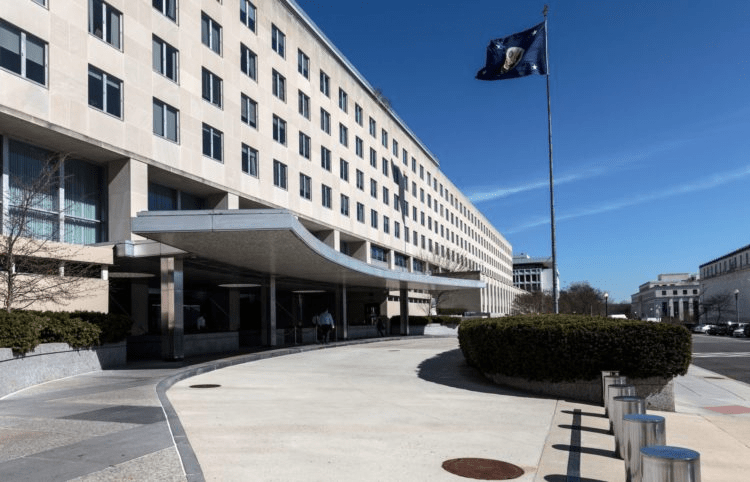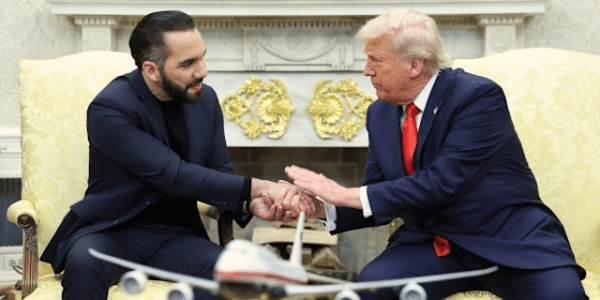
State Department Removes Anti-LGBTQ+ Violence From Human Rights Report Draft

Read more at Huff Post.

The Trump administration has removed all references to violence against LGBTQ+ people and gender-based violence in drafts of the State Department’s much anticipated annual report on international human rights.

The draft of the report, which was leaked to and first reported by The Washington Post on Wednesday, scales back its critiques of abuses in countries with a record of human rights abuses. In particular, the Post learned of drafts of human rights reports for El Salvador, Israel and Russia that completely excise references of LGBTQ+ people and violence toward those communities.

The erasure of LGBTQ+ people and the abuses they face in the draft report underscores the Trump administration’s intention to scale back references to human rights broadly and take its anti-LGBTQ+ agenda worldwide.

“The 2024 Human Rights report has been restructured in a way that removes redundancies, increases report readability and is more responsive to the legislative mandate that underpins the report,” a senior State Department official, speaking on the condition of anonymity to brief the news media, told reporters on Wednesday. “The human rights report focuses on core issues.”

The State Department did not immediately respond to HuffPost’s request for comment.

In a section about El Salvador, the draft report notes the country had “no credible reports of significant human rights abuses.” In a previous report from 2023, the State Department found “significant human rights issues” in El Salvador, including “politically motivated killings” and “harsh and life-threatening prison conditions.”

This spring, President Donald Trump secured a multimillion-dollar deal with El Salvador’s President Nayib Bukele to allow 252 Venezuelan men in the U.S. to be deported and housed within the country’s notorious new Terrorism Confinement Center, known as CECOT.

After being jailed for more than 120 days at CECOT, the men, most of who had no criminal history, told stories of being physically and mentally abused for days on end.

Jerce Reyes Barrios, one of the men held at CECOT, told HuffPost reporters Jessica Schulberg and Matt Shuham about his harrowing experience inside the prison. Reyes Barrios recalled a prison official saying, “Welcome to hell on earth, where you’ll be condemned to spend the rest of your lives; where I’m going to make sure that you never eat chicken or meat again.”

Andry José Hernández Romero, a gay Venezuelan makeup artist, alleged that CECOT guards groped him and forced him to perform oral sex while he was in solitary confinement.

A former State Department employee, Keifer Buckingham, said the removal of references to violence against LGBTQ+ people was a “glaring omission,” especially when it comes to Russia. In 2023, Russia’s supreme court deemed what it called an “international LGBT public movement” as extremist, and the courts began their first convictions of people last year under the order.

In February of 2024, a man in Volgograd was found guilty of “displaying the symbols of an extremist organisation” after posting a photo of the LGBTQ pride flag on social media. That same month, a woman near Moscow was sentenced to five days detention for wearing frog-shaped earrings that were rainbow colored.

The drafts of the reports for El Salvador and Russia were marked “finalized,” and the draft for Israel was marked “quality check,” according to the Post. It is still unclear when the reports, which are typically released to the public each March or April, will be sent to Congress and then the public, and if they will include these omissions.

U.S. diplomats have released the State Department’s annual human rights reports for nearly 50 years. Historically their findings have been widely read and anticipated by foreign leaders and diplomats, and have been used in legal proceedings both domestically and abroad.

However, this year human rights advocates decried the news about the ways in which the Trump administration has softened the descriptions of human rights abuses, especially the violence against LGBTQ+ people.

Uzra Zeya, the CEO of Human Rights First, an international human rights nonprofit, said in a statement that the changes were “a radical break” from the original goal to “objectively and even-handedly describe the human rights situation in every country and territory in the world.”

“This severely undermines their credibility and value in guiding U.S. decision-making on a wide range of critical foreign policy issues. Purging mention of elections, corruption, and global human rights abuses against LGBTQI+ persons, persons with disabilities, women and girls, refugees and other vulnerable groups runs counter to American interests and values and makes Americans abroad less safe and informed,” she continued.

Amanda Klasing, the national director of government relations for Amnesty International, said in a statement that she believes the mandate to scale back the report came from Secretary of State Marco Rubio, who instructed employees to delete sections that included stories from survivors of human rights violations and to ignore instances of repression in certain countries.

“The secretary’s instructions were to cut everything not legislatively mandated, but the leaked documents appear to show effort to narrow the scope of what the world hears about human rights abuses around the world,” she wrote.

“The downplaying or exclusion of key issues, such as discrimination and attacks on civil society, from this year’s report will hinder efforts from governments and civil society organizations around the world to respond to these abuses,” she continued.

The Trump administration’s erasure of LGBTQ+ people and gender-based violence has continued on other international stages. At a United Nations meeting in June, a U.S. delegate spent much of her time in a routing meeting on pollution to discuss the United States’ new “national position” on gender.

“Use of the term ‘gender’ replaces the biological category of sex with an ever-shifting concept of self-assessed gender identity and is demeaning and unfair, especially to women and girls,” the delegate said.

In at least six speeches before the United Nations, U.S. delegates have condemned what it calls “gender ideology,” and pushed the Trump administration’s support for recognizing so-called “biological sex,” according to ProPublica.

During his first day in office, Trump signed an executive declaring that the federal government only recognizes “two sexes, male and female,” and signaled that all references to “gender” would thus be replaced with the term “biological sex.”

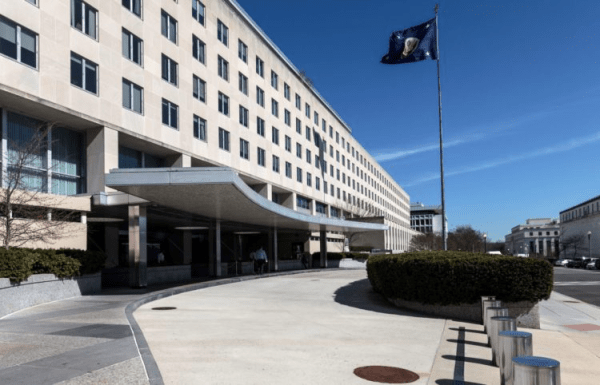
State Department to remove LGBTQ information from annual human rights report

*This is being reported by the Washington Blade

The State Department has not commented a report that indicates it plans to remove LGBTQ-specific information from their annual human rights report.

Politico on March 19 reported the Trump-Vance administration “is slashing the State Department’s annual human rights report — cutting sections about the rights of women, the disabled, the LGBTQ+ community, and more.” The Politico article notes it obtained “documents” and spoke with “a current and a former State Department official who were familiar with the plan.”

“We are not previewing the human rights report at this time,” a State Department spokesperson told the Washington Blade on March 21.

Congress requires the State Department to release a human rights report each year. 

The 2023 report specifically noted Uganda’s Anti-Homosexuality Act that contains a death penalty provision for “aggravated homosexuality.” The 2022 report highlighted, among other things, anti-LGBTQ crackdowns in Afghanistan, Russia, and Hungary and so-called conversion therapy.

President Donald Trump since he took office has signed a number of executive orders that have specifically targeted the LGBTQ and intersex community. These include the “Defending Women from Gender Ideology Extremism and Restoring Biological Truth to the Federal Government” directive that, among other things, bans the State Department from issuing passports with “X” gender markers.

The State Department has eliminated references to transgender travelers from its travel advisories. Germany, Denmark, and Finland have issued travel advisories for trans and nonbinary people who are planning to visit the U.S.

A directive that Secretary of State Marco Rubio issued bans embassies and other U.S. diplomatic institutions from flying the Pride flag. (Former President Joe Biden in March 2024 signed a government spending bill with a provision that banned Pride flags from flying over U.S. embassies.)

The U.S. has withdrawn from the U.N. LGBTI Core Group, a group of U.N. member states that have pledged to support LGBTQ and intersex rights, and the Organization of American States’ LGBTI Core Group. The Trump-Vance administration’s decision to suspend most U.S. foreign aid spending has been a “catastrophe” for the global LGBTQ and intersex rights movement.

The Trump administration is poised to abandon LGBTQ individuals in Africa

This blog is originally appeared at Washington Blade American’s LGBT News Source

Ugandan officials have expressed support for the incoming U.S. president.

As the results of the U.S. presidential election were revealed on November 5, showing that former President Donald Trump had secured a second term, homophobic political leaders in Uganda celebrated 7,000 miles away, in the capital city of Kampala.

“The sanctions are gone,” said Anita Among, Uganda’s parliamentary speaker, addressing members of parliament. She was referring to her previous U.S. travel ban imposed by the Biden administration on June 16, 2023, after Uganda passed the controversial “Kill The Gays” law on May 28, 2023.

The law, officially named the Anti-Homosexuality Act, was signed into effect by President Yoweri Museveni on May 28, 2023. The legislation imposes life imprisonment for same-sex acts, up to 20 years in prison for “recruitment, promotion, and funding” of same-sex “activities,” and the death penalty for those convicted of “attempted aggravated homosexuality.”

As the results of the U.S. presidential election were revealed on November 5, showing that former President Donald Trump had won a second term, homophobic political leaders celebrated 7,000 miles away in Uganda’s capital, Kampala.

“The sanctions are gone,” said Anita Among, Uganda’s parliamentary speaker, referring to the fact that she had been barred from entering the U.S. by the Biden administration on June 16, 2023, following Uganda’s passage of the “Kill The Gays” law on May 28, 2023.

The law, officially called the Anti-Homosexuality Act, was signed into law by President Yoweri Museveni on May 28, 2023. It mandates life imprisonment for same-sex acts, up to 20 years in prison for the “recruitment, promotion, and funding” of same-sex “activities,” and the death penalty for those convicted of “attempted aggravated homosexuality.”

On May 8, Among declared that the law’s enactment proved “the Western world will not come and rule Uganda.” The following day, she tweeted: “The president … has assented to the Anti-Homosexuality Act. As the parliament of Uganda, we have answered the cries of our people. We have legislated to protect the sanctity of [the] family. We have stood strong to defend our culture and [the] aspirations of our people,” thanking Museveni for his “steadfast action in the interest of Uganda.”

Among further stated that Ugandan MPs had resisted pressure from “bullies and doomsday conspiracy theorists” and urged the country’s courts to enforce the new law. The passage of this bill, along with Among’s and other African homophobes’ celebrations of Trump’s re-election, indicates the likely direction for Africa’s LGBTQ+ community over the next four years.

For years, political and religious leaders across Africa, including both Christian and Muslim zealots, have exploited homophobia to consolidate political and religious power. They claim that same-sex relations and gay rights are foreign imports from the West and use homophobia to position themselves as defenders of African values. By stoking fear and division, they galvanize popular support and votes.

However, as others have pointed out, homophobia itself is a Western import, rooted in colonial history. From sodomy laws inherited from colonial rule to the parliaments passing these laws today, the tools used by homophobes in Uganda and elsewhere in Africa are themselves colonial legacies.

And homophobia in Africa is intensifying.

In mid-March 2023, Museveni told the Monitor newspaper that “Western countries should stop wasting the time of humanity by imposing their social practices on us.” Kenyan President William Ruto echoed these sentiments in the same month, declaring that “our culture and religion does not allow same-sex marriages.”

On April 2, 2023, Museveni called on African leaders to reject “the promotion of homosexuality,” claiming that homosexuality posed a “big threat and danger to the procreation of the human race.” He further asserted that “Africa should provide the lead to save the world from this degeneration and decadence, which is really very dangerous for humanity.”

On December 29, 2023, Burundian President Evariste Ndayishimiye, speaking in Cankuzo province, made a defiant statement that powerful nations “should keep” their aid if it came with an obligation to extend rights to LGBTQ+ people. He added, “If we find these people in Burundi, they should be taken to stadiums and stoned, and doing so would not be a crime.”

In Ghana, lawmakers have been debating the Proper Human Sexual Rights and Ghanaian Family Values Bill, which was introduced in August 2021. Under current law, same-sex relations are punishable by up to three years in prison. However, the new bill criminalizes even identifying as LGBTQ+, outlaws being transgender, and introduces jail sentences of up to 10 years for advocating for LGBTQ+ rights. It also mandates that all citizens report perceived LGBTQ+ individuals or activities to the authorities.

The bill passed in the Ghanaian parliament on February 28, though President Nana Addo Dankwa Akufo-Addo has not yet announced whether he will sign it, pending the outcome of two Supreme Court cases challenging its constitutionality. On July 17, the Supreme Court postponed a ruling on the bill until all legal challenges are resolved.

Former Ghanaian President John Dramani Mahama, a leading candidate in the upcoming elections, expressed his opposition to same-sex marriage and transgender rights. He stated during a meeting with clergy in eastern Ghana, “The faith I have will not allow me to accept a man marrying a man, and a woman marrying a woman.” He also rejected the notion of someone changing their gender, stating, “I don’t believe that anyone can get up and say I feel like a man although I was born a woman and so I will change and become a man.”

In Kenya, opposition parliamentarian Peter Kaluma introduced the Family Protection Bill in February 2023. The bill, which mirrors aspects of Uganda’s law, would impose prison sentences of up to 10 years or even the death penalty for same-sex relations. The bill is currently being reviewed by a parliamentary committee, with a full vote expected soon. President William Ruto, an evangelical Christian, has endorsed this legal crackdown on LGBTQI+ rights.

In Mali, the National Transitional Council, effectively the country’s legislature after a military coup in 2020, approved a new penal code on October 31 that criminalizes same-sex relations by 132 votes to one. The exact penalties for same-sex acts remain unclear, but the Justice and Human Rights Minister, Mamadou Kasogue, confirmed that “anyone who indulges in this practice, or promotes or condones it, will be prosecuted.”

Trump’s foreign policy advisors are already preparing an explicitly anti-LGBTQ+ rights agenda for his second term. The Project 2025 report, crafted under the guidance of the Heritage Foundation, proposes that the U.S. “stop promoting policies birthed in the American culture wars” and cease pressuring African governments to respect human rights, including LGBTQ+ rights, women’s rights, and abortion rights.

The report claims that “African nations are particularly (and reasonably) non-receptive to the US social policies such as abortion and pro-LGBT initiatives,” and suggests that the U.S. should focus on “core security, economic, and human rights engagement” without promoting “divisive policies that hurt shared goals.”

The implementation of this policy shift on LGBTQ+ rights in Africa will be overseen by Trump’s nominee for Secretary of State, Marco Rubio, and his selection for Assistant Secretary of State for African Affairs. They will be tasked with promoting and funding homophobic groups across the continent, a strategy that is expected to be pursued with enthusiasm.

While African leaders claim they are defending the continent from Western influences, they are in fact advancing their own agendas, often in partnership with right-wing Christian nationalists in the West. However, LGBTQ+ communities in both Africa and the West share a common interest in resisting these attacks, and civil society groups, along with human rights advocates, are increasingly active. As LGBTQ+ activist Eric Gilari from Kenya stated, “One day we shall defeat these assaults on our human rights and triumph in equality and inclusion for LGBTQ persons within African countries. This ideal must be our guiding light in this moment of darkness and tears.”

What Trump’s Presidency Could Mean for Trans People: Potential Policies and Warning Signs to Watch

This blog is originally appeared at LGBTQ Nation

Why Allies Must Act: Defending Trans Rights Protects Everyone’s Freedoms

As the election dust settles, the focus shifts to practical realities. For transgender people like me, a pressing question looms: What actions will this new Trump administration take?

It’s tempting to jump to extreme conclusions—like the idea of being rounded up and placed in camps. But it likely won’t look like that. There won’t be “camps,” nor will there be overt “rounding up.” Instead, the approach will be more subtle, and that subtlety is precisely what makes it so dangerous.

The quiet nature of these changes will make them easier for cisgender people to overlook. However, their awareness is vital—not only for our survival but for their own protection, as the erosion of trans rights often signals broader attacks on freedoms that could ultimately affect everyone.

The groundwork for trans oppression is already being laid. In recent years, Republicans have pursued anti-trans legislation with alarming intensity, proposing over 1,000 laws targeting everything from medical care and bathroom usage to IDs, sports, and even how we dress. Trump has vowed to push similar policies at the federal level, and Project 2025 outlines an even more expansive agenda.

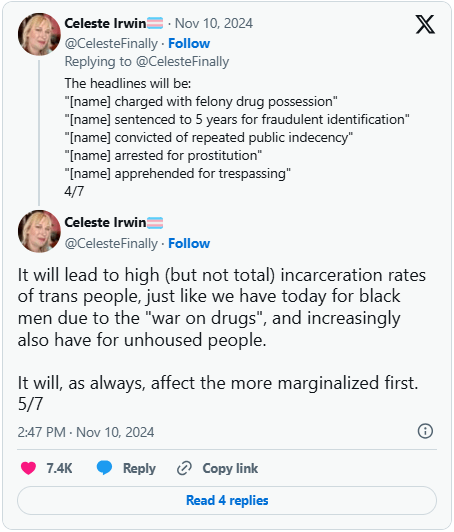
To understand what trans oppression under Trump might look like, we can look to other marginalized groups. For instance, the mass incarceration of Black men wasn’t achieved through blatant decrees like “round them up” but through systemic oppression: harsh laws with disproportionate penalties, over-policing, and economic barriers that strip away basic human needs. Trans people have already faced similar tactics, such as laws criminalizing “cross-dressing” to police our existence.

Under another Trump administration, this oppression might escalate. It could involve banning hormone replacement therapy and criminalizing those who seek it out. Policies might mandate that gender markers on IDs match sex assigned at birth, penalizing those of us who continue to live authentically with fraud or perjury charges. Involuntary commitment to mental institutions could even be a reality.

These measures, even if sporadically enforced, create an ever-present climate of fear—a psychological toll that leaves us constantly bracing for the next law, the next crackdown, the next violation of our humanity. And in this hostile environment, the silence or complacency of cisgender allies would make it all the easier for these oppressive systems to thrive.

The coming years will likely see escalating attacks on trans people, particularly the most marginalized among us—trans women of color, disabled trans people, and others who already face significant barriers. These policies will make it harder for them to access stable employment and lead precarious lives, amplifying systemic inequities.

We cannot wait for something as blatant as a “lock up all the trans people” decree. The oppression will come in quieter, more insidious forms: laws and policies that restrict our rights to healthcare, employment, and basic expression. Even if trans people comply with these laws, the result will still be a kind of prison—a life stripped of autonomy and dignity.

If you are cisgender, we need your help. Not just because it’s the right thing to do, but because these attacks on trans rights will eventually pave the way for attacks on your rights. Consider abortion access: for decades, conservatives framed their arguments around “protecting life” to avoid addressing bodily autonomy directly. But the fight against gender-affirming care removes that pretense altogether. By banning medically supported, evidence-based care simply because they don’t like it, lawmakers set a dangerous precedent that could extend to other healthcare decisions.

Your body could be next.

Employment and education are also at risk. Imagine a national “Don’t Say Gay/Trans” policy that bars teachers like me—who are openly transgender—from the profession. Policies like these won’t stop at targeting trans people. Deadnaming and misgendering trans students could morph into strict gendered dress codes for everyone, eroding freedom of expression for all students. What starts as an attack on trans rights often metastasizes into broader assaults on personal liberties.

As we approach January 20th, now is the time to act:

  • Get involved: Connect with your local LGBTQ+ center and see how you can support their efforts.
  • Stay informed: Follow trans journalists and activists to keep up with the latest developments.
  • Advocate: Write to your representatives in both parties, showing them that you stand with trans people.
  • Speak out: Use your voice, wear supportive messages, and engage your cisgender friends to build awareness.
  • Support trans people directly: Check in with your trans friends, especially now, as they navigate a political climate fueled by over $200 million of anti-trans rhetoric during the election. Let them know you’re there for them.

This isn’t just about protecting trans people—it’s about preserving freedom and dignity for everyone. Together, we can resist these threats and build a future where everyone has the right to live authentically.

Blog at WordPress.com.

Up ↑