
This blog is originally appeared at Them
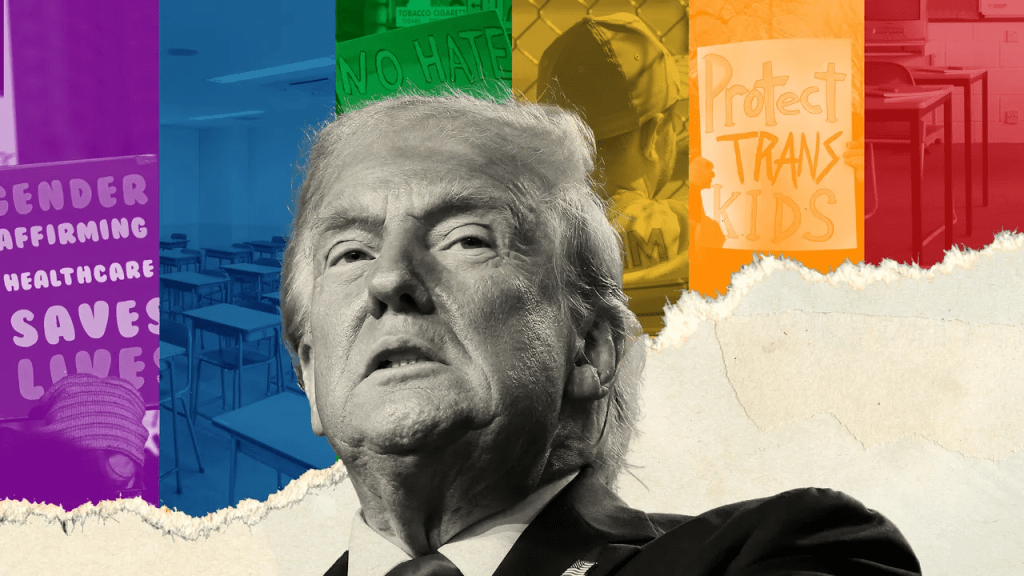
Trump has pledged to eliminate gender-affirming care for trans youth, ban trans kids from participating in sports, and erase trans people from public life. Is he actually able to carry out these promises?
As the second Trump administration starts to take form, civil rights advocates are bracing for a new wave of attacks on the LGBTQ+ community. During his first term, Trump’s White House enacted over 200 policies that harmed LGBTQ+ equality, including the ban on openly trans individuals serving in the military, cuts to HIV/AIDS funding, and the repeal of protections for trans patients seeking healthcare and trans individuals in need of emergency shelter.
Trump has made it clear that he intends to continue reversing LGBTQ+ rights once he returns to the White House in January. On his 2024 campaign website, the president-elect outlined an aggressive agenda targeting fundamental rights and protections for LGBTQ+ people. This includes a ban on gender-affirming medical care for trans youth, federal “Don’t Say Gay” policies restricting LGBTQ+ discussions in schools, a nationwide ban on trans student-athletes competing according to their gender identity, and a federal law defining gender as binary and assigned at birth—measures that would have far-reaching consequences for trans, nonbinary, and intersex Americans.
Civil rights groups say they are already bracing for the upcoming battle as Trump assembles a diverse group of anti-LGBTQ+ nominees for his Cabinet. What will bolster his administration’s power to push its far-right agenda is the GOP’s control over all three branches of government: six of the nine Supreme Court justices were appointed by Republican presidents, and conservatives will hold majorities in both houses of Congress for the first time since 2016.
Them spoke with legal experts to assess how feasible Trump’s anti-LGBTQ+ threats are and what strategies advocates might use to fight back. Despite the challenges ahead, Ezra Cukor, co-interim legal director of Advocates for Trans Equality, remains hopeful, believing this is merely “one chapter in a story of trans folks being a part of civil society in the United States.”
“There have been moments of joy, and there have been moments of challenge,” he tells Them. “In this moment, I’m just grateful to be part of a broader civil rights fabric, knowing that there’s a long history of trans folks insisting on our basic rights and working for our liberation and that there are many of us in this together.”
Ending Gender-Affirming Care for Trans Youth
In a January 2023 video posted on his Truth Social platform, Trump vowed to launch an all-out assault on gender-affirming healthcare for trans youth. He called on Congress to pass a law banning “child sexual mutilation” in all 50 states and pledged to cut Medicaid and Medicare funding to any hospital providing gender-affirming care to minors. Trump also promised to instruct the Department of Justice to investigate whether medical providers had “deliberately covered up horrific long-term side effects” of transition care for youth, and he vowed to support a “private right of action” for patients who might later regret the transition treatments they received as children. (This, despite the fact that rates of transition regret are notably low.)
Civil rights groups are already preparing for the fight ahead as Trump selects a range of anti-LGBTQ+ nominees for his Cabinet. What will strengthen his administration’s ability to push its far-right agenda is the GOP’s control over all three branches of government: six of the nine Supreme Court justices were appointed by Republican presidents, and conservatives will hold majorities in both houses of Congress for the first time since 2016.
Them spoke with legal experts to gauge how feasible Trump’s anti-LGBTQ+ threats truly are and what actions advocates might take to resist them. Despite the significant challenges, Ezra Cukor, co-interim legal director of Advocates for Trans Equality, remains hopeful, viewing this moment as “one chapter in a story of trans folks being a part of civil society in the United States.”
“There have been moments of joy, and there have been moments of challenge,” Cukor tells Them. “In this moment, I’m just grateful to be part of a broader civil rights fabric, knowing that there’s a long history of trans folks insisting on our basic rights and working for our liberation, and that there are many of us in this together.”
Ending Gender-Affirming Care for Trans Youth
In a January 2023 video posted on his Truth Social platform, Trump promised to launch a full-scale assault on gender-affirming healthcare for trans youth. He called on Congress to pass a law banning “child sexual mutilation” across all 50 states and vowed to eliminate Medicaid and Medicare funding for hospitals providing gender-affirming care to minors. Trump also pledged to direct the Department of Justice to investigate whether medical providers had “deliberately covered up horrific long-term side effects” of transition care for youth, and he expressed support for a “private right of action” for patients who might later regret their transition treatments. (This, despite the fact that regret rates for transition treatments are extremely low.)
Sasha Buchert, a senior attorney with Lambda Legal, argues that the push for a national trans sports ban exposes the hypocrisy of Republicans’ long-standing stance that LGBTQ+ educational policies should be decided at the state and local level. “Once the far right gets in power, suddenly they feel like they should be imposing their beliefs on the rest of the country,” Buchert tells Them, pointing to the 26 state attorneys general who opposed the Biden administration’s interpretation that Title IX protects trans students from discrimination. “These issues aren’t in isolation. They’re part of a widespread onslaught of attacks targeting the trans community and specifically trans youth.”
Given the potential for a filibuster, Buchert predicts Trump will not wait for Congress to act, instead seeking “immediate gratification” to appease his base. She expects him to issue an executive order that would bar trans students from protection under Title IX, echoing the early days of his first term, when his Department of Education repealed Obama-era guidance that required schools to treat trans students in accordance with their gender identity.
Buchert vowed that Lambda Legal would challenge such an order in court, pointing out that courts have consistently ruled against targeted sports bans, which they view as discriminatory toward trans athletes. Anti-trans sports laws in Arizona and Idaho have been blocked by the courts for now, while the Fourth Circuit Court of Appeals blocked West Virginia from preventing a trans student, Becky Pepper-Jackson, a 14-year-old middle school runner, from competing. (West Virginia intends to appeal that ruling to the Supreme Court.)
“The federal courts have agreed that it really does deprive [trans student athletes] and harm them by not allowing them to participate,” Buchert says. “The argument that they can still play on a boys’ team or intramural team doesn’t hold any water. The courts have seen right through that. It’s like saying before marriage equality: ‘You can still get married. You just can’t get married to somebody of the same gender.’”
Enacting National “Don’t Say Gay” Policies
Trump has also pledged to implement broader policies targeting LGBTQ+ students in schools, including “Don’t Say Gay”-style restrictions in the classroom and regulations that would force teachers to out trans students to their parents. His 2024 platform promises to “protect the rights of parents from being forced to allow their minor child to assume a gender” without their consent, frequently repeating false claims that schools are transitioning children without their families’ knowledge. “Can you imagine you’re a parent and your son leaves the house and you say, ‘Jimmy, I love you so much. Go have a good day in school,’ and your son comes back with a brutal operation?” Trump asked at a Wisconsin rally. “Can you even imagine this? What the hell is wrong with our country?”
Should Trump push his proposed policies through Department of Education regulations or an executive order, Chris Erchull, a staff attorney with the LGBTQ+ advocacy group GLAD, believes the legal system will stand with queer students. He points out that courts have long held that all students are “entitled to a full education.” “You go all the way back to the promise of Brown v. Board of Education, which said that separate education is not equal education,” he tells Them, referencing the landmark 1954 Supreme Court ruling that desegregated schools by race. “Those principles apply when we’re talking about the rights of LGBTQ+ students today. For students to get a complete education, they need to see themselves represented. You can’t suppress their identities in the classroom, or you’ll be depriving them of that.”
Erchull also notes that in the past year, advocates have won several key victories in the fight against anti-LGBTQ+ restrictions in schools. In March, Florida settled a lawsuit that rolled back parts of its “Don’t Say Gay” law, narrowing the scope of the state’s regulations. The law was so broadly worded that school districts, fearing lawsuits for noncompliance, had applied it to nearly all aspects of campus life, including student clubs like Gender-Sexuality Alliances. Just two months later, a New Hampshire district court ruled that an anti-LGBTQ+ law restricting classroom discussions in the state was “unconstitutionally vague.”
“Those are really powerful examples of how the courts can step up and be a voice of reason amidst attempts to undermine public education,” Erchull says. “There’s this zero-sum thinking where, if LGBTQ+ students are represented and seen, that’s depriving other people of something, and that’s not true at all. What research shows is that inclusive and supportive school environments benefit all students.”
Federal Law Erasing Trans People
Trump’s campaign website promises that, if re-elected, he will push Congress to pass a law defining gender as strictly male and female, assigned at birth. This pledge echoes a policy from his first presidency, when the Department of Health and Human Services (HHS) attempted to narrow the federal definition of gender to “immutable biological traits identifiable by or before birth.” A 2018 memo reportedly circulated within HHS stated that “the sex listed on a person’s birth certificate, as originally issued, shall constitute definitive proof of a person’s sex unless rebutted by reliable genetic evidence.”
Passing a federal bill through Congress to define trans people out of existence would be unprecedented, requiring support from both houses to succeed. Sarah Warbelow, legal director at the Human Rights Campaign, notes that LGBTQ+ advocates have already seen the potential impact of such policies through laws enacted at the state level. In May 2023, Montana Gov. Greg Gianforte (R) signed a law redefining sex as strictly male or female in portions of the state code. While that statute was struck down by a district court earlier this year, Kansas and Tennessee still have similar mandates in place.
Warbelow emphasizes that these types of restrictions have far-reaching consequences on trans people’s daily lives, impacting their ability to obtain identity documents and access spaces that align with their identities. However, she also points out that the full implications of such laws are unclear. After Kansas passed its 2023 law redefining gender, Attorney General Kris Kobach (R) claimed that schools were required to out trans students to their parents, even though the law did not explicitly state this. Warbelow notes that “there are huge unknowns” about how a federal law erasing trans identities would be interpreted or applied, whether by the courts, individual states, or schools.
“It becomes unclear how it would be operationalized,” she tells Them. “To the extent that it is interpreted broadly, it could have ramifications for non-discrimination laws. In Bostock, the Supreme Court interpreted the term ‘sex’ to be broadly understood as including LGBTQ+ people in the context of non-discrimination laws, so it could potentially eliminate those legal protections for LGBTQ+ people in the future.”
That’s why Warbelow says that the Human Rights Campaign, as the nation’s largest LGBTQ+ organization, is exploring “every option” to counter Trump’s anti-trans agenda. She adds that if litigation becomes necessary, the organization will likely invoke constitutional protections related to free speech, equal protection under the law, and due process to challenge a federal redefinition of gender. “We know it’s going to be incredibly tough work, but we have no choice but to fight,” she asserts. “We’ve got to throw our all at preserving democracy and the rights of LGBTQ+ people.”




 fleeredstates.blog
You must be logged in to post a comment.