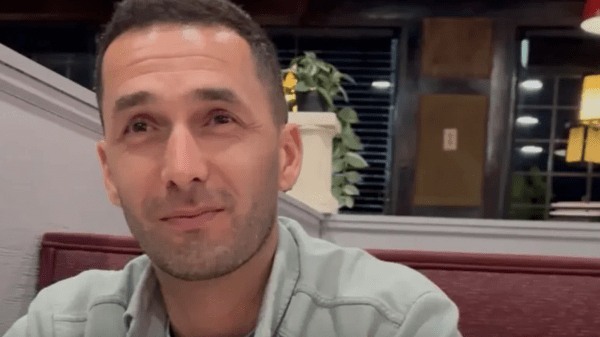
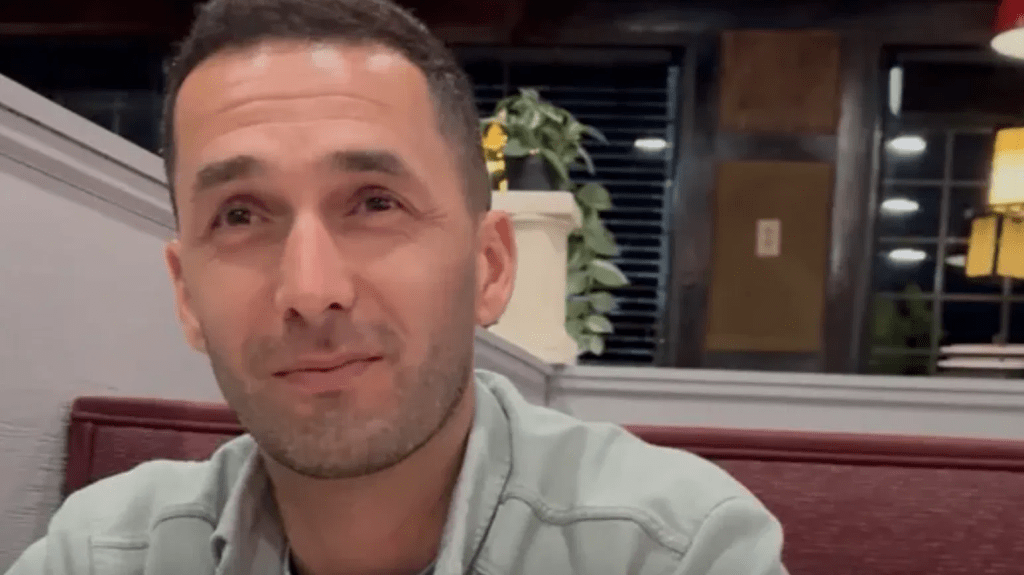
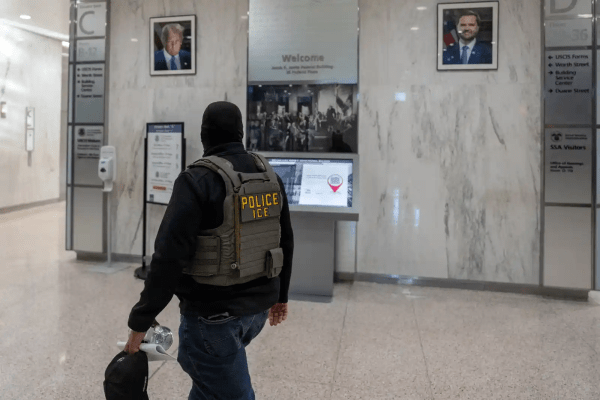
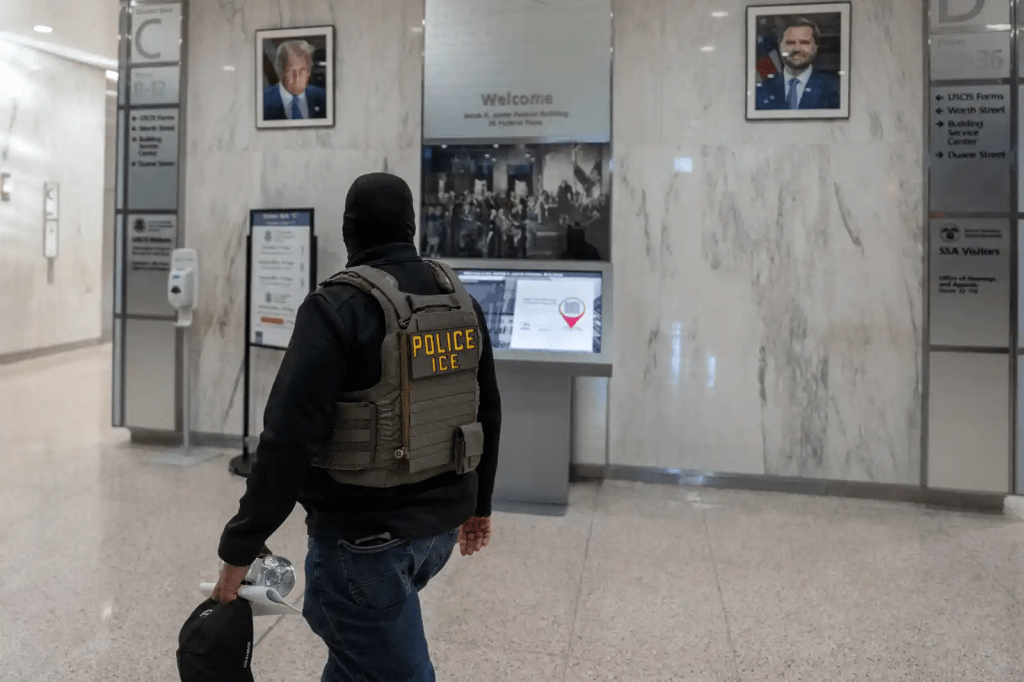
A gay couple from Azerbaijan is suffering the current administration’s crusade against immigrants from two sides of a heavy glass partition at an ICE detention facility in Georgia.
“He’s inside, but I’m outside, but I’m living the same situation,” Samir Gadirov, 30, told the Advocate of his husband held in detention. “I’m experiencing the same situation, same feelings.”
Gadirov’s husband, Tural Atakishiyev, 40, was taken into custody in January during a routine immigration check-in in North Carolina, where the couple lives and has a small home renovation business.
The couple met when Gadirov, a permanent U.S. resident, was on vacation in Azerbaijan in 2024. Atakishiyev entered the U.S. with temporary permission, applied for asylum and work authorization, and the couple married last November.
Their marriage opened a path for residency for Atakishiyev, as well, Gadirov said.
But five weeks ago, Atakishiyev was taken into custody. The day still feels unreal, Gadirov said.
He described waiting at the check-in office where Atakishiyev was reporting, and noticing that the staffer was avoiding eye contact. His husband never returned.
The Department of Homeland Security claims Atakishiyev had missed check-ins, which Gadirov disputes. “We never, never missed any of those, and we only followed the rules,” he said. “We applied for asylum, we got married, we applied for I-130, and every legal step that needs to be done, we have done that. But ICE now is lying.”
Now Gadirov drives the six hours from North Carolina to the Stewart Detention Center in southwestern Georgia for his single allotted visit per week with Atakishiyev.
“I can see him through glass windows only,” he said. “The food is awful, and the medication is awful. It’s been like a month, but they have not given him his prescription medication, the pills, because he has panic attacks.”
“He already lost 25 pounds,” Gadirov said.
Now the couple faces a choice: fight their case for months while Atakishiyev remains detained, or “self-deport” to Azerbaijan, where LGBTQ+ people suffer discrimination and worse, and their marriage won’t be recognized.
They’ve chosen the latter.
“I knew the U.S. as a free country,” Gadirov said. “The United States was equal to freedom, but now it’s not.”
Gadirov said his husband’s health mattered more than staying in the United States.
“His mental health is very important to me,” he said. “So, five, six months inside, we don’t want it.”
Now Gadirov is trying to convince DHS, ICE, and an immigration judge to simply let his husband go so the couple can leave the country.
“We’ll have to deal again with ICE to kind of figure out his plane ticket and how we can make this situation as quick as possible,” Gadirov said. “But it seems like it’s very slow.”
In the meantime, Gadirov is thankful for help from a local church and an immigrant advocacy group who’ve started a GoFundMe campaign to help with what comes next for the couple.
Gadirov envisions a life in the country.
“We can live in the countryside, and kind of start our lives from scratch, from zero,” he said.
“He’s my second half,” Gadirov said of Atakishiyev. “If we can be happy as a couple together in Azerbaijan, in the countryside, we are fine with that.”
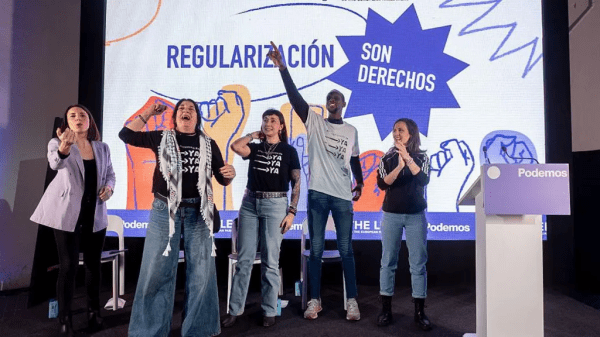
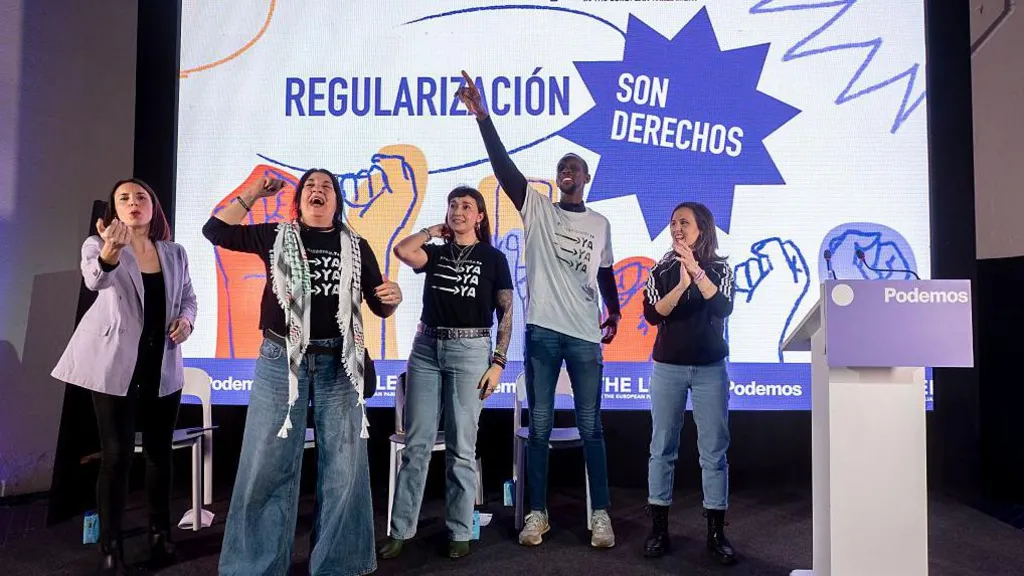
The Spanish government has announced a plan to legalise the status of undocumented migrants, a measure expected to benefit at least half a million people.
Regularisation will be available to foreign nationals who do not have a criminal record and can prove they lived in Spain for at least five months prior to 31 December 2025.
“This is an historic day for our country,” said Elma Saiz, Spain’s minister of inclusion, social security and migration.
The measure will provide beneficiaries with an initial one-year residence permit, which can then be extended. Requests for legalisation are expected to begin in April and the process will remain open until the end of June.
“We are reinforcing a migratory model based on human rights, integration, co-existence and which is compatible with economic growth and social cohesion,” Saiz said.
Spain has seen a large influx of migrants in recent years, mainly from Latin America.
The conservative think-tank Funcas found that the number of undocumented migrants in Spain had risen from 107,409 in 2017 to 837,938 in 2025 – an eight-fold increase.
The highest number of undocumented arrivals currently living in Spain are believed to be from Colombia, Peru and Honduras.
Spain’s socialist-led coalition government has been an outlier on this issue among the larger European nations, underlining the importance of migrants for the economy.
The country has been outperforming the other main EU economies in recent years, posting expected growth of close to 3% in 2025.
Unemployment, a longstanding weakness of the Spanish economy, has dipped below 10% for the first time since 2008, according to figures released on Tuesday.
Prime Minister Pedro Sánchez has described immigrants as representing “wealth, development and prosperity” for Spain, pointing to their contribution to the social security system.
The government and parties on the left have also emphasised the need to treat migrants in a humane way.
“Providing rights is the answer to racism,” said Irene Montero, of the far-left Podemos party and a former minister in a coalition government with the Socialists.
She has campaigned for this measure, which followed an agreement between the party and the government. A civic legislative proposal, calling for a mass migrant regularisation, received the support of around 700,000 people but had been languishing in parliament.
This measure will be approved by royal decree, meaning it does not require parliamentary approval.
It is the first large-scale migrant regularisation in Spain for two decades.
Several such initiatives, by governments of both the Socialists and the conservative People’s Party (PP), legalised the status of an estimated half a million migrants between 1986 and 2005.
However, Alberto Núñez Feijóo, leader of the PP, said the latest mass legalisation would “increase the pull effect and overwhelm our public services”.
Pepa Millán, spokeswoman for the far-right Vox, said the initiative “attacks our identity”, adding that the party would appeal before the Supreme Court in a bid to block it.
In the midst of the Trump administration’s attacks on both the LGBTQ community and immigrants, the non-profit organization Immigration Equality is working to ensure that queer asylum seekers and refugees have access to legal services.
Immigration Equality, which has represented LGBTQ immigrants since it was founded in 1994, has been a haven for individuals who come from countries where they are persecuted for their identity. They offer both direct representation and a program where asylum seekers’ cases are vetted and matched with pro-bono lawyers.
But since the Trump administration’s recent attacks on immigrants, the process of filing these individuals’ cases and fighting for their safety has become significantly more difficult. Immigration Equality’s director of law and policy, Bridget Crawford, noted in an interview with Gay City News that Trump has been attacking all cases, not just a certain few.
“A lot of what the Trump administration seems to be focused on is not efficient, fair adjudication of claims,” she said. “It seems to be focused on eliminating the claims altogether and preventing people from making them, or quickly dispensing with them without due process.”
Alongside blocking initial claims from being made and removing more than one-third of immigration judges, the appellate courts are also shifting their decisions to move less favorably toward immigrants, despite many of these cases having overwhelming evidence that they meet the requirements for refugee status and protection.
All of these obstacles have resulted in an uptick in Immigration Equality’s cases being denied, and these issues are being further inflamed after Trump recently announced the pause of many immigrant cases, following the shooting of two West Virginia National Guard members.
But Crawford made sure to note that despite these hardships, Immigration Equality is still winning cases.
“We still have many people, both trans and LGB, who are successful in their claims,” she said. “The reality is that under the law, as it is written, and the precedent as it’s been established for decades, these are very strong claims — people continue to win because they meet the definition of asylum under our law.”
These policies have invoked fear in immigrants pursuing a case, as they are scared of not having their case heard and fear showing up for their case and being put into detention centers, despite following all the correct procedures. Being LGBTQ amplifies this fear.
“As an LGBTQ+ advocacy organization, we have long witnessed mistreatment of our population in the immigration detention system,” Crawford said. A 2024 report published by Immigration Equality revealed that under both Democratic and Republican administrations, there were consistent reports of “sexual harassment, verbal and sexual abuse, physical abuse, prolonged solitary confinement, and inadequate medical care.”
The few protections that were in place to prevent this abuse have gradually been gutted, according to Crawford. These included internal watchdog agencies like the Civil Rights Civil Liberties (CRCL). In the past, if someone filed a complaint of mistreatment, it would be investigated by these internal agencies. Recently, though, these complaints have not been looked into.
Against the backdrop of the Trump administration’s restrictive immigration policies, the work of Immigration Equality is their clients find hope in them, Immigration Equality finds hope in its clients.
“They are the reason we all went into this work in the first place,” said Crawford. “We have these incredible stories of bravery and perseverance that serve as a source of inspiration for all of us. So many of our clients have survived so much worse, and we look to them for a sense of perspective.”
A Dutch court has upheld the decision to reject an American trans woman’s application for asylum after the 28-year-old challenged the decision earlier this year.
Veronica Clifford-Carlos, a visual artist from California, applied for asylum in the Netherlands in the wake of the president’s continued targeting of trans rights and villainization of the trans community.
With the support of Dutch advocacy group LGBT Asylum Support – which is working with about 20 other trans Americans on asylum claims as well – Clifford-Carlos said the anti-trans administration has made her feel unsafe remaining in the United States.
The court, however, disagreed that Clifford-Carlos personally faces a legitimate risk of persecution, Reuters reported. The judge also said she did not prove she systemically lacks protection or access to essential services.
The court sent her case back to immigration authorities to review again due to a procedural error the first time around.
A statement from LGBT Asylum Support in August explained that the Netherlands’ Immigration and Naturalisation Service (IND) “generally states that discrimination by authorities and fellow citizens can be considered an act of persecution if it is so severe that victims can no longer function socially and societally” but that it “maintains that there are no grounds for exceptional treatment of transgender and queer refugees from the U.S.”
Clifford-Carlos was the first trans American to legally challenge an asylum rejection in the Netherlands. In September, she toldReuters how bad it had become in the States for her since the new administration took office.
“I have people screaming f**got at me in the street… I have people threatening my life, threatening to assault me, threatening to follow me home and kill my family.”
She spoke to The World in September from a Dutch refugee camp, where she explained, “It feels like the U.S. doesn’t see me as human. I am not seen as a woman in the eyes of the government, and because of my transition, I am technically not a man either.”
She said the thought of returning to the U.S. gives her “more dread than I have ever experienced in my entire life.”
The Netherlands has long been considered a refuge for LGBTQ+ acceptance. In 1981, it was the first country in the world to grant refugee status to someone due to their sexual orientation, and in 2001, it became the first country to grant marriage equality.
But Marlou Schrover, an economic and social history professor in the country, told The World that reality has not lived up to the reputation. She said it is extremely rare for someone to be given refugee status based solely on LGBTQ+ identity, and that one must not only prove they have experienced physical violence, but that the police refused to help when it was reported.
Schrover explained that Dutch immigration authorities still view the United States as mostly safe for trans people because there are many other states they can move to if they don’t feel safe in their own.
The administration’s anti-trans policies may also not be enough, she said. “Exclusion from the military or exclusion from sports may be unpleasant and horrible, but it’s not seen as persecution in the eyes of Dutch immigration officials.”
She added that granting asylum to trans people from the U.S. is a risky decision because it makes a big statement about the U.S. and could affect relations between the two countries.
Are you thinking about leaving the United States for safety, stability, or a better quality of life? In this powerful conversation, we sit down with Dan Brotman, an American expat based in Montreal who specializes in investment migration—including Golden Visas, Digital Nomad Visas, and residency-by-investment options tailored to the LGBTQ+ community.
With an academic background in immigration policy, multiple citizenships, and years of frontline experience helping people relocate, Dan brings unmatched insight into how Americans can legally, safely, and strategically build a future outside the U.S. Follow Dan on Instagram: @danbrotman linktr.ee/danbrotman
🏡 IN THIS VIDEO, WE COVER:
🌍 Why Americans—Especially LGBTQ+ People—Are Exploring Life Abroad
We discuss political extremism, threats to civil rights, financial instability, and what it means to live somewhere your rights are not up for debate.
💶 Golden Visas & Migration Pathways
Dan explains the residency-by-investment programs opening doors across Europe, Latin America, and beyond—and why securing a visa before your “red line” is crossed is essential.
❤️🩹 Healthcare Without Fear
Real stories from Spain, Uruguay, and Canada:
€80/month private healthcare in Spain
A 5-day ICU stay for $19
An emergency room visit in Canada that cost $0
A U.S. insurance premium high enough to rent an apartment in Valencia
🧠 Financial Relief & Peace of Mind
We explore how predictable, low-cost healthcare abroad reduces anxiety for families who worry about a single medical emergency derailing their finances.
🎓 Education & Opportunity
Why families are sending their children to Europe—especially the Netherlands—for nearly free, world-class university education.
🏳️🌈 Rights, Safety & Community
Dan discusses LGBTQ+ rights, abortion access, universal healthcare, and gun laws in Canada—issues considered settled and not weaponized politically.
🚨 Red Lines & Safety Planning
We explore how LGBTQ+ people can assess danger, decide their personal boundaries, and obtain the documentation needed to leave quickly if the situation in the U.S. deteriorates.
This is an essential conversation for anyone considering relocation for safety, rights, opportunity, or long-term stability.
🔔 Subscribe for more guides on LGBTQ+ migration, Golden Visa pathways, and global relocation options.
President Donald Trump’s second term has especially targeted two groups in particular: immigrants and LGBTQ people. On his first day in office, he ended the U.S. Refugee Admissions Program, which left thousands of refugees who had already been approved to live in the United States stranded. He also drastically lowered the cap on the number of refugees allowed to enter the U.S. from 125,000 to 7,500. Thankfully, Immigration Equality is here to help.
“For many decades, we’ve seen clients arrive with nothing but hope and fear, and walk out with safety and freedom,” Anto Chavez, Immigration Equality’s communications director, told LGBTQ Nation. “It’s just becoming harder to fight, but we’re still here with them. We still hold their hand every step of the way. We have more than 700 active legal cases, our legal staff trains thousands of lawyers nationwide to represent queer immigrants pro bono, and we fight in the courts and Congress to expand protections.”
Founded in 1994, Immigration Equality provides free legal help for immigrants and asylum seekers who are LGBTQ+ or HIV-positive. The group is fighting Trump’s seemingly arbitrary executive orders on immigration in courts — and winning.
Chavez spoke with LGBTQ Nation about how the sociocultural landscape around immigration has changed now that Trump is back in office and what average citizens can do to fight for the rights of queer immigrants in our community.
For forever, immigrant communities have learned how to take care of each other without relying on systems that have failed us. We have to continue to do that. We have to continue to fight. Anto Chavez, Immigration Equality communications director
LGBTQ Nation: What has changed under Trump’s second term for immigrants applying for asylum to escape anti-LGBTQ persecution in their home countries?
Anto Chavez: The anti-immigrant rhetoric has shaped the culture and the cultural shift in our country; this happened during Trump’s term as well. But it really changes how queer immigrants even envision themselves in the U.S.
At the beginning of this administration, some of our clients were refugees. We have an asylum program and a refugee program. Historically, we have worked with ICE (Immigration and Customs Enforcement), but we opened up our refugee program a few years ago. After we launched it, some folks were really scared to even just decide to come to the U.S. I think there was a lot of misinformation, [but] this is still a place that’s safer for many folks.
But when it comes to policy — I mean, if we talk about refugee work, every avenue has been blocked for us. The refugee resettlement program went from thousands a year to zero, and so we’ve had to really look into other options.
How has Donald Trump’s executive order drastically lowering the refugee cap affected refugees who were already approved?
Since January 20, after the executive order suspending the refugee resettlement program and halting the process for many folks, we had people who were ready to travel and had to cancel. So for queer and trans asylum seekers, this means just fewer pathways for relocation or protection from persecution.
The U.S. has historically been a place where queer immigrants have been able to come and live freely. It’s scary to think it’s starting to change.
There are increased barriers for asylum seekers who are already here as well. Policies like what was called “Remain in Mexico,” were reinstated. The CBP (Customs and Border Patrol) One app, which allowed those migrating for humanitarian reasons to schedule asylum interviews at ports of entry, was ended, and existing appointments were canceled.
There has been increased deportation, including of multiple LGBTQ asylum seekers. There’s also the abuse that happens in detention, particularly to queer and trans immigrants. It’s just out of this world. We have some reports that queer immigrants are more likely to be assaulted and abused in ICE detention and put into solitary confinement.
Throughout Ali’s childhood in Iraq, he was repeatedly bullied by students and teachers for what he described as his feminine behavior. During his pre-teen and teenage years, men sexually assaulted him, but he couldn’t report it to the police for fear that he’d be thrown into jail for years since Iraq has criminalized homosexuality.
Ali was afraid to come out or talk about these assaults to his family. Although he wasn’t sure if his father knew he was gay, his dad knew other LGBTQ+ people from his travels abroad for work. His father used to tell him, “One day, we’re gonna go to travel to Europe or America and have a good life,” adding, “You’re gonna be safe and you’re gonna be happy.” But then his father died of a heart attack in 2014, and Ali’s abusive older brother (10 years his senior) assumed control of the family, making Ali terrified for his future.
In November 2023, Ali went out with another man for ice cream. While they were out in the rain, five Iraqi police officers suddenly surrounded and arrested them, believing they were romantically involved. Though Ali lied and told the officers they were just cousins, the officers accused them of being prostitutes and slapped, kicked, and hit them in the streets, eventually taking them to the police station.
At the police station, they took Ali’s phone and found images of male models and some men kissing. Police said that the images confirmed Ali’s intent to conduct sex work. They forced him to sign a confession that he had had sex with another man; one officer tried to coerce Ali into performing oral sex; and the police eventually threw him in jail, leaving his family with no clue as to his whereabouts.
In the remote jail, far from the city where Ali lived, he shared a cold, small, crowded cell with about 15 other people, ranging in age from 15 to 60. The police took Ali’s clothes and gave him dirty ones to wear, along with a small blanket.
“Everyone’s sleeping next to each other [on the floor] so close, and it was just so scary,” he told LGBTQ Nation. “Like, I was thinking an animal can’t even live there.” One guard suggested that he tell other inmates that he was arrested for using counterfeit money, because if he admitted he was gay, they might mistreat him.
“I was ultimately released, but I was terrified for my safety because the police had my home address and personal information and had accused me of being gay. I believed I could be imprisoned at any time,” Ali said in a court document explaining his situation. “After my arrest, I knew I had to leave the country to survive. I did not feel that I could trust anyone.”
Ali’s experiences mirror that of other LGBTQ+ Middle Easterners who are entrapped, harassed, detained, and tortured under suspicion of being queer. Ali considered taking his own life to escape the persecution, but he couldn’t go through with it.
A second chance, but with the U.S. government working against him
Ali eventually applied for aid under the U.S. Refugee Admissions Program (USRAP), a 1980 federal program that has helped millions of refugees fleeing persecution in their home countries to relocate safely in the United States and build lives, families, and businesses.
Refugee processing and resettlement are lengthy processes requiring participation from numerous governmental and nongovernmental entities. Ali, like thousands of refugees, first underwent extensive security checks and referrals before being approved under USRAP and resettling into a single apartment in the United States.
“When I learned I would be resettled in Dallas, I was so excited that I began screaming with happiness and jumping and dancing,” Ali said.
It’s hard to know exactly how many LGBTQ+ people seek asylum in the U.S., but a 2021 study by the Williams Institute estimated that 11,400 LGBTQ+ individuals did so between 2012 and 2017. Approximately 4,385 of them made asylum claims specifically related to their LGBTQ+ status.
I am very concerned that if people back in Iraq learned about my sexual orientation and my interactions with the police, my family would be in danger.Ali, a gay Iraqi refugee currently living in Dallas, Texas
He came to the U.S. with only $120 to his name. Upon arrival, Catholic Charities provided him with a case manager and financial assistance for his first three months, as well as help in finding other programs to assist him in getting a job and obtaining basic necessities. Ali soon applied for a matching grant program that would cover one year of rent and utilities and provide him a monthly allowance, as well as a Refugee Cash Assistance program to provide a monthly stipend for six months and potentially longer.
However, by early February, he was notified that both programs had shut down due to an executive order signed by Donald Trump on January 20, entitled “Realigning the U.S. Refugee Admissions Program.” The order claimed that federally funded programs for admitting refugees aren’t in the country’s best interests because they “compromise the availability” of “taxpayer resources” for American citizens.
Trump’s order effectively halted refugee admissions indefinitely, ending USRAP and freezing millions in congressionally appropriated USRAP funding. Trump’s order threw Ali’s life into disarray, stranded thousands of other refugees and separated families who had already been approved under USRAP, and ended the funding of various groups and charities that used federal funding to provide vital survival benefits to refugees.
Ali learned that the case manager helping him secure benefits had been laid off after Trump’s order, and his apartment managers told him he might be evicted if he couldn’t pay the rent. Running out of food, he subsisted on peanut butter.
In response to the chaos, the International Refugee Assistance Project (IRAP) filed Pacito v. Trump on February 10 in the Western District of Washington. The case is a class action lawsuit filed on behalf of the individuals and major resettlement agencies harmed by Trump’s order. It asserts that, by indefinitely ending USRAP, Trump and federal agencies exceeded their lawful authority and violated both federal law – and rulemaking procedures required under the Administrative Procedure Act – as well as the Constitution. The lawsuit seeks to block the order, restore funding, and enforce long-established protections for refugees.
In March, a district court agreed with IRAP’s lawsuit and granted a preliminary injunction against Trump’s order, writing, “The results have been harrowing.” The court noted that refugees have few (if any) rights – they have no right to work; limited access to healthcare, housing, or education; and often face discrimination.
Luckily, a charity helped Ali find a job at a local coffee shop, and he also secured a second job at a local mall. He had learned English, he said, by watching old episodes of Keeping Up with the Kardashians, a reality TV show about an ethnically Armenian celebrity family living in the United States. Now, he has made several good friends and has started building a community by attending a local church.
But other individual refugees who had been approved to come to the U.S. under USRAP after years of processing have either been stranded in the U.S. without homes or work or else trapped in their home or host countries as their scheduled flights to the U.S. were abruptly canceled, the district court wrote in its May decision. This has left the refugees vulnerable to physical danger and financial hardship without stable housing, income, basic necessities, alternative paths to refuge, or access to integration services that would help them become self-sufficient.
Furthermore, Trump’s order effectively defunded congressionally mandated resettlement-support services, making them unable to pay their employees and keep their offices open and undermining decades of work building up infrastructures, relationships, and the associated goodwill to facilitate refugee integration in local communities. The order required these services to furlough or lay off hundreds of staff all over the United States, threatening their continued existence.
The courts are trying to restrain Trump, but he has other plans
In April, the Ninth Circuit Court of Appeals granted the federal government a partial emergency stay of the district court’s injunction. While the appeals court has required the government to reinstate resettlement and placement services to refugees for 90 days after their admission into the United States, the court also appointed a magistrate judge to help review individual cases of refugees harmed by Trump’s order, while IRAP’s class action suit continues to be heard by the courts.
“Iraq is a very unsafe place for LGBTQ+ people,” Ali said in his court filing. “When I speak to people back in Iraq, I hide the fact that I’m gay and that the police arrested and abused me for being gay… I am very concerned that if people back in Iraq learned about my sexual orientation and my interactions with the police, my family would be in danger.”
I want to help everyone in my situation because it is difficult for me now, and I know there are other refugees who recently arrived and are struggling even more than me.Ali, a gay Iraqi refugee currently living in Dallas, Texas
Ali also worries that, if he criticizes the Trump Administration for ending USRAP, conservative organizations could somehow locate his name and personal information for harassment or violent retaliation. If his name is made public, it could make it even more difficult for him to find employment or could lead to other kinds of anti-immigrant and anti-gay discrimination.
Ali understands that, in this case, he’s not only representing himself, but thousands of other refugees nationwide and across the world. “I want to help everyone in my situation because it is difficult for me now, and I know there are other refugees who recently arrived and are struggling even more than me.”
The Trump Administration is considering a radical overhaul of USRAP that would continue to largely defund the program and reduce the number of refugees allowed annually into the U.S. from 125,000 (the number established by former President Joe Biden) to 7,500. Trump’s plan would give preferred relocation assistance to English speakers, white South Africans, and Europeans who have left their countries after making anti-immigrant statements or supporting anti-immigrant political parties, The New York Times reported on October 15.
“[Trump’s plan reflects] a preexisting notion… as to who are the true Americans,” said Barbara L. Strack, a former chief of the refugee affairs division at Citizenship and Immigration Services during the Bush, Obama and Trump administrations. “And they think it’s white people and they think it’s Christians.”
In a statement, IRAP wrote, “These actions reflect a broader pattern of President Trump attempting to strong-arm other branches of government into rubber-stamping his political agenda, sidestepping the checks and balances Congress established to ensure refugee policy serves humanitarian – not partisan- ends. Such departures from established process and principle undermine the United States’ legal obligations and moral leadership, sending a dangerous message that access to refuge may depend on identity rather than need.”
In this episode, we sit down with Help Me Leave (www.helpmeleave.us ) — an organization dedicated to creating pathways to safety for LGBTQ people in the United States.
Help Me Leave works to:
🌍 Support amnesty and refuge visas for LGBTQ Americans facing discrimination and hostility
✈️ Provide emergency relocation assistance to those in urgent need
🤝 Build a global network of allies, advocates, and skilled volunteers who can help
The conversation explores: Why LGBTQ people in the U.S. are increasingly seeking refuge abroad
How the group is building momentum toward meaningful immigration solutions
Ways YOU can get involved, contribute, or share your skills to support this mission
“Help Me Leave! is continuing to build momentum. Follow for further updates and get in touch if you have skills that can help.”
In a world and at a point where LGBTQ rights are under increasing threat, organizations like Rainbow Railroad are delivering life-saving action and offering hope as they do. Founded in 2006 as a grassroots response to the grave needs of LGBTQ individuals facing persecution, Rainbow Railroad has evolved into a global leader in queer humanitarian response. Their mission is clear and critical — to help LGBTQ people escape life-threatening situations and access the safety and freedom they deserve.
The Washington Blade was honored to speak with Latoya Nugent, head of engagement at Rainbow Railroad, a determined advocate and strategist who brings lived experience, passion, and vision to this work. In our conversation, Latoya sheds much-needed light on the evolution of the LGBTQ refugee crisis, the organization’s global impact, and how everyday people can get proactive in supporting LGBTQ asylum seekers and those displaced.
Can you share with us a little bit about Rainbow Railroad and how it was formed?
Rainbow Railroad is a global non-profit organization with offices in New York and Toronto. We were founded in 2006 as a volunteer-led initiative focused on helping LGBTQI+ people at risk find safety. Our primary work supports individuals living in what we call “countries of criminalization” – places where it’s illegal to be LGBTQI+.
We officially registered as a charity in Canada in 2013 and received 501(c)(3) status in the U.S. in 2015. Since then, we’ve grown to a team of about 60 staff working across direct service and advocacy. Our mission is to ensure LGBTQI+ people in danger can access safety and support, while also driving global advocacy to improve conditions on the ground.
Largely because there simply weren’t many organizations doing this work. While humanitarian protection has existed for decades, very few have focused specifically on how forced displacement affects LGBTQI+ people. The persecution faced by our community is often deeply personal and not adequately understood or addressed in global protection systems.
Rainbow Railroad was founded by a group of lawyers in Toronto who witnessed extreme anti-LGBTQI+ violence in Jamaica and the broader Caribbean. They knew a solution was needed to create safe passage for those fleeing persecution. What started as a small initiative has now become a global force, responding to crises like the fall of Kabul, the Chechnya purge in 2017, and the Anti-Homosexuality Act in Uganda.
Because we’ve worked so closely with governments, especially the Canadian government, and have deepened our involvement in global coalitions, our ability to respond at scale has expanded. In 2023, we secured a historic partnership with the Canadian government to provide comprehensive, end-to-end relocation support for LGBTQI+ people. That had never existed before within the humanitarian protection framework.
How has anti-LGBTQ and anti-transgender persecution evolved or intensified in recent years?
We’re seeing a rising, coordinated global movement against LGBTQI+ rights, heavily influenced by some religious and political groups. Alarmingly, some countries that had previously decriminalized LGBTQI+ identities are now reversing progress. Take Trinidad and Tobago, for example.
In 2023, Russia labeled the LGBTQI+ movement as “extremist.” In the U.S., under the current administration, we’ve seen federal resources for LGBTQI+ individuals and organizations stripped away. Websites have removed key information, and funding has been cut.
Globally, trans people are often the first targets, whether through state violence or community aggression. While we saw real progress for a while, a lot of that is now under threat. The movement today is focused on holding the line and preventing further erosion of rights.
What are some of the biggest misconceptions the public holds about LGBTQ refugees and asylum seekers?
A major one is the misunderstanding of how deeply personal the persecution is. Even people working in humanitarian spaces sometimes don’t grasp how intimate and life-threatening the experience is for LGBTQI+ people.
Unlike those fleeing war or natural disasters, circumstances that the world is more conditioned to understand, LGBTQI+ asylum seekers are often met with disbelief. People question their identity, their trauma, and even their right to seek protection.
And because the system isn’t designed with us in mind, many are retraumatized throughout the process. There’s also a lack of data. No one is formally tracking how many displaced people identify as LGBTQI+. So we’re forced to estimate based on global population models, but we believe there are upwards of 11 million LGBTQI+ individuals affected by displacement.
Also, the growing anti-immigrant sentiment worldwide paints refugees as threats, and LGBTQI+ asylum seekers get caught in that same narrative. Many wrongly believe that people choose to be refugees, but no one chooses this. It’s called forced displacement for a reason.
Here in the US, how does misinformation shape asylum policy?
Misinformation leads to policies that don’t reflect reality. If you start by distrusting asylum seekers, you miss their humanity. You see them as burdens or threats, not as people fleeing unimaginable violence.
As federal support gets cut, civil society organizations like Rainbow Railroad have to fill the gaps. But we’re not replacing a government system — we’re trying to patch a sinking ship.
And here’s the truth: LGBTQI+ asylum seekers will continue to arrive in the U.S. because it’s still safer than many of the countries they’re fleeing. Even with rising hostility here, they’re not being chased with machetes, like in parts of Nigeria, Jamaica, or Egypt. That’s the level of danger we’re talking about. And that needs to be understood.
In what ways does the US resettlement system fall short for LGBTQ refugees?
Before the federal program we partnered with was suspended in January 2025, we saw firsthand how the system wasn’t built with LGBTQI+ people in mind.
Most LGBTQI+ individuals relocate alone, often fleeing their own families. Yet the resettlement system assumes people arrive with built-in support networks, which they don’t. That leaves them vulnerable to social isolation and instability from day one.
Making an asylum claim also requires proving you deserve protection, which can be incredibly retraumatizing. You’re forced to provide evidence of your identity and persecution — even when you’ve had to hide both for survival. If you can’t “prove” it, your claim may be denied.
Add language barriers, lack of culturally competent translators, and complex paperwork, and you’ve got a system that’s often inaccessible to the very people it’s meant to help.
Can you tell us about the Communities of Care program? What prompted its creation?
The program launched in 2023 as part of a federal initiative to support LGBTQI+ refugee resettlement in the U.S. We mobilized small groups of volunteers, five or more LGBTQI+ individuals or allies, to support refugees as they settled into their new communities. They helped with housing, employment, education, transportation, and creating a sense of belonging.
When the program was suspended in January, we transformed it. Now, it focuses on supporting asylum seekers already in the U.S., many of whom are struggling without federal support.
We call on three or more volunteers to form a Community Support Team and work with an LGBTQI+ asylum seeker for six months. We train these teams to offer trauma-informed, competent care. It’s a way to create chosen family and rebuild community.
Can you tell us about the Community Access Fund?
That fund directly responds to the reduction in U.S. federal support for displaced LGBTQI+ individuals. We realized that many small, grassroots organizations doing vital work are severely underfunded or entirely volunteer-run.
So we created a pool of funds that these organizations can apply to. The first grantee was actually founded by someone we helped relocate to New York a few years ago. He saw that there were countless LGBTQI+ asylum seekers in NYC without access to community or services and decided to create that support himself.
We’ve supported groups in cities like New York, LA, and D.C., and the impact has been powerful. The fund is all about redistributing resources to the people who need them and who are already doing the work on the ground.
What can the average US citizen do to make a difference for LGBTQ asylum seekers and refugees?
So much! First, consider opening your home. Through our Rainbow Housing Drive, we ask people to offer a spare room or apartment at no cost, below-market, or even market rate, to someone in need.
You can also volunteer to form a Community Support Team with just two other people. Or donate to Rainbow Railroad. Honestly, even $5 helps. If everyone did that, the scale of what we could accomplish would be phenomenal.
We also encourage people to contact their elected officials at the city, state, or federal level. Let them know these issues matter to you. Support campaigns that uplift LGBTQI+ immigrants. Solidarity is powerful, and when we act together, we create real change.
This work can be heavy. As the Head of Engagement, how do you stay motivated?
Self-care is essential. Every morning, I wake up early and walk to work. It clears my mind. I take recovery seriously — emotional, physical, social, creative. Some evenings I turn my bathroom into a mini spa — candles, music, and a long bath. It grounds me.
But what really fuels me is my own journey. I’ve personally benefited from the work Rainbow Railroad does. I know how life-saving it is to be lifted from trauma and relocated somewhere you can truly live. Being part of gifting that to others drives me every day.
Our team is incredible. Resilient, dedicated, and deeply committed. And despite the challenges, we celebrate every win, no matter how small. Every life we help change matters.
Finally, what message of hope would you share with LGBTQ people who are fleeing persecution right now?
Hope is real, and it’s on the other side. There’s an entire global community, an army of people, who may not necessarily know your story, but who are bound together by our identities, understanding the persecution and discrimination that we as a community face. that knowledge makes us committed to doing everything in our power to ensure that everyone, every LGBTQI+ person, can live with not only dignity but also safety.
Trust that army to keep doing the work and to show up in solidarity. It may be difficult tomorrow or even next month, but there’s hope on the other side.
Ready to call Spain your new home? Join the thousands of Expats who have successfully relocated to Spain with our expert advice, resources, insider knowledge and handpicked network of service providers.
We ran into Alastair & Alison Johnson through the Expatsi organization. Find out everything you need to know about moving to Spain in this informative talk from people who know! Check them out at https://movingtospain.com/
Thinking about moving to Spain to escape political extremism in the U.S.? As part of the Flee Red States project, we sit down with Alastair Johnson of MovingToSpain.com , who has lived in Spain for many years with his wife and adult son.
In this interview, Alastair shares his first-hand experiences about:
🏳️🌈 The acceptance and visibility of the LGBTQ community in Spain
🏥 Easy access to Spain’s public healthcare system
🏡 Lifestyle, culture, and why Spain is a welcoming choice for American expats
🌞 The benefits of living abroad in a progressive, inclusive country
If you’re considering moving to Spain from the USA, becoming an American expat in Europe, or simply curious about LGBTQ rights in Spain, this video gives you practical insights and inspiration.





 fleeredstates.blog
You must be logged in to post a comment.