Japan to roll out nationwide LGBTQIA+ education for the first time

Read more at ABC.net .

Japan is set to roll out nationwide LGBTQIA+ education for the first time in schools, workplaces, universities and homes.

Japanese media reports that the plan is designed to promote public understanding and awareness of gender and sexual diversity in the country, which has not legalised same-sex marriage.

The draft program reportedly notes that LGBTQIA+ people can “experience confusion, anxiety and difficulties in daily life due to insufficient public understanding.”

The scheme has been years in the making, with the Act on the Promotion of Public Understanding of the Diversity of Sexual Orientation and Gender Identity passed in 2023, requiring the creation of a plan.

The final plan is yet to be made public, with experts also awaiting more detail.

Reports suggest schools are set to provide information to students about sexually and gender-diverse people, while also ensuring that pupils have adequate access to social workers and counsellors.

Universities would revise curricula to ensure that people training to become healthcare professionals and teachers have in-depth knowledge of sexual diversity.

Videos, leaflets and training videos promoting awareness, diversity and academic research will be combined with stronger consultation schemes to measure the public’s understanding of sexual diversity.

Yearly reports on the program, public understanding and related policies will be introduced, with the overall scheme to be reviewed once every three years.

The plan was presented to and approved by the ruling Liberal Democratic Party (LDP) earlier this month, and is expected to be signed off by Prime Minister Takaichi Sanae’s cabinet soon.

‘Great initial step’

Alisha Khojanazar is a molecular neuroscience research technician at Okinawa Institute of Science and Technology and identifies as a “woman of transgender origin”.

She welcomed the education plan as a “great initial step”.

“I think it will help a lot, especially young adults and queer adolescents who are just discovering their identities or genders,”

she said.

“If it would lead to some kind of broader protection by law, that would be great. But with the current political climate in Japan, I would love it to be more inclusive.”

She told the ABC her university was very welcoming to the LGBTQIA+ community, with gender-neutral bathrooms and pride celebrations held regularly, but said the country had a long way to go.

“It’s very hard to meet someone who is open and queer and Japanese,” she said, adding many people in the country were reluctant to speak freely about their sexuality or gender.

Yui Oizumi, a student at Sophia University in Tokyo, identifies as queer.

She described the education plan as a “baby step” that would have some positive effects.

“Training teachers and employers to be mindful is good. But at the same time, I think it’s not really going to do much to change the perception of regular everyday people and how they think about queer people,” she said.

“I think that’s going to take more time and more conscious effort through media as well.”

She said outright homophobia was rare in Japan, but she constantly ran into people who did not understand that she was queer.

“That is such an alien concept that people are like, ‘What do you mean? That doesn’t make any sense.’ And that’s kind of where the struggle lies the most for me,” she said.

She added that friends of hers in a lesbian relationship had been denied rental properties because they were in a same-sex relationship, and believed an anti-discrimination law would better protect the community.

Gay rights in Japan

There are no national laws outlawing discrimination against gay people in Japan, but some local government areas and labour laws offer some protections.

Japan is the only member of the G7 to not legalise gay marriage.

The Japanese government also does not recognise the marriages of same-sex couples if they were legally married in other countries.

Kazuyoshi Kawasaka, an expert in LGBTQIA+ rights in Japan at The University of Tokyo, said the government had decided against anti-discrimination laws to appease conservative factions of the LDP.

Ms Takaichi opposes same-sex marriage, despite previously saying that “there should be no prejudice against sexual orientation or gender identity”.

“The LDP is very conservative, especially for promoting traditional family values. So that is very tricky for the LGBTQ activists in Japan,” Dr Kawasaka said.

“I think that a bigger [anti-discrimination law] protection is much more effective, actually,” he said.

Political scientist at Monash University Charles Crabtree said education was a good starting point.

“Misinformation or a cloudy sense of ‘the other’, whatever that ‘other’ is, impedes individuals’ ability to empathise with those who are different from them,” Dr Crabtree said.

“Education can have an effect, but it depends on what that content is and how much it foregrounds lived experiences, and potentially even highlights the experiences of discrimination that people within this community have felt.”

He described the issue of same-sex marriage in Japan as “rather dire” but said opposition to legalising it was possibly not as strong as it seemed.

In 2024, Dr Crabtree published a public opinion survey of people in Japan as part of the Stanford Japan Barometer, which is believed to be the largest semi-regular opinion poll published of the Japanese public.

Of the 8,000 respondents, 47 per cent were in favour of legalising gay marriage, with 16 per cent opposed and 37 per cent neutral on it.

“It’s hard to characterise exactly what that 37 per cent means, but it suggests to us that there are people who may be potentially malleable in terms of their views,” Dr Crabtree said.

“On the whole, we found this to be a much more rosy picture than what we had seen from other survey data.

“Education efforts might help nudge neutrals to more positive levels of support, which all might matter because higher levels of public support might encourage more dramatic and meaningful government action.”

He said the data found younger people were much more in favour of same-sex marriage than older people in Japan.

Ms Takaichi also received a lot of support from young people, he added, something that could have spurred on the draft education plan.

In November last year Tokyo High Court ruled in favour of Japan’s same-sex marriage ban, saying it did not violate key elements of the country’s constitution.

However the judge noted that “it is inevitable that constitutional violations will arise” and that “the issue should first be thoroughly deliberated in the Diet [Japan’s national parliament].”

It was the final ruling of six court cases across the country, with the issue now awaiting a Supreme Court ruling.

Some 36,000 signatures were submitted to Japan’s top court last week in support of legalising same-sex marriage.

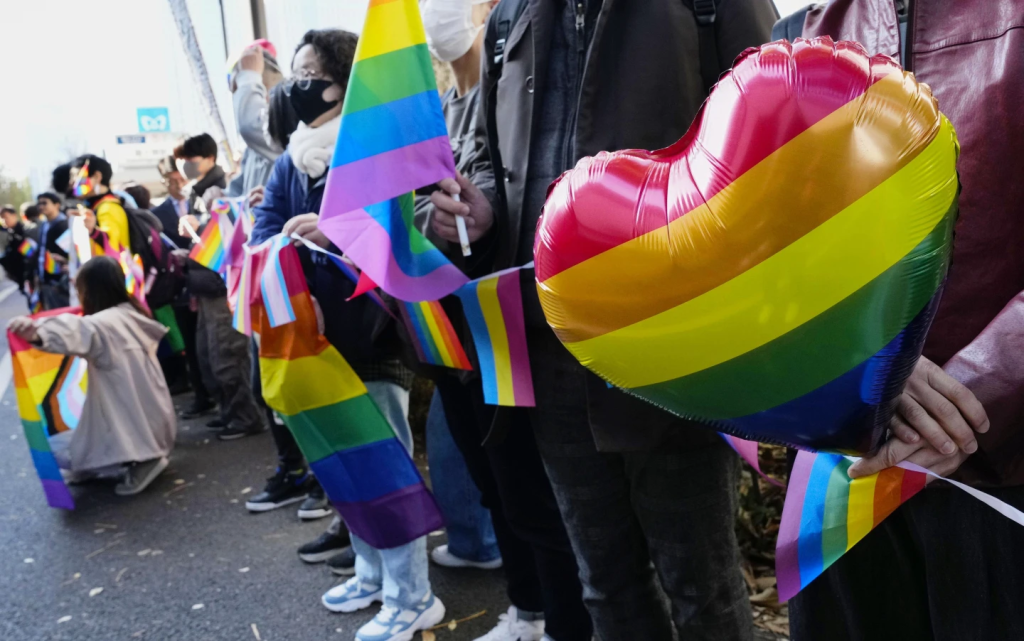
About 15,000 people also braved the rain to march through Tokyo’s streets as part of annual pride celebrations.
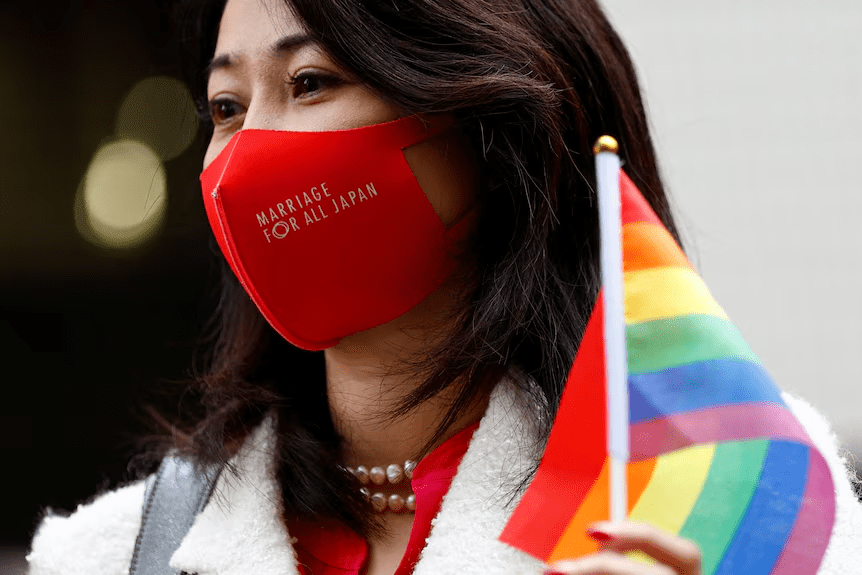
Court’s ruling against same-sex marriage sets up a Japan Supreme Court decision

Read more at AP News.

A court found Japan’s refusal to legalize same-sex marriage was constitutional Friday in the last of six cases that are expected to be brought to the Supreme Court for a final and definitive ruling, possibly next year.

The Tokyo High Court said marriage under the law is largely expected to be a union between men and women in a decision that reversed a lower court ruling last year and was the first loss at high courts in the six cases brought by those seeking equal marriage rights.

Judge Ayumi Higashi said a legal definition of a family as a unit between a couple and their children is rational and that exclusion of same-sex marriage is valid. The court also dismissed damages of 1 million yen ($6,400) each sought by eight sexual minorities seeking equal marital rights.

Plaintiffs and their lawyers said the decision was unjust but they were determined to keep fighting through the Supreme Court.

“I’m so disappointed,” plaintiff Hiromi Hatogai told reporters outside the court. “Rather than sorrow, I’m outraged and appalled by the decision. Were the judges listening to us?”

“We only want to be able to marry and be happy, just like anyone else,” said another plaintiff, Rie Fukuda. “I believe the society is changing. We won’t give up.”

With all six high court cases done, the Supreme Court is expected to handle all appeals and make a decision.

Though discrimination still exists at school, work and elsewhere, public backing for legalizing same-sex marriage and support in the business community have rapidly increased in recent years.

Japan is the only member of the Group of Seven industrialized countries that does not recognize same-sex marriage or provide any other form of legally binding protection for LGBTQ+ couples.

Prime Minister Sanae Takaichi ‘s conservative ruling Liberal Democratic Party is the main opponent of same-sex marital rights in Japan. The government has argued that marriage under civil law does not cover same-sex couples and places importance on natural reproduction.

More than 30 plaintiffs have joined the lawsuits on marriage equality filed across Japan since 2019. They argue that civil law provisions barring same-sex marriage violate the Constitutional right to equality and freedom of marriage.

Friday’s ruling was only the second that found the current government policy constitutional after the 2022 Osaka District Court decision.

Japan expands protections for same-sex couples

Read more at Gay Times.

The Japanese government has expanded legal protections to same-sex couples.

According to The Japan Times, the government has decided to recognise same-sex couples as being in “de facto marriages” under nine additional laws, including the Disaster Condolence Grant law.

This follows a decision earlier this year to extend 24 existing laws – including the Domestic Violence Prevention Act, Land and House Lease Act, Child Abuse Prevention Act, and Public Housing Act – to same-sex couples.

Japan’s LGBTQIA+ community has long been engaged in a battle for marriage equality.

Currently, the country’s constitution defines marriage as “mutual consent between both sexes” and does not recognise marriage equality.

In March 2021, the Sapporo District Court ruled that the government’s refusal to recognise same-sex marriage was unconstitutional under Article 14 of the Japanese constitution, which bans discrimination based on “race, creed, sex, social status, or family origin.”

While the historic ruling offered a sign of hope for LGBTQIA+ equality, the community was hit with a major setback the following year.

In June 2022, a district court in Osaka ruled against three LGBTQIA+ couples and their call for same-sex marriage.

“From the perspective of individual dignity, it can be said that it is necessary to realise the benefits of same-sex couples being publicly recognised through official recognition,” the court said on 20 June.

“Public debate on what kind of system is appropriate for this has not been thoroughly carried out.”

A few months later, a Tokyo court upheld the ruling.

However, despite the court doubling down on its stance, the presiding judge also stated that the lack of a legal system and protections for same-sex couples infringes on their human rights (per CNN).

While the marriage equality movement in Japan has suffered a handful of setbacks, it has also seen a few notable wins over the last three years.

In May 2023, the Japanese government faced renewed pressure when the Nagoya District Court ruled the country’s same-sex marriage ban unconstitutional.

In 2024, the Tokyo High Court and the Sapporo High Court issued separate rulings marking the ban as unconstitutional.

Most recently, Japan’s Osaka High Court and Nagoya High Court delivered similar decisions in March 2025.

Japan Osaka court holds same-sex marriage ban unconstitutional

The Osaka High Court held that Japan’s lack of recognition of same-sex marriage is unconstitutional on Tuesday. The Osaka High Court is the fifth court to rule that the ban on same-sex marriage is unconstitutional after similar rulings in the high courts of SapporoTokyoFukuoka and Nagoya.

While Presiding Judge Kumiko Honda upheld the Osaka District Court’s decision not to award damages, Honda ruled that Japan’s Civil Code and Family Register Act that do not allow same-sex marriage violates the right to equality as set out in Article 14 of the Constitution of Japan, which states: “All of the people are equal under the law and there shall be no discrimination in political, economic or social relations because of race, creed, sex, social status or family origin.” The court also ruled that the marriage ban breaches Article 24, where laws involving marriage and family “shall be enacted from the standpoint of individual dignity and the essential equality of the sexes.”

In 2019, three same-sex couples filed a lawsuit against the Japanese government, requesting 1 million yen (about $7,400) in damages per person from the state. They were among 14 couples who filed lawsuits in Sapporo, Tokyo, Nagoya, Fukuoka and Osaka. The plaintiffs had appealed to the High Court after the Osaka District Court in June of 2022 ruled that the lack of same-sex marriage recognition was constitutional under the 1947 constitution as marriage was for heterosexual unions only, making the same-sex marriage ban lawful.

Japan is the only International Group of Seven (G7) country that does not recognise same-sex marriage. Human Rights Watch put out a dispatch highlighting how the other G7 countries are encouraging Japan to enact laws to allow same-sex marriage, counter discrimination and uphold protections for sexual and gender minorities. Prior to the May summit in 2023, LGBTQ groups called for Japan’s government to legalise same-sex marriage and while support for the LGBTQ community grows and the Japanese Diet, Japan’s national legislature, passed the Act on Promotion of Public Understanding of Diversity of Sexual Orientation and Gender Identity, promoting understanding of the LGBTQ.

Amnesty International indicated in a report that protections for sexual and gender minorities are still absent. Currently, in Japan, same-sex couples have some recognition from local governments, such as “partnership certificates,” offering some rights, but these do not give rights such as inheritance, spousal visits or parental recognition.

Blog at WordPress.com.

Up ↑