More Kansas schools receive warning letters about LGBTQ policies, including Wichita

Read more at the Wichita Eagle.

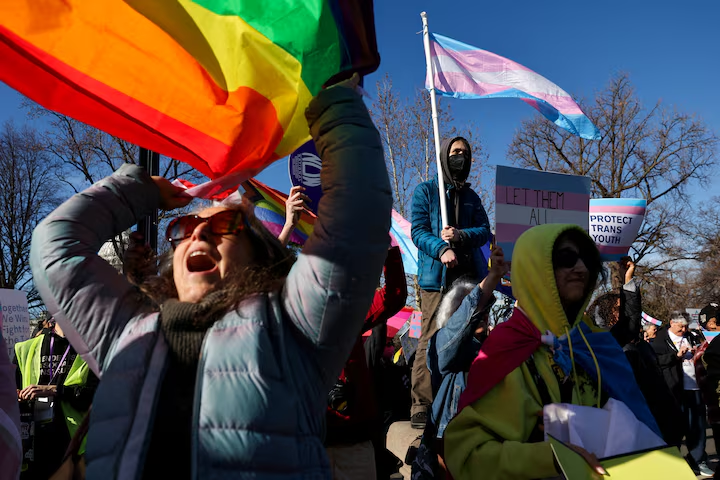
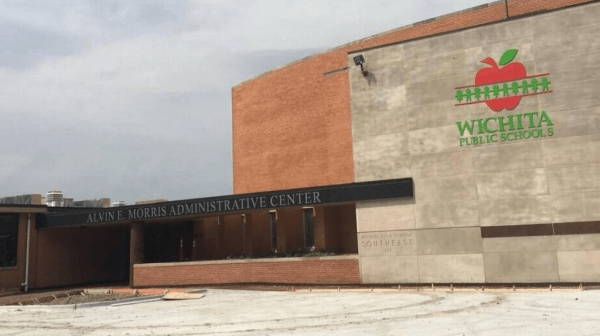
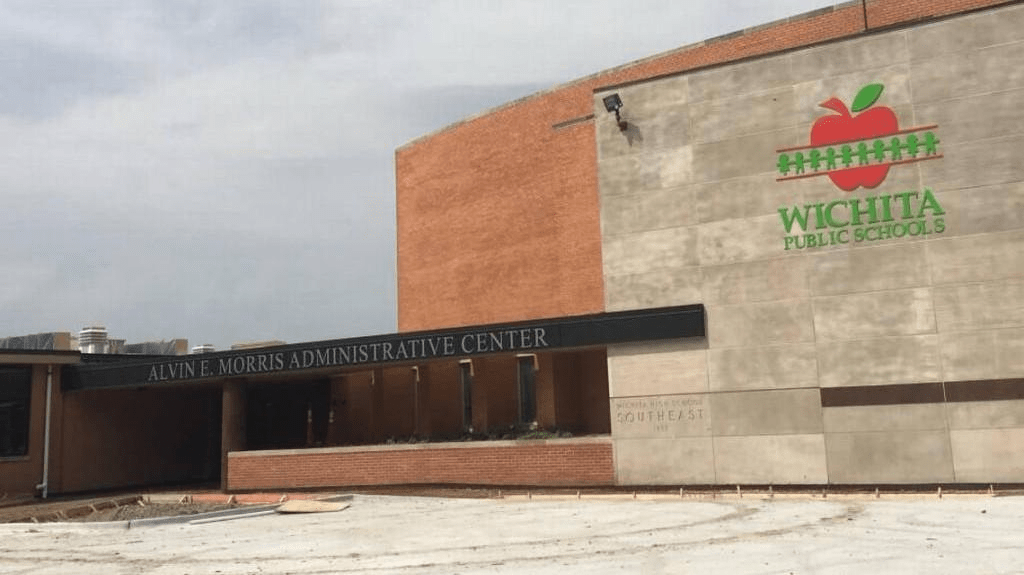
The Kansas Attorney General’s Office has sent letters to more Kansas school districts, including Wichita’s, warning of possible legal action over LGBTQ policies. Along with Wichita Public Schools, the letters were also sent to the Lawrence Public School District, the Cherryvale School District in southeast Kansas, and the State Board of Education.

The letters alleged that the school districts were not following state and federal laws regarding school policies for LGBTQ students and libraries. “I am writing to warn you that these policies make you vulnerable to lawsuits and the loss of federal funding, endanger your students, and violate the constitutional and legal rights of parents, students and your employees,” the letter to USD 259 read. The letters are similar to those sent by Attorney General Kris Kobach to some northeast Kansas school districts, which are now under federal investigation. A letter addressed to Wichita Public Schools alleges that East High and “possibly other schools” were engaging “in gender transitioning of minors without parental knowledge or consent.” Without going into specifics, it also alleges that the district “may have additional transgender policies” that don’t align with state and federal law.

Earlier this year, the district quietly removed language regarding diversity from its website and online policy handbook after the Trump administration published a letter to public schools threatening federal funding if they continued diversity, equity and inclusion programs. In a statement to the Eagle, Wichita Public Schools said the district follows Kansas and federal law. The largest school district in Kansas also said it wasn’t aware of what allegations were made to the AG’s office to prompt the letter. The attorney general’s office has not responded to an Eagle inquiry about why it sent the letters to those school districts and the State Board of Education. “The letter made several broad recommendations – from policies to student support to parental review of instructional materials – which the Board of Education has not had the opportunity to fully discuss,” the statement read. The letter gives the district a Jan. 2 deadline to revise its policies and to identify books and other materials in schools that are “religiously objectionable.” Letters sent to the other school districts and the state board make similar statements and recommendations, but the letter sent to Lawrence Public Schools makes more pointed recommendations. The attorney general’s letter to the Lawrence School District specifically called on it to take down its “LGBTQ Advisory Guide” from the district’s website.

That guide was still available on its site as of Thanksgiving week. It also wants the district to ensure students use locker rooms for the gender they’re assigned at birth, as well as allowing only “biological females” to play in girls sports. The state legislature recently passed a law banning transgender student athletes from girls sports. Cherryvale and Lawrence Public Schools have yet to respond to a request for comment – but both of the school districts’ calendars show that they’re closed for Thanksgiving break. A letter addressed to the State Board of Education makes similar allegations about several other school districts in the state, but doesn’t name them. “As of today, the State Board has not issued any comment,” the board’s spokesperson said in a statement to the Eagle.

Kansas Supreme Court Delivers Big Win For Driver’s License Gender Markers

Read more at Erin in the Morning.

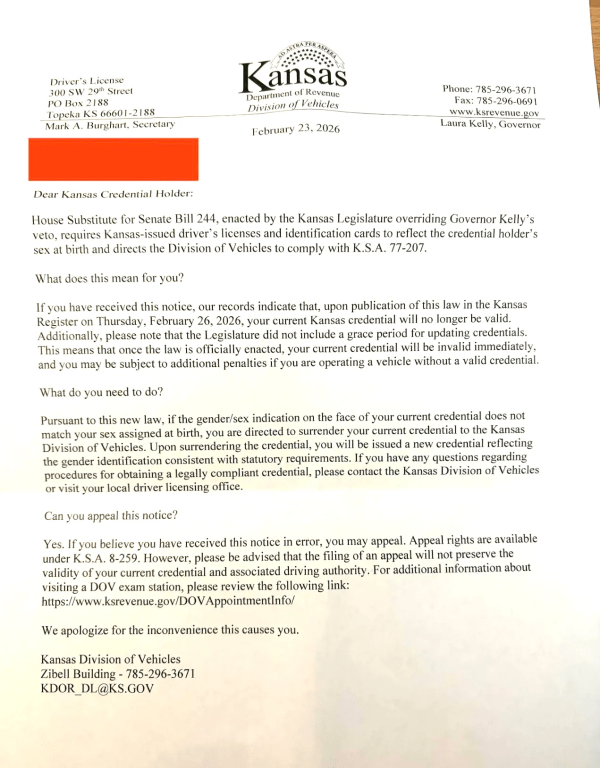
After a grueling two-year fight, starting on Tuesday, the Kansas Department of Revenue (KDOR) will resume issuing accurate driver’s licenses to transgender Kansans, a spokesperson for the ACLU of Kansas told Erin in the Morning.

Last week, the Kansas Supreme Court declined to hear Attorney General Kris Kobach’s request to uphold a district court order preventing the state from updating IDs for trans residents. And while there is still a fight ahead, it marks a notable victory for trans people in a state that has been holding their driver’s licenses hostage for years.

“I want every transgender Kansan to be able to live their lives authentically,” said Kathryn Redman, a 65-year-old resident and a plaintiff in the case, Kansas v. Harper, brought on by the ACLU and Stinson LLP.

AG Kobach asserted that the courts needed to put a stop to the license updates indefinitely, claiming it would interfere with law enforcement’s ability to identify and apprehend criminal suspects. The Court of Appeals called this “mere speculation.”

“There is no hidden agenda,” Redman told Erin in the Morning. “All I tried to accomplish and what I have accomplished by my transition is, I now live my life at peace with myself.”

In theory, the case should now be returned to a new trial court for final resolution. But the conservative Kobach doesn’t want to let that happen. He and other Republican officials have sought to call a special legislative session on the matter—a process they were already undertaking in a transparent attempt at gerrymandering, and it has seen renewed fanfare in light of the court events this past week.

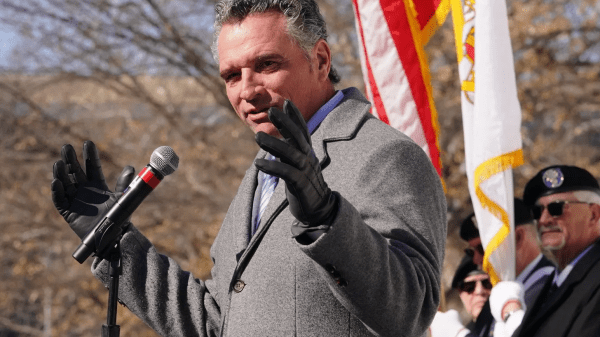
The fight to strip trans Kansans of their rights, state Senate President Ty Masterson wrote in an Oct. 1 letter, is considered “even more important than redistricting.” He called on the Kansas State Republican Caucus to simply “add a few words” to state law to stop Kansans from updating their gender markers.

The legal proceedings have ricocheted from court to court since July 2023, when legislators overrode Democratic Governor Laura Kelly’s veto on Senate Bill 180. The anti-trans law takes after legislation proposed by right-wing, anti-trans organizations, misleadingly dubbed the “Women’s Bill of Rights.” In practice, the only thing the bill does is codify sex segregation and target the equal rights of transgender people. It makes no mention of forcing Kansans to carry a driver’s license with an inaccurate gender marker.

“Rather than accepting the decisions of the two highest courts in our state, Mr. Kobach is resorting to backroom attempts to change the law and shut the courts out of our government so he can have full, unchecked power,” Micah Kubic, executive director of the ACLU of Kansas, said in a statement. “This is, simply put, a power grab by the attorney general that goes beyond his baseline of cheap political theater and wasteful litigation.”

Kubic denounced Kobach’s “extremist and discriminatory agenda,” adding that it “threatens not just the privacy and agency of all Kansans but also the very checks and balances of our state government.”

Kansas Lawmakers Override Veto of Ban on Transition Care for Minors

*This was reported by the NY Times

The Republican-controlled Kansas Legislature on Tuesday overrode the Democratic governor’s veto of a bill that bans gender-transition treatments for minors, fulfilling a longtime goal of conservative lawmakers and joining about half of the country’s states in enacting bans or sharp limits on those procedures.

The Kansas bill had broad Republican support, but its status had been uncertain because of the opposition of Gov. Laura Kelly, who said it was “disappointing that the Legislature continues to push for government interference in Kansans’ private medical decisions.” Ms. Kelly vetoed similar bills in each of the last two years, and lawmakers had previously failed to override her.

This time, Republicans in both chambers mustered the two-thirds margin necessary to override her and celebrated the decision as following President Trump’s lead on the issue. Kansas had been among the only states where Republicans hold significant legislative power without such a law.

“Today, a supermajority of the Kansas Senate declared that Kansas is no longer a sanctuary state” for those procedures, Senator Ty Masterson, the chamber’s president, said in a statement.

Republican supporters of the measure, which bans hormone treatments, puberty blockers and transition surgeries for transgender patients younger than 18, described it as guarding young people from life-altering choices that they could later regret. Under the new law, doctors who provide those treatments to minors could lose their licenses and be sued by patients or their parents.

The shift in Kansas comes as President Trump and his administration crack down on gender transitions for minors nationally, seeking to end funding for hospitals that provide those treatments. The Trump administration has also moved to ban trans women and girls from competing in women’s sports, to bar trans people from serving openly in the military, to house trans women who are federal prisoners with men, and to no longer reflect the gender identities of trans people on passports.

Democrats and L.G.B.T.Q. advocates called the Kansas legislation an invasion of privacy that would have devastating health consequences. In her veto message, Ms. Kelly said “infringing on parental rights is not appropriate, nor is it a Kansas value,” and warned that enacting the measure could have economic consequences.

“This legislation will also drive families, businesses, and health care workers out of our state, stifling our economy and exacerbating our workforce shortage issue,” the governor wrote.

The new law comes as part of a broader push by Republicans in Kansas, a state that Mr. Trump carried last year by 16 percentage points, to place limits on transgender people. Kansas stopped changing birth certificates to reflect gender identity in 2023 after lawmakers overrode another veto by Ms. Kelly and passed a law defining male and female as a person’s sex at birth.

But as Republicans across the country have moved in recent years to restrict transition treatments for minors, Kansas had remained an outlier on the Great Plains. Bans or severe limits are already in place in three of its four bordering states — Colorado is the exception — and across much of the rest of the Midwest.

Bans elsewhere have been challenged in state and federal courts with a range of preliminary outcomes. Many expect the U.S. Supreme Court to ultimately decide whether there is a national right to access such treatments.

Blog at WordPress.com.

Up ↑