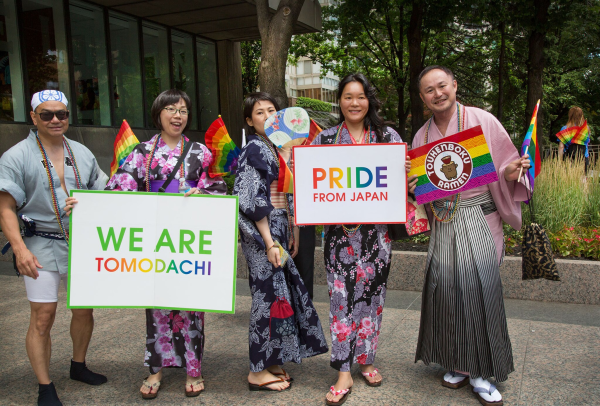
The Osaka High Court held that Japan’s lack of recognition of same-sex marriage is unconstitutional on Tuesday. The Osaka High Court is the fifth court to rule that the ban on same-sex marriage is unconstitutional after similar rulings in the high courts of Sapporo, Tokyo, Fukuoka and Nagoya.
While Presiding Judge Kumiko Honda upheld the Osaka District Court’s decision not to award damages, Honda ruled that Japan’s Civil Code and Family Register Act that do not allow same-sex marriage violates the right to equality as set out in Article 14 of the Constitution of Japan, which states: “All of the people are equal under the law and there shall be no discrimination in political, economic or social relations because of race, creed, sex, social status or family origin.” The court also ruled that the marriage ban breaches Article 24, where laws involving marriage and family “shall be enacted from the standpoint of individual dignity and the essential equality of the sexes.”
In 2019, three same-sex couples filed a lawsuit against the Japanese government, requesting 1 million yen (about $7,400) in damages per person from the state. They were among 14 couples who filed lawsuits in Sapporo, Tokyo, Nagoya, Fukuoka and Osaka. The plaintiffs had appealed to the High Court after the Osaka District Court in June of 2022 ruled that the lack of same-sex marriage recognition was constitutional under the 1947 constitution as marriage was for heterosexual unions only, making the same-sex marriage ban lawful.
Japan is the only International Group of Seven (G7) country that does not recognise same-sex marriage. Human Rights Watch put out a dispatch highlighting how the other G7 countries are encouraging Japan to enact laws to allow same-sex marriage, counter discrimination and uphold protections for sexual and gender minorities. Prior to the May summit in 2023, LGBTQ groups called for Japan’s government to legalise same-sex marriage and while support for the LGBTQ community grows and the Japanese Diet, Japan’s national legislature, passed the Act on Promotion of Public Understanding of Diversity of Sexual Orientation and Gender Identity, promoting understanding of the LGBTQ.
Amnesty International indicated in a report that protections for sexual and gender minorities are still absent. Currently, in Japan, same-sex couples have some recognition from local governments, such as “partnership certificates,” offering some rights, but these do not give rights such as inheritance, spousal visits or parental recognition.
More than a quarter million LGBTQ+ young people and family members in the U.S. have relocated to other states because of LGBTQ+-related politics or laws, according to estimates outlined in a new report exploring the population’s response to hostile policy environments.
According to the brief compiled by The Trevor Project and Movement Advancement Project, 9 in 10 LGBTQ+ young people say politics have impacted their well-being, while 4 in 10 say they’ve thought about moving to another state because of unfriendly LGBTQ+ politics or laws at home.
The portion was even higher for transgender and nonbinary youth, 94% of whom said politics had affected their well-being and nearly half (45%) who said they’d considered relocating.
“For many LGBTQ+ young people in the U.S., the steady stream of anti-LGBTQ+ news may feel overwhelming right now,” said Steven Hobaica, a research scientist for the Trevor Project, a national LGBTQ+ youth advocacy group focused on suicide prevention. “It’s heartbreaking to see that nearly half of transgender and nonbinary youth have considered moving due to anti-LGBTQ+ policies.”
While just 4% of LGBTQ+ young people ages 13 to 24 reported uprooting because of anti-LGBTQ+ policies, that translates to roughly 266,000 young people and family members based on LGBTQ+ youth population estimates, the groups said.
Trump administration presents new threats
The report comes as President Donald Trump returns to the White House after making gender identity issues a focal point of his campaign. On Monday, after being sworn in, Trump issued a spate of executive orders that included seeking to remove legal protections for transgender people in federal spaces, laying the groundwork to potentially bar transgender individuals from military service and declaring that the U.S. government will only recognize two sexes, male and female.
“No matter a person’s political beliefs, we know, from our research and from what LGBTQ+ young people tell us, that policies like these take a damaging toll on LGBTQ+ young people’s mental health,” said Janson Wu, The Trevor Project’s senior director of state advocacy and government affairs.
The organization said its crisis services saw a 33% increase on Inauguration Day compared to typical volume. But that still paled, it noted, to the sevenfold increase in crisis services experienced the day after the 2024 election.
“No matter your political beliefs or how you feel about the current administration, one thing must be made clear to all of us living in the United States: Real young people’s lives are at risk,” said Trevor Project CEO Jaymes Black.
Recent years have already seen increasing numbers of state laws and proposed legislation targeting the LGBTQ+ community, especially measures aimed at curbing the rights of transgender youth.
“It’s critical that we not only call attention to the negative impact of these divisive political attacks but also highlight that this research supports the idea that more inclusive policy environments lead to better outcomes for LGBTQ young people across a range of measures,” said Logan Casey, director of policy research for Movement Advancement Project.
Hostile climates raise mental, emotional health risk
The organizations said they compiled the report given a lack of research into how LGBTQ+ young people respond to hostile policy environments, despite studies showing that those youths experience greater mental health challenges and higher suicide risk in such environments.
“By gaining more knowledge of how LGBTQ+ young people respond to their policy environment, advocates and policymakers can create or modify policy to better support LGBTQ+ young people and their families,” the report said.
Their joint report is based on data gleaned from The Trevor Project’s 2024 U.S. National Survey on the Mental Health of LGBTQ+ Young People, which collected responses from more than 18,600 LGBTQ+ individuals between the ages of 13 and 24. It also incorporates data from Movement Advancement Project, a Boulder, Colorado-based group that tracks LGBTQ+-related laws and policies throughout the U.S. and its territories and assigns each a negative or positive policy index.
More than a quarter (27%) of respondents lived in states with negative policy indexes, the report said. Those individuals were more likely than their counterparts to consider moving to other states and also likelier to travel to other states to receive health care.
The report noted that not all LGBTQ+ young people and their families desiring to relocate have the resources to do so.
“Notably, the same factors that might preclude the ability of LGBTQ+ young people and their families from moving, such as poverty, housing discrimination, and employment access, are the same ones that disproportionately affect LGBTQ+ people of color and increase their risk of mental health and suicide,” the report said.
The Department of Defense has announced that 800 military members who were discharged under Don’t Ask, Don’t Tell (DADT) have received upgrades to honorable discharges.
Defense Secretary Lloyd Austin shared the news today, highlighting that just over a year ago, the Department began proactively reviewing the records of former service members discharged due to their sexual orientation under DADT. These individuals may have been eligible for an upgrade to their discharge status or a change to their reason for separation but had not yet applied for the change.
“After a year of exceptional work, the Military Department Review Boards directed relief in 96.8% of the 851 cases that they proactively reviewed,” Austin said.
This marks a significant step in addressing the injustices faced by LGBTQ+ service members during the DADT era.
Don’t Ask, Don’t Tell (DADT) was a 1990s policy that prohibited gay and bisexual individuals from serving openly in the military. Under this policy, service members couldn’t openly declare their sexual orientation, but the military was also barred from actively investigating, harassing, or discriminating against non-straight personnel. While it aimed to provide some level of protection, the policy still enforced secrecy and led to the discharge of countless LGBTQ+ service members.
An estimated 14,000 service members were separated under Don’t Ask, Don’t Tell (DADT) with less-than-honorable discharges before the policy was repealed in 2011. These discharges meant that veterans received fewer benefits from the Department of Veterans Affairs, including assistance with home loans, tuition, and healthcare.
Last year, a group of veterans filed a civil rights lawsuit against the Department of Defense, seeking to overturn their less-than-honorable discharges. The lawsuit argued that many veterans, discharged because of their actual or perceived sexual orientation, were given a discharge status or separation codes publicly linked to “homosexuality,” depriving them of the benefits they earned through their service.
Veterans with less-than-honorable discharges often face significant hurdles when applying for jobs, apartments, and loans, as they are required to present their DD-214 discharge papers — documents that can involuntarily out them as LGBTQ+ every time they are shown.
“This case is not about damages,” said Jocelyn Larkin, one of the lawyers involved in the lawsuit. “It’s about changing that piece of paper because the impact of changing it is so incredibly consequential for our clients.”
This past January, Reps. Robert Garcia (D-CA), Mark Pocan (D-WI), and Chris Pappas (D-NH) sent a letter to Secretary Austin urging him to expedite the process of upgrading less-than-honorable discharges for LGBTQ+ service members. They noted that many veterans who sought upgrades have experienced a prolonged, burdensome process that often required legal help, and that many were unaware they even had the option to seek an upgrade.
Today, Secretary Austin reported that 96% of the service members separated under DADT have now received honorable discharges. “We will continue to strive to do right by every American patriot who has honorably served their country,” Austin said.
To stay up-to-date on the latest news shaping LGBTQ+ communities worldwide, subscribe to the LGBTQ Nation newsletter.
LGBTQ+ ballot initiatives have long served as a wedge issue, mobilizing conservative voters and influencing the rights and freedoms typically protected by law. The 2024 election follows this tradition, with LGBTQ+ civil rights once again being subjected to public debate.
In New York, voters will decide whether to include sexual orientation, gender identity, and gender expression in the state’s anti-discrimination amendment. Meanwhile, reproductive rights will also be up for a vote in 10 other states.
California, Colorado, and Hawaii voters will decide this November whether to repeal their states’ constitutional bans on same-sex marriage.
Since 1998, same-sex unions have consistently been the top issue on state referendums. In that time, 34 states have put the question to voters, with many passing constitutional amendments that prohibited same-sex marriage. These amendments were often used as a political tool to mobilize conservative voters, particularly in the 2004 election when 11 states approved such bans, helping to boost George W. Bush’s campaign.
Marriage equality consistently lost at the ballot box until 2012, when voters in Maine, Maryland, Minnesota, and Washington approved same-sex marriage, signaling a shift in public opinion that had been building since around 2009, when support for same-sex marriage crossed the 50% threshold in national polls.
In 2015, the Supreme Court’s landmark Obergefell v. Hodges decision struck down all state constitutional amendments banning same-sex marriage, declaring such bans unconstitutional. However, these amendments remain in place in several state constitutions. Activists are now pushing to repeal them, especially in light of concerns that the conservative-leaning Supreme Court could overturn Obergefell, as Justice Clarence Thomas hinted after the court struck down Roe v. Wade.
The Origins of Ballot Initiatives on LGBTQ+ Rights
California’s 1978 election introduced the first state ballot initiative related to LGBTQ+ rights—Proposition 6, also known as the Briggs Initiative. Sponsored by Orange County legislator John Briggs, the initiative sought to ban anyone who engaged in “public homosexual activity” from working in California public schools. The proposal was part of a broader wave of anti-gay activism spurred by Anita Bryant’s 1977 “Save Our Children” campaign in Florida, which successfully repealed Dade County’s anti-discrimination ordinance based on sexual orientation. Harvey Milk played a pivotal role in organizing the opposition to Prop 6, which was defeated by a 16-point margin.
Since then, other states have introduced ballot initiatives aimed at legalizing or banning discrimination based on sexual orientation or gender identity. Over time, voters have increasingly supported anti-discrimination measures. In 1988, Oregon voters overturned the governor’s authority to ban discrimination based on sexual orientation. In 2018, Massachusetts voters upheld a law prohibiting discrimination based on gender identity.
Maine and Oregon: Key States in the Fight for LGBTQ+ Rights
Maine and Oregon have consistently put LGBTQ+ rights to a vote. In Maine, voters initially blocked same-sex marriage in 2009, but then approved it by the same 53% margin in 2012. Maine also rejected anti-LGBTQ+ discrimination protections in 1998 and 2000, only to approve them in 2005. In Oregon, voters defeated a “don’t say gay” measure in 2000 by a narrow 5.7% margin.
Many states also used ballot measures to resist the inclusion of sexual orientation as a protected identity in anti-discrimination laws. In the 1990s, voters in Oregon, Idaho, and Maine approved such measures, protecting sexual orientation as a legally recognized identity.
The Impact of Other Ballot Measures on LGBTQ+ Rights
It’s not just LGBTQ+-specific ballot measures that impact the community. Other laws, such as voter ID requirements in Arkansas and North Carolina, disproportionately affect trans individuals and other marginalized LGBTQ+ people, limiting their ability to vote.
In addition to these referendums, the candidates voters elect at the state level will play a critical role in shaping LGBTQ+ rights. Republican-led legislatures have introduced or passed hundreds of bills targeting LGBTQ+ individuals, particularly in areas such as gender-affirming health care, bathroom access, inclusive education, and sports participation. Supporting state-level and local candidates who champion LGBTQ+ rights will have long-term implications, even if certain issues are not directly decided by referendum.
Civil Rights and Public Opinion
The fight for civil rights has a long history of being put to public referendum. Since 1868, issues related to race, sex, and disability have often been decided by voters, with initial support for discrimination gradually giving way to support for equality. While women’s rights gained public approval in the 1970s, LGBTQ+ rights did not see widespread support until the 2000s.
The question of whether civil rights should be determined by public opinion, rather than by courts or legislatures, has allowed forms of discrimination—such as racism, sexism, and homophobia—to become entrenched in law. Although public opinion on LGBTQ+ rights is often divided and fluid, most polls now show a majority in favor of anti-discrimination laws for LGBTQ+ individuals.
The Importance of Voting
With LGBTQ+ rights on the ballot this November, it’s more crucial than ever to vote. In addition to ballot measures, the elected officials who hold office at the state and local levels will have the power to pass or block pro-equality legislation, impacting LGBTQ+ rights for years to come. Whether through referendums or legislative action, LGBTQ+ rights remain at stake, and your vote matters.
Make your voice heard—not just on ballot measures, but by choosing candidates who will protect and advance equality for all.
In a major win for LGBTQ+ rights, Thailand has become the first Southeast Asian country to legalize same-sex marriage.
The bill, passed by Parliament earlier this year, was signed into law by King Maha Vajiralongkorn on Tuesday through Royal Assent. The law will take effect in 120 days, with the first same-sex weddings anticipated in January.
Siritata Ninlapruek, an LGBTQ+ activist, expressed, “We are all delighted and excited. We’ve been fighting for our rights for over ten years, and now it’s finally happening.”
With this historic change, marriage laws in Thailand will no longer use gendered terms like “husband” and “wife,” replacing them with inclusive, gender-neutral terms like “partner.” Same-sex couples now enjoy the same legal rights as their heterosexual counterparts, including adoption and inheritance rights.
Waaddao Chumaporn, another LGBTQ+ rights advocate, told AFP, “The law is a monumental step towards equal rights in Thailand.”
Chumaporn is planning a mass wedding for over a thousand LGBTQ+ couples in Bangkok on January 22, the first day same-sex couples can legally marry.
Though Thailand is known for being more accepting of LGBTQ+ individuals compared to neighboring countries, the legalization of same-sex marriage comes after years of political challenges. LGBTQ+ advocates like Apiwat Apiwatsayree have been waiting for this moment for over a decade.
“We’ve been waiting for a long time,” said Apiwat, who plans to marry his partner of 17 years.
Human rights and LGBTQ+ organizations worldwide celebrated this achievement. Amnesty International’s Thailand Researcher, Chanatip Tatiyakaroonwong, remarked, “Thailand has taken a historic step towards becoming the first country in Southeast Asia to legalize marriage for LGBTI couples. This landmark moment is a reward for the tireless work of activists, civil society organizations, and lawmakers who have fought for this victory.”
Thai Prime Minister Srettha Thavisin made marriage equality a key issue during his tenure, driving the law forward.
Srettha shared on X, “Another important step for Thailand. The same-sex marriage law passes. Equality is concrete here in Thailand.”
For more updates on LGBTQ+ issues worldwide, subscribe to the LGBTQ Nation newsletter to stay informed about the latest headlines shaping LGBTQ+ communities globally.
A federal judge has determined that Ron DeSantis was disseminating falsehoods when he referred to gender-affirming care as “mutilation.”
This year has been a series of setbacks for Florida Gov. Ron DeSantis. His presidential ambitions are dwindling due to his lack of charisma and campaign missteps. His conflict with Disney is draining millions from Florida taxpayers. Additionally, a federal court has strongly suggested that DeSantis was dishonest in justifying his prohibition on medical care for transgender youth.
DeSantis consistently argued that the law was essential to prevent the “mutilation” of young individuals. For instance, he criticized a reporter who challenged him on this when he signed the bill in May.
“And when you talk to people—I know people in your industry will dress it up with a euphemism—and they’ll say it’s health care to cut off the private parts of a 14 or 15-year-old,” DeSantis stated. “That is not health care. That is mutilation.”
Inform that to U.S. District Judge Robert Hinkle.
“When assessing the governor’s motives, how should I interpret these statements? It appears to be more than mere exaggeration.”
Hinkle is overseeing a legal challenge to the law brought by three Florida families with transgender children. He has implemented a stay against the measure from being enforced during the legal proceedings and has consistently shown skepticism toward the state’s arguments. In a ruling that invalidated Florida’s ban on Medicaid coverage for gender-affirming care, Hinkle emphasized, “Gender identity is real.”
Hinkle conceded that he cannot completely discern DeSantis’ intentions. He raised the question of whether the plaintiffs could demonstrate that DeSantis endorsed the law “because he hates transgender people.” The families’ attorney argued that the law is inherently unconstitutional, making DeSantis’ motivations less pivotal to the case.
Hinkle indicated his belief that the law’s purpose isn’t truly to prevent mutilation but rather to obstruct transgender youth from accessing healthcare. This strongly suggests that DeSantis might face an unfavorable ruling from the court.
This development also signals that DeSantis might have based his campaign on an unsuccessful concept. Relying heavily on anti-trans stances to perform well in the Iowa presidential caucus, he finds himself facing challenges with Nikki Haley gaining popularity and his campaign in disarray. The outlook for him in Iowa appears uncertain, making the end of 2023 potentially regrettable for DeSantis, with the prospect of 2024 being even more challenging.
You must be logged in to post a comment.