City council members attempted to defund a weekly pizza party for LGBTQ+ students. However, what happened next took everyone by surprise.
In the small town of Ellensburg, Washington, pizza has become an unlikely source of controversy.
City council member Joshua Thompson claims that the weekly pizza gatherings for LGBTQ+ students are influencing high schoolers to adopt a “gay lifestyle” or explore transgender identities, framing the popular dish as a catalyst for these changes.
City council member Joshua Thompson sparked controversy when he declared that the weekly Pizza Klatch at Ellensburg High School—a safe space for LGBTQ+ students and allies—was a “target on minors” and claimed it was influencing students to adopt gay or transgender identities.
During a council meeting in the Yakima Valley town of Ellensburg, Washington (population 18,703), Thompson proposed cutting the $1,400 annual funding for the program, which provides pizza and a supportive environment for an average of 27 students each week. The program, initiated by the Ellensburg Diversity, Equity, and Inclusion (DEI) Commission in 2023, aims to foster connection and safety for LGBTQ+ youth.
Councilwoman Sarah Beauchamp, a mother of an LGBTQ+ child, strongly defended the funding, emphasizing its importance for students’ well-being. “$1,400 a year for these kids to hang out and have friendships,” she said. “We are not making them transgender. We’re not turning them homosexual by having a place for them to gather and feel safe.”
Thompson’s motion to defund the pizza program failed, as did a compromise amendment requiring parental permission for students to attend. Ultimately, the council voted 4–3 to approve the DEI Commission’s $10,000 budget request but excluded the $1,400 for the weekly pizza gatherings.
However, the funding shortfall was quickly addressed by Ellensburg resident Steve Verhey, a former council candidate who raised over $2,200 through an online fundraiser within days. “I’m a little bit annoyed at having to do the city council’s job for them,” Verhey told KNDO News. “The city council’s job is to keep everyone who lives in Ellensburg safe and to give them the conditions they need to thrive.”
Thanks to community support, the Pizza Klatch will continue to provide a welcoming space for LGBTQ+ students—funded entirely by private donations—for another year and beyond.
He claimed that his experience delivering babies proves that transgender people don’t actually exist, though his argument remains unclear.
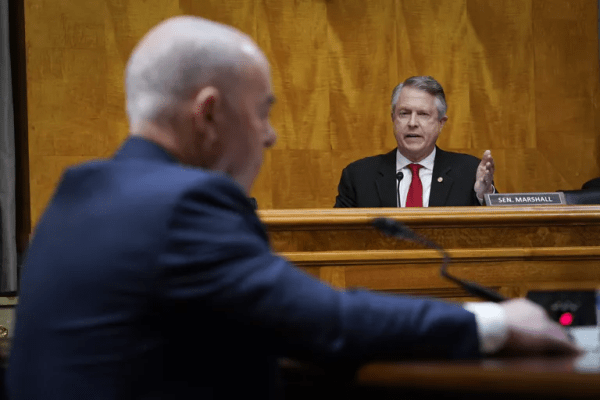
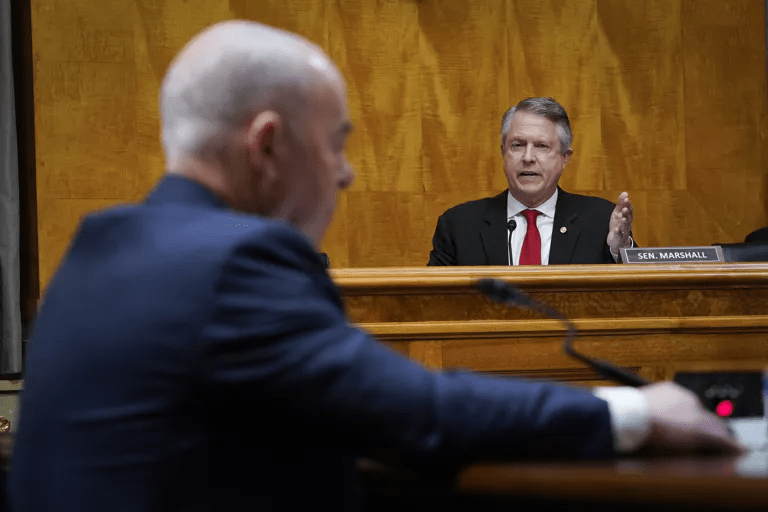
Washington, D.C. — Senator Roger Marshall (R-Kansas) questioned Secretary of Homeland Security Alejandro Mayorkas at a Senate Homeland Security and Governmental Affairs Committee hearing focused on the President’s proposed budget request for the Department of Homeland Security for fiscal year 2025. The hearing examined resources and authorities requested to protect the homeland.
This week, Sen. Marshall introduced the “Defining Male and Female Act of 2024,” a bill aimed at legally erasing the recognition of transgender individuals. Marshall argued that the bill is a response to what he describes as the Biden administration’s effort to “replace biological sex with dangerous radical gender ideology.”
The proposed legislation consists largely of definitions, with terms like “father” and “girl” now explicitly tied to the words “male” and “female.” Under the bill, “male” and “female” are defined as individuals who “naturally have, had, will have, or would have, but for a congenital anomaly or intentional or unintentional disruption, the reproductive system that at some point produces, transports and utilizes sperm or eggs for fertilization.”
Marshall claims the bill would prevent transgender individuals from participating in school sports and ensure “sex separation” in spaces like restrooms, locker rooms, dorms, prisons, and shelters for victims of sexual assault.
“As a physician who has delivered over 5,000 babies, I can confidently say that politicizing children’s gender and using them as pawns in a radical woke agenda is not only wrong, it is extremely dangerous,” Marshall said. However, his experience as a former OB/GYN does not make him an expert on transgender issues. “We must codify the legal definition of sex based on science, not feelings. With this legislation, we can fight back against the Biden-Harris Administration’s assault on our children.”
Marshall’s assertion that the Biden administration is behind the existence of transgender people is inaccurate; transgender individuals have existed long before Biden’s presidency and will continue to exist long after it. Transgender people are not an “ideology”; they are human beings.
A similar bill was introduced in July in the House of Representatives by Rep. Mary Miller (R-IL), who also claimed her bill would prevent Title IX protections from applying to transgender people. However, the argument that transgender individuals are not protected by Title IX hinges on the notion that discrimination based on gender identity is discrimination based on sex assigned at birth. In other words, if a school allows cisgender girls to compete on a sports team but excludes transgender girls, this constitutes discrimination based on sex, as the only difference between the two groups is their sex assigned at birth. Title IX bans sex-based discrimination in education.
While Marshall’s bill is unlikely to pass in the current Senate controlled by Democrats, its introduction could signal plans to reintroduce it next session when Republicans are projected to regain control of the chamber.
Why Allies Must Act: Defending Trans Rights Protects Everyone’s Freedoms
As the election dust settles, the focus shifts to practical realities. For transgender people like me, a pressing question looms: What actions will this new Trump administration take?
It’s tempting to jump to extreme conclusions—like the idea of being rounded up and placed in camps. But it likely won’t look like that. There won’t be “camps,” nor will there be overt “rounding up.” Instead, the approach will be more subtle, and that subtlety is precisely what makes it so dangerous.
The quiet nature of these changes will make them easier for cisgender people to overlook. However, their awareness is vital—not only for our survival but for their own protection, as the erosion of trans rights often signals broader attacks on freedoms that could ultimately affect everyone.
The groundwork for trans oppression is already being laid. In recent years, Republicans have pursued anti-trans legislation with alarming intensity, proposing over 1,000 laws targeting everything from medical care and bathroom usage to IDs, sports, and even how we dress. Trump has vowed to push similar policies at the federal level, and Project 2025 outlines an even more expansive agenda.
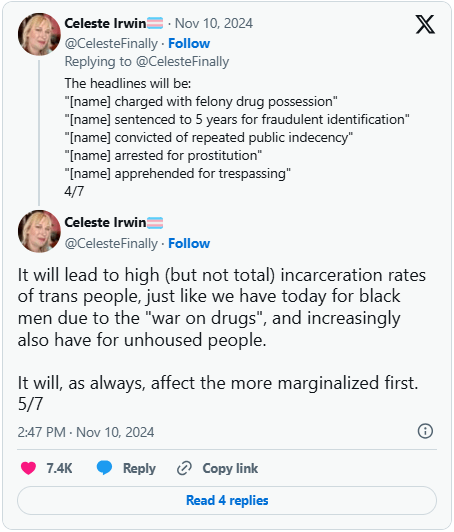
To understand what trans oppression under Trump might look like, we can look to other marginalized groups. For instance, the mass incarceration of Black men wasn’t achieved through blatant decrees like “round them up” but through systemic oppression: harsh laws with disproportionate penalties, over-policing, and economic barriers that strip away basic human needs. Trans people have already faced similar tactics, such as laws criminalizing “cross-dressing” to police our existence.
Under another Trump administration, this oppression might escalate. It could involve banning hormone replacement therapy and criminalizing those who seek it out. Policies might mandate that gender markers on IDs match sex assigned at birth, penalizing those of us who continue to live authentically with fraud or perjury charges. Involuntary commitment to mental institutions could even be a reality.
These measures, even if sporadically enforced, create an ever-present climate of fear—a psychological toll that leaves us constantly bracing for the next law, the next crackdown, the next violation of our humanity. And in this hostile environment, the silence or complacency of cisgender allies would make it all the easier for these oppressive systems to thrive.
The coming years will likely see escalating attacks on trans people, particularly the most marginalized among us—trans women of color, disabled trans people, and others who already face significant barriers. These policies will make it harder for them to access stable employment and lead precarious lives, amplifying systemic inequities.
We cannot wait for something as blatant as a “lock up all the trans people” decree. The oppression will come in quieter, more insidious forms: laws and policies that restrict our rights to healthcare, employment, and basic expression. Even if trans people comply with these laws, the result will still be a kind of prison—a life stripped of autonomy and dignity.
If you are cisgender, we need your help. Not just because it’s the right thing to do, but because these attacks on trans rights will eventually pave the way for attacks on your rights. Consider abortion access: for decades, conservatives framed their arguments around “protecting life” to avoid addressing bodily autonomy directly. But the fight against gender-affirming care removes that pretense altogether. By banning medically supported, evidence-based care simply because they don’t like it, lawmakers set a dangerous precedent that could extend to other healthcare decisions.
Your body could be next.
Employment and education are also at risk. Imagine a national “Don’t Say Gay/Trans” policy that bars teachers like me—who are openly transgender—from the profession. Policies like these won’t stop at targeting trans people. Deadnaming and misgendering trans students could morph into strict gendered dress codes for everyone, eroding freedom of expression for all students. What starts as an attack on trans rights often metastasizes into broader assaults on personal liberties.
As we approach January 20th, now is the time to act:
Get involved: Connect with your local LGBTQ+ center and see how you can support their efforts.
Stay informed: Follow trans journalists and activists to keep up with the latest developments.
Advocate: Write to your representatives in both parties, showing them that you stand with trans people.
Speak out: Use your voice, wear supportive messages, and engage your cisgender friends to build awareness.
Support trans people directly: Check in with your trans friends, especially now, as they navigate a political climate fueled by over $200 million of anti-trans rhetoric during the election. Let them know you’re there for them.
This isn’t just about protecting trans people—it’s about preserving freedom and dignity for everyone. Together, we can resist these threats and build a future where everyone has the right to live authentically.
“No one stepped in to help,” one witness said, describing how people cheered as the women were assaulted.
LGBTQ+ advocates say bystanders cheered as two transgender women were brutally attacked in Minneapolis earlier this month.
According to a statement from Minneapolis Police to The Independent, the two women were confronted by a group making derogatory comments at a downtown light rail station on November 10, which escalated into a “physical altercation.”
Amber Muhm, one of the organizers of a rally supporting the victims of the attack at the station, spoke with The Independent about the incident. She identified the two women only as Dahlia and Jess. They told her that as they were leaving the station, a man yelled anti-trans slurs at them. When Jess asked him to stop, he “sucker punched” her. In response, Dahlia struck the man with her cane, which prompted four or five other men to join in and violently assault the pair.
Both women were knocked unconscious, with Dahlia suffering a broken nose and Jess left with multiple rib contusions.
“No one came to help them,” Muhm told CBS News, recounting that bystanders cheered on the attackers while the women were being beaten. “It was a traumatic event, and they’re still dealing with the physical consequences, but the community is what’s keeping them grounded right now,” Muhm added.
Minneapolis police confirmed to CBS News that they were investigating the incident, but no arrests had been made as of Sunday night. Muhm called for more urgent action from the police. “They need to step up because this keeps happening, and it’s ridiculous and unacceptable at this point,” she said.
Dahlia and Jess had moved to Minnesota from Iowa specifically because of the state’s Trans Refuge law, which was introduced by state Rep. Leigh Finke (D), Minnesota’s first openly trans legislator. The law, passed in March 2023, protects access to gender-affirming care in the state, regardless of laws in other states.
At the rally, Rep. Finke predicted that more trans people would likely relocate to Minnesota following the re-election campaign of former President Donald Trump, whose political ads during the 2024 election cycle fueled anti-trans rhetoric. “People are so emboldened now. There’s so much false data, so many false narratives about trans people,” Muhm said, referencing claims made by rally bystanders that gender-affirming surgeries were being performed “on 10-year-olds.”
One speaker at the rally told CBS News that Trump’s re-election is instilling fear in the trans community. “People are talking to me about erasing their social media presence, going back in the closet,” they said.
Despite the mounting fear, Muhm encouraged the community to remain strong. “The community here is beautiful. We’re building a movement, we’re going to get through this, and we’re going to be stronger for it. Minneapolis is going to be such a beautiful place for trans people to live,” she said.
However, with rising concerns about anti-trans violence, Muhm acknowledged that many trans people in the city are preparing for a possible surge in hostility. “People are about to get a lot more hostile and emboldened in their transphobia,” she said. “So, what do we do to protect ourselves when we’re out?” Many in the community are enrolling in self-defense classes and looking into acquiring handgun permits to safeguard themselves.
Donald Trump triumphed over Kamala Harris early Wednesday morning in a presidential election marked by the Republican candidate’s anti-trans and anti-immigrant rhetoric.
On what may go down as one of the darkest days in U.S. history, a twice-impeached former president, who is both an accused rapist and a convicted felon, has been elected to the White House once again.
Donald Trump defeated Vice President Kamala Harris early Wednesday morning in an election dominated by the Republican candidate’s anti-trans and anti-immigrant rhetoric. Trump secured crucial battleground states—North Carolina, Georgia, Pennsylvania, and Wisconsin—after weeks of polling that showed him and Harris in a tight race.
“Trump was expected to declare victory even if he had lost, but his actual win now paves the way for what promises to be one of the most extreme presidential agendas in U.S. history. The consequences of another Trump presidency will be particularly dire for LGBTQ+ Americans, with his campaign platform outlining a full-scale assault on queer rights. On his 2024 campaign website, Trump vowed to implement a federal ban on gender-affirming care for minors and to redefine gender at the federal level, recognizing only male and female as legitimate genders—based solely on birth assignment. His platform also called for national “Don’t Say Gay” policies targeting LGBTQ+ students in schools and vowed to “keep men out of women’s sports.” Trump’s running mate, J.D. Vance, a former senator, introduced a bill that would imprison doctors who provide gender-affirming care to trans youth.
These policies would continue the trajectory of Trump’s first term, which was marked by a relentless assault on the LGBTQ+ community. Among the most significant actions were the ban on transgender people serving in the military, the removal of LGBTQ+ references from federal websites, the rollback of protections for trans students, and the opposition to workplace protections for LGBTQ+ employees. His administration also implemented a ban on people living with HIV from military deployment, disbanded the Presidential Advisory Council on HIV/AIDS, and cut global funding for HIV prevention and treatment.
During his 2024 campaign, LGBTQ+ Americans were once again bombarded with anti-LGBTQ+ messaging. Trump ran on a platform of staunch opposition to trans rights, supported by millions of dollars in ads from right-wing groups that portrayed the trans community as a threat to public safety and decency. One of the most widely circulated ads of the election cycle declared: ‘Kamala is for they/them. President Trump is for you.’ In his first and only debate with Harris, Trump made headlines by falsely claiming that she supported ‘transgender operations on illegal aliens in prison’—a statement LGBTQ+ advocates later clarified was a misrepresentation of the legal requirement to provide medically necessary care to incarcerated individuals. He also falsely accused Harris’ running mate, Tim Walz, of being ‘very heavy into transgender issues.'”
As advocates have consistently warned, the impact of Trump returning to the White House will be devastating for many vulnerable and marginalized groups. While Trump has repeatedly wavered on whether he supports national restrictions on abortion and contraception following the 2022 overturning of Roe v. Wade, his running mate, J.D. Vance, has made it clear that he ‘would like abortion to be illegal nationally.’ Trump has also floated the idea of defunding schools that teach the history and legacy of slavery, and he has persistently called for the disbanding of the Department of Education. Furthermore, his mass deportation agenda, aimed at expelling thousands of undocumented workers from the U.S., would reportedly cost the federal government millions of dollars each year.
In addition to these proposals, Trump’s allies—such as House Speaker Mike Johnson—have signaled plans to launch another attempt to repeal and replace the Affordable Care Act. This could jeopardize critical healthcare protections for seniors, pregnant patients, people with disabilities, and LGBTQ+ individuals, potentially leaving millions without access to vital services.
While it will be months before a second Trump administration fully takes shape, the public already has a clear sense of how he plans to govern. Throughout his volatile presidential campaign, Trump vowed to act as a dictator ‘on day one,’ promising to dismiss Jack Smith, the special prosecutor overseeing numerous criminal cases against him. In recent weeks, he has suggested using the National Guard to target American citizens, even fantasizing about journalists being shot, while repeatedly labeling those who oppose his fascistic views as the ‘enemy from within.’ Trump has also reportedly offered key positions in his administration to figures like Elon Musk and Robert F. Kennedy Jr.—the latter being an outspoken conspiracy theorist who has advocated for banning vaccines and removing fluoride from public drinking water.
In response to the looming threat of a second Trump term, some LGBTQ+ U.S. residents—particularly families of trans youth—have already fled the country out of fear for their safety and well-being. However, many others who would be directly impacted by his policies will not have the privilege of leaving. As during his first presidency, LGBTQ+ advocates are expected to continue their fight through the courts, the legislature, and public protests, standing firm against a wave of harmful policies that threaten their rights and freedoms.
The vice-presidential candidate received an even lower score than Rep. Marjorie Taylor Greene.
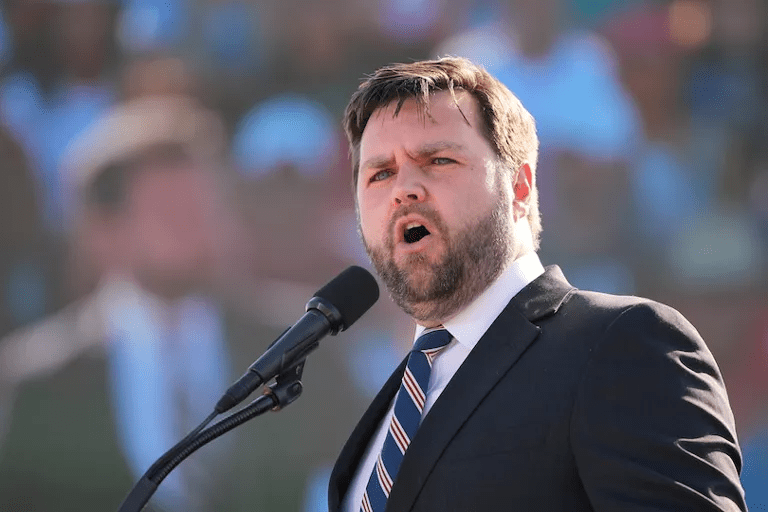
Republican vice-presidential candidate Sen. J.D. Vance (R-OH) received a zero rating on the Human Rights Campaign’s (HRC) newly released Congressional Scorecard for the 118th Congress.
This biannual report evaluates each member of Congress on their record regarding LGBTQ+ rights, assigning scores out of 100. Vance’s zero score indicates he did not support HRC’s stance on any LGBTQ+-related legislation.
This comes as no surprise, as Vance recently attributed America’s educational challenges to transgender inclusion, alleging that teachers are too occupied with “radical ideas” about gender to focus on fundamental academics. He also opposed the federal Respect for Marriage Act and, last year, refused to confirm U.S. foreign ambassadors, claiming they lacked sufficient opposition to LGBTQ+ rights. Additionally, Vance introduced Senate legislation aimed at banning gender-affirming care for trans youth and limiting access for trans adults.
Sen. Vance’s close alignment with Donald Trump—who worked to dismantle LGBTQ+ rights during his first term—further underscores his adversarial stance toward LGBTQ+ people.
Other senators who scored zero on the HRC report include Mitt Romney (R-UT), Ted Cruz (R-TX), Lindsey Graham (R-SC), Josh Hawley (R-MO), and Marco Rubio (R-FL). In the House, members receiving zeros included Reps. Lauren Boebert (R-CO), Jim Jordan (R-OH), James Comer (R-KY), Greg Steube (R-FL), Dan Bishop (R-NC), and House Speaker Mike Johnson (R-LA), who is noted for his outspoken anti-LGBTQ+ positions.
Interestingly, Rep. Marjorie Taylor Greene (R-GA), despite her frequent opposition to LGBTQ+ rights, scored an 8 for supporting HRC’s position on four bills—having voted against larger spending bills containing anti-LGBTQ+ measures. However, the report did not analyze her reasons for these votes.
On the opposite end of the spectrum, 217 members of Congress scored 100, demonstrating a full commitment to advancing LGBTQ+ rights and countering anti-LGBTQ+ legislation. Among those with perfect scores were senators Tammy Baldwin (D-WI), Bernie Sanders (D-VT), John Fetterman (D-PA), Tammy Duckworth (D-IL), and Laphonza Butler (D-CA), the first Black lesbian to serve in the Senate. Independent Sen. Kyrsten Sinema (I-AZ) scored a 93, as she missed two votes and did not co-sponsor specific anti-discrimination bills.
In the House, representatives like Adam Schiff (D-CA), Ayanna Pressley (D-MA), Jamie Raskin (D-MD), and Steny Hoyer (D-MD) achieved scores of 100. Every out LGBTQ+ House member also received a perfect score. Former Rep. George Santos (R-NY) was excluded from the scorecard due to his expulsion before completing his term.
Steny Hoyer, celebrating his perfect score, highlighted Congress’s duty to combat discrimination, especially against LGBTQ+ Americans facing hostility from MAGA Republicans. “I will continue to work with Democrats to advocate for LGBTQ+ Americans and their rights,” Hoyer stated.
HRC president Kelley Robinson underscored the increasing attacks on LGBTQ+ inclusion in Congress, condemning the addition of anti-LGBTQ+ measures to key legislation. She also noted the success of organizers in blocking over 100 anti-LGBTQ+ riders. “With a record-high 75 million Equality Voters nationwide, informed voting and representation matter now more than ever,” Robinson affirmed, emphasizing the LGBTQ+ community’s resilience and the Senate’s critical role in protecting rights against extreme measures from the House.







 fleeredstates.blog
You must be logged in to post a comment.