More than two dozen Ohio lawmakers are supporting a bill that would designate the weeks between Mother’s Day and Father’s Day “Natural Family Month.”
Though the bill, introduced by Republican state Reps. Josh Williams and Beth Lear, doesn’t define “natural family” in its text, critics say it is intended to exclude LGBTQ families and promote marriage and childrearing between heterosexual, monogamous couples only.
When asked whether “Natural Family Month” will also recognize gay couples and parents with adopted children, Williams said in an emailed statement to NBC News that “the purpose of the month is to promote natural families—meaning a man, a woman, and their children—as a way to encourage higher birth rates.”
He added, “This is not about discriminating against other family structures, but about supporting the one most directly tied to the creation and raising of children.”
Lear did not return a request for comment.
After introducing the bill earlier this week, Williams and Lear said in joint statements that the initiative is intended to promote child rearing.
“At a time when marriage is trending downward and young couples are often choosing to remain childless, it’s important for the State of Ohio to make a statement that marriage and families are the cornerstone of civil society, and absolutely imperative if we want to maintain a healthy and stable Republic,” Lear said.
Dwayne Steward, the director of statewide LGBTQ advocacy group Equality Ohio, told a local queer news site that the bill is both bad policy and a “calculated act of strategic erasure.”
“It not only invalidates the existence of single parents and countless other caregivers, but it takes direct aim at LGBTQ+ families across our state,” Steward told the Buckeye Flame. “The so-called ‘Natural Family Foundation,’ the group pushing this legislation, has made their ideology clear: if you’re not a heterosexual, monogamous couple with children, you don’t count as a family at all.”
Steward, who did not immediately return NBC News’ request for comment, added, “As an adoptive parent, myself, I feel this erasure personally. This bill is not just offensive; it’s dangerous.”
Last year, Ohio considered eight bills targeting LGBTQ people, according to a tally by the American Civil Liberties Union. Two of those — a provision that requires school personnel to notify parents of “any request by a student to identify as a gender that does not align with the student’s” birth sex, and a measure that prohibits certain transition-related medical care for minors — became law.
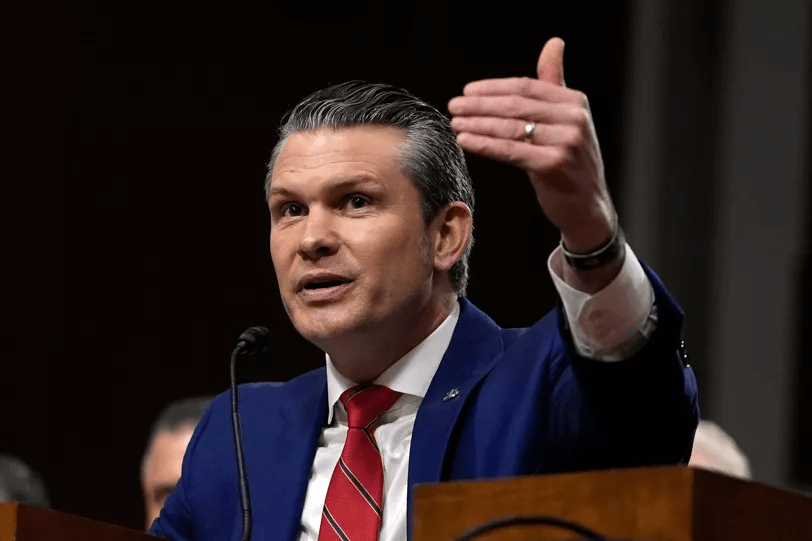
The military has been ordered to identify troops who either have or may have gender dysphoria, the psychological term for the distress caused by one’s gender identity and sex assigned at birth not being the same. The goal is to get started on forcing transgender people out of the military ahead of the June 6 date set by Defense Secretary Pete Hegseth to start the purge.
Earlier this month, the Supreme Court ruled that the administration could start forcing transgender people out of the military, while several legal challenges to the trans military ban are being heard by lower courts. Hegseth then said that transgender service members would have until June 6 (or July 7 for those in the reserves) to voluntarily leave the military and have a chance to keep some of the benefits they accrued in their time in the armed services.
Orders issued yesterday, Advocate reports, will have each branch of the military start identifying transgender people to kick out after June 6. It tells each branch to identify people who have a diagnosis of gender dysphoria or “symptoms consistent with gender dysphoria” and review their medical records.
“Commanders who are aware of service members in their units with gender dysphoria, a history of gender dysphoria, or symptoms consistent with gender dysphoria will direct individualized medical record reviews,” the directive says. It also reaffirms that gender-affirming care is banned for transgender active-duty members of the military.
Stars and Stripes reports that an unnamed senior Defense Department official explained that commanders can now start medical screenings for servicemembers who don’t identify as transgender but who they suspect may have gender dysphoria.
“[This] is also consistent with what we expect and require of commanders generally, to ensure that their service members are fit and capable for duty — whether it’s under this policy or any other qualification where they may have concern that that service member requires medical intervention or is not able to perform their duties,” they said.
“The implementation requires some steps to ensure that those who go forward in service remain eligible to meet the high standards of the department. The department requires high standards to ensure that the force is ready to fight and win the nation’s wars as called upon.”
On May 8, Hegseth issued a memo saying that transgender servicemembers would have until June 6 to voluntarily start the process of leaving the military and get an honorable discharge, which would make them eligible for voluntary separation pay, as well as some health care and employment assistance benefits.
“There’s no guarantee to access to your pension or severance or an honorable discharge,” said Rae Timberlake of the trans service member organization Sparta Pride. They are one of the estimated 1000 transgender service members choosing to leave the military voluntarily now in order to get some of the benefits they have been earning throughout their career that might not be available if the military forces them out for being transgender after June 6.
“This is not voluntary,” they said. “This is a decision that folks are coming to under duress.”
National Center for Lesbian Rights attorney Shannon Minter told Advocate that the May 15 memo is “disturbing.”
“From the beginning this policy has been implemented in a rushed and chaotic manner that is completely unnecessary and deeply disrespectful to these service members, who deserve at the very least clear information and an orderly process so that they can make informed decisions that will have such a profound effect on their lives and their families,” he said.
“It is also deeply concerning that the separation codes that this guidance indicates will appear on the records of officers who are involuntarily separated will create the false impression that they are some sort of risk to national security. This is grossly untrue and will needlessly limit their civilian employment opportunities.”
The purge stems from an executive order issued in January that said that trans people can’t lead “an honorable, truthful, and disciplined lifestyle and that not using pronouns associated with a person’s sex assigned at birth violates the military’s “high standards for troop readiness, lethality, cohesion, honesty, humility, uniformity, and integrity.” This runs counter to actual studies of transgender people in the military that have found that they can serve without issue.
The executive order led to several lawsuits challenging it, including a lawsuit filed in Washington state brought by seven transgender servicemembers and one trans person who wants to join the military. A federal judge in that case issued a temporary injunction, blocking the Department of Defense from implementing the ban while the court heard the case.
Trump’s Department of Justice (DOJ) appealed the injunction, but the U.S. Court of Appeals for the Ninth Circuit refused to lift it. So, the DOJ appealed to the Supreme Court, which lifted the injunction earlier this month.
Stars and Stripes reports that there are around 4200 service members with a diagnosis of gender dysphoria.
The Rainbow Map and Index has been published annually since 2009 and ranks all 49 European countries on legal and policy practices for LGBTQ+ people.
The latest rankings, published on Wednesday (14 May), show that the UK had dropped to 22nd, with an overall score of 46 per cent, making it now the second-worst country for LGBTQ+ laws in western Europe and Scandinavia – above only Italy.
The UK was named the best place in Europe for LGBTQ+ rights, with an 86 per cent rating, in 2015. But it has been falling ever since and dropped seven places from last year’s position, mainly because of the recent Supreme Court ruling which deemed that the protected characteristic of “sex” in the 2010 Equality Act was based on “biology” and excluded trans people.
For laws that relate to the recognition of trans people’s gender identity, the UK is now ranked 45th. ILGA-Europe said that the Supreme Court’s verdict constituted a legal block on effective recognition of trans people’s identities. The only other European nations in a similar position are Bulgaria, Georgia, Hungary and Russia.
While Scotland had had introduced the Hate Crime and Public Order (Scotland) Act, which came into effect last year, the legislation only applies to the devolved nation so had only a minimal effect on the UK’s overall score.
Malta tops the new list, with a score of 89 per cent, followed by Belgium (85 per cent), Iceland (84 per cent), Denmark (80 per cent) and Spain (78 per cent).
Other nations above the UK include Finland (70 per cent), Ireland (63 per cent), Austria (54 per cent), Croatia (49 per cent) and Estonia (46 per cent).
‘The UK must do better’
Commenting on the rankings, ILGA-Europe’s executive director, Chaber, said: “The time to push back is now, before the targeted attacks we’re seeing in countries like Hungary, the UK and Georgia become the norm rather than the exception. Political leaders must lead by example and turn their words into action.”
A spokesperson for TGEU, the European transgender rights network, claimed that while the UK was once a “frontrunner on equality”, it now has a Supreme Court, prime minister and equality watchdog “singing from the same hymn sheet as anti-trans campaigners”.
They went on to say: “The UK Supreme Court’s decision, which defined a ‘woman’ for the anti-discrimination law, has severely undermined legal certainty for trans people. Furthermore, it has reinforced privacy risks and exclusion from essential services such as hospital wards, public toilets, changing rooms and refuges, as well as reception centres for asylum seekers.”
Meanwhile, Equality Network chief executive Rebecca Don Kennedy said: “It is shameful that having been ranked best in Europe for LGBTI+ laws 10 years ago, we have fallen so far. For our treatment of trans people after the Supreme Court ruling, we are now known as one of the worst countries in Europe. The UK must do better.
“Scotland, when analysed separately, has in the past been considered progressive and a beacon of LGBTI+ equality and human rights. That seems to be quickly deteriorating. We ask the Scottish government to act now and do everything they can to improve the lives of LGBTI+ people and to not submit to growing anti-LGBTI+ narratives both globally and right here in Scotland.
And Vic Valentine, the manager of Scottish Trans, said: “That the UK has slipped so far down the rankings for LGBTI+ equality in Europe is an important reminder that we can’t take progress for granted.
“From the outside, the UK is viewed as a cautionary tale of how things can go backwards rather than forwards. But none of this is inevitable.
“Governments and parliaments can – and should be – forced to protect and promote the rights of everyone. Yet politicians across the UK are quietly watching on as last month’s Supreme Court ruling seems to have set back trans people’s rights by two decades. It is very much in their power to put us back on the right path.
‘We call on the UK government to urgently take whatever action is needed to ensure that trans people can live safely and freely, and [to] reverse this decade of decline in the rights of LGBTI+ people.”
The Texas House voted today to repeal the “anti sodomy” law that has been on the books since 1973. HB1738 was the first bill to make it to the House floor for a vote since the law was enacted, and subsequently deemed unconstitutional in 2003 by the Lawrence v Texas ruling of the Supreme Court of the United States.
The bill for was authored by Dallas state representative Venton Jones, a member of the LGBTQ Caucus and long time activist.
The bill repeals Penal Code Section 21.06. Texas Penal Code Section 21.06, also known as “homosexual conduct,” makes it a Class C misdemeanor to engage in deviate sexual intercourse with another individual of the same sex. This means that the law criminalizes sexual activity between people of the same gender. The penalty for a Class C misdemeanor is generally a fine of up to $500.
The vote was 72 Yeas, 55 Nays, 5 Present Not Voting. The vote remains to be certified.
The bill faces an uphill battle in the Republican controlled Texas Senate. The Texas legislative session ends June 2.
11 other states still have some form of sodomy law on the books.
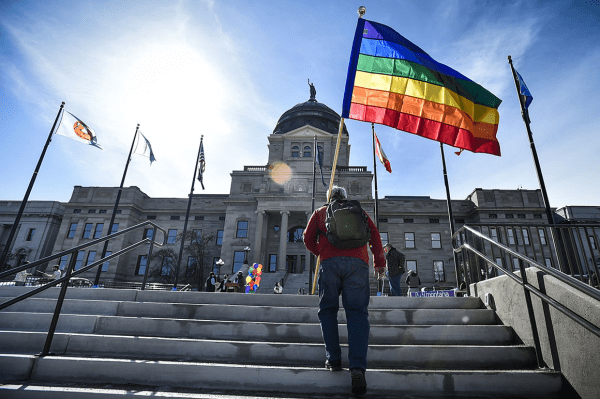
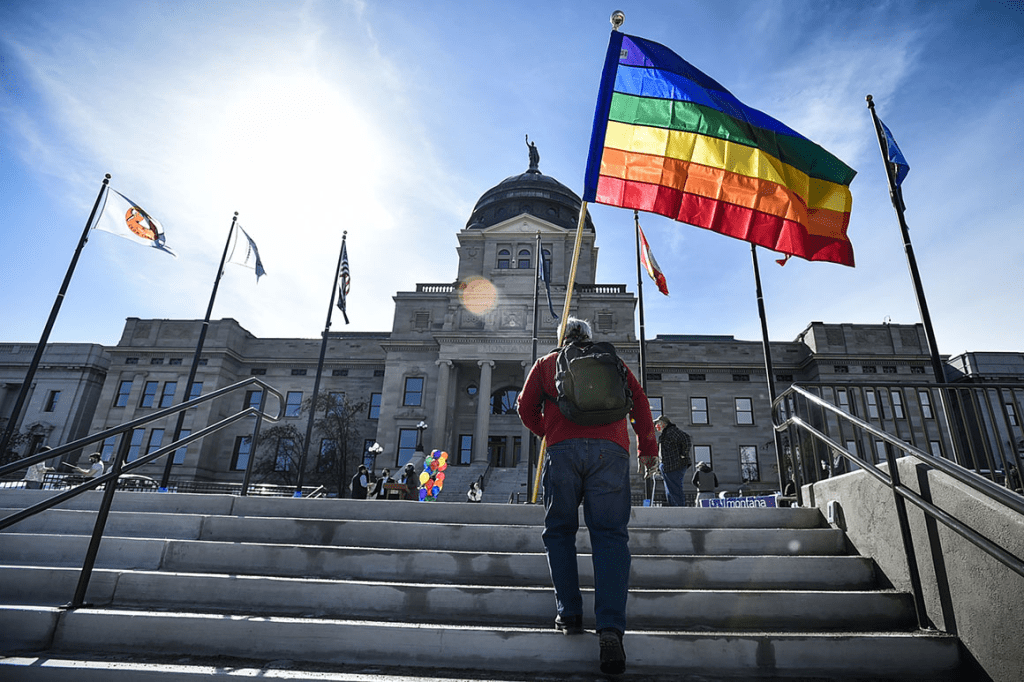
Today, a Montana Court struck down SB 99, a 2023 Montana law that categorically bans often life-saving health care for transgender youth. The Court granted Plaintiffs’ motion for summary judgment in Cross v. Montana, holding that SB 99 violates the constitutional rights of transgender youth who are seeking gender-affirming care and the healthcare professionals who are providing that care.
The lawsuit challenging SB 99 was brought by Lambda Legal, the American Civil Liberties Union (ACLU), and the ACLU of Montana. This ruling removes completely the threat hanging over Montana transgender youth and their families that their access to critical medical care would be terminated.
“I will never understand why my representatives worked so hard to strip me of my rights and the rights of other transgender kids,” said Phoebe Cross, a 17-year-old transgender boy. “It’s great that the courts, including the Montana Supreme Court, have seen this law for what it was, discriminatory, and today have thrown it out for good. Just living as a trans teenager is difficult enough, the last thing me and my peers need is to have our rights taken away.”
“Today, the court saw through the state’s vitriol and hollow justifications and put the final nail in the coffin of this cruel, and discriminatory, law,” said Lambda Legal Staff Attorney Nora Huppert. “No parent should ever be forced to deny their child access to the safe and effective care that could relieve their suffering and provide them a future. Because Montana’s Constitution protects their right to privacy, transgender youth in Montana can sleep easier tonight knowing that they can continue to thrive.”
“We are very pleased that the Court saw through the State’s unfounded arguments about why gender-affirming medical care should be treated differently from other forms of care,” said ACLU staff attorney Malita Picasso. “The Court recognizes SB 99 for what it truly is, an effort by the State to legislate transgender Montanans out of existence.”
“The Montana Constitution protects the privacy and dignity of all Montanans,” said Akilah Deernose, ACLU-MT Executive Director. “In the face of those protections, cruel and inhumane laws like SB 99 will always fail. Today’s decision should be a powerful message to those that seek to marginalize and harass transgender Montanans.”
In its ruling, the court stated:
“[t]he Court is forced to conclude that the State’s interest is actually a political and ideological one: ensuring minors in Montana are never provided treatment to address their “perception that [their] gender or sex” is something other than their sex assigned at birth. In other words, the State’s interest is actually blocking transgender expression.”
Plaintiffs in the case include Molly and Paul Cross and their 17-year-old transgender son Phoebe; Jane and John Doe joining on behalf of their 16-year-old transgender daughter; and two providers of gender affirming care who bring claims on their own behalf and on behalf of their Montana patients.
On December 11, 2024, the Montana Supreme Court upheld a preliminary injunction that SB 99 was likely unconstitutional under the Montana state constitution’s privacy clause, which prohibits government intrusion on private medical decisions. The ruling rested entirely on State constitutional grounds, insulating transgender adolescents, their families and health care providers from any potential negative outcome at the United States Supreme Court.
The U.S. Supreme Court will soon rule in U.S. v. Skrmetti, the landmark case brought by Lambda Legal, the ACLU, and the ACLU of Tennessee, Lambda Legal on behalf of three families and a medical provider challenging a Tennessee ban on gender-affirming hormonal therapies for transgender youth on the grounds the ban violates the Equal Protection Clause of the U.S. Constitution.
More information about the case is available here.
The Trump administration is justifying the president’s claim that top U.S. law firm Susman Godfrey is a national security threat by citing its donations to an LGBTQ+ legal nonprofit.
Trump targeted Susman Godfrey in an April 9 executive order which sought to revoke security clearance from Susman lawyers and restrict their access to federal buildings. The order was seen as retaliation for the firm having represented Dominion Voting Systems in its 2021 defamation suit against Fox News after the right-leaning media outlet repeated Trump’s claims that Dominion’s voting machines helped “steal” the 2020 election from Trump. During a signing ceremony in the Oval Office last month, White House Deputy Chief of Staff went so far as to falsely suggest that the firm “is very involved in the election misconduct,” according to Bloomberg Law.
Susman challenged Trump’s order in court, arguing that it violated the firm’s and its clients’ constitutional rights to free speech and due process. On April 15, a federal judge granted the firm a temporary restraining order barring the administration from enforcing parts of the order while the case proceeds. The case was back in court last week, where a lawyer for Trump’s Justice Department faced sharp questioning from U.S. District Judge Loren AliKhan about the administration’s justification for Trump’s order, according to Reuters.
On Monday, May 12, Lawfare senior editor Roger Parloff posted a screenshot from court filings on Bluesky that indicates the administration’s flimsy rationale.
In his order, Trump alleged that Susman “funds groups that engage in dangerous efforts to undermine the effectiveness of the United States military through the injection of political and radical ideology.” As evidence for the claim, which Susman denies, the Trump Department of Justice cites the fact that the firm “has provided funds to GLBTQ Legal Advocates and Defenders (GLAD), which previously sued the Federal Government to enjoin Department of Defense policy, based on a radical theory of gender ideology.”
In August 2017, GLAD filed a lawsuit on behalf of five transgender servicemembers challenging Trump’s first term trans military ban. The organization later joined Equality California and the National Center for Lesbian Rights as co-counsels in another case challenging the ban.
While Above the Law’s Joe Patrice notes that the administration’s argument that charitable contributions to an LGBTQ+ nonprofit constitute a national security threat is laughable, he also notes that the administration’s characterization of GLAD’s legal challenge is alarming.
“To call a federal [civil rights] lawsuit an effort to undermine the government requires adopting the premise that it’s a threat to make sure the government isn’t doing anything illegal,” Patrice writes.
Susman Godfrey is one of several top law firms that have been the subject of Trump’s recent executive orders. While the firm and three others have chosen to fight the administration in court, nine firms have reportedly struck deals with Trump, promising over $900 million worth of pro bono work for the administration, according to Business Insider.
“The whole point of the Susman Godfrey executive order and those like it is to intimidate law firms into abandoning advocacy on behalf of their clients,” a lawyer for the firm argued in court last week, according to Reuters. “That is unconstitutional, full stop.”
Meanwhile, as Bloomberg Law notes, the firms that have challenged Trump’s executive orders have been winning in court. Like Susman Godfrey, WilmerHale and Jenner & Block have both been granted court orders temporarily blocking large parts of Trump’s orders. And on May 2, a federal judge struck down Trump’s order against Perkins Coie in its entirety, accusing the president of “settling personal vendettas” with his executive orders.
According to CBS News, in her April 15 decision granting Susman’s request for a temporary restraining order, Judge AliKhan also said that Trump’s executive order targeting the firm was “based on a personal vendetta,” adding that the administration’s attempt “to use its immense power to dictate the positions that law firms may or may not take” threatens the foundation of legal representation in the U.S.
The news out of the #txlege is heavy, but we will continue to fight back against anti-LGBTQIA+ legislation at the Capitol and across Texas.
These bills will have a massive impact on trans Texans. This week is a time of grief and a source of pain for many. During this time of uncertainty and confusion, please hold on to each other and know that you are not alone. Hundreds of thousands of Texans are in your corner.
This past Monday, we passed a key landmark. All House bills that had not been referred out of committee are no longer eligible to become law. That means that 139 of the 200+ bad bills have died—bills that would have criminalized being trans or sought to ban trans care for adults outright.
“Despite some of the worst bills dying, the news of HB 229 and HB 778 passing the House weighs heavy on all of us. No matter where the fight takes us, we will survive, and we will do it together.” -Brad Pritchett, Interim CEO of Equality Texas
If you are struggling right now, please consider reaching out to:
Dozens of trans people and their allies gathered in the outdoor Capitol rotunda Friday, chanting at the top of their lungs.
They will not erase us.
The next day, the Texas House of Representatives preliminarily passed a bill that aims to do just that.
House Bill 229 strictly defines men and women based on the reproductive organs they were born with, and orders state records to reflect this binary. The bill, titled the “Women’s Bill of Rights,” lays out the “biological truth for anybody who is confused,” said author Rep. Ellen Troxclair, an Austin Republican.
The bill passed on second reading 86-36 after an at times tense debate, and is expected to be finally approved next week before going to the Senate, which has already passed several bills with a similar focus.
Surrounded by a cadre of Republican women, Troxclair said the goal of the bill was to ensure women’s rights aren’t “eroded by activists” as more people come out as trans and nonbinary. Democrats argued against the bill for almost three hours with Rep. Jessica González, D-Dallas, saying “it is harmful, it is dangerous, and it is really freaking insulting.”
If this bill becomes law, more than 120,000 trans Texans would be forced to be defined in state records by the sex they were assigned at birth, rather than the gender they identify as, even if they’ve already legally changed their birth certificates and driver’s licenses.
This year, the proposals that have gained the most traction reflect a more fundamental question: what is a woman?
For conservative lawmakers, the answer is simple, and best defined by reproductive organs. For trans people and their allies, the answer is simple, and best left to an individual’s assertion of their gender identity.
Only one of those groups controls the Texas Capitol.
“We’re a state that believes in truth, and we’re a state that honors the hard-won achievements of women, the women who fought for the right to vote, to compete in sports and to be safe in public spaces, to be treated equally under the law,” Troxclair said on the floor. “But if we can no longer define what a woman is, we cannot defend what women have won. We cannot protect what we cannot define.”
In the bill, a woman is defined as “an individual whose biological reproductive system is developed to produce ova,” and a man is “an individual whose biological reproductive system is developed to fertilize the ova of a female.” Democrats criticized this as overly simplistic, excluding trans people, but also intersex people and those who can’t conceive children.
“Any biologist knows there are variations in sex chromosomes, hormone levels and other traits … where an individual’s biological characteristics don’t align with typical male or female categorization,” said Rep. Jon Rosenthal, a Democrat from Houston. “The real question is, do you believe that all people have the basic rights of life, liberty and the pursuit of their own personal happiness?”
This bill aligns with an executive order from Gov. Greg Abbott, who declared in January that Texas only recognizes two sexes, male and female, and a non-binding legal opinion from Attorney General Ken Paxton, who said state agencies should not honor court opinions to change someone’s sex listed on official documents.
At the Capitol rally on Friday, Lambda Legal senior attorney Shelly Skeen said revoking these changed documents, and preventing people from changing them in the future, “affects every aspect of our daily lives.” Having a birth certificate or drivers’ license that reflects a different sex than their physical presentation, or that doesn’t align with their passport or other documents, could leave trans people in a legal limbo and potentially open them up to violence, she said.
It could impact the state facilities, like prisons, they are sorted into, the bathrooms and locker rooms they are supposed to use and the discrimination protections they are entitled to, Skeen said. Unlike other bills, like the so-called “bathroom bill,” this legislation does not have civil or criminal penalties for using a facility that doesn’t align with one’s sex.
Troxclair did accept one amendment, by El Paso Democrat Rep. Mary González, to clarify how intersex people, who are born with both sets of reproductive organs, fit into these definitions.
The chamber also preliminarily approved Senate Bill 1257, which would require health insurers that cover gender-affirming care also cover any adverse consequences and costs of detransitioning. The bill, authored by Sen. Bryan Hughes and sponsored by Rep. Jeff Leach, passed 82-37.
Leach said he brought this bill on behalf of people who were left with tens and hundreds of thousands of dollars of medical bills because their health insurance wouldn’t cover the costs of detransitioning.
“The illustration that I think best describes this is, if you take somebody to the dance and they want to go home, then you have to take them home,” Leach said during the debate on Saturday.
The bill says that any insurance company that covers gender-affirming care must cover all detransition-related costs for its members, even if that person wasn’t on the health insurance plan at the time they transitioned. Democrats filed more than half a dozen amendments to narrow the scope of the bill, critiquing the bill as a health insurance mandate. None of the amendments passed.
Last session, Texas lawmakers outlawed gender-affirming care for minors. Trans advocates worry that raising the cost of covering gender-affirming care will result in health insurers not covering the treatments for adults, either.
“If you can make it painful enough for providers and insurers, health care is gone,” said Emmett Schelling, the executive director of the Transgender Education Network of Texas. “It doesn’t just feed into gender-affirming care. It bleeds into health care that we all need, that we all deserve.”
Speaking on the floor Saturday, Rep. Ann Johnson, a Houston Democrat, said the Legislature was telling insurance companies not to cover gender-affirming care.
“The reality is this bill, however you couch it, is about eliminating the existence of trans individuals in Texas,” Johnson said. “Stop pretending that you’re for freedom. Stop pretending that this is about the kids.”
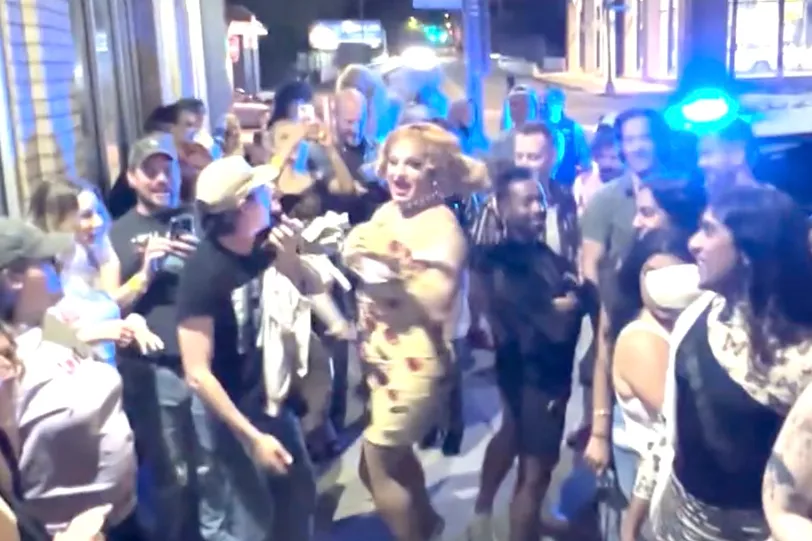
In a moment of resistance and queer solidarity, a drag show went on despite patrons and performers being kicked out of a bar by about 20 police officers in bulletproof vests.
Police raided Pittsburgh LGBTQ+ venue P Town Bar on Friday in the middle of a drag event.
Drag artist Indica was performing alongside trans model and nightlife legend Amanda Lepore when police began to gather in the back of the establishment, QBurgh reported. When Indica finished her rendition of “Bohemian Rhapsody,” police directed patrons to exit the bar but did not explain why beyond saying it was a “compliance check.”
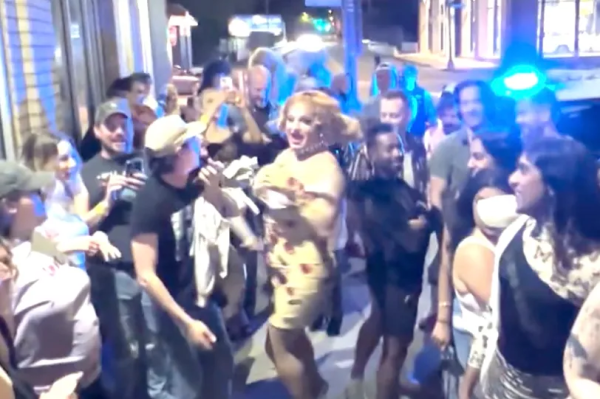
“We waited 30 minutes outside for them to inspect every crevice,” Indica told QBurgh. But the patrons and performers refused to let the cops quash their spirit and instead created their own public performance space.
Video captured during the wait shows the crowd belting Chappell Roan’s Pink Pony Club while Indica dances up and down the sidewalk, collecting tips.
“Guess what, divas?” she said when the performance ended. “This is why queer people have gotta stick the f*ck together in 2025… Make some noise for the queer people in your life everybody.” The crowd cheered.
QBurgh described the moment as one of “resistance, solidarity, and improvisational beauty” and one that “reminded everyone there that drag isn’t just entertainment, it’s political. And when the music stops, the queens don’t.”
Police proceeded to allow 70 people to reenter the bar, saying it had been over capacity with the 130 people who were in attendance.
“The raid was a jarring experience in 2025,” one witness said. “Dozens of state police, geared up with bulletproof vests, flooded the bar and told us to get out. None of the officers would explain what was happening. We stood in the rain for maybe 30 minutes or so until most patrons were let back in. Fortunately the situation was calm and orderly, but they really just overtook this queer space with an entire fleet of police to ‘count heads’ or whatever their excuse was.”
Corey Dunbar, a security guard for P Town Bar, praised the way the staff handled the incident, saying they “ensured patrons’ safety and nerves during the process” since “many people were shaken up.”
State police told QBurgh the raid was instigated by the Allegheny County Nuisance Bar Task Force. It is not known who made the initial complaint that led the cops there.
Witnesses said officers would not look the queens in the eye and would not answer their questions about why things like this never happen at straight bars. Indica also said that some officers even asked to take selfies with Lepore.


 The news out of the
  If you are struggling right now, please consider reaching out to: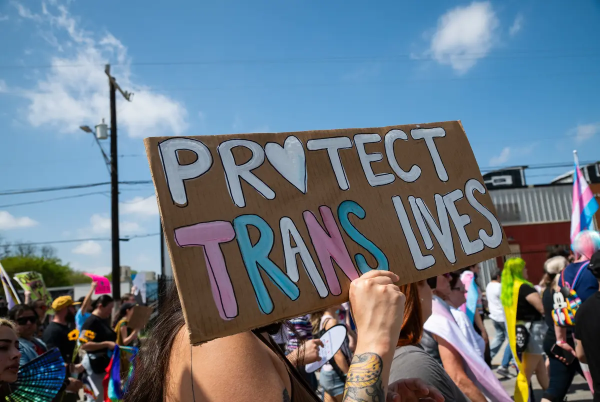

 fleeredstates.blog
You must be logged in to post a comment.