The outcome of the Iowa caucuses solidifies the top echelon, or more precisely, the top two tiers: Donald Trump secured the win, and following a notable gap, Ron DeSantis and Nikki Haley essentially ended up in a tie for the second position.
On January 15, former President Donald Trump emerged victorious in the Iowa Republican presidential caucuses, marking his triumph in the initial election contest of 2024. (Video: Blair Guild/The Washington Post, Photo: Jabin Botsford/The Washington Post)
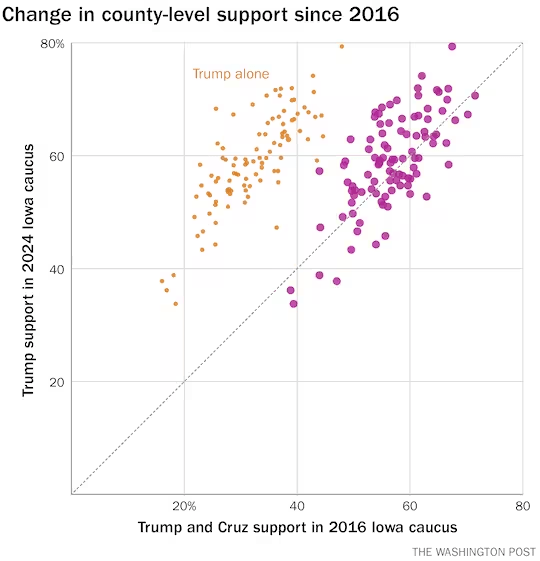
During the evening, we have been juxtaposing Trump’s 2024 performance with the combined performance of Trump and Sen. Ted Cruz (R-Tex.) eight years prior. This comparison remained consistent, as Trump’s county-level performance deviated by an average of merely 2 percentage points from the combined performance in 2016.
He improved by two points. In 59 out of Iowa’s 99 counties, he surpassed the Trump-Cruz support from 2016. Currently, he is on track to secure victory in all three counties where he performed least favorably in 2016.
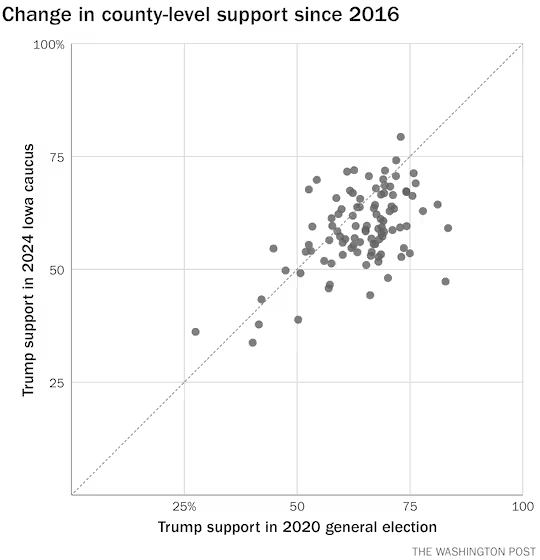
Despite facing competition from several other Republicans, Trump garnered greater support in 27 counties compared to his performance in the 2020 general election.
On average, his performance in Iowa’s counties tonight was only about 5 points lower than it was in November 2020.
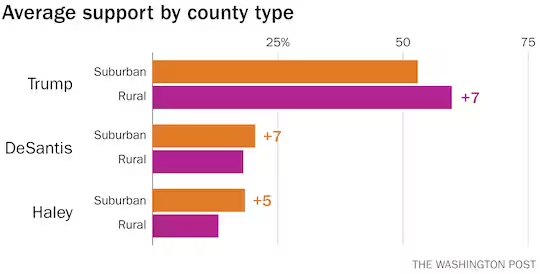
The average remained consistent in both suburban and rural counties. Similar to his performance in 2016, Trump exhibited stronger results in rural counties. However, in a notable shift, he also garnered over half the vote on average in suburban counties this time. As anticipated, both Haley and DeSantis performed better in suburban counties compared to rural ones.
It’s a matter of fine distinctions, really. Trump is anticipated to secure victory in every county except one: Johnson County, where, due to its high percentage of college-educated residents, Trump faced notable challenges in 2016.
Nikki Haley is currently ahead by a single vote in that area.
For the third instance in the past year, the Supreme Court declined a chance to significantly worsen the situation for transgender youth.
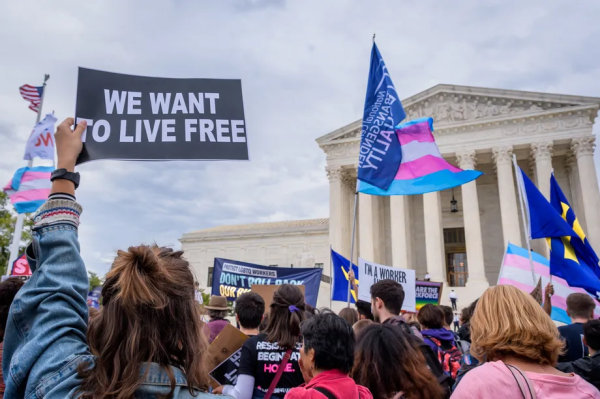
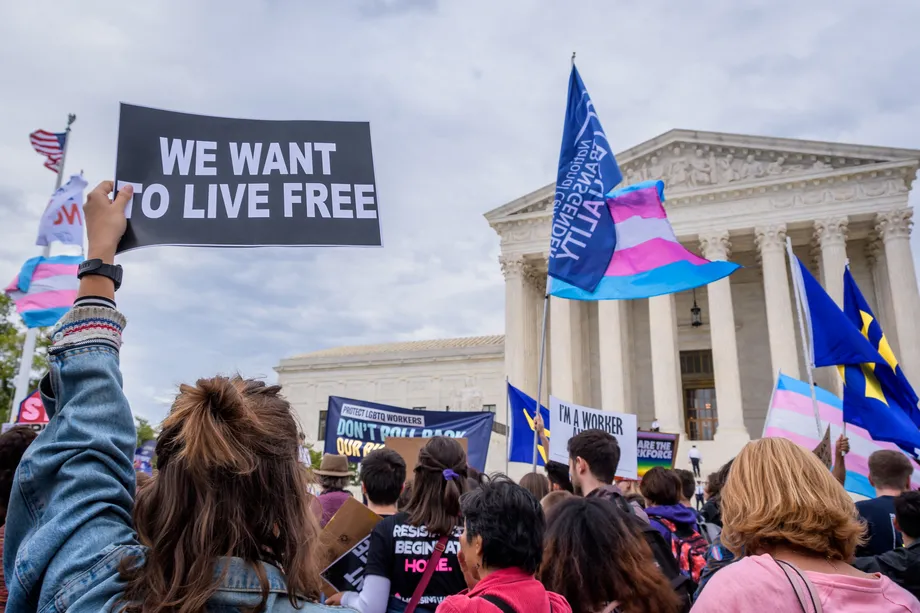
Protesters advocating for transgender rights outside the Supreme Court building in 2019.
For the third occasion in the past year, the Supreme Court surprisingly declined a case seeking to curtail the rights of young transgender individuals in a significant portion of the country.
On Tuesday, the Court declared its decision not to consider Metropolitan School District v. A.C., a case questioning whether public school districts can mandate transgender students to use bathrooms corresponding to their assigned birth sex rather than their gender identity.
In the A.C. case, the United States Court of Appeals for the Seventh Circuit sided with three transgender students, allowing them to use bathrooms that align with their gender identity. With the Supreme Court opting not to review this case, the Seventh Circuit’s decision will remain in effect, at least for the time being. The Seventh Circuit holds authority over federal legal matters in Illinois, Indiana, and Wisconsin.
Despite meeting the usual criteria the justices typically use to determine which cases to consider, the Court declined to take up this case. Notably, the issue of whether transgender students have the right to use bathrooms aligning with their gender identity has generated division among federal appeals courts, prompting the Supreme Court to often intervene and address such conflicts.
The opposition to transgender rights was also advocated by Republican attorney Paul Clement, a highly influential figure with considerable sway over the conservative wing of the Court, who previously served as the US Solicitor General.
A.C. marks the second occasion in slightly over a month where the Court has abstained from a significant LGBTQ rights dispute causing discord among lower court judges. In December, the Court similarly declared that it would not review Tingley v. Ferguson, a case challenging Washington state’s limitations on “conversion therapy” — a practice attempting to convert LGBTQ individuals into cisgender heterosexuals or hinder them from expressing their authentic sexual orientation or gender identity.
The lower court, which affirmed Washington’s restrictions, emphasized in its opinion that “every significant medical, psychiatric, psychological, and professional mental health organization opposes the utilization of conversion therapy.
Furthermore, in April of the previous year, in a case known as West Virginia v. B.P.J., the Court chose not to remove a transgender student from her middle school girl’s cross-country team. A lower court had halted a West Virginia state law preventing her from competing with other girls, and the Supreme Court declined a petition to temporarily reinstate that law during the ongoing litigation. (There remains a possibility that this case may return to the justices in the future.)
These rulings are unexpected for three main reasons. First, Republican appointees hold six out of the nine seats on the Supreme Court, and this Court has typically been highly receptive to concerns raised by the religious right. As recently as last June, the Court decided that a conservative Christian website designer possesses a constitutional right to discriminate against LGBTQ customers.
Moreover, both A.C. and Tingley met the standard criteria that justices typically employ to decide which cases to consider. In each instance, lower courts were in disagreement regarding the interpretation of federal law concerning LGBTQ rights.
Furthermore, in all three cases, the anti-LGBTQ side presented a plausible argument asserting that current law aligns with their desired result. The Tingley case hinges on conflicting language in a 2018 Supreme Court decision, which could be interpreted to endorse either outcome in Tingley. Meanwhile, the A.C. and B.P.J. cases pose questions that the Court left unresolved in its pivotal LGBTQ rights decision in Bostock v. Clayton County (2020).
In essence, it seems that, for the time being, the Court is avoiding cases related to transgender rights.
Cases involving transgender rights related to bathrooms and sports pose particularly intricate questions under the existing legal framework.
In the case of Bostock, the question revolved around whether a federal law prohibiting workplace discrimination based on “sex” also encompasses discrimination against LGBTQ individuals. Six justices determined that it does, and the Court affirmed that “it is impossible to discriminate against a person for being homosexual or transgender without discriminating against that individual based on sex.” For instance, if an employer dismisses a male employee for dating a man while allowing female employees to date men, it constitutes ordinary sex discrimination, as the employer permits women to engage in an activity not allowed for men.
Likewise, Bostock established that if an employer punishes an “employee who was identified as female at birth” for presenting as a man or participating in stereotypically male behavior, while not penalizing “a person identified as male at birth” for the same actions, it constitutes sex discrimination prohibited by federal law.
Although this marked a historic triumph for transgender rights, it also left unanswered one of the crucial questions in such cases: whether the legal concept of “gender” is distinct from the “status as either male or female [as] determined by reproductive biology.” Bostock, indeed, was decided under the assumption that the term “sex” exclusively pertains to “biological distinctions between male and female.”
Nevertheless, even under the assumption that the law pertains solely to “biological” sex, Bostock still determined that most forms of discrimination against transgender individuals contravene that law. This is because such discrimination inherently involves treating men (or individuals assigned male at birth) differently from women (or individuals assigned female at birth).
Federal law, nevertheless, allows for sex discrimination in specific restricted situations. For instance, the law prohibiting sex discrimination in most educational institutions permits these institutions to have “separate living facilities for the different
Likewise, longstanding interpretations of federal prohibitions against sex discrimination acknowledge the allowance of sex-segregated sports teams, as otherwise, women-only teams would not be viable.
Cases such as A.C. and B.P.J., in essence, pose a question that Bostock did not conclusively address. Bostock did not take a definitive stance on whether a transgender man is considered a man. In contrast, the Seventh Circuit had to determine, in deciding the A.C. case, “who counts as a ‘boy’ for the boys’ rooms, and who counts as a ‘girl’ for the girls’ rooms.”
If you seek a more in-depth examination of the legal arguments supporting and opposing the obligation for schools to treat transgender girls and boys equivalently to their cisgender counterparts, I delved into those arguments in greater detail in this piece. Presently, it’s worth noting that the Supreme Court seems resolute in avoiding a definitive resolution to this question, despite the ongoing divergence of opinions in lower courts on how it should be addressed.
In the state, Republican legislators have already submitted a minimum of twelve bills that LGBTQ advocates argue could adversely impact the community.
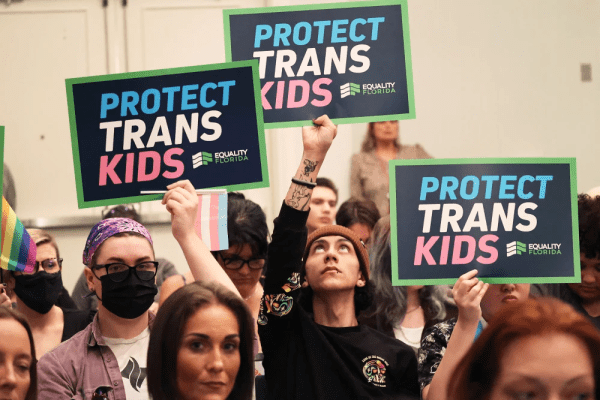
Individuals display signs during a collaborative board meeting of the Florida Board of Medicine and the Florida Board of Osteopathic Medicine in Lake Buena Vista in the year 2022.
The legislative session in Florida commenced just this week, and within the first few days of the new year, Republican lawmakers have already presented more bills aimed at the LGBTQ community than there are days elapsed.
Certain bills, such as one seeking to alter the state’s definition of sex and another intending to criminalize “lewd or lascivious grooming,” stand out as some of the most extreme among the hundreds introduced in state Legislatures this year. Additionally, there’s a proposal to prevent government employees from being compelled to use their colleagues’ requested pronouns, and another bill aims to shield children from “harmful material” online. However, the ambiguous nature of what constitutes harmful material raises concerns among advocates, as it could potentially encompass LGBTQ content.
Moreover, a proposal put forth by Republican state Senator Jason Brodeur aims to classify almost all public allegations of anti-LGBTQ bias as “defamation per se.” This legislation would prohibit journalists from defending such claims by referencing the subject’s “constitutionally protected religious expression or beliefs” or scientific beliefs. Those found liable in successful lawsuits would face damages of no less than $35,000.
“Florida has consistently led in introducing new challenges to freedom and equality, and this year’s array of bills continues the trend,” remarked Brandon Wolf, a representative for the Human Rights Campaign, an LGBTQ advocacy group, and a survivor of the Pulse nightclub mass shooting in Orlando, Florida. “During this session, we anticipate heightened assaults on education, medical freedom, and the basic right of transgender individuals to live authentically.”
One of the most far-reaching bills comes from Republican Representative Dean Black, introducing a comprehensive measure that mandates Floridians to submit an affidavit confirming that their driver’s license or other state ID aligns with the sex indicated on their original birth certificate. Consequently, transgender individuals in Florida would be compelled to surrender any existing ID reflecting their gender identity and would be barred from obtaining such identification in the future.
Additionally, Black’s proposal mandates that any health insurance policy in the state covering transition-related “prescriptions or procedures” must also include coverage for “treatment to detransition” from such procedures. The bill further necessitates the inclusion of so-called conversion therapy in health insurance policies, compelling coverage for mental health services that aim to address a person’s perception that their gender is inconsistent with their sex assigned at birth, thereby affirming their birth sex.
Furthermore, the legislation would compel any school district or state agency engaged in collecting vital statistics for anti-discrimination compliance or accurate data on public health, crime, economics, or other purposes to include the identification of individuals’ birth sex in the dataset. This provision has the potential to impose limitations on the comprehensive collection of data concerning transgender individuals.
Black stated that the purpose of the bill is to address the “defining question of this decade: ‘What constitutes a woman?'”
“In truth, this legislation merely seeks to formalize what is already universally accepted but has unfortunately been manipulated by an extremist political movement determined to alter the laws of nature to suit their distorted agenda,” Black declared in a press statement.
Gillian Branstetter, a communications strategist with the American Civil Liberties Union, noted that Florida is not the inaugural state to contemplate a measure restricting transgender individuals from obtaining driver’s licenses reflecting their gender identity. Montana, North Dakota, Kansas, and Tennessee have already implemented comparable laws, with the ACLU presently involved in legal action against Kansas’ restriction. Additionally, Nebraska and Oklahoma have instituted executive orders that similarly define sex within state law.
Branstetter asserted that the bills represent a “clear attempt” to counter the Supreme Court’s decision in Bostock v. Clayton County, which established that federal employment law safeguards LGBTQ individuals from discrimination. Justice Neil Gorsuch’s opinion explicitly clarified that discrimination grounded in sex encompasses both sexual orientation and gender identity.
“In essence, these bills are designed to provide extensive authority to the state to erase the existence of ‘transgender,'” Branstetter stated.
A new proposal introduced by Republican Representative Taylor Yarkosky criminalizes “lewd or lascivious grooming,” categorizing it as an offense. The bill defines this as an individual “preparing or encouraging a child to participate in sexual activity through overtly sexually themed communication with the child or engaging in conduct with or in the presence of the child without permission from the child’s parent or legal guardian.”
While the bill doesn’t explicitly mention LGBTQ individuals, one of its Republican sponsors has publicly voiced criticism of all-ages drag performances. Additionally, the term “grooming” has been recently employed by some conservative officials to characterize LGBTQ
Florida’s series of legislative measures extends a trend that has persisted for several years. In the previous year, state Republican legislators presented 10 bills specifically addressing LGBTQ individuals, and four of them were enacted into law. Among these was a measure that extended the reach of Florida’s Parental Rights in Education Act, commonly criticized as the “Don’t Say Gay” law.
“Florida might serve as a testing ground for anti-LGBTQ+ hostility, but it is not isolated,” remarked Wolf, the advocate from the Human Rights Campaign. “The bills originating from the state are indicative of a broader agenda orchestrated by a national extremist network seeking to enforce these measures nationwide.”
Last year, conservative legislators introduced an unprecedented number of bills aimed at LGBTQ individuals, surpassing 500 filings nationwide, as reported by the ACLU. An analysis by NBC News revealed that seventy-five of these bills were enacted into law.
As of last month, Branstetter mentioned that the ACLU has documented 212 bills of such nature for the year 2024.
Thailand Advances Towards Recognizing Same-Sex Marriages
Thailand is set to become the next Asian country to achieve marriage equality as the government cabinet recently approved a bill to legalize same-sex weddings.
The legislation is scheduled to be debated in Parliament later this week.
The proposed amendment to the Civil and Commercial Code seeks to replace “men and women” and “husband and wife” with “individuals” and “marriage partners.” Following this, there will be efforts to amend the pension fund law to formally recognize same-sex couples.
In recent years, Thailand has faced challenges in passing marriage equality legislation despite being recognized as one of the most LGBTQ+-friendly countries. The new government, however, has committed to fulfilling this promise, actively campaigning on the issue and aiming to revive and pass the legislation.
Marriage equality took center stage in the recent election, with Prime Minister Srettha Thavisin advocating for it. In a recent news conference, Srettha emphasized that the proposed change would grant LGBTQ+ couples the “exact same equal rights” as heterosexual couples.
The bill will undergo multiple rounds of debate before potential passage. Upon approval, it will then be presented to King Maha Vajiralongkorn for consent, marking the final step before becoming law.
Thai citizens widely favor marriage equality, with 60% expressing support and 32% in opposition, aligning with the government’s push to legalize same-sex marriage.
The European Union will support families regardless of how the child was conceived or born.
The European Union has voted to endorse parenthood, inclusive of same-sex parents, across the continent.
The European Certificate of Parenthood will acknowledge parenthood irrespective of the method of conception, birth, or family structure, ensuring associated rights to education, healthcare, custody, and succession.
The decision upholds the rights of same-sex parents throughout the EU, irrespective of individual country policies, provided the child is born in a member state.
Nations can establish their regulations on recognizing certain forms of parenthood, such as surrogacy. However, once a certificate is approved in one member country, it must be acknowledged in all of them. States can only reject a parenthood certificate if it is “manifestly incompatible with public order” in specified cases.
The European Certificate of Parenthood will not serve as a replacement for national documents. Instead, it will be accessible online and available for citizens across all EU countries. Once issued, it must be recognized and honored.
“No child should face discrimination based on their lineage or birth circumstances. Presently, children can legally lose parental recognition when crossing into another Member State. This is unacceptable,” emphasized Maria-Manuel Leitão-Marques, a Member of the European Parliament from Portugal. “With this vote, we are moving closer to the objective of ensuring that parenthood recognized in one Member State holds true across all Member States.”
The measure would safeguard over two million children.
“This provision is necessary to safeguard the fundamental rights of minors regardless of the sexual orientation of their parents and regardless of how they were born,” said Italian MEP Sabrina Pignedoli. “Anyone who is a father or mother in one Member State will, in fact, be automatically recognized in all other Member States and will, therefore, be able to move freely with their children throughout Europe.”
“Today, unfortunately, this is not the case in Hungary, Poland, or Bulgaria, countries that do not recognize parenthood established in another state in the cases of LGBT parents,” Pignedoli continued. “Even in Italy, as is known, there is strong discrimination, and the judicial authority often has to intervene to re-establish the rights recognized abroad.”
In Italy, as in other conservative countries, anti-abortion and anti-LGBTQ+ groups opposed the measure.
After receiving approval from the European Parliament, the measure must now secure unanimous passage from the governments of all member countries.
Alabama has been granted the ability to enforce its felony ban on gender-affirming health care for minors, as per a federal court ruling on Thursday.
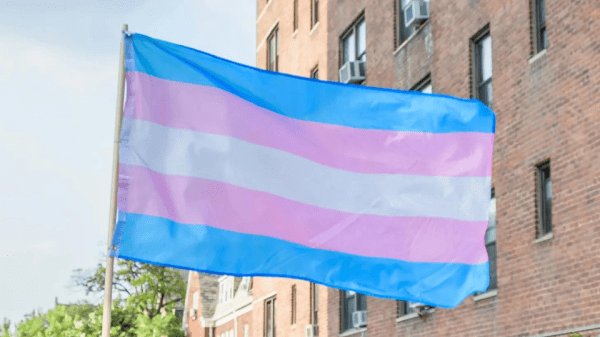
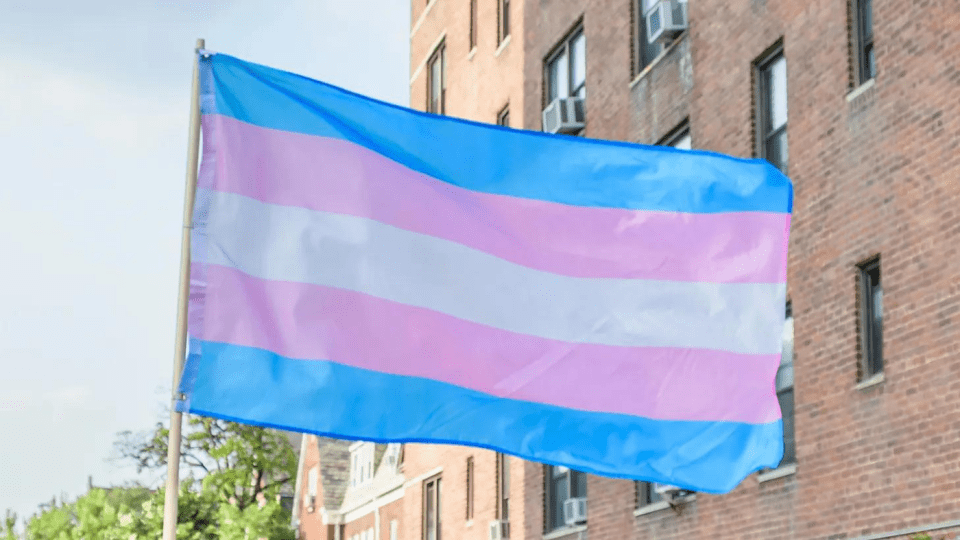
A transgender pride flag is displayed.
The decision allows the state to proceed with the ban, lifting a preliminary injunction that had prevented officials from enforcing it for over a year.
On Thursday, the U.S. 11th Circuit Court of Appeals lifted the injunction against Alabama’s 2022 law, turning it into a felony for physicians to prescribe puberty blockers or hormones to transgender individuals under 19. Convictions could lead to sentences of up to a decade in prison.
When the injunction was issued in 2022, U.S. District Judge Liles C. Burke stated that Alabama failed to provide credible evidence demonstrating that gender-affirming treatments are “experimental.”
In August, a federal appeals court reversed this decision, stating, “The use of these medications in general—let alone for children—almost certainly is not ‘deeply rooted’ in our nation’s history and tradition,” referencing the Supreme Court’s decision overturning Roe v. Wade.
In November, Alabama’s attorneys requested the 11th Circuit stay the enforcement of the district court’s preliminary injunction, which was granted Thursday in a brief unsigned order.
A September request for a rehearing made by the Alabama families challenging the law is still pending, and a full trial on the constitutionality of the ban is slated for August.
Alabama Attorney General Steve Marshall praised Thursday’s decision as “a significant victory for our country, for children, and for common sense.”
In a joint statement, lawyers representing the families challenging the law said the ruling will cause significant harm to children and parents in Alabama.
“Alabama’s transgender healthcare ban will harm thousands of transgender adolescents across the state and will put parents in the excruciating position of not being able to get the medical care their children need to thrive,” according to the statement, issued Thursday by the National Center for Lesbian Rights, GLBTQ Legal Advocates & Defenders, the Southern Poverty Law Center, and the Human Rights Campaign.
Including Alabama, 23 states have enacted laws or policies that heavily restrict or ban gender-affirming health care for transgender minors. Laws passed in five states — Alabama, Florida, Oklahoma, North Dakota, and Idaho — include provisions that make it a felony crime to provide treatment to trans youth under 18.
Estonia has become the inaugural former Soviet state to legalize marriage equality.
Commencing this week, same-sex couples in Estonia can enter into marriage, marking the country as the first among the former Soviet nations to legalize marriage equality.
Marriage equality legislation was approved by the parliament of the Baltic state with a vote of 55 to 34 in June of the previous year. This decision followed the election of progressive Prime Minister Kaja Kallas in February 2023. The law officially came into effect on January 1, this past Monday.
Presently, same-sex couples have the option to submit marriage applications online. Typically, these applications take between one to six months to process, with the initial ones not anticipated to be finalized before February 2.
“Laws offer clarity and shape our perspectives,” remarked Minister of Social Protection Signe Riisalo. “I trust that baseless concerns will diminish, and critics of this decision will recognize that what is perceived as a loss is, in fact, a significant gain for many of us.”
In June of the previous year, LGBTQ+ individuals in Estonia expressed their appreciation to the parliament for passing the law. Numerous couples, who were previously in civil unions, are now planning to solemnize their marriages.
“For the LGBT+ community, this is a crucial message from the government, signaling that, at last, we are equal to other couples; that we are valued and entitled to the same services and opportunities,” conveyed Keio Soomelt, the manager of the Baltic Pride festival, to The Guardian.
In 1991, the year Estonia gained independence from the Soviet Union, homosexuality was decriminalized. However, it is only in recent times that a majority of the country has backed same-sex marriage. A decade ago, only 34% of Estonians supported marriage equality, while a slim majority—53%—now supports it, as indicated by a poll from the Estonian Human Rights Center.
“A decade ago, I didn’t witness as many same-sex couples openly holding hands in public,” noted Marielle Tuum, a Tallinn resident and teacher. She mentioned that people in Estonia are now more open, revealing her plan to marry her girlfriend in the spring and host a wedding in the fall.
“I’m thrilled that I can have a meaningful wedding here at home, rather than somewhere else with less significance,” she expressed.
The legislation was scheduled to be enforced starting January 1, 2024.
A federal judge has provisionally halted the implementation of an Idaho law that prohibited gender-affirming healthcare treatments for transgender individuals under the age of 18. The law, initially scheduled to become effective on January 1, 2024, would have criminalized the provision of such care.
On Wednesday, District Court Judge Lynn Winmill declared that the limitations imposed by the law violate the Due Process Clause and the Equal Protection Clause within the Fourteenth Amendment of the U.S. Constitution.
“Transgender children deserve fair treatment within legal frameworks,” expressed Winmill in his verdict. “Parents should possess the right to make fundamental decisions regarding the care of their children.”
He went on to say, “Repeatedly, these cases highlight that the primary function of the Fourteenth Amendment is to safeguard disadvantaged minorities and uphold our essential rights against legislative overreach… and this remains equally valid for transgender children and their parents in the 21st Century.”
Governor Brad Little signed HB 71 into law in April. This legislation prohibits the use of puberty blockers, which enable children to explore their gender identity and temporarily halt the development of permanent sex characteristics. Additionally, the law bans hormone therapies and surgeries. Medical professionals interviewed by ABC News have emphasized that surgeries on adolescents are infrequent and are only considered after careful consideration on a case-by-case basis.
The law includes a provision for children with a “medically verifiable genetic disorder of sex development,” commonly referred to as intersex.
Restrictions on access to gender-affirming care have been enforced in at least 20 states, with many of them encountering legal challenges. The legislation in Arkansas, the inaugural of its kind in the U.S., was also deemed unconstitutional by a federal judge.
Advocates for these limitations assert that they safeguard children from “medically unnecessary interventions that result in irreparable infertility, chronic health problems, and mutilated reproductive organs,” as stated in a press release by the conservative Christian lobbying group Idaho Family Policy Center after the bill was signed.
The adolescent plaintiffs central to this legal action, who stand to be affected by the legislation, emphasize that gender-affirming care has been crucial for their mental well-being. This sentiment aligns with findings from several studies.
According to the CDC, transgender youth are at a higher risk of facing anxiety, depressed mood, and suicidal ideation and attempts, primarily linked to gender-related discrimination and gender dysphoria. A recent study in the New England Journal of Medicine has established that gender-affirming hormone therapy is effective in enhancing the mental health of transgender adolescents and teenagers.
A plaintiff noted that puberty blockers had “near immediate positive effects” on her. Winmill’s decision highlights that by interrupting the physical changes contributing to her depression and anxiety, her mental health significantly improved.
The second plaintiff initiated puberty blockers following “several months of therapy, additional visits with her doctor, and lab work.” As per the filing, after a few months, she commenced low-dose hormone therapy.
“As a pseudonym for the plaintiff, the filing stated, ‘Since receiving gender-affirming medical care, Jane’s mental health has significantly improved, but the debate over HB 71 and other anti-transgender bills has affected her mental health and her grades.’ ‘When the bill passed, Jane wept in the hallway at school, and her parents had to take her home. The passage of the bill has also caused the Doe family to consider leaving Idaho so that Jane can continue to access the medical care that has helped her so significantly.”
Prominent national medical associations, including the American Academy of Pediatrics, the American Medical Association, the American Academy of Child and Adolescent Psychiatry, and over 20 others, concur that gender-affirming care is safe, effective, beneficial, and medically necessary.
In alignment with a House bill introduced in November, a Senate Republican presented a proposal on Thursday that aims to impose limitations on the use of personal pronouns by government agencies.
Senator Jonathan Martin, representing Fort Myers and a member of the Republican party, submitted the proposal (SB 1382) for deliberation in the upcoming 2024 legislative session, commencing this Tuesday. The identical House bill (HB 599) has been filed by Representative Ryan Chamberlin, a Republican from Belleview.
The introduction of these bills may contribute to ongoing legislative debates on matters concerning gender identity. The bills assert, in essence, that the state policy recognizes a person’s sex as an unchangeable biological characteristic. It further states that assigning a pronoun not corresponding to the person’s sex is considered inaccurate.
These bills would prohibit state and local government agencies from mandating employees and contractors to use a person’s preferred personal title or pronouns if they don’t align with the sex assigned to that person at birth.
Furthermore, these bills would bar employees of government agencies and contractors from presenting preferred pronouns to their employers that “do not correspond to his or her sex.” Additionally, employers would be prohibited from requesting workers to provide personal pronouns.
“If you choose to target our communities, be prepared to face competition from within our community.”
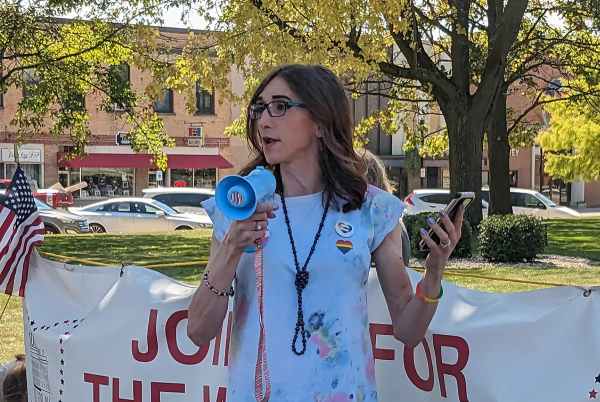
A transgender woman is seeking to replace an Ohio legislator who endorsed the state’s anti-drag bill. If successful, she would also become the first openly transgender individual to hold a position in the state’s House of Representatives.
Arienne Childrey is presently the sole candidate in the unopposed March 19 Democratic primary election for the representation of Ohio’s District 84. The 40-year-old shared with the local Cincinnati outlet CityBeat that her decision to run was driven by the intention to challenge state Rep. Angela King (R).
During the previous summer, King and her fellow Republican state Rep. Josh Williams presented House Bill 245. This bill aimed to alter the legal definition of “adult cabaret performances” in the state, encompassing “performers or entertainers who exhibit a gender identity that is different from the performer’s or entertainer’s gender assigned at birth using clothing, makeup, prosthetic or imitation genitals or breasts, or other physical markers.”
The introduced legislation is among numerous bills in state legislatures nationwide that seek to prohibit drag performances in the presence of children. During testimony last month, King referenced a video of a drag performance that occurred in her community.
While King asserted that under HB 245, transgender individuals would still have the freedom to “express their gender as they go to a grocery store, the post office, and live their daily lives,” critics argue that the bill would disproportionately impact the transgender community. In a statement during the summer, Densil Porteus, the executive director of Stonewall Columbus, mentioned that the proposed law “aims to give power to others as to when they believe gender impersonation/drag is being performed.”
As highlighted by writer Joy Ellison in an August editorial for Matter, the current version of the bill explicitly states that transgender entertainers would face a prohibition on performing in locations other than adult venues in Ohio.
Childrey, a resident of Ohio since 2014 and the founder of Northwest Ohio Trans Advocacy, expressed to CityBeat that she couldn’t passively observe King running unopposed in the imminent November election.
“If you’re going to target our communities, then you’ll need to contend with someone from within our community,” she asserted.
“It’s long overdue for us to have someone at the Statehouse genuinely dedicated to addressing those issues—matters that truly affect people and can enhance our lives—rather than someone more focused on causing harm rather than providing assistance,” she added.
Childrey stands against Ohio’s recently enacted prohibition on gender-affirming care. Additionally, her campaign emphasizes education-related matters such as boosting teacher salaries, expanding broadband access in rural areas, and fortifying unions throughout the state.
“Arienne’s dedication to public service and her ability to persevere in the face of challenges set a compelling example for everyone,” stated the transgender advocacy organization TransOhio. “As she confronts the hurdles that come with this groundbreaking journey, we also want to recognize the importance of her candidacy and the influence it will have in paving the way for future generations of trans leaders.”
“The only thing that could bring me more joy than being the first trans woman elected in the state of Ohio,” Childrey expressed, “is to not be the only trans person elected in the state of Ohio.”












You must be logged in to post a comment.