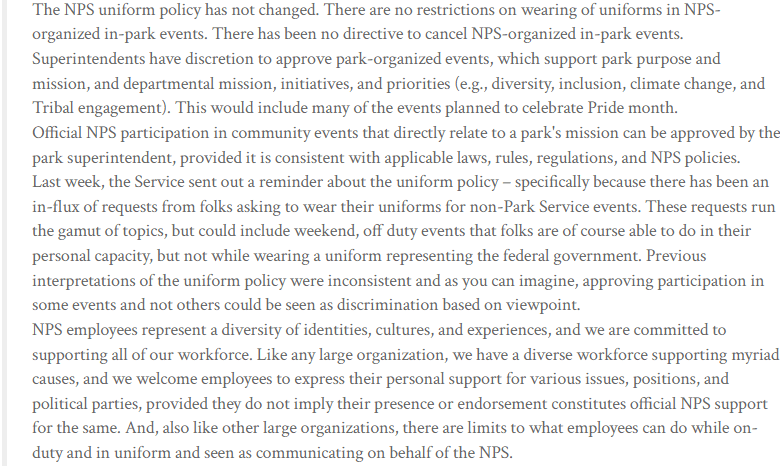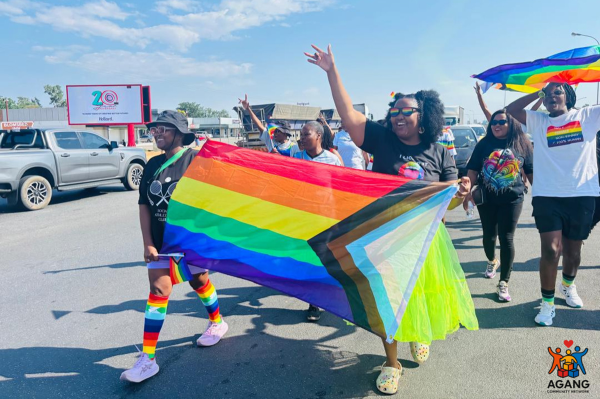
The first courageous annual Palapye Pride in Botswana

Read more at The Washington Blade.

“When the sun rose on 1 Nov., 2025, Pride morning in Palapye, the open space where the march was scheduled to begin was empty. I stood there trying to look calm, but inside, my chest felt tight. I was worried that no one would come. It was the first-ever Pride in Palapye, a semi-urban village where cultural norms, religious beliefs, and tradition are deeply woven into everyday life.

I kept asking myself if we were being naive. Maybe people weren’t ready. Perhaps fear was going to win. For the first 30 minutes, it was me, a couple of religious leaders and a handful of parents. That was it. The silence was loud, and every second felt like it stretched into hours. I expected to see the queer community showing up in numbers, draped in color and excitement. Instead, only the wind was moving.

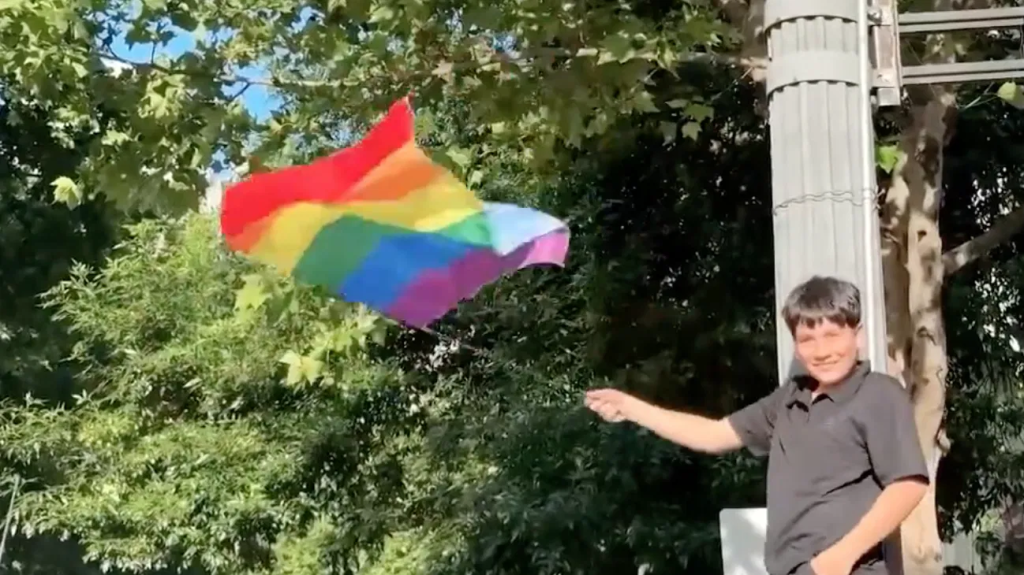
But slowly, gently, just like courage often arrives, people started to show up with a rainbow flag appearing from behind a tree and a hesitant wave from someone standing at a distance.

That’s when I understood that people weren’t late, just that they were afraid. And their fear made sense. Showing up openly in a small community like Palapye is a radical act. It disrupts silence. It challenges norms. It forces visibility. Visibility is powerful, but it is never easy. We marched with courage, pulling from the deepest parts of ourselves. We marched with laughter that cracked through the tension. We marched not because it was easy, but because it was necessary,” narrates activist Seipone Boitshwarelo from AGANG Community Network, which focuses on families and friends of LGBTIQ+ people in Botswana. She is also a BW PRIDE Awards nominee for the Healing and Justice Award, a category which acknowledges contributions to wellness, mental health, and healing for the LGBTIQ+ community across Botswana.

Queer Pride is Botswana Pride!

Pride is both a celebration and a political statement. It came about as a response to systemic oppression, particularly the criminalization and marginalization of LGBTIQ+ people globally, including in Botswana at some point. It is part of the recognition, equality, and assertion of human rights. It also reminds us that liberation and equality are not automatically universal, and continued activism is necessary. A reminder of the famous saying by Fannie Lou Hamer, “Nobody is free until everybody’s free.”

The 2023 Constitutional Review process made one thing evident, which is that Botswana still struggles to acknowledge the existence of LGBTIQ+ people as full citizens. Instead of creating a democratic space for every voice, the process sidelined and erased an entire community. In Bradley Fortuin’s analysis of the Constitutional review and its final report, he highlighted how this erasure directly contradicts past court decisions that explicitly affirmed the right of LGBTIQ+ people to participate fully and openly in civic life. When the state chooses to ignore court orders and ignore communities, it becomes clear that visibility must be reclaimed through alternative means. This is why AGANG Community Network embarked on Palapye Pride. It is a radical insistence on belonging, rooted in community and strengthened through intersectionality with families, friends, and allies who refuse to let our stories be erased.

Motho ke motho ka batho!

One of the most strategic decisions made by the AGANG Community Network was to engage parents, religious leaders, and local community members, recognizing their value in inclusion and support. Thus, their presence in the march was not symbolic, but it was intentional.

Funding for human rights and LGBTIQ+ advocacy has been negatively impacted since January 2025, and current funding is highly competitive, uneven and scarce, especially for grassroots organizations in Botswana. The Palapye Pride event was not funded, but community members still showed up and donated water, a sound system, and someone even printed materials. This event happened because individuals believed in its value and essence. It was a reminder that activism is not always measured in budgets but in willingness and that “motho ke motho ka batho!” (“A person is a person because of other people!”).

Freedom of association for all

In March 2016, in the the Attorney General of Botswana v. Rammoge and 19 Others case, also known as the LEGABIBO registration case, the Botswana Court of Appeal stated that “members of the gay, lesbian, and transgender community, although no doubt a small minority, and unacceptable to some on religious or other grounds, form part of the rich diversity of any nation and are fully entitled in Botswana, as in any other progressive state, to the constitutional protection of their dignity.” Freedom of association, assembly, and expression is a foundation for civic and democratic participation, as it allows all citizens to organize around shared interests, raise their collective voice, and influence societal and cultural change, as well as legislative reform.

The Botswana courts, shortly after in 2021, declared that criminalizing same-sex sexual relations is unconstitutional because they violated rights to privacy, liberty, dignity, equality, and nondiscrimination. Despite these legal wins, social stigma, cultural, and religious opposition continue to affect the daily lived experience of LGBTIQ+ people in Botswana.

The continuation of a declaration

AGANG Community Network is committed to continuing this work and creating safe and supportive spaces for LGBTIQ+ people, their families, friend, and allies. Pride is not just a day of fun. It is a movement, a declaration of queer existence and recognition of allyship. It is healing and reconciliation while amplifying queer joy.
LGBTQ+ people march against Javier Milei & for Pride in Buenos Aires this weekend

Read more at LGBTQ Nation.

The streets of Buenos Aires were filled with sounds of celebration and protest on Saturday as Argentina’s largest Pride march rolled from the city’s central Plaza de Mayo to the National Congress building. 

Hundreds of thousands turned out in support of the LGBTQ+ community and against right-wing Argentine President Javier Milei’s public attacks on it.

The political backdrop for the march was a resounding victory last week for Milei’s party, La Libertad Avanza (LLA), in legislative elections. Low voter turnout may have contributed to a strong showing that took pollsters and the opposition by surprise.

LLA won more than 40 percent of the vote nationwide and 15 of 24 districts, providing the Trump-aligned leader with a veto-proof number of votes in the legislature. It also promised delivery of Trump’s $20 billion bailout for Milei to address Argentina’s ailing economy.

Attendees on Saturday marched under the slogan “Against hate and violence: more pride and unity,” as they navigated packed downtown streets and boulevards toward the capital building.

“These days, with the current government, there is a lot of hate. You can see it in the streets and on social media,” Nahuel Vassallo, a 22-year-old university student, told the Buenos Aires Times. “That’s why standing here to defend our rights and who we are is so key.”

Milei has charted a course of division and blame similar to Trump’s.

Earlier this year, he took the international far-right’s “war on woke” to the World Economic Forum in Davos, Switzerland, with a fiery speech declaring that LGBTQ+ “gender ideology constitutes plain and simple child abuse.”

“They are pedophiles,” he said of the LGBTQ+ community.

“The mental virus of woke ideology” is “the great epidemic of our time that must be cured,” he added. “This is the cancer we need to get rid of,” along with “feminism, diversity, inclusion, abortion, environmentalism, and gender ideology.”

The rhetorical assault inspired a massive demonstration in Buenos Aires days later.

Milei responded by amending the country’s Gender Identity Law by decree. The groundbreaking measure, passed in 2012, dropped requirements for any diagnosis or treatment for someone to prove their gender identity, depathologizing transgender identity. The amended legislation banned gender-affirming hormone treatments and surgeries for trans people under 18. 

Mileie has also dissolved the government agencies responsible for gender equality and anti-discrimination efforts.

Argentina has a history of pro-LGBTQ+ legislation that is under attack by Milei and his far-right supporters. The country was the first in Latin America to legalize same-sex marriage in 2012.

According to the latest report from the National Observatory on LGBT+ Hate Crimes, hate crime incidence is up 70 percent in the first six months of 2025 vs. the same period last year. Perhaps more worrying, security forces perpetrated more than half, double the number last year.

Viviana Cardano, from the ATE state-workers union, said the LGBT+ community had suffered under Milei’s divisive politics.

“Today we are all here to reject the policies of this new government and the persecution that the LGBTQ+ community has been suffering since Milei’s statements in Davos,” she said on Saturday.

Among the thousands of signs at the march, one read: “There is no pride without justice.”

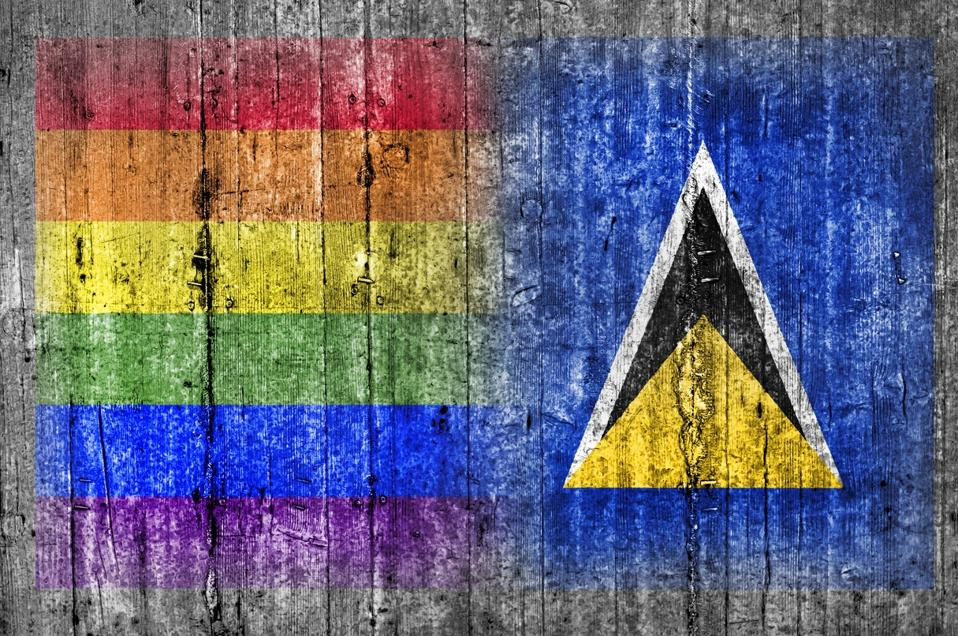
St. Lucia Strikes Down Colonial-Era Sodomy Law, Marking Major Win For LGBTQ Rights In The Caribbean

Read more at Forbes.

“These provisions… exacerbate, if not condone, the stigmatisation of homosexual persons in civil society and engender feelings of hostility fueled by persons who are inclined to take the moral high ground,” stated Eastern Caribbean Supreme Court Judge Shawn Innocent in his late July ruling striking down St. Lucia’s ban on same-sex intimacy.

The ruling coming down from the Heraldine Rock Building sparked swift, though not unanimous, reaction. The Caribbean’s LGBTQIA community celebrated the long-overdue victory, while religious conservatives issued dire warnings.

As Judge Innocent explained on the bench, many islanders and Caribbean citizens continue to navigate the fault lines between a dated colonial inheritance and a modern identity.

“It is the law itself which violates their constitutional rights,” Innocent’s ruling said. “They do not have to await prosecution under those sections to experience a violation. Without any equivocation, his liberty has been emasculated and abridged.”

The ruling made St. Lucia the latest in a growing list of Caribbean nations—including Barbados, Dominica, Antigua and Barbuda, and St. Kitts and Nevis—to decriminalize consensual same-sex relations through the courts. In doing so, it affirms what many legal scholars and LGBTQIA activists have long argued: that the region’s colonial-era sodomy laws are not just outdated, they are unconstitutional.

The win in St. Lucia comes at a time when the Caribbean LGBTQIA movement appears to not only be making progress in changing laws, but changing attitudes. This stands in contrast to the United States, where movement workers are fighting back against regressive measures, state-based legislation, and attempts by the Trump administration to gut federal civil rights protections.

For Glenroy Murray, St. Lucia’s policy change, part of a nearly decade-long strategy led by the Eastern Caribbean Alliance for Diversity and Equality (ECADE) and other local organizing groups, is the product of years of sustained advocacy.

“In the Caribbean, queer activists are saying: we deserve space, and we’re going to claim it—despite prevailing attitudes that have existed in this region for a long time,” said Murray, the Caribbean lead for Human Dignity, a legal advocacy organization that provides technical, legal, and communications support to queer organizations and governments worldwide.

What began as a debate among legal scholars, researchers, and grassroots LGBTQIA activists about the countries most ripe for a legal challenge to colonial-era sodomy laws has since evolved into a broad-based movement to decriminalize sexuality and fight for human rights across the region.

For the Caribbean movement, the struggle has been twofold: first, dismantling outdated “saving law clauses” that shield colonial-era statutes from constitutional challenge. Found in several post-independence constitutions, these clauses preserve pre-existing laws—even if they conflict with modern human-rights protections. In practice, they’ve made it far more difficult to overturn criminal statutes against same-sex intimacy. Activists argue that true equality cannot be achieved without dismantling these legal shields.

Compounding this are well-funded, transnational conservative movements determined to make LGBTQIA rights in the Caribbean harder to secure. Angelique Nixon, senior lecturer and researcher at University of the West Indies, St. Augustine Campus’ Institute for Gender and Development Studies, said that these actors, backed by U.S.-based evangelical and faith-based groups, frame equality as a Western imposition and deploy religious and moral rhetoric to stir cultural resistance.

“Globally, we’re seeing the rise of well-funded, transnational anti-rights movements that actively export homophobic and transphobic ideologies across borders, often under the guise of protecting traditional values or religious freedoms,” Nixon said.

“This transnational dimension makes our struggle particularly challenging,” she emphasized.

The American religious right has directly targeted the Caribbean: groups affiliated with the American Center for Law and Justice (ACLJ) have conducted legal training in Belize, while Alliance Defending Freedom (ADF) and other U.S. advocacy networks have bolstered local opposition to reform.

Meanwhile, Family Watch International—designated a hate group by the Southern Poverty Law Center—has expanded its regional influence, launching campaigns in Africa and elsewhere.

Earlier in 2025, Trinidad and Tobago’s Court of Appeal overturned a 2018 ruling decriminalizing consensual same-sex intimacy, citing its “saving law clause.” While the court reduced penalties from 25 years to five years’ imprisonment, it emphasized that only the legislature could fully repeal the provisions, a move Nixon warns will further endanger queer people.

“Without strong political leadership, these laws will stay in place and continue to justify stigma, discrimination, and violence—even if they’re not enforced,” Nixon said. “The mere existence of these laws creates a chilling effect. Legal ambiguity and inaction can silence LGBTQI+ people and make them more vulnerable.”

Murray underscored that these laws are rooted in colonial imposition. “Many of the laws against sodomy, buggery, and so-called ‘unnatural offenses’—in other words, laws criminalizing sexuality—were imposed across the Caribbean by the British,” he said. “In Jamaica, the law criminalizing intimacy between men dates back to 1864, and it remains in effect today.”

Quick not to lay all the blame on colonial powers, Murray added: “I won’t let Caribbean governments off the hook. They could have changed these laws a long time ago—there have been repeated calls to repeal them. In some cases, governments have not only retained these provisions but made them worse. And at times, there’s been a clear intentionality to keeps them in place.”

While legal reform remains paramount, organizers have also worked diligently to change hearts and minds—advancing broader issues like health equity, education, and housing.

In its fight against liberal American misconceptions about Caribbean homophobia, the movement’s organizing strategy has centered on balancing the region’s often-professed anti-LGBTQIA identity with lived experiences that are far more varied. Murray explained that this nuance does not discount the violence, displacement, and harm faced by LGBTQIA people, but it has remained front of mind for organizers.

“For a time, much of our culture was not pro-gay, but it still allowed for a type of existence,” Murray said. “Over time, as queer people became more visible, violence escalated—and that’s when the region became known for being homophobic.”

Despite stigma, advocates have advanced regional efforts like the Pan-Caribbean Partnership Against HIV/AIDS, housing access expansion, and educational equity.

“In general, our leadership across the region is clear: they don’t support discrimination,” Murray said “When we talk about housing, we make it inclusive. When we talk about healthcare, we make it inclusive. And that matters.”

Murray’s analysis came with a caveat.

“But on hot-button issues like discrimination protections or relationship recognition, leaders tend to be far more cautious—often because of misperceptions about voters,” he said.

Beyond policy and legal reform, organizers recognize that shifting public opinion is essential. A 2023 survey by the Equality for All Foundation/J-FLAG, Jamaica’s leading LGBTQIA rights group, found that 50 percent of Jamaicans support changing laws to ensure equal rights, a dramatic shift from 2018, when 69 percent predicted strong resistance.

This change, advocates say, stems from grassroots organizing, increased visibility of LGBTQIA people, and the political engagement of younger voters. Nixon believes the movement could benefit from even greater international support.

“We need solidarity rooted in care, justice, and long-term commitment,” Nixon said. “Effective support must go beyond symbolic gestures to include sustained material and strategic assistance. That means funding community-led initiatives, creating safe spaces for healing and organizing, and backing the grassroots work that makes all this possible.”

LGBTQ group says pride flags were vandalized at Apex NC Park

*This is reported by WRAL.

An LGBTQIA+ fitness group in Apex claimed their pride flag was vandalized several times in the last few weeks, most recently on Wednesday, June 4. 

The Apex Police Department is now involved. 

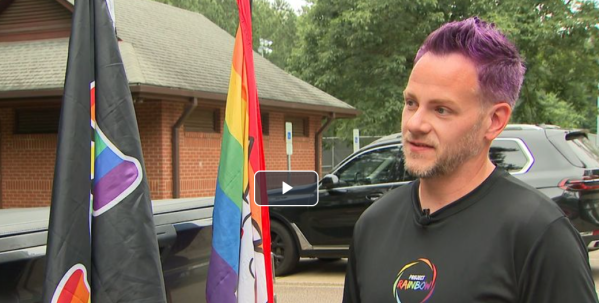
Project Rainbow is a fitness and wellness group based in Apex that holds weekly community walks around the area, specifically in Apex Community Park.

On May 28, the group recorded and confronted a man who deliberately removed and destroyed a pride flag that serves as a marker for the group to identify the gathering location at the park. The flag was then discarded into the surrounding woods. 

Initially believed to be an isolated incident, the group returned to Apex Park for their walk Wednesday. This time, the group had a larger turnout and additional flags were added to show “unity and resilience.” 

Project Rainbow said the same man came back and repeated the same act of vandalism. 

The group said the actions from this person have caused “concern among participants” and highlights “the need for increased community awareness and support for safe, inclusive spaces.”

Tom Voss, the lead of Project Rainbow, said when the vandalism was happening, it was “unreal.”

“I was like, ‘wow this is actually happening in our backyard here in Apex.’ It was disheartening too,” said Voss. “This is an inclusive community and, we feel great coming here and will continue to be here but when it happened again, it was kind of mind blowing.”

Voss said they have added more safety protocols to the group and will continue to host walks in the park.

WRAL News reached out to Apex Police to ask if they’re planning to investigate the person and figure out their motivation. No charges have been announced.

This incident occurred during an important month for the LGBTQIA+ community, as June is Pride Month, which WRAL News recognizes by highlighting LGBTQIA+ history, local leaders and events happening around the Triangle for Pride Month.

Kennedy Center’s events scheduled for LGBTQ+ pride celebration canceled, organizers say

*This is reported by the AP

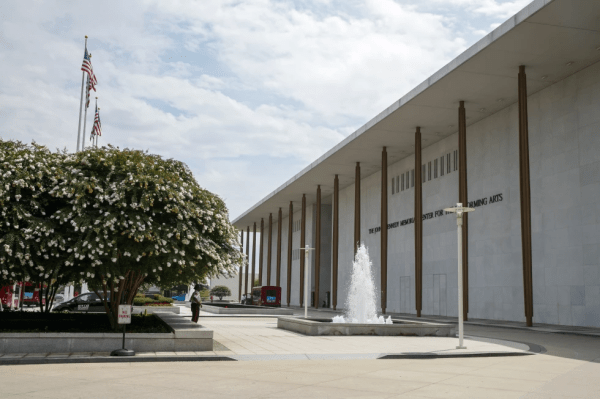
Organizers and the Kennedy Center have canceled a week’s worth of events celebrating LGBTQ+ rights for this summer’s World Pride festival in Washington, D.C., amid a shift in priorities and the ousting of leadership at one of the nation’s premier cultural institutions.

Multiple artists and producers involved in the center’s Tapestry of Pride schedule, which had been planned for June 5 to 8, told The Associated Press that their events had been quietly canceled or moved to other venues. And in the wake of the cancellations, Washington’s Capital Pride Alliance has disassociated itself from the Kennedy Center.

“We are a resilient community, and we have found other avenues to celebrate,” said June Crenshaw, deputy director of the alliance. “We are finding another path to the celebration … but the fact that we have to maneuver in this way is disappointing.”

The Kennedy Center’s website still lists Tapestry of Pride on its website with a general description and a link to the World Pride site. There are no other details.

The Kennedy Center did not respond to a request from the AP for comment.

The move comes on the heels of massive changes at the Kennedy Center, with President Donald Trump firing both the president and chairman in early February. Trump replaced most of the board with loyalists, who then elected him the new Kennedy Center chairman.

The World Pride event, held every two years, starts in just under a month — running from May 17 through June 8 with performances and celebrations planned across the capital city. But Trump administration policies on transgender rights and comments about Kennedy Center drag performances have sparked concern about what kind of reception attendees will receive.

“I know that D.C. as a community will be very excited to be hosting World Pride, but I know the community is a little bit different than the government,” said Michael Roest, founder and director of the International Pride Orchestra, which had its June 5 performance at the Kennedy Center abruptly canceled within days of Trump’s takeover.

Roest told the AP he was in the final stages of planning the Kennedy Center performance after months of emails and Zoom calls. He was waiting on a final contract when Trump posted on social media Feb. 7 of the leadership changes and his intention to transform the Kennedy Center’s programming.

Immediately the Kennedy Center became nonresponsive, Roest said. On Feb. 12, he said, he received a one-sentence email from a Kennedy Center staffer stating, “We are no longer able to advance your contract at this time.”

“They went from very eager to host to nothing,” he said. “We have not since heard a word from anybody at the Kennedy Center, but that’s not going to stop us.”

In the wake of the cancellation, Roest said he managed to move the International Pride Orchestra performance to the Strathmore theater in nearby Bethesda, Maryland.

Crenshaw said some other events, including a drag story time and a display of parts of the AIDS Memorial Quilt, would be moved to the World Pride welcome center in Chinatown.

Monica Alford, a veteran arts and culture journalist and event planner, was scheduled to organize an event June 8 as part of Tapestry of Pride, but said she also saw communication abruptly end within days of Trump’s takeover.

Alford has a long history with the Kennedy Center and organized the first-ever drag brunch on the Kennedy Center rooftop in 2024, and said she regarded the institution — and its recent expansion known as The Reach — as “my home base” and “a safe space for the queer community”

She said she was still finalizing the details of her event, which she described as “meant to be family-friendly, just like the drag brunch was family-friendly and classy and sophisticated.”

She said she mourns the loss of the partnership she nurtured with the Kennedy Center.

“We’re doing our community a disservice — not just the queer community but the entire community,” she said.

Roest said he never received an explanation as to why the performance was canceled so late in the planning stages. He said his orchestra would no longer consider performing at the Kennedy Center, and he believes most queer artists would make the same choice.

“There would need to be a very, very public statement of inclusivity from the administration, from that board, for us to consider that,” he said. “Otherwise it is a hostile performance space.”

I talked to 4 trans refugees to find out how they’re building new lives in blue states

*This is being reported by LGBTQNation.

Karma Yoakum had been part of a community of political activists in Texas for years. However, as the relentless tide of anti-trans legislation kept rising, it became clear that it was time for them to relocate, recover their energies, and take on a different role in the larger fight. 

Finding a new home in the Pacific Northwest, Karma was able to do just that. But the road wasn’t without its challenges, and finding their new community required intention and perseverance once they had recovered a little bit of who they were by living in a state that wasn’t trying to persecute them for their existence.

As anti-trans sentiment and legislation have been on the rise across the United States in recent years, many trans and nonbinary people have made the difficult decision to flee red states. In moving to a bluer state, trans people are making a choice based on safety, but that doesn’t make it an easy choice. It means leaving behind a home and community you have built over years or your whole life because of the machinations of people who hate you. While a new state can fix a lot of problems, building a new community doesn’t happen overnight. The president’s re-election and the introduction of federal anti-trans bills have created a flashpoint for even more trans people to seek safer pastures in states that might protect them.

I wanted to understand the challenges and opportunities that trans people face when starting over and building a new community in a blue state. I spoke with four trans and nonbinary people who have relocated in the last six to twelve months. They shared the challenges, the successes, and advice for others who are considering relocating to a sanctuary state.

Why trans people are leaving their red state communities

Major relocations often happen around an institution, such as going to college or starting a new job. But moves like those come with some built-in community-building support. 

Relocating as a refugee from a red state can be a more lonely affair. Most of the people I spoke with found that building a new community felt like work exacerbated by not having the same connections and support systems they had in the communities they left behind.

Clark Roman had been well-established in St. Louis. Both Clark and his boyfriend had owned their own houses and had a strong community of friends and chosen family in the city. But he says he saw the writing on the wall in 2023 when the Missouri attorney general enacted a de facto ban on trans hormones and trans healthcare that included adults. While his emergency rule was blocked by a judge and then withdrawn, the legislature went on to pass a gender-affirming care ban for trans youth. It was clear where things were headed, and Clark moved to Minneapolis a few months later.

Leaving behind a large community, both queer-centric and otherwise, Clark has found it hard to make more connections in his new city. At the center of it is the challenge of the modern age: balancing work and social life. “The honest truth is I have a very, very stressful job and I have not had the space in my life to build community the way I want.” He noted that it felt like he had to “treat building a new community as a second job.”

Karma also struggled to make connections when they first relocated from Texas to Washington state. After living in Texas for years, they reached a point where they found themselves saying, “I’m feeling scared and trapped and there’s absolutely nothing keeping me in Texas anymore.”

Karma moved 2,000 miles to Seattle but found a problem when they arrived. While their new home was more welcoming to the gender diverse, there was still culture shock to get over. “Where is everybody? I heard it was this wonderful panacea, a place where I would be welcomed. So, I looked around and I learned what the Seattle chill was. And it’s not a horrible thing, it’s just a difference in culture, because I’m used to southern culture.”

Chris (his name has been changed to protect his privacy)  echoed Karma’s frustrations over Washington state’s laid-back attitude to building community. Like Clark, Chris was living in St. Louis, saw the anti-trans legislation in Missouri in 2023, and concluded that “living in Missouri as a trans human, [he] was at risk.” He made the move to Washington state in 2024 while watching the coming election without much hope.

While St. Louis had its flaws, Chris was leaving behind a lot of queer community and resources. He had worked with the St. Louis Metro Trans Umbrella Group for nearly 20 years, enjoyed events and meetups, and collected queer friends through meets at clubs, bars, and drag shows. But the same culture shock that Karma experienced has made it hard to build new connections: “It’s been honestly a huge struggle, much more than I anticipated.”

While it’s important to know that people are struggling with finding new communities in their new states, it’s not all doom and gloom. Clark and Chris have both been able to stay in touch with parts of their communities from before their moves through travel and online communication. While that’s not always the same, it’s a nice option to have. I also spoke with Mira Lazine – an LGBTQ Nation contributor – who relocated from Cincinnati to Minneapolis and had a different sort of experience.

While the Ohio governor vetoed HB 68, which banned gender-affirming care for minors, he then introduced care guidelines for the state. “These rules were basically going to amount to a total care ban for all adults in Ohio,” explained Mira. “And it even would include some aspects of conversion therapy and mental health treatment.” 

It was time to relocate, and someone recommended Minneapolis. For Mira, finding a new community in this queer-friendly space came a lot easier.

“Within the first week of moving here, I went to a few coffee shops, and everyone, like the baristas, were trans, and they were recommending me support groups to join, discord servers I can join, like the whole nine yards. And it’s just been way easier to meet people and meet other queer people and form connections here.” 

While Karma and Chris suffered from culture shock, Mira found herself among other transplants to the state who had their relocation in common: “Probably like 80% of the queer people I’ve met aren’t originally from Minnesota, so we’re all like, yeah, we need community, let’s build one.”

Finding new communities in blue states

All of the people that I spoke with had been in their new homes for less than a year. While there have been struggles, they have been able to find resources and spaces to start that community-building process and are in different places in their journeys.

Clark noted that his struggle to find community in Minneapolis is probably the biggest dissatisfaction in his life right now. But he can see a light at the end of the tunnel through some of the community spaces that he is attending. “The synagogue I go to is very open and trans-friendly. So that was helpful.” Clark is also looking at getting more involved with Transplants, a group for LGBTQ+ people who have relocated to Minneapolis and St. Paul. 

Chris has found that his work at a university in Washington provides some space for community building. “Their DEI office held a holiday event for, I guess, everyone, but the folks who showed up to that event were primarily queer folks and persons of color. And that was fantastic.” 

Chris still faces challenges, even at the events. He told me that he has been going to meet-up groups, Portland Pride, the Ingersoll Gender Center, and more, but he wasn’t satisfied with the results. Chris suggested that part of that problem might be visibility: “I am stealth, so at my workplace, I’m not fully out [as trans]. Where I landed is sort of a purple city in a blue state. I’m typically able to pass as male and not be questioned at all, which is, is nice, but at the same time, it’s hard because I think visibility might help me connect with more queer people.”

For Karma, their initial struggles with community-building in Seattle began to bear fruit around the one-year mark. “I did the things that I’ve tried before, and I figured, if they’ve worked everywhere else, they ought to work here. Maybe it just takes a little longer. And yeah, that was it. It takes a little longer.”

Karma found that organizations were the key. They found like-minded people when they returned to playing music with the local band that is part of the LGBTQ+ band organization, Pride Bands Alliance, an international group that Karma has worked with since the 1990s. Similarly, local chapters of a national support network have provided success in community building: “PFLAG, all you have to do is show up to a meeting. There are people there that if you need a hug, they are instant family. And people that aren’t instant family are there because they want support.”

Karma also reached into her past in political activism and found that, post-move, they had the energy to continue in their new home. “The third place that I decided to get involved was the Gender Justice League. Dealing with legislation, dealing with victims of violence here in the Seattle area. So, supporting our community, advocating like crazy.” After months of struggling to find their people, Karma now finds that barely a day on their calendar doesn’t include a community event, a catch-up, or a coffee meet.

No regrets

Everyone’s experience with relocating to a bluer state will be unique. However, there was one ringing agreement amongst all the people that I spoke with: no regrets. When asked what advice they had for someone considering a move, Clark, Chris, Mira, and Karma all urged people to relocate if they felt it might help.

Clark grieves what he left behind but recognizes that it was the right call for him, and he’s going to keep trying to find his new community. “I think it’s dissatisfying at first. But it’s important to [show] up repeatedly because I think that repeated showing up [is] how I made my community originally in St. Louis.” 

Chris echoed those sentiments, noting that he has no regrets and that it has been “completely worth it.” Watching recent election results come in wouldn’t have been fun anywhere, but he was glad to be in a safe space for it all “despite challenges and some loneliness.”

Karma isn’t even considering going back. “I would say do it. The relief that I felt by at least being in a community where I know that I’d no longer have to deal with local politics.”

“In Texas, the local politics were against me,” they said. “At least here, I know locally and statewide, my representatives really do represent everybody, and they have my back. And that has made so much a difference in my life.”

DHS quietly eliminates ban on surveillance based on sexual orientation and gender identity

*This is reported on by the Advocate.com

The Department of Homeland Security has eliminated policies preventing the investigation of individuals or groups solely based on their sexual orientation or gender identity.

The DHS Office of Intelligence and Analysis quietly updated its policy manual earlier this month, as first reported by Bloomberg, removing LGBTQ+ identities from the General Requirements section that prohibit surveillance based solely on immutable characteristics.

The manual now states: “OSIC Personnel are prohibited from engaging in intelligence activities based solely on an individual’s or group’s race, ethnicity, sex, religion, country of birth, nationality, or disability. The use of these characteristics is permitted only in combination with other information, and only where (1) intended and reasonably believed to support one or more of I&A’s national or departmental missions and (2) narrowly focused in support of that mission (or those missions).”

The manual previously stated, via the internet archive: “OSIC Personnel are prohibited from engaging in intelligence activities based solely on an individual’s or group’s race, ethnicity, gender,religion, sexual orientation, gender identity, country of birth, nationality, or disability. The use of these characteristics is permitted only in combination with other information, and only where (1) intended and reasonably believed to support one or more of I&A’s national or departmental missions and (2) narrowly focused in support of that mission (or those missions).”

TRENDING

LGBTQ+ VoicesPoliticsTransgenderVideoSupport UsScroll To Top

By continuing to use our site, you agree to our Private Policy and Terms of Use.

Accept

Politics

DHS quietly eliminates ban on surveillance based on sexual orientation and gender identity

all directions in building control room

shutterstock creative

All directions surveillance camera

The DHS quietly updated its policy manual earlier this month, removing LGBTQ+ identities from the section prohibiting surveillance based solely on immutable characteristics.

Ryan Adamczeski

February 26 2025 1:56 PM EST

Support The Advocate
LGBTQ+ stories are more important than ever. Join us in fighting for our future. Support our journalism.

One-timeMonthly

$5$19.67$50

Join the Fight

The Department of Homeland Security has eliminated policies preventing the investigation of individuals or groups solely based on their sexual orientation or gender identity.

The DHS Office of Intelligence and Analysis quietly updated its policy manual earlier this month, as first reported by Bloomberg, removing LGBTQ+ identities from the General Requirements section that prohibit surveillance based solely on immutable characteristics.

The manual now states: “OSIC Personnel are prohibited from engaging in intelligence activities based solely on an individual’s or group’s race, ethnicity, sex, religion, country of birth, nationality, or disability. The use of these characteristics is permitted only in combination with other information, and only where (1) intended and reasonably believed to support one or more of I&A’s national or departmental missions and (2) narrowly focused in support of that mission (or those missions).”

The manual previously stated, via the internet archive: “OSIC Personnel are prohibited from engaging in intelligence activities based solely on an individual’s or group’s race, ethnicity, gender, religion, sexual orientation, gender identity, country of birth, nationality, or disability. The use of these characteristics is permitted only in combination with other information, and only where (1) intended and reasonably believed to support one or more of I&A’s national or departmental missions and (2) narrowly focused in support of that mission (or those missions).”

Trending stories

Elon Musk uses burner accounts on X, doesn’t fact-check: report

Joyful resistance: What the AIDS crisis teaches us about fighting the Trump administration now

Joe Biden has tied the record for most LGBTQ+ judges confirmed in federal courts

MAGA is turning on itself as Dan Crenshaw threatens to ‘kill’ Tucker Carlson in hot mic moment

Zaya Wade reveals she’s obsessed with Kit Connor and ‘Heartstopper’

France becomes world’s first country to enshrine abortion rights in constitution

Here’s why this Mediterranean Virgin Voyages cruise belongs on your bucket list

Plus nominated for 2025 GLAAD Media Award alongside industry giants like Vogue, People, and Variety

EDC Las Vegas is ready to make history with iconic 2025 lineup

Celebrating Black History Month with our annual African American issue

Lexi Love goes public with HIV status after Trump wipes resources from federal website

10 queer-coded fantasy characters from our childhoods

Exclusive: Lady Bunny releases new ‘Hot To Blow’ video

Chris Pratt reacts to Patrick Schwarzenegger’s full frontal on ‘White Lotus’

Chris Pratt has a NSFW reaction to Patrick Schwarzenegger baring it all in ‘White Lotus’

All 6 rogue Mississippi cops got long prison sentences in ‘Goon Squad’ torture of 2 Black men

Out and About with D.K. Uzoukwu

Trump’s orders prompt CDC to erase HIV resources

How climate disasters hurt mental health in young people

All the LGBTQ+ (and queerish) characters in the MCU so far

SFAF’s Dr. Tyler TerMeer says he’ll continue to fight for health care for all

Tate McRae says her gay fans are her ‘favorite’ & reveals her dream collaboration

Seeking escape, this lesbian sailed to the Arctic Circle

Ready for ‘Replay’! Cynthia Erivo’s new era has visuals & release date

These iconic queer performances should’ve won Academy Awards

  • 0
  • 1
  • 2
  • 3
  • 4
  • 5
  • 6
  • 7
  • 8

The changes come shortly after Donald Trump signed executive orders forcing the removal of all references to diversity, equity, and inclusion in government, as well as mandating that the federal government deny the existence of transgender people by recognizing only two sexes — male or female — despite the scientific and medical consensus that sex is a spectrum.

Trump has appointed Kristi Noem, former governor of South Dakota, as the Secretary of Homeland Security. Noem has a history of targeting LGBTQ+ rights, including by signing executive orders banning transgender athletes from participating on teams that align with their identities and banning gender-affirming care for youth, though she is best known for her admission that she killed a 14-month-old puppy she deemed untrainable.

The Office of Intelligence and Analysis “has a long track record of civil liberties and civil rights abuses,” according to the Brennan Center for Justice, including unconstitutionally surveilling journalists and racial justice activists as well as monitoring “political views shared by millions of Americans — about topics like abortion, government, and elections — that DHS baldly asserts will lead to violence.”

City offers $10,000 reward for reporting trans individuals using public restrooms

This blog is originally appeared at LGBTQ Nation.

This marks the first instance of a city allowing individuals to sue trans people for using public restrooms.

The city of Odessa, Texas, has implemented a $10,000 bounty for anyone who reports a transgender person using a restroom that matches their gender identity, according to independent journalist Erin Reed.

Under this ordinance, individuals—excluding local and state government officials—are allowed to sue transgender people for using such facilities. The rewards for successful claims include “injunctive relief” to prevent further violations, nominal and compensatory damages if the plaintiff can prove harm, statutory damages of at least $10,000 per violation, as well as court costs and attorney’s fees.

While the bounty is set at a minimum of $10,000, there is no maximum limit on how much the reward can grow.

In addition to the bounty, Odessa’s ordinance includes criminal penalties for individuals who use restrooms that align with their gender identity. Those found in violation of the law can be charged with a Class C misdemeanor, punishable by a fine of up to $500. Anyone who refuses to use a bathroom corresponding with what the city considers their biological sex—after being asked to leave by a building owner—could also face misdemeanor trespassing charges.

The law defines “biological sex” based on birth certificates, either the original or a corrected version in cases of clerical errors. This means that even if a transgender person has updated their birth certificate to reflect their gender identity, they could still be in violation of the ordinance if they use a bathroom that aligns with their gender.

There are no exceptions for disabled individuals who may be accompanied by someone of a different gender, and the law could potentially lead to lawsuits targeting people who are gender non-conforming or whose gender expression doesn’t fit societal norms.

Similar bathroom bans with criminal penalties have been enacted in states like Utah and Florida, while other states, like North Dakota, have laws without clear penalties or enforcement mechanisms. Erin Reed compared Odessa’s bounty system to the anti-abortion bounty laws in Texas, where private citizens are empowered to sue anyone who aids in an abortion. This strategy shifts the responsibility of enforcement from government officials to private individuals, circumventing the usual legal processes.

Johnathan Gooch, communications director for Equality Texas, condemned the ordinance, telling the Texas Tribune, “It’s a very aggressive way to alienate trans people from public life, and I think it is counter to the spirit of friendship that most Texans embody.”

He added, “It enables vigilantes to target anyone they don’t think matches the gender expression they expect to see in the bathroom, and that is truly insane.”

National Park Service cracks down on Pride leaving LGBTQ+ rangers feeling betrayed

This blog is originally appeared at Advocate.

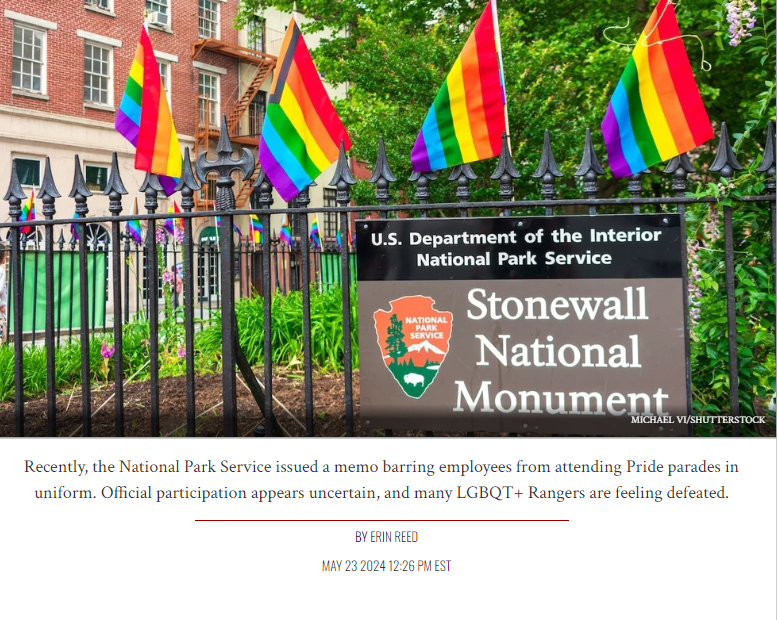
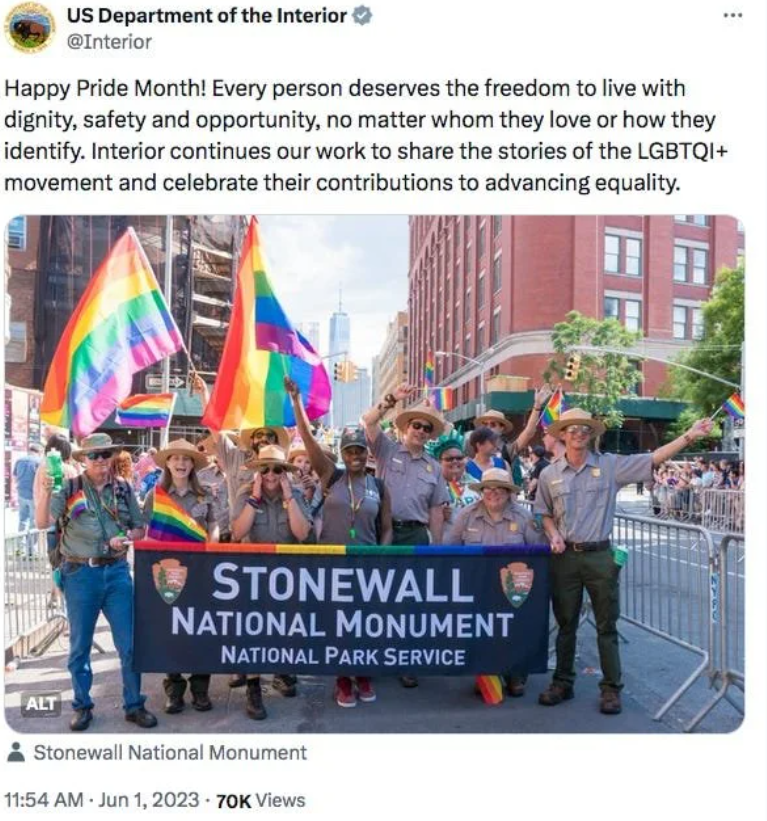
On May 17, the National Park Service (NPS) made an official ruling that park rangers and other employees are no longer allowed to attend Pride events and parades in uniform. This marks a reversal of a long-standing tradition of NPS participation in Pride parades across the U.S., including the presence of official delegations. Anonymous LGBTQ+ NPS employees have expressed feelings of betrayal, noting that participation in major city Pride events is now in question, as several parade applications remain unprocessed and approvals are unclear. The decision comes at a time of heightened scrutiny on LGBTQ+ issues nationwide, with increasing crackdowns on Pride flags and LGBTQ+ rights—largely driven by Republican lawmakers and appointees. This time, however, the policy change is being driven by the NPS itself, under the leadership of a director appointed by President Biden.

The new directive was first shared in an internal memo to NPS staff, which did not specifically mention Pride but highlighted that “requests from employees asking to participate in uniform in a variety of events and activities, including events not organized by the NPS,” are in conflict with agency policy. The memo cited a policy stating that NPS employees cannot wear their uniforms to events that might be interpreted as supporting “a particular issue, position, or political party.” LGBTQ+ employees, however, have criticized this application of the policy, arguing that Pride is about identity and diversity, not a political stance or issue. They pointed out that under the previous guidelines, NPS employees were able to participate in Pride events with approval, and that internal Employee Resource Group (ERG) documents, such as the “OUTsiders Guide to Pride,” had endorsed such participation for years.

In a follow-up statement, the NPS argued that the ERG guide conflicts with official policy and that discussions are underway to review it and other related documents. The agency also emphasized that its participation in Pride celebrations could be perceived as an endorsement of a particular “issue of public concern,” which they described as a justification for limiting official participation. In their view, what has long been seen as a celebration of diversity and inclusion is now categorized as a political statement, with the NPS deeming official participation in such events “extremely limited.”

The decision sparked immediate concern among National Park Service employees and LGBTQ+ advocates. Many pointed out that the NPS has a long history of participating in Pride parades across the country, even under the Trump administration, which was known for its efforts to restrict LGBTQ+ representation in federal agencies, including at embassies. Employees also highlighted the significant role the NPS plays in managing Stonewall National Monument, a site dedicated to LGBTQ+ history and civil rights. Notably, the founding documents of Stonewall National Monument explicitly state that its purpose is “to preserve and protect Christopher Park and the historic resources associated with it” and “to interpret the Stonewall National Historic Landmark’s resources and values related to the lesbian, gay, bisexual, and transgender civil rights movement.” This has raised questions about how the NPS can reconcile this mission with its new stance on Pride participation.

One NPS employee, speaking anonymously, revealed that several requests for Pride parade participation are currently “collecting dust” on desks, waiting for approval for representation in major city Pride events. When asked about the decision to categorize Pride festivals as an “issue of public concern,” the employee responded, “Pride is not political, it’s not a cause, you just are LGBTQ+. It’s a celebration of who we are.” They added, “Morale is just so low right now. There’s not a lot of fight left in us.”

I reached out to an NPS spokesperson for clarification on whether the agency would continue participating in major city Pride events this year, as it has in previous years. The spokesperson responded that the policy “had not changed,” noting that “previous interpretations of the uniform policy were inconsistent” and that approving participation in some events while denying others could be perceived as “discrimination based on viewpoint.” While the spokesperson confirmed that in-park Pride events have not been canceled, they did not clarify whether NPS employees would continue to participate in major U.S. city Pride parades or celebrations. Attempts to follow up on this question went unanswered.

The characterization of Pride as a potentially “political” event raises concerns, particularly given the founding documents of Stonewall National Monument, which directly reference the “resources and values” of the LGBTQ+ community. NPS resources currently available on the site encourage people to “Celebrate Pride” and emphasize that “The LGBTQ experience is a vital facet of America’s rich and diverse past.” The resource underscores the importance of not making LGBTQ+ people invisible, stating, “By recovering the voices that have been erased and marginalized, the NPS embarks on an important project to capture and celebrate our multi-vocal past.” By barring employees from wearing Pride symbols or participating in Pride events, the NPS may unintentionally appear to be erasing and marginalizing its LGBTQ+ employees—contradicting its own stated mission.

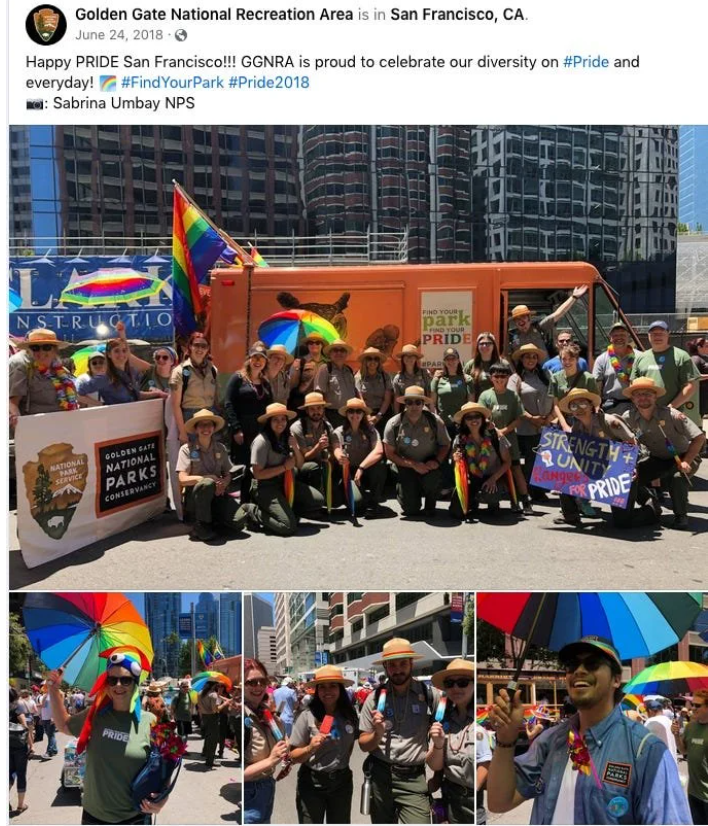
National Park Service employees have marched in uniform in Pride parades for years. In 2014, for example, Christine Lenhertz, a member of the NPS, requested permission for a group of LGBTQ+ park employees to wear their uniforms while participating in a Pride parade. Initially denied, the group filed a complaint, prompting a ruling from the Office of the Solicitor for the Department of the Interior, which determined there was no reason to prevent them from marching in uniform. Since then, NPS contingents have regularly participated in Pride events across the country.

The future of Pride parade participation for NPS employees in uniform remains uncertain. While it seems that some Pride events within National Parks, like those at Stonewall, may still take place, external participation in major city Pride events appears to be on hold in at least some locations across the U.S. The possibility of individual or smaller LGBTQ+-affiliated Park Ranger contingents joining city Pride celebrations looks even less likely, with little hope of approval for participation.

You can read the full response from an NPS spokesperson to the request for comment here:

Blog at WordPress.com.

Up ↑