Slovakia’s parliament, has approved a sweeping constitutional amendment that legally recognizes only two sexes—male and female, and imposes new limits on adoption and surrogacy, sparking alarm from human rights groups and LGBTQ+ advocates.
The amendment, passed in a narrow 90‑vote majority in the 150‑seat National Council, also restricts adoption to married heterosexual couples and bans surrogate pregnancies. It was framed by Prime Minister Robert Fico’s government as a defense of “sovereignty in cultural and ethical matters” and traditional values. Fico heralded the vote as “a great dam against progressivism.”
The constitutional change marks one of the most significant curbs yet on LGBTQ+ and reproductive rights in the country, critics say, aligning Slovakia more closely with Hungary’s conservative trajectory, and raising concerns about violations of international commitments and human rights.
What the Law Does
Defining Sex and Gender: The amendment states explicitly that only two sexes—male and female—are recognized under Slovak law. Legal definitions of gender identity beyond that framework are excluded.
Adoption Restrictions: Only married heterosexual couples will now be able to adopt children. Same‑sex couples are excluded from adoption rights under the new wording.
Ban on Surrogacy: The law prohibits surrogate pregnancies.
Assertion of “National Identity”: The amendment declares that Slovakia retains sovereignty over issues of national identity, culture, and state ethics, even potentially above European Union law in certain areas.
Passage and Political Dynamics
The vote was precariously close. Fico’s coalition controls fewer than the 90 votes required for constitutional amendments, but 12 opposition lawmakers from conservative parties defected last minute, providing the margin required for passage.
Some opposition figures expressed outrage, describing defectors as traitors, alleging the vote was a political maneuver to distract from declining public approval and other unpopular measures.
President Peter Pellegrini said he would sign the amendment into law, framing the constitutional majority as a signal of political consensus in deeply polarized times.
Responses and Broader Implications
Human rights organizations were quick to condemn the change. Critics warn it will lengthen the legal limbo for trans, non‑binary, and intersex people, reduce access to gender recognition, and further institutionalize discrimination.
There are also worries it will lead to clashes with EU law, which guarantees certain protections for minority and LGBTQ+ populations. Legal scholars suggest the amendments may violate international treaties and could become the subject of legal challenges.
For Slovak LGBTQ+ individuals, the change is deeply personal. It removes recognition for anyone who doesn’t fit neatly into “male” or “female,” and restricts family formation for non‑heterosexual parents.
New York lawmakers are demanding that Amtrak police stop arresting LGBTQ people on charges of public lewdness in a men’s bathroom at Penn Station, likening the crackdown to “the Stonewall era.”
The letter from Rep. Jerrold Nadler, two state senators and a state assemblymember follows reports by Gothamist and The City that 200 people have been arrested since June for alleged public lewdness or indecent exposure in the bathroom. At least 20 of those people were immigrants transferred to ICE custody after the arrest, law enforcement officials said.
“We demand that Amtrak Police immediately cease identifying and targeting members of the LGBTQ community for search, seizure and arrest on the basis of their perceived sexual orientation or gender identity,” the lawmakers wrote to Amtrak President Roger Harris. “While Amtrak is entitled to ensure that its facilities are not used for illicit purposes, we do not believe Amtrak should be doing so with a hostile arrest campaign reminiscent of anti-LGBTQ policing from the Stonewall era.”
State Sens. Brad Hoylman-Sigal and Liz Krueger, and Assemblymember Tony Simone, who all represent parts of Manhattan, also signed the letter.
The crackdown involved undercover officers posted in the bathrooms at urinals or in stalls, looking for men meeting up for anonymous sex. A cruising app called “Sniffies” featured a group dedicated to the bathroom. In recent weeks it featured numerous men warning others to avoid the bathroom because of the police presence.
The lawmakers alleged police were using “questionable and potentially discriminatory tactics.”
The lawmakers requested a meeting with Amtrak police to discuss the issue. The surge in enforcement comes as President Donald Trump’s administration has taken over the redevelopment of Penn Station from the MTA.
“As you may know, there is a long and painful tradition of police forces using loitering, identification, prostitution, lewdness and similar laws to target LGBTQ people for harassment, arrest and incarceration,” the letter read.
Amtrak Deputy Police Chief Martin Conway previously said the arrests came in response to complaints from customers. Amtrak spokesperson Jason Abrams said incidents at Penn Station have declined since the enforcement surge.
“Amtrak remains committed to maintaining a safe and welcoming environment for all travelers and will continue to monitor conditions closely, making adjustments as needed to uphold the highest standards of security,” Abrams said.
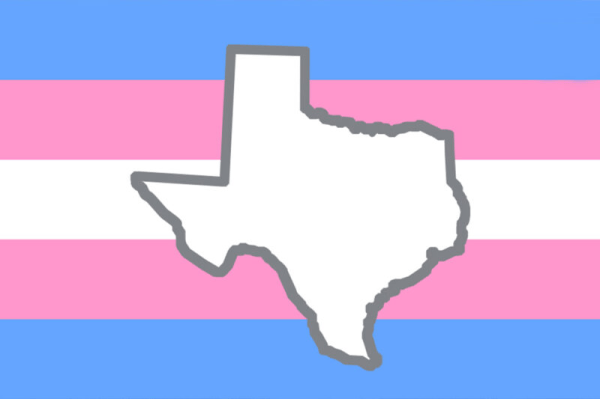
Texas enacts controversial “bathroom bill” into law
By Marissa Armas
Updated on: September 27, 2025 / 1:01 PM CDT / CBS Texas
It’s a controversial new law that’s drawing sharp criticism from LGBTQ advocates across Texas.
Gov. Greg Abbott officially signed the so-called “bathroom bill” on Monday. While some are applauding the move, others say it unfairly targets transgender people and others.
On Monday, Abbott signed Senate Bill 8 into law, which requires people in government buildings and schools to use certain facilities based on the sex they were assigned at birth.
Impact on public institutions statewide
The law applies to restrooms, locker rooms, and other changing facilities in public schools, universities, prisons, jails, and other government-owned buildings. It also limits which family violence shelters transgender people can access.
The only exceptions are for children under 10 accompanied by an adult, as well as custodians, law enforcement, and medical workers.
Community leaders express concern
Because of the new law, community engagement strategist Gordy Carmona is having tough conversations with many of the people they serve.
“It’s just heartbreaking,” said Carmona. “I know how it’s going to impact so many of the people that I care about that I know, both personally and professionally.”
Brad Pritchett, CEO of Equality Texas, said the law’s intent is clear.
“Even though the letter of this law is plainly written, the intent of the law is really about trying to keep transgender, nonbinary, and intersex Texans from being able to participate in public life here in the state of Texas,” Pritchett said.
Supporters call it ‘common sense’
Abbott posted a video Monday about the bill signing, saying, “I signed a law banning men in women’s restrooms. It is a common-sense public safety issue.”
State Rep. Angelia Orr echoed that message, saying, “Let’s hope more states follow suit. This is common sense policy to protect the women and girls of Texas!”
Enforcement details remain unclear
Pritchett said there are still many questions about how the law will be enforced.
“We don’t really know what cities or school districts, or political subdivisions are going to do to try to enforce this bill,” said Pritchett. “There are things that are reasonable, and there are things that are unreasonable, and our goal is to ensure that no unreasonable things are taking place, with regards to how people are accessing essential spaces for themselves.”
Fines target institutions, not individuals
While individuals won’t be fined for violating the law, institutions can face steep penalties — $5,000 for a first offense and up to $125,000 for subsequent violations
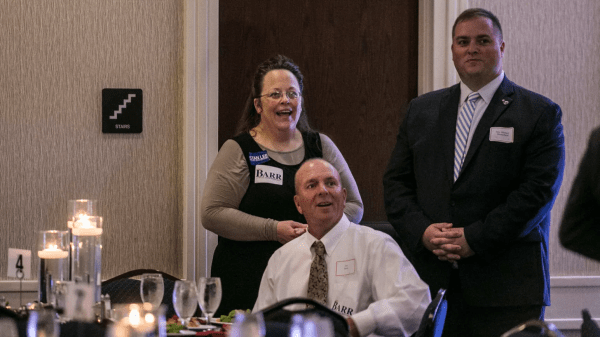
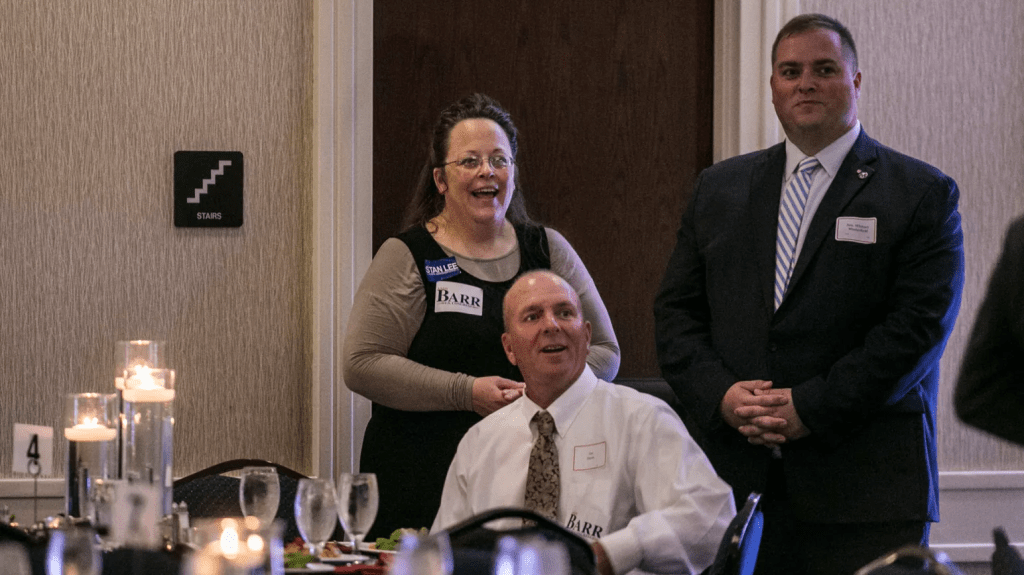
Last month, it was reported that the Supreme Court will formally consider a petition for a case calling on them to overturn their 2015 ruling in Obergefell v. Hodges, the historic ruling that made gay marriage legal nationwide. The petition comes from former Kentucky county clerk Kim Davis, who has made headlines and been embroiled in legal battles since she refused to sign marriage licenses for gay couples.
While Davis has been fighting against gay marriage since it was made legal, her lawyers have been doing it for longer. Davis is being represented by Liberty Counsel, a far-right Christian legal group and Southern Poverty Law Center-designated anti-LGBTQ hate group.
Since its inception in 1989, the group has opposed gay rights causes, including fighting against gay marriage, the legalization of homosexuality, and bans onconversion therapy. In one instance, the group’s Facebook cover photoreferenced the Bible verse Leviticus 20:13, which reads, “If a man has sexual relations with a man as one does with a woman, both of them have done what is detestable. They are to be put to death; their blood will be on their own heads.”
When asked about the cover photo, the group responded in an email that “Liberty Counsel has never promoted or condoned the killing of anyone or asked anyone to ‘like’ any quote about killing gays.”
Experts say Liberty Counsel is arguably more powerful than ever in 2025, fueled by publicity from Davis’ case and the opportunity to capitalize on a moment when American politics are stacked toward the right-wing—something that could upend gay marriage.
“The alignments will never be as favorable as they are at this moment,” Anne Nelson, author of “Shadow Network: Media, Money, and the Secret Hub of the Radical Right,” told Uncloseted Media. “That’s why they’re going for broke.”
History
Liberty Counsel was founded by preacher turned lawyer Mat Staver and his wife, Anita.
Mat Staver, who now serves as the chairman, senior pastor, and primary spokesperson for the group, authored the 2004 book “Same-sex Marriage: Putting Every Household at Risk,” where he wrote that “homosexuality is rooted in fractured emotions” and “a common thread in virtually every case is some sort of sexual or emotional brokenness.”
While the organization started operations solely in Florida, Mat Staver told the Orlando Sentinel shortly after Liberty Counsel launched that the group “would be a Christian antithesis to the ACLU” and that he “always felt the Lord calling [him] to combine [ministry and law] together.”
Liberty Counsel was active throughout the 1990s, with a focus on First Amendment cases, but Staver and his group didn’t gain national attention until 1994, when he argued before the Supreme Court for a case that challenged the constitutionality of a Florida court ruling that barred anti-abortion protests outside of a clinic. Some parts of the ruling were successfully overturned while others remained in place.
After that, the group built up a reputation for taking up cases related to religion in schools and other public institutions, including one instance where they threatened a lawsuit against one school for changing the lyrics of a Christmas song in a school play.
Attacking Gay Rights
After the turn of the century, Liberty Counsel became more active on gay issues. In 2003, they filed an amicus brief in Lawrence v. Texas, the case that decriminalized gay sex nationwide, arguing in favor of state laws banning it by saying that “deregulating human sexual relations will erode the institution of marriage.”
When California was taken to court over Proposition 8, a 2008 state constitutional amendment that sought to ban gay marriage in the state, Liberty Counsel attempted to be among the lawyers defending it. The group publicly criticized fellow far-right Christian legal group Alliance Defending Freedom for, in their view, arguing the case poorly.
One lawyer for Liberty Counsel also disagreed with legal positions taken by one pro-Prop 8 lawyer, who reportedly refused to argue that homosexuality is an “illness or disorder.” In their amicus brief in support of the proposition, Liberty Counsel argued that homosexuality “presents serious physical, emotional, mental, and other health-related risks.”
And in 2015, just months before the Obergefell ruling, the group offered to represent Alabama judges who refused to perform gay marriages after a state ban was overturned.
Once gay marriage became legal nationwide, Liberty Counsel took up Kim Davis’ case, which brought them more media attention than ever before.
“Kim Davis was a boon to Liberty Counsel,” says Peter Montgomery, research director at People for the American Way, an advocacy group aimed at challenging the far right. “[She] got them a huge amount of publicity, and I think they’ve really grown since they first took up her case.”
Much of the earned media from the Davis case, however, was negative. Liberty Counsel received criticism for encouraging Davis to continue refusing gay marriage licenses in violation of a court order. And even a Fox News panel of legal experts called Davis a “hypocrite” and Mat Staver’s legal arguments “stunningly obtuse” and “ridiculously stupid.”
In an email to Uncloseted Media, Liberty Counsel took issue with criticism of the group’s past litigation, writing that “[they] have 40 wins [they] briefed or argued at the US Supreme Court, including a 9-0 win in Shurtleff v. City of Boston.”
Liberty Counsel has created their own media, including a daily 11-minute radio broadcast, Faith and Freedom. Launched in 2010, the program is syndicated on 145 stations across the country and frequently contains anti-LGBTQ rhetoric, including assertions that LGBTQ-inclusive policies in the Boy Scouts create “a playground for pedophiles”; that gay people “know intuitively that what they are doing is immoral, unnatural, and self-destructive”; and that gay people are “not controlled by reason,” but rather “controlled by … lust.”
And after being boosted in popularity by Kim Davis, a 2016 CBS News investigation found that the group had worked with lawmakers in at least 20 states to author anti-LBGTQ bills, including trans bathroom bans.
“They’re pretty much anti-LGBT in every way you can be,” Montgomery told Uncloseted Media. “Staver is pretty shameless in lying about gay people and the laws.”
Why Now?
Davis’ case has fallen in and out of public attention over the years, with the Supreme Court rejecting a previous petition in 2020. Despite this, Liberty Counsel has remained confident in the case’s potential to upend gay marriage. In 2023, the group told their supporters in an email that they planned to use Davis’ case to persuade the Supreme Court to overturn Obergefell. These comments came a year after Supreme Court Justice Clarence Thomas expressed interest in reconsidering Obergefell in his opinion on the case that overturned Roe v. Wade.
“[The far right have] been working for decades to get their pieces in place, so at this particular moment, looking at the chessboard, they’ve got a critical mass of conservative states with Republicans in the state house, they’ve got the White House, they’ve got both houses of Congress, and they’ve got a majority on the Supreme Court,” says Nelson. “In a year, that could change.”
Increasing Notoriety
Montgomery says that Liberty Counsel’s popularity and influence has been on the rise since the start of the pandemic, when the group gained traction by opposing restrictions on churches meeting during COVID lockdowns. During this period, Staver claimed that COVID-19 vaccines are designed to “prevent people from procreating.”
“One of the ways that [Staver] has boosted his visibility and influence was riding that parade, which a number of people on the religious right did, and took advantage of the resentment of public health restrictions,” says Montgomery.
Since then, the group has falsely claimed that the Respect for Marriage Act “would allow pedophiles to marry children,” and Staver wrote in a newsletter that “the LGBTQ agenda seeks nothing less than to eliminate all religious freedom rights that might make them feel bad about their choices.”
In the meantime, affiliates of the group have been cozying up to the Supreme Court. In 2022, a representative of the Liberty Counsel-owned D.C. ministry Faith & Liberty was caught bragging about praying with Supreme Court justices just weeks after the court overturned Roe v. Wade. Staver told Rolling Stone these allegations are “entirely untrue.”
In his majority opinion on the case, Justice Alito cited an amicus brief filed by Liberty Counsel where the group argues that “the birth control and abortion movements are racist and eugenic.”
Part of a Bigger Picture
Liberty Counsel’s website reports that it generated nearly $28 million in revenue between July 1, 2023 and June 30, 2024. While their internal team has roughly 40 employees listed on LinkedIn, they have claimed to have anywhere from 90 to 700 affiliate attorneys across the country. Some of the group’s larger and more consistent donors reportedly include fracking baron Farris Wilks; the Christian TV network Good Life Broadcasting; and Liberty University, where Staver previously worked as dean of the law school.
“The big Christian nationalist and plutocratic donors understand that the Supreme Court, and the judiciary in general, are central to their aims … so over the past few decades they spent enormous sums grooming and promoting candidates for the judiciary whose interpretation of the law is favorable to their interests,” Katherine Stewart, an author and expert on religious nationalism, told Uncloseted Media in an email. “Liberty Counsel has successfully positioned itself as one of the players in that space. It only picks up a slice from the total pie, but the pie is so well-funded that even a slice is rich indeed.”
Beyond this, Liberty Counsel is affiliated with a number of other right-wing groups, several of which operate directly under the group’s umbrella. Staver holds leadership positions in other conservative groups, including Salt & Light Council and National Hispanic Christian Leadership Conference—the former of which has been outspokenly anti-LGBTQ. Liberty Counsel is also a member of the Remnant Alliance, a coalition of groups known for coordinating to elect Christian nationalist candidates to local school boards. A leaked membership directory from 2020 also listed Staver as a member of the Council for National Policy, a secretive group that includes Republican politicians and major leaders of Christian right organizations, though Staver told Uncloseted Media that Liberty Counsel and the Council for National Policy are not affiliated.
Nelson says connections like these allow different groups on the far right to coordinate together on anti-LGBTQ policies.
“They’ll have coordinated messaging about whatever campaign they’re launching at the moment. And it’s highly coordinated, as in the same story, the same language, the same spokespeople. It’s really quite impressive. And so all of a sudden there’ll be a story that will just erupt.”
The Council for National Policy did not respond to a request for comment.
When Liberty Counsel filed its most recent petition for Davis’ case to the Supreme Court, multiple right-wing media outlets whose leadership have been members of the Council for National Policy quickly covered the story with a favorable spin, including Salem Media Group, the WashingtonTimes and WorldNetDaily. And earlier this year, Staver networked at the National Religious Broadcasters conference, where he discussed plans to overturn Obergefell.
Montgomery says that this coordination is especially powerful because different groups are able to influence different spheres. For example, while Liberty Counsel pressures the courts, a group like Salt & Light Council works to activate supporters in ministry.
“They have this broader vision of wanting to change the culture and change the country,” he says. “They are all different approaches to moving the country in the direction they want: courts, legislative advocacy, lobbying, organizing, and media outreach.”
Nelson says the far right’s recent legal success is thanks in part to the influx of right-wing judges since the start of Trump’s first term.
“It’s worked initially with trying to get local and political opposition to these laws, and it’s linked to getting the appointments of judges who’ve had to pass a litmus test,” she says. “And then [their strategy involves] mounting the lawsuits, starting usually at the state level and working their way up the court system, specializing in states where they believe they’ll have sympathetic judges. … It’s gaming [the system].”
In an email to Uncloseted Media, Liberty Counsel says this characterization does not describe their litigation strategy.
What Does This Mean for Marriage Equality?
Despite all of this, many legal experts believe that this latest challenge to marriage equality is a long shot. Liberty Counsel’s arguments were largely rejected by a federal appeals court panel earlier this year, and several of the justices have shown little to no interest in revisiting Obergefell. Just this month, conservative Justice Amy Coney Barrett wrote that the right to marriage is “fundamental” and called for people to “tune … out” concerns about gay marriage being overturned.
However, given the current political moment, Nelson says that the threat to Obergefell should not be underestimated.
“This long-range strategy is coming to fruition, and a lot of the pieces are in place,” she says. “Under the current circumstances, with the current judiciary, they’ve got a reasonable chance of allowing states to ban same-sex marriages on a state level with an eye towards eventually banning it [on a nationwide level] in the future.”
The Slovak government on Wednesday indefinitely postponed a proposed constitutional amendment that would limit the rights of same-sex couples and toughen rules surrounding gender transition.
The amendment would also see national law take precedence over European Union law.
The government admitted to “not having secured enough votes” to pass the contentious text in parliament and postponed it indefinitely.
Following the amendment’s publication in late January, nationalist Prime Minister Robert Fico invoked “the traditions, the cultural and spiritual heritage of our ancestors” to construct a “constitutional barrier against progressive politics” and restore “common sense”.
“There are two sexes, male and female”, defined at birth, the proposal states — an echo of US President Donald Trump’s inauguration speech.
“Sex cannot be modified except for serious reasons, according to procedures that will be established by law,” it continues.
The amendment only authorises adoption for married couples, with rare exceptions.
It also states that Slovakia’s “sovereignty” regarding “cultural and ethical questions” should override EU law.
A pair of Christian couples in Massachusetts are suing the state, saying their rights were violated when they lost their foster licenses over their views on gender and sexuality.
The couples — Audrey and Nick Jones, in Worcester County, and Greg and Marianelly Schrock, in Middlesex County — argue their First Amendment rights to freedom of religious exercise and freedom of speech are being violated in the lawsuit filed in federal court this month.
Their argument hinges on a state requirement that foster parents sign an agreement that they will “support, respect, and affirm the foster child’s sexual orientation, gender identity, and gender expression” — and that refusing to do so forced them out of the foster parent role.
The case comes as Massachusetts faces a dire shortage of families willing to serve as foster parents. The Joneses and Schrocks would provide a loving home for any child — including a gay or transgender child, their attorney told GBH News.
But, as Audrey Jones told their licensing agent, she and her husband “cannot support a child dating someone of the same sex or affirm a child who wanted to use different pronouns.” They argue the policy is unconstitutionally restrictive and ultimately harms foster children who have no place to go.
LGBTQ+ advocates told GBH News they were saddened and outraged by the case and worry it will test the strength of anti-discrimination laws. They specifically point to the vulnerability of LGBTQ+ youth in foster care: Nationally, 40% have run away or have been kicked out of their homes for being LGBTQ+, and LGBTQ+ youth who are in foster care are three times more likely to attempt suicide than LGBTQ+ youth who are not, according to the Trevor Project.
“These are already traumatized kids facing additional trauma because of their identity — and this isn’t about the foster parents,” said Tanya Neslusan, the executive director of MassEquality. “When you are parenting children, it is never about the parents — it is about the children and making sure that their needs are prioritized. And if you can’t in good conscience do that, then that’s really what it comes down to.”
This lawsuit follows a similar case filed two years ago by Mike and Kitty Burke, a Catholic couple from Southampton. They sued after being denied a foster care license because they would “not be affirming to a child who identified as LGBTQIA,” per court filings. Attorneys for the state recently asked the court to dismiss that case since the Burkes have since moved to Florida.
“Because it’s a state-run system, the state has to have some leeway to make some decisions about … what it means to keep a child emotionally safe and healthy while that child is in state custody.”
Josh Gupta-Kagan, Columbia Law School
Mallory Sleight, an attorney on the Jones-Schrock case who works for the Alliance Defending Freedom’s parental rights team, says her organization has been contacted by six Massachusetts families about this issue. The Joneses and Schrocks, she says, previously served as foster parents without issue and want their licenses back. But she said requiring them to sign the agreement violates their religious beliefs.
“DCF has said that these families are required to agree ahead of time that they would use any chosen pronouns,” she said. “And by using chosen pronouns, you are agreeing that a boy is in fact a girl, or a girl is in a fact a boy. And biblically, these families simply do not hold that belief. And by speaking that belief, especially to a child, they are violating their own religious convictions.”
Legal experts say this case follows more than a century of legal battles and legislation about the role religion can play in the foster care system — and, in the last few years, how that overlaps with LGBTQ+ foster children. Experts agreed that the U.S. Supreme Court’s recent openness to religious discrimination lawsuits could give the plaintiffs reason to hope.
In the lawsuit, the families suggested a less restrictive policy that would give the Department of Children and Families discretion about which children are placed with which parents. Department leadership could choose to not revoke foster parents’ licenses and instead just give social workers leeway to not place gender non-conforming children with such parents — a stance the Boston Globe Editorial board endorsed last week.
“If the department wants to, the department can specifically match them with children that they think would be good fits for their homes. So that could be religious children — because there are religious foster children who would love to be with religious foster parents who they could go to church with and be in Sunday school and read the Bible with,” Sleight told GBH News.
“By using chosen pronouns, you are agreeing that a boy is in fact a girl, or a girl is in a fact a boy. And biblically, these families simply do not hold that belief.”
Mallory Sleight, an attorney representing the Joneses and Schrocks
Still, some experts doubt the merits of the case. They say the rights of the legal parent or guardian and the child’s right to health and safety will outweigh the rights of a foster parent acting as a temporary caretaker.
“This is not like going to speak in the town square,” said Josh Gupta-Kagan, a Columbia Law School professor who focuses on children and families issues. “Because it’s a state-run system, the state has to have some leeway to make some decisions about … what it means to keep a child emotionally safe and healthy while that child is in state custody.”
And advocates say they want LGBTQ+ children to feel safe and comfortable in their foster homes.
“We would hope that the goal of every foster parent coming into the system to help … we hope that everyone comes in thinking: ‘I will affirm every child no matter their race, their gender identity, their sexual and their sexual orientation,’” said Shaplaie Brooks, executive director of the Massachusetts Commission on LGBTQ Youth.
Brooks said the Department of Children and Families has been “moving the needle” on helping LGBTQ+ youth in the foster care system — but says that big steps still need to be taken. Her commission has been helping support couples fostering LGBTQ+ children, connecting them with gender-affirming care resources.
“Especially as of late … DCF has tried to center the needs of each child as best as possible in their care,” she said.
In fact, Gupta-Kagan imagines a hypothetical lawsuit if the policy didn’t exist and the state allowed foster parents to not affirm or support LGBTQ+ youth — a lawsuit “that the state is not fulfilling its obligation to keep children in its custody safe.”
A spokesperson for DCF told GBH News it does not comment on pending litigation. State attorneys have not responded to the complaint in court, and an initial hearing hasn’t been set yet in the case.
Six months after Iowa removed gender identity as a protected class from its civil rights laws, the state now must pay $85,000 to LGBTQ+ students ejected from the Iowa Capitol in 2020, among them trans students who were denied access to the building’s bathrooms.
Iowa Safe Schools, an LGBTQ+ youth advocacy group, sponsored the visit of about 150 Iowa students and chaperones to the Capitol to meet with legislators in 2020. The group’s then-executive director, Nate Monson, told the Iowa Register that, at the time, Iowa State Patrol troopers told several transgender students they couldn’t use one of the bathrooms and had to use a gender-neutral restroom instead.
When Monson intervened, arguing that the troopers’ directions were inconsistent with state law, the entire group was ordered to leave.
“I went up to the trooper and said, ‘No, that’s not what the law says,’” Monson said. “The civil rights code includes gender identity. He told me it did not. Then I told him yes, it did. And he said, ‘Well it doesn’t include bathrooms.’”
The students were then told to leave the Capitol altogether, that they had been banned from the Capitol grounds, and they would be arrested if they returned.
The students and several Iowa Safe Schools leaders filed suit in 2022, alleging sex-based discrimination, harassment, and unlawful retaliation.
Under terms of a settlement agreement — filed in July and approved by the Iowa State Board of Appeals on Tuesday — the state will pay the students and group leaders to settle the case without admitting any wrongdoing.
“These individuals were exercising their constitutional and civil rights when they were singled out and removed from the Iowa Capitol solely because of their identity and their affiliation with an LGBTQ+ organization,” said Devin C. Kelly, an attorney for the plaintiffs, following the Board of Appeals approval.
“At a time when LGBTQ+ Iowans and their families continue to face growing challenges, this settlement reaffirms a simple truth: all Iowans are equal under the law,” Kelly added.
In a letter to the Board of Appeals, state attorney Jeffrey Peterzalek made it a point to say that the plaintiffs’ legal claims “would now not be allowed” under the updated Civil Rights Act.
With Republican Gov. Kim Reynolds’ signature in February, Iowa became the first state in the nation to remove a previously protected class from its civil rights laws. The change took effect July 1.
The law, which took effect Sept. 1, bars schools from sponsoring a “student club based on sexual orientation or gender identity.” It also forbids schools from providing instruction, guidance or programming on sexual orientation or gender identity. Schools are barred from helping in the social transitioning of a transgender child, which can include using new names or pronouns.
A former faculty sponsor for a Gender and Sexuality Alliance in Plano ISD; a Houston high schooler; the Gender and Sexuality Alliances Network, a nonprofit that represents GSA clubs in Texas schools; and advocacy group Students Engaged in Advancing Texas say their freedom of speech and expressive association “will be irreparably suppressed” under the new law.
Texas AFT, the teachers’ union, joined the lawsuit as a plaintiff Sept. 15.
“S.B. 12 is one of the most extreme education censorship laws in the country, undermining the free speech rights of Texas students, parents, and educators,” said Brian Klosterboer, senior staff attorney at the ACLU of Texas, who filed the suitin the U.S. District Court for the Southern District of Texas.“We’re challenging this law in court because our schools should be places of truth, inclusion, and opportunity — not fear and erasure.”
The lawsuit names Texas Education Commissioner Mike Morath as a defendant, as well as Plano, Katy and Houston ISDs.
“Plano ISD is obligated to comply with the law as written unless or until the courts provide further direction,” said Zoheb Hassanali, the district’s assistant director of communications, public relations and social media.
He said district staff have received training to ensure compliance with the law.
“Our focus continues to be on educating and supporting our students, and we will not allow external litigation to distract us from that responsibility,” he added.
Houston ISD’s press office said the district does not comment on pending litigation.
Representatives from Katy ISD and the Texas Education Agency did not respond to emailed requests for comment.
The legal action comes as school districts across Texas are adopting policies to comply with the state law, which prohibits diversity, equity and inclusion efforts in K-12 schools.
Rep. Jeff Leach, R-Allen, who introduced the legislation, said it ensures parents are at the “head of the table when it comes to their kids’ education.”
In addition to the ban on LGBTQ clubs, the legislation requires schools to get a parent’s permission before a child can join any school club.
“Our schools should be about teaching history and reading, writing and math and civic responsibility,” Leach said as he advocated for the bill in the Legislature. “We need to get away from some of the more toxic social issues.”
If the law is not blocked, all 22 student-run Gender and Sexuality Alliance clubs registered with the GSA Network will likely shut down, according to the filing.
Leach criticized the organizations during legislative discussions, calling them “school-sponsored and school-sanctioned sex clubs.” Supporters and members of the clubs say they provide safe and welcoming spaces for students.
The groups in the lawsuit say the ban “ostracizes” students “who have a sexual orientation or gender identity that differs from other students.” It also “harms allies of LGBTQ+ students who seek to learn about issues impacting their friends and advocate for a safer and more inclusive school environment,” according to the filing.
At least one Gender and Sexuality Alliance in Plano ISD disbanded ahead of the law’s implementation date, according to court documents. Students tried to start a new club, but school administrators said it would not be allowed.
One student decided to be homeschooled because the club shut down “and the fact that their affirming name and pronouns will no longer be respected by teachers and staff,” court documents read.
The law has created “a climate of fear and discrimination” in the Plano ISD school, “where the voices of LGBTQ+ students and educators are suppressed.” The school is not identified in the lawsuit, and the teacher and student plaintiffs go by pseudonyms to protect them from retaliation.
The Plano ISD teacher, who was also the faculty sponsor of the now-disbanded Gender and Sexuality Alliance, said the law’s “vague and broad” requirements create “a massive gray area about how and whether she can support her transgender students.”
Texas AFT, the teachers’ union, said it has already received a “high volume of inquiries” from members on its grievance hotline about what the law means, its “harsh professional consequences and the harm it is causing their relationships with their students and concerned parents.”
For a Houston high schooler at Kinder High School for the Performing and Visual Arts, the law could mean she can’t join or start a Gender and Sexuality Alliance at her new school.
The high schooler participated in GSA in middle school, where she “found community and support in her own experience of coming out as an LGBTQ+ student and felt safer and happier,” the filing reads.
Under the law, she worries she won’t have that same experience. She already feels the law “is suppressing her ability to speak with teachers” about certain topics, including social transitioning.
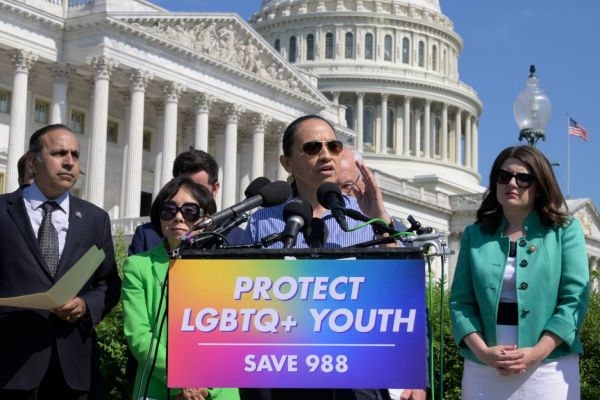
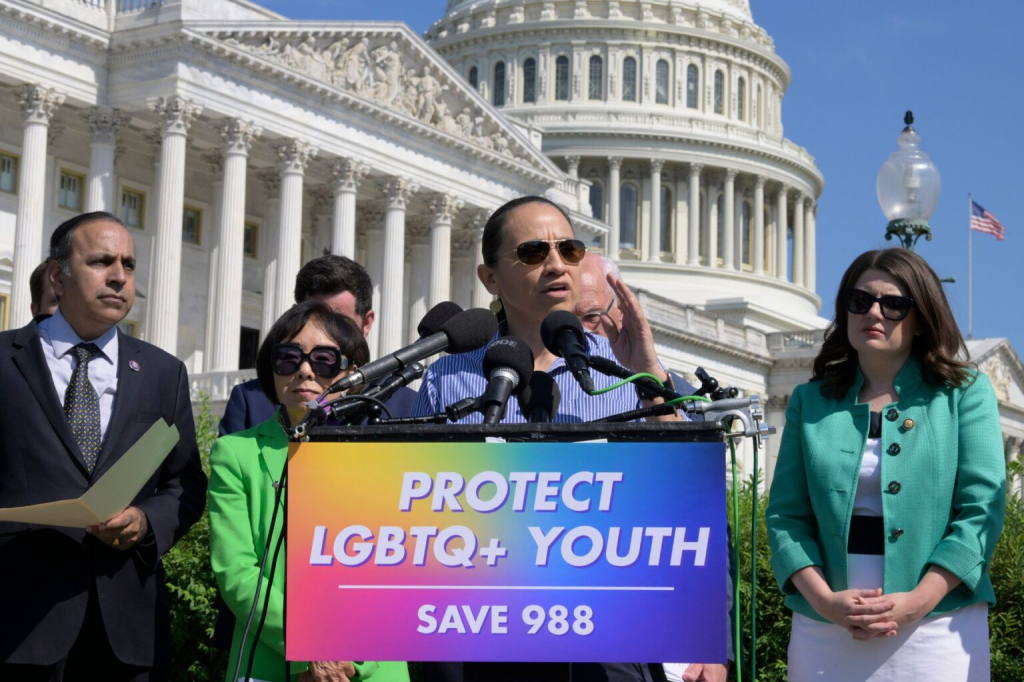
Sens. Tammy Baldwin, a Democrat, and Lisa Murkowski, a Republican, introduced a bipartisan bill on Wednesday to re-establish national emergency suicide prevention services for LGBTQ+ youth — which have been stripped by the Trump administration at a time when the vulnerable group needs it most.
In July, the Trump administration terminated the 988 hotline’s LGBTQ+ services, which connected young people in crisis with counselors trained in supporting LGBTQ+ youth. This new bill, backed by the LGBTQ+ youth suicide prevention organization Trevor Project as well as the American Foundation for Suicide Prevention, would modify the Public Health Service Act to reinstate those services and require the Secretary of Health and Human Services to maintain them. The bill now moves to committee.
The Trevor Project estimates that more than 1.8 million LGBTQ+ young people seriously consider suicide each year in the United States, as they face high rates of bullying, assault and discrimination. And when the 2024 presidential race was called for Donald Trump, calls and texts to the Trevor Project’s own crisis hotlines spiked by 700 percent, as LGBTQ+ youth felt afraid about the outcome of the election.
“Given that LGBTQ+ youth are more than four times as likely to attempt suicide than their peers, the need for these services remains pressing,” said Jaymes Black, CEO of The Trevor Project, in a statement. “This is not about politics, or identity; this is about doing what is best to support our country’s highest risk populations — and save young people’s lives nationwide.”
During his first term in 2020, President Trump signed a bipartisan law to create 988 as a more accessible resource for mental health emergencies. The free hotline launched in July 2022. Since then, millions of people in crisis have turned to 988. And nearly 1.5 million of those calls, texts and chats were sent by young Americans seeking specialized LGBTQ+ services.
“We are in the middle of a mental health crisis, and the 988 lifeline saves lives, plain and simple,” said Baldwin, who wrote the original legislation to create the 988 hotline. Cutting funds for specialized services within 988 puts the lifeline in jeopardy, she said in a statement.
“There is absolutely no good reason that Donald Trump took away this specialized help for our LGBTQ youth. Mental health does not see partisan lines or geography,” the Wisconsin Democrat added.









 fleeredstates.blog
You must be logged in to post a comment.