LGBTQ+ Americans have always been here, but as sector of society has largely been ignored until recently. LGBTQ+ seniors are continuing to increase in number, with the need for services that make them comfortable in their golden years becoming a growing issue.
According to surveys by SAGE and the Williams Institute, there are an estimated 2.7 million LGBTQ+ adults aged 50 and older in the United States, including 1.1 million who are 65 and older. By 2030, this number is projected to grow to around 7 million. Baby Boomers and Gen X, no longer plagued by the near certain early death sentence of AIDS, and contributing to growing numbers of elderly LGBTQ people.
There are a few projects across the country that have started to look at retirement community living for this sector of the population. We recently shared reporting of places in Boston MA and Austin TX. An alternative to apartment style living are single story units of housing, such as in Durham NC at the Village Hearth.
Village Hearth is located just 15 minutes from downtown Durham NC, one of NC’s major cities part of the Research Triangle. 28 homes surround a village green. For those willing to purchase their own home and be part of an HOA, this type of housing is an option.
CBS News recently profiled the village. Check out their report below.
On Wednesday, an Austin-based group broke ground on a new affordable housing development geared toward LGBTQ+ senior citizens.
The development, which will be known as Iris Gardens, is located at 1013 Montopolis Drive in southeast Austin. It will consist of 150 units for people aged 55 and older and will be considered a first of its kind for Austin through a partnership with Family Eldercare and the national housing developer, Vecino Group.
It will also offer on-site services, including mental wellness and social connection programs.
“This project just felt like it was the right thing to do,” Family Eldercare CEO Dr. Aaron Alarcon said.
Alarcon said people who are at or below the 30% to 60% area median income will be accepted. The goal is to give people who live at the complex a safe and affordable space.
At the moment, there’s an uptick of elderly people experiencing homelessness, according to Austin’s Homeless Strategy Officer David Gray.
“Oftentimes, what happens is seniors are on a fixed income, but the cost of living in our city and in our county is going up,” Gray said.
Gray said his office plans to lend a helping hand to reduce barriers and will have a list of people set to move in. Those barriers include moving expenses, helping get identification and clearing old debt.
When it comes to adding more affordable housing in Austin, Gray noted that the city is on track to to add 1,200 units by 2026 as part of its homeless response system.
Other barriers people face as they try to gain access to affordable housing are criminal backgrounds and evictions. Gray said that one tool with landlords is to reduce screening criteria by looking past criminal history and past evictions.
However, when it comes to Iris Gardens, Gray said the city wanted to focus on a community that was not being properly served.
“While this is the groundbreaking for this development, this is not the first [and] this is not going to be the last. And we’re really excited to have more of these celebrations in the future,” Gray said.
Other organizations, like Rainbow Connections ATX, will also help with outreach.
“I feel that this is necessary; it’s a long time coming,” said Annie Saldivar, project manager for Rainbow Connections ATX.
The four-story building has a price tag of $51 million, with money coming from the Austin Housing Finance Corporation, Travis County, CITI Bank and Redstone Equity.
AUSTIN, Texas — On Wednesday, an Austin-based group broke ground on a new affordable housing development geared toward LGBTQ+ senior citizens.
The development, which will be known as Iris Gardens, is located at 1013 Montopolis Drive in southeast Austin. It will consist of 150 units for people aged 55 and older and will be considered a first of its kind for Austin through a partnership with Family Eldercare and the national housing developer, Vecino Group.
It will also offer on-site services, including mental wellness and social connection programs.
“This project just felt like it was the right thing to do,” Family Eldercare CEO Dr. Aaron Alarcon said.
Alarcon said people who are at or below the 30% to 60% area median income will be accepted. The goal is to give people who live at the complex a safe and affordable space.
At the moment, there’s an uptick of elderly people experiencing homelessness, according to Austin’s Homeless Strategy Officer David Gray.
“Oftentimes, what happens is seniors are on a fixed income, but the cost of living in our city and in our county is going up,” Gray said.
Gray said his office plans to lend a helping hand to reduce barriers and will have a list of people set to move in. Those barriers include moving expenses, helping get identification and clearing old debt.
When it comes to adding more affordable housing in Austin, Gray noted that the city is on track to to add 1,200 units by 2026 as part of its homeless response system.
Other barriers people face as they try to gain access to affordable housing are criminal backgrounds and evictions. Gray said that one tool with landlords is to reduce screening criteria by looking past criminal history and past evictions.
However, when it comes to Iris Gardens, Gray said the city wanted to focus on a community that was not being properly served.
“While this is the groundbreaking for this development, this is not the first [and] this is not going to be the last. And we’re really excited to have more of these celebrations in the future,” Gray said.
Other organizations, like Rainbow Connections ATX, will also help with outreach.
“I feel that this is necessary; it’s a long time coming,” said Annie Saldivar, project manager for Rainbow Connections ATX.
The four-story building has a price tag of $51 million, with money coming from the Austin Housing Finance Corporation, Travis County, CITI Bank and Redstone Equity.
The development is set to be completed by spring 2027.
Anne Isabella Coombes, a 67-year-old transgender female swimmer, swam topless with her breasts exposed at the Cornwall County Masters swim meet as a protest to being forced to compete with cisgender men by Swim England, the UK’s governing body overseeing the country’s competitive swimming.
Swim England told Coombes she was no longer eligible to compete in the women’s category, despite her doing so in 2022 and 2023. So the organization placed her in a new “open” category where trans female and nonbinary competitors swim against cis men. Swim England replaced its men’s category with its open category starting in September 2023, to “negate… post-puberty transgender females[‘]… biological level of performance advantage post-transition,” the organization wrote.
“It is widely recognised that fairness of competition must be protected and Swim England believes the creation of open and female categories is the best way to achieve this,” the organization said upon announcing the new policy. “The updated policy ensures there are entry-level competitive opportunities for transgender people to participate in the majority of our disciplines within their gender identity.”
When Coombes asked what she’d be required to wear during swim meets in the “open” category, Swim England informed her that she would “need to wear a female swimming costume despite having to compete with the men, which ‘outs’ me as a woman who is transgender,” she told The Reading Chronicle.
“I explained to the person on the phone that they are not allowed to do that, and he didn’t have an answer,” she added, saying that the swimsuit requirement compelled her to stop competitively swimming until 2025. She only resumed in order to protest Swim England’s policies, which say that competitors’ swimwear must be in “good moral taste.”
She said the organization told her that she can swim in a men’s swimsuit without having to ask in advance for a referee’s permission, but that the referee can disqualify her if they choose.
“Deciding on whether exposing my breasts is in ‘good moral taste’ or whether I need to cover them up so that ‘those involved in competitive swimming are appropriately safeguarded’ is an entirely subjective decision of the referee,” she told the aforementioned company.
“In other words, I could turn up to the competition and run the risk of not being able to compete in whichever costume I intend to wear,” she continued. “No other swimmer has this concern. These regulations also mean that Swim England is treating me as a male by default.”
The Reading Chronicle didn’t say whether the referee disqualified her for her protest.
“I’m trying to show the world that this policy isn’t thought through, and it’s meant to hit trans people and nobody else,” she said. “I want to make it clear through this protest that trans people are not a threat when it comes to sport. We aren’t winning everything, and if we started to, then I would be first in line to discuss other options. Right now, it is a non-issue.”
Numerous competitive sports’ governing bodies have recently changed their policies to ban trans women from competing against cis women in the name of fairness — despite previously having policies that allowed trans athletes using hormone therapy to compete with members of their own gender identity.
Critics of these policies say that they mostly harm female athletes who could be subjected to invasive medical investigations in order to prove their gender. Critics also say that these policy changes add to social stigma that vilifies trans female athletes as a threat to women’s rights and do nothing to address the sexism, abuse, and lack of funding that actually harm cis female athletes.
Coombes said she has been protesting against the recent UK high court ruling that the legal definition of a woman under the country’s 2010 Equality Act is based on “biological sex.” Though the court has said that trans women still have anti-discrimination protections under the law, the UK Human Rights Commission said in a confusing “guidance” that trans women can be excluded from “women-only” spaces in hospitals, shops, and restaurants, and trans men can be excluded from “men-only” spaces.
Coombes has spoken at protests against the ruling and told the aforementioned publication, “Most trans people just want to get on with their lives and be treated as the gender they are. But unfortunately, given what the Supreme Court has done, we need to stand up and say ‘I’m trans, I exist, and you’re not going to silence me.’ Existence is resistance.”
After a year-long effort to install an official historical marker recognizing the LGBTQ+ community at the Rainbow Lounge — a gay bar in Fort Worth, Texas that was targeted in an infamous 2009 police raid — the effort was ultimately thwarted by Republican Tarrant County Judge Tim O’Hare.
The site for the historical marker, 651 S. Jennings Avenue, was the location of the Rainbow Lounge. Shortly after opening, on June 28, 2009, Fort Worth police and Texas Alcoholic Beverage Commission agents raided the bar without prior notice, using excessive force and arresting patrons for “public intoxication.” The raid resulted in one man being hospitalized for brain bleeding, and another suffering broken ribs.
The raid, which occurred on the 40th anniversary of the Stonewall Riots, mobilized the Dallas-Fort Worth area LGBTQ+ community and garnered national publicity, ultimately leading to sweeping reforms of the city’s anti-discrimination laws and the implementation of diversity training for local legal officials.
Unfortunately, the Rainbow Lounge burned down in June 2017. To this day, the site lies abandoned as leasing issues prevent the bar from being rebuilt. Investigators never stated the cause of the fire; arson was never officially ruled out.
Todd Camp, who runs Fort Worth LGBTQ+ history group, Yesterqueer, told The Fort Worth Reportthat the city approved of a historical marker after Camp gave a presentation on local queer history to city staff.
Everything seemed to be moving accordingly, however, Tarrant County Judge Tim O’Hare issued a letter to the historic commission claiming the application for the historical marker was improperly submitted and did not go through the Tarrant County Historical Commission’s “thorough approval process.” Before a state marker can be submitted to the state for approval, it must undergo a review process from the local county’s historical society.
While O’Hare argued that the process “bypassed established precedent” for approval, former Tarrant County Historical Commission chair Coletta Strickland told The Fort Worth Report that this wasn’t the case.
“There was nothing untoward or out of the ordinary that was done for this application,” Strickland said.
Nevertheless, O’Hare wrote in a letter opposing the gay bar’s historical marker, “Allowing the marker to proceed under these circumstances risks generating unnecessary controversy and undermining the credibility of both the local and state historical commissions.”
While his letter didn’t directly attack LGBTQ+ people, a statement from the judge’s chief of staff Ruth Ray said that O’Hare does not support a historical marker glorifying radical gender ideology and drag performances.
“People visit public spaces for recreation and relaxation, often with their children. As the vast majority of our nation agrees, transgenderism should not be pushed on our children,” Ray said.
O’Hare has a history of opposing LGBTQ+ rights and having far-right political beliefs. As a Tarrant County judge, he has led efforts to cut funding for non-profits that work with at-risk children, citing their views on racial inequality and LGBTQ+ rights.
There are over 16,000 historical markers that can be found in all 254 of Texas’s counties to commemorate elementary schools, historic mansions, plantations, Black historic locations, and even ones dedicated to historical female figures from Texas.
Despite this large number and the size of the state, there is currently only one officially designated LGBTQ+ historical marker in Texas: “The Crossroads” in the Oak Lawn neighborhood of Dallas, recognizing its significance as the heart of the city’s LGBTQ+ community.
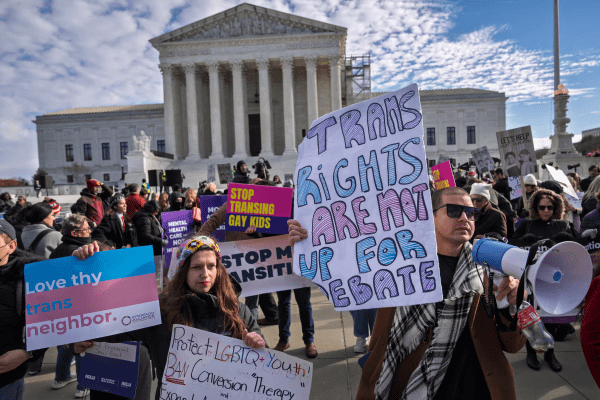
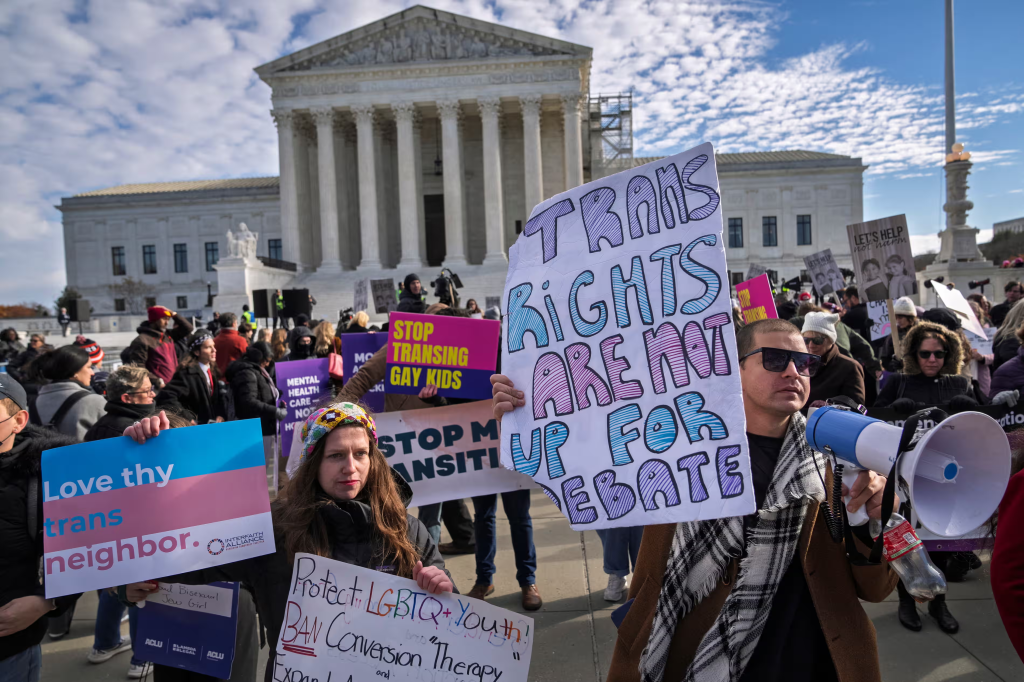
A Tennessee state law banning gender-affirming care for minors can stand, the US supreme court has ruled, a devastating loss for trans rights supporters in a case that could set a precedent for dozens of other lawsuits involving the rights of transgender children.
The case, United States v Skrmetti, was filed last year by three families of trans children and a provider of gender-affirming care. In oral arguments, the plaintiffs – as well as the US government, then helmed by Joe Biden – argued that Tennessee’s law constituted sex-based discrimination and thus violated the equal protection clause of the 14th amendment. Under Tennessee’s law, someone assigned female at birth could not be prescribed testosterone, but someone assigned male at birth could receive those drugs.
Tennessee, meanwhile, has argued that the ban is necessary to protect children from what it termed “experimental” medical treatment. During arguments, the conservative justices seemed sympathetic to that concern, although every major medical and mental health organization in the US has found that gender-affirming care can be evidence-based and medically necessary. These groups also oppose political bans on such care.
All six of the supreme court’s conservative justices joined in at least part of the decision to uphold the law, although several also wrote their own concurring opinions. In his majority decision, Chief Justice John Roberts emphasized that the ruling primarily rested on the justices’ finding that the law did not violate the equal protection clause, rather than on an ideological opposition to trans rights.
“This case carries with it the weight of fierce scientific and policy debates about the safety, efficacy and propriety of medical treatments in an evolving field. The voices in these debates raise sincere concerns; the implications for all are profound,” Roberts wrote. He added: “We leave questions regarding its policy to the people, their elected representatives, and the democratic process.”
In recent years, the question of transgender children and their rights has consumed an outsized amount of rightwing political discourse. Since 2021,26 states have passed bans on gender-affirming care for minors, affecting nearly 40% of trans youth in the US. Twenty-six states have also outlawed trans kids from playing on sports teams that correspond with their gender identity.
Many of these restrictions have been paused by court challenges, but the supreme court’s decision could have vast implications for those lawsuits’ futures. A study by the Trevor Project, a mental health non-profit that aims to help LGBTQ+ kids, found that anti-trans laws are linked to a 72% increase of suicide attempts among trans and nonbinary youth.
Justice Sonia Sotomayor dissented from the majority opinion, alongside Justices Ketanji Brown Jackson and Elena Kagan. Because the law discriminates on the basis of sex, Sotomayor argued in her dissent, it should face higher legal scrutiny than the majority decided to give it.
“Male (but not female) adolescents can receive medicines that help them look like boys, and female (but not male) adolescents can receive medicines that help them look like girls,” Sotomayor wrote. “By retreating from meaningful judicial review exactly where it matters most, the Court abandons transgender children and their families to political whims. In sadness, I dissent.”
A federal judge on Tuesday blocked President Donald Trump’s administration from refusing to issue passports to transgender and nonbinary Americans nationwide that reflect their gender identities.
U.S. District Judge Julia Kobick in Boston expanded, opens new tab a preliminary injunction she issued in April that allowed six transgender and nonbinary individuals who challenged the policy to obtain passports consistent with their gender identities or with an “X” sex designation while the lawsuit moves forward.
Kobick did so after concluding the policy the U.S. Department of State adopted pursuant to an executive order Trump signed likely discriminated on the basis of sex and was rooted in an irrational prejudice toward transgender Americans that violated the U.S. Constitution’s Fifth Amendment.
While Kobick’s April ruling was limited in its scope, the judge, an appointee of Democratic President Joe Biden, on Tuesday granted the case class action status and halted the policy’s enforcement against transgender, nonbinary and intersex passport holders.
Kobick said granting class action status to two categories of passport holders was appropriate given that the administration’s actions affected them uniformly “by preventing them from obtaining passports with a sex marker consistent with their gender identity.”
Li Nowlin-Sohl, a lawyer for the plaintiffs at the American Civil Liberties Union, called the ruling “a critical victory against discrimination and for equal justice under the law.”
White House spokeswoman Anna Kelly in a statement called the decision “yet another attempt by a rogue judge to thwart President Trump’s agenda and push radical gender ideology that defies biological truth.”
The case is one of several concerning an executive order Trump signed after returning to office on January 20 directing the government to recognize only two biologically distinct sexes, male and female.
The order also directed the State Department to change its policies to only issue passports that “accurately reflect the holder’s sex.”
The State Department subsequently changed its passport policy to “request the applicant’s biological sex at birth,” rather than permit applicants to self-identify their sex, and to only allow them to be listed as male or female.
Prior to Trump, the State Department for more than three decades allowed people to update the sex designation on their passports.
In 2022, the Biden administration allowed passport applicants to choose “X” as a neutral sex marker on their passport applications, as well as being able to self-select “M” or “F” for male or female.
The Trevor Project received official notice yesterday that the Substance Abuse and Mental Health Services Administration (SAMHSA) is initiating the closure of the 988 Suicide & Crisis Lifeline’s LGBTQ+ Youth Specialized Services program within 30 days, effective July 17, 2025.
Jaymes Black, CEO of The Trevor Project, released the following statement in response:
“We received official notice that the Trump administration has ordered the closure of The 988 Suicide & Crisis Lifeline’s LGBTQ+ Youth Specialized Services program, effective July 17, 2025. This means that, in 30 short days, this program that has provided life-saving services to more than 1.3 million LGBTQ+ young people will no longer be available for those who need it.
“This is devastating, to say the least. Suicide prevention is about people, not politics. The administration’s decision to remove a bipartisan, evidence-based service that has effectively supported a high-risk group of young people through their darkest moments is incomprehensible. The fact that this news comes to us halfway through Pride Month is callous – as is the administration’s choice to remove the ‘T’ from the acronym ‘LGBTQ+’ in their announcement. Transgender people can never, and will never, be erased.
“Congress can still act to reverse this fatal decision. We are asking everyone to join the overwhelming public support for evidence-based crisis services, and urge Congress to act. Learn more by visiting TheTrevorProject.org/ActNow.
“I want every LGBTQ+ young person to know that you are worthy, you are loved, and you belong – despite this heartbreaking news. The Trevor Project’s crisis counselors are here for you 24/7, just as we always have been, to help you navigate anything you might be feeling right now.”
In September 2022, The Trevor Project began providing its best-practice crisis services to LGBTQ+ youth through the 988 Lifeline. When individuals contact the 988 via phone, text, or chat, they are given the option to “press 3” or “reply PRIDE” to be connected with counselors trained specifically to assist LGBTQ+ contacts up to age 25. Initially, The Trevor Project served as the sole provider for the pilot phase of 988 LGBTQ+ youth specialized services, before transitioning to serve as one of seven centers that currently make up the LGBTQ+ Youth Subnetwork.
The Trevor Project serves nearly 50% of the LGBTQ+ youth specialized services’ contact volume. In 2024 alone, The Trevor Project directly servedmore than 231,000 crisis contacts, and trained and supported nearly 250 crisis counselors and operational support staff to support the 988 Lifeline. Previously, the LGBTQ+ Youth Subnetwork received up to $50 million in restricted federal funds to provide these life-saving services.
The Trevor Project’s supporters in the House and Senate advocated for the continued funding for these life-saving programs. The organization launched a petition to demand lawmakers protect LGBTQ+ youth and an Emergency Lifeline fundraising campaign. On June 2, 2025, more than 100 entertainment icons – across film, music, TV, sports, theater, comedy, fashion, culinary arts, and book publishing – joined The Trevor Project’s sign-on letter to protect federal funding for LGBTQ+ youth suicide prevention.
If you or someone you know needs help or support, The Trevor Project’s trained crisis counselors are available 24/7 at 1-866-488-7386, via chat at TheTrevorProject.org/Get-Help, or by texting START to 678678.
The Trump administration is using its anti-trans actions to try to dismantle civil rights for both trans and cis women alike – and it’s taking an unusual route to do so.
The Department of Energy (DOE) is seeking to rescind the section of Title IX that says schools must allow students to play on sports teams with the opposite sex if there is no team for their sex available (unless the sport is a contact sport). The rule has allowed girls to play on boys’ teams in schools that don’t offer an equivalent girls’ team.
The DOE claims the policy “ignore[s] differences between the sexes which are grounded in fundamental and incontrovertible reality” and says eliminating it aligns with Donald Trump’s anti-trans executive order, “Keeping Men Out of Women’s Sports.”
The rescission of the rule would only apply to schools that receive funding from the DOE, which provides money to some schools for research and other programs, such as its Renew America’s School grant to assist with energy upgrades.
What’s more, the administration is exploiting a loophole to try to rush the rule change through without the standard 60-day public comment period. The DOE is using a process called a direct final rule (DFR), which does not require the formal rulemaking process but is typically used for simple changes, such as form updates.
The DFR process allowed the rule change to take effect on July 15 unless “significant adverse comments” had been submitted by June 16. Thousands of comments were submitted, though they are not visible to the public. It’s not clear whether the rule will officially take effect.
If the rule does change, it will not only affect trans athletes. Schools that receive DOE funding will no longer be required to allow cisgender girls to play on boys’ teams when a girls’ team does not exist.
Shiwali Patel, senior director of safe and inclusive schools for the National Women’s Law Center, told K-12 Divethe change is “blatant sexism, and harmful to women and girls.”
″The Trump administration is trying to gut long-standing Title IX protections that intend to provide women and girls with more opportunities to play sports, and without following the legally required rulemaking process, no less.”
Patel added that the administration clearly “doesn’t actually care about ‘protecting’ women and girls,” as it has used this claim to justify its crusade against trans rights, especially when it comes to trans student-athletes.
Julia Martin, director of policy and government affairs at legal and consulting group The Bruman Group, explained that the administration was able to keep the proposed rule change under wraps for so long because no one would have expected it to come from the DOE, as the Department of Education typically handles these kinds of policies.
The proposed change, in fact, was slipped into the middle of a list of 47 so-called “burdensome and costly regulations” outlined in a DOE press release in May announcing the department’s plan for a major overhaul to puportedly “save the American people an estimated $11 billion and cut more than 125,000 words fro the Code of Federal Regulations.”
“Part of what I see happening is this sense of overwhelm,” Kel O’Hara, senior attorney for policy and education equity at Equal Rights Advocates, told HuffPost. “There’s so much happening that it’s hard to follow. [The Trump administration] is trying to put these things through back doors, which makes it hard for the people who normally keep an eye on these things to catch it.”
O’Hara said the administration’s use of the DFR process is also worrisome for the future of other civil rights protections. “The really concerning part from my perspective is that this could essentially provide a blueprint for dismantling civil rights protections across the board.”
A second proposed rule change also seeks to rescind similar Title IX protections for education programs. The administration is also using the DFR loophole to try to push this change through on the same timeline.
Exactly one year after opening its doors, The Pryde has transformed the historic 1902 structure into New England’s first LGBTQ+ welcoming affordable senior housing community.
Karmen Cheung, Pennrose New England Regional VP, recalled the building’s previous state.
“I remember walking in and doing a tour of the building when it was vacant for the first time,” Cheung said. “It was actually kind of creepy, cold, dark.”
The vision, however, was clear: to turn an historic building into an independent living space where LGBTQ+ seniors could feel a strong sense of belonging. The result is a vibrant community that residents like Brian Salvaggio deeply appreciate.
“It’s bright, it’s open, it’s lively,” Salvaggio said. “It’s really the first group of people that’s lived here, so you feel part of something.”
For many residents, The Pryde offers a much-needed haven.
“As we get older and we want more community around us and we want more support around us, that’s really what brought us here,” resident Pat Xavier said.
The 100% accessible building addresses a critical need for a generation of LGBTQ+ elders who grew up without the legal protections and societal acceptance now afforded to younger generations, according to Gretchen Van Ness, executive director of LGBTQ Senior Housing.
“This generation of LGBTQ elders has faced such losses that they come into their elder years with a much smaller safety net than a lot of other folks are lucky to have,” Van Ness said.
The journey to create The Pryde was a dedicated nine-and-a-half-year collaboration between LGBTQ Senior Housing and Pennrose Management. Throughout the renovation, developers diligently preserved the building’s historic charm, retaining elements like original chalkboards and bell systems.
“Every unit is actually a little different because of those historic pieces,” Cheung said.
The Pryde is open to anyone over 62 who qualifies for affordable housing, though demand has far outstripped availability.
“We are 100% occupied,” Van Ness said. “This community is full and it’s hopping and there’s a million things going on.”
For residents, the most significant impact is the feeling of safety and liberation from discrimination and isolation.
“That’s just a wonderful feeling because, you know, there’s no more hiding,” Brian Salvaggio said. “Not at our age. We want to be who we are and enjoy the time we have.”
After a year of operation, residents and representatives alike believe The Pryde stands as a powerful blueprint for LGBTQ+ senior living communities everywhere, demonstrating how inclusive spaces can transform lives.
The California legislature is expected to restore $40 million in the state budget for LGBTQ+ health programs that was cut by Democratic Gov. Gavin Newsom.
Lawmakers are set to approve their revisions to the governor’s budget today, according to the Bay Area Reporter, which will restore funding for the California Department of Public Health’s Office of Health Equity (OHE). Newsom had eliminated the funds in his revised budget proposal released last month, drawing heavy condemnation from both lawmakers and LGBTQ+ groups.
The office funds several programs for LGBTQ+ youth, women, and transgender people through its Gender Health Equity Section (GHES), which is “dedicated to eliminating systemic bias that impacts health outcomes based on gender, gender identity, and sexual orientation.” In pausing funds, the governor also paused enrollment for undocumented adults in state healthcare programs.
The Los Angeles LGBT Center, which has been a recipient of some of the funds, including $1.9 million in 2022 for its Audre Lorde Health Program, sharply criticized Newsom’s proposed budget. CEO Joe Hollendoner said in a statement that the cuts were “a betrayal of queer and trans Californians.”
“Let’s be clear: balancing the state budget on the backs of vulnerable queer communities is a moral failure,” he said. “In cutting this funding, Governor Newsom has chosen to sacrifice the health and dignity of those already navigating intersecting barriers of misogyny, racism, transphobia, and xenophobia — including undocumented LGBTQ+ people. These cuts, along with the pausing of enrollment for adult undocumented Californians, are a clear attack on our healthcare system and the people who depend on it.”
The governor must still approve the legislature’s revisions to the state budget, which has has until June 30 to sign into law. Newsom, who is set to negotiate with lawmakers over the next few days, has not indicated whether or not he will agree to leave the funds.




















 fleeredstates.blog
You must be logged in to post a comment.