
Alabama GOP passes 10 Commandments-in-schools bill on same day as rollbacks of LGBTQ+ rights

*This is reported by LGBTQNation

The Alabama state House of Representatives passed several anti-LGBTQ+ bills this past Thursday. The bills include an expansion of the state’s “Don’t Say Gay” law, a ban on drag performances, a ban on Pride flags, and a ban on school employees calling trans students by the correct pronouns.

One of the bills would also require the Ten Commandments to be posted in every school in the state.

H.B. 244 extends the state’s ban on discussing LGBTQ+ people in schools, which currently only applies to grades K through 5, to all grade levels. It also bans school employees from “displaying flags or insignia relating to sexual orientation or gender identity,” which would include Pride flags. It also bans school employees from referring to a student with pronouns or a “title” that is “inconsistent with the student’s biological sex at birth.”

State Rep. Mark Gidley (R) said that the bill was necessary because an unnamed student told him that they have a teacher who can’t teach without mentioning “all things gay and transgender.” Gidley didn’t say what school this happened in.

State Rep. Neil Rafferty (D), the only out gay person in the chamber, said that LGBTQ+ people are “not the problem.”

“I want you to know you are not the problem. You are not broken, and you’re absolutely not alone,” he said. “They’re not theories. They’re not talking points, not threats to be neutralized. They’re people. They’re Alabamian, and they deserve better than what we are offering them right now.”

State Rep. Phillip Ensler (D) said that the bill will make kids feel unwelcome in schools.

“If they don’t trust a teacher, if they think a teacher doesn’t like them or use them differently or views them as unequal, they’re not going to be as open to learning,” he said.

The bill passed with 76 votes in favor and nine against.

H.B. 67 bans public schools and libraries from hosting drag performances in the presence of minors without parental consent, and also says that trans people must use the restroom associated with their sex assigned at birth in places where minors might use the restroom. It also passed 76-9.

“This bill is an attempt to censor LGBTQ experiences from the public and is contradictory to our First Amendment rights,” the ACLU of Alabama said in a statement. “Supporters of this bill argue that drag performances are not appropriate for minors. That’s a decision for that minor’s parents, caregivers, and family to make – not the State of Alabama.”

On the same day, the chamber passed H.B. 178, a bill that would require all public schools in the state, both K-12 schools as well as colleges and universities, to display the Ten Commandments in “a common area.” The bill doesn’t give schools funding for this and instead suggests that they seek donations.

“The First Amendment guarantees that students and their families —not politicians or the government—get to decide which religious beliefs, if any, they adopt and what role those beliefs will play in their lives,” the ACLU of Alabama said in a statement. “Displaying the Ten Commandments in public school classrooms blatantly violates this promise. Students can’t focus on learning if they don’t feel safe and welcome in their schools.”

The bill, sponsored by Rep. Gidley, also requires schools to display a statement near the Ten Commandments that says they are “a key part of the Judeo-Christian religious and moral tradition that shaped Western Civilization and ultimately the founding of the United States.”

“This is about returning foundational principles to schools to be taught,” Gidley said about his bill.

Democrats called the bill a distraction.

“We’re focusing on issues that really don’t put more money in the pockets of every Alabamian,” said House minority leader Anthony Daniels (D). “It does not reduce the cost at the gas pump. We’re talking about solving problems for the average Alabamanian. This particular issue does nothing.”

One Democrat pointed out that the Ten Commandments aren’t age-appropriate for younger children.

“I think that the 10 commandments have their place, but I don’t know that we need to mandate that they be in our schools,” said state Rep. Marilyn Lands (D), the Alabama Reflector reports. “I think we teach our children well in our homes, and I think we have churches to teach them, but I’m not sure that they belong in our schools.”

The bill passed the state house 88-11. All three bills now go on to the state senate.

Louisiana passed a similar bill regarding the Ten Commandments last year, requiring them to be displayed in every classroom in the state. A federal judge blocked the bill from taking effect, saying it was “unconstitutional on its face.”


Greenfield (Mass.) City Council passes ‘sanctuary city’ resolution for trans, gender-diverse people

*This is reported by the Greenfield Recorder.

City Council voted 9-0, with one abstention, to approve a resolution declaring Greenfield a “sanctuary city” for transgender and gender-diverse people Wednesday evening.

The vote followed more than two hours of public comment, with more than 20 residents voicing their support.

The resolution, which was initially proposed by resident Trystan Greist, was written in anticipation of a federal rollback on LGBTQ rights. Prior to the passage of the resolution, councilors had expressed plans to pass an ordinance in the near future vowing support for the trans community, which would codify it into municipal law.

“There’s absolutely no reason that we shouldn’t do this and a million reasons why we should,” Precinct 2 Councilor Rachel Gordon said. “My only concern is that it’s just a resolution. … I think it’s really important as a community and a council that we then make this into an ordinance that has real teeth so that people have as much protection as possible.”

Among the dozens of resolution supporters — some carrying signs and pinning trans flags to their clothes — was Greist, who explained that while the resolution might not have any legal backing, it could serve as a determining factor for trans and gender-diverse individuals deciding whether to move to Greenfield.

“The reason I wrote [this resolution] wasn’t just for the trans people living in the region — and there are a lot of us, and there are more coming — but it’s for all of the trans families in the nation that are currently under siege,” Greist explained. “We need to put out that we’re here and that we’re welcoming and that we’re safe. To be perfectly honest, I’m hoping that if enough cities in Massachusetts pass resolutions like this, we will eventually become a trans sanctuary state.”

Some residents and activists who spoke in support of the resolution shared their concerns over the state of the trans and broader queer communities, with some expressing fear that the “X” gender marker on their licenses would put targets on their backs in other states.

Others shared experiences of having their pride flags removed from their properties, or facing other forms of discrimination and intimidation because of their gender identities.

“My wife is from here, and when we closed on our house on High Street, before we unlocked our door, the first things that we did were we hung our pride flag on the porch and stamped our Black Lives Matter sign into the front yard,” resident Lev BenEzra said. “Since that time, our pride flag has been ripped down from our porch not once, not twice, but three different times, and yanked in such a manner that the person had to have climbed up onto our porch.”

Other residents, such as Trystan Greist’s spouse Arjuna Greist, quoted pastor and Holocaust survivor Martin Niemöller’s famous poem “First They Came,” to argue that even those outside the trans community have a moral obligation to take a stand against mistreatment and discrimination.

“‘First they came for the socialists’ — we all know the poem. We hear the powerful lesson that we must speak up for any group under attack by a fascist regime, if only to ensure that someone is left to help when they inevitably come for us,” Arjuna Greist said. “We have an opportunity today, here in Greenfield and all over our state and country, to write our own poem together.”

Prior to his vote, At-Large Councilor John Garrett, who also works as a high school history teacher, spoke to Arjuna Greist’s reference to the poem in his remarks. He said the comments “chilled him” and gave historical context to a moral obligation against neutrality.

City Council President Lora Wondolowski, one of the resolution’s early supporters, expressed enthusiasm and pride for the community’s support of the resolution.

“I’m really moved. I knew it would be emotional to hear the stories and I still feel it deep in my heart. When my ex-wife and I moved to Greenfield over 20 years ago, we didn’t know if we’d be welcomed here. I’ve had Slurpees thrown at me from moving cars, and I’ve also seen the best and had neighbors who I never thought would be supportive be really supportive of our family,” Wondolowski said. “This resolution allows us to be full-throated in our support of the community.”

Judge grants “critical victory” to trans people suing Trump for his anti-trans passport policy

*this is being reported by LGBTQNation

U.S. District Judge Julia E. Kobick has issued a partial preliminary injunction against the Trump administration’s executive order barring trans people from changing the gender markers on their passports.

Kobick’s decision mandates that six of seven trans and nonbinary plaintiffs in a lawsuit filed by the American Civil Liberties Union (ACLU) receive passports that accurately reflect their gender identities. This includes allowing an X marker for those who do not identify as male or female.

“The Executive Order and the Passport Policy on their face classify passport applicants on the basis of sex and thus must be reviewed under intermediate judicial scrutiny,” Kobick stated, as reported by the Associated Press. “That standard requires the government to demonstrate that its actions are substantially related to an important governmental interest. The government has failed to meet this standard.”

She agreed that the plaintiffs could successfully prove the administration’s order is “based on irrational prejudice toward transgender Americans,” is “arbitrary and capricious,” and “was not adopted in compliance with the procedures required by the Paperwork Reduction Act and Administrative Procedure Act.”

“This ruling affirms the inherent dignity of our clients, acknowledging the immediate and profound negative impact that the Trump administration’s passport policy would have on their ability to travel for work, school, and family,” said Jessie Rossman, legal director at ACLU of Massachusetts, in a statement. “By forcing people to carry documents that directly contradict their identities, the Trump administration is attacking the very foundations of our right to privacy and the freedom to be ourselves. We will continue to fight to rescind this unlawful policy for everyone so that no one is placed in this untenable and unsafe position.”

The ACLU also plans to file a motion requesting Kobick’s decision apply to all trans and nonbinary people across the country.

“This decision is a critical victory against discrimination and for equal justice under the law,” said Li Nowlin-Sohl, senior staff attorney for the ACLU’s LGBTQ & HIV Project. “But it’s also a historic win in the fight against this administration’s efforts to drive transgender people out of public life. The State Department’s policy is a baseless barrier for transgender and intersex Americans and denies them the dignity we all deserve. We will do everything we can to ensure this order is extended to everyone affected by the administration’s misguided and unconstitutional policy so that we all have the freedom to be ourselves.”

The ACLU filed Orr v. Trump in February after the president signed an executive order declaring that there were only two immutable genders: male and female. Afterward, Secretary of State Marco Rubio ordered that all passport applications requesting an “X” gender marker be suspended, as well as any applications listing a person’s gender identity rather than the sex they were assigned.

“I thought that 18 years after transitioning, I would be able to live my life in safety and ease,” trans man and plaintiff Reid Solomon-Lane said in a statement when the lawsuit was filed. “Now, as a married father of three, Trump’s executive order and the ensuing passport policy have threatened that life of safety and ease. If my passport were to reflect a sex designation that is inconsistent with who I am, I would be forcibly outed every time I used my passport for travel or identification, causing potential harm to my safety and my family’s safety.”

The lawsuit argues the passport policy is a violation of the Constitution’s Equal Protection and Due Process clauses and is also a violation of the First Amendment by compelling speech from trans, nonbinary, and intersex passport holders.

The Trump administration has argued the policy will not harm anyone.

“Some Plaintiffs additionally allege that having inconsistent identification documents will heighten the risk that an official will discover that they are transgender,” the Justice Department said. “But the Department is not responsible for Plaintiffs’ choice to change their sex designation for state documents but not their passport.”

Top 10 Cities to Live in Spain

Spain has consistently ranked high for quality of life, and there are numerous compelling reasons why expats should consider making it their new home:

Lifestyle and Culture:

  • High Quality of Life: Spain frequently tops rankings for quality of life, with expats reporting high satisfaction with the climate, culture, and overall living conditions.
  • Laid-back Lifestyle: Spaniards are known for their relaxed and friendly approach to life, prioritizing enjoyment and social connections over stress. This can be a refreshing change for those accustomed to a faster pace.
  • Rich Culture and History: Spain boasts a diverse cultural heritage, with influences from various civilizations evident in its architecture, language, and traditions. There are numerous festivals and celebrations throughout the year.
  • Outdoor Activities: With varied topography and a pleasant climate, Spain offers a wide range of outdoor activities, from skiing in the Sierra Nevada to watersports along its extensive coastline.
  • Gastronomy: Spanish cuisine is world-renowned, emphasizing fresh, local ingredients and social dining. Tapas culture is a significant part of Spanish social life.

Cost of Living:

  • Affordable: Generally, the cost of living in Spain is considered affordable compared to many other Western European countries and the United States. This includes rent, groceries, and dining out.
  • Regional Variations: The cost of living can vary significantly depending on the city and region, with major cities like Madrid and Barcelona being more expensive than smaller towns.

Healthcare:

  • Excellent Healthcare System: Spain has a highly-rated universal healthcare system (Sistema Nacional de Salud – SNS) that provides free or low-cost basic services to residents.
  • Accessibility for Expats: Expats can access the public healthcare system once registered, often tied to employment or residency. Private health insurance is also available and relatively affordable.

Community and Integration:

  • Welcoming Environment: Spaniards are generally known for their friendliness and hospitality, making it easier for expats to feel at ease and integrate.
  • Large Expat Communities: Spain has a significant number of expats, particularly in major cities and coastal areas, fostering a diverse and supportive environment. It’s often easy to find communities based on nationality or interests.

Climate and Geography:

  • Pleasant Climate: Many regions of Spain enjoy a mild climate with plenty of sunshine, encouraging an active outdoor lifestyle year-round.
  • Diverse Landscapes: From the northern coast with its surfing culture to the Mediterranean beaches and the mountainous regions, Spain offers a variety of landscapes to explore.

Transportation:

  • Modern and Affordable: Spain has a well-developed and affordable transportation system, including high-speed trains, metro networks, buses, and trams, especially in urban areas.

Things to Consider:

  • Language: While English is spoken in tourist areas and by some expats, learning Spanish is crucial for full integration and daily life, especially in more local settings.
  • Bureaucracy: Navigating administrative processes can sometimes be challenging.
  • Job Market: Depending on your profession, the job market might differ from your home country. Salaries may also be lower in some sectors.

Overall, Spain offers a compelling combination of a high quality of life, affordable living, excellent healthcare, and a welcoming culture, making it an attractive destination for expats seeking a fulfilling experience abroad.

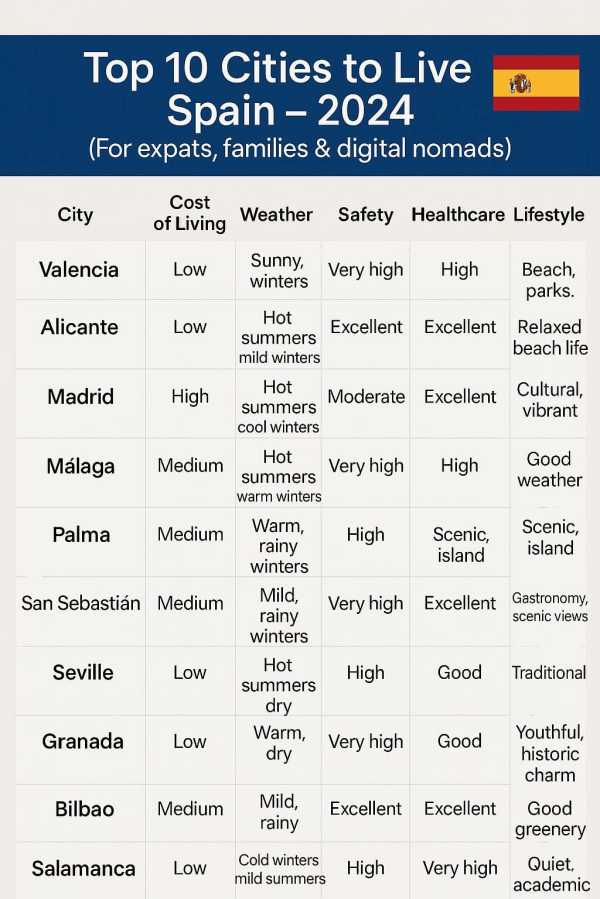
Want to live in Spain? Consider these top 10 cities.

LGBTQ+ Real Estate Leaders Speak Out: Fighting for Equality in Housing & Politics

This episode we are joined by the amazing Cori Taber. What happens when real estate meets resistance, advocacy, and identity? In this candid conversation, LGBTQ+ real estate professionals Cori Taber, Bob McCranie, Kimber Fox, and Leslie Wilson sit down to discuss the evolving challenges of being openly queer in an industry—and a country—facing political pushback. 🏳️‍🌈 Topics covered include: How anti-LGBTQ+ legislation affects clients and agents The role of advocacy in real estate Why “just doing business” isn’t neutral anymore Personal stories from the frontlines of inclusion in housing 📍 Whether you’re an agent, ally, or advocate, this video unpacks the real stakes of LGBTQ+ visibility in today’s market. 🔔 Subscribe for more conversations at the intersection of real estate, rights, and representation.

More Than 850 Anti-LGBTQ Bills Filed So Far in 2025 — the Most in US History

*This is reported by Truthout.

Over the past five years, Republican lawmakers have turned anti-trans legislation into a full-blown political obsession. What began as a handful of bills targeting sports participation and so-called religious exemptions has metastasized into a sweeping campaign against nearly every facet of transgender life — bathroom access, IDs, medical care, even the legality of one’s identity. In 2020, there were just over 100 bills aimed at LGBTQ+ people. In 2025, that number has ballooned to more than 850, the vast majority singling out transgender Americans. What we are witnessing now is not a legislative trend — it’s a coordinated nationwide crusade.

In 2020, most anti-trans legislation centered on banning transgender youth from sports — a proposal that, at the time, was considered extreme. The political optics of attacking LGBTQ+ people so soon after the Obergefell ruling were poor, and the memory of North Carolina’s disastrous bathroom ban was still fresh. That law, which forced trans people to use restrooms that didn’t align with their gender identity, backfired spectacularly and was widely credited with helping sink Republican prospects in the 2018 midterms in the state.

Nevertheless, some Republicans had identified sports as a way to get their foot in the door to further discrimination. The president of the American Principles Project, Terry Schilling, detailed how this was the case: “The women’s sports issue was really the beginning point in helping expose all this because what it did was, it got opponents of the LGBT movement comfortable with talking about transgender issues.”

In the years that followed, the volume and severity of anti-trans legislation escalated dramatically. Over 200 bills were proposed in 2022, and more than 500 in 2023, with each legislative session raising the ceiling on what Republicans considered politically palatable. Sports bans, once fringe, became boilerplate by 2021. The next year, states that had passed sports bans moved swiftly to criminalize gender-affirming care, and drag bans and bathroom restrictions emerged as the new line of attack. Today, those once-extreme measures are commonplace, and Republicans are setting their sights on even broader targets: bans on ID changes, adult healthcare restrictions, and increasingly punitive measures that chip away at the basic legal recognition of trans lives. Some bills have even been proposed to criminalize transgender identities altogether.

As of 2025, a staggering 867 bills have been introduced targeting transgender people across the United States. Of these, 122 would ban gender-affirming care for some segment of the trans population. Another 77 seek to bar transgender people from certain bathrooms — a threat made more tangible as arrests for alleged “wrong bathroom” usage have begun to mount. Seventy-three bills aim to eliminate legal recognition of transgender people entirely, often by revoking updated driver’s licenses, stripping correct gender markers, and invalidating identification documents. Others target drag (and transgender people dressed in the “wrong clothes”) or require schools to forcibly out transgender students. A newer, especially chilling category would classify gender-affirming care or even social transition as child abuse, opening the door for state-sanctioned removal of trans youth from supportive homes. So far, 51 anti-trans bills have been signed into law this year, with many more advancing through state legislatures.

As state legislatures escalate their assault on transgender rights, the federal government under Trump has doubled down — punishing blue states for protective laws, banning transgender people from military service, investigating teachers for affirming trans students, defunding hospitals that provide care, and targeting organizations simply for acknowledging the word “transgender.” In scope and intensity, 2025 has become the most punishing year yet for transgender people in America. The goal is unmistakable: to make it nearly impossible for transgender people to live openly, safely, and with dignity in public life.

Judge blocks Trump administration from passport changes affecting some transgender Americans

*This is being reported by WFAA.

A federal judge on Friday blocked the Trump administration from enacting a policy that bans the use of “X” marker used by many nonbinary people on passports as well as the changing of gender markers.

In an executive order signed in January, the president used a narrow definition of the sexes instead of a broader conception of gender. The order says a person is male or female and it rejects the idea that someone can transition from the sex assigned at birth to another gender. The framing is in line with many conservatives’ views but at odds with major medical groups and policies under former President Joe Biden.

U.S. District Judge Julia Kobick, who was appointed by President Joe Biden, sided with the American Civil Liberties Union’s motion for a preliminary injunction, which stays the action while the lawsuit plays out.

“The Executive Order and the Passport Policy on their face classify passport applicants on the basis of sex and thus must be reviewed under intermediate judicial scrutiny,” Kobick wrote. “That standard requires the government to demonstrate that its actions are substantially related to an important governmental interest. The government has failed to meet this standard.”

The ACLU, which sued the Trump administration on behalf of five transgender Americans and two nonbinary plaintiffs, said the new policy would effectively mean transgender, nonbinary and intersex Americans could not get an accurate passport.

“We all have a right to accurate identity documents, and this policy invites harassment, discrimination, and violence against transgender Americans who can no longer obtain or renew a passport that matches who they are,” ACLU lawyer Sruti Swaminathan said.

In response to the lawsuit, the Trump administration argued the passport policy change “does not violate the equal protection guarantees of the Constitution.” They also contended that the president has broad discretion in setting passport policy and that plaintiffs would not be harmed by the policy, since they are still free to travel abroad.

Trump administration opens a “snitch line” to report trans kids getting health care

*This is being reported by LGBTQNation.

The Trump administration has opened a new “snitch line” to report what it calls violations of Trump’s executive order “Protecting Children From Chemical and Surgical Mutilation.” 

In twin actions this week, the Department of Health and Human Services (HHS) continued its efforts to end gender-affirming care for trans youth with the new whistleblower portal and the launch of an investigation of “a major pediatric teaching hospital” over the alleged firing of a nurse because she sought a religious exemption to avoid administering puberty blockers and hormones to minor patients.

Though unnamed, the nurse is likely whistleblower Vanessa Sivadge, who worked at Texas Children’s Hospital and provided testimony to Congress this week about her alleged termination.

The “snitch line” was shared publicly on Monday with guidance for potential whistleblowers published on the HHS website.

“You have three options to report a tip or complaint related to the chemical and surgical mutilation of children or whistleblower retaliation,” the guidance states, with instructions to provide identifying information of those involved in the alleged order violation.

“Please reference EO 14187 in your complaint,” the guidance states, referring to Trump’s “Chemical and Surgical Mutilation” order.

That order has been blocked by multiple federal judges with temporary restraining orders, but the Trump administration continues to invoke it in its crackdown on doctors and hospitals.

One ruling, by U.S. District Judge Lauren King in the Western District of Washington, termed the order a violation of constitutional protections by “treating people differently based on sex or transgender status.” Those cases continue to make their way through the courts.

The concurrent hospital investigation is designed to showcase the administration’s weaponization of 50-year-old federal anti-abortion provisions known as the Church Amendments to protect anti-trans whistleblowers. Those allow religious accommodation to anti-abortion healthcare providers based on “religious beliefs or moral convictions respecting sterilization procedures.”

Trump’s order characterizes gender-affirming care as “maiming and sterilizing.”

In January, the Justice Department dropped charges against Dr. Eithan Haim, a Texas surgeon accused of leaking private medical information about minors who received gender-affirming care at the same Texas hospital where Sivadge worked. He shared that information with rightwing media outlets.

The DOJ had previously charged Haim with violating HIPAA laws with “intent to cause malicious harm.” He called himself a whistleblower.

The Trump administration continues to characterize evidence-based trans healthcare as “mutilation”, despite every major medical association, including the American Academy of Pediatrics, the American Medical Association, and the Endocrine Society, supporting the practice.

Indiana governor signs law banning trans women from collegiate sports

*This is being reported by LGBTQNation.

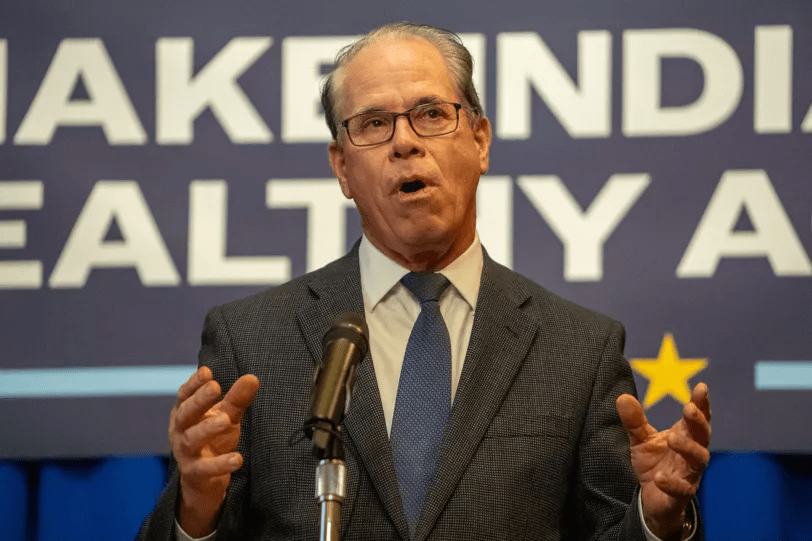
On Tuesday, Indiana Gov. Mike Braun (R) signed legislation banning trans women from playing on college women’s sports teams.

The law “prohibits a male, based on the student’s biological sex at birth in accordance with the student’s genetics and reproductive biology, from participating on an athletic team or sport designated as being a female, women’s, or girls’ athletic team or sport.” It also requires state schools and some private schools to “establish grievance procedures for a violation of these provisions.”

The legislation extends the state’s anti-trans sports policies that already exist for K-12 athletes. In 2022, the Indiana legislature voted to override then-Gov. Eric Holcomb’s (R) veto of an anti-trans sports bill, which banned transgender girls and women from participating in school sports. Holcomb claimed it was unconstitutional and addressed a nonexistent issue in the state.

In March, Braun also signed two anti-trans executive orders, one banning trans women from women’s sports at the collegiate level and the other declaring there are only two genders: male and female.

“Women’s sports create opportunities for young women to earn scholarships and develop leadership skills,” he said in a statement at the time. “Hoosiers overwhelmingly don’t want those opportunities destroyed by allowing biological males to compete in women’s sports, and today’s executive order will make sure of that.” 

In a statement defending his executive order legally erasing trans and nonbinary identities, he touted the “scientific fact of biological sex” and claimed “replacing” that with “the always-changing, self-reported idea of ‘gender identity’ has real consequences.”

“Indiana will not go along with this radical new idea of what gender means,” he said, “and we will not allow tax dollars to be used to promote this ideology — instead, we’re going to focus on providing Freedom and Opportunity for all Hoosiers.”

The press release announcing the orders stated, “Indiana will not go along with the extreme gender ideology that created the problem in women’s sports in the first place.”

In reality, there is no problem in women’s sports, as there is only a record of a handful of out transgender college and K-12 students even participating.

NCAA President Charlie Baker told a Senate committee in December that he is aware of fewer than 10 transgender athletes among more than 500,000 student-athletes who compete in NCAA championship sports.

And reporting by the Associated Press in 2021 revealed that dozens of lawmakers who sponsored legislation to restrict trans athletes’ participation in school sports couldn’t cite a single example in their own state where trans athletes had caused problems. 

Even more, a recent study found that trans women actually underperform when compared to cis athletes. The study confirms that transitioning presents various physical changes, such as a lower center of mass and fat distribution, decreased muscle mass and bone density, and lower blood oxygen levels.

Police officers forcibly remove mom of trans kid from meeting for saying just one word

*This is being reported by LGBTQNation.

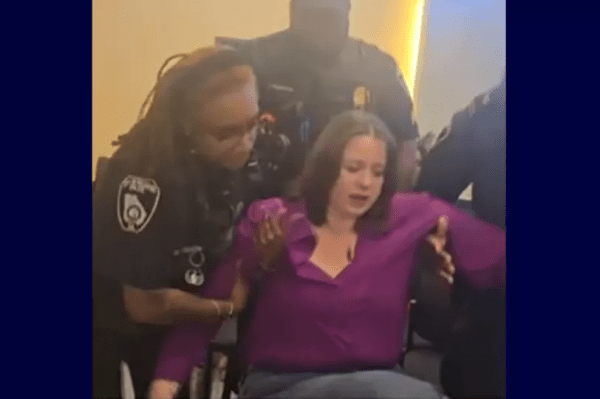
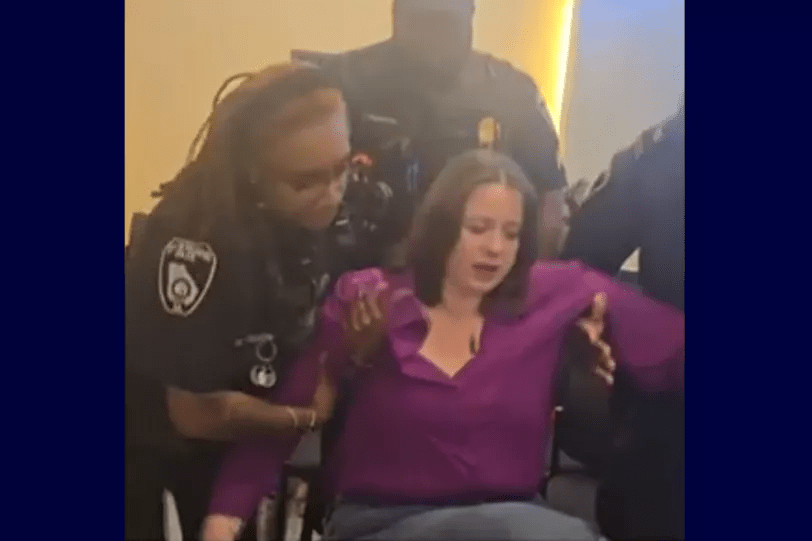
The mother of a transgender child who tried to speak out against proposed changes to her school district’s diversity, equity, and inclusion (DEI) policies was forcibly removed by four police officers when she said one word at a meeting of the City Schools of Decatur Board of Education on Tuesday evening.

That word was “cowards.”

“I’m practicing my rights as a parent. I’m in no way resisting,” she said as she was carried out. “I’m not resisting, and this is what fascists do!”

Kotler went to the emergency board meeting to speak against changes to the district’s DEI policy, which used to require that “all learning environments… be inclusive, safe, secure, and supportive while also ensuring that no student group is marginalized.” This policy, as well as four others, was changed to remove words like “equity” and “Americans with Disabilities Act.” Two of the policies were rescinded completely.

The district’s DEI policy now states that it is “designed to achieve fair and just access to opportunity and resources that provide all humans the ability to thrive.”

Kotler, who is the mother of three children, including one transgender daughter and one nonbinary child, went to the meeting and shouted “Cowards!” at the board. Advocate reports that Board Chair Carmen Sulton asked her to leave.

“I said one word, I have already stated I have no intention of speaking again until public comment,” she responded. “I’m going to sit here. I have offered that if it makes the board feel comfortable, you, as a security employee, are welcome to sit next to me. If I speak again outside of public comment, I will leave. I have the right to be here, I have not used harsh language or threats.”

Police then approached her, but she didn’t get up. So they lifted her out of her seat and dragged her away, dropping her off on the stairs in front of the building.

“I’m practicing my rights as a parent. I’m in no way resisting,” she said as she was dragged off. “I’m not resisting and this is what fascists do!”

“It’s beyond evil that anyone is threatening these programs,” she later told Atlanta News First. “Our children spend a huge chunk of their lives at school. Their own sense of self and self-worth is developed at school. If we stop policies and programs that make those spaces inclusive and safe for everyone, we know what happens.”

“There are marginalized children and economically disadvantaged children in our district who rely on these programs.”

Decatur’s is one of many school districts across the country rewording their DEI policies in light of the new presidential administration’s antipathy towards promoting equal rights for minority students, particularly those who are transgender and nonbinary.

Blog at WordPress.com.

Up ↑