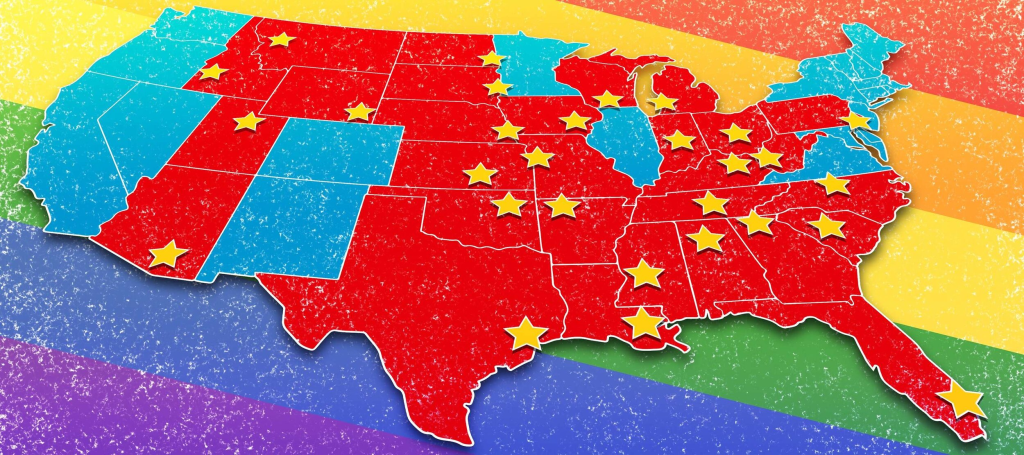
Blue Pockets in Red Places: The Top 10 LGBTQ+-Friendly Cities in Conservative States

When you think of the premier LGBTQ+ destinations in America, coastal giants like San Francisco and New York usually dominate the conversation. But a massive shift has been happening. Attracted by a lower cost of living, growing tech hubs, and a desire to build grassroots communities, LGBTQ+ Americans have been moving to traditionally conservative states in record numbers.

Living in a red state doesn’t mean you have to sacrifice a vibrant, welcoming queer community. In fact, some of the most resilient, tight-knit, and celebratory LGBTQ+ scenes in the country exist right in the heart of the American South, Midwest, and Mountain West.

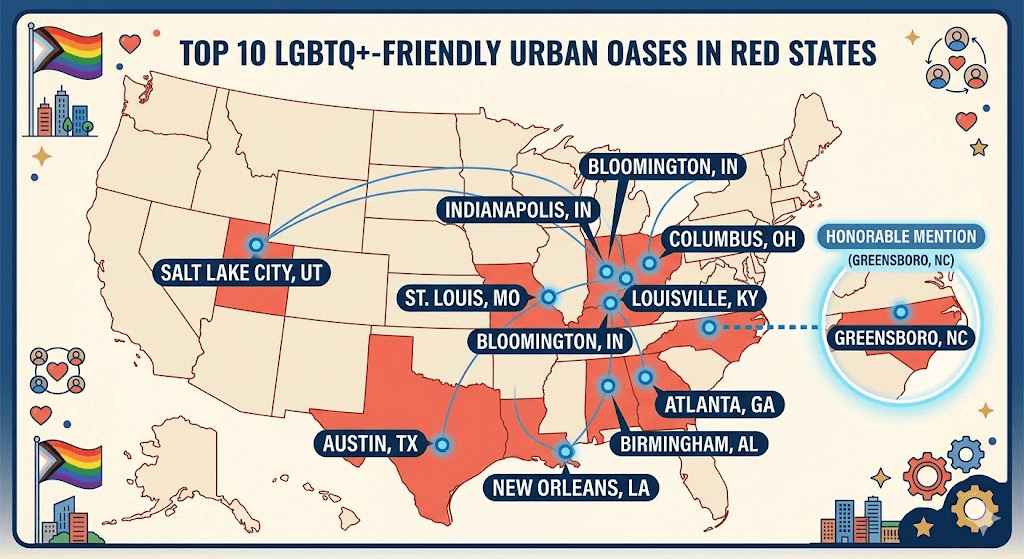
Here is a look at the top 10 LGBTQ+-friendly urban oases located in firmly red states.

1. Austin, Texas

Texas is a massive force in conservative politics, but its capital city operates on its own wavelength. Driven by the proud moniker “Keep Austin Weird,” Austin is a deeply progressive, diverse oasis. Nearly 6% of Austin’s population identifies as LGBTQ+, one of the highest concentrations in the country. The city features a dedicated LGBTQ Quality of Life Advisory Commission to advise local government, and the bars lining Fourth Street make the community highly visible and deeply woven into the city’s famous live-music fabric.

2. Salt Lake City, Utah

Perhaps the biggest surprise to outsiders is Salt Lake City. Despite being the global headquarters of the deeply conservative LDS (Mormon) Church, SLC has undergone a massive cultural transformation. It routinely ranks among the top ten cities in the nation for its percentage of LGBTQ+ residents, elected its first openly lesbian mayor back in 2015, and features the vibrant, inclusive Marmalade District as the historic epicenter of its queer culture.

3. St. Louis, Missouri

Missouri’s statewide political landscape tilts heavily conservative, but St. Louis stands out as a massive beacon for the LGBTQ+ community—especially for those looking for affordability. The city consistently scores a perfect 100 on the Human Rights Campaign’s Municipal Equality Index. Neighborhoods like The Grove feature miles of rainbow-painted crosswalks, queer-owned boutiques, lively nightlife, and active community centers.

4. Atlanta, Georgia

While Georgia has leaned “purple” in recent federal elections, its state legislature and rural areas remain firmly conservative. Atlanta, however, is frequently crowned the “LGBTQ+ Capital of the South.” It features an incredibly diverse, politically active queer population, anchored by a historic and massive Black queer community. The neighborhood of Midtown is the heart of the action, where rainbow flags fly year-round from restaurants, bars, and high-rises.

5. Louisville, Kentucky

Kentucky may be famous for coal and bluegrass, but Louisville is widely celebrated for its progressive, welcoming charm. Louisville has maintained a perfect 100 score on the Municipal Equality Index for years, thanks to local ordinances that protect LGBTQ+ residents in housing, employment, and public accommodations. The Highlands neighborhood is the city’s cultural heart, known for its eclectic, artsy vibe.

6. Columbus, Ohio

Ohio has solidified its status as a reliable red state in recent election cycles, but Columbus remains a booming, progressive powerhouse. Home to Ohio State University and a massive corporate tech presence, Columbus boasts one of the largest LGBTQ+ populations in the Midwest. The Short North Arts District is the epicenter of the community, packed with queer-owned galleries, bars, and businesses that make the city incredibly welcoming.

7. Indianapolis, Indiana

Indiana has a reputation for deeply conservative state politics, but its capital city is a distinct blue hub. Indianapolis has long held a perfect 100 on the Municipal Equality Index. The historic Mass Ave Arts District serves as the city’s progressive heartbeat, featuring a high concentration of inclusive theaters, bars, and restaurants. The city’s corporate pillars (like Eli Lilly and Salesforce) also actively champion local diversity initiatives.

8. New Orleans, Louisiana

Louisiana is culturally conservative, but New Orleans is a law unto itself. Long heralded as one of the most bohemian and accepting cities in the world, NOLA’s queer history runs deep. While the Faubourg Marigny neighborhood and the edge of the French Quarter host famous gay establishments, the entire city embraces an open, “live and let live” ethos. Events like Southern Decadence bring hundreds of thousands of queer travelers to the city every Labor Day weekend.

9. Bloomington, Indiana

While Indianapolis handles the big-city energy, Bloomington represents the classic, ultra-progressive college town oasis. Home to Indiana University, Bloomington punches way above its weight class for inclusivity. It features comprehensive local non-discrimination ordinances and a highly visible queer academic and local population. It consistently ranks as one of the most affordable and welcoming small cities for LGBTQ+ singles and families alike.

10. Birmingham, Alabama

Often a surprise addition for those unfamiliar with the modern deep South, Birmingham has built an incredibly resilient and active LGBTQ+ infrastructure despite a heavily conservative state environment. The city boasts a perfect 100 on the Municipal Equality Index and supports vital resources like the Magic City Acceptance Center, a sanctuary for queer and trans youth. The city’s progressive core ensures a vibrant local nightlife scene where community protection and grassroots activism go hand in hand.

The Takeaway: While statewide laws in red states can present hurdles, the local leadership, municipal protections, and fiercely supportive grassroots networks in these ten cities prove that you can find a safe, joyful, and thriving community just about anywhere in America.

Honorable Mention: Greensboro, North Carolina

While North Carolina frequently finds itself at the center of heated national political debates, Greensboro quietly serves as a masterclass in local progressivism and community building.

Greensboro has scored a perfect 100 on the Human Rights Campaign’s Municipal Equality Index for five consecutive years, consistently ranking as a top city for inclusivity in the state. Driven by a massive student population from local universities and an active grassroots network, the city boasts a thriving queer culture. Year-round events like Green Queen Bingo pack local venues, and institutions like Chemistry Nightclub and Twist Lounge anchor a welcoming nightlife scene. It’s a prime example of a mid-sized Southern city proving that inclusivity isn’t just a big-city trait.
Why leaving red states isn’t so simple for LGBTQ Americans

Read more at Axios.

LGBTQ Americans aren’t just fleeing red states for blue enclaves. They are also building lives in cheaper, fast-growing metros where jobs, housing and politics collide.

Why it matters: The “red-state exodus” narrative misses a quieter reality. Affordability and work are keeping some LGBTQ+ people in — and drawing others to — places that may be politically complicated but economically viable.

By the numbers: Homebuyers needed to earn $150,364 annually to afford the median-priced home in states with LGBTQ housing protections as of 2024, per an Axios analysis of real estate company Redfin data.

  • That’s 46.8% more income needed than in states without such protections.
  • LGBTQ Americans have lower homeownership rates and face higher rates of poverty and housing instability than non-LGBTQ Americans, according to the Williams Institute.
  • The LGBTQ homeownership rate trails the rate for straight and cisgender Americans by about 20 percentage points, according to the Urban Institute.

Zoom in: There is evidence of strong LGBTQ populations in the Southern metros that complicate the old “blue enclave” frame.

  • The Atlanta metro had an estimated 194,000 LGBT adults, or 4.6% of adults, according to the Williams Institute.
  • The Raleigh-Cary metro area in North Carolina had an estimated 32,000 LGBT adults, and the broader Triangle’s LGBTQ footprint includes Durham’s long-running Pride infrastructure and LGBTQ networks.
  • The Charlotte metro had an estimated 74,000 LGBTQ adults, or 4% of adults.

State of play: Advocacy groups warn that conservative-led statehouses are making some states riskier for LGBTQ people, especially transgender people, as the ACLU tracks more than 500 anti-LGBTQ bills in 2026.

  • Groups now maintain emergency relocation resources for LGBTQ families and transgender people affected by hostile state laws.
  • Blue states are often framed as safer legal destinations because they tend to have stronger nondiscrimination laws and protections for health care access — in addition to friendlier rules on identity documents.

Yes, but: Cities with stronger LGBTQ protections like San Francisco and Boston often come with significantly higher housing costs, creating a tension between safety and affordability.

What they’re saying: “LGBTQ people across the country, just like everyone else across the country, are thinking about economics and affordability every day,” Logan Casey, director of policy research for the advocacy group Movement Advancement Project, tells Axios.

  • Casey said many LGBTQ Americans are weighing wages, health care and proximity to family while also navigating state policies over safety and legal protections.
  • “The point is less about the outcome of whether you choose to move or not. It’s more about the fact that LGBTQ people are being forced to think about it in the first place.”

Caveat: There is still no definitive national dataset proving LGBTQ Americans are relocating en masse to cheaper red-state metros.

  • Researchers caution that LGBTQ migration data remains limited because federal surveys have historically failed to consistently collect sexual orientation and gender identity data.

Flashback: After the 1969 Stonewall uprising, LGBTQ migration became closely associated with urban enclaves, like New York’s Greenwich Village, San Francisco’s Castro District and parts of Los Angeles, Chicago and Houston.

  • Those neighborhoods offered safety, political organizing, nightlife and community at a time when LGBTQ Americans had few alternatives.
  • LGBTQ people always lived in every state, congressional district and rural county, but it defined the public imagination of where queer life happened.

The bottom line: The tension between affordability, opportunity and rights is quietly reshaping the map of LGBTQ America.

Japan to roll out nationwide LGBTQIA+ education for the first time

Read more at ABC.net .

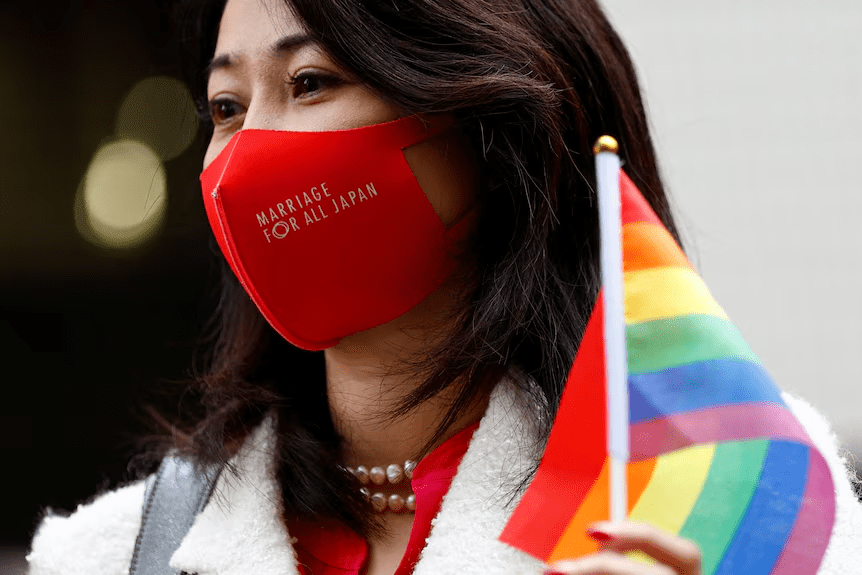
Japan is set to roll out nationwide LGBTQIA+ education for the first time in schools, workplaces, universities and homes.

Japanese media reports that the plan is designed to promote public understanding and awareness of gender and sexual diversity in the country, which has not legalised same-sex marriage.

The draft program reportedly notes that LGBTQIA+ people can “experience confusion, anxiety and difficulties in daily life due to insufficient public understanding.”

The scheme has been years in the making, with the Act on the Promotion of Public Understanding of the Diversity of Sexual Orientation and Gender Identity passed in 2023, requiring the creation of a plan.

The final plan is yet to be made public, with experts also awaiting more detail.

Reports suggest schools are set to provide information to students about sexually and gender-diverse people, while also ensuring that pupils have adequate access to social workers and counsellors.

Universities would revise curricula to ensure that people training to become healthcare professionals and teachers have in-depth knowledge of sexual diversity.

Videos, leaflets and training videos promoting awareness, diversity and academic research will be combined with stronger consultation schemes to measure the public’s understanding of sexual diversity.

Yearly reports on the program, public understanding and related policies will be introduced, with the overall scheme to be reviewed once every three years.

The plan was presented to and approved by the ruling Liberal Democratic Party (LDP) earlier this month, and is expected to be signed off by Prime Minister Takaichi Sanae’s cabinet soon.

‘Great initial step’

Alisha Khojanazar is a molecular neuroscience research technician at Okinawa Institute of Science and Technology and identifies as a “woman of transgender origin”.

She welcomed the education plan as a “great initial step”.

“I think it will help a lot, especially young adults and queer adolescents who are just discovering their identities or genders,”

she said.

“If it would lead to some kind of broader protection by law, that would be great. But with the current political climate in Japan, I would love it to be more inclusive.”

She told the ABC her university was very welcoming to the LGBTQIA+ community, with gender-neutral bathrooms and pride celebrations held regularly, but said the country had a long way to go.

“It’s very hard to meet someone who is open and queer and Japanese,” she said, adding many people in the country were reluctant to speak freely about their sexuality or gender.

Yui Oizumi, a student at Sophia University in Tokyo, identifies as queer.

She described the education plan as a “baby step” that would have some positive effects.

“Training teachers and employers to be mindful is good. But at the same time, I think it’s not really going to do much to change the perception of regular everyday people and how they think about queer people,” she said.

“I think that’s going to take more time and more conscious effort through media as well.”

She said outright homophobia was rare in Japan, but she constantly ran into people who did not understand that she was queer.

“That is such an alien concept that people are like, ‘What do you mean? That doesn’t make any sense.’ And that’s kind of where the struggle lies the most for me,” she said.

She added that friends of hers in a lesbian relationship had been denied rental properties because they were in a same-sex relationship, and believed an anti-discrimination law would better protect the community.

Gay rights in Japan

There are no national laws outlawing discrimination against gay people in Japan, but some local government areas and labour laws offer some protections.

Japan is the only member of the G7 to not legalise gay marriage.

The Japanese government also does not recognise the marriages of same-sex couples if they were legally married in other countries.

Kazuyoshi Kawasaka, an expert in LGBTQIA+ rights in Japan at The University of Tokyo, said the government had decided against anti-discrimination laws to appease conservative factions of the LDP.

Ms Takaichi opposes same-sex marriage, despite previously saying that “there should be no prejudice against sexual orientation or gender identity”.

“The LDP is very conservative, especially for promoting traditional family values. So that is very tricky for the LGBTQ activists in Japan,” Dr Kawasaka said.

“I think that a bigger [anti-discrimination law] protection is much more effective, actually,” he said.

Political scientist at Monash University Charles Crabtree said education was a good starting point.

“Misinformation or a cloudy sense of ‘the other’, whatever that ‘other’ is, impedes individuals’ ability to empathise with those who are different from them,” Dr Crabtree said.

“Education can have an effect, but it depends on what that content is and how much it foregrounds lived experiences, and potentially even highlights the experiences of discrimination that people within this community have felt.”

He described the issue of same-sex marriage in Japan as “rather dire” but said opposition to legalising it was possibly not as strong as it seemed.

In 2024, Dr Crabtree published a public opinion survey of people in Japan as part of the Stanford Japan Barometer, which is believed to be the largest semi-regular opinion poll published of the Japanese public.

Of the 8,000 respondents, 47 per cent were in favour of legalising gay marriage, with 16 per cent opposed and 37 per cent neutral on it.

“It’s hard to characterise exactly what that 37 per cent means, but it suggests to us that there are people who may be potentially malleable in terms of their views,” Dr Crabtree said.

“On the whole, we found this to be a much more rosy picture than what we had seen from other survey data.

“Education efforts might help nudge neutrals to more positive levels of support, which all might matter because higher levels of public support might encourage more dramatic and meaningful government action.”

He said the data found younger people were much more in favour of same-sex marriage than older people in Japan.

Ms Takaichi also received a lot of support from young people, he added, something that could have spurred on the draft education plan.

In November last year Tokyo High Court ruled in favour of Japan’s same-sex marriage ban, saying it did not violate key elements of the country’s constitution.

However the judge noted that “it is inevitable that constitutional violations will arise” and that “the issue should first be thoroughly deliberated in the Diet [Japan’s national parliament].”

It was the final ruling of six court cases across the country, with the issue now awaiting a Supreme Court ruling.

Some 36,000 signatures were submitted to Japan’s top court last week in support of legalising same-sex marriage.

About 15,000 people also braved the rain to march through Tokyo’s streets as part of annual pride celebrations.

Idaho police say alleged antigay beating can’t be charged as a hate crime

Read more at the Advocate.

An Idaho man was arrested for allegedly assaulting a gay couple outside a restaurant. But despite allegations that Pedro Villareal hurled antigay slurs before beating two men, authorities charged him only with a misdemeanor and said the state’s hate crime law doesn’t apply.

Caldwell Police say Villareal and other men started shouting slurs at Eric Reed and Juan Olvera outside Acapulco, a restaurant in town, and then chased them from a plaza to nearby railroad tracks, according to Boise TV station KTVB. There, the victims told police, Villareal allegedly began assaulting them. The attack left Reed’s lip split and required six stitches.

Reed and Olvera later sat down with the TV station, where Reed described the fear he experienced during the attack. “I literally felt they were going to kill us for being gay,” Olvera said. “It’s a scary thing to live through, and I never would wish this on anyone.”

But police said Villareal won’t face hate crime charges, even though law enforcement officials said they would like to pursue them. That’s because Idaho state law doesn’t cover crimes based on sexual orientation or gender identity as acts of hate.

“We’re here to serve the citizens of Caldwell and Idaho, and unfortunately, when we’re unable to give them the justice that they feel that they need, under the application of the law, it is frustrating,” Lt. Jeffrey Peterson, a spokesperson for Caldwell Police, told the news outlet.

That’s not the first time the limitation in Idaho’s state law has prevented prosecutors from pursuing hate crime allegations.

Related: Idaho Senate Republicans send extreme anti-transgender bathroom bill with felony penalties to governor

Matthew Alan Lehigh was arrested by Boise Police in 2023 and charged with aggravated assault, malicious injury to property, and arson after a string of crimes that included allegedly trying to drive a car into a gay couple after vandalizing an LGBTQ+ center and a Pride flag at the couple’s home. It wasn’t until federal prosecutors stepped in, however, that Lehigh faced any hate crime charges despite clear evidence of anti-LGBTQ+ motivation.

But despite individuals being victimized based on gender identity and sexual orientation, Idaho’s hate crime statute covers only harassment and targeting of victims based on “race, color, religion, ancestry, or national origin.”

Civil rights groups, including the ACLU of Idaho, have campaigned for years to “add the words” and update the state’s hate crime and non-discrimination laws.

Wanna pee in Idaho? First, get a forced DNA test to prove your gender, state GOP lawyer suggests

Read more at LGBTQ Nation.

A recent court hearing on a lawsuit brought by six transgender Idahoans against the state’s latest bathroom bill has revealed just how unworkable the draconian new law would be. In fact, to enforce it, an attorney for the red state said restroom users might need to undergo forced DNA testing.

House Bill 752, which passed the Legislature this year with only Republican votes, prohibits trans people from using public restrooms that match their gender identity, both in government-owned buildings and private businesses that serve the public.

The law is set to take effect July 1.

The suit says the Idaho law — one of three recently passed by Republican legislatures that impose criminal penalties on offenders — violates the plaintiffs’ constitutional rights to due process, equal protection, and privacy. The challenge was brought by the American Civil Liberties Union (ACLU), the ACLU of Idaho, and Lambda Legal.

At the hearing, the judge in the case — Chief U.S. District Judge for the District of Idaho, Amanda K. Brailsford — questioned the state over how exactly they would determine the sex at birth of an individual accused of violating the law, The Idaho Capital Sun reports.

Kell Olson, a trans attorney for Lambda Legal, told the judge that if police confronted him and asked for his ID, officers would find that his ID lists him as male. Brailsford noted, for the record, that most of the plaintiffs suing the state also have state-issued IDs with gender markers that are aligned with their gender identity. 

Idaho Solicitor General Michael Zarian suggested the solution was simple: “There is DNA testing.”

Pressed on whether DNA testing required consent, Zarian hedged, saying that wasn’t necessarily the case and that he doubted the accused would be asked to undergo DNA testing on the spot.

Lambda’s Olson told the court that DNA testing usually requires a warrant. 

Both the Idaho Sheriffs’ Association and the Idaho Fraternal Order of Police called the proposed law impractical and unworkable.

There is no “clear or reasonable way” to determine a person’s sex at birth during a field contact without engaging in “invasive and inappropriate” questioning or searches, said one police group president.

Following the hearing, ACLU of Idaho attorney Emily Croston said the state didn’t help itself on the issue of enforcement.

“I don’t think the state has an answer for how you identify someone’s biological sex,” Croston told reporters. “Are we just going to look at folks as they enter a restroom and determine whether we think they look enough like a man or a woman? That’s ridiculous.”

The hearing only reinforced the plaintiffs’ argument that the law is unconstitutionally vague, and police organizations’ earlier doubts that it’s practically unenforceable.

Proving the former claim, Solicitor General Zarian tried using an exemption in the law to demonstrate how reasonable the ban is. The law allows individuals to use restrooms that don’t align with their sex if they are in “dire need” of going to the bathroom, he pointed out.

Pressed by Judge Brailsford, Zarian acknowledged that it “might be difficult to prove someone had a dire need,” but that vagueness, he claimed, doesn’t mean that the law itself is unconstitutionally vague.

Idaho law enforcement didn’t have to similarly tie themselves in knots when they formally opposed the ban during debate in the Legislature earlier this year. Both the Idaho Sheriffs’ Association and the Idaho Fraternal Order of Police called the proposed law impractical and unworkable.

There is no “clear or reasonable way” to determine a person’s sex at birth during a field contact without engaging in “invasive and inappropriate” questioning or searches, said one police group president.

The ACLU notes that analyses of public safety data have found policies inclusive of transgender people’s access to public accommodations have no impact on rates of harassment or violence, while policies that restrict access actually increase the risk of harassment and violence. Trans people are four times as likely as their cisgender peers to be the victims of violence.

Nine bathroom bans have passed by red state legislatures in recent years, but Idaho’s is the only one to cover private businesses as well as government buildings. A first offense is a misdemeanor, with up to one year in prison; a second offense jumps to a felony, with up to five years in prison.

A fourth violation would constitute a third felony conviction, punishable under Idaho’s persistent violator statute by a mandatory minimum of five years and up to life in prison. 

Homosexuality is now illegal in 66 nations

Read more at Erasing 76 Crimes.

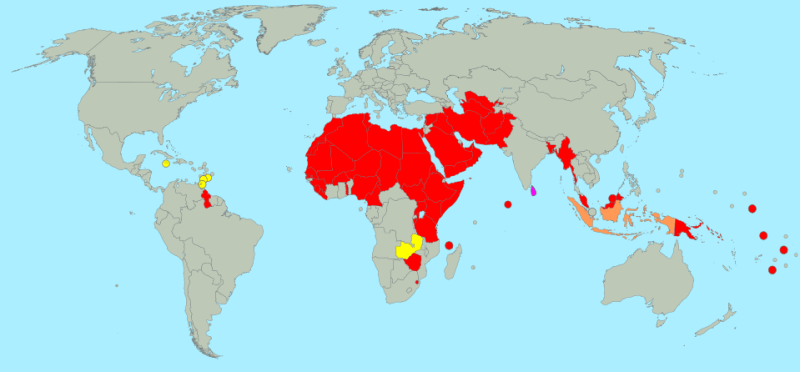
In adopting an anti-gay law on June 11, 2026, the West African nation of Niger strengthened a wave of anti-homosexuality legislation and proposed legislation in Africa that has reversed, at least temporarily, the slow decrease in the number of nations with anti-gay laws.

Previously, its neighbors Burkina Faso and Mali criminalized homosexuality in 2025. Together with a March 2025 decision by the Trinidad and Tobago Court of Appeal to reinstate that country’s laws against homosexuality, these countries have turned back a wave a progress on decriminalization.

Niger’s new anti-LGBTQ law comes in the wake of Senegal’s enactment of a law in March that provides for up to 10 years in prison for gay sex and the Ghana parliament’s approval of a bill last month that, if approved by Ghana’s president, would imprison people for up to three years if they “identify” as LGBTQ.

Before those reversals, the number of nations with laws against gay sex had fallen to 63 from more than 90 at the beginning of the 2000s. The latest countries to end the criminalization of same-sex intimacy are St. Lucia in 2025; Namibia, Niue, and Dominica in 2024; Mauritius and the Cook Islands in 2023; and Singapore, Antigua & Barbuda, Saint Kitts & Nevis, and Barbados in 2022.

For more information, see the Erasing 76 Crimes page “List of 66 countries where homosexuality is illegal.” There you will find:

  • A full list of nations with anti-homosexuality laws.
  • Recent history of many nations repealing or overturning those laws and a few nations newly adopting them.
  • A comparison of this site’s list with the similar list compiled by ILGA, the International Lesbian, Gay, Bisexual, Trans and Intersex Association.

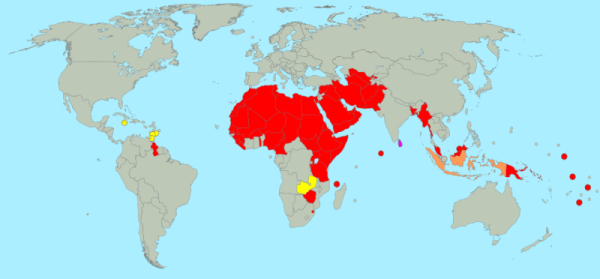
Map of the 66 countries where sexual relations between people of the same sex are illegal. YELLOW countries have sodomy laws that are currently being challenged before local courts. Sri Lanka, in PINK, currently has a bill before its parliament to repeal its sodomy law. Indonesia, in ORANGE, has laws that criminalize homosexuality only in some subnational jurisdictions. All states in RED have nationwide sodomy laws and no known legislative efforts or court challenges to remove them. 

Hundreds march in Kathmandu for Nepal’s Pride Month

Read more at AP News.

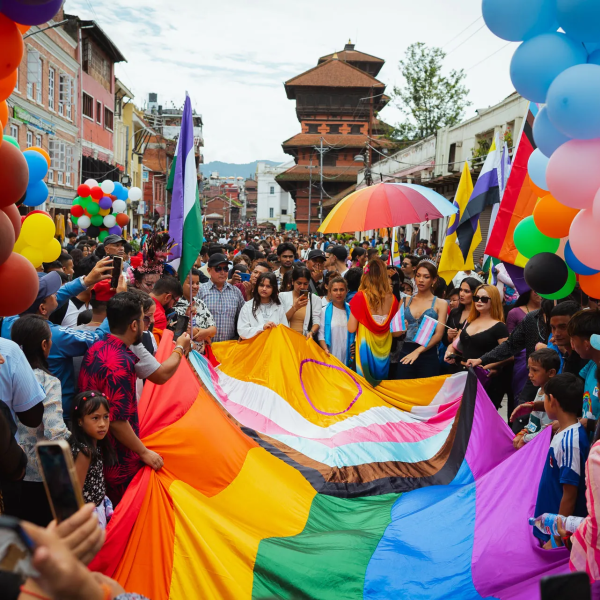
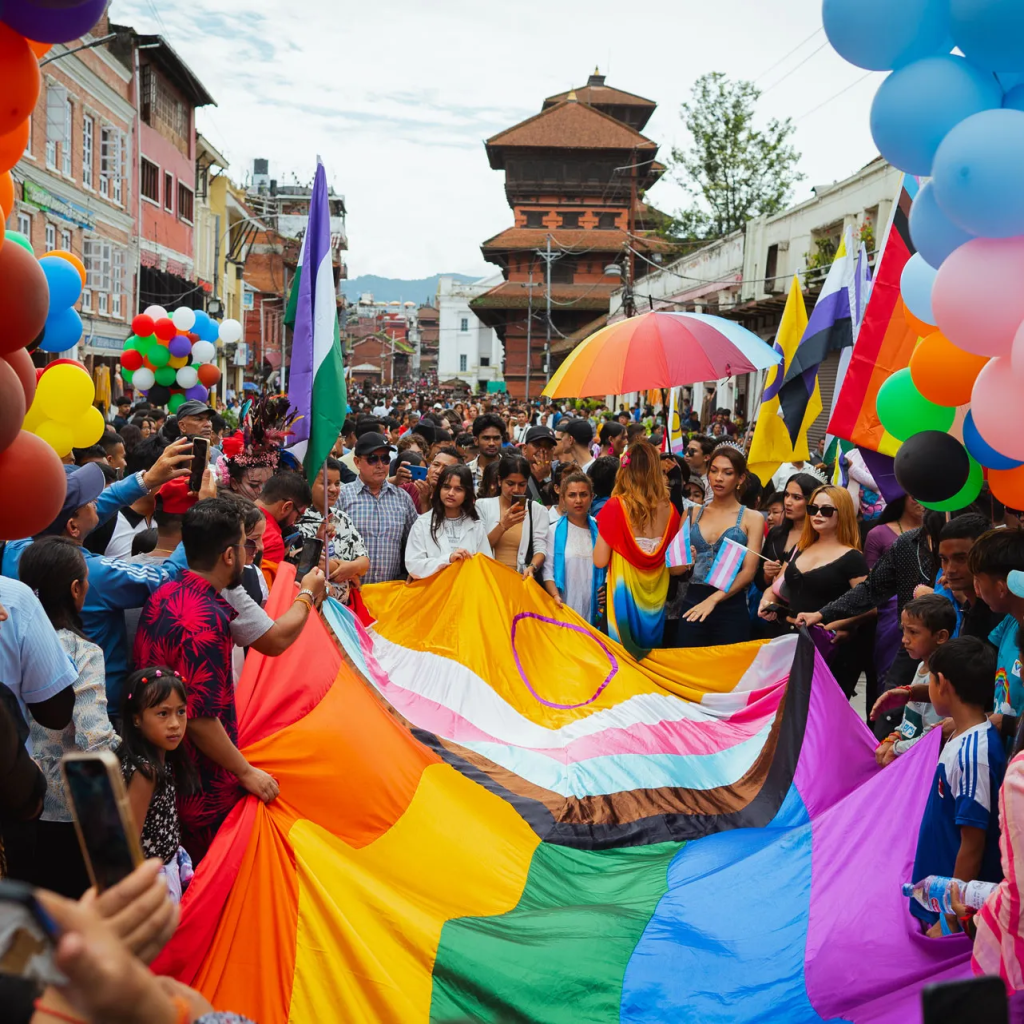
Hundreds of members of Nepal’s LGBTQ+ community and their supporters took to the streets of Kathmandu on Saturday to celebrate Pride Month.

Nepal has a growing LTGTQ+ community and has made significant gains for the rights of sexual minorities in the past few years.

The government elected in March under Prime Minister Balendra Shah has formed the Ministry of Women, Children, Gender and Sexual Minorities and Social Security, the first time a department has been dedicated to deal with the issues of women and sexual minorities.

Nepal became one of the first in Asia to allow same-sex marriage. The 2015 constitution explicitly states there can be no discrimination on the basis of sexual orientation.

A 2007 court decision required the government to make changes in favor of LGBTQ+ people. People who do not identify as female or male are now able to choose “third gender” on their passports and other government documents.

From Pride to prison: Ranking all 48 World Cup countries on LGBTQ rights

Read more on Outsports.

On June 22 at MetLife Stadium in New Jersey, Norway will play Senegal in World Cup group play. The match will pit the country ranked No. 2 in the world for gay rights against one ranked No. 192, a place where same-sex activity can land you in prison for 10 years.

A similar dynamic will occur June 15 in Los Angeles, when New Zealand (No. 6 best for LGBTQ equality) plays Iran (No. 191), a nation where LGBTQ people face capital punishment.

Welcome to the 2026 World Cup, which features 48 countries from every continent save for Antarctica, making it a true global reflection, including support for LGBTQ rights.

Some of the 48 World Cup countries are very gay-friendly, with robust laws and protections, while some are in-between. And nearly a third are downright hostile, with LGBTQ protections nonexistent and punishment for same-sex behavior a prison sentence (or worse).

The website Equaldex is a valuable resource for a country-by-country look at the state of LGBTQ equality.

It uses a 100-point scale to rank countries on the laws surrounding whether homosexuality is legal, and laws on same-sex marriage, censorship, changing gender, gender-affirming care, employment and housing discrimination, adoption, serving in the military and conversion therapy. It also parses public opinion on LGBTQ issues.

Using the site’s 100-point scale, World Cup countries Norway, Uruguay, Spain and New Zealand all rank in the top six in the world. Iceland (1st) and Denmark (5th) did not qualify.

At the opposite end, Iran (ranked 191) and Senegal (192) are among the seven least LGBTQ-accepting countries in the world. Overall, there isn’t much difference in countries ranked 10-20 points from each other.

We broke down the 48 countries into three groups, using Equaldex rankings. Human Rights Watch has similar rankings if you want to dive deeper. We have a group-by-group breakdown below, with the ranking for all 48 countries.

We love the gays (27 countries)

In these countries, LGBTQ rights are generally robust, with variations depending on the category. In the U.S., for example, a push against trans rights has been acute at the federal level and in many states, pushing its ranking down.

Norway (ranked 2 on Equaldex equality index), Uruguay (3), Spain (4), New Zealand (6), Germany (9), Canada (11), Australia (12), Belgium (13), Portugal (14), Netherlands (17), Sweden (18),  Brazil (19), France (20), Argentina (21), Austria (22), Czechia (23), Colombia (24), Mexico (25), Switzerland (26), UK (31, Scotland and England), USA (32), Cape Verde (33), South Africa (35), Ecuador (39), Croatia (48) and Curacao (not ranked, but same-sex marriage legal and subject to Dutch law). Note: Same-sex marriage is banned in Cape Verde but LGBTQ rights are otherwise respected and the island nation is considered an “LGBTQ oasis” in Africa.

Don’t ask, don‘t tell (6 countries)

This list reflects six countries that are ambivalent about LGBTQ rights, where homosexuality is legal but same-sex marriage is banned, or in Asian countries where there are still social stigmas.

Japan (ranked 57), Bosnia and Herzegovina (66), South Korea (81), Panama (96), Paraguay (106), Turkey (113).

We hate the gays (15 countries)

These 15 countries are simply awful for LGBTQ rights, where it can be dangerous to show same-sex affection. This guide is another resource for LGBTQ travelers, especially places to avoid.

Haiti (ranked 124), Ivory Coast (128), Congo DR (144), Uzbekistan  (146), Ghana (157), Tunisia (160), Saudi Arabia (165), Algeria (166), Morocco (167), Iraq (168), Jordan (173) Egypt (176), Qatar (184), Iran (191), Senegal (192 out of 197 countries).

RANKINGS BY GROUP

Group A: Mexico, South Africa, South Korea, Czechia

Mexico (Equaldex score and rank): 71 out of 100. Ranked 25th worldwide. Same-sex marriage legal.

South Africa: 67 out of 100. Ranked 35. Same-sex marriage legal.

South Korea: 46 out of 100. Ranked 81. Same-sex marriage in South Korea is unregistered cohabitation.

Czechia: 72 out of 100. Ranked 23. Same-sex marriage in Czechia is civil unions (marriage rights).

Group B: Canada, Bosnia and Herzegovina, Qatar, Switzerland

Canada: 78 out of 100. Ranked 3. Same-sex marriage legal.

Bosnia and Herzegovina: 59 out of 100. No ranking listed. Same-sex marriage in Federation of Bosnia and Herzegovina is banned.

Qatar:  8 out of 100. Ranked 184. Homosexuality is illegal and the punishment is imprisonment.  From Equaldex: “LGBTQ+ individuals face harassment, discrimination, and violence in Qatar, and are not allowed to engage in same-sex sexual activity.”

Switzerland: 70 out of 100. Ranked 26. Same-sex marriage legal.

Group C: Brazil, Morocco, Haiti, Scotland

Brazil: 75 out of 100. Ranked 19. Same-sex marriage legal.

Morocco: 13 out of 100. Ranked 167. Same-sex behavior is punished by imprisonment of between six months and three years, and a fine.

Haiti: 28 out 100. Ranked 124. Same sex marriage is not legal.

Scotland (part of the UK). 68 out of 100. Ranked 31. Same-sex marriage legal.

Group D: USA, Paraguay, Australia, Turkey

USA: 68 out of 100. Ranked 32. Same-sex marriage legal.

Paraguay: 34 out of 100. Ranked 106. Same-sex marriage is banned.

Australia: 78 out of 100. Ranked 12. Same-sex marriage is legal.

Turkey: 32 out of 100. Ranked 113. Same-sex marriage is  banned.

Group E: Germany, Curacao, Ivory Coast, Ecuador

Germany: 80 out of 100. Ranked 9. Same-sex marriage is legal.

Curacao: 74 out of 100. No rank listed. Same-sex marriage is legal. Curacao is a constituent island country within the Kingdom of the Netherlands.

Ivory Coast: 23 out of 100. Ranked 128. Same-sex marriage is banned.

Ecuador: 65 out of 100. Ranked 39. Same-sex marriage is legal.

Group F: Netherlands, Japan, Sweden, Tunisia

Netherlands: 76 out of 100. Ranked 17. Same-sex marriage is legal.

Japan: 53 out of 100. Ranked 57. Same-sex marriage in Japan is unregistered cohabitation.

Sweden: 75 out of 100. Ranked 18. Same-sex marriage is legal.

Tunisia: 14 out of 100. Ranked 160. Homosexuality is punished with imprisonment for three years.

Group G: Belgium, Egypt, Iran, New Zealand

Belgium: 78 out of 100. Ranked 13. Same-sex marriage is legal.

Egypt: 10 out of 100. Ranked 176. Homosexual activity in Egypt is illegal with prison terms of three months to 10 years.

Iran: 5 out of 100. Ranked 191. From Equaldex: The punishment for homosexuality is currently death for men. For women, the punishment is up to 100 lashes. Women with a certain number of repeat offenses can become subject to the death penalty as well.

New Zealand: 81 out of 100. Ranked 6. Same-sex marriage is legal.

Group H: Spain, Cape Verde, Saudi Arabia, Uruguay

Spain: 83 out of 100. Ranked 4. Same-sex marriage is legal.

Cape Verde: 68 out of 100. Ranked 33. Homosexuality is legal but same-sex marriage is banned.

Saudi Arabia: 13 out of 100. Ranked 165. From Equaldex: The full extent of Saudi Arabian law is unclear as a result but it is commonly interpreted to punish homosexuality with death as a result of all sexual activity outside of marriage being punishable by death and the lack of recognition of same-sex marriage.

Uruguay: 87 out of 100. Ranked 3. Same-sex marriage is legal.

Group I: France, Senegal, Iraq, Norway

France: 74 out of 100. Ranked 20. Same-sex marriage is legal.

Senegal: 4 out of 100. Ranked 192. Homosexuality is illegal with prison terms up to 10 years.

Iraq: 13 out of 100. Ranked 168. In 2024, Iraq’s parliament passed a law that criminalizes same-sex relationships with a maximum 15-year prison sentence.

Norway: 88 out of 100. Ranked 2. Norway gets the highest LGBTQ equality score out of the 48 World Cup teams (Iceland is No. 1 overall in the world).

Group J: Argentina, Algeria, Austria, Jordan

Argentina: 74 out of 100. Ranked 21. Same-sex marriage is legal.

Algeria: 13 out of 100. Ranked 166. Same-sex activity is illegal with prison terms of two months to two years.

Austria: 73 out of 100. Ranked 22. Same-sex marriage is legal.

Jordan: 17 out of 100. Ranked 173.  From Equadex: Homosexual activity has been legal in Jordan since 1951, however, the Penal Code includes vague provisions around “morality” and “indecent acts” that could be used to target LGBTQ+ people.

Group K: Portugal, Congo DR, Uzbekistan, Colombia

Portugal: 77 out of 100. Ranked 14. Same-sex marriage is legal.

Congo DR:  21 out of 100. Ranked 144. Same-sex marriage is illegal.

Uzbekistan: 20 out of 100. Ranked 146. From Equadex:  Article 120 of the penal code states male homosexuality is punishable by 3 years in prison. Female homosexuality is not illegal, but lesbians still face heavy social persecution.

Colombia: 71 out of 100. Ranked 24. Same-sex marriage is legal.

Group L: England, Croatia, Ghana, Panama

England (part of the UK): 80 of 100. UK ranked 31; England highest ranked in UK. Same-sex marriage is legal.

Croatia: 57 out of 100. Ranked 48. Civil unions have same rights as marriage.

Ghana: 15 out of 100. Ranked 157. Homosexual activity in Ghana is male illegal (up to three years in prison), female legal.

Panama: 39 out 100. Ranked 96. Homosexuality is legal, same-sex marriage is banned.

The Global Spectrum of Equality: Ranking LGBTQ+ Rights Among World Cup Group D– USA, Australia, Paraguay, & Turkey

When we travel the world or study global culture, it becomes quickly apparent that human rights are anything but uniform. The legal and social realities for the LGBTQ+ community vary dramatically depending on the borders you cross.

To understand this spectrum, we are looking at four vastly different nations who happened to be grouped together to play in the opening round of the FIFA World Cup: Australia, the United States, Paraguay, and Turkey. Utilizing data from global trackers like Equaldex, here is how these nations stack up regarding legal rights and cultural openness.

1. Australia: Leading the Pack 🇦🇺

Equaldex Score: 78/100

  • The Reality: Australia sits firmly among the most progressive nations in the world for LGBTQ+ individuals. Since overwhelmingly passing marriage equality via a historic public postal survey in 2017, the country has continued to strengthen its framework. Same-sex couples enjoy full adoption rights, and discrimination based on sexual orientation or gender identity is strictly illegal nationwide. Culturally, Australia is highly vibrant and open, home to world-renowned celebrations like the Sydney Gay and Lesbian Mardi Gras.

2. The United States: Progress Amid Polarization 🇺🇸

Equaldex Score: 68/100

  • The Reality: The U.S. features a strong federal foundation, highlighted by the nationwide legalization of same-sex marriage in 2015 and federal workplace protections. However, its lower score compared to Australia reflects its highly fragmented legal landscape. Because so many laws are handled at the state level, an LGBTQ+ individual’s daily experience changes dramatically depending on where they live. While major metro areas and progressive states offer world-class openness, conservative regions have seen an influx of restrictive legislation, particularly targeting gender-affirming care and transgender youth.

3. Paraguay: The Conservative Constitutional Exception 🇵🇾

Equaldex Score: 34/100

  • The Reality: While its neighbors like Argentina and Brazil have become beacons of LGBTQ+ progress in South America, Paraguay remains stuck in a deeply traditional past. Homosexuality is legal, but that is essentially where the rights end. The country’s constitution explicitly bars same-sex marriage, there are zero national anti-discrimination protections, and the government actively enforces a ban on discussing LGBTQ+ or “gender ideology” topics in public schools. Public openness is minimal, and discretion is highly advised for travelers.

4. Turkey: Growing Political and Social Hostility 🇹🇷

Equaldex Score: 32/100

  • The Reality: Turkey technically legalized same-sex activity all the way back in 1858, making it legal on paper longer than many Western nations. However, legal status has not translated into safety or acceptance. There are no civil unions, no protections against hate crimes, and the current political landscape has grown increasingly hostile. The government frequently uses anti-LGBTQ+ rhetoric, and major events like Istanbul Pride have been systematically banned and met with police intervention for years. While urban hot spots like parts of Istanbul maintain a resilient underground community, the general climate remains a steep uphill battle.

The Takeaway

This ranking highlights that global equality is not a straight line of steady progress. While Australia and the U.S. represent environments where the community is woven into the legal and cultural fabric, countries like Paraguay and Turkey remind us of the immense legal barriers and social pushback millions still face daily.

The red state, blue state divide is real. But it’s driven by more than just politics

*Read more at NPR. Flee Red States is featured in this article.

Three years ago, Jessa Davis had an epiphany: After she came out as a trans woman, remaining in deep-red Texas felt untenable. So, she sold her house in Odessa and moved to the liberal bastion of Seattle, Wash.

Davis describes herself as a trans refugee. Back in Texas, she says, lived in a “pretty hostile and frankly dangerous” place. “I had a lot of close calls, a lot of threats.”

Davis volunteered with organizations advocating for trans and queer rights in Odessa and remembers thinking, “I’ve got one life and I don’t want to spend the next 20 years of [it] fighting a battle that I’m not sure we’re going to win in a place like Texas.”

Her fight for LGBTQ rights continues, but it feels more manageable in a city she views as welcoming and supportive. After arriving, Davis quickly became active in local issues and now serves as co-chair on a commission advising the city on LGBTQ issues. She and other commissioners have urged Seattle to declare a state of emergency to provide more resources for the growing number of people relocating there to escape anti-LGBTQ laws and hostile social climates elsewhere in the country.

Davis’ case reflects what sociologists call “ideological sorting” — the tendency to choose communities aligned with one’s political and cultural values. Popularized in the 2008 book The Big Sort, it sets out to explain the widening divide between red and blue America.

In a country that’s growing ever-more polarized, the shifting demographics cut in both directions — and it is happening across the country. In one study from 2022, researchers concluded that “at no point since the Civil War have partisans been as clustered within individual states as today.”

Research in recent years, however, suggests that the story is more complex and nuanced — and that simply seeking out like-minded neighbors is more often than not just one factor among several driving the shift.

From blue state to red

As Davis and others arrive in Seattle seeking refuge from hostile laws and rhetoric, some of Seattle’s longtime residents, like Kirby Wilbur, have moved out, fleeing to conservative enclaves.

Wilbur also describes himself as a “refugee.” He relates an experience that is a virtual mirror image of Davis’. In Seattle, the local conservative talk show host — who also briefly served as Washington state Republican chair — felt like a stranger in a strange land.

As he neared retirement, he and his wife Trina began thinking about an escape plan. A friend told them about McKinney, Texas, a conservative Dallas-Fort Worth suburb. Wilbur had never heard of McKinney, but decided to have a look.

“There were like 3,000 square foot homes with a pool for $300,000,” he says.

In Texas, Wilbur met with Paul Chabot in 2020, who runs a specialty realty service, Conservative Move. Started in 2017, the company has helped thousands of people relocate from blue states to red states, Chabot says.

But the Wilburs still weren’t ready. Then came the 2020 George Floyd protests in Seattle. Kirby Wilbur says after the mobs, looting and vandalism, he and Trina had their own epiphany. “We looked at each other and said, ‘No, we can’t live this way. This is it.'”

Chabot, a retired U.S. Navy commander, says Wilbur — who has since become a part-time realtor with Conservative Move — is like most of his clients, who “feel like they can’t talk politics with people on their street.”

Conservative Move assists a lot of families with children who say they want a better quality of life for their kids — things like lower crime, stronger schools and lower taxes, according to Chabot. They also want to be somewhere they don’t feel judged for their political beliefs, he says.

“It’s not like people are leaving just because they hate Democrats. They don’t like Democrat policies, but they really feel like they’re alone, alienated, ostracized,” he says.

Chabot’s counterpart on the left is Bob McCranie. In 2020, McCranie started a web page called Flee Texas. “Very quickly… it got overwhelmed by people from all sorts of other places saying, ‘Oh my gosh, talk to me,'” he says.

As a result, he broadened the reach a few years later, launching Flee Red States. Since then, he says he has 40 closings related to the project and more than 875 people on a mailing list. He says he’s even helped people move out of the country.

McCranie says for some of his clients, the stakes are much higher than simply whether they can have a political conversation over the back fence. “People are moving because they don’t feel safe in their own state, in their own country,” he says.

For instance, some conservative groups are trying to overturn Obergefell v. Hodges, the U.S. Supreme Court’s landmark 2015 ruling that established same-sex marriage as a constitutional right. McCranie says some of his clients are wondering, “Where would we be safe as a couple and as a family?”

U.S. Census Bureau data for 2024 indicates that almost exactly as many people moved from Texas to Washington as went the other direction. However, a nationwide Stateline analysis paints a more one-sided picture. Republican counties, defined by the 2020 presidential election vote, gained 3.7 million people from mid-2020 to mid-2023, while blue counties lost the same amount — a time period that encompasses pandemic dislocations and lockdowns and the rise of remote work, Stateline notes.

But those broad trends can belie individual experiences. Rachelle Vega, interviewed last year by NPR, moved from Austin — widely considered the most progressive city in Texas — to Santa Fe, N.M., which has some of the country’s strongest LGBTQ protections. Vega wanted a more welcoming environment for her two adult trans children. In her new home, “There’s this sense of live and let live that is pervasive,” she told NPR.

This political sorting is not only occurring from state to state, but on a city, county and neighborhood level, according to Bruce Desmarais, a professor of political science and social data analytics at Penn State University. In a 2019 study, Desmarais and colleagues found that “people tend to be moving from one very sort of left-leaning city to the next” — like Vega — and the same is true, Desmarais says, for people moving from one right-leaning area to another.

Ticking the boxes beyond party affiliation

Take Stefanie Chiappetta’s experience. Four years ago, she and her husband, Samuel, moved from Middleborough, Mass., to Conway, S.C., and politics were the main reason.

In solidly blue Massachusetts, the town of Middleborough is an exception. It went for President Trump over Vice President Kamala Harris by a comfortable margin in 2024.

Chiappetta says “more conservative” was “box one” on her list when looking for a fresh start after retirement. Second was taxes. She and her husband had been paying nearly $7,000 a year in property taxes in Massachusetts, but in Conway, it’s a fraction of that, she says. The last important item was the weather. Chiappetta says she and her husband both have back issues. The cold weather “was making us more miserable,” she says.

Although Chiappetta puts politics at the forefront, her weighting of other factors illustrates a key caveat, says Steven Webster, an associate professor of political science at Indiana University.

“Americans do have a preference for living near co-partisans,” Webster, who has also researched ideological sorting, says. However, “things like the affordability of homes [and] living in a good school district far outweigh any explicit partisan-based motivation for choosing one location over another.”

The neighbor agreeing with you about President Trump is “the cherry on top,” he says.

Just as Chiappetta gravitated to a lower-tax city and state — which often tend to be conservative — “a Democrat might move to an area with good access to public transportation,” Webster says.

“While desiring access to public transportation may correlate with being a Democrat, one’s decision to move to that area is based [on] that desire rather than being with other Democrats,” he says.

“Places shape people more than people sort into places,” he concludes.

Political birds of a feather

Some researchers put more weight on party realignment — a long-term shift in the political landscape caused by voters changing their allegiances – than voter migration to explain the biggest share of the ideological sorting.

“Southern whites converted Republican, suburbs of major cities converted Democratic, and the political map redrew itself without most people moving,” notes Josh Zhang, an assistant professor of sociology at Stony Brook University.

In 2023, Zhang and colleagues published a study that looked at ideological sorting on a granular level. Using anonymized cell-phone data and other real-time information, they found that “people in heavily Democratic or Republican neighborhoods tend to visit places — religious institutions, schools, restaurants — whose other visitors lean the same way.”

James Henson, director of the Texas Politics Project at the University of Texas at Austin, points out that while the general trend is understood, “geographic sorting is rarely, if ever, going to be absolute. Despite aggregate sorting, there are always going to be individual exceptions in a given area.”

Despite Wilbur’s decision to move to be closer to fellow conservatives, he readily acknowledges that such ideological sorting is a negative for the country as a whole. “Nobody talks to each other anymore,” he says. The divisions in our political discourse have increasingly led to physical division, he says.

Davis is also concerned about “isolating ourselves in bubbles” and recalls the rare occasions when she was able to break through to someone in Odessa. She argues that physical sorting reduces those opportunities for connection.

“That’s the importance of being able to sit down with someone, share a beer in a dive bar in West Texas, and have a conversation about why I’m leaving — what’s happening, and why I feel I have to go.”

Blog at WordPress.com.

Up ↑