Since Trump took office last year, traveling as a trans person has felt terrifying.
I used to travel by plane frequently. As a consultant, I was in a new state at least quarterly for client visits and onsite training. But last year, things changed for me, as they did for many others.
When I changed my name (over 10 years ago), I did not change my gender marker. The name on my ID is “Rex” while my gender marker shows “F”. The reasoning on my name change petition marks “the petitioner seeks to conform their name to their gender identity.”
I’ve heard stories from friends and community members whose passports were reissued with their name or gender marker unconsensually reverted to their assigned sex at birth.
These actions don’t just invalidate and dehumanize transgender, nonbinary, and gender-expansive (TGX+) people. They also increase the risk of harassment and violence by forcibly outing us.
Last year, I traveled out of state for work only one time. I took the one hour flight from Los Angeles to Las Vegas for a conference. As I went through security, I wondered, “When they check my ID, will they look at my gender marker this time?” “Will it flag an additional security check?” “What will happen if they find out that I’m trans?”
It also encouraged deeper consideration of traveling while TGX+.
As I consider travel this year and beyond, I’ve developed some personal travel guidelines to help keep me safe. Organizations can adopt these to support the safety of their TGX+ employees, too.
Here are some considerations for TGX+ individuals while traveling…
1. Always travel together.
There is safety in numbers. Travel with a trusted friend or colleague and use the buddy system at crucial checkpoints (security, restrooms, etc.).
2. Consider all options.
What is the best mode of transportation for you? Car? Train? Plane? For me, traveling by plane feels the most precarious, and I am not willing to do it without support from a trusted source. Take time to consider which travel options are the safest and most suitable for your needs.
3. Make a safety plan.
Ensure you create a safety plan that includes considerations for where you are traveling, a point person who knows all your travel details, and an emergency contact who is available if necessary (this can be a person or a reputable organization such as Lambda Legal). For planning support, check out the Travel While Trans database.
4. Always bring documents.
When traveling, carry your identification (e.g., passport) and court-ordered official documents stating any name and gender marker changes. Before traveling, make copies of all documents and forms of identification. Keep one copy at home, and give another to a trusted confidant in case your documents get lost or confiscated. Contact Lambda Legal if any issues arise during travel.
While I’ve heard plenty of stories from other trans, nonbinary, and gender expansive folks who have traveled nationally and internationally without issues over the past year, I feel the need to be prepared to support my safety in the worst-case scenario.
We shouldn’t have to make these considerations, but they are important steps to take for the safety and well-being of TGX folks. Trans people deserve to exist without fear. The more equipped we are, and the more support we have to navigate the current climate, the more we can create a future that centers our joy, which is what traveling should truly be about.
Belgium often prides itself on being an LGBTQ-friendly country, yet anti-trans activists hide their transphobia behind superficial pro-trans statements. Rylan Verlooy explores how this paradox affects trans people’s activism. Here, they show how resistance takes the form of everyday acts of educating others, strengthening community spaces, and caring for trans lives
The myth of LGBTQ-friendliness
Belgium is often hailed as an ‘LGBTQ+ paradise‘ because of its comprehensive and inclusive legislation. In 2003, it was the second country worldwide to introduce marriage for registered same-sex couples and, since 2006, adoption rights. Since 2018, trans people have been able to legally change their binary sex marker based on self-determination. Still, Belgium’s LGBTQ-friendly image has been damaged by recent reports on transphobic violence, the persistent exclusion of non-binary people from state recognition, and the rising presence of anti-gender politics targeting trans people.
This poses a contradictory reality for trans people. On the one hand, the state provides some legal protection for some trans people. Trans people are part of Belgian narratives about the country’s LGBTQ-friendliness. On the other hand, transphobia is still widespread and invigorated by anti-gender politics. How can a country celebrate LGBTQ+ inclusion while simultaneously allowing for anti-trans politics?
Anti-trans politics in an ‘LGBTQ-friendly’ country
While the UK and the US are reversing trans rights and introducing anti-trans bills, Belgian anti-trans actors mostly employ a different strategy. Adapting to Belgium’s LGBTIQ-friendly image, they often claim to support trans rights and to empathise with trans people. But at the same time, they push pathologising anti-trans narratives and promote conversion therapy. They commonly describe trans women as ‘biological men’, and trans men as ‘girls with gender dysphoria’, or ‘victims of the woke craze’.
Some Belgian anti-trans actors often claim to support trans rights, but at the same time push anti-trans narratives and promote conversion therapy
Furthermore, they normalise misgendering in the media and in everyday interactions. Being misgendered is often a daily reality for trans people. However, in anti-trans politics, it is a consistent and intentional strategy to deny trans identities. This normalisation of misgendering also affects how friends and family speak about trans people in an increasingly negative way. Non-binary people in particular are the target of ridicule, making it harder for them to open up to families and friends.
The illusion of trans-inclusivity
Anti-trans actors sometimes preface statements with pretend support for some trans rights. Claims such as ‘we respect everyone, also people who transitioned’ allow anti-trans actors to gain legitimacy with a broader public. Indeed, it gives them an aura of trans-inclusivity. Furthermore, their affiliations with self-claimed ‘trans experts’ at universities, research institutes, and hospitals lead the media to present these actors as competent even when they have no professional experience working with trans people. Like other anti-gender actors, Belgian anti-trans actors create scientific-sounding discourse that serves their ideological agenda. Such discourse undermines trans rights – and disregards scientific rigour.
Together with parent organisations, self-declared ‘anti-woke’ academics, and Catholic groups, they form a well-connected network. This network promotes conversion therapy, the restriction or abolition of gender-affirming healthcare, and the exclusion of trans people in sports. However, the ostensible support for trans rights by these actors makes it harder to resist.
Care as radical resistance
Against the backdrop of anti-trans politics, everyday practices of resistance are increasingly important to trans communities. This includes educating others, but also practices of care to support each other and themselves.
Misinformation is a key strategy in anti-trans politics. Educating others on trans issues is therefore increasingly important for trans activists. There is a growing need for a ‘trans 101’; a simple introduction into trans issues and needs. However, many would rather educate people on intersecting injustices instead of constantly focusing on basic information about their trans lives.
Belgium may portray itself as LGBTQ-friendly, but this doesn’t necessarily mean that the country’s trans people are safe in public. Building and maintaining community spaces for trans people is therefore crucial
To care for one another, building and maintaining community spaces is crucial in a society that marginalises trans experiences. During interviews, more and more people reported the need for a welcoming space where trans people can simply exist. Activists want to unite trans people on the dancefloor, in talking groups, or in community kitchens. They emphasised that even though Belgium is seen as LGBTQ-friendly, that doesn’t necessarily mean trans people are safe in public, hence the importance of these trans-inclusive spaces.
Creating a liveable life
Other everyday activist practices include providing haircuts for trans people, cooking together, having movie nights, or acting as ‘queer mother’ offering emotional support to help trans youth navigate society. These everyday examples of care, along with the creation of community spaces, are crucial in sustaining trans people’s survival, and keeping alive the hope of a liveable life amid the lived consequences of anti-trans politics.
Everyday acts of care, such as providing haircuts for trans people or offering emotional support to trans youth, are crucial to keep alive the hope of a liveable life
These everyday practices of care are what Hil Malatino alludes to when he developed the concept of an ‘infrapolitics of care’ that ‘enables both political resistance and intracommunal survival and resistance’. These daily acts of care are a radical political act aimed at trans survival. Indeed, these instances of resistance are often unexpected and messy, but constitute a palpable way to practice solidarity when facing intricate strategies of marginalisation in a country that claims to be LGBTQ-friendly.
Caring for trans voices in research
While my research concentrates on the specific context of Belgium, its results echo the transnational dynamics of anti-trans politics, even in countries not considered LGBTQ-friendly. Trans voices disrupt this image of LGBTQ-friendliness and reveal how anti-trans rhetoric unfolds against the backdrop of a structural exclusion.
To further make sense of anti-trans politics across contexts, it is essential to attend to the voices of trans activists. Listening to their insights can lead to a more robust understanding of the issues at stake in anti-trans politics and the continuous structural transphobia. Their voices reveal the importance of everyday instances of resistance to anti-trans politics and transphobia, because these exclusionary currents affect trans people’s everyday lives.
Legislative attacks on the LGBTQ+ community have been pushed everywhere from city councils to the White House — but there are still some areas that are safe.
Over 1,000 anti-LGBTQ+ laws have been proposed across every state legislature in the U.S. over the past two years, according to the American Civil Liberties Union, and 126 have passed into law. Less than two months into the 2025 legislative session, 390 laws targeting LGBTQ+ people have been proposed.
Still, marriage equality and anti-discrimination protections based on sexual orientation and gender identity are still guaranteed federally by U.S. Supreme Court rulings (for now). On top of that, at least 15 states have “shield laws” protecting access to gender-affirming care and abortion.
Based on laws surrounding marriage, family rights, health care, education, and youth collected by the Movement Advancement Project, here are the 15 best states for LGBTQ+ people.
The states include California, Colorado, Connecticut, Illinois, Maine, Maryland, Massachusetts, Minnesota, Nevada, New Jersey, New York, Oregon, Rhode Island, Vermont, and Washington. Honorable mentions go to Washington DC, Delaware, Hawaii, Michigan, New Mexico, and Virginia.
You can read about each state in more detail in the Advocate’s article.
The European Union rejected a call to ban conversion therapy on Wednesday, even after over a million people petitioned for the ban in its 27 member states.
Last month, the European Parliament voted in favor of a ban on conversion therapy. The vote came after the European Citizens’ Initiative petitioned the European Parliament to take up the matter after 1.2 million people signed a petition.
The matter was then sent to the European Commission, the only body that can introduce binding legislation in the EU. But the European Commission has rejected the call, saying that the EU does not have the authority to force member states to ban the harmful practice.
European Commission President Ursula von der Leyen said that conversion therapy has “no place in our union” and that the EU will push each individual member state to ban the practice in a recommendation to be published next year. That recommendation will be non-binding.
The European Commission flew the rainbow flag outside its headquarters in Brussels, Belgium, yesterday, Le Monde reports.
The EU’s Agency for Fundamental Rights said in 2024 that one in four LGBTQ+ European citizens is the victim of conversion therapy practices, which have been linked to depression, low self-esteem, substance abuse issues, anxiety, suicidality, and other mental health issues. Ten of the 27 EU member states already ban the practice.
The group Against Conversion Therapy, which launched the original petition, called the decision a “missed opportunity” in a statement.
“In an international political context where the rise of reactionary ideas is affecting the entire world, it is urgent the European Union acts,” the group said.
European Commissioner for Equality Hadja Lahbib hailed the decision to encourage member states to ban the practice as “historic,” the LA Times reports.
“Conversion practices are built on a lie, the lie that LGBTQ+ people need to be fixed, that there is something wrong with who they are,” Lahbib said after listening to victim testimony. “And there is, of course, nothing to fix, there is nothing to cure, and there is no one to change.”
“You cannot torture away a person’s identity, and you cannot legislate it away. And yet these practices continue, unfortunately.”
Last month, the European Economic and Social Committee (EESC) held a debate on conversion therapy before it voted to recommend that Europe ban the practice.
“These so-called conversion practices or therapies are not only harmful, they are a profound violation of human dignity and fundamental rights,” said EESC President Séamus Boland during the debate, according to an EESC release. “Let us be absolutely clear: there is nothing to fix or cure. What needs to change is not people, but the systems, attitudes, and structures that deny them their dignity.”
Graeme Reid, the United Nations independent expert on sexual orientation and gender identity, also spoke during the debate, saying that banning conversion therapy is key to the EU meeting its human rights obligations and that “every person has the right to live free from coercion, fear and shame.”
The United Nations has called for conversion therapy to be banned worldwide. Last month, the U.S. Supreme Court ruled that conversion therapy practices are protected by the First Amendment and can only be banned if states can meet the high legal requirements involved in curtailing religious free exercise.
The Texas attorney general has secured an unusual settlement over child transgender care that compels Texas Children’s Hospital to create the nation’s first ever “detransition clinic” in addition to paying the state $10 million.
According to Attorney General Ken Paxton, the multidisciplinary clinic would offer medical care to patients “who were subjected to ‘gender-transition’ procedures.” The care would be free to patients for the first five years of the clinic’s operation. The move follows an investigation that began in 2023 by the attorney general’s office into Texas Children’s Hospital in Houston. That same year, Gov. Greg Abbott signed Senate Bill 14 that bars transgender children from receiving puberty blockers and hormone therapies.
Gender-affirming care is an umbrella term for the treatment of gender dysphoria, or the discomfort that comes when someone’s gender identity does not align with the sex they were assigned at birth. Gender-affirming care ranges from “socially transitioning” — using different pronouns or dressing differently — to puberty blockers, hormone therapy and surgical interventions.
“Today is a monumental day in the fight to stop the radical transgender movement,” Paxton said in a statement issued Friday. “I applaud Texas Children’s Hospital for changing course and committing to being a part of the solution by agreeing to form a first-of-its kind Detransition Clinic that will help provide free care to those who have been victimized by twisted, morally bankrupt transgender ideology.”
Texas Children’s will fund all services provided through the “detransition clinic” for the first five years.
The settlement also requires the hospital to pay $10 million for billing Texas Medicaid after the state accused the hospital of illegal ‘gender-transition’ interventions, including by using false diagnosis codes. It also required Texas Children’s to terminate and revoke the medical privileges of five physicians. Paxton and the hospital have not released the name of the physicians or a copy of the settlement.
Texas Children’s, the nation’s largest pediatric hospital, said in a statement that it made the “difficult decision” to settle with the attorney general’s office to close a legal chapter that has been, “wrought with falsehoods and distractions.”
The hospital said it spent three three years producing more than 5 million documents to both the state and the U.S. Department of Justice.
“All reviews and investigations continue to support the facts – we have been compliant with all laws,” the hospital statement said. “To be clear – we are settling to protect our resources from endless and costly litigation … We stand proud knowing we will always put our purpose over politics and that we have and will continue to follow the law.”
The Texas Medical Association and Texas Hospital Association declined to answer questions for the story.
Unclear what services clinic will provide
Texas Children’s, one of the world’s leading pediatric hospitals based in the heart of Houston’s medical center, did not say how it will roll out its clinic or what services it will provide, though the hospital said in the statement that the clinic will include “supportive, multidisciplinary services we already deliver to all patients who need our care.”
Detransitioning is the stopping or reversal of transitioning care by social, medical or legal means, and it is rare for people to regret transitioning after taking hormone therapy and surgical interventions.
On the clinical side, detransitioning could mean stopping hormone treatment or procedures to reverse previous surgeries. Similar to transitioning, detransitioning requires intensive mental health assessments to root out other factors that might be creating the desire to stop transitioning, according to research. Common reasons for destransitioning include lack of family support, financial barriers and social pressure.
When someone chooses to detransition, “it is not normally because of healthcare complications,” said Andrea Segovia, senior field and policy director for the Transgender Education Network of Texas.
Segovia is concerned that access to mental healthcare will not be woven into the clinic’s services. In March, Paxton released an opinion saying that mental health providers licensed by the state cannot provide gender-transitioning care to minors under state law. It’s not clear if Paxton believes state law bars detransitioning mental healthcare as well.
For those who do want to detransition, the resources already exist, said Kellan Baker, senior advisor for the Movement Advancement Project, a national think tank that focuses on LGBTQ policies.
Detransitioning services, although they are rarely needed, can and have been offered properly when accompanied with mental health resources. But Baker said he’s not confident that this clinic, born out of a heated conflict between a hospital and the attorney general, has the best intentions for the transgender community.
“Texas Children’s is not creating this clinic — the Texas attorney general is creating it,” Baker said. “A clinic created by a politician via legal intimidation is not in the best interests of any patient. Doctors should be the ones making decisions about how to provide medical care, not politicians.”
‘Resource that no one is asking for’
Brad Pritchett, CEO of Equality Texas, a nonprofit that advocates for the LGBTQ community, said in a statement that the attorney general is “blackmailing a hospital system into creating a resource that no one is asking for.”
Pritchett said Texas’ politically-motivated detransition clinic “ignores the actual science and years of data about the overwhelming benefits of gender-affirming care.”
Several medical associations including the American Medical Association, American Academy of Pediatrics, American Academy of Child and Adolescent Psychiatry and American Psychiatric Association, have supported evidence-based gender-transitioning care as appropriate and medically necessary for children.
Pritchett added that it is “embarrassing that a hospital once revered for its care has lost its integrity and put politics over patients.”
Dallas state Rep. Jessica González who chairs the Texas House LGBTQ Caucus said in a statement that the settlement is “shameful, and is the furthering of an agenda to eradicate transgender people from the eyes of society.”
Transgender people make up about 1% of the population, which is why, Segovia said, it is “infuriating” that the state is creating the detransition clinic as access to other healthcare services are struggling — such as rural hospitals and reproductive care.
Texas Children’s has to fully fund the clinic for five years, which will take away attention and limited resources from the hospital’s other departments such as care for children with cancer and infants with heart conditions, González said.
“Using a settlement to compel a hospital to build an ideologically framed clinic opens the door to more state interference in medical practice, more dangerous stigmatization that truly harms
young Texans, and, sadly, more lives lost in our nation’s suicide epidemic,” said González, one of the few only queer representatives in Texas.
Houston state Sen. Molly Cook, who is also openly queer, said Paxton is manufacturing a political spectacle because providers know how to help someone detransition and the state doesn’t need a clinic to train them on it.
“This is an asinine waste of money that is typical of Texas’s out-of-touch statewide leadership,” Cook said in a statement. “Texas Children’s already provides care for patients who choose to change a course of treatment.”
The need for such a clinic in Texas is made even smaller by the fact that the state’s ban on gender-transitioning care for minors has resulted in very few Texas children receiving such care statewide.
The five doctors that Paxton said Texas Children’s will need to fire adds to the four doctors he’s already sued to stop providing gender-affirming care. He’s also sued Children’s Health System of Texas, headquartered in Dallas, accusing them of violating SB 14. Some parts of Texas already suffer from a pediatric endocrinologist shortage in the wake of SB 14.
Segovia with the Transgender Education Network of Texas said she’s worried that other states will follow Texas’ lead in forcing more of these clinics to open.
“It’s terrifying what other states will take from this.”
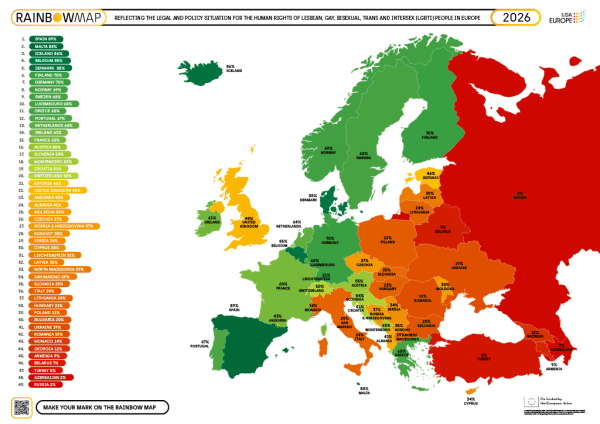
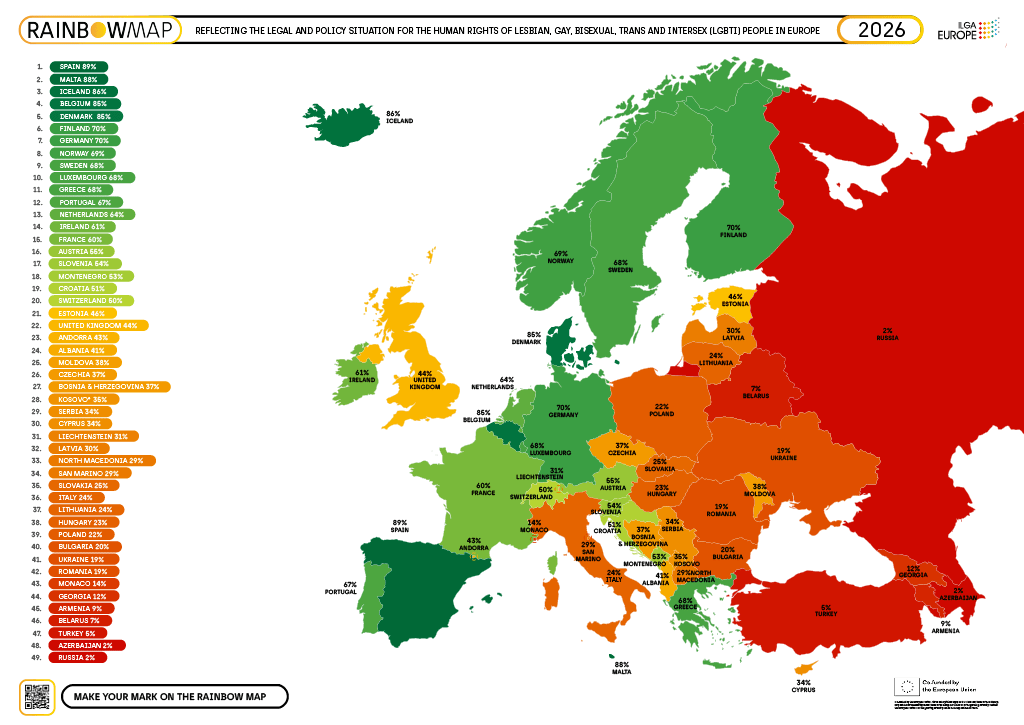
The ILGA Rainbow Map for 2026 was just released. Spain jumps ahead of Malta for the first time in a decade to lead Europe in LGBTQ legal rights. You can check out the map here and see the rankings below.
Poland’s Prime Minister Donald Tusk said on Tuesday that his government would quickly work to follow recent court rulings requiring Poland to legally recognize same-sex marriages conducted in other European Union (EU) member nations.
Recent rulings by the Court of Justice of the European Union (CJEU) and Poland’s Supreme Administrative Court (NSA) both require Poland to recognize foreign same-sex marriages, after a married same-sex couple (including a Polish citizen) weren’t allowed to have their 2018 German marriage certificate entered into the Polish civil registry.
The men challenged the denial at the NSA, which then referred the case to the CJEU. The CJEU ruled in November 2025 that the couple’s marriage was valid throughout the EU’s 27-member bloc, and that Poland could recognize their union without also altering its laws to start offering same-sex marriages.
Then, last March, the NSA ordered the government to transcribe the men’s same-sex marriage certificate into the Polish system, resulting in de facto government recognition of a same-sex couple’s marriage in the country; a historic first for Poland.
In comments to the media before a closed cabinet meeting on Tuesday, Tusk apologized for the “years of rejection and humiliation” that same-sex couples have experienced due to Poland not legally recognizing their marriages, Notes from Poland reported.
“[This is] a matter of human dignity: the right to happiness, the right to equal treatment by the state,” Tusk said. “I would like to apologize to all those who, for many, many years, felt rejected and humiliated. For many years, the [Polish] state has failed the test.”
Tusk also said that Poland currently “lacks statutory regulations” that would ensure that same-sex couples receive the same legal and social protections as different-sex couples.
However, he said, “We have committed to – and I will personally ensure this – abiding by the rulings as a priority,” adding that any changes must be conducted in compliance with existing Polish law. He also urged government members “to respect the dignity of every human being” while figuring out and implementing new policies, some of which may require parliamentary or executive approval.
Karolina Gierdal, a lawyer with the Polish LGBTQ+ advocacy organization Lambda Warszawa, told TVP World, “It is sad that the LGBT community is once again presented as a threat, as if society needs reassurance that adoption rights ‘won’t happen.’ The reality is that children are already being raised in same-sex families in Poland, and maintaining the current legal situation means reducing the level of legal protection available to those children.”
Separately, Warsaw Mayor Rafał Trzaskowski, who is a senior figure in Tusk’s Civic Platform party (Platforma Obywatelska, PO), announced that his city would begin legally recognizing foreign same-sex marriages immediately on a municipal level, long before the national government updates its own policies.
Last month, a group of over 100 non-governmental organizations urged Poland to take action to abide by the CJEU and NSA’s rulings. The groups noted that Tusk and his party were elected to power in 2023 on promises to restore Poland’s rule of law, after 10 years of corrupt, anti-democratic rule by the country’s far-right, anti-LGBTQ+ Law and Justice Party.
“Right-wing governments have distorted what we understand by the rule of law, treating it as an empty slogan rather than a real principle of state operation,” the groups wrote. “In a democratic state governed by the rule of law, the government has no authority to decide which judgments merit enforcement.”
So far, 18 countries in the EU offer legalized same-sex marriages, though all member countries are required to legally recognize them, even if they don’t offer them to their own citizens.
While Tusk’s political party promised to work to offer national same-sex civil partnerships, the initiative died due to opposition from Poland’s center-right Polish People’s Party (PSL). A parliamentary coalition considered offering some rights to same-sex couples and unmarried partners instead, but without actually offering civil unions nationwide.
However, neither proposal has come up for a parliamentary vote.
Colorado’s legislature has just passed a bill to curtail conversion therapy in the state. It now goes to Gov. Jared Polis‘ (D) desk. Polis is gay, has been supportive of LGBTQ+ rights in the past, and is expected to sign it.
The bill, H.B. 26-1322, or the Civil Actions for Conversion Therapy Survivors Act, would allow conversion therapy survivors to sue therapists for damages if they tried to change their sexual orientation or gender identity.
The bill defines conversion therapy as treatment provided by a licensed mental health professional with the “predetermined outcome” of changing someone’s gender identity or sexual orientation. This effectively keeps the bill from applying to members of the clergy or lay ministries – most conversion therapy in the U.S. is performed by religious organizations, not licensed therapists – and creates an exemption for discussions of LGBTQ+ identities that come up in therapy, a matter of contention in a recent Supreme Court case.
The legislation passed the state senate last week in a party-line vote after already passing the Colorado House of Representatives. The state senate amended the bill so it had to pass the state house again, which happened late last week, the Colorado Daily Camera reports.
The bill was introduced as the Supreme Court considered a challenge to Colorado’s previous ban on conversion therapy, passed in 2019. That ban on conversion therapy has never been enforced in the state, but a Christian therapist sued, saying that it violated her freedom of speech. She argued that it would ban her from even discussing LGBTQ+ identities with her clients, even though the state said repeatedly that it would not.
The Court ultimately ruled against the ban in Chiles v. Salazar, saying that it violated therapists’ First Amendment rights, and sent the case back to a lower court to reevaluate the law under a higher legal standard. Experts believe this means that Colorado’s 2019 conversion therapy ban – and bans like it passed in 26 other states and hundreds of municipalities – will likely eventually be overturned by courts.
The new bill is an attempt to circumvent the Court’s decision by treating it as a civil matter. The bill was introduced by state Reps. Alex Valdez (D) and Karen McCormick (D), and in the Colorado Senate by state Sens. Lisa Cutter (D) and Kyle Mullica (D).
LGBTQ+ rights advocates supported the bill, including trans National Center for LGBTQ Rights Legal Director Shannon Minter, who referred to the Supreme Court’s decision in Chiles as “specific guidance about how to amend conversion therapy laws to be viewpoint-neutral.”
“Given the urgency of this issue and the danger that conversion therapy poses to youth, Colorado moved swiftly,” he said. “Today this legislation is moving to the desk of Governor Polis and will protect Colorado’s youth and families from this discredited practice.”
“Colorado’s story is still being written, and today we took another step toward becoming a state where LGBTQIA+ people can live openly, safely, and fully as themselves,” said One Colorado executive director Nadine Bridges in a statement. “This victory belongs to the survivors, advocates, and community members who refused to let this issue be forgotten.”
Conversion therapy is a harmful practice based on the idea that LGBTQ+ identities are the result of trauma and that LGBTQ+ people need to fundamentally change who they are in order to be a good person. The practice has been linked to several harmful results, including anxiety, depression, eating disorders, and suicidality.
A same-sex couple fighting for a legal marriage in South Korea has the staunch support of two very loving parents behind them.
Park Yeo-jin and Hwang Hee-yeon committed to each other for life in a 2020 wedding ceremony, but have been unable to register their marriage legally, since South Korea doesn’t recognize marriage between two people of the same sex.
They have filed a lawsuit in response, and Yeo-Jin’s parents have submitted heartwarming depositions in support, as reported by South Korean publication Hankyoreh.
“I can’t help wondering what is so wrong about the courage and devotion that these two people have shown,” wrote her father.
He admitted he was “worried that they could end up hurt” when he first learned they were dating, due to “how hostile the world can be.” He also thought it could be a phase.
“But the two of them have been truly brave,” he said, “supporting each other with love and devotion through all of life’s hardships. As a father and a human being, I respect Park Yeo-jin and Hwang Hee-yeon and their wishes.”
“As someone who knows them well, I don’t see any difference between them and other married couples, even if they are a same-sex couple,” he continued. “I think we make society better when we focus on and embrace what is fundamentally right rather than discriminating based on difference.”
Yeo-jin’s mother also wrote to the court, saying that the couple has shown “love and dedication to one another, living and planning their future together.” She said seeing that “helped turn my concerns into affirmation and support for them.”
“If marriage is a relationship based on love and trust where you spend your life together, overcoming life’s difficulties through understanding and dedication,” she added, “then Yeo-jin and Hee-yeon are unquestionably a married couple.”
The court held a hearing on the matter on April 27, reportedly the first time in 11 years that a case of this nature was not dismissed outright.
“I was surprised and thankful that we were unexpectedly given this hearing,” Hee-yeon told Hankyoreh. “The fact that we were able to share our experience was encouraging and meaningful.”
“What we want isn’t special rights or treatment,” she added. “All we want is for the bare minimum rights so that we can protect and take responsibility for one another, just like any other couple.”
South Korea has made some advances recently. In October 2025, it was announced that the country’s census would allow same-sex couples to identify themselves as spouses for the first time. LGBTQ+ activists praised the move as a significant step toward equality.
While homosexuality is not criminalized in the country, same-sex marriage remains illegal, and according to Equaldex, only 23% of the public fully supports LGBTQ+ people being open about who they are.
Despite South Korea’s portrayal in its global entertainment industry as modern and gay-friendly, the country has long tolerated LGBTQ+ discrimination and, in a 2020 report, was ranked among the least gay-inclusive countries in the Organization for Economic Cooperation and Development.
The absence of progress can be traced to lobbying efforts by the United Christian Churches of Korea and other church associations, and to very public hate campaigns by loosely affiliated groups like Anti-Homosexuality Christian Solidarity, who have deep-rooted connections to the country’s political class.
Efforts to pass a broad anti-discrimination law through the legislature have failed many times, but hope was renewed last year when the country’s liberal party took a majority of seats in the legislature.
While LGBTQ+ rights have a long way to go in South Korea, advocates scored another major victory in the summer of 2024, when the nation’s top court ruled to uphold the rights of people in same-sex relationships, giving them the same rights as people in heterosexual relationships.
The landmark ruling states that benefits from South Korea’s National Health Insurance Service (NHIS) can be claimed by people in same-sex partnerships and that treating same-sex couples differently from heterosexual ones is “an act of discrimination that… violates human dignity and the right to pursue happiness.”
Earlier this year, a group of 47 anti-LGBTQ+ organizations launched a new campaign to end marriage equality in the U.S., demanding that the Supreme Court overturn Obergefell v. Hodges. The campaign, called “Greater Than” – a response to the push for equality by claiming that straight people are “greater than” queer people – immediately got the media’s attention.
Now the Seattle Timeshas revealed that a key organization behind the Greater Than campaign is being funded by the conservative Christian business Hobby Lobby, the same business that got the Supreme Court to rule in 2014 that for-profit corporations don’t have to pay for employees’ health care that covers contraception if that contraception goes against the corporation’s religious beliefs.
Katy Faust is the founder and president of Them Before Us, an organization devoted to ending marriage rights for same-sex couples in the U.S. Faust’s mother is a lesbian who came out after marrying Faust’s father, and her parents divorced when she was 10. She converted to Christianity a few years later, when she was in high school.
Faust insists that she didn’t devote her life to attacking LGBTQ+ rights out of some kind of resentment towards her mother, although she now says she no longer considers her mother a parent.
The Seattle Times notes that Faust has been campaigning against marriage rights since at least 2012, when she started a blog called “Ask The Bigot,” a website she claimed would “debunk” the notion that marriage rights opponents are bigots.
She advocated for ending marriage rights over the years, but saw an opportunity for a renewed push after the Supreme Court overturned federal reproductive rights protections guaranteed in Roe v. Wade in 2022. The Court effectively let states decide whether abortion would be legal, and many of them immediately banned it, something people like Faust hope to see happen for same-sex marriage.
And the recent push is getting more funding. Them Before Us was founded in 2018, and its IRS reports show that it received less than $50,000 in revenue for its first few years of operation before Roe was overturned. In 2022, though, it received $200,000. In 2024, that became nearly $1 million, and Faust collected a salary of $135,000.
Them Before Us’s 2024 filings show a $300,000 donation from The Servant Foundation, a Christian organization funded by Hobby Lobby’s founder, David Green, and his family. It’s the same organization behind those “He Gets Us” ads about Jesus that ran during the 2024 and 2025 Super Bowls.
Them Before Us – referring to how children’s interests should come before adults’ – is attempting to refocus the debate on marriage rights around children in order to capitalize on the recent moral panic around “groomers,” a push from the right that started in the early 2020s to associate LGBTQ+ people with child sex abuse once again.




















You must be logged in to post a comment.