Study finds that Nevada is the safest state for LGBTQ residents

Read more at 8NewsNow.

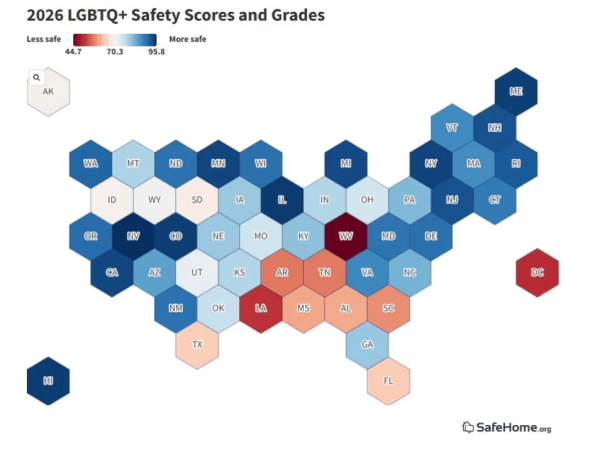
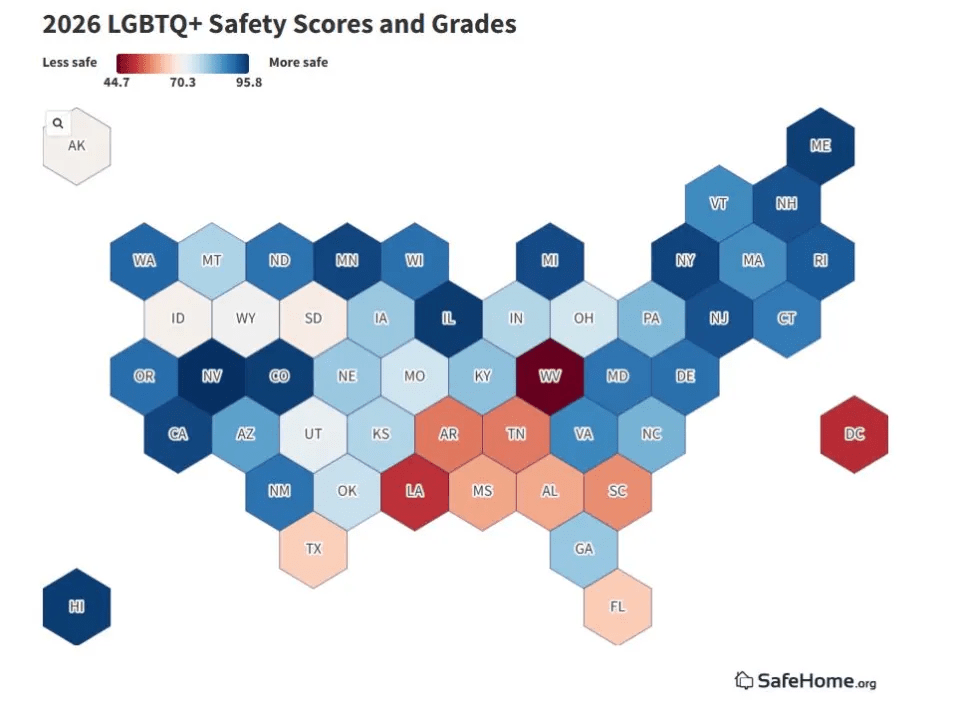
According to the 2026 LGBTQ+ State Safety Report Cards, Nevada earned the study’s only “A+” rating and scored nearly a full point over the second-highest-scoring state.

The study was done by safehome.org by evaluating all 50 states using factors such as hate crime protections, anti-discrimination laws, healthcare access, legal protections, and reported hate crime data.

The hate crime score is based on FBI Uniform Crime Report data on anti-LGBTQ+ hate crimes in each state. The study showed that the total number of hate crimes reported in the latest data did decline slightly from the prior year, but that number was still over 2,500 incidents in one year.

Overall, 13 states recieved “A” grades, while six earned a failing “F” grade.

The states that scored the highest out of 100 points in the study were Nevada (95.8), Illinois (94.9), Hawaii (94.7), Colorado (94.5), and Maine (94.4).

Nevada was in the top 10 states nationally for both legal protections and hate crime data, the study found. The state also had perfect or nearly perfect scores in several pro-equality law categories, including non-discrimination, parenting rights, youth protections, and healthcare access.

In 2022, Nevada voters amended the state constitution to enshrine protections against discrimination based on sexual orientation, gender identity, or expression. Later, in 2025, a Nevada bill that would have restricted transgender athletes in school sports died in committee.

Additionally, in 2025, the state recognized Las Vegas’ historic “Fruit Loop” district as an official landmark.

West Virginia (44.7) scored the lowest out of all 50 states and Washington, D.C., followed by D.C. (50.8), Louisiana (51.4), Arkansas (56.7), and Tennessee (56.9).

The study found that 28 percent of LGBTQ Americans have considered moving across state lines in search of better legal protection and safety.

Maine kills anti-trans ballot measure over forged & invalid petition signatures

Read more at LGBTQ Nation.

Maine’s Secretary of State Shenna Bellows (D) ruled on Tuesday that Protect Girls’ Sports in Maine, an anti-transgender campaign, submitted invalid and forged signatures in its bid for a November ballot measure that sought to ban trans students from school sports and restrooms. As a result, the measure will not appear on the voting ballot this November, Erin in the Morning reported.

The campaign, bankrolled by out-of-state billionaire Richard Uihlein, submitted 79,692 signatures — well over the 67,682 required to qualify. However, a court review of the campaign’s petitions in May invalidated 12,542 of the signatures, leaving the campaign 532 signatures short of the required number.

Some of the signatures were thrown out because the collectors didn’t witness the signing (as required by state law). Others were invalidated because the signatures did not match the voters’ signatures on voter registries, because the signatories signed more than once, because the signers weren’t registered voters, or because the signatures were forgeries. Collectors were paid $3 to $4 per signature.

Though Bellows approved the signed petitions as valid in March, following a court evidentiary review, she ruled on Tuesday that the petitions fell short of the required number of signatures to get the measure on the November ballot.

The ballot measure would’ve defined a student’s sex as “a biological status as male or female recorded at birth on the person’s original birth certificate,” effectively ending any legal recognition of trans students, not just in the cases of restrooms and sports. It also would’ve carved trans students out of legal protections enshrined in the Maine Human Rights Act (a statewide anti-discrimination law), and would’ve allowed cisgender students to sue any school that allowed trans students to use sex-segregated school spaces alongside them.

In a statement celebrating Bellows’ ruling, David Farmer, campaign manager for the Campaign for Free and Fair Schools coalition, said, “The paid, out-of-state signature gatherers and the billionaire who paid to try to put this question on the ballot failed to follow the rules. We believe that the appeals process and the reviews by the Secretary of State are working as the law intends. They are protecting the integrity of our elections.”

Even if voters had approved the measure in November, it would likely have faced legal challenges, since it would’ve resulted in trans students and their families facing harassment and discrimination.

Transgender journalist Erin Reed noted that Uihlein is a major funder of the American Principles Project, a right-wing conservative organization that has spent tens of millions on anti-trans election ads. Reed also noted that an independent analysis published by Atmos and HEATED found that 80% of the nation’s 45 major anti-trans organizations have gotten funding from billionaires or fossil fuel companies. 

Reed also noted that anti-trans ballot measures will go in front of voters in both Washington and Colorado.

“Both efforts are also funded by conservative megadonors,” she wrote, “and both are part of the same strategy that produced the Maine initiative: Use ballot initiatives to roll back trans rights in states whose elected legislatures have refused to do so.”

Uihlein and Protect Girls Sports in Maine’s efforts came after Maine Gov. Janet Mills (D) repeatedly refused to comply with the president’s extortive attempts to withhold federal education funding in retaliation for the state’s trans-inclusive school policies.

The U.S. Department of Justice has sued Maine, challenging the state’s trans-inclusive interpretation of Title IX. That legal battle is currently ongoing.

Parents demanded that a trans child be banned from sports. The town rejected their request.

Read more at LGBTQ Nation.

A town in Maine voted Monday night to continue to comply with the state’s Human Rights Act, allowing a transgender grade-schooler to play on a girls’ recreational basketball team.

The 3–2 vote at the November 10 special meeting of the St. George, Maine, Select Board came after a group of parents submitted a letter at last week’s regular monthly meeting raising their “deep concern” about the St. George Parks & Recreation Department’s youth basketball program allowing a transgender girl to play on its third and fourth grade girls’ team.

“While we understand that Maine law allows children to participate [in sports] based on how they identify, we also believe that these policies have created a very uncomfortable situation for many families in our community,” local parent Emily Chadwick read from the group’s letter during the public comment portion of the November 4 meeting.

In video from the meeting, Chadwick and others who spoke initially seemed to go out of their way not to mention the trans child or indeed to even specify the reason for their “concerns” or to ask the board to take any specific action beyond considering “how these policies impact all the children involved, not just one.”

Noting that the group seemed to be referencing the Maine Human Rights Act (MHRA), which bars discrimination based on gender identity, Select Board Chair Jane Conrad told those in attendance that their proper course of action would be “to lobby your legislators” to change the law. The Select Board members, she explained, “are in charge of enforcing the law.”

The board ultimately decided to schedule the November 10 special meeting to discuss whether it would continue to comply with the law and to allow for the broader community to weigh in.

Monday night’s meeting opened with Colin Hurd, deputy counsel for the Maine Human Rights Commission, clarifying precisely what is covered by the state human rights law.

“Under the Maine Human Rights Act, it’s illegal to prevent a person from playing sports on the team of their gender identity solely because their sex assigned at birth is different from the people that they will be playing with or against,” Hurd explained. “Furthermore, under the same provision, it’s illegal to prevent a person from using the restroom or locker room that most closely corresponds with their gender identity. So, the law, the Human Rights Act, is pretty unequivocal on these matters.”

Following the meeting’s hour-long public comment period, Conrad once again reiterated that it is not the board’s role “to determine or debate the law,” adding that in recent years, the board has consistently voted to follow state law, even when individual members disagreed with it. While she encouraged board members to voice their objections to the law, she also expressed her hope that they would vote to follow it, as not doing so would likely invite a lawsuit that they would lose, “and the taxpayers of our town would have to foot the bill.”

While some speakers at both the November 4 and 10 meetings seemed to reference a February 5 executive order banning transgender women and girls from women’s and girls’ sports (which neither changed nor established any law) and his administration’s interpretation of Title IX, Conrad noted that no court has ruled so far that any federal law supersedes the Maine Human Rights Act. She also noted that attempts in the state’s most recent legislative session to restrict trans people’s participation in sports have all been rejected.

As Them notes, the dust-up in St. George follows Maine’s Democratic Gov. Janet Mills’s months-long feud with the president over her refusal to comply with his anti-trans executive order. Mills has argued that the state’s human rights law prevents her from banning trans athletes from women’s and girls’ sports. However, as Them notes, several school districts in the state have nonetheless opted to institute trans sports bans in compliance with the executive order. An anti-trans advocacy group recently launched a new effort to amend the MHRA via ballot referendum so that it is in compliance with the presidential administration’s anti-trans interpretation of Title IX.

Bondi: Justice Department cut funding for Maine corrections department over transgender inmate

*This is reported by The Hill.

The Justice Department revoked funding for the Maine Department of Corrections over the state’s placement of a transgender woman in a women’s prison, Attorney General Pam Bondi said Tuesday. 

Bondi made the announcement during an interview with Fox News, saying the department pulled all “nonessential” funding from the state corrections department on Monday after federal officials learned “a guy” was serving time in one of the state’s two women’s facilities. Bondi said the inmate was convicted of murder. 

The loss in funding for the department totaled upward of $1.5 million, according to Fox News. The Justice Department did not return a request for comment. 

In a news release, Maine’s corrections department said it received formal notice from the Department of Justice on Monday that certain federal grants “are being terminated because they ‘no longer effectuate the program goals or agency priorities.’” The cuts will impact state-run initiatives related to substance abuse treatment and support for children with incarcerated parents, the corrections department said. 

The notice from the Justice Department, a copy of which was obtained by The Hill, does not mention transgender inmates. “While the Department is aware of related public statements by the United States Attorney General, the notice is the only communication that has been received by the Department,” Maine’s corrections department said. 

The move by the Justice Department is the latest development in a monthlong battle between the Trump administration and Maine over the state’s refusal to ban transgender student-athletes from girls’ and women’s sports as ordered by the president.  

Another Trump executive order directs transgender women in federal women’s prisons to be moved to men’s facilities. A federal judge temporarily blocked the administration from enforcing that order in February. 

Trump admin cut off food aid for kids in Maine to punish state over trans athletes. They’re suing.

*This is being reported by LGBTQNation.

When Maine Gov. Janet Mills (D) told President Donald Trump, “See you in court,” she meant it.

On Monday, Maine sued the U.S. Department of Agriculture (USDA) and Secretary of Agriculture Brooke Rollins over the department’s halt on federal funding for education programs in the state in retaliation for its refusal to ban transgender women and girls from school sports.

As Reuters notes, Rollins announced the funding freeze in an April 2 letter to Mills, saying that the decision was “only the beginning” but that the governor could “end it at any time by protecting women and girls in compliance with federal law.” The funding freeze jeopardizes programs that provide free or reduced-price meals to children in Maine schools, childcare centers, and after-school programs.

Mills has publicly clashed with the administration, and with Trump specifically, over its assertion that allowing transgender women and girls to participate in women’s and girls’ sports violates Title IX, the federal civil rights law that prohibits discrimination on the basis of sex in schools that receive federal funding.

In February, the Maine Principals Association announced that it would not comply with Trump’s February 5 executive order banning transgender student-athletes from participating in girls’ and women’s sports. After Trump threatened to cut off the state’s funding, Mills and Maine Attorney General Aaron Frey accused the president of using school children “as pawns in advancing his political agenda” and vowed to “take all appropriate and necessary legal action to restore that funding and the academic opportunity it provides.”

“The State of Maine will not be intimidated by the president’s threats,” Mills said.

During a February 21 meeting with Democratic and Republican governors at the White House, Trump singled out Mills, asking whether she planned to comply with his anti-trans executive order. Mills said that her state was “complying with the state and federal laws.” When Trump continued to petulantly insist that Mills comply with his order, the governor told the president she would see him in court.

In its lawsuit, Maine calls the USDA’s funding freeze a “blatantly unlawful action” in violation of the Administrative Procedures Act. Rollins, the state argues, “took this action without following any of the statutory and regulatory requirements that must be complied with when terminating federal funds based on alleged violations of Title IX.”

The state argues that Rollins provided no legal basis for her assertion that by allowing trans students to participate in women’s and girls’ sports, Maine is in violation of Title IX and that her interpretation of the law is wrong. “Indeed, several federal courts have held that Title IX and the Equal Protection Clause require schools to permit transgender girls and women to play on girls’ and women’s teams,” the complaint reads.

However, the state is not asking the court to interpret Title IX. It merely asks the court to vacate Rollins’s “arbitrary, capricious” funding freeze for failing to meet the “statutory and regulatory requirements that the federal government must comply with before it may freeze federal funds owed to a state.”

In a statement, Frey said that Trump “and his cabinet secretaries do not make the law, and they are not above the law, and this action is necessary to remind the president that Maine will not be bullied into violating the law.”

Blog at WordPress.com.

Up ↑