In a precedent-setting decision that could bode well for the legalization of same-sex marriage in the Philippines, the country’s Supreme Court has ruled that same-sex couples can be considered co-owners of property acquired over the course of their relationship.
The ruling came about based on a lesbian couple that is decidedly not interested in getting married, the Philippines Star reported.
The ruling promulgated on February 5 and penned by Associate Justice Jhosep Lopez made its way to the country’s highest court after the two women had lived together for several years. In that time, they purchased a house and lot in Quezon City, and registered it under only one partner’s name.
Then they decided to split.
The two women initially agreed to sell the property and divide the proceeds equally. Knowing they wouldn’t benefit from community property laws afforded to married couples, the partner who officially owned the house and lot signed an “acknowledgment” confirming that the other had paid for roughly 50% of the purchase and renovation costs of the property.
Then she reneged on the deal.
After she denied the other woman’s co-ownership and refused to sell, the scorned partner went to court, filing a case based on the signed acknowledgement.
A back-and-forth over culpability, damages, and lack of proof ensued across two courts and appeals before the case landed at the nation’s highest court.
A case pitting a similar but married plaintiff and defendant would normally fall under Article 147 of the Philippines Family Code. That article applies to couples who are legally eligible to marry and “presumes” joint ownership of property acquired during cohabitation, the high court explained.
But because the Family Code limits marriage to a union between a man and a woman, the high court held that the case of the battling lesbian couple necessarily fell under Article 148, which applies to those prohibited from marriage and requires proof of actual contribution for a property to be considered common.
That signed “acknowledgement” provided the proof.
“Having admitted the actual contribution of petitioner, their corresponding shares are prima facie presumed equal. Thus, with Article 148 of the Family Code and the Acknowledgement executed by respondent, petitioner is a co-owner to the extent of 50% share of the subject property,” the ruling read.
“Considering that there is co-ownership between petitioner and respondent, then each co-owner may demand at any time the partition of the thing owned in common, insofar as her share is concerned. Having rightful interest over the subject property, petitioner has the right to demand the division of the subject property,” Judge Lopez added.
Legislation legalizing civil unions or full marriage equality for same-sex couples in the Philippines has been stalled in the country’s Congress over multiple sessions.
Concurring opinions in the case noted the gap between public opinion, which is generally supportive of LGBTQ+ rights in the Philippines, and legislative action.
Justice Lazaro‑Javier recognized “the prevailing values in modern society as well as the glaring yet unjustified difference in the treatment of heterosexual couples vis-à-vis their homosexual counterparts,” while the majority ruling called on Congress to address the issue at the core of the case more broadly.
“Mostly, public reason needs to be first shaped through the crucible of campaigns and advocacies within our political forums before it is sharpened for judicial fiat,” the court said.
The Virginia Senate voted this past Friday in favor of repealing an amendment to the state constitution that defines marriage as only between a man and a woman.
Senate Joint Resolution 3, introduced by state Sen. Adam Ebbin (D), passed the chamber in a 26-13 vote and would ban the state “from denying the issuance of a marriage license to two adult persons seeking a lawful marriage on the basis of the sex, gender, or race of such persons.” It also requires Virginia to “recognize any lawful marriage between two adult persons and to treat such marriages equally under the law, regardless of the sex, gender, or race of such persons.”
A proposed Constitutional amendment must be voted on by two successive state legislatures before heading to the ballot, where voters ultimately decide its fate. Both chambers voted in favor of the resolution in 2025, and the House of Delegates already approved it again earlier this month. As such, the resolution will go to voters during the November 2026 elections.
Virginia’s 2006 constitutional ban on same-sex marriage has been unenforceable since the 2015 Supreme Court Obergefell v. Hodges decision that legalized marriage equality nationwide. In 2024, amid increasing threats that the Court may reexamine the decision, then-Gov. Glenn Youngkin (R) (who is generally anti-LGBTQ+) signed a bill codifying same-sex marriage in the Commonwealth.
The law now ensures same-sex marriage remains legal in Virginia regardless of any change in federal protections, but those championing the constitutional amendment say it’s still not enough.
“It’s time for the Virginia constitution to accurately reflect the law of the land. Full stop,” Ebbin said in a statement. “20 years ago, the Virginia Bill of Rights was unnecessarily stained in an overreaction. It’s past time to fix that and see that loving Virginia couples are not mistreated or discriminated against. I am confident that the voters will ratify this marriage equality amendment in November.”
“It’s about time Virginia gets this done,” added state Rep. Mark Sickles (D), who introduced the resolution in the House of Delegates. “All Virginia couples deserve the freedom to marry without fear that their rights could be rolled back. By advancing this amendment, we’re ensuring that the freedom to marry is protected by the people. It’s up to the voters now and I’m confident they’ll do the right thing in November.”
Virginia’s resolution comes after a new trend last year in which several Republican-led states introduced resolutions calling for the Supreme Court to overturn Obergefell. Two justices on the Supreme Court have openly stated that they want to overturn Obergefell, which has stirred fears in the LGBTQ+ community as the court has moved increasingly to the right.
In a victory for LGBTQ+ people, the Supreme Court opted in November not to hear an appeal from former Kentucky county clerk Kim Davis asking the court to reconsider its marriage equality decision.
Even if the Supreme Court had taken the case, Chris Geidner, the gay publisher and author of Law Dork, told LGBTQ Nation last year that he didn’t think a case like Davis’ would provide sufficient legal reasoning to overturn same-sex marriage entirely.
Rather, he said that a successful religious freedom or free speech challenge to Obergefell would do other “bad things,” like hollow out civil protections or public accommodations for same-sex couples, essentially inconveniencing or endangering them, but not outright denying them the right to a marriage license.
A court found Japan’s refusal to legalize same-sex marriage was constitutional Friday in the last of six cases that are expected to be brought to the Supreme Court for a final and definitive ruling, possibly next year.
The Tokyo High Court said marriage under the law is largely expected to be a union between men and women in a decision that reversed a lower court ruling last year and was the first loss at high courts in the six cases brought by those seeking equal marriage rights.
Judge Ayumi Higashi said a legal definition of a family as a unit between a couple and their children is rational and that exclusion of same-sex marriage is valid. The court also dismissed damages of 1 million yen ($6,400) each sought by eight sexual minorities seeking equal marital rights.
Plaintiffs and their lawyers said the decision was unjust but they were determined to keep fighting through the Supreme Court.
“I’m so disappointed,” plaintiff Hiromi Hatogai told reporters outside the court. “Rather than sorrow, I’m outraged and appalled by the decision. Were the judges listening to us?”
“We only want to be able to marry and be happy, just like anyone else,” said another plaintiff, Rie Fukuda. “I believe the society is changing. We won’t give up.”
With all six high court cases done, the Supreme Court is expected to handle all appeals and make a decision.
Though discrimination still exists at school, work and elsewhere, public backing for legalizing same-sex marriage and support in the business community have rapidly increased in recent years.
Japan is the only member of the Group of Seven industrialized countries that does not recognize same-sex marriage or provide any other form of legally binding protection for LGBTQ+ couples.
Prime Minister Sanae Takaichi ‘s conservative ruling Liberal Democratic Party is the main opponent of same-sex marital rights in Japan. The government has argued that marriage under civil law does not cover same-sex couples and places importance on natural reproduction.
More than 30 plaintiffs have joined the lawsuits on marriage equality filed across Japan since 2019. They argue that civil law provisions barring same-sex marriage violate the Constitutional right to equality and freedom of marriage.
Friday’s ruling was only the second that found the current government policy constitutional after the 2022 Osaka District Court decision.
The European Court of Justice has issued a ruling that all nations in the European Union (EU) must recognize lawful same-sex marriages that were performed in other EU countries. Previously, a country could refuse to recognize a marriage if it had taken place in another country and did not align with its own laws.
The court declared that EU citizens have a right to “a normal family life” regardless of borders. “When they create a family life in a host member state,” they said, “in particular by virtue of marriage, they must have the certainty to be able to pursue that family life upon returning to their member state of origin.”
Citizens of the European Union have the right to freedom of movement between the different nations within the union. The court suggested that this right, as well as the right to “respect for private and family life,” would be breached if one country could refuse to acknowledge a lawful marriage from another country.
The court added in a press release, “Member States are therefore required to recognize, for the purpose of the exercise of the rights conferred by EU law, the marital status lawfully acquired in another Member State.”
The case was brought to the Luxembourg-based court on behalf of a Polish couple who had been married in Berlin, Germany, where same-sex marriage is recognized. When, years later, they returned to their home country, they submitted their marriage certificate, which was in German, to the Polish government to be transcribed and recognized in the Polish civil register.
The Polish government denied their request, as the country does not recognize same-sex marriages. With this new ruling, they will no longer be able to refuse legally.
Of the 27 EU member states, only 18 have legalized same-sex marriage.
LGBTQ+ rights have taken some big hits in Poland in recent years. The far-right Law and Justice Party held power from 2015 to 2023 and enacted a range of anti-LGBTQ+ policies during that time. It was only in April of this year that the last “LGBT-free” zone created by the party was finally repealed.
Poland is currently led by a coalition government. The prime minister, Donald Tusk, campaigned on introducing same-sex civil unions and has pushed for such legislation to be passed. However, Poland’s president, Karol Nawrocki of the Law and Justice Party, has said that he would veto any legislation that would legalize same-sex marriage.
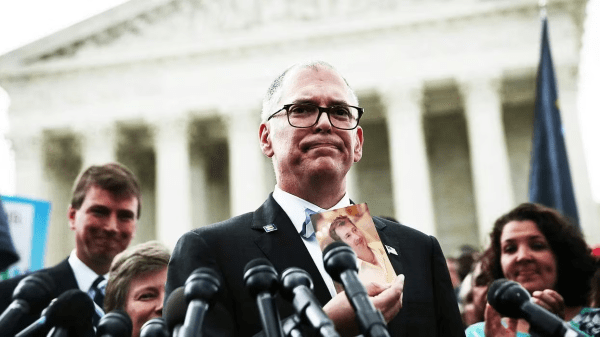
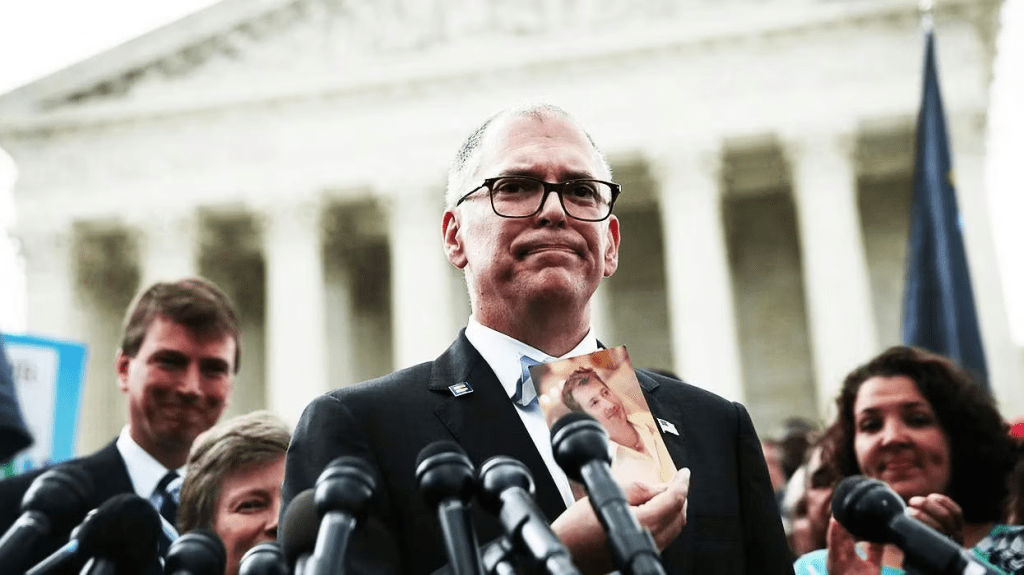
When the nine U.S. Supreme Court justices meet behind closed doors on Friday, the justices will decide whether to hear an appeal from former Kentucky county clerk Kim Davis, a name that became synonymous with anti-LGBTQ+ attitudes to marriage equality a decade ago.
Davis, who refused to issue marriage licenses to same-sex couples after Obergefell v. Hodges made marriage equality the law of the land in 2015, has asked the court not only to overturn her financial settlement in a civil case loss in lower courts but also to reconsider the landmark ruling itself.
While Davis’s petition centers on whether she can be held personally liable for emotional-distress damages, her legal team is also urging the justices to revisit the constitutional right to marry. For those who remember the culture war that surrounded Davis’s defiance, the possibility that her name might again appear on the Supreme Court docket has reignited deep anxiety across the LGBTQ+ community
In separate interviews with The Advocate, Jim Obergefell, the plaintiff whose name now defines that right, and GLAD Law legal director Josh Rovenger described the moment as both surreal and revealing. One is the man who stood before the Court ten years ago and won the right to have his marriage recognized. The other works at the organization that helped secure that victory. Both see the Davis petition not just as a legal maneuver but as a test of whether the country can sustain a principle it once declared settled.
“A narrow case, shoehorning a broad agenda”
Rovenger explained what this case is and what it isn’t.
“This is a narrow case with a technical legal question,” he said, emphasizing that it concerns emotional-distress damages and qualified immunity, not marriage equality itself. “Attorneys who want to overturn Obergefell are trying to shoehorn that into a very narrow case.”
Davis, a former Rowan County clerk, was found liable for denying marriage licenses to same-sex couples in violation of clearly established law. A jury awarded damages to those couples, and the Sixth Circuit Court of Appeals affirmed the decision. Davis’s petition now asks the Supreme Court to review that ruling, Rovinger explained. While she has framed the case as one about her religious freedom, Rovenger said the issue before the Court remains technical.
“The Supreme Court receives thousands of petitions a year,” he said. “It would really be anomalous for them to take a case with such a narrow fact pattern and use it to revisit Obergefell.”
Still, Rovenger acknowledged why people are uneasy.
“Given the rollback of rights we’ve seen in other areas, Dobbs being the most prominent, that fear makes sense,” he said. “But this case is not the vehicle for that kind of sweeping reversal.”
The limits of the Respect for Marriage Act
Part of the current confusion, Rovenger said, stems from uncertainty about how the Respect for Marriage Act interacts with the Obergefell decision. The 2022 law, signed by President Joe Biden, requires states and the federal government to recognize marriages performed in other states. However, it does not compel every state to issue marriage licenses if Obergefell were to be overturned.
“In a world where Obergefell didn’t exist,” he said, “a couple married in one state would still have their marriage recognized federally and by other states, but not necessarily be able to marry everywhere.”
He called that distinction significant, not only for its practical consequences but for what it would signal about equality itself.
“A patchwork approach across states,” he said, “is fundamentally different from a nationwide right.”
Rovenger also pointed to the Supreme Court’s own language on “reliance interests” — the idea that people build their lives on the stability of established rights. Trump-appointed Justice Amy Coney Barrett, he noted, has recently said marriage equality has created such interests, making it less likely to be undone. Barrett had told the New York Times that Obergefell created “concrete reliance interests.”
“Those interests,” Rovinger said, “remain one of the critical factors the Court considers when deciding whether to revisit precedent.” According to Gallup, 68 percent of Americans support marriage equality.
Jim Obergefell: “Disgusted by this twisting of religious freedom”
For Jim Obergefell, the case is personal. He said he was “disgusted” that his fellow citizens would work against another group’s well-being and happiness, using religious liberty as an excuse.
“This modern version of religious freedom — this belief that one’s personal religion trumps everything else — is a twisting and perverting of what our founders intended,” he said.
Obergefell said Davis’s refusal to follow the law was emblematic of a broader problem: public officials placing private faith above civic duty.
“She swore an oath to serve all people,” he said. “And yet she used her government position to persecute others.”
His frustration extends to the justices themselves and their recent decisions, which have often ignored established understandings of the law. Justice Clarence Thomas recently said that past decisions “aren’t gospel.”
“Why should anyone feel secure about the right to marry,” he asked, “when this Court has proven it doesn’t believe in precedent?”
“One of those justices’ own marriage exists because of a Supreme Court decision,” Obergefell said, referring to Loving v. Virginia, the 1967 ruling that struck down bans on interracial marriage. Thomas is Black, and his wife, Ginny, is white. “If this Court overturns Obergefell, then what does that say about their own logic?” Obergefell added.
“People should be concerned”
Obergefell said that the LGBTQ+ community’s fear is warranted.
“Absolutely, people should be concerned. I’m concerned,” he said on Saturday. “Yesterday I officiated a wedding for a cousin who asked whether they should get married now instead of waiting. My answer was yes.”
He explained that even with the Respect for Marriage Act in place, states could still move swiftly to block new marriages if Obergefell were struck down.
“Ohio [where I live] still has a Defense of Marriage Act on the books,” he said. “If Obergefell is overturned, Ohio could immediately say, ‘no more marriage licenses for queer couples.’”
Obergefell warned that political forces aligned against LGBTQ+ rights have shown a willingness to manipulate electoral systems to maintain power.
“We have a political party that has turned its back on democracy,” he said. “They’re doing everything they can solely to remain in power — to punish and to be vindictive.”
A fragile majority, a durable principle
Despite deep pessimism about the Court, Obergefell said he still finds hope in younger generations.
“They don’t see difference the way older generations do,” he said. “There are millions of people out there who share my values, who believe in humanity, who believe every person deserves happiness and rights. That gives me hope.”
Rovenger echoed the sentiment, though his version is more procedural.
“We’re all watching closely,” he said. “We’ll keep an eye on whether the case gets relisted and on any separate statements that come out. But we’re not panicking. We’re prepared for all possibilities and ready to meet that moment if it comes.”
For now, the fate of Obergefell doesn’t hinge on oral arguments or public hearings but on what happens in a private conference room inside the marble halls of the Supreme Court. Whether the justices see the Davis case as a technical dispute or a cultural flashpoint will determine not only one woman’s liability but perhaps the trajectory of a right that has defined a generation.
If the Court declines to hear the case, the lower-court rulings stand, and marriage equality remains intact. If it grants review, the nation will enter another defining chapter in its legal history.
Either way, Obergefell’s warning lingers: “They’ve turned the idea of freedom on its head,” he said. “And unless we stand up for what it truly means, we risk losing more than marriage, and we risk losing the very promise of equality itself.”
The Texas Supreme Court on Friday gave judges in the state a pass if they don’t want to marry same-sex couples, unilaterally granting public officials the right to discriminate against queer couples.
In an end run around equal protection concerns, the high court amended the Texas Code of Judicial Conduct to read, “It is not a violation of these canons for a judge to publicly refrain from performing a wedding ceremony based upon a sincerely held religious belief.”
The change follows years of litigation that inspired a lawsuit by a county judge in Texas asking federal courts to declare that Texas law does not and cannot punish him for his practice of officiating opposite-sex, but not same-sex, marriages in the state.
Jack County Judge Brian Umphress, who sued in 2020 because he only wanted to perform weddings for opposite-sex couples, argued that his conduct would run afoul of the Texas State Commission on Judicial Conduct, despite protections he believed he enjoyed consistent with his religious freedom rights under the First and Fourteenth Amendments, Houston Public Media reports.
In response, the U.S. Court of Appeals for the Fifth Circuit put the lower federal-court proceedings on hold and asked the Texas Supreme Court to answer the question, “Does Canon 4A(1) of the Texas Code of Judicial Conduct prohibit judges from publicly refusing, for moral or religious reasons, to perform same-sex weddings while continuing to perform opposite-sex weddings?” That part of the code requires judges to refrain from behavior that would “cast reasonable doubt on the judge’s capacity to act impartially as a judge.”
The high court’s answer came with the amended code of conduct, bypassing public argument.
Judge Umphress’ fear of sanction for his discriminatory conduct was based on the case of McLennan County Justice of the Peace Dianne Hensley in Waco, who spent years in court arguing she had a right to refuse to marry gay couples.
Hensley replied to requests from gay couples with a statement that read, “I’m sorry, but Judge Hensley has a sincerely held religious belief as a Christian, and will not be able to perform any same-sex weddings.”
That conduct earned a public warning from the Judicial Conduct Commission, which said Hensley was violating a requirement that justices of the peace be impartial, even in extrajudicial duties like officiating weddings.
Her refusal to treat LGBTQ+ people equally cast “doubt on her capacity to act impartially to persons appearing before her as a judge due to the person’s sexual orientation,” the commission wrote.
Hensley claimed that no one’s rights were denied since a same-sex couple could have found another judge to marry them, despite the fact that she was the only justice of the peace performing marriages in Waco at the time.
Hensley filed a lawsuit against the commission with help from the First Liberty Institute, a Texas-based anti-LGBTQ+ legal organization, arguing for protections under the Texas Religious Freedom Restoration Act. The commission eventually dismissed its sanction a few months after the Texas Supreme Court allowed Hensley’s case to proceed.
That decision from the Texas high court earned Hensley a supportive concurring opinion from the chief justice, who publicly supported the Waco judge before his appointment.
“Judge Hensley treated them respectfully,” Chief Justice Jimmy Blacklock wrote of the couples she refused to marry. “They got married nearby. They went about their lives. Judge Hensley went back to work, her Christian conscience clean, her knees bent only to her God. Sounds like a win-win.”
Jason Mazzone, a law professor at the University of Illinois at Urbana-Champaign who’s familiar with both cases, said the Texas Supreme Court’s code of conduct workaround still leaves open the possibility for a gay couple with standing to challenge a judge’s decision not to marry them on constitutional equal protection grounds.
“One of the claims that I think will be made in response to litigation that is likely is that, ‘Well, there are other people who can perform the wedding ceremony, so you can’t insist that a particular judge do it,’” Mazzone said. “But that, of course, is not how equal protection works, and it’s not how we expect government officials to operate.”
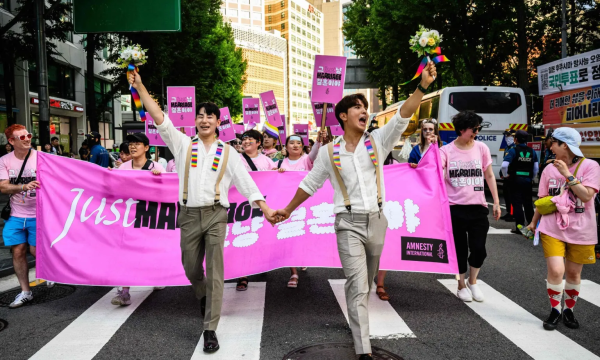
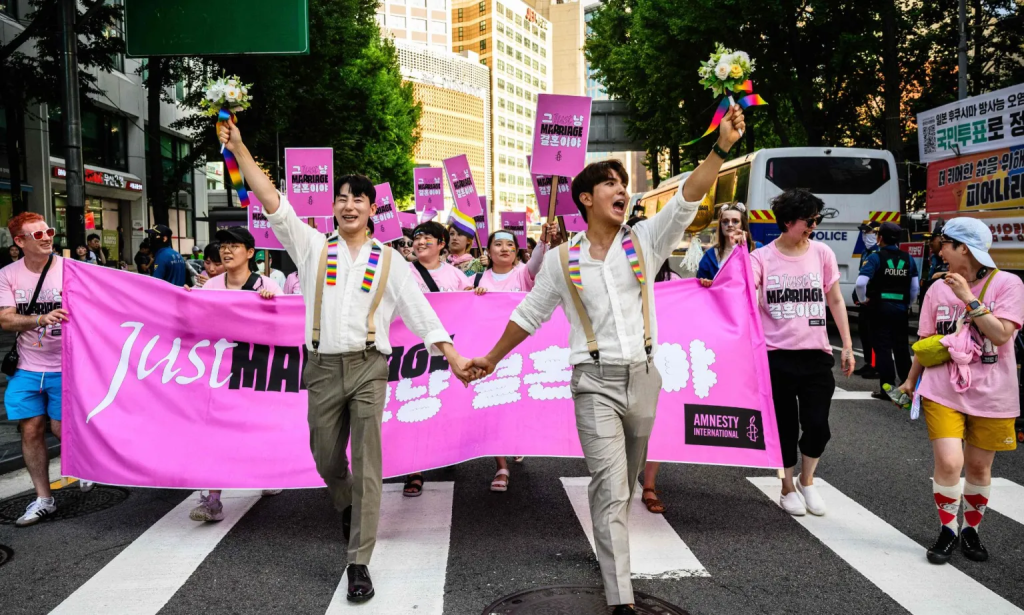
Under newly announced policy changes, the Ministry of Data and Statistics will recognise same-sex couples living in the same household in the Population and Housing Census.
The government confirmed on Tuesday (21 October) it would allow same-gender housholds to pick “spouse” and “cohabiting partner” options on the census, which circulates every five years.
Previous iterations flagged the options as errors and rejected, according to Rainbow Action Korea – a coalition of 49 LGBTQ+ organisations.
“In past surveys, couples of the same gender could not select ‘spouse’ even if they lived together as such. The system would return an error,” They said in a statement reported by Straits Times.
“This is the first step towards having LGBTQ+ citizens fully reflected in national data.”
Same-sex marriage is not currently legal in South Korea. As of 2023, cohabiting couples can receive spousal coverage under the National Health Insurance Service (NHIS).
A 2024 ruling upholding same-sex couple’s rights to access health insurance benefits was heralded as a “significant step” towards LGBTQ+ equality, with many arguing it paves the way towards legalising same-sex marriage.
The centre-left Justice Party similarly commended the government’s decision to update the census, arguing it could lead to “further change.”
“The day will come when even transgender citizens are visible in national statistics,” a spokesperson continued.
LGBTQ+ rights progress remains slow in the East Asian country. LGBTQ+ people are banned from adoption and military service, while hate crime protections are non-existent.
While legally changing gender has been permitted without sterilisation since 2020, gender-affirming care remains heavily restricted.
An Ipsos survery found that, as of May 2025, 31 per cent of South Koreans are anti-LGBTQ+, while 51 per cent oppose same-sex public displays of affection.
Despite this, nearly a quarter believe the country is a “good place” for LGBTQ+ people.
Rainbow Action argued that, while the move was a positive step, the government hadn’t done enough to inform the public about the change which could limit participation.
The Japanese government has expanded legal protections to same-sex couples.
According to The Japan Times, the government has decided to recognise same-sex couples as being in “de facto marriages” under nine additional laws, including the Disaster Condolence Grant law.
This follows a decision earlier this year to extend 24 existing laws – including the Domestic Violence Prevention Act, Land and House Lease Act, Child Abuse Prevention Act, and Public Housing Act – to same-sex couples.
Japan’s LGBTQIA+ community has long been engaged in a battle for marriage equality.
Currently, the country’s constitution defines marriage as “mutual consent between both sexes” and does not recognise marriage equality.
“From the perspective of individual dignity, it can be said that it is necessary to realise the benefits of same-sex couples being publicly recognised through official recognition,” the court said on 20 June.
“Public debate on what kind of system is appropriate for this has not been thoroughly carried out.”
A few months later, a Tokyo court upheld the ruling.
However, despite the court doubling down on its stance, the presiding judge also stated that the lack of a legal system and protections for same-sex couples infringes on their human rights (per CNN).
While the marriage equality movement in Japan has suffered a handful of setbacks, it has also seen a few notable wins over the last three years.
A district court in Ukraine has formally recognized a same-sex couple as family, the first legal precedent of its kind in the country, the Kyiv Independentreports.
The plaintiffs in the case were Zoryan Kis, first secretary of Ukraine’s Embassy in Israel, and his longtime partner, Tymur Levchuk. The couple has lived together since 2013 and were married in the U.S. in 2021.
Ukraine does not currently recognize same-sex marriages or civil unions.
In 2024, Ukraine’s Foreign Ministry refused to acknowledge Levchuk as Kis’ family member, denying him spousal rights to accompany his husband on his diplomatic posting to Tel Aviv. The couple filed a legal complaint naming the Foreign Ministry as a defendant in September.
The court’s decision cited both the Ukrainian constitution and precedent from the European Court of Human Rights (ECHR), to which Ukraine is a signatory. ECHR requires member states to ensure legal recognition and protection for same-sex families.
The couple’s shared finances and property, joint travel records, photographs, correspondence, and witness testimony were among the evidence considered by the court establishing a long-term domestic partnership.
“A very big and important step toward marriage equality in Ukraine, and a small victory in our struggle for ‘simple family happiness’ for Ukrainian diplomats,” Kis posted to Facebook after the court rendered its judgment.
“Now we have a court ruling that confirms the feelings Tymur Levchuk and I have for each other,” he said, while thanking the judge in the case.
Public support for LGBTQ+ rights in Ukraine has grown steadily in recent years as the country has drawn closer to Europe, and in particular after Russia’s war on the sovereign nation in 2022.
Legal progress on the issue has remained slow, however. Legislation recognizing civil partnerships was introduced in 2023 but hasn’t advanced through the Ukrainian parliament’s Legal Policy Committee.
The proposed bill would legalize civil partnerships for both same-sex and heterosexual couples, providing inheritance, medical, and property rights, but not the full status of marriage.
Kis and Levchuk are longtime civil rights activists in Ukraine. In 2015, the couple filmed a video for Ukrainian online magazine Bird in Flight, reenacting a recent social experiment conducted in Moscow featuring two young men holding hands as they walked through the city to gauge the public’s reaction. The responses in Kyiv mostly ranged from shrugs to bemusement, until Levchuk sat on Kis’ lap.
June 26, 2015 was a milestone day in the United States when the SCOTUS decision was announced in the case of Obergefell v Hodges. A narrow 5-4 ruling brought nationwide marriage equality for LGBTQ people much sooner than many expected it. I certainly did not even think it would occur in my lifetime. The nation was split down the middle on the topic. A piecemeal approach was commonplace, with some states making it legal before the ruling, and others staunchly opposed to it in their state constitutions. Yet, a conservative justice saw fit to challenge the status quo and actually base a ruling on the US Constitution for a change, rather than political ideology.
We had already been married for almost 4 years at that point. We were living in Texas in July 2011 and my boyfriend at the time decided to ask me to marry him (now her, but that is another story for another day). We had been living together nearly 10 years. Going to Canada was floated as an idea. I had family in New Jersey and Andrew Cuomo in New York had just its own marriage equality law June 24 that year to take effect in July. So, New York it was! I had become an internet wedding planner of my own wedding by then to be wed on October 09, 2011, one day difference from our “10th anniversary”. It was tedious. It was stressful. It was fun. It was one of the best days of my life. I will never do it again. Sorry boys and girls.
While our own wedding anniversary of 14 years is coming this fall, I sit here writing this and worried that we will have to go through even more bullshit to not only keep our marriage legally intact, but to ensure future generations maintain their right to due process and equality under the law. We have a Supreme Court who has already shown it has the balls to revisit and repeal established forward thinking case law precedent. See, Roe v Wade’s death as a result of Dobbs v. Jackson Women’s Health Organization. Chief Justice Roberts and Justices Thomas, and Alito, who each wrote a dissenting opinion in Obergefell v Hodges are still proudly part of the conservative super majority on the bench. Yes, there is a Respect for Marriage Act that was finally passed in 2022 to help reaffirm O v H.
But we also have a President and House who are willing to turn back time. We have state legislators, who are now firing the opening salvo towards repeal of marriage equality. House reps in 9 states in 2025 proposed resolutions urging SCOTUS to repeal O v H. Those resolutions were passed in North Dakota and Idaho. 4 other states introduced bills, which failed, to introduce covenant marriage to their books, which would have created an exclusive category for opposite sex couples.
I hope everyone enjoys their anniversary, whether you were married today or at another point in time. But please remain vigilant and pay fucking attention to what is going on around you. Your rights can always be removed with the stroke of a pen. And sometimes that pen needs to be shoved into an uncomfortable place.
This is us. Climate change was on full display.
John Turner-McClelland is the editor of several blogs including FleeRedStates. He is a licensed real estate agent in Texas and North Carolina. He was on a Vice News panel once and was allowed to speak for 5 seconds on air. He has been a proud liberal LGBTQ activist and former elected official for a few decades or so. Yes, he is still married.












 fleeredstates.blog
You must be logged in to post a comment.