The Pennsylvania House passed House Bill 1800, focusing on marriage equality, on a 127-72 vote, moving to change the state’s definition of marriage from a contract between a man and a woman to a contract between two individuals.
HB 1800 passes state House
The bill is sponsored by Democrat Rep. Malcolm Kenyatta of Philadelphia. The vote mostly followed party lines, with some Democrats voting against and some Republicans voting for the bill.
Opponents argued marriage should stay out of government, while supporters said the change would keep government out of marriage.
The bill would change the definition of marriage in the state to be between two consenting adults and remove a section stating that if a same-sex marriage happens in another state, it would be void in Pennsylvania.
Lawmaker comments on floor and response
“I don’t believe that we need government to put a stamp of approval on marriage. And I’ve been in the minority for that position for some time,” said Rep. Bryan Cutler, R-Pa. Dist. 100. “We need to recognize the foundation of marriage is actually for the stability of children, whether it’s history or whether it’s consistent with beliefs.”
“It is about a covenant that is deep and meaningful, and the one that I share, and thousands of Pennsylvanians share is deep and meaningful,” said Rep. Kenyatta. “So, marriage is not symbolic. They are legal, they are practical. There are financial things connected to the institution of marriage.”
“Marriage equality has been something I’ve been advocating for my entire career. It’s about time that we update Pennsylvania’s laws to reflect modern society,” said Rep. Dave Madsen, D-Pa. Dist. 104.
What’s next
The bill now heads to the Republican-controlled Senate, where it is unclear whether lawmakers will take up the proposal and vote on it.
Only one U.S. state has a majority that opposes marriage equality, another has the highest concentration of LGBTQ+-identified people, and a majority of Republicans agree that transgender people deserve the same rights and protections as other Americans, according to a newly released 50-state survey conducted by the Public Religion Research Institute (PRRI).
PRRI interviewed more than 22,000 adults nationwide throughout the last year as part of its American Values Atlas. The findings provide a snapshot of how individual states and demographic groups view same-sex marriage, anti-discrimination protections, and trans rights at a time when all of those are under attack from Christian nationalist forces.
The survey revealed the two U.S. states with the lowest levels of support for same-sex marriage: Only 47% of respondents from Mississippi support same-sex marriage with Arkansas close behind at 50%. Conversely, the highest levels of support for same-sex marriage were expressed by 85% of respondents from Massachusetts and the same amount Rhode Island, with the 81% of respondents from Vermont close behind.
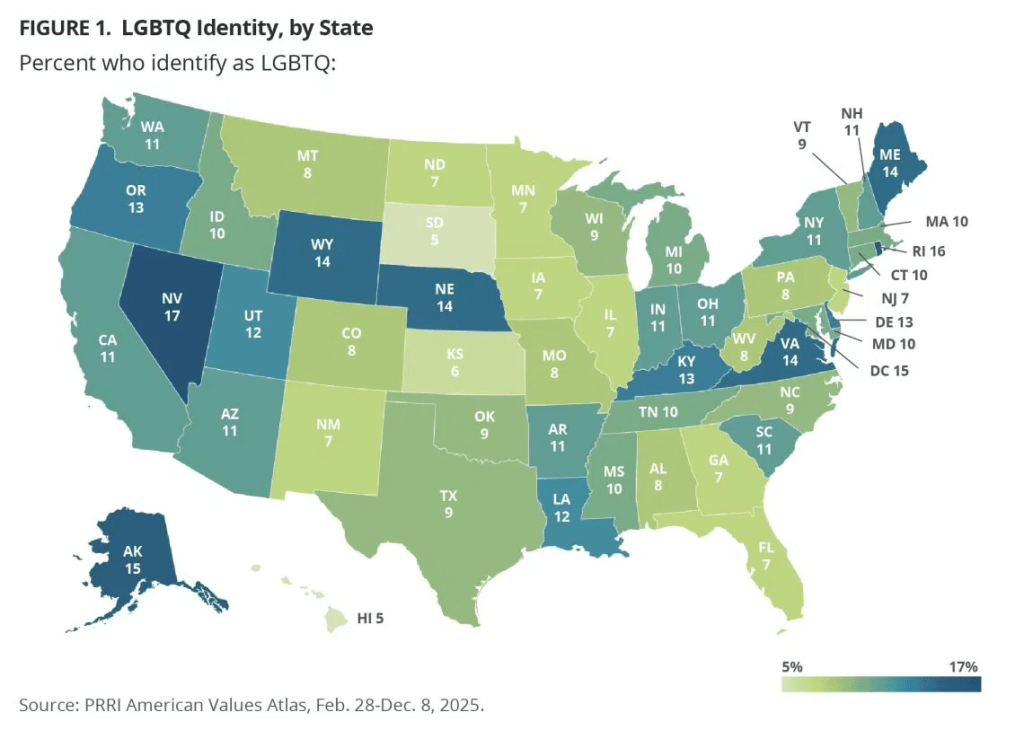
The survey asked respondents whether they self-identified as LGBTQ. It found that 17% of respondents in Nevada self-identified as LGBTQ — the highest percentage of all U.S. states, followed by 14% of respondents in Maine, Nebraska, and Wyoming.
The states with the lowest percentage of self-identified LGBTQ respondents were Hawaii and South Dakota, with just 5% each. Kansas was the state with the second-lowest number of self-identified LGBT respondents, with just 6%.
Among states whose respondents voiced the highest level of support for nondiscrimination protections for LGBTQ+ people were Massachusetts (85%), Maryland (82%), and Alaska (81%). However, Mississippi (60%), Wyoming (57%), and Arkansas (53%) showed the lowest support for such protections.
States with the most respondents opposed to religiously based ant-LGBTQ+ service refusals were Massachusetts (72%), Hawaii (71%), Vermont (71%), and Connecticut (70%). Conversely, only 44% of West Virginia respondents voiced opposition to such refusals — the lowest percentage among all U.S. states.
Interestingly, the poll found that seven in 10 Americans (71%) agreed that “transgender people deserve the same rights and protections as other Americans,” including most Democrats (88%), independents (77%), and Republicans (57%). This is especially surprising, seeing as the Republican Party and its president have spent the last decade vilifying trans people as mentally ill and a danger to the privacy and safety of women, girls, and children.
PRRI’s survey also looked at LGBTQ+ attitudes in relation to Christian nationalism. It found that Christian nationalism rejecters (91%) were the most likely to support LGBTQ+ nondiscrimination protections, followed by 77% of skeptics, 61% of sympathizers, and 42% of adherents of Christian nationalism.
Unsurprisingly, adherents and sympathizers of Christian nationalism were less likely to support same-sex marriage and less likely to oppose religiously based refusals for LGBTQ+ people, compared to respondents who either reject or are skeptical of Christian nationalism.
The Idaho House of Representatives passed a measure this week asking the Supreme Court to overturn its landmark 2015 decision legalizing same-sex marriage across the U.S. But the legislation lost three Republican votes compared to a similar measure that passed in the state House last year.
As the Idaho Statesmanreports, House Joint Memorial 17 passed in a 44–26 vote Tuesday. The measure, introduced by State Rep. Tony Wisniewski (R), is a formal legislative request for the Supreme Court to overturn its 2015 decision in Overgefell v. Hodges. The measure argues that the decision establishing the constitutional right of same-sex couple to legally marry is “at odds with the Constitution of the United States and the principles upon which the United States is established.” In its Obergefell ruling, the measure argues, the Court applied a definition of liberty that would not have been recognized by the country’s founders. The decision, it says, “relies on the dangerous fiction of treating the Due Process Clause of the Fourteenth Amendment to the Constitution as a font of substantive rights” which “strays from the full meaning of the Constitution.”
House Joint Memorial 17 is identical to House Joint Memorial 1, which the Idaho House passed last year.
This time around, however, 17 Republican lawmakers joined House Democrats to vote against the measure, with three more Republican no votes than in 2025.
According to the Statesman, Republican Reps. Dori Healey and Mike Pohanka, who both voted for House Joint Memorial 1 last year, both voted against the 2026 measure. Grayson Stone, who is serving as a long-term substitute for Rep. Don Hall (R) and recently announced that he is running for Hall’s seat, also voted against the measure. Late last year, Hall replaced former Republican Rep. Lance Clow, who voted for House Joint Memorial 1. Hall resigned due to health issues earlier this year.
Stone reportedly acknowledged that his no vote might amount to “political suicide,” but cited the Bible as the reason for his vote.
“This entire argument is rooted in the Bible,” Stone said, according to the Statesman, noting that the Bible includes instructions on how to shave. “I just don’t understand why we have to apply the Bible to specific aspects of our life, but not all of it. So, I will be voting against this bill.”
Pohanka, meanwhile, noted that his own religious beliefs on same-sex marriage have not changed since he voted for the 2025 measure. However, he told the Statesman that he represents all his constituents and wants to get back to actually legislating.
“I thought we advanced [House Joint Memorial 1] last year,” he said. “This year, to me, it’s just going to cause hurt and pain and I don’t want to do that.”
Healey declined to comment on his vote, according to the Statesman.
House Joint Memorial 17 now advances to the Idaho Senate, which declined to vote on the 2025 measure. Even if the state senate approves House Joint Memorial 17, it would not compel the Supreme Court to act.
The Virginia Senate voted this past Friday in favor of repealing an amendment to the state constitution that defines marriage as only between a man and a woman.
Senate Joint Resolution 3, introduced by state Sen. Adam Ebbin (D), passed the chamber in a 26-13 vote and would ban the state “from denying the issuance of a marriage license to two adult persons seeking a lawful marriage on the basis of the sex, gender, or race of such persons.” It also requires Virginia to “recognize any lawful marriage between two adult persons and to treat such marriages equally under the law, regardless of the sex, gender, or race of such persons.”
A proposed Constitutional amendment must be voted on by two successive state legislatures before heading to the ballot, where voters ultimately decide its fate. Both chambers voted in favor of the resolution in 2025, and the House of Delegates already approved it again earlier this month. As such, the resolution will go to voters during the November 2026 elections.
Virginia’s 2006 constitutional ban on same-sex marriage has been unenforceable since the 2015 Supreme Court Obergefell v. Hodges decision that legalized marriage equality nationwide. In 2024, amid increasing threats that the Court may reexamine the decision, then-Gov. Glenn Youngkin (R) (who is generally anti-LGBTQ+) signed a bill codifying same-sex marriage in the Commonwealth.
The law now ensures same-sex marriage remains legal in Virginia regardless of any change in federal protections, but those championing the constitutional amendment say it’s still not enough.
“It’s time for the Virginia constitution to accurately reflect the law of the land. Full stop,” Ebbin said in a statement. “20 years ago, the Virginia Bill of Rights was unnecessarily stained in an overreaction. It’s past time to fix that and see that loving Virginia couples are not mistreated or discriminated against. I am confident that the voters will ratify this marriage equality amendment in November.”
“It’s about time Virginia gets this done,” added state Rep. Mark Sickles (D), who introduced the resolution in the House of Delegates. “All Virginia couples deserve the freedom to marry without fear that their rights could be rolled back. By advancing this amendment, we’re ensuring that the freedom to marry is protected by the people. It’s up to the voters now and I’m confident they’ll do the right thing in November.”
Virginia’s resolution comes after a new trend last year in which several Republican-led states introduced resolutions calling for the Supreme Court to overturn Obergefell. Two justices on the Supreme Court have openly stated that they want to overturn Obergefell, which has stirred fears in the LGBTQ+ community as the court has moved increasingly to the right.
In a victory for LGBTQ+ people, the Supreme Court opted in November not to hear an appeal from former Kentucky county clerk Kim Davis asking the court to reconsider its marriage equality decision.
Even if the Supreme Court had taken the case, Chris Geidner, the gay publisher and author of Law Dork, told LGBTQ Nation last year that he didn’t think a case like Davis’ would provide sufficient legal reasoning to overturn same-sex marriage entirely.
Rather, he said that a successful religious freedom or free speech challenge to Obergefell would do other “bad things,” like hollow out civil protections or public accommodations for same-sex couples, essentially inconveniencing or endangering them, but not outright denying them the right to a marriage license.
When the nine U.S. Supreme Court justices meet behind closed doors on Friday, the justices will decide whether to hear an appeal from former Kentucky county clerk Kim Davis, a name that became synonymous with anti-LGBTQ+ attitudes to marriage equality a decade ago.
Davis, who refused to issue marriage licenses to same-sex couples after Obergefell v. Hodges made marriage equality the law of the land in 2015, has asked the court not only to overturn her financial settlement in a civil case loss in lower courts but also to reconsider the landmark ruling itself.
While Davis’s petition centers on whether she can be held personally liable for emotional-distress damages, her legal team is also urging the justices to revisit the constitutional right to marry. For those who remember the culture war that surrounded Davis’s defiance, the possibility that her name might again appear on the Supreme Court docket has reignited deep anxiety across the LGBTQ+ community
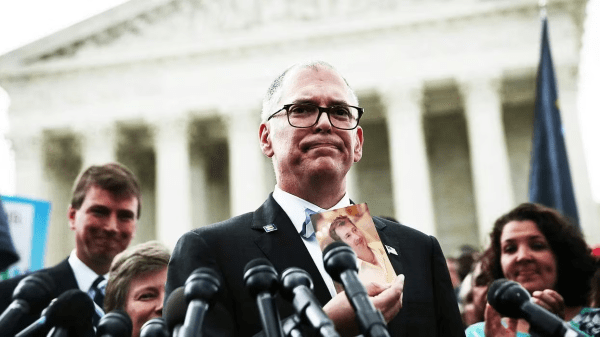
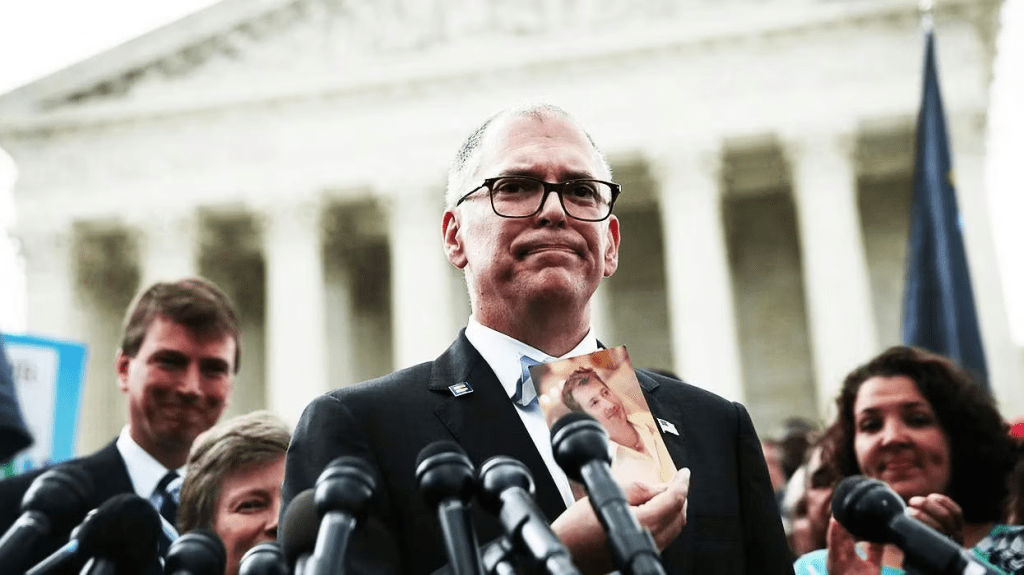
In separate interviews with The Advocate, Jim Obergefell, the plaintiff whose name now defines that right, and GLAD Law legal director Josh Rovenger described the moment as both surreal and revealing. One is the man who stood before the Court ten years ago and won the right to have his marriage recognized. The other works at the organization that helped secure that victory. Both see the Davis petition not just as a legal maneuver but as a test of whether the country can sustain a principle it once declared settled.
“A narrow case, shoehorning a broad agenda”
Rovenger explained what this case is and what it isn’t.
“This is a narrow case with a technical legal question,” he said, emphasizing that it concerns emotional-distress damages and qualified immunity, not marriage equality itself. “Attorneys who want to overturn Obergefell are trying to shoehorn that into a very narrow case.”
Davis, a former Rowan County clerk, was found liable for denying marriage licenses to same-sex couples in violation of clearly established law. A jury awarded damages to those couples, and the Sixth Circuit Court of Appeals affirmed the decision. Davis’s petition now asks the Supreme Court to review that ruling, Rovinger explained. While she has framed the case as one about her religious freedom, Rovenger said the issue before the Court remains technical.
“The Supreme Court receives thousands of petitions a year,” he said. “It would really be anomalous for them to take a case with such a narrow fact pattern and use it to revisit Obergefell.”
Still, Rovenger acknowledged why people are uneasy.
“Given the rollback of rights we’ve seen in other areas, Dobbs being the most prominent, that fear makes sense,” he said. “But this case is not the vehicle for that kind of sweeping reversal.”
The limits of the Respect for Marriage Act
Part of the current confusion, Rovenger said, stems from uncertainty about how the Respect for Marriage Act interacts with the Obergefell decision. The 2022 law, signed by President Joe Biden, requires states and the federal government to recognize marriages performed in other states. However, it does not compel every state to issue marriage licenses if Obergefell were to be overturned.
“In a world where Obergefell didn’t exist,” he said, “a couple married in one state would still have their marriage recognized federally and by other states, but not necessarily be able to marry everywhere.”
He called that distinction significant, not only for its practical consequences but for what it would signal about equality itself.
“A patchwork approach across states,” he said, “is fundamentally different from a nationwide right.”
Rovenger also pointed to the Supreme Court’s own language on “reliance interests” — the idea that people build their lives on the stability of established rights. Trump-appointed Justice Amy Coney Barrett, he noted, has recently said marriage equality has created such interests, making it less likely to be undone. Barrett had told the New York Times that Obergefell created “concrete reliance interests.”
“Those interests,” Rovinger said, “remain one of the critical factors the Court considers when deciding whether to revisit precedent.” According to Gallup, 68 percent of Americans support marriage equality.
Jim Obergefell: “Disgusted by this twisting of religious freedom”
For Jim Obergefell, the case is personal. He said he was “disgusted” that his fellow citizens would work against another group’s well-being and happiness, using religious liberty as an excuse.
“This modern version of religious freedom — this belief that one’s personal religion trumps everything else — is a twisting and perverting of what our founders intended,” he said.
Obergefell said Davis’s refusal to follow the law was emblematic of a broader problem: public officials placing private faith above civic duty.
“She swore an oath to serve all people,” he said. “And yet she used her government position to persecute others.”
His frustration extends to the justices themselves and their recent decisions, which have often ignored established understandings of the law. Justice Clarence Thomas recently said that past decisions “aren’t gospel.”
“Why should anyone feel secure about the right to marry,” he asked, “when this Court has proven it doesn’t believe in precedent?”
“One of those justices’ own marriage exists because of a Supreme Court decision,” Obergefell said, referring to Loving v. Virginia, the 1967 ruling that struck down bans on interracial marriage. Thomas is Black, and his wife, Ginny, is white. “If this Court overturns Obergefell, then what does that say about their own logic?” Obergefell added.
“People should be concerned”
Obergefell said that the LGBTQ+ community’s fear is warranted.
“Absolutely, people should be concerned. I’m concerned,” he said on Saturday. “Yesterday I officiated a wedding for a cousin who asked whether they should get married now instead of waiting. My answer was yes.”
He explained that even with the Respect for Marriage Act in place, states could still move swiftly to block new marriages if Obergefell were struck down.
“Ohio [where I live] still has a Defense of Marriage Act on the books,” he said. “If Obergefell is overturned, Ohio could immediately say, ‘no more marriage licenses for queer couples.’”
Obergefell warned that political forces aligned against LGBTQ+ rights have shown a willingness to manipulate electoral systems to maintain power.
“We have a political party that has turned its back on democracy,” he said. “They’re doing everything they can solely to remain in power — to punish and to be vindictive.”
A fragile majority, a durable principle
Despite deep pessimism about the Court, Obergefell said he still finds hope in younger generations.
“They don’t see difference the way older generations do,” he said. “There are millions of people out there who share my values, who believe in humanity, who believe every person deserves happiness and rights. That gives me hope.”
Rovenger echoed the sentiment, though his version is more procedural.
“We’re all watching closely,” he said. “We’ll keep an eye on whether the case gets relisted and on any separate statements that come out. But we’re not panicking. We’re prepared for all possibilities and ready to meet that moment if it comes.”
For now, the fate of Obergefell doesn’t hinge on oral arguments or public hearings but on what happens in a private conference room inside the marble halls of the Supreme Court. Whether the justices see the Davis case as a technical dispute or a cultural flashpoint will determine not only one woman’s liability but perhaps the trajectory of a right that has defined a generation.
If the Court declines to hear the case, the lower-court rulings stand, and marriage equality remains intact. If it grants review, the nation will enter another defining chapter in its legal history.
Either way, Obergefell’s warning lingers: “They’ve turned the idea of freedom on its head,” he said. “And unless we stand up for what it truly means, we risk losing more than marriage, and we risk losing the very promise of equality itself.”
The Texas Supreme Court on Friday gave judges in the state a pass if they don’t want to marry same-sex couples, unilaterally granting public officials the right to discriminate against queer couples.
In an end run around equal protection concerns, the high court amended the Texas Code of Judicial Conduct to read, “It is not a violation of these canons for a judge to publicly refrain from performing a wedding ceremony based upon a sincerely held religious belief.”
The change follows years of litigation that inspired a lawsuit by a county judge in Texas asking federal courts to declare that Texas law does not and cannot punish him for his practice of officiating opposite-sex, but not same-sex, marriages in the state.
Jack County Judge Brian Umphress, who sued in 2020 because he only wanted to perform weddings for opposite-sex couples, argued that his conduct would run afoul of the Texas State Commission on Judicial Conduct, despite protections he believed he enjoyed consistent with his religious freedom rights under the First and Fourteenth Amendments, Houston Public Media reports.
In response, the U.S. Court of Appeals for the Fifth Circuit put the lower federal-court proceedings on hold and asked the Texas Supreme Court to answer the question, “Does Canon 4A(1) of the Texas Code of Judicial Conduct prohibit judges from publicly refusing, for moral or religious reasons, to perform same-sex weddings while continuing to perform opposite-sex weddings?” That part of the code requires judges to refrain from behavior that would “cast reasonable doubt on the judge’s capacity to act impartially as a judge.”
The high court’s answer came with the amended code of conduct, bypassing public argument.
Judge Umphress’ fear of sanction for his discriminatory conduct was based on the case of McLennan County Justice of the Peace Dianne Hensley in Waco, who spent years in court arguing she had a right to refuse to marry gay couples.
Hensley replied to requests from gay couples with a statement that read, “I’m sorry, but Judge Hensley has a sincerely held religious belief as a Christian, and will not be able to perform any same-sex weddings.”
That conduct earned a public warning from the Judicial Conduct Commission, which said Hensley was violating a requirement that justices of the peace be impartial, even in extrajudicial duties like officiating weddings.
Her refusal to treat LGBTQ+ people equally cast “doubt on her capacity to act impartially to persons appearing before her as a judge due to the person’s sexual orientation,” the commission wrote.
Hensley claimed that no one’s rights were denied since a same-sex couple could have found another judge to marry them, despite the fact that she was the only justice of the peace performing marriages in Waco at the time.
Hensley filed a lawsuit against the commission with help from the First Liberty Institute, a Texas-based anti-LGBTQ+ legal organization, arguing for protections under the Texas Religious Freedom Restoration Act. The commission eventually dismissed its sanction a few months after the Texas Supreme Court allowed Hensley’s case to proceed.
That decision from the Texas high court earned Hensley a supportive concurring opinion from the chief justice, who publicly supported the Waco judge before his appointment.
“Judge Hensley treated them respectfully,” Chief Justice Jimmy Blacklock wrote of the couples she refused to marry. “They got married nearby. They went about their lives. Judge Hensley went back to work, her Christian conscience clean, her knees bent only to her God. Sounds like a win-win.”
Jason Mazzone, a law professor at the University of Illinois at Urbana-Champaign who’s familiar with both cases, said the Texas Supreme Court’s code of conduct workaround still leaves open the possibility for a gay couple with standing to challenge a judge’s decision not to marry them on constitutional equal protection grounds.
“One of the claims that I think will be made in response to litigation that is likely is that, ‘Well, there are other people who can perform the wedding ceremony, so you can’t insist that a particular judge do it,’” Mazzone said. “But that, of course, is not how equal protection works, and it’s not how we expect government officials to operate.”





 fleeredstates.blog
You must be logged in to post a comment.