Tennessee lawmakers have advanced a host of anti-LGBTQ bills that would run counter to U.S. Supreme Court precedent.
Two measures, both proposed by Rep. Gino Bulso, R-Franklin, would challenge landmark cases that legalized same-sex marriage and established protections for discrimination based on sexual orientation or gender identity.
Rep. Gloria Johnson, D-Knoxville, questioned the legality to going against Bostock v. Clayton County, which established that LGBTQ people are protected from discrimination under the Civil Rights Act of 1964.
“We’re talking about federal law that supersedes state law,” Johnson said. “You can’t just ignore the federal law. So, therein is the problem for those of us who believe in our U.S. Constitution.”
Bulso answered, arguing that, “The Civil Rights Act of 1964 does not govern all employers. It only governs employers with more than 15 employees.”
The legislation, Bulso said, would only apply to small businesses — but could jeopardize federal funding by putting the state at odds with federal law.
There’s a similar fiscal note on another of Bulso’s bills that would challenge Obergefell v. Hodges. Bulso argued that the opinion only dictates that public actors must recognize same-sex marriages, not private citizens.
Tom Lee, member of the Board of Directors of the Tennessee Pride Chamber, spoke against the bill, arguing that it could allow discrimination against LGBTQ couples.
“Imagine if under this bill a private employer said, ‘Well, you can’t take family leave because I, as a private citizen, don’t recognize — using the language of the bill — your purported marriage,’” Lee said. “Or a bank says, ‘You’ll pay the higher rate (for unmarried couples). We’re not bound by the 14th Amendment. You’re not married in our eyes.’”
Both measures advanced Wednesday along party lines.
Other measures proposed this year would expand previous bills aimed at LGBTQ Tennesseans. State law that allows teachers to ignore a student’s preferred pronouns would expand to include honorifics like “Mr.” or “Mrs,” and the state’s drag ban would expand the type of businesses that could be penalized under the law.
Marcus Ellsworth with the Tennessee Equality Project said that the legislature wants to consider queer people obscene at a time when all people, regardless of gender or sexuality, are struggling.
“What is actually obscene is that every year we have to watch our state prioritize wasting time, money, and resources, fabricating ways to hurt us,” Ellsworth said.
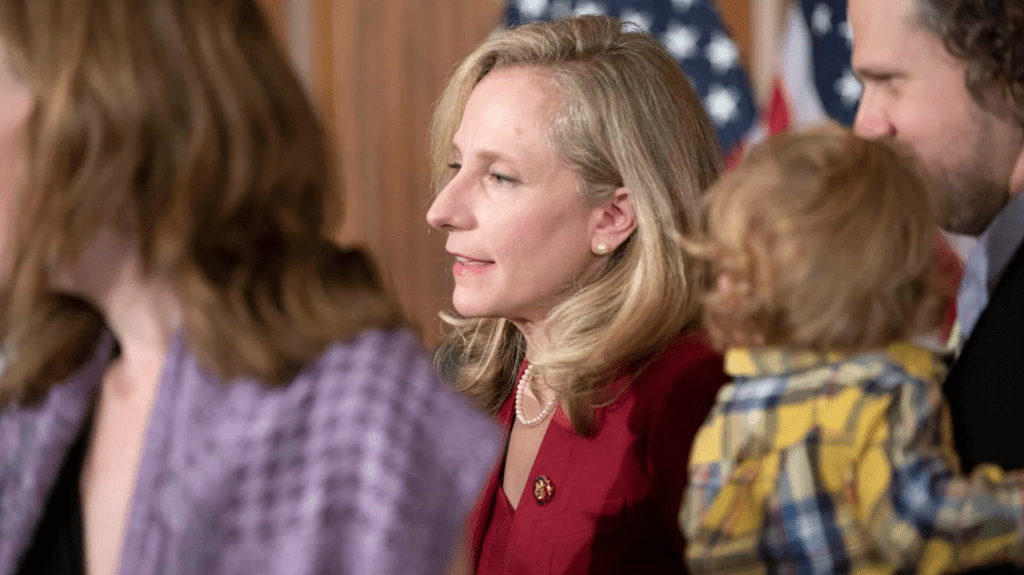
Virginia Gov. Abigail Spanberger (D) signed legislation that sent several potential state constitutional amendments to voters this past Friday, including a measure that would remove the state’s ban on same-sex marriage from the state constitution, which was originally passed in 2006.
While the state’s ban on marriage equality has not been enforced since the 2015 Obergefell v. Hodges Supreme Court decision, which legalized marriage equality in all 50 states, advocates for its removal say that it is discriminatory and could be enforced if Obergefell were ever overturned.
“We want to make sure that Virginia families know that here in Virginia, it is not just a Supreme Court decision that protects them, but it is also our state constitution,” Spanberger said in comments during the signing ceremony. “It’ll be a big step for Virginia to ensure that every family knows that Virginia is a place that welcomes them, appreciates them, and sees them for the wonderful family and Virginians that they are.”
“So before I get too emotional on that one, I will start signing.”
LGBTQ+ issues played a large role in the 2025 Virginia gubernatorial campaign, with Republican candidate Winsome Earle-Sears running ads throughout the election season that accused Spanberger of wanting “boys to play sports and share locker rooms with little girls” and letting “children change genders without telling their parents.”
At a debate later in the year, Spanberger pointed out Earle-Sears’ opposition to anti-discrimination laws and her opposition to marriage equality. Earle-Sears blurted out, “That’s not discrimination!” when Spanberger brought up how Earle-Sears believes “it’s OK for someone to be fired from their job for being gay.”
LGBTQ+ advocates hailed the marriage ballot initiative measure.
“Twenty years after banning marriage equality, it’s time for our commonwealth to fully complete our evolution – and finish the job on protecting marriage equality for all,” said Equality Virginia Executive Director Narissa Rahaman in a statement. “It’s up to all of us to vote on November 3, 2026 to safeguard marriage for all Virginians and remove the stain that exists in our constitution. We have come too far over the past 20 years to have any doubt that Virginia voters will support love and dignity for all couples this November.”
Spanberger also signed a bill that will send a reproductive rights amendment to voters in the fall. The proposed amendment would give Virginians a right to reproductive health care and include IVF, contraception, and abortion.
“This amendment protects families’ entire scope of reproductive needs,” said state Sen. Jennifer Boysko (D), who introduced it in the Virginia Senate.
“I look forward to spending ample time in advance of the 2026 elections campaigning to make sure that people understand the importance of this constitutional amendment,” Gov. Spanberger said last year, according to the Virginia Mercury.
Spanberger sent two other constitutional amendments to voters on Friday. One would automatically restore voting rights for convicted felons who finished their prison sentences (they currently have to appeal to the governer after their sentences are over to get their voting rights back), and the other would allow the state’s General Assembly to change the state’s congressional district map in the middle of decades in order to respond to other states doing the same, according to WOBC.
Texas judges can decline to perform same-sex weddings because of their “sincerely held religious belief” and not be in violation of the rules on judicial impartiality, according to the Texas Supreme Court.
A lawsuit is being brought by Judge Brian Keith Umphress in Jack County, Texas, against the Texas State Commission on Judicial Conduct. In November 2019, the commission issued a “public warning” to Dianne Hensley, a justice of the peace who recused herself from officiating at same-sex weddings, according to coverage by Legal Newsline.
Umphress later sued the commission’s members, citing that a judge’s refusal to officiate only same-sex unions could result in sanctions by the commission and violate his federal constitutional rights.
He is seeking declaratory and injunctive relief to restrain the commission from punishing judges for not performing same-sex marriage ceremonies, for either religious or secular reasons.
A court found Japan’s refusal to legalize same-sex marriage was constitutional Friday in the last of six cases that are expected to be brought to the Supreme Court for a final and definitive ruling, possibly next year.
The Tokyo High Court said marriage under the law is largely expected to be a union between men and women in a decision that reversed a lower court ruling last year and was the first loss at high courts in the six cases brought by those seeking equal marriage rights.
Judge Ayumi Higashi said a legal definition of a family as a unit between a couple and their children is rational and that exclusion of same-sex marriage is valid. The court also dismissed damages of 1 million yen ($6,400) each sought by eight sexual minorities seeking equal marital rights.
Plaintiffs and their lawyers said the decision was unjust but they were determined to keep fighting through the Supreme Court.
“I’m so disappointed,” plaintiff Hiromi Hatogai told reporters outside the court. “Rather than sorrow, I’m outraged and appalled by the decision. Were the judges listening to us?”
“We only want to be able to marry and be happy, just like anyone else,” said another plaintiff, Rie Fukuda. “I believe the society is changing. We won’t give up.”
With all six high court cases done, the Supreme Court is expected to handle all appeals and make a decision.
Though discrimination still exists at school, work and elsewhere, public backing for legalizing same-sex marriage and support in the business community have rapidly increased in recent years.
Japan is the only member of the Group of Seven industrialized countries that does not recognize same-sex marriage or provide any other form of legally binding protection for LGBTQ+ couples.
Prime Minister Sanae Takaichi ‘s conservative ruling Liberal Democratic Party is the main opponent of same-sex marital rights in Japan. The government has argued that marriage under civil law does not cover same-sex couples and places importance on natural reproduction.
More than 30 plaintiffs have joined the lawsuits on marriage equality filed across Japan since 2019. They argue that civil law provisions barring same-sex marriage violate the Constitutional right to equality and freedom of marriage.
Friday’s ruling was only the second that found the current government policy constitutional after the 2022 Osaka District Court decision.
The European Court of Justice has issued a ruling that all nations in the European Union (EU) must recognize lawful same-sex marriages that were performed in other EU countries. Previously, a country could refuse to recognize a marriage if it had taken place in another country and did not align with its own laws.
The court declared that EU citizens have a right to “a normal family life” regardless of borders. “When they create a family life in a host member state,” they said, “in particular by virtue of marriage, they must have the certainty to be able to pursue that family life upon returning to their member state of origin.”
Citizens of the European Union have the right to freedom of movement between the different nations within the union. The court suggested that this right, as well as the right to “respect for private and family life,” would be breached if one country could refuse to acknowledge a lawful marriage from another country.
The court added in a press release, “Member States are therefore required to recognize, for the purpose of the exercise of the rights conferred by EU law, the marital status lawfully acquired in another Member State.”
The case was brought to the Luxembourg-based court on behalf of a Polish couple who had been married in Berlin, Germany, where same-sex marriage is recognized. When, years later, they returned to their home country, they submitted their marriage certificate, which was in German, to the Polish government to be transcribed and recognized in the Polish civil register.
The Polish government denied their request, as the country does not recognize same-sex marriages. With this new ruling, they will no longer be able to refuse legally.
Of the 27 EU member states, only 18 have legalized same-sex marriage.
LGBTQ+ rights have taken some big hits in Poland in recent years. The far-right Law and Justice Party held power from 2015 to 2023 and enacted a range of anti-LGBTQ+ policies during that time. It was only in April of this year that the last “LGBT-free” zone created by the party was finally repealed.
Poland is currently led by a coalition government. The prime minister, Donald Tusk, campaigned on introducing same-sex civil unions and has pushed for such legislation to be passed. However, Poland’s president, Karol Nawrocki of the Law and Justice Party, has said that he would veto any legislation that would legalize same-sex marriage.
South Korea made a quiet but meaningful policy change in October. For the first time, the national census now allows same-sex couples living together to identify each other as “spouse” in official records.
While this adjustment does not confer any legal rights, it marks a symbolic step in recognizing LGBTQ+ households in the state’s demographic data.
But as same-sex couples slowly appear in national statistics, legal marriage still remains out of reach. And public support for it is not growing. In fact, it is recently shrinking.
Two major opinion surveys in 2025 have confirmed the trend. In a Hankook Research poll, 31 percent of South Koreans said they supported the legalization of same-sex marriage, down from 36 percent in 2021. In a separate survey by Gallup Korea, 34 percent backed legalization while 58 percent opposed it, a reversal that returns the numbers to where they stood nearly a decade ago.
Although many advocates have long assumed that rising visibility and generational change would drive progress, the latest data presents a different picture. The Korea Herald consulted two advocates who argue that it may be time to ask a different question: Does same-sex marriage need broad public support to move forward, or can the law lead the way?
Public may seem unsure until ‘law decides for them’
Yi Ho-rim, executive director of Marriage for All Korea, a leading local LGBTQ+ advocacy group, sees this moment as a reminder that legal change is not always a popularity contest. “The support for legalization has declined somewhat, but that doesn’t mean the conversation is stagnant,” Yi said.
“In fact, we see the current moment as a result of political polarization, not public apathy.”
Yi links the decline to the broader social climate. “Far-right mobilization earlier this year, combined with heightened political tension and increased online radicalization among young men, likely influenced the shift,” she noted. “When public discourse is overwhelmed by noise and fear, minority issues like same-sex marriage naturally become sidelined.”
Yi has argued that laws can reshape public perception. “In Taiwan, support for same-sex marriage was limited before legalization in 2019. But once the law passed, social attitudes evolved quickly. That pattern is not unique to Taiwan. We’ve seen similar changes in many countries.”
This pattern is not just anecdotal. Yi points to a notable case in South Korea’s own polling history. “There’s no way to prove causality,” she said, “but it’s hard to see it as a coincidence that Gallup Korea’s support numbers jumped by 10 percentage points between 2013 and 2014, exactly when countries like New Zealand, France and several US states made headlines by legalizing same-sex marriage.”
Park Dae-seung, a political philosopher at Seoul National University and director of the Institute for Inequality and Citizenship in Seoul, agrees. “Constitutional democracies are designed to protect minority rights, even when those rights are unpopular,” Park said.
“Laws that affirm dignity and equality are rarely embraced by a majority at first. But they send a powerful social signal. They tell people what is ‘normal’. In other words, it’s the law that decides for them what’s acceptable.”
“Korean politicians routinely cite ‘lack of public consensus’ as a reason to delay bills like the Life Partnership Act or Marriage Equality Act, both of which remain stalled in the National Assembly for years,” he added. “But it’s an excuse.”
While younger South Koreans have historically been more supportive of LGBTQ+ rights, the generational divide is showing unexpected shifts. The latest Gallup Korea poll revealed that support for same-sex marriage among people in their 20s dropped by 15 percentage points between 2023 and 2025. At the same time, support among those over 70 nearly doubled, from 10 percent to 19 percent.
Yi sees this as a sign that older generations are not immovable. “These are people who still get most of their information from legacy media. When the 2024 Supreme Court ruling recognized same-sex cohabiting partners as eligible for health insurance benefits, it was widely reported. That may have helped normalize the issue.”
Groups like the Coalition Against Homosexuality and Same-Sex Marriage, backed by conservative Christian organizations, have actively resisted even symbolic shifts. In October, the group filed a criminal complaint against government officials who authorized same-sex partner recognition in the 2025 census. They claimed it violated the law by creating “false public records” and warned of a wider moral collapse.
Yi has contended that public discomfort should not be used to delay basic rights. “Many of these objections rely on the idea that LGBTQ+ people do not value love, care or long-term commitment,” she said.
“But that is only because most people have never met a same-sex couple in their daily lives. We are still largely invisible, and the numbers show it. In the 2025 Hankook Research survey, people who personally know an LGBTQ+ person were nearly twice as likely to support same-sex marriage. Visibility alone makes a real difference.”
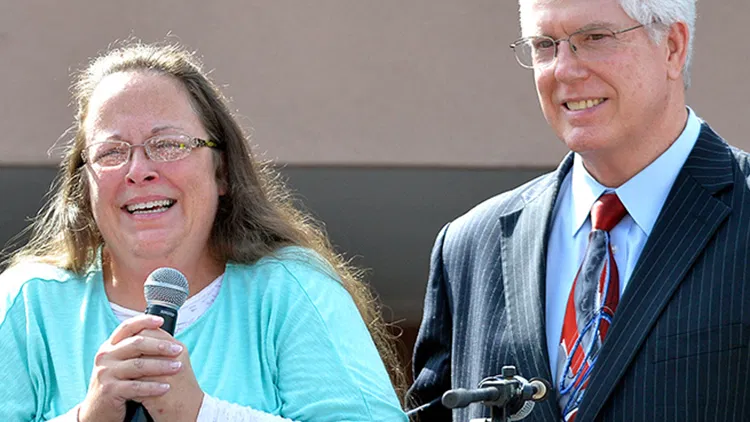
Liberty Counsel, the Christian hate group behind Kim Davis’s attempt to have the Supreme Court overturn its marriage equality decision, says their fight to end LGBTQ+ equality is far from over.
“I have no doubt that Davis’s resolve will serve as a catalyst to raise up many more challenges to the wrongly decided Obergefell opinion,” wrote Liberty Counsel President Mat Staver in a message on the group’s website. “Until then, we must pray, fight, and contend for when Obergefell is no longer the law of the land.”
The Supreme Court ruled in its 2015 Obergefell v. Hodges decision that people have a fundamental right to choose who to marry, regardless of their spouse’s gender. The decision legalized marriage equality in all 50 states.
A county clerk in Kentucky, Kim Davis, refused to issue marriage licenses to same-sex couples, which led to a lawsuit and ten years of legal fights.
This year, with help from the lawyers at Liberty Counsel, she filed an appeal to the Supreme Court to overturn a judgment against her that required her to pay $360,000 to a gay couple whom she had illegally denied a marriage license. In that petition, she asked the Supreme Court to end marriage equality, arguing that her case proved that LGBTQ+ equality was inherently a threat to the rights of Christians like herself.
Last week, the Supreme Court rejected her appeal, leaving its decision in favor of marriage rights in place for at least another year.
Anti-LGBTQ+ activists, though, aren’t going to give up.
“This time, Kim Davis is the victim of religious animus and is being deprived of her constitutional freedom of religion,” Staver wrote. “Tomorrow, it could be you.”
“This may mark the end of an era in litigating Davis’s case, but the fight to overturn Obergefell and protect religious liberty has just begun.”
Staver’s argument is similar to an argument that Justices Clarence Thomas and Samuel Alito made in 2020 that the mere existence of married same-sex couples is a violation of Christians’ religious freedom because seeing married same-sex couples encourages people to judge Christians “as bigots.” (That opinion was delivered in the context of a different appeal filed by Davis.)
“Since Obergefell, parties have continually attempted to label people of good will as bigots merely for refusing to alter their religious beliefs in the wake of prevailing orthodoxy,” Thomas wrote at the time.
The Supreme Court rejected a longshot effort Monday to overturn its ruling guaranteeing same-sex marriage nationwide.
Former Kentucky county clerk Kim Davis directly asked the justices to overrule the 2015 landmark decision after a jury awarded damages to a couple whom Davis refused to issue a marriage license.
“The Court can and should fix this mistake,” her attorneys wrote in court filings.
In a brief order, the justices declined to take up Davis’s appeal alongside dozens of other petitions up for consideration at the justices’ weekly closed-door conference. There were no noted dissents.
Court watchers viewed Davis’s appeal as a longshot effort, but it sparked trepidation among LGBTQ rights groups since several conservative justices who dissented in the decade-old case remain on the court.
Davis gained national attention after she raised religious objections to issuing marriage licenses to same-sex couples despite the Supreme Court’s decision in Obergefell v. Hodges.
Among the refused couples was David Ermold and David Moore, who sued. Davis was found to have violated a judge’s order in another case, which required her to keep issuing licenses.
Davis was jailed for five days, the couple obtained their license and Kentucky later passed a law enabling clerks to keep their signatures off marriage certificates.
But Davis kept fighting in court after the couple won $100,000 in emotional distress damages from a jury plus $260,000 in attorneys’ fees.
Primarily, Davis’s appeal concerned arguments that she has a private First Amendment religious defense against the award, despite acting as a government official.
She tacked onto it a request to overturn Obergefell outright, insisting the whole lawsuit would fall if the justices do so.
The Japanese government has expanded legal protections to same-sex couples.
According to The Japan Times, the government has decided to recognise same-sex couples as being in “de facto marriages” under nine additional laws, including the Disaster Condolence Grant law.
This follows a decision earlier this year to extend 24 existing laws – including the Domestic Violence Prevention Act, Land and House Lease Act, Child Abuse Prevention Act, and Public Housing Act – to same-sex couples.
Japan’s LGBTQIA+ community has long been engaged in a battle for marriage equality.
Currently, the country’s constitution defines marriage as “mutual consent between both sexes” and does not recognise marriage equality.
“From the perspective of individual dignity, it can be said that it is necessary to realise the benefits of same-sex couples being publicly recognised through official recognition,” the court said on 20 June.
“Public debate on what kind of system is appropriate for this has not been thoroughly carried out.”
A few months later, a Tokyo court upheld the ruling.
However, despite the court doubling down on its stance, the presiding judge also stated that the lack of a legal system and protections for same-sex couples infringes on their human rights (per CNN).
While the marriage equality movement in Japan has suffered a handful of setbacks, it has also seen a few notable wins over the last three years.
Last month, it was reported that the Supreme Court will formally consider a petition for a case calling on them to overturn their 2015 ruling in Obergefell v. Hodges, the historic ruling that made gay marriage legal nationwide. The petition comes from former Kentucky county clerk Kim Davis, who has made headlines and been embroiled in legal battles since she refused to sign marriage licenses for gay couples.
While Davis has been fighting against gay marriage since it was made legal, her lawyers have been doing it for longer. Davis is being represented by Liberty Counsel, a far-right Christian legal group and Southern Poverty Law Center-designated anti-LGBTQ hate group.
Since its inception in 1989, the group has opposed gay rights causes, including fighting against gay marriage, the legalization of homosexuality, and bans onconversion therapy. In one instance, the group’s Facebook cover photoreferenced the Bible verse Leviticus 20:13, which reads, “If a man has sexual relations with a man as one does with a woman, both of them have done what is detestable. They are to be put to death; their blood will be on their own heads.”
When asked about the cover photo, the group responded in an email that “Liberty Counsel has never promoted or condoned the killing of anyone or asked anyone to ‘like’ any quote about killing gays.”
Experts say Liberty Counsel is arguably more powerful than ever in 2025, fueled by publicity from Davis’ case and the opportunity to capitalize on a moment when American politics are stacked toward the right-wing—something that could upend gay marriage.
“The alignments will never be as favorable as they are at this moment,” Anne Nelson, author of “Shadow Network: Media, Money, and the Secret Hub of the Radical Right,” told Uncloseted Media. “That’s why they’re going for broke.”
History
Liberty Counsel was founded by preacher turned lawyer Mat Staver and his wife, Anita.
Mat Staver, who now serves as the chairman, senior pastor, and primary spokesperson for the group, authored the 2004 book “Same-sex Marriage: Putting Every Household at Risk,” where he wrote that “homosexuality is rooted in fractured emotions” and “a common thread in virtually every case is some sort of sexual or emotional brokenness.”
While the organization started operations solely in Florida, Mat Staver told the Orlando Sentinel shortly after Liberty Counsel launched that the group “would be a Christian antithesis to the ACLU” and that he “always felt the Lord calling [him] to combine [ministry and law] together.”
Liberty Counsel was active throughout the 1990s, with a focus on First Amendment cases, but Staver and his group didn’t gain national attention until 1994, when he argued before the Supreme Court for a case that challenged the constitutionality of a Florida court ruling that barred anti-abortion protests outside of a clinic. Some parts of the ruling were successfully overturned while others remained in place.
After that, the group built up a reputation for taking up cases related to religion in schools and other public institutions, including one instance where they threatened a lawsuit against one school for changing the lyrics of a Christmas song in a school play.
Attacking Gay Rights
After the turn of the century, Liberty Counsel became more active on gay issues. In 2003, they filed an amicus brief in Lawrence v. Texas, the case that decriminalized gay sex nationwide, arguing in favor of state laws banning it by saying that “deregulating human sexual relations will erode the institution of marriage.”
When California was taken to court over Proposition 8, a 2008 state constitutional amendment that sought to ban gay marriage in the state, Liberty Counsel attempted to be among the lawyers defending it. The group publicly criticized fellow far-right Christian legal group Alliance Defending Freedom for, in their view, arguing the case poorly.
One lawyer for Liberty Counsel also disagreed with legal positions taken by one pro-Prop 8 lawyer, who reportedly refused to argue that homosexuality is an “illness or disorder.” In their amicus brief in support of the proposition, Liberty Counsel argued that homosexuality “presents serious physical, emotional, mental, and other health-related risks.”
And in 2015, just months before the Obergefell ruling, the group offered to represent Alabama judges who refused to perform gay marriages after a state ban was overturned.
Once gay marriage became legal nationwide, Liberty Counsel took up Kim Davis’ case, which brought them more media attention than ever before.
“Kim Davis was a boon to Liberty Counsel,” says Peter Montgomery, research director at People for the American Way, an advocacy group aimed at challenging the far right. “[She] got them a huge amount of publicity, and I think they’ve really grown since they first took up her case.”
Much of the earned media from the Davis case, however, was negative. Liberty Counsel received criticism for encouraging Davis to continue refusing gay marriage licenses in violation of a court order. And even a Fox News panel of legal experts called Davis a “hypocrite” and Mat Staver’s legal arguments “stunningly obtuse” and “ridiculously stupid.”
In an email to Uncloseted Media, Liberty Counsel took issue with criticism of the group’s past litigation, writing that “[they] have 40 wins [they] briefed or argued at the US Supreme Court, including a 9-0 win in Shurtleff v. City of Boston.”
Liberty Counsel has created their own media, including a daily 11-minute radio broadcast, Faith and Freedom. Launched in 2010, the program is syndicated on 145 stations across the country and frequently contains anti-LGBTQ rhetoric, including assertions that LGBTQ-inclusive policies in the Boy Scouts create “a playground for pedophiles”; that gay people “know intuitively that what they are doing is immoral, unnatural, and self-destructive”; and that gay people are “not controlled by reason,” but rather “controlled by … lust.”
And after being boosted in popularity by Kim Davis, a 2016 CBS News investigation found that the group had worked with lawmakers in at least 20 states to author anti-LBGTQ bills, including trans bathroom bans.
“They’re pretty much anti-LGBT in every way you can be,” Montgomery told Uncloseted Media. “Staver is pretty shameless in lying about gay people and the laws.”
Why Now?
Davis’ case has fallen in and out of public attention over the years, with the Supreme Court rejecting a previous petition in 2020. Despite this, Liberty Counsel has remained confident in the case’s potential to upend gay marriage. In 2023, the group told their supporters in an email that they planned to use Davis’ case to persuade the Supreme Court to overturn Obergefell. These comments came a year after Supreme Court Justice Clarence Thomas expressed interest in reconsidering Obergefell in his opinion on the case that overturned Roe v. Wade.
“[The far right have] been working for decades to get their pieces in place, so at this particular moment, looking at the chessboard, they’ve got a critical mass of conservative states with Republicans in the state house, they’ve got the White House, they’ve got both houses of Congress, and they’ve got a majority on the Supreme Court,” says Nelson. “In a year, that could change.”
Increasing Notoriety
Montgomery says that Liberty Counsel’s popularity and influence has been on the rise since the start of the pandemic, when the group gained traction by opposing restrictions on churches meeting during COVID lockdowns. During this period, Staver claimed that COVID-19 vaccines are designed to “prevent people from procreating.”
“One of the ways that [Staver] has boosted his visibility and influence was riding that parade, which a number of people on the religious right did, and took advantage of the resentment of public health restrictions,” says Montgomery.
Since then, the group has falsely claimed that the Respect for Marriage Act “would allow pedophiles to marry children,” and Staver wrote in a newsletter that “the LGBTQ agenda seeks nothing less than to eliminate all religious freedom rights that might make them feel bad about their choices.”
In the meantime, affiliates of the group have been cozying up to the Supreme Court. In 2022, a representative of the Liberty Counsel-owned D.C. ministry Faith & Liberty was caught bragging about praying with Supreme Court justices just weeks after the court overturned Roe v. Wade. Staver told Rolling Stone these allegations are “entirely untrue.”
In his majority opinion on the case, Justice Alito cited an amicus brief filed by Liberty Counsel where the group argues that “the birth control and abortion movements are racist and eugenic.”
Part of a Bigger Picture
Liberty Counsel’s website reports that it generated nearly $28 million in revenue between July 1, 2023 and June 30, 2024. While their internal team has roughly 40 employees listed on LinkedIn, they have claimed to have anywhere from 90 to 700 affiliate attorneys across the country. Some of the group’s larger and more consistent donors reportedly include fracking baron Farris Wilks; the Christian TV network Good Life Broadcasting; and Liberty University, where Staver previously worked as dean of the law school.
“The big Christian nationalist and plutocratic donors understand that the Supreme Court, and the judiciary in general, are central to their aims … so over the past few decades they spent enormous sums grooming and promoting candidates for the judiciary whose interpretation of the law is favorable to their interests,” Katherine Stewart, an author and expert on religious nationalism, told Uncloseted Media in an email. “Liberty Counsel has successfully positioned itself as one of the players in that space. It only picks up a slice from the total pie, but the pie is so well-funded that even a slice is rich indeed.”
Beyond this, Liberty Counsel is affiliated with a number of other right-wing groups, several of which operate directly under the group’s umbrella. Staver holds leadership positions in other conservative groups, including Salt & Light Council and National Hispanic Christian Leadership Conference—the former of which has been outspokenly anti-LGBTQ. Liberty Counsel is also a member of the Remnant Alliance, a coalition of groups known for coordinating to elect Christian nationalist candidates to local school boards. A leaked membership directory from 2020 also listed Staver as a member of the Council for National Policy, a secretive group that includes Republican politicians and major leaders of Christian right organizations, though Staver told Uncloseted Media that Liberty Counsel and the Council for National Policy are not affiliated.
Nelson says connections like these allow different groups on the far right to coordinate together on anti-LGBTQ policies.
“They’ll have coordinated messaging about whatever campaign they’re launching at the moment. And it’s highly coordinated, as in the same story, the same language, the same spokespeople. It’s really quite impressive. And so all of a sudden there’ll be a story that will just erupt.”
The Council for National Policy did not respond to a request for comment.
When Liberty Counsel filed its most recent petition for Davis’ case to the Supreme Court, multiple right-wing media outlets whose leadership have been members of the Council for National Policy quickly covered the story with a favorable spin, including Salem Media Group, the WashingtonTimes and WorldNetDaily. And earlier this year, Staver networked at the National Religious Broadcasters conference, where he discussed plans to overturn Obergefell.
Montgomery says that this coordination is especially powerful because different groups are able to influence different spheres. For example, while Liberty Counsel pressures the courts, a group like Salt & Light Council works to activate supporters in ministry.
“They have this broader vision of wanting to change the culture and change the country,” he says. “They are all different approaches to moving the country in the direction they want: courts, legislative advocacy, lobbying, organizing, and media outreach.”
Nelson says the far right’s recent legal success is thanks in part to the influx of right-wing judges since the start of Trump’s first term.
“It’s worked initially with trying to get local and political opposition to these laws, and it’s linked to getting the appointments of judges who’ve had to pass a litmus test,” she says. “And then [their strategy involves] mounting the lawsuits, starting usually at the state level and working their way up the court system, specializing in states where they believe they’ll have sympathetic judges. … It’s gaming [the system].”
In an email to Uncloseted Media, Liberty Counsel says this characterization does not describe their litigation strategy.
What Does This Mean for Marriage Equality?
Despite all of this, many legal experts believe that this latest challenge to marriage equality is a long shot. Liberty Counsel’s arguments were largely rejected by a federal appeals court panel earlier this year, and several of the justices have shown little to no interest in revisiting Obergefell. Just this month, conservative Justice Amy Coney Barrett wrote that the right to marriage is “fundamental” and called for people to “tune … out” concerns about gay marriage being overturned.
However, given the current political moment, Nelson says that the threat to Obergefell should not be underestimated.
“This long-range strategy is coming to fruition, and a lot of the pieces are in place,” she says. “Under the current circumstances, with the current judiciary, they’ve got a reasonable chance of allowing states to ban same-sex marriages on a state level with an eye towards eventually banning it [on a nationwide level] in the future.”











 fleeredstates.blog
You must be logged in to post a comment.