
Read more at LGBTQ Nation.
This November, voters in six states will decide on eight LGBTQ+-related ballot measures, including four anti-trans sports bans in Colorado, Arizona, Nebraska, and Washington; two measures restricting gender-affirming care for transgender youth in Colorado and Missouri; a measure that could out LGBTQ+ kids to their potentially unsupportive parents in Washington; and one pro-LGBTQ+ measure to remove a state same-sex marriage ban in Virginia.
“This isn’t actually about giving voters a say in democracy. It’s a political tactic by a small but vocal minority of extremists who want to turn out their base, driven by the fear and misunderstandings about people who are transgender,” said Adam Snipes, the director of strategic partnerships at the Ballot Initiative Strategy Center, during a September 30 GLAAD media briefing attended by LGBTQ Nation.
Snipes is correct: anti-trans measures are being used as “ballot candy” to increase Republican turnout at the polls.
But statewide anti-trans proposals have dramatically increased since 2015, the year that the US Supreme Court legalized marriage equality. In 2016, North Carolina passed an anti-trans bathroom bill. Since then, similar anti-trans measures have expanded to sports, educational policies, healthcare, and other areas.
Approximately 91% of anti-trans bills fail in state legislatures, GLAAD’s senior director of news and campaigns Barbara Simon said. But such legislation and ballot measures give anti-LGBTQ+ politicians and activists “a permission slip” that emboldens them to use marginalizing and dehumanizing rhetoric that harms vulnerable youth, Simon said.
“This is really part of a national MAGA playbook, which is about distracting voters from real issues facing families — like high healthcare costs, gas costs, housing costs — and instead just flaming fears about a small, really already vulnerable group of people… in this case, LGBTQ+ kids,” Washington’s first out lesbian state House Speaker, Rep. Laurie Jinkins (D), told the press briefing.
Anti-trans sports bans in Colorado, Arizona, Nebraska, & Washington
Colorado, Arizona, Nebraska, and Washington are all considering ballot measures with nearly identical language that would ban students who are transgender from playing school sports on sex-segregated teams that differ from the sex they were assigned at birth. None of these measures take intersexuality into account, leaving intersex students unsure about their place on the sports field.
Generally speaking, these measures fall largely on young girls and women to “prove” their sex, often with invasive medical exams that aren’t usually part of standard athletic exams. (Athletic medical exams usually focus on athletes’ eyesight, bone health, as well as respiratory, cardiovascular, or other issues that could affect overexerted athletes.)
Medical examinations to verify athletes’ sex can violate the privacy of all young girls and women — causing a decrease in their sports participation overall. Furthermore, such exams may not be covered by patients’ health insurance plans, adding an extra financial burden for low-income families.
These measures undermine local control by overriding policies and recommendations already put in place by local school boards and associations that have articulated what’s best for their students’ needs. These ballot measures also do nothing to address the sexism, abuse, and poor funding that harm girls and women and discourage them from participating in sports to begin with.
Arizona’s Proposition 318
Based on a 2022 Arizona law that federal courts had blocked from enforcement (before the US Supreme Court ruled such bans as constitutional last June), the so-called “Protect Girls’ Sports in Arizona Act” would require K-12 schools and private sports leagues to designate which sports are sex-segregated and then decide participation based on the sex listed upon each player’s birth certificate.
Additionally, schools and private leagues would have to ban trans athletes from restrooms, showers, and locker rooms that don’t match the sex they were assigned at birth. The measure would allow athletes to sue schools or leagues that violate its provisions.
Darrell Hill, the policy director for ACLU of Arizona, told KTAR that facilities and cities could interpret the law too broadly and restrict restroom and locker room access to trans kids and adults in various situations that have nothing to do with sports participation. “It can really act as a big barrier for trans people to participate in public life,” he said.
While the measure seems to “verify” athletes’ sex via birth certificates, state Sen. Mitzi Epstein (D) said it would “subject girls to invasive inspections and questions about their gender,” effectively harming all girls and women (and communicating that they are less valued than boys and men), “in an effort to score political points by discriminating against trans girls.”
The Arizona Interscholastic Association says no trans student-athletes have tried to compete in the state since the 2022 law was signed. It’s unclear whether any tried to compete before the 2022 law was signed.
Colorado’s Proposition 134
Proposition 134 would then require K-12 schools, colleges, and athletic associations to designate sex-segregated and co-ed sports and then forbid boys from participating on girls’ teams and vice versa.
The measure would define girls as people with female reproductive organs and boys as those with male reproductive organs, but it’s unclear how sex would be determined. While some supporters say a doctor-signed form or a DNA cheek swab could suffice, opponents warn that it could subject girls to invasive genital inspections.
Z Williams, a school parent and director of Bread and Roses Legal Center, told The Colorado Sun, “Kids have been playing sports with trans kids for decades…. Playing sports is an important and healthy part of growing up: People building a sense of who they are, learning how to work with a team, learning to lose. To take that away from kids simply for who they are is absurd. It is socially and politically cruel.”
Chris Cook, the father of an 11-year-old transgender girl, told the aforementioned publication, “It would tell kids that simply participating in school sports could mean being questioned, scrutinized, or subject to invasive gender inspections to prove who they are. No child should have to live with that fear, and this doesn’t affect (just) transgender kids. When schools are asked to police students’ gender, any child who looks too tall, too strong, or doesn’t fit someone’s idea of what a girl should look like could be singled out.”
Nebraska’s Measure 442
Measure 442 would write into the state constitution a 2025 law, sponsored by state Sen. Kathleen Kauth (R), that already requires public K-12 and college athletes to play on teams matching their sex at birth. The measure defines one’s sex at birth as having a reproductive system that “does or at some point will produce, transport, and utilize” either eggs ( for a woman or girl) or sperm (for a man or boy).
The measure would apply to all athletic teams or sports sponsored by public schools, postsecondary educational institutions, private schools, or educational institutions that compete against public schools.
Interestingly, the state Supreme Court recently heard arguments challenging the measure’s legality. Opponents say that the ballot measure’s sponsors failed to “adequately inform the public of what they are trying to accomplish” when collecting signatures for the effort. The measure will appear on ballots regardless of the court’s decision; if the court rules against it, all votes upon it will simply be invalidated.
Washington’s Initiative IL26-638
IL26-638 would bar students who are “biologically male” from competing in K-12 schools and nonprofit sports teams designated for girls and women. The initiative would require every student who wants to compete in girls’ sports to obtain a signed statement from a health care provider verifying their sex. Students wanting to play on boys’ teams wouldn’t have to obtain any such statement.
The initiative permits three verification methods: genetic testing, testosterone measurement, or a visual examination of reproductive anatomy. Seeing as the first two methods are expensive and not covered by insurance, most parents will likely go for the third option, requiring kids to expose their genitals to adult medical professionals.
Over 100 doctors and other medical professionals recently released a statement against the initiative, with some saying they would refuse to conduct invasive exams to verify the sex of young girls and women.
“IL26-638 would make every girl in Washington who wants to compete in a female-only interscholastic sport prove her sex to a doctor, regularly, in order to play,” the Washington State PTA noted, calling the initiative “discriminatory,” “harmful,” and “disproportionate.”
Trans journalist Erin Reed noted that even if the measure passes, it could still face constitutional challenges under the longstanding legal precedent of Washington laws protecting trans students.
“Washington adopted an Equal Rights Amendment in 1972 declaring that ‘equality of rights and responsibility under the law shall not be denied or abridged on account of sex,’” Reed wrote. “That provision triggers strict scrutiny for claims of sex discrimination, a standard that would likely render a categorical ban on transgender participation in sports unconstitutional — particularly given the state’s more liberal judiciary.”
Restricting gender-affirming healthcare in Colorado and Missouri
Two states, Colorado and Missouri, both have ballot measures to restrict gender-affirming healthcare for trans youth. However, they differ in significant ways.
Colorado’s Proposition 135
Colorado’s Proposition 135 is a vaguely written measure that would forbid doctors from performing surgeries on anyone under 18 “for the purpose of altering biological sex characteristics,” including changes to sexual organs, body shape, facial appearance, or voice (even though such surgeries on minors are rare to nonexistent).
The measure would also ban state or federal funds, Medicaid, and private insurance from paying for these surgeries. Though the measure’s language doesn’t specifically mention transgender youth, its restrictions would apply to any young person. However, the law wouldn’t place any restrictions on prescribing hormone therapy, puberty blockers, counseling, or support for social transition.
The measure includes exceptions for male circumcision, people born with a “medically verifiable disorder of sex development,” and “acquired physical or chemical abnormalities,” meaning that intersex individuals could still be eligible for augmenting surgeries.
Nevertheless, the Colorado Medical Society opposes the measure (along with dozens of other LGBTQ+ and allied organizations statewide), saying it would interfere with doctors’ medical judgment. The measure is backed by Protect Kids Colorado, an organization led by anti-LGBTQ+ activist Erin Lee.
Jax Gonzalez, political director at One Colorado, said the measure’s vague language around a minor’s “perception of sex or gender” leaves both patients and providers unclear about what procedures would be prohibited.
“All of us have gender and have lots of ideas about that, and so, does that mean that if a patient brings up a conversation about their own gender, regardless of their general identity, does that mean that that provider can’t treat them anymore?” Gonzalez, who is trans, told News From the States.
Missouri’s Amendment 3
Missouri’s Amendment 3 main purpose is to repeal the abortion-rights amendment that voters approved in 2024 and to make most abortions illegal in the state, except for ones that are conducted in cases of medical emergencies, fetal anomalies, and within the first 12 weeks of pregnancies caused by rape or incest.
The final clause in the measure would “prohibit gender transition procedures for minors,” which is curious, seeing as the state has banned gender-transition surgeries for minors since August 2023. The measure would also ban puberty blockers and hormone replacement therapy for minors.
Currently, state law forbids any new prescriptions of the aforementioned medications for trans youth until 2027; the measure would write this ban into the state constitution, meaning it would continue indefinitely.
Forcibly outing trans students to their parents in Washington
Washington voters will consider IL26-001, a measure that would repeal the state’s current parents’ rights laws and replace them with language taken verbatim from Louisiana. The measure would give parents unrestricted access to school, medical, and mental health counseling records without requiring student consent, including information on confidential conversations about a child’s sexual orientation or gender identity.
“When a student … is dealing with anxiety, they need trusted adults and mental health resources they can turn to that help them make sense of their world,” the American Civil Liberties Union (ACLU) of Washington wrote in opposition to the measure. “[Allowing parents to view sensitive counseling records is a] violation of privacy [that] can undermine the relationships that students may have with counselors and other trusted adults in schools.”
“The sad truth is not all students have a supportive adult they can turn to and talk about their sexuality, gender identity, or mental health without fear. Allowing schools to disclose private health information — as IL26-001 proposes — would severely impact a student’s stability at home, at a time when they need love and support, not punishment and rejection,” the ACLU of Washington added.
Indeed, statistics show that 40% of homeless queer youth say they were kicked out of their homes when their families learn of their identities, meaning that the measure could worsen at-home conflicts for LGBTQ+ students with unsupportive or abusive parents.
This initiative and the state’s ballot measure banning trans athletes are opposed by state Gov. Bob Ferguson (D), the state’s US Sen. Patty Murray (D), the Washington State Parent-Teachers Association (PTA), by the Washington State Nurses Association, the League of Women Voters, and domestic violence prevention groups, because they put kids at greater risk of violence and harm.
Defending marriage equality in Virginia
A bright spot on the somewhat gloomy horizon, Virginia’s Question 2 asks voters to remove the state’s 2006 constitutional ban on same-sex marriage and to add a right to marry regardless of a partner’s sex, gender, or race.
The state’s current ban, rendered inactive by the US Supreme Court’s 2015 Obergefell v. Hodges decision legalizing marriage equality, defines marriage as “only a union between one man and one woman” and bans any union, partnership, or legal status for unmarried couples that carries the rights and benefits of marriage. Question 2 would remove all of this language and acknowledge that “Marriage is one of the vital personal rights essential to the orderly pursuit of happiness.”
Virginians approved their state’s same-sex marriage ban in 2006, with 57% voting yes. A federal judge struck it down in 2014, but it stayed in the state constitution. State election officials say the ban would become enforceable again if the US Supreme Court ever overturned Obergefell v. Hodges, as some of the court’s conservative justices have threatened.
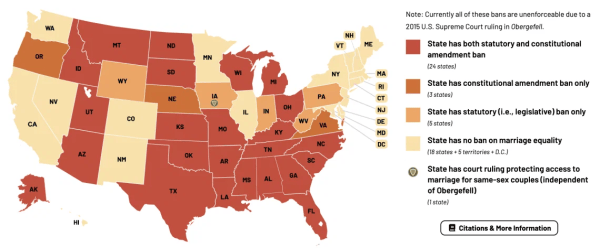
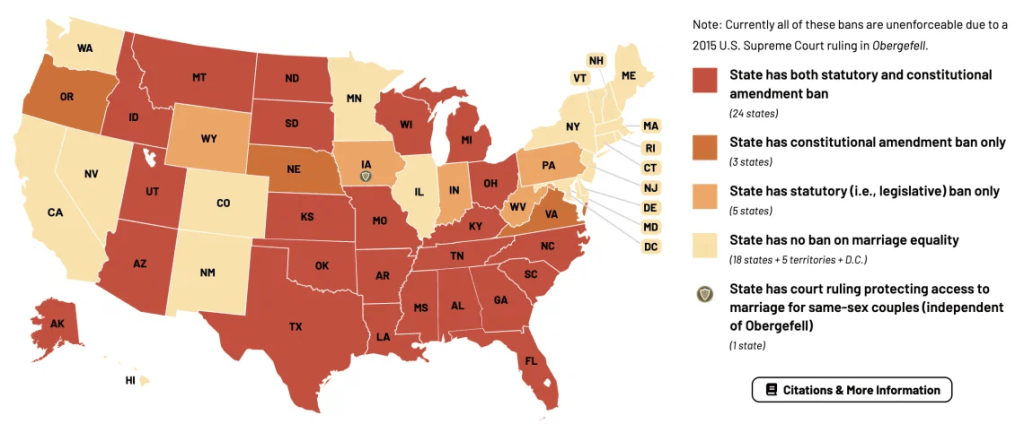
Currently, 24 states have dormant bans against same-sex marriage in both their state constitution and their statutes, five have such a ban in their statutes only, and three have such a ban in their constitution only, according to the Movement Advancement Project.
Since 2020, voters in four states have voted to repeal previously approved same-sex marriage bans. Nevada did in 2020, and California, Colorado, and Hawaii all did the same in 2024.
These ballot measures are about LGBTQ+ involvement in civic life
“As somebody who grew up trans, sports and other activities represented more than just competition,” Adrianna Suluai, the Policy & Advocacy Director at UTOPIA Washington, an organization dedicated to uplifting queer and transgender Pacific Islanders, told the press briefing.
“They were opportunities for me to participate, build confidence, and be around other young people and feel like I was a part of something. And when you’re a young person who may already feel different, sometimes simply having a place where you can show up and belong means everything,” Suluai added.
Suluai’s comment applies not only to the sports field but also to LGBTQ+ youth in classrooms, doctors’ and counselors’ offices, and the general public.
Because these ballot measures are often sold as ways to “protect children’ and strengthen “parental rights,” it’s all the more imperative that LGBTQ+ voters and allies understand them and share their potentially harmful consequences with other sympathetic voters.












You must be logged in to post a comment.