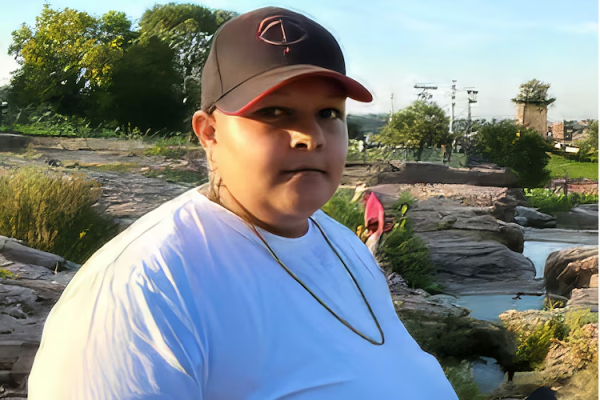
Gerika Mudra — an 18-year-old cis biracial lesbian high school student in Minnesota — filed a discrimination complaint against Buffalo Wild Wings, alleging that, while enjoying dinner with a friend around the Easter holiday in April, a female employee at the chicken restaurant’s Owatonna location followed her into the women’s restroom and demanded proof of her female gender.
Minnesota has no laws restricting restroom use by transgender people. However, Mudra’s lawsuit — filed with the Minnesota Department of Human Rights by the LGBTQ+-inclusive legal group Gender Justice — alleges that the employee violated the Minnesota Human Rights Act, a law that explicitly prohibits discrimination in public accommodations based on sexual orientation and gender identity.
The employee reportedly pounded on a bathroom stall door and said, “This is a women’s restroom. The man needs to get out of here.” When Mudra exited the stall, she told the employee, “I am a lady,” NBC News reported. The server reportedly responded, “You have to get out now.”
In response, Mudra unzipped her hoodie to show that she has breasts. (Mudra was wearing a shirt that covered her chest.) The employee reportedly said nothing in response, but left the restroom. Buffalo Wild Wings didn’t respond to NBC News’ request for comment.
“This wasn’t the first time something like this happened, but this is like the worst time,” Mudra said in a video created by Gender Justice. “This one… she was like, mad, screaming. She made me feel very uncomfortable.”
“After that, I just don’t like going in public bathrooms. I just hold it in,” she added. “I want to be able to use the bathroom in peace.”
Mudra’s stepmother, Shauna Otterness, said she was “enraged” upon hearing about the incident, which she called “cruel and humiliating.”
“We know Gerika was targeted because of how she looks,” Otterness said. “She didn’t do anything wrong. She just didn’t fit what that server thought a girl should look like. I was shocked and heartbroken by how many people shared similar stories after I posted about it online.”
“This shouldn’t be normal,” Otterness added. “We can do better, and we have to.”
The Minnesota Human Rights Act explicitly forbids discrimination based on gender identity, whether real or perceived. As such, if the employee’s behavior arose from the suspicion that Mudra was trans, the employee’s actions are still potentially illegal. Additionally, the law requires businesses to train staff, enforce anti-discrimination policies, and ensure their spaces are safe and welcoming to everyone, Gender Equity noted.
While Minnesota doesn’t have laws restricting trans people’s restroom use, 19 states do. Republicans nationwide have repeatedly accused trans women of “invading” women’s spaces to harm girls and women. No evidence shows that trans-inclusive restroom policies contribute to a rise in restroom-related assaults.
Gender Justice also noted that nearly one-third of LGBTQ+ people report experiencing harassment for using a bathroom, and nearly 60% of trans people have avoided using public restrooms out of fear of harassment or violence.
“The transphobia that’s happening, it really affects everyone and it’s really bad for everyone because… there’s expectations about what women should look like, what women’s bodies should look like. And if you don’t meet those stereotypes, you’re gonna be targeted,” said Jess Braverman, Gender Justice’s legal director.
Holding one’s bodily waste to avoid restrooms can result in increased urinary tract infections, constipation, the presence of blood in the urine, and even kidney disease, according to the American Medical Association. Exclusionary bathroom policies can also contribute to increased anxiety, depression, and suicidality amongst trans individuals, according to the National Institutes of Health.
“Black girls and women also face relentless policing of their appearance and identity. In schools, they are suspended at six times the rate of white girls, often for subjective reasons tied to how they dress, speak, or wear their hair,” Gender Justice added. “These same biases follow them into places like restaurants and bathrooms where they are often treated as suspicious or out of place for simply being themselves.”
Morgan Peterson, Gender Justice’s executive director, said, “A growing culture of suspicion and control is targeting trans, gender-nonconforming, and Black girls and women—anyone who doesn’t match narrow ideas of how women should look or behave. When people are harassed just for existing, none of us are truly safe.”
Cis women are regularly harassed because of transphobic restroom policies
In January, anti-trans Rep. Lauren Boebert (R-CO) reportedly told a cis woman in a Capitol women’s restroom, “You shouldn’t be here,” before storming back into the restroom with her transphobic colleague, Rep. Nancy Mace (R-SC), only to realize the woman wasn’t trans.
“I made an error regarding a mistaken identity,” Boebert said in a statement after the incident. “I apologized, learned a lesson, and it won’t happen again.”
In November 2022, a cisgender woman harassed another cis woman with short hair in the public restroom of the Rampart Casino in Las Vegas, Nevada, because she thought she was transgender.
Karma Yoakum had been part of a community of political activists in Texas for years. However, as the relentless tide of anti-trans legislation kept rising, it became clear that it was time for them to relocate, recover their energies, and take on a different role in the larger fight.
Finding a new home in the Pacific Northwest, Karma was able to do just that. But the road wasn’t without its challenges, and finding their new community required intention and perseverance once they had recovered a little bit of who they were by living in a state that wasn’t trying to persecute them for their existence.
As anti-trans sentiment and legislation have been on the rise across the United States in recent years, many trans and nonbinary people have made the difficult decision to flee red states. In moving to a bluer state, trans people are making a choice based on safety, but that doesn’t make it an easy choice. It means leaving behind a home and community you have built over years or your whole life because of the machinations of people who hate you. While a new state can fix a lot of problems, building a new community doesn’t happen overnight. The president’s re-election and the introduction of federal anti-trans bills have created a flashpoint for even more trans people to seek safer pastures in states that might protect them.
I wanted to understand the challenges and opportunities that trans people face when starting over and building a new community in a blue state. I spoke with four trans and nonbinary people who have relocated in the last six to twelve months. They shared the challenges, the successes, and advice for others who are considering relocating to a sanctuary state.
Why trans people are leaving their red state communities
Major relocations often happen around an institution, such as going to college or starting a new job. But moves like those come with some built-in community-building support.
Relocating as a refugee from a red state can be a more lonely affair. Most of the people I spoke with found that building a new community felt like work exacerbated by not having the same connections and support systems they had in the communities they left behind.
Clark Roman had been well-established in St. Louis. Both Clark and his boyfriend had owned their own houses and had a strong community of friends and chosen family in the city. But he says he saw the writing on the wall in 2023 when the Missouri attorney general enacted a de facto ban on trans hormones and trans healthcare that included adults. While his emergency rule was blocked by a judge and then withdrawn, the legislature went on to pass a gender-affirming care ban for trans youth. It was clear where things were headed, and Clark moved to Minneapolis a few months later.
Leaving behind a large community, both queer-centric and otherwise, Clark has found it hard to make more connections in his new city. At the center of it is the challenge of the modern age: balancing work and social life. “The honest truth is I have a very, very stressful job and I have not had the space in my life to build community the way I want.” He noted that it felt like he had to “treat building a new community as a second job.”
Karma also struggled to make connections when they first relocated from Texas to Washington state. After living in Texas for years, they reached a point where they found themselves saying, “I’m feeling scared and trapped and there’s absolutely nothing keeping me in Texas anymore.”
Karma moved 2,000 miles to Seattle but found a problem when they arrived. While their new home was more welcoming to the gender diverse, there was still culture shock to get over. “Where is everybody? I heard it was this wonderful panacea, a place where I would be welcomed. So, I looked around and I learned what the Seattle chill was. And it’s not a horrible thing, it’s just a difference in culture, because I’m used to southern culture.”
Chris (his name has been changed to protect his privacy) echoed Karma’s frustrations over Washington state’s laid-back attitude to building community. Like Clark, Chris was living in St. Louis, saw the anti-trans legislation in Missouri in 2023, and concluded that “living in Missouri as a trans human, [he] was at risk.” He made the move to Washington state in 2024 while watching the coming election without much hope.
While St. Louis had its flaws, Chris was leaving behind a lot of queer community and resources. He had worked with the St. Louis Metro Trans Umbrella Group for nearly 20 years, enjoyed events and meetups, and collected queer friends through meets at clubs, bars, and drag shows. But the same culture shock that Karma experienced has made it hard to build new connections: “It’s been honestly a huge struggle, much more than I anticipated.”
While it’s important to know that people are struggling with finding new communities in their new states, it’s not all doom and gloom. Clark and Chris have both been able to stay in touch with parts of their communities from before their moves through travel and online communication. While that’s not always the same, it’s a nice option to have. I also spoke with Mira Lazine – an LGBTQ Nation contributor – who relocated from Cincinnati to Minneapolis and had a different sort of experience.
While the Ohio governor vetoed HB 68, which banned gender-affirming care for minors, he then introduced care guidelines for the state. “These rules were basically going to amount to a total care ban for all adults in Ohio,” explained Mira. “And it even would include some aspects of conversion therapy and mental health treatment.”
It was time to relocate, and someone recommended Minneapolis. For Mira, finding a new community in this queer-friendly space came a lot easier.
“Within the first week of moving here, I went to a few coffee shops, and everyone, like the baristas, were trans, and they were recommending me support groups to join, discord servers I can join, like the whole nine yards. And it’s just been way easier to meet people and meet other queer people and form connections here.”
While Karma and Chris suffered from culture shock, Mira found herself among other transplants to the state who had their relocation in common: “Probably like 80% of the queer people I’ve met aren’t originally from Minnesota, so we’re all like, yeah, we need community, let’s build one.”
Finding new communities in blue states
All of the people that I spoke with had been in their new homes for less than a year. While there have been struggles, they have been able to find resources and spaces to start that community-building process and are in different places in their journeys.
Clark noted that his struggle to find community in Minneapolis is probably the biggest dissatisfaction in his life right now. But he can see a light at the end of the tunnel through some of the community spaces that he is attending. “The synagogue I go to is very open and trans-friendly. So that was helpful.” Clark is also looking at getting more involved with Transplants, a group for LGBTQ+ people who have relocated to Minneapolis and St. Paul.
Chris has found that his work at a university in Washington provides some space for community building. “Their DEI office held a holiday event for, I guess, everyone, but the folks who showed up to that event were primarily queer folks and persons of color. And that was fantastic.”
Chris still faces challenges, even at the events. He told me that he has been going to meet-up groups, Portland Pride, the Ingersoll Gender Center, and more, but he wasn’t satisfied with the results. Chris suggested that part of that problem might be visibility: “I am stealth, so at my workplace, I’m not fully out [as trans]. Where I landed is sort of a purple city in a blue state. I’m typically able to pass as male and not be questioned at all, which is, is nice, but at the same time, it’s hard because I think visibility might help me connect with more queer people.”
For Karma, their initial struggles with community-building in Seattle began to bear fruit around the one-year mark. “I did the things that I’ve tried before, and I figured, if they’ve worked everywhere else, they ought to work here. Maybe it just takes a little longer. And yeah, that was it. It takes a little longer.”
Karma found that organizations were the key. They found like-minded people when they returned to playing music with the local band that is part of the LGBTQ+ band organization, Pride Bands Alliance, an international group that Karma has worked with since the 1990s. Similarly, local chapters of a national support network have provided success in community building: “PFLAG, all you have to do is show up to a meeting. There are people there that if you need a hug, they are instant family. And people that aren’t instant family are there because they want support.”
Karma also reached into her past in political activism and found that, post-move, they had the energy to continue in their new home. “The third place that I decided to get involved was the Gender Justice League. Dealing with legislation, dealing with victims of violence here in the Seattle area. So, supporting our community, advocating like crazy.” After months of struggling to find their people, Karma now finds that barely a day on their calendar doesn’t include a community event, a catch-up, or a coffee meet.
No regrets
Everyone’s experience with relocating to a bluer state will be unique. However, there was one ringing agreement amongst all the people that I spoke with: no regrets. When asked what advice they had for someone considering a move, Clark, Chris, Mira, and Karma all urged people to relocate if they felt it might help.
Clark grieves what he left behind but recognizes that it was the right call for him, and he’s going to keep trying to find his new community. “I think it’s dissatisfying at first. But it’s important to [show] up repeatedly because I think that repeated showing up [is] how I made my community originally in St. Louis.”
Chris echoed those sentiments, noting that he has no regrets and that it has been “completely worth it.” Watching recent election results come in wouldn’t have been fun anywhere, but he was glad to be in a safe space for it all “despite challenges and some loneliness.”
Karma isn’t even considering going back. “I would say do it. The relief that I felt by at least being in a community where I know that I’d no longer have to deal with local politics.”
“In Texas, the local politics were against me,” they said. “At least here, I know locally and statewide, my representatives really do represent everybody, and they have my back. And that has made so much a difference in my life.”
Investigators probing what they described as the torturous killing of a 24-year-old transgender man in upstate New York, allegedly at the hands of five people, say they have found no evidence that the homicide was a hate crime.
The remains of the victim, identified as 24-year-old Sam Nordquist of Minnesota, were discovered on Wednesday in a field in Benton, New York, in Yates County, according to Capt. Kelly Swift, a New York State Police investigator.
Swift said investigators suspect that Nordquist was tortured and killed in neighboring Ontario County and moved “in an attempt to conceal a crime.”
“Based on evidence and witness statements, we have determined that Sam endured prolonged physical and psychological abuse at the hands of multiple individuals,” Swift said Friday during a news conference.
A criminal complaint obtained by Rochester, New York, ABC affiliate WHAM alleged that the suspects sexually assaulted Nordquist with a “table leg and broomstick.” The complaint further alleges that the suspects subjected Nordquist to “prolonged beatings by punching, kicking and striking [Nordquist] with numerous objects, including but not limited to sticks, dog toys, rope, bottles, belts, canes and wooden boards.”
According to the complaint, the torture allegedly took place in room 22 at Patty’s Lodge in Hopewell, New York, in Ontario County between Jan. 1 and Feb. 2.
Swift said investigators executed a search warrant at the hotel on Thursday, specifically searching room 22 for evidence.
“In my 20-year law enforcement career, this is one of the most horrific crimes I have ever investigated,” Swift added. “My thoughts are with Sam’s family during this time.”
Suspects charged with murder
The suspects arrested in the case were identified by Swift as Precious Arzuaga, 38, of Canandaigua, New York; Jennifer Quijano, 30, of Geneva, New York; Kyle Sage, 33, of Rochester, New York; Patrick Goodwin, 30, also of Canandaigua; and Emily Motyka, 19, of Lima, New York.
Ontario County District Attorney James Ritts said all five suspects have all been charged with second-degree murder under the state’s depraved indifference statute. He said the suspects have been arraigned and are being held without bail at the Ontario County Jail.
It was unclear if the suspects had hired or were appointed attorneys to represent them.
No indication of a hate crime
In a joint statement released on Sunday, the state police and Ritts addressed whether investigators are pursuing hate crime charges against the suspects.
“At this time we have no indication that Sam’s murder was a hate crime,” the joint statement reads. “To help alleviate the understandable concern his murder could be a hate crime, we are disclosing that Sam and his assailants were known to each other, identified as LGBTQ+, and at least one of the defendants lived with Sam in the time period leading up to the instant offense.”
Authorities said they released the information after getting “multiple inquiries from across our community, New York State and the entire nation.”
In the statement, officials noted that under the New York State penal code, a hate crime is defined as an offense committed “in whole or in substantial part because of a belief or perception regarding the race, color, national origin, ancestry, gender, gender identity or expression, religion, religious practice, age, disability or sexual orientation of a person regardless of whether the belief or perception is correct.”
“We are still in the early stages of this investigation,” the joint statement reads. “While significant evidence has been obtained, we are continuing to follow up on leads brought to State Police. We urge the community not to speculate into the motive behind the murder as we work to find justice for Sam.”
Governor described the killing as ‘sickening’
New York Gov. Kathy Hochul said in a statement released Sunday that she had directed the State Police to provide any support and resources to Ritts’ office “as they continue their investigation, including into whether this was a hate crime.” The statement further said that Hochul had directed the New York State Division of Human Rights Hate and Bias Prevention Unit to offer assistance and support “to all community members affected by this terrible act of violence,” adding, “There must be justice for Sam Nordquist.”
Hochul also said that she had instructed the New York State Office of Victim Services to offer support to Nordquist’s family.
“The charges against these individuals are sickening and all New Yorkers should join together to condemn this horrific act,” Hochul said in the statement. “We are praying for Sam Nordquist’s family, community and loved ones who are experiencing unimaginable grief.”
‘Beyond depraved’
“The facts and the circumstances of this crime are beyond depraved,” Ritts said Friday during the press conference. “This is by far the worst homicide investigation that our office has ever been part of. No human being should have to endure what Sam endured.”
Nordquist’s family filed a missing person report with the Canandaigua Police Department on Feb. 9, after last hearing from Nordquist on Jan. 1, according to a missing-person flyer issued by the Missing People in America organization.
According to the flyer, Nordquist’s family said he left Minnesota on Sept. 28, 2024, with a round-trip plane ticket to New York. The family, according to the flyer, alleged that he met a woman online who convinced him to visit her.
The family, according to the flyer, claimed Nordquist was planning to fly back to Minnesota within two weeks, but never boarded his return flight.
“I don’t understand why someone would do that to another person,” Kayla Nordquist, Sam’s sister, told Saint Paul, Minnesota, ABC affiliate KSTP. “Sam was amazing and would give the shirt off his back to anyone.”
When asked Friday about the missing-person flyer, Swift declined to comment.
Swift would not disclose details of the abuse, saying the investigation is in its early stages. However, she said, Nordquist was “subjected to repeated acts of violence and torture in a manner that ultimately led to his death.”
Swift said more arrests were possible and asked anyone with information about the crime to contact state police investigators.
Ritts said he anticipates a grand jury will take action in the case “very quickly.”
Multiple vigils for Nordquist are being scheduled this week in several states, including one Monday evening at the Wood Library in Canandaigua, New York, according to Family Counseling Service of the Finger Lakes, which is hosting the event. Two other vigils are planned for Monday night in Nordquist’s home state of Minnesota, including one outside the Minnesota State Capitol building in Saint Paul.
On Tuesday evening, vigils are scheduled to take place at the Phelps Arts Center in Phelps, New York, and at The Presbyterian Church in Geneva, New York. On Thursday, a vigil is scheduled to take place on the Main Plaza in downtown New Braunfels, Texas, about 30 miles northeast of San Antonio.





 fleeredstates.blog
You must be logged in to post a comment.