Americans’ support for same-sex marriage has dipped in the last year, according to a new poll.
In the Gallup poll, 65 percent of respondents said same-sex marriages “should be valid” under the law, while 32 percent said same-sex marriages “should not be valid” under the law. Three percent had no opinion.
Last May, 68 percent said same-sex marriages “should be valid” under the law and 29 percent said the marriages “should not be valid.” In May 2024, 69 percent backed the legality of same-sex marriages and 23 percent did not.
In recent years, Republican lawmakers in some states have called for the Supreme Court to reconsider its landmark Obergefell v. Hodges decision made in 2015, which guaranteed same-sex marriage nationwide. A number of GOP senators in 2022 voted against the Respect for Marriage Act, which protects same-sex and interracial marriages.
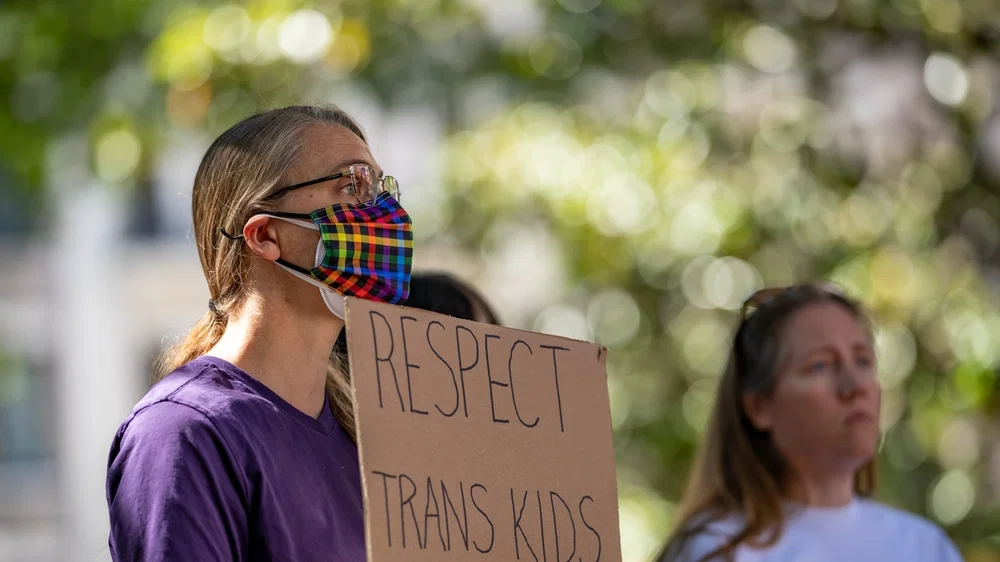
More recently, conservatives have increasingly targeted transgender people through efforts to limit access to gender-affirming care and restrict transgender children competing in sports categories aligned with their gender.
Tension boiled over between House Republicans concerning gay rights earlier this week, with GOP Rep. Mike Lawler (N.Y.) and former Rep. George Santos (R-N.Y.) pushing back on Rep. Andy Ogles (R-Tenn.) who made a now-deleted social media post saying that “homosexuality has no place in America.”
“Happy Nuclear Family Month,” Ogles added in the message, seemingly referencing Pride Month, which is celebrated in June.
In response to his Republican colleague, Lawler said, “Homosexuality exists. In America.”
“In fact, Andy, you have family, friends, neighbors, colleagues and constituents who are gay and lesbian. It doesn’t make them less than or somehow unworthy of being an American. What an absolutely idiotic statement to make.”
Ogles later told The Hill that he had not approved the post.
The Gallup poll took place from May 1 to 17, featuring 1,001 adults and a margin of error of 4 percentage points.
Maine’s Secretary of State Shenna Bellows (D) ruled on Tuesday that Protect Girls’ Sports in Maine, an anti-transgender campaign, submitted invalid and forged signatures in its bid for a November ballot measure that sought to ban trans students from school sports and restrooms. As a result, the measure will not appear on the voting ballot this November, Erin in the Morning reported.
The campaign, bankrolled by out-of-state billionaire Richard Uihlein, submitted 79,692 signatures — well over the 67,682 required to qualify. However, a court review of the campaign’s petitions in May invalidated 12,542 of the signatures, leaving the campaign 532 signatures short of the required number.
Some of the signatures were thrown out because the collectors didn’t witness the signing (as required by state law). Others were invalidated because the signatures did not match the voters’ signatures on voter registries, because the signatories signed more than once, because the signers weren’t registered voters, or because the signatures were forgeries. Collectors were paid $3 to $4 per signature.
Though Bellows approved the signed petitions as valid in March, following a court evidentiary review, she ruled on Tuesday that the petitions fell short of the required number of signatures to get the measure on the November ballot.
The ballot measure would’ve defined a student’s sex as “a biological status as male or female recorded at birth on the person’s original birth certificate,” effectively ending any legal recognition of trans students, not just in the cases of restrooms and sports. It also would’ve carved trans students out of legal protections enshrined in the Maine Human Rights Act (a statewide anti-discrimination law), and would’ve allowed cisgender students to sue any school that allowed trans students to use sex-segregated school spaces alongside them.
In a statement celebrating Bellows’ ruling, David Farmer, campaign manager for the Campaign for Free and Fair Schools coalition, said, “The paid, out-of-state signature gatherers and the billionaire who paid to try to put this question on the ballot failed to follow the rules. We believe that the appeals process and the reviews by the Secretary of State are working as the law intends. They are protecting the integrity of our elections.”
Even if voters had approved the measure in November, it would likely have faced legal challenges, since it would’ve resulted in trans students and their families facing harassment and discrimination.
Transgender journalist Erin Reed noted that Uihlein is a major funder of the American Principles Project, a right-wing conservative organization that has spent tens of millions on anti-trans election ads. Reed also noted that an independent analysis published by Atmos and HEATED found that 80% of the nation’s 45 major anti-trans organizations have gotten funding from billionaires or fossil fuel companies.
Reed also noted that anti-trans ballot measures will go in front of voters in both Washington and Colorado.
“Both efforts are also funded by conservative megadonors,” she wrote, “and both are part of the same strategy that produced the Maine initiative: Use ballot initiatives to roll back trans rights in states whose elected legislatures have refused to do so.”
Uihlein and Protect Girls Sports in Maine’s efforts came after Maine Gov. Janet Mills (D) repeatedly refused to comply with the president’s extortive attempts to withhold federal education funding in retaliation for the state’s trans-inclusive school policies.
The U.S. Department of Justice has sued Maine, challenging the state’s trans-inclusive interpretation of Title IX. That legal battle is currently ongoing.
Ghana’s parliament on Friday approved a new bill that criminalizes the so-called promotion of LGBTQ activity, part of a broader crackdown on sexual minorities in West Africa.
The Human Sexual Rights and Family Values Bill, 2025, passed by a voice vote after the Constitutional and Legal Affairs Committee unanimously recommended its adoption, first deputy speaker Bernard Ahiafor said.
The bill was introduced last year shortly after President John Dramani Mahama took office. Lawmakers from Mahama’s political party, the National Democratic Congress, had been urged by religious leaders and other supporters of the bill to vote on it, and Mahama will now face pressure to sign it.
Lawmakers passed an earlier version of the bill in 2024, under Mahama’s predecessor, President Nana Akufo-Addo, but it faced legal challenges and Akufo-Addo never signed it into law.
The bill approved on Friday maintains the existing penalty of up to three years in prison for same-sex sexual acts. It also bans “funding, sponsorship or promotion” of LGBTQ acts, with prison terms ranging from three to five years. And it introduces a “duty to report” prohibited LGBTQ acts to a police officer or other authorities, with violators facing up to three years behind bars.
The bill further amends Ghana’s Extradition Act of 1960 to make offences under the new law extraditable offences.
West Africa has seen a raft of anti-LGBTQ legislation in recent months.
Senegalese President Bassirou Diomaye Faye in March signed a bill doubling the maximum prison term for same-sex sexual acts to 10 years and criminalizing any efforts to promote homosexuality.
In September last year, lawmakers in Burkina Faso voted to criminalize same-sex sexual acts for the first time and to criminalize “behaviour likely to promote homosexual practices and similar practices.”
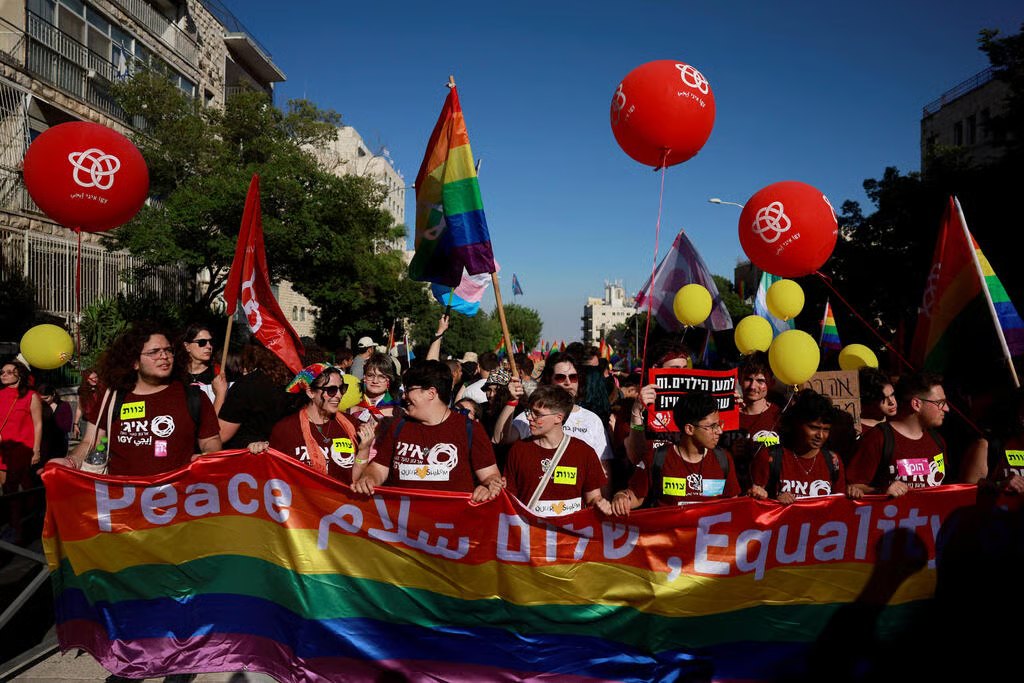
The Aguda – The Association for LGBTQ+ Equality in Israel published its 2025 Pride Index for local authorities on Thursday, with Ramat Gan, Rishon Lezion and Tel Aviv-Yafo taking first place with a perfect score of 110 points. Jerusalem, Ashkelon and Nahariya joined the index for the first time this year. The findings point to wide gaps between authorities: while some have implemented broad policies and permanent services for the LGBTQ+ community, others have taken little action in the field.
The Pride Index, published for the seventh year, was presented at the President’s Residence to President Isaac Herzog, with representatives of local authorities and the association in attendance. The index evaluates municipal policy toward the LGBTQ+ community in areas including education, welfare, public visibility, culture and organizational infrastructure. This year, 46 local authorities were assessed, with a maximum possible score of 110 points, including bonus questions.
According to the index, culture — including Pride events and year-round community activities — is the area receiving the greatest municipal investment, while education saw the lowest level of investment.
In the large-authority category (more than 100,000 residents), Ramat Gan, Rishon Lezion and Tel Aviv-Yafo ranked first with full scores of 110 points. They were followed by Haifa with 106 points and Herzliya with 104.
Netanya, which scored 99 points, received a special distinction for a “significant leap,” partly due to expanded activity in education, welfare and community services. In the medium-sized authority category, Givatayim and Ra’anana shared first place with 108 points, followed by Kiryat Bialik with 105 points and Ramat Hasharon with 104.
Among smaller authorities, Hof HaCarmel ranked first with 101 points, followed by Drom HaSharon with 98 points and Binyamina-Giv’at Ada with 86. Eight authorities joined the index for the first time this year: Azor, Ashkelon, Bnei Shimon, Tirat Carmel, Jerusalem, Nahariya, Katzrin and Kiryat Ono. The Aguda said participation itself marks “an important step in building a path and laying the foundations for community action.”
The data show the average municipal score this year stood at about 72.5 points. Alongside authorities that achieved especially high scores, others received very low marks, underscoring significant disparities in policy and services for the LGBTQ+ community across Israel.
Notably, despite the 46 authorities assessed this year, many municipalities in Israel still do not participate in the index at all — a fact the Aguda views as evidence that major gaps in attitudes toward the LGBTQ+ community remain between different local authorities nationwide.
Speaking at the ceremony, President Isaac Herzog said, “The Pride Index reflects the growing commitment of local authorities in Israel to the values of equality and human dignity.” Referring to Jerusalem’s inclusion in the index, he said it carried “special importance,” because “even amid complexity, it is possible and necessary to strengthen every person’s sense of belonging, security and dignity.”
Aguda chairperson attorney Nimrod Gorenstein said, “Local authorities are the community’s first line of defense.” He added: “Every authority has its own character, but all share a common responsibility to lead, set an example and show that it is possible to build a diverse, vibrant and safe society here.”
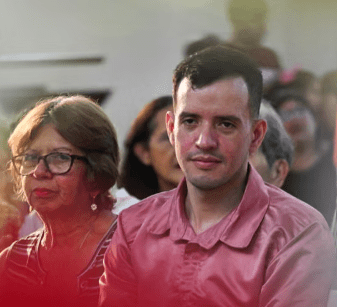
One of the Venezuelan men sent from the US to El Salvador’s most notorious prison by Donald Trump has moved to Spain to request asylum after concluding that he did not feel safe back home and did not trust US authorities sufficiently to return to fight his legal case.
Andry José Hernández Romero left Venezuela for Spain in early February and is due for his first asylum hearing in court there in a few days, hoping that the country’s liberal approach to immigration will afford him kinder treatment than the US or his own country had provided him, he revealed to the Guardian in his first interview since leaving for Europe.
The 33-year-old hairstylist and makeup artist originally came to the US from his home in western Venezuela to escape persecution as a gay man and the risks of opposing the government of its then president Nicolás Maduro.
Speaking in a video call fromsouthern Spain, Hernández is still recovering from the trauma of his experiences in Venezuela, the US and El Salvador, but expressed optimism about his new surroundings.
“I can say I feel safe here, this is a place where I can be reborn, heal my mental health, let people know about my abilities as a makeup artist and find the happiness they took away from me more than a year ago,” he said in the interview conducted in Spanish.
Hernández gained global attention last year when he and 252 other Venezuelan migrants were abruptly deported from the US without due process or any word to their families, and in defiance of a judge, and flown by the Trump administration to the brutal mega-prison for alleged terrorists in El Salvador known as Cecot.
Images of the bewildered and terrified group being roughed up and having their heads shaved, and then lined up on the ground with bowed heads, flashed around the world, a new symbol of the returning US president’s harsh anti-immigration agenda. They were held incommunicado for months in cages and initially given no prospect of release under allegations of having ties to a Venezuelan gang, which Hernández and the others vehemently denied.
International human rights groups found Hernández and the other detainees faced psychological and physical abuse, including cases of sexual violence, before they were suddenly released in a prisoner swap last summer and returned home.
Hernández received a jubilant reception. He began trying to rebuild his life, and he told the Guardian he initially promised his family he would never leave Venezuela again.
However, after a few weeks he began fearing for his life once more after a knock on his family’s door in Táchira.
“I had received a call from the vice-president’s office and I was offered a job, which I declined, and then they came to my house and my family had to tell them I wasn’t there,” Hernández said. He had actually hidden during the visit.
He explained that before the vice-president’s office could even specify the kind of job it wanted him to do, he refused it. It was August 2025 and Delcy Rodríguez ran the office. He didn’t want to have ties to a government that had persecuted him as a gay man, he said, and having officials coming to the house just made him convinced he was going to be surveilled by the authorities.
He was back home, surrounded by his family, feeling protected during a time that he had expected to be a rough transition into society, back at work and even making new friends.
Months later, Rodríguez was sworn in as the acting president of Venezuela following the capture of Maduro by the US military. Around the same time, Hernández made up his mind.
“That’s when I made the decision to come to Spain,” he said.
He has some relatives there and Venezuelans do not require a visa to enter Spain, while those fleeing persecution are allowed to request asylum.
“I have heard that Spain is a country with open policies towards immigrants and the LGBTQ+ communities and that they don’t experience discrimination,” said Hernández. He feels secure and optimistic about making another fresh start.
In March 2025, the Trump administration controversially invoked the Alien Enemies Act of 1798 to order the expulsion of Hernández and 136 other men who ended up in Cecot. Hernández was accused of being a member of the Venezuelan gang Tren de Aragua, which Trump designated a terrorist group and bizarrely accused of staging an invasion of the US.
It didn’t matter that Hernández had explained to immigration officials that he had fled Venezuela due to persecution stemming from his sexual orientation. His crown tattoos above the names of his parents were deemed proof of gang affiliation. He has denied the charge throughout his ordeal and his attorneys noted he has no criminal record.
Lindsay Toczylowski, co-founder of the Immigrant Defenders Law Center (ImmDef), who is acting as Hernández’s lawyer, said that in nearly two decades of helping asylum seekers from around the world fleeing violence, she had “never been in a situation where it was not safe for a client to seek protection in the US”.
The US federal judge James Boasberg ordered the Trump administration to facilitate the return of the men deported under the Alien Enemies Act to El Salvador and allow them to receive the due process that he ruled they had been denied. But most recently, a court of appeals blocked Boasberg from investigating whether the Trump administration knowingly defied his order from March 2025 to return the planes carrying Hernández and the other Venezuelan deportees.
“From a legal perspective, we believe that it’s important for him to clear his name if he wants to travel to the US in the future. But from a moral perspective, he was accused with absolutely no evidence of being part of something that he has never had anything to do with. No one should be accused of something like that without any option to refute the allegations,” said Toczylowski.
“There are no immediate options available for him [and the others] to finally have their day in court and be able to clear” their names, she added.
In Spain, where Hernández now waits for his first asylum interview, scheduled for the end of this month, officials have defied the increasingly harsh immigration policies being embraced in Europe and the US. Earlier this year, the Spanish prime minister, Pedro Sánchez, announced that Spain would grant legal status to roughly 500,000 migrant workers, most from Latin America.
Spain has a strong record of taking in immigrants, especially Venezuelans seeking international protection, like Hernández.
According to numbers shared by the Spanish government with the Guardian, Venezuelans made up the highest number of requests for international protection there in 2025. And up to 30 April this year, more than 25,000 Venezuelans have sought asylum in Spain.
Hernández said he is still marked by the trauma he endured during his time at Cecot. For example, when someone approaches him and simply taps him on the shoulder, his mind jumps back to the prison. He still wants to clear his name, though, but doesn’t know how to do so at the moment.
Remarkably, he said: “I don’t hold a grudge against the US. I can’t judge an entire country based on the actions of a group of people like Donald Trump [or] Kristi Noem, but entering the US at this time doesn’t guarantee I will keep my freedom and that is why I will continue to fight my case from Spain.
“Recovering my happiness will only be possible at the right place with the right people.”
For an American couple living abroad, you might think 4,000 miles between their adopted home country and the U.S. would help keep the political chaos across the Atlantic on mute.
You’d be wrong, says Bryan McColgan, who’s made a life with his husband in Sweden for the last seven years.
“While it can be easier to ‘turn off’ the political tumult in America, the truth is that America affects the entire world. Even in Sweden, we can’t escape the political and economic repercussions of America.”
McColgan’s husband, Victor, knew Sweden from a study-abroad program in college and loved it. Both men have Swedish ancestry. So the pair decided to pack up and move their lives and dog to Stockholm in 2019.
“Living in a different country means every day is a learning experience,” McColgan says. “After seven years, I am still learning every day, whether it’s the language, how things work, or some aspect of Swedish culture or history. It can be challenging not to feel 100% comfortable all the time, but this is also the best part of living abroad.”
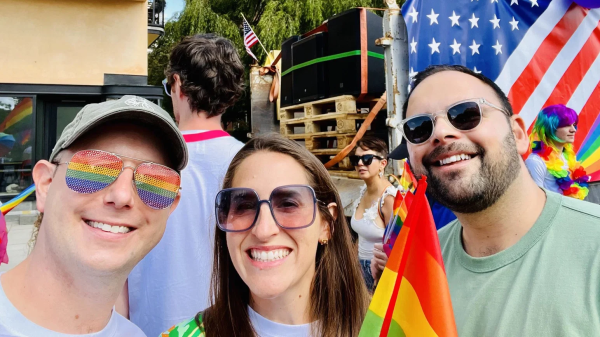
The couple stays connected with their compatriots through a group called Americans in Sweden. That’s how they ended up joining the U.S. Embassy for the Stockholm Pride parade in 2023, along with McColgan’s best friend on a visit to Sweden’s “endless summer.”
“While Stockholm is very dark and cold most of the year, the endless summer sun is a thing of beauty,” McColgan says.
Stockholm enjoys about 20 hours of daylight in peak summer. The parade stepped off that year on one of those “joyful days.”
“People lined up all along the parade route for miles. The American float was extremely popular at this time,” McColgan says. A DJ was spinning American hits while Bryan, Victor, Oriana, and a scrum of Americans in Sweden danced down the parade route.
“Swedes love music, and American music is some of the most popular in Sweden,” he says.
Two years later: record scratch.
The current administration ended the U.S. Embassy’s participation in Stockholm Pride and every other Pride celebration around the world in 2025.
“We have not engaged in any Embassy activities since then,” McColgan says.
Swedes don’t hold Americans responsible for the bad behavior of their government, he explains.
“I haven’t experienced any anti-American attitudes towards Americans in Sweden during my time here. Once I explain my political position and voting record, Swedes understand where I’m coming from and don’t ask me to defend myself.”
While Americans endure their own endless summers with a sundowning president, Bryan and Victor are enjoying Sweden’s “very open and accepting” embrace of them and the LGBTQ+ community.
“There is a respect for privacy and a lack of making LGBTQ+ issues political talking points,” he says. “People live their lives and focus on fixing the big problems that we all face.”
The same “values of equality, family-centricity, and open-mindedness” that Swedish immigrants brought to the U.S. are alive and well where they came from, McColgan says.
The European Union rejected a call to ban conversion therapy on Wednesday, even after over a million people petitioned for the ban in its 27 member states.
Last month, the European Parliament voted in favor of a ban on conversion therapy. The vote came after the European Citizens’ Initiative petitioned the European Parliament to take up the matter after 1.2 million people signed a petition.
The matter was then sent to the European Commission, the only body that can introduce binding legislation in the EU. But the European Commission has rejected the call, saying that the EU does not have the authority to force member states to ban the harmful practice.
European Commission President Ursula von der Leyen said that conversion therapy has “no place in our union” and that the EU will push each individual member state to ban the practice in a recommendation to be published next year. That recommendation will be non-binding.
The European Commission flew the rainbow flag outside its headquarters in Brussels, Belgium, yesterday, Le Monde reports.
The EU’s Agency for Fundamental Rights said in 2024 that one in four LGBTQ+ European citizens is the victim of conversion therapy practices, which have been linked to depression, low self-esteem, substance abuse issues, anxiety, suicidality, and other mental health issues. Ten of the 27 EU member states already ban the practice.
The group Against Conversion Therapy, which launched the original petition, called the decision a “missed opportunity” in a statement.
“In an international political context where the rise of reactionary ideas is affecting the entire world, it is urgent the European Union acts,” the group said.
European Commissioner for Equality Hadja Lahbib hailed the decision to encourage member states to ban the practice as “historic,” the LA Times reports.
“Conversion practices are built on a lie, the lie that LGBTQ+ people need to be fixed, that there is something wrong with who they are,” Lahbib said after listening to victim testimony. “And there is, of course, nothing to fix, there is nothing to cure, and there is no one to change.”
“You cannot torture away a person’s identity, and you cannot legislate it away. And yet these practices continue, unfortunately.”
Last month, the European Economic and Social Committee (EESC) held a debate on conversion therapy before it voted to recommend that Europe ban the practice.
“These so-called conversion practices or therapies are not only harmful, they are a profound violation of human dignity and fundamental rights,” said EESC President Séamus Boland during the debate, according to an EESC release. “Let us be absolutely clear: there is nothing to fix or cure. What needs to change is not people, but the systems, attitudes, and structures that deny them their dignity.”
Graeme Reid, the United Nations independent expert on sexual orientation and gender identity, also spoke during the debate, saying that banning conversion therapy is key to the EU meeting its human rights obligations and that “every person has the right to live free from coercion, fear and shame.”
The United Nations has called for conversion therapy to be banned worldwide. Last month, the U.S. Supreme Court ruled that conversion therapy practices are protected by the First Amendment and can only be banned if states can meet the high legal requirements involved in curtailing religious free exercise.
The Texas attorney general has secured an unusual settlement over child transgender care that compels Texas Children’s Hospital to create the nation’s first ever “detransition clinic” in addition to paying the state $10 million.
According to Attorney General Ken Paxton, the multidisciplinary clinic would offer medical care to patients “who were subjected to ‘gender-transition’ procedures.” The care would be free to patients for the first five years of the clinic’s operation. The move follows an investigation that began in 2023 by the attorney general’s office into Texas Children’s Hospital in Houston. That same year, Gov. Greg Abbott signed Senate Bill 14 that bars transgender children from receiving puberty blockers and hormone therapies.
Gender-affirming care is an umbrella term for the treatment of gender dysphoria, or the discomfort that comes when someone’s gender identity does not align with the sex they were assigned at birth. Gender-affirming care ranges from “socially transitioning” — using different pronouns or dressing differently — to puberty blockers, hormone therapy and surgical interventions.
“Today is a monumental day in the fight to stop the radical transgender movement,” Paxton said in a statement issued Friday. “I applaud Texas Children’s Hospital for changing course and committing to being a part of the solution by agreeing to form a first-of-its kind Detransition Clinic that will help provide free care to those who have been victimized by twisted, morally bankrupt transgender ideology.”
Texas Children’s will fund all services provided through the “detransition clinic” for the first five years.
The settlement also requires the hospital to pay $10 million for billing Texas Medicaid after the state accused the hospital of illegal ‘gender-transition’ interventions, including by using false diagnosis codes. It also required Texas Children’s to terminate and revoke the medical privileges of five physicians. Paxton and the hospital have not released the name of the physicians or a copy of the settlement.
Texas Children’s, the nation’s largest pediatric hospital, said in a statement that it made the “difficult decision” to settle with the attorney general’s office to close a legal chapter that has been, “wrought with falsehoods and distractions.”
The hospital said it spent three three years producing more than 5 million documents to both the state and the U.S. Department of Justice.
“All reviews and investigations continue to support the facts – we have been compliant with all laws,” the hospital statement said. “To be clear – we are settling to protect our resources from endless and costly litigation … We stand proud knowing we will always put our purpose over politics and that we have and will continue to follow the law.”
The Texas Medical Association and Texas Hospital Association declined to answer questions for the story.
Unclear what services clinic will provide
Texas Children’s, one of the world’s leading pediatric hospitals based in the heart of Houston’s medical center, did not say how it will roll out its clinic or what services it will provide, though the hospital said in the statement that the clinic will include “supportive, multidisciplinary services we already deliver to all patients who need our care.”
Detransitioning is the stopping or reversal of transitioning care by social, medical or legal means, and it is rare for people to regret transitioning after taking hormone therapy and surgical interventions.
On the clinical side, detransitioning could mean stopping hormone treatment or procedures to reverse previous surgeries. Similar to transitioning, detransitioning requires intensive mental health assessments to root out other factors that might be creating the desire to stop transitioning, according to research. Common reasons for destransitioning include lack of family support, financial barriers and social pressure.
When someone chooses to detransition, “it is not normally because of healthcare complications,” said Andrea Segovia, senior field and policy director for the Transgender Education Network of Texas.
Segovia is concerned that access to mental healthcare will not be woven into the clinic’s services. In March, Paxton released an opinion saying that mental health providers licensed by the state cannot provide gender-transitioning care to minors under state law. It’s not clear if Paxton believes state law bars detransitioning mental healthcare as well.
For those who do want to detransition, the resources already exist, said Kellan Baker, senior advisor for the Movement Advancement Project, a national think tank that focuses on LGBTQ policies.
Detransitioning services, although they are rarely needed, can and have been offered properly when accompanied with mental health resources. But Baker said he’s not confident that this clinic, born out of a heated conflict between a hospital and the attorney general, has the best intentions for the transgender community.
“Texas Children’s is not creating this clinic — the Texas attorney general is creating it,” Baker said. “A clinic created by a politician via legal intimidation is not in the best interests of any patient. Doctors should be the ones making decisions about how to provide medical care, not politicians.”
‘Resource that no one is asking for’
Brad Pritchett, CEO of Equality Texas, a nonprofit that advocates for the LGBTQ community, said in a statement that the attorney general is “blackmailing a hospital system into creating a resource that no one is asking for.”
Pritchett said Texas’ politically-motivated detransition clinic “ignores the actual science and years of data about the overwhelming benefits of gender-affirming care.”
Several medical associations including the American Medical Association, American Academy of Pediatrics, American Academy of Child and Adolescent Psychiatry and American Psychiatric Association, have supported evidence-based gender-transitioning care as appropriate and medically necessary for children.
Pritchett added that it is “embarrassing that a hospital once revered for its care has lost its integrity and put politics over patients.”
Dallas state Rep. Jessica González who chairs the Texas House LGBTQ Caucus said in a statement that the settlement is “shameful, and is the furthering of an agenda to eradicate transgender people from the eyes of society.”
Transgender people make up about 1% of the population, which is why, Segovia said, it is “infuriating” that the state is creating the detransition clinic as access to other healthcare services are struggling — such as rural hospitals and reproductive care.
Texas Children’s has to fully fund the clinic for five years, which will take away attention and limited resources from the hospital’s other departments such as care for children with cancer and infants with heart conditions, González said.
“Using a settlement to compel a hospital to build an ideologically framed clinic opens the door to more state interference in medical practice, more dangerous stigmatization that truly harms
young Texans, and, sadly, more lives lost in our nation’s suicide epidemic,” said González, one of the few only queer representatives in Texas.
Houston state Sen. Molly Cook, who is also openly queer, said Paxton is manufacturing a political spectacle because providers know how to help someone detransition and the state doesn’t need a clinic to train them on it.
“This is an asinine waste of money that is typical of Texas’s out-of-touch statewide leadership,” Cook said in a statement. “Texas Children’s already provides care for patients who choose to change a course of treatment.”
The need for such a clinic in Texas is made even smaller by the fact that the state’s ban on gender-transitioning care for minors has resulted in very few Texas children receiving such care statewide.
The five doctors that Paxton said Texas Children’s will need to fire adds to the four doctors he’s already sued to stop providing gender-affirming care. He’s also sued Children’s Health System of Texas, headquartered in Dallas, accusing them of violating SB 14. Some parts of Texas already suffer from a pediatric endocrinologist shortage in the wake of SB 14.
Segovia with the Transgender Education Network of Texas said she’s worried that other states will follow Texas’ lead in forcing more of these clinics to open.
“It’s terrifying what other states will take from this.”
As first reported by the Seattle Gay News, the City of Seattle is close to declaring a state of civil emergency in response to LGBTQ+ refugees from red states moving there. That comes after Seattle’s LGBTQ Commission, an advisory committee that counsels local leaders on matters related to Seattle’s queer community, reportedly sent a letter last month asking the city council to make an emergency declaration. The commission said that the city needed “an effective and empathetic response” to protect a “rapid influx of 2SLGBTQIA+ persons seeking refuge in Seattle.”
For some ex-Texans, Seattle has become a haven. Victoria Scott, a trans woman and freelance writer, lived in Houston working as a programmer at NASA after college in 2018. After coming out as transgender, she said that she found both Houston and Texas hostile. Scott moved around and lived briefly in Reno, Nevada, before settling in Seattle with her wife at the end of 2023. In Seattle, Scott found the foundation she had long needed.
“It’s done more for my day-to-day lived experience and mental health as a trans woman than basically any other thing I’ve ever done,” Scott told Chron.
For her, Seattle was everything Houston wasn’t. (For one, it isn’t nearly as hot.) Scott appreciates the city’s relatively decent cost of living and protective state and local laws for LGBTQ+ residents. But Scott also said that there were more queer and trans people out and about in Seattle, noting that she could form physical communities in a way she couldn’t in Texas. She attributed that to Seattle’s long, vibrant queer history.
“Trans people here are normalized to a degree they’re not elsewhere,” Scott said. “I get culture shock visiting other places now because I return pretty suddenly to people staring or murmuring about me … Here, I genuinely feel like just another woman.”
Seattle isn’t perfect, but Scott noted that many of the problems she encounters in the city have nothing to do with her being transgender, something she couldn’t say while living in the South. In addition to writing, she now works with a Washington state non-profit called TRACTION that serves transgender people throughout the state. The group’s Open Arms program helps transgender people across the nation resettle in supportive states and cities, mostly in Seattle. Scott says she’s seen plenty of queer and trans Seattle transplants both through her work and out in the community.
“It is very much an ongoing migration,” Scott said
In its letter, the Seattle LGBTQ Commission cited data from a 2025 survey by the non-profit Movement Advancement Project. That survey found that after the 2024 election, queer and trans people were moving from Republican-led states that have passed anti-LGBTQ legislation to Democratic-led states like Washington. Texas was noted as one such hostile state in the Seattle LGBTQ Commission’s letter.
“Many [internally displaced persons] have relocated from states such as Texas, Florida, Tennessee, Kansas, and Idaho due to anti-trans legislation, threats to personal safety, and barriers to healthcare and legal recognition,” the commission wrote.
Aspen Coyle, who manages the Open Arms program at TRACTION, told Chron via email that the group matches trans people in need with volunteers who help them through the process of moving. Coyle said that of the 533 people TRACTION has been in contact with, 117 have been from Texas, the highest of any state, followed by Florida and Ohio. That tracks, Coyle said, with a 2025 study by Plume, an online gender-affirming care provider, which found that Texas had the highest number of trans residents who fled their home state: nearly 20 percent. The top location trans respondents moved to in that Plume survey? Washington state.
Coyle said Texas transplants she’s worked with have described trans people leaving the state as an “exodus,” and that many tell her “they’re the last trans people in their area.”
“It is absolutely dire. People are leaving because they can’t get healthcare, they can’t get a job, they might get arrested for going to the bathroom, they get harassed in public,” Coyle said. “The baseline hostility to their existence is unbearable.”
Poland’s Prime Minister Donald Tusk said on Tuesday that his government would quickly work to follow recent court rulings requiring Poland to legally recognize same-sex marriages conducted in other European Union (EU) member nations.
Recent rulings by the Court of Justice of the European Union (CJEU) and Poland’s Supreme Administrative Court (NSA) both require Poland to recognize foreign same-sex marriages, after a married same-sex couple (including a Polish citizen) weren’t allowed to have their 2018 German marriage certificate entered into the Polish civil registry.
The men challenged the denial at the NSA, which then referred the case to the CJEU. The CJEU ruled in November 2025 that the couple’s marriage was valid throughout the EU’s 27-member bloc, and that Poland could recognize their union without also altering its laws to start offering same-sex marriages.
Then, last March, the NSA ordered the government to transcribe the men’s same-sex marriage certificate into the Polish system, resulting in de facto government recognition of a same-sex couple’s marriage in the country; a historic first for Poland.
In comments to the media before a closed cabinet meeting on Tuesday, Tusk apologized for the “years of rejection and humiliation” that same-sex couples have experienced due to Poland not legally recognizing their marriages, Notes from Poland reported.
“[This is] a matter of human dignity: the right to happiness, the right to equal treatment by the state,” Tusk said. “I would like to apologize to all those who, for many, many years, felt rejected and humiliated. For many years, the [Polish] state has failed the test.”
Tusk also said that Poland currently “lacks statutory regulations” that would ensure that same-sex couples receive the same legal and social protections as different-sex couples.
However, he said, “We have committed to – and I will personally ensure this – abiding by the rulings as a priority,” adding that any changes must be conducted in compliance with existing Polish law. He also urged government members “to respect the dignity of every human being” while figuring out and implementing new policies, some of which may require parliamentary or executive approval.
Karolina Gierdal, a lawyer with the Polish LGBTQ+ advocacy organization Lambda Warszawa, told TVP World, “It is sad that the LGBT community is once again presented as a threat, as if society needs reassurance that adoption rights ‘won’t happen.’ The reality is that children are already being raised in same-sex families in Poland, and maintaining the current legal situation means reducing the level of legal protection available to those children.”
Separately, Warsaw Mayor Rafał Trzaskowski, who is a senior figure in Tusk’s Civic Platform party (Platforma Obywatelska, PO), announced that his city would begin legally recognizing foreign same-sex marriages immediately on a municipal level, long before the national government updates its own policies.
Last month, a group of over 100 non-governmental organizations urged Poland to take action to abide by the CJEU and NSA’s rulings. The groups noted that Tusk and his party were elected to power in 2023 on promises to restore Poland’s rule of law, after 10 years of corrupt, anti-democratic rule by the country’s far-right, anti-LGBTQ+ Law and Justice Party.
“Right-wing governments have distorted what we understand by the rule of law, treating it as an empty slogan rather than a real principle of state operation,” the groups wrote. “In a democratic state governed by the rule of law, the government has no authority to decide which judgments merit enforcement.”
So far, 18 countries in the EU offer legalized same-sex marriages, though all member countries are required to legally recognize them, even if they don’t offer them to their own citizens.
While Tusk’s political party promised to work to offer national same-sex civil partnerships, the initiative died due to opposition from Poland’s center-right Polish People’s Party (PSL). A parliamentary coalition considered offering some rights to same-sex couples and unmarried partners instead, but without actually offering civil unions nationwide.
However, neither proposal has come up for a parliamentary vote.














You must be logged in to post a comment.