Scrolling through Facebook is sometimes repetitive, thanks to an algorithm that feeds you what Mark Zuckerberg thinks is best for you. Sometimes, you get pleasantly surprised by pages that seemingly post things out of nowhere you would not expect.
March 31 is the International Transgender Day of Visibility. You might expect the usual suspects, like HRC or your local LGBTQ organization to acknowledge it– maybe even hold a vigil. But would you expect a mainstream TV channel to post about it? And not just for the news of the day itself?
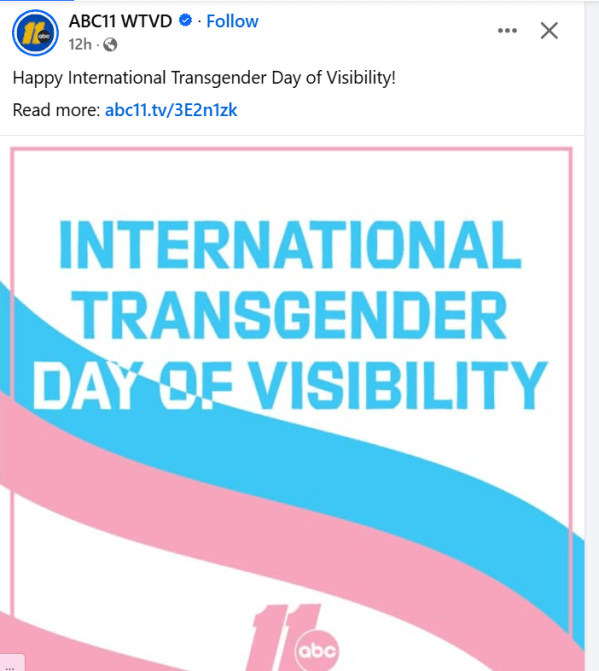
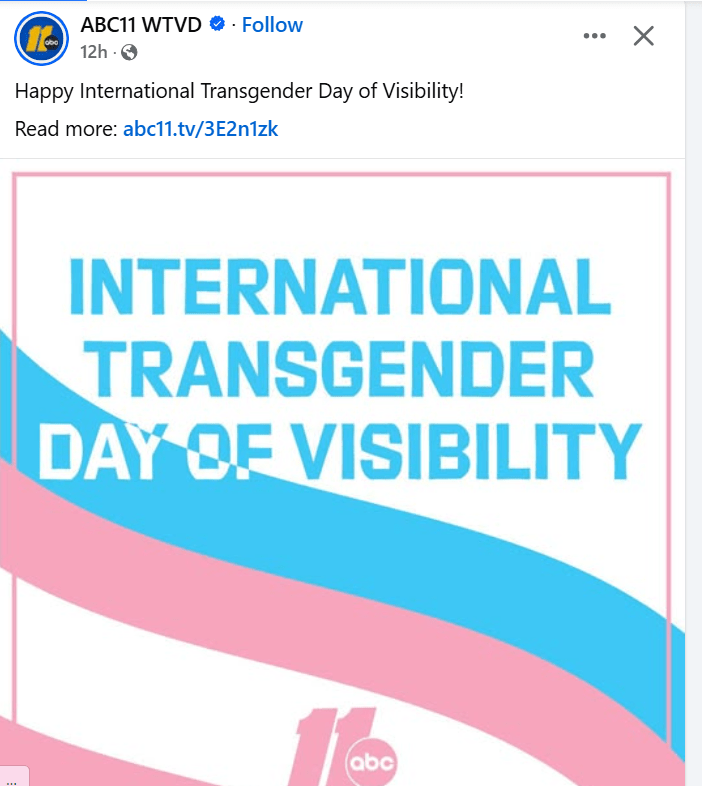
Local Raleigh North Carolina ABC affiliate channel 11 WTVD posted a Facebook message and photo wishing everyone a happy International Transgender Day of Visibility. The post then oddly links to a cushy story about a troupe of trans and nonbinary folks who are running an improv show in Hollywood at the Upright Citizens Brigade. Personally, I would have preferred a story about transgender folks in North Carolina and what they go through on a daily basis. But, we got something, dammit.
As one would imagine, the post has also earned over 11,000 comments and 16,000+ reactions. They go both directions and if you would like to read them you can on their Facebook post. Showing support as you read by clicking like or love, and a positive comment, would also be appreciated by many.
Senate Bill 516, filed by Sen. Vickie Sawyer from Iredell County and Sen. Brad Overcash from Gaston County, would require transgender individuals to use the bathroom or locker room of their biological sex in public schools and prisons.
However, the bathroom rules aren’t as extensive as House Bill 2. Some institutions that receive government funding, such as domestic violence shelters, would be impacted, but many government buildings would be exempt. It would also allow individuals to sue facilities if they believe these rules have been violated.
Senate Bill 516 also goes a step further, defining sex strictly as male and female and preventing individuals from changing their birth certificates or driver’s licenses after gender reassignment surgery.
The controversial 2016 bill, House Bill 2 was often referred to as the “bathroom bill.” However, former North Carolina Gov. Pat McCrory said that was a misleading description that he hopes is changed this time around.
“It’s much more complex than that. We’re dealing with locker rooms and showers and women’s sports and fairness and even security regarding what your driver’s licenses say,” McCrory said. “It’s a very complex issue. It’s a very emotional issue.”
McCrory acknowledged that many cite this controversy as the reason he narrowly lost his reelection campaign in 2016. It put North Carolina in the national spotlight due to the nationwide boycotts that followed, leading to an estimated $3.76 billion in economic losses. The law was partially repealed after a letter signed by more than 200 CEOs pushing for the change.
In the time since, many other states have passed similar legislation without such sweeping boycotts. McCrory said the companies owe North Carolina an apology.
“PayPal, Bruce Springsteen, Ringo Starr, you name it. And frankly, I think a lot of them owe North Carolina an apology,” McCrory said. “I don’t think corporations are ever going to get involved in this issue again, because public opinion now has turned, although it is still an extremely complex issue, and we ought to have good dialogue on it.”
Critics still worry this bill will cause an uptick in discrimination against the LGBTQ+ community, especially transgender youth.
Time Out Youth, a Charlotte-area nonprofit that provides support for LGBTQ+ kids and young adults including housing and mental health counseling, says it’s already seeing a steep increase in need.
“We saw more new young people last month than we’d seen all of the previous year in one month,” spokesperson Elissa Miller said.
While they are not able to comment on this specific bill, Miller says this is a reminder of what transgender youth are facing right now.
“Being a queer young person right now is very difficult,” she said. “Their very identities are kind of under debate, in the spotlight. Decisions are being made about them, without them.”
Equality NC also sent WCNC Charlotte a statement, saying in part: “We were disheartened to learn of yet another attack on our transgender community — this time in the form of SB 516.”
McCrory says he expects this version of the bill to face less scrutiny and hopes the people on both sides of the debate can avoid it as well.
“My family and I got a lot of physical and verbal threats during that three-month period, and it was not right, and I wanted to have good conversation,” he said. “It’s not time for anyone to spike the ball saying we were right 10 years ago. It’s time for respect and dignity.”
The bill’s sponsors did not immediately respond to requests for comment.
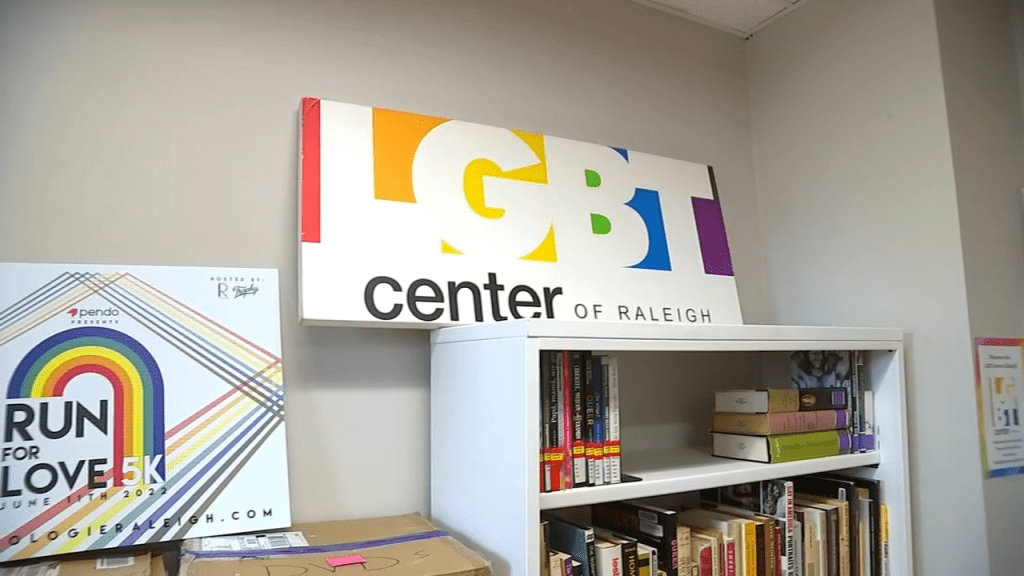
Raleigh leaders are embarking on a special effort to document historic and significant LGBTQ sites around the city.
On Monday night, a consultant hired by the city presented a study of those places, as well as recommendations on the locations that should be given an historic designation.
Over 250 properties have been identified.
Willie Pilkington, a resident in Raleigh said we all have something to contribute.
“When you see a marker, and if it’s a gay, lesbian, bisexual and transgender reference point, then that’s just one more ‘ah ha’,” he said. “This is who those people are. This what they actually did…and that’s what those markers do.”
City leaders said the effort is a step in preserving the stories and history of the LGBTQ community.
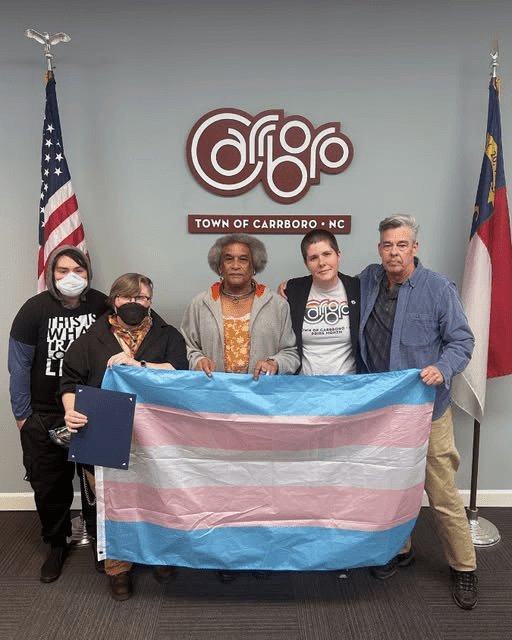
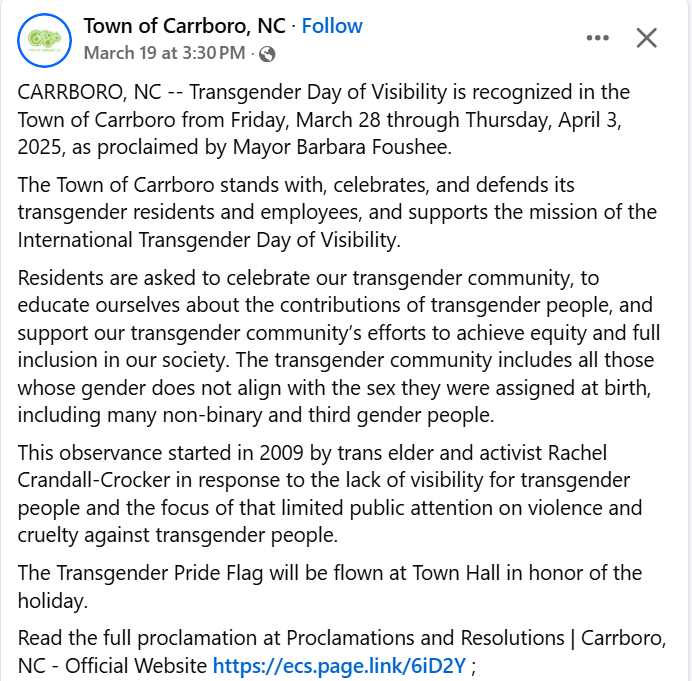
Carrboro, the small sister town of Chapel Hill NC, officially recognizes Transgender Day of Visibility. Carrboro’s welcomeness is well known, and elected the first openly gay mayor in the state back in 1995. The proclamation was read by Councilmember Catherine Fray, the first openly non binary person elected to office in NC.
North Carolina State Representative Deb Butler (D–New Hanover), one of the first openly gay members of the state House, has filed two bills aimed at securing marriage equality and protecting LGBTQ+ families in the state.
The proposals – H174 and H175 – come as lawmakers brace for potential challenges to same-sex marriage rights amid a shifting federal judiciary.
H174 seeks to repeal North Carolina’s outdated ban on same-sex marriage, a statute that remains on the books despite being rendered unenforceable by the U.S. Supreme Court’s 2015 ruling in Obergefell v. Hodges. If enacted, the bill would affirm the federal protections of all married couples, regardless of gender.
H175 would introduce a constitutional amendment explicitly safeguarding marriage equality in North Carolina. The amendment is designed as a long-term shield, ensuring that even if the Supreme Court revisits Obergefell, LGBTQ+ families will remain protected from discriminatory state-level policies.
“In North Carolina, we must defend the rights of our LGBTQ+ citizens,” Rep. Butler said. “Marriage equality is a settled issue for the vast majority of Americans, and our state should reflect that reality. These bills are about ensuring dignity, security and legal protection for all families in the face of uncertainty at the federal level.”
According to a news release, Butler’s initiative is part of a broader effort to fortify civil rights protections across North Carolina. Advocates, legal experts and LGBTQ+ organizations have voiced strong support for the bills, emphasizing the urgent need for state-level safeguards amid a volatile national political climate.
The legislation now heads to the North Carolina General Assembly.


 fleeredstates.blog
You must be logged in to post a comment.