Where in Europe do people feel least safe walking alone at night?

Read more at Euro News.

Is France less safe than Rwanda and Bangladesh? The new World Safety Index has raised questions on security across Europe.

People feel less safe walking alone at night in Italy and France than in dozens of other countries, including Iraq, Rwanda, and Bangladesh, according to a new report.

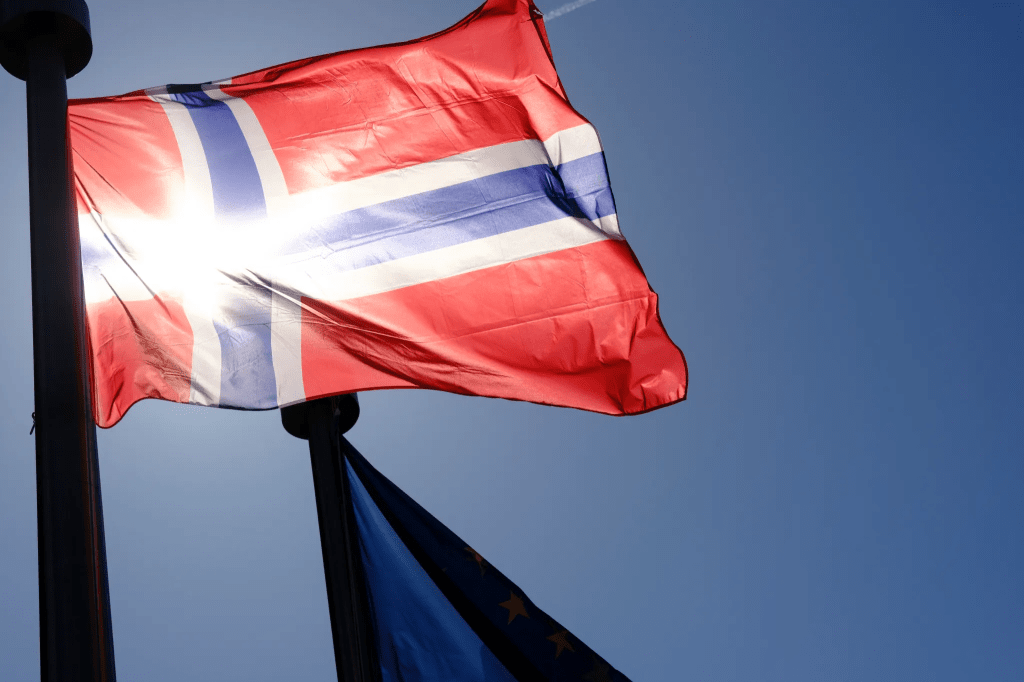
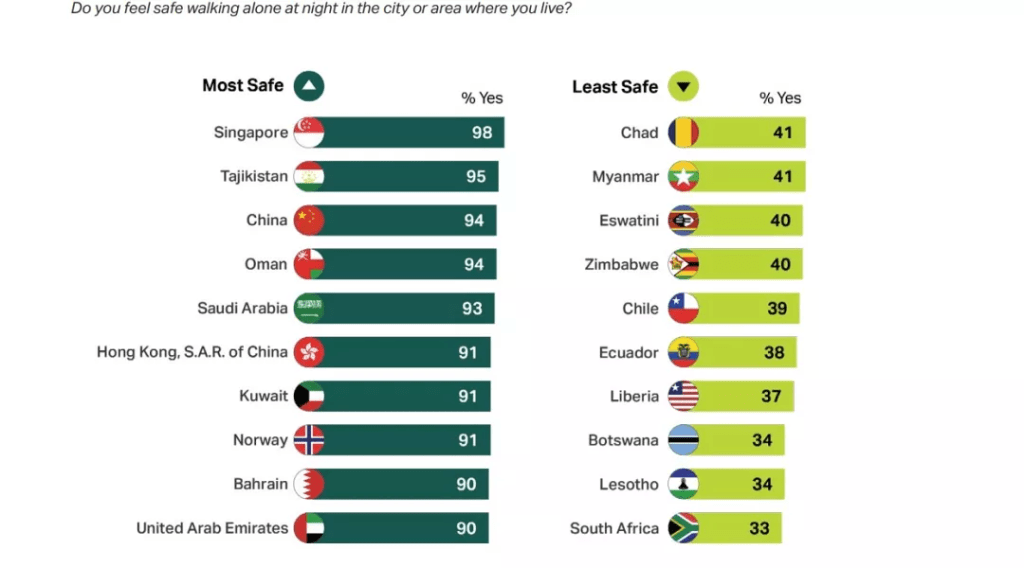
In fact, the 2025 edition of The Global Safety Report features only one European nation in the top 10 countries with the highest sense of security: Norway (91%).

Denmark and Kosovo, both with 89%, are the second-highest ranking European countries, respectively 11th and 12th worldwide.
Italians feel least safe in Europe, France 56th worldwide

With 60%, the perception of security among Italians is the lowest in Europe, and the 95th in the world, behind war-torn Ukraine (62%), Nicaragua (63%), Mauritania (64%) and Niger (67%).

France, ranked in 56th place with 73%, fared higher than Italy but placed behind similar European economies such as Spain (81%), Germany (78%) and the UK (76%), as well as non-European nations like Egypt (82%), Bangladesh (74%) and Belize (74%).

The Gallup report surveyed 145,170 adults aged 15 and older across 144 countries and territories.

How does Europe compare to the rest of the world?

Globally, 73% of adults worldwide said they feel safe walking alone at night in the city or area where they live.

It’s the highest level on Gallup’s record (which began in 2006) and a 13% increase over the past decade.

“The paradox is striking,” the researchers said in the report. “We are living through more armed conflicts than at any time since the Second World War. And yet, Gallup finds that more people than ever say they feel safe in their communities.”

The world region with the highest sense of security is Asia-Pacific (79%).

Western Europe follows in second place (77%), ahead of the Middle East and North Africa (74%).

Security perception: Post-Soviet Europe nearly overtakes America

With a 34-point jump over the past two decades, the former Soviet bloc has experienced the greatest growth in safety perceptions across all macroregions, reaching 71%.

If the trend continues, the former USSR countries — Russia excluded — could surpass North America, which now stands at 72%.

Along with sub-Saharan Africa, North America has been the only world region to see a decline in security perception since 2006 (-4%).

Overall, the region where people feel the least safe globally is Latin America and the Caribbean (50%).

Gender gap: Many more women feel unsafe than men

The Gallup report also highlights a stark gender gap: 32% of women, globally, claim they don’t feel safe compared to 21% of men.

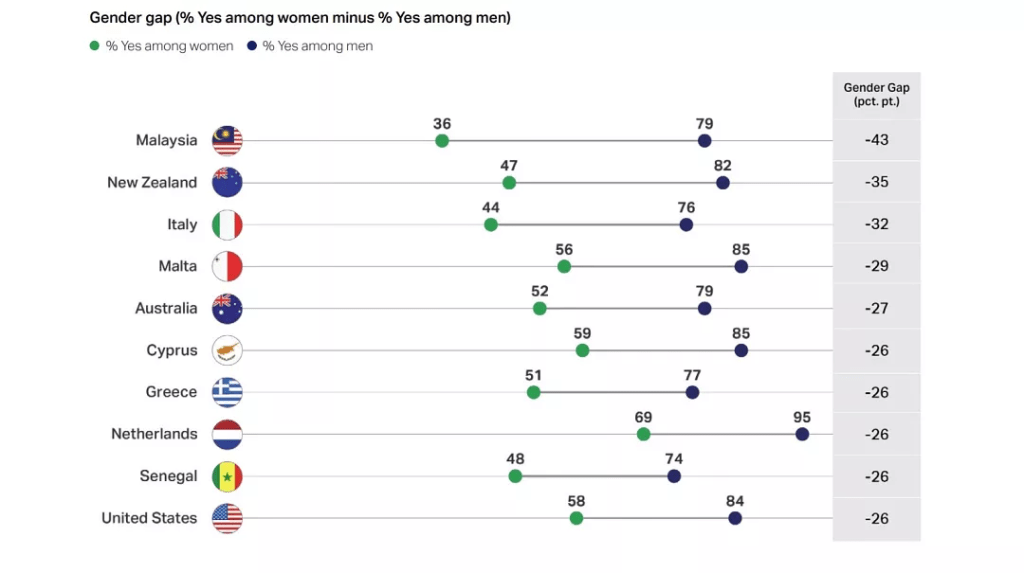
Five of the world’s 10 countries with the highest gender gap in this sense are EU member states.

Again, Italy’s performance here is the worst in Europe, with a 32-point gap between the security perception of Italian men versus that of Italian women — 76% of men feel safe walking alone at night versus 44% of women.
The report says that “56% of intentional homicides where the victim is a woman or girl are perpetrated by an intimate partner or family member, compared to 11% when the victim is male.”

“While men are more likely to be victims of lethal violence in public, rates of reported non-lethal violence are much closer between genders,” it adds.

Perception vs reality: Which countrie see themselves better — or worse — than they really are?

A low sense of safety doesn’t always mean a country is actually unsafe and vice versa.

The Global Peace Index — which factors in Gallup’s safety perception along with other, more pragmatic data like homicide rates, violent crime, access to firearms, terrorism and political instability — often paints a more nuanced picture.

Across Europe, many nations turn out to be safer than they think.

Germany, for instance, ranks 20th worldwide in the Global Peace Index, yet only 34th when it comes to their citizens’ perception.

Italians and Brits also seem to underestimate their safety levels, with a gap of 62 and 15 positions, respectively, between perception and estimated reality.

France, on the other hand, tends to perceive itself as more secure than it might be — ranking 56th by its own perception but 74th in the Global Peace Index.

Still, it remains more secure than several non-European nations, including the aforementioned Rwanda (91st) and Bangladesh (123rd).

Spain seems to have a more grounded perception of reality. The country placed 25th in the Global Peace Index and 29th in Gallup’s safety perception table.

Church of Norway apologizes for how it treated LGBTQ+ people

Read more at LGBTQ Nation.

The Church of Norway apologized on Thursday to the country’s LGBTQ+ community for decades of discrimination, Reuters reports.

Presiding Bishop Olav Fykse Tveit acknowledged the church’s regret at the London Pub in Oslo, site of a shooting during Pride celebrations in June 2022. Two people died in the homophobic attack.

Tveit said the Evangelical Lutheran church, the largest denomination in Norway, had caused harm to gay people and thanked those who campaigned for change.

“The church in Norway has imposed shame, great harm, and pain,” the bishop said. “This should not have happened, and that is why I apologize today.”

A similar acknowledgment by the church’s bishops in 2022 addressed past discrimination, including a description of gay people by the Norwegian Bishops’ Conference in the 1950s as a “social danger of global dimensions.”

Seventy years later, same-sex couples can marry in the Church of Norway.

A service was scheduled to follow the bishop’s remarks at the Oslo Cathedral on Thursday evening.

The church’s acknowledgement of institutional discrimination follows several over recent years by other Christian denominations.

In 2023, the Church of England apologized for “shameful” treatment of the LGBTQ+ community. The Protestant church represents 85 million Anglicans worldwide.

“We want to apologize for the ways in which the Church of England has treated LGBTQI+ people — both those who worship in our churches and those who do not,” the bishops said in a statement.

“For the times we have rejected or excluded you, and those you love, we are deeply sorry. The occasions on which you have received a hostile and homophobic response in our churches are shameful, and for this we repent.”

At the same time, bishops have refused to allow same-sex marriages in Anglican churches. Just this week, bishops turned back plans to officiate discrete blessings for same-sex couples, although these can take place within routine church services.

In August, the United Church of Canada, the largest Protestant denomination in the country, acknowledged harms to the two spirit and LGBTQ+ communities in Canada.

“We have failed to celebrate and delight in all of your beautiful Creation. We have wounded people instead of seeking wholeness. We are sorry,” said the Rev. Michael Blair, the church’s General Secretary, in a message accompanying the official apology.

“We, The United Church of Canada, express our deepest apologies to all those who have experienced homophobia, transphobia, and biphobia within The United Church of Canada,” it read in part.

Those institutional expressions of regret have been accompanied by recent individual apologies by church leaders, many in the Catholic Church.

In January, Catholic Cardinal Wilton Gregory of Washington, D.C., issued a personal apology from the pulpit.

“I apologize for my own failure to emulate Christ’s compassion,” he said. “The way that we have treated our LGBTQ brothers and sisters has brought them tears, and to many of us, disgrace.”

“I apologize from the heart for the hurt that has resulted in the loss of so many of our family members who belong to God no less than I do,” he said.

Last year, a Catholic bishop in Germany apologized for the church’s mistreatment of LGBTQ+ people, encouraging congregants to be more supportive of equality and inclusion.

“We want to be a diocese that values ​​diversity,” Bishop Stephan Ackermann said during what he called a “public confession.” The next month, Archbishop Heiner Koch of Berlin also apologized, labelling homophobia an “unholy line of tradition.”

In 2016, Pope Francis said in a gaggle with reporters aboard the papal plane that Christians owe apologies to gay people and others who have been offended or exploited by the church.

“I repeat what the Catechism of the Catholic Church says: that they must not be discriminated against, that they must be respected and accompanied pastorally,” Francis said.

“The Church must ask forgiveness for not behaving many times – when I say the Church, I mean Christians! The Church is holy, we are sinners!”

A formal apology from the Catholic Church has not been forthcoming.

Politician calls for transgender Americans to be offered asylum in Norway: ‘We have to act’

*This is reported by Pink News

A Norwegian transgender politician, representing the Green Party (MDG), has advocated for transgender Americans to be granted asylum in Norway due to the anti-trans discrimination they are facing in the US.

Karina Ødegård, who is on track to becoming Norway’s first transgender member of parliament, has told Norwegian newspaper Afterposten that the challenges faced by trans people in the US are similar to the persecution experienced by marginalised groups in 1930s Germany.

The Green Party have supported Ødegård’s proposals.

Referring to the rise of fascism in Europe and the persecution of Jewish people and other minorities, she said: “What would we have done in the 1930s if we knew what was about to happen? That’s where we are now. Then we have to act,” she said.

Ødegård has said that in contrast to the US, the state and healthcare system in Norway helped her to be herself.

“One thing is that you see [in the US] the development of an illiberal democracy. I find that extremely problematic. Then it gets even worse because the Trump administration has singled out transgender people as scapegoats to be hanged and removed,” she explained.

This comes after President Trump signed a raft of executive orders targeting trans people, preventing them from serving in the military, banning trans women from participating in women’s sports, and requiring official documents to only list their gender registered at birth.

LGBTQ+ rights in Norway

Norway is generally considered to be a very LGBTQ+ friendly country, as it was one of the first countries to pass an anti-discrimination law that explicitly included sexual orientation in 1981.

Listen to this article

1:33 / 2:30

Also, same-sex marriage and adoption has been legal there since 2009.

Unfortunately, Norway doesn’t yet legally recognise non-binary identities, nor does it offer gender-affirming care for under-18s, stating a “lack of comprehensible research” despite the majority of Norwegian people believing that it should be accessible.

Norway has laws (The Tenancy Act, the Housing Association Act and the Residential Building Association Act) that all prohibit housing discrimination on the basis of sexual orientation. Married and committed same-sex couples are permitted to adopt under Norwegian law, and self-ID is also allowed: to change their gender, trans citizens only have to send a notification to the National Population Register.

15 Best Countries for LGBTQ Expats – NBC News

This blog originally appeared at NBC News.

Prior to this week’s stunning presidential election results, a number of LGBTQ advocates and celebrities threatened to leave the U.S. should Donald Trump be elected. Now that the real estate mogul and reality TV star is America’s president-elect, NBC OUT has compiled a handy list of LGBTQ-friendly countries for U.S. expatriates.

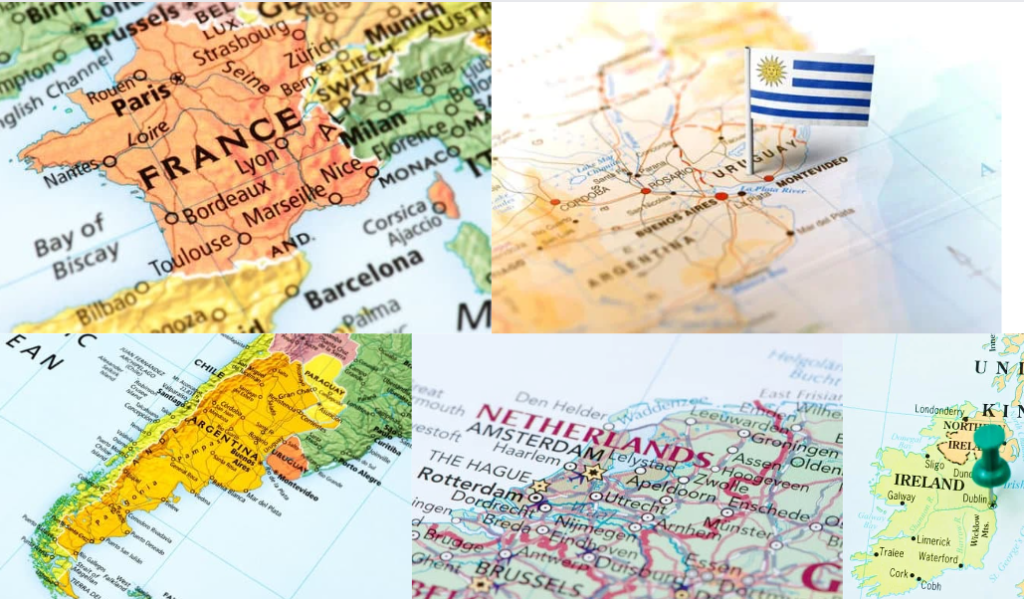
Argentina, Belgium,Canada, Denmark,France, Iceland,Ireland,Luxembourg,New Zealand,The Netherlands,
Norway,South Africa, Spain, Sweden,Uruguay,

Read Full Article – https://www.nbcnews.com/feature/nbc-out/15-best-countries-lgbtq-expats-n683201


If you’re ready to look for a better state or county for you and your family (or family of choice), reach out to us at www.FleeRedStates.com

Blog at WordPress.com.

Up ↑