What are the safest places for gay and trans people? See where your state ranks

*This is reported by USA Today.

As Oklahoman legislators push to restrict trans rights and overturn the 2015 Supreme Court decision legalizing gay marriage, Zane Eaves says his identity as a transgender man has put a target on his back in his home state.

One of 18,900 trans adults in Oklahoma, Eaves has received death threats as has his wife of 10 years and their two children.

“All the hatred and political stuff going on” are driving this Oklahoma lifer from the place he was born and raised, Eaves, 35, said. He has only crossed the state line three times in his life, but in recent weeks, he made the difficult decision to move his family to North Carolina to be closer to friends and allies. 

“I am just trying to stay alive and keep my marriage,” Eaves said.

Oklahoma ranks 44th in the nation on a list released Monday of the most and least welcoming states for lesbian, gay, bisexual, transgender and queer Americans.

More and more, the question of where LGBTQ+ people feel safe is one of blue vs. red, according to advocacy group Out Leadership.

LGBTQ+ equality fell across the board for the third straight year, according to Out Leadership’s State LGBTQ+ Business Climate Index shared exclusively with USA TODAY. But the sharpest declines came in Republican-led states. 

While progressive strongholds championed supportive policies and protections, conservative states elected a slate of leaders who openly oppose gay and trans rights and sponsored an unprecedented wave of anti-LGBTQ+ legislation, Out Leadership CEO and founder Todd Sears said.

So-called “Don’t Say Gay” bills, religious exemptions and other legislation tanked the rankings of 19 red states in the Out Leadership index, according to Sears. 

Today, the divide between states that roll out the welcome mat and less hospitable parts of the country is wider than ever, he said.  

The least and most welcoming LGBTQ+ states

Each year for the last seven, Out Leadership has released the State LGBTQ+ Business Climate Index to gauge the overall climate for gay and transgender people state by state, mapping out where they will face the most and the least discrimination and hardship. 

Out Leadership’s index measures the impact of state government policies and prevalent attitudes about the LGBTQ+ community, weighing factors such as support for young people and families, health access and safety, political and religious attitudes, work environment and employment and nondiscrimination protections.

The Northeast had six of the 10 highest-ranked states, while the Southeast had six of the lowest-ranked.

Massachusetts, led by the nation’s first openly lesbian governor, Democrat Maura Healey and New York, which guaranteed gender-affirming care and LGBTQ+ refugee protections, tied for first place in this year’s index, with Connecticut and New Jersey close behind.

The least LGBTQ+ friendly state was Arkansas, which ranked last for the third straight year. South Carolina, Louisiana, South Dakota and Alabama also received low scores.

The states that had the largest gains in the index were Kentucky and Michigan, which Out Leadership attributed to “pro-equality” leadership from governors Andy Beshear and Gretchen Whitmer, both Democrats. The steepest declines were in Ohio, Florida and Utah, all led by Republican governors.

Where are the safest places to live?

The Out Leadership index was created as a LGBTQ+ inclusion reference guide for business leaders. But gay and trans people soon began using it to figure out where they should – and should not – live and work, never more so than now as rights rollbacks from the Trump administration and red statehouses hit close to home.

Opposition to transgender rights was a central plank in Trump’s presidential campaign and since taking office he has signed a series of executive orders recognizing only male and female genders, keeping trans athletes out of women’s sports, banning trans people from serving in the military and restricting federal funding for gender-affirming care for trans people under age 19. 

Even states seen as safer for LGBTQ+ people have been navigating these edicts around trans athletes. Trump threatened to cut federal funding to California if a trans girl competed in a state track and field event held Saturday.

AB Hernandez, a junior from Jurupa Valley High School in Riverside County, shared first place in the high jump and triple jump and second in the long jump. She shared the awards podium with her cisgender competitors under a new rule drafted by state athletics officials days before the event to mollify critics.

Republican-led states have been in the vanguard of anti-trans legislation, causing greater geographic polarization and prompting fears among LGBTQ+ residents, even those who live in liberal cities.

Jordan McGuire, a 27-year-old gay man in North Dakota, said the years he spent living in the Deep South taught him about the repressive discrimination routinely faced by gay and genderqueer people. 

At the same time, socially progressive cities in conservative states like Fargo and Grand Forks are no longer the safe havens they once were, he said. 

Now that his fiancee is transitioning to female, the couple is exploring a move to a “sanctuary” state that will be safer for them. 

“It feels like five or 10 years ago, trans people were not under the same microscope they are now and that has definitely influenced our move,” McGuire said. “Yeah, people were prejudiced but it wasn’t a witch hunt. They weren’t looking for people in bathrooms and schools. But now things are so polarized.”

That rising anxiety was captured in a post-election survey from UCLA’s Williams Institute which found that nearly half of transgender people had already fled unsupportive communities and nearly 1 in 4 were considering uprooting their lives. 

The most frequently cited reasons for wanting to move were concerns about LGBTQ+ rights – 76% – the sociopolitical climate – 71% – anti-trans rhetoric and climate – 60% – and anti-trans laws and policies – 47%. 

LGBTQ+ Americans on the move

Interest in relocating to friendlier states is even higher today than it was after Trump’s reelection, say nonprofit workers who aid trans and gender-diverse people relocate to more liberal states with broader protections. 

So far in 2025, Rainbow Railroad in Canada has received more than 3,000 requests from LGBTQ+ people living in the United States, up more than 1,000% from the same time last year, according to communications director Timothy Chan.

Nearly all requested international relocation support. For now, Rainbow Railroad can’t aid Americans with resettlement services because of immigration restrictions, Chan said. 

TRACTION has heard from a record number of people from states as far away as Texas, Oklahoma and Arkansas with many of them reporting being threatened or feeling unsafe in their homes and neighborhoods, said Michael Woodward, the executive director of the trans-led organization in Washington state. 

Trans and gender-diverse people historically face financial hardship due to systemic oppression and discrimination, and need assistance finding jobs and housing as well as with interstate moving expenses that can run tens of thousands, Woodward said.

TRACTION used to get a few applications a week until Trump won a second term. In the two weeks following the election, “we received as many requests for assistance as we’d received in the entire life of the project thus far,” he said. 

After the inauguration, TRACTION started getting three to five applications every day. With one employee and a handful of volunteers, his organization is struggling to keep up with demand, Woodward said.

A trans teen is fleeing the country after enduring years of hate for being good at track

*This is reported by LGBTQ Nation.

A teenage trans athlete is fleeing the country with her mother after experiencing severe bullying and harassment by right-wing media, fellow athletes, and politicians.

11th grader Ada Gallagher currently runs on the girls’ track team at Portland, Oregon’s McDaniel High School. She first became part of the national debate over trans athletes in 2023 when she won the state championship in the 200-meter race. A report from that time said the crowd met her victory with a chorus of boos, a sentiment that quickly spread across the country as the anti-trans right got its hands on the story.

Gallagher, who now competes with a security guard by her side, has endured years of death threats and vile insults, and she has also been a focal point of conservative media outlets.

Most recently, a video of Gallagher winning a March 19 400-meter race in a landslide was shared widely among conservatives. She also won the 200-meter race at the same meet.

Prominent anti-trans activist Riley Gaines – who has built an entire career off of tying for 5th place with a trans athlete three years ago – shared the video on X and misgendered Gallagher, writing, “Does he have no shame? Do his PARENTS have no shame?”

Gallagher’s mother, Carolyn, was not able to celebrate her daughter’s win like any mother should, as she knew the hate it would bring. She told Oregon Live she thought, “I know the optics of this are going to be horrible.”

But she wished people understood that the meet consisted of a total of three schools and that neither of the other two had strong competitors in the race Gallagher won so easily. She also wished people knew that, despite what Fox News claimed, Gallagher did not set a season record in the 400-meter race and actually ran a massive five seconds slower than she did in the same event at state the previous year, where she got second place.

For as long as she could, Gallagher tried to rise above it all, to keep her head in the game and just do what she loves: run.

But it has finally become too much.

“When they call me a predator, that’s the worst one. I hate it so much,” Gallagher told Oregon Live.

Only six days after Gallagher’s victory in March, the U.S. Department of Education’s Office for Civil Rights began investigating Portland Public Schools and the Oregon School Activities Association (OSAA), alleging the organizations are violating Title IX by allowing trans athletes to participate in sports on the teams that align with their gender (OSAA policy states it “endeavors to allow students to participate for the athletic or activity program of their consistently asserted gender identity while providing a fair and safe environment for all students”).

A statement from Portland Public Schools Superintendent Kimberlee Armstrong in the wake of the lawsuit expressed a dedication to protecting vulnerable students.

“I stand firm in our legal responsibilities, and I deeply value every student’s right to be treated with dignity, safety, and respect. PPS is in full compliance with Oregon state law, which may differ from federal guidance. We are actively working with our legal and state partners to navigate this complex legal landscape.”

“While I am limited in what I can share at this time due to the sensitive nature of the matter and our duty to protect student privacy, I want to be clear: my commitment—and our district’s commitment—to doing what’s right for all students, especially those most vulnerable, remains unwavering.”

But Gallagher and her mother hope all the noise will quiet down once they leave for Canada, where Carolyn was born and raised, despite the fact that Gallagher is devastated to leave her team, her friends, and especially, her girlfriend.

As Oregon Live states, Gallagher “joined the track team last spring not because she believed she would win, not out of some desire to manipulate the system and compete where she could win, but because her friends urged her to. Because they wanted her there.”

Now the team captain, she says the team is “the only place where people really know me.”

“I think people think I want to be this spotlight for trans people,” she said. “Not at all. I just like running.”

While competing is what also leads her to endure all this hate, she said it all goes away during the 23 or so seconds she is running.

“You hear the feet around you hit the ground,” she said. “Senses are heightened. There’s nothing to think about, it’s just track.”

Democrats lash out as Texas Legislature bans school clubs that support gay teens

*This is reported by the Texas Tribune

Democrats took to the floor of the Texas House on Saturday to label a ban on clubs that support gay teens the work of “monsters” and to say the ban endangers children and strips them of their dignity.

The Democratic representatives grew emotional in opposition to a bill that would ban K-12 student clubs focused on sexuality and gender identity.

Senate Bill 12, authored by Sen. Brandon Creighton, won final legislative passage Saturday after lawmakers in both chambers adopted the conference committee reports that specifically clarified that schools will be banned from authorizing or sponsoring student clubs based on sexual orientation or gender identity.

Backers proclaimed that the bill enshrines a parent’s rights and puts the parent not just at the table, but at the head of the table where the child’s best interests are decided. They also targeted diversity, equity and inclusion (DEI) policies, claiming that they project ideologies on students and put too much focus on race, sexuality and gender identity instead of the quality of education.

Rep. Gene Wu, D-Houston, emphasized that these clubs exist because of a long history of oppression against the LGBTQ+ community. He warned against demonizing students and teachers for discussing gender and sexuality.

“The real monsters are not kids trying to figure out who they are,” Wu said during the House discussion. “The monsters are not the teachers who love them and encourage them and support them. They are not the books that provide them with some amount of comfort and information. The real monsters are here.”

Lawmakers shared personal stories about LGBTQ+ youth. Rep. Rafael Anchía said his daughter was a vice president of a pride club at her school. He stressed that these clubs “are no more about sex than 4-H or ROTC or the basketball team.”

“It wasn’t a sex club,” Anchía said. “They’d get together and they’d watch movies. They’d color. They’d go to musicals. It was about a kid who felt weird who found her people and everything about it was good. I don’t know why grown-ups in this body are so triggered with my daughter getting together with her classmates in a school-sponsored activity.”

Anchía also told the Texas Tribune he “didn’t sign up for five anti-LGBT bills this session.”

Rep. Jolanda Jones, D-Houston, shared her experience as a Black woman and a lesbian, saying she didn’t come out until the age of 50 because she knew “the world wasn’t safe.” She warned that banning LGBTQ+ clubs could worsen bullying.

“And we have the nerve to say that we care about mental health,” Jones said. “We’ve passed bill after bill about access to care, about youth suicide, about prevention and treatment. But this bill makes kids sicker, sadder, more alone. This bill doesn’t protect children. It endangers them. It doesn’t give parents more rights. It strips children of their dignity.”

SB 12 is often referred to as the “Parental Bill of Rights” because it claims to give parents more control over their children’s schools. But Rep. Erin Zwiener, D-Driftwood, addressed those who are “afraid that your kids or your grandkids might grow up queer,” warning that the bill could harm family relationships.

“Getting silence in schools from the LGBTQ community, which is what this bill is designed to do, will not stop your kids from being gay,” Zwiener said. “It will just make them afraid to come out. It will make them afraid to live their lives as their full selves. It will make them afraid to tell you when they figure out that they’re LGBTQ and it might damage your relationship with them forever.”

Rep. Nicole Collier, D-Fort Worth, argued that allowing religious organizations in schools but banning “clubs that allow students to be who they are, is a double standard that flies in the face of the principles you say you support.”

“An LGBTQ person can’t change who they are any more than the fact that I can’t change that I’m Black,” Collier said. “What you’re saying to students today is that you will be accepted as long as you are who we say you should be.”

If signed by the governor, the bill will become law on Sept. 1.

Texas Senate approves bill strictly defining man and woman based on reproductive organs

*This is reported by The Hill.

The Texas Senate has sent legislation to Gov. Greg Abbott (R) that would strictly define genders across state law based on male and female reproductive organs — potentially creating new hurdles for transgender and intersex Texans whose gender identity would revert to the sex they were assigned at birth in state records.

Abbott spokesman Andrew Mahaleris confirmed to The Hill on Wednesday that the governor plans to approve the measure.

“The State of Texas recognizes only two sexes — male and female,” Mahaleris said. “Governor Abbott looks forward to reaffirming this universal truth and signing HB 229 into law.”

Supporters of the legislation said that it follows a directive Abbot issued earlier this year that state government in “Texas recognizes only two sexes — male and female.”

Abbott cited in the directive an executive order that President Trump signed shortly after his January inauguration that designates male and female as the only sexes recognized by the federal government and on a biological basis.

“All Texas agencies must ensure that agency rules, internal policies, employment practices, and other actions comply with the law and the biological reality that there are only two sexes—male and female,” Abbott wrote in his January letter to state agencies.

The latest Senate-approved bill, dubbed the “Women’s Bill of Rights,” defines sex as “an individual’s biological sex, either male or female.” Under the legislation, a woman or female is an “individual whose biological reproductive system is developed to produce ova” and a male or man is “someone whose reproductive system is developed to fertilize the ova of a female.”

Additionally, it defines “mother” as “a parent of the female sex.”

Critics of the measure argue that the bill oversimplifies sex, gender and a broad spectrum of personal experiences.

“If a law forces non-binary Texans, who are real people, into categories that don’t reflect their lived experiences or identities … that would actually become discrimination in practice,” state Sen. José Menéndez (D) said during the floor debate on the bill before its passage. “That’s a concern that I have.”

State Sen. Mayes Middleton (R), who sponsored the bill, said that it would preserve women’s designated spaces, like restrooms and prisons, based on “biological reality.” He noted that it carries no criminal or civil penalties.

“For our entire history we never had to define this because common sense dictated we didn’t, but unfortunately, that seems to have changed,” he said in the floor debate.

Abbott has previously pushed back against past criticism for signing laws that target LGBTQ people. He approved legislation in 2023 and 2021 to bar transgender athletes from competing in women’s and girls sports in Texas schools and colleges.

Trans man says he was detained after using women’s restroom in South Carolina

TRENDING

LGBTQ+ VoicesPoliticsTransgenderVideoBecome a MemberScroll To Top

By continuing to use our site, you agree to our Private Policy and Terms of Use.

Accept

News

Trans man says he was detained after using women’s restroom in South Carolina

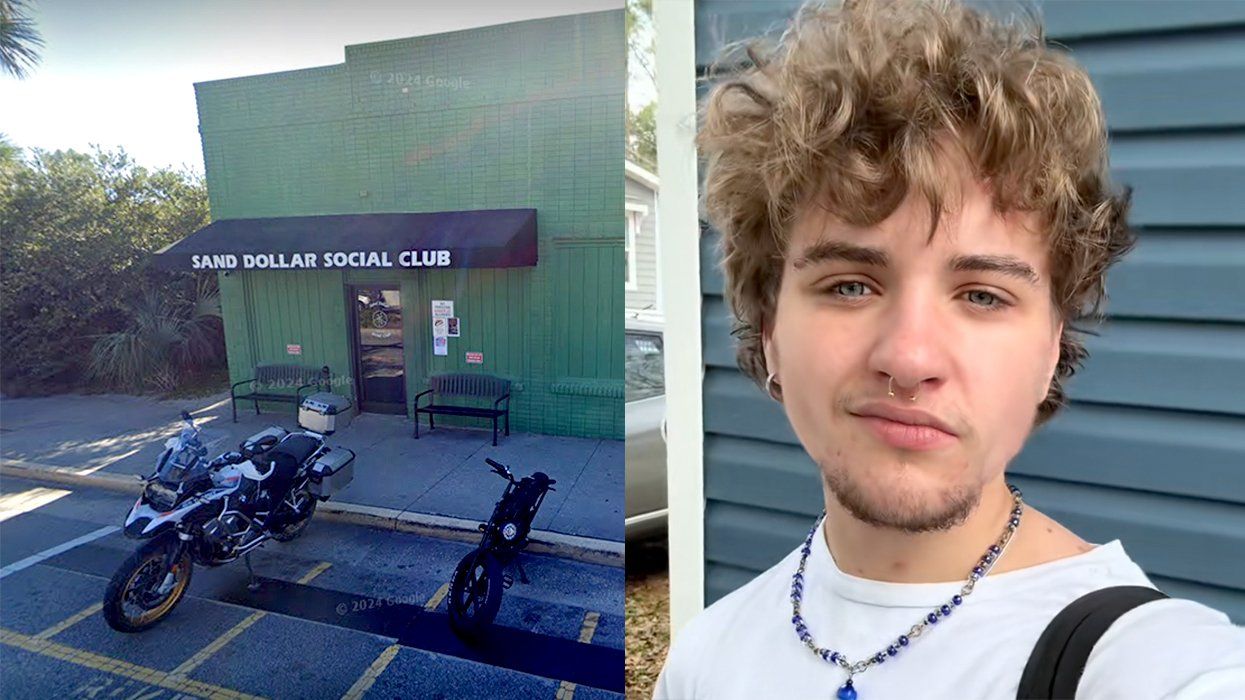
Sand Dollar Social Club Folly Beach South Carolina alongside footage still of trans man Luca Strobel

©2025 Google Maps Data; footage still via tiktok @fulltimecowboy

Sand Dollar Social Club (left) and Luca Strobel

Anti-trans lawmakers want to force trans men to use the women’s restroom. Here’s what happened when one did.

*This is reported by The Advocate.

A 25-year-old South Carolina trans man has gone viral on TikTok, saying he was accosted in a bar by staff, called slurs, and detained by police after using the women’s restroom.

Luca Strobel, who posts under the Tiktok handle @FulltimeCowboy, said he had gone to pick up his friend, Caroline Frady, also 25, at Sand Dollar Social Club in Folly Beach on the night of Friday, May 16, to be her “sober ride” home.

After a lengthy drive to the bar, Strobel said he stepped inside to use the men’s room. However, there were no stalls—only urinals, rendering it inaccessible to him as a trans man.

At first, an employee warned both Strobel and his friend against entering the bathroom of the “opposite” sex, but after a brief back-and-forth, Strobel said he believed he had permission to do so. He also said he and Frady were the only two people in the restroom, which Frady confirmed to Erin in the Morning.

That’s when a man who said he was the bar owner burst into the women’s room, peering over the stall to look at Strobel as he used the restroom.

“They’re looking over the top of the stall at me without my clothes on,” Strobel said in the video. “They can fully see me naked other than me having my shirt on, and they just start screaming that there’s ‘a man’ in here.”

He said the owner and employee ejected him and his friend from the bar — grabbing and pushing them out as they reportedly called Strobel anti-trans slurs. The police were waiting at the door, Strobel said.

The officer cuffed him “so tight that I can’t even feel my fingers,” Strobel said. “I still have a bruise on my knuckle.” Meanwhile, his arresting officer allegedly kept calling him a “little girl.”

“We didn’t get booked, but we did get cuffed, and when we got to the station, we were asking a bunch of questions that they refused to answer,” Strobel said. “They just kept saying, ‘Take it up in court, take it up in court, take it up in court.’”

Sand Dollar Social Club could not be reached for comment. The Folly Beach Public Safety Department did not respond to a request for comment.

In a follow-up video, Strobel said he was released on $500 bond, hit with a trespass notice barring him from entering Sand Dollar Social Club, and issued a ticket for public intoxication and disorderly conduct. Frady said she received the same.

In an interview with Erin in the Morning, Strobel emphasized that he had not consumed a single drink — he was there for the sole purpose of being the designated driver. He says officers did not breathalyze him.

There is no state law in South Carolina preventing a trans man (or any man) from using the women’s room in public accommodations, such as a bar. However, there has been an avalanche of anti-trans bills nationwide seeking such mandates, including in South Carolina, where lawmakers enacted a version of this policy targeting schools in 2024, and re-introduced it in 2025.

In other words, Strobel was using the bathroom that many conservative lawmakers and anti-trans pundits want to force him to use — and he got arrested anyway, seemingly because of the panic surrounding gendered bathrooms.

This kind of harassment is no stranger to trans and gender nonconforming people—in April, a trans girl in Florida was arrested for using the women’s bathroom in an act of protest against that state’s anti-trans bathroom bill. She washed her hands in the sink before being escorted out by police. In February, cisgender lesbian in Arizona made headlines after documenting her own experience having police interrogate her gender while she was using a women’s restroom.

Erin in the Morning’s 2025 anti-trans legislation risk map designates South Carolina as a “high risk” state to travel to. Last year, Republican Gov. Henry McMaster signed a trans-affirming health care ban for minors into law.

Strobel says he believes the bar staff knew he was trans because his shirt revealed his top surgery scars. Nonetheless, he said he refuses to “go stealth,” or hide his trans identity, because he believes that trans visibility in the South is important.

“Of course my safety is important to me, but at the end of the day, I want people to know that we exist,” Strobel told Erin in the Morning. “I want people to know that it’s OK, that just because you live here doesn’t mean that you can’t be who you are.”

On the other hand, Strobel said this recent incident has made him feel that he may no longer have a choice; that the risk of further transphobic violence is too great to remain. Strobel said he is raising funds to relocate somewhere that he can finally, after all these years, not just feel authentic, but be safe.

This German town wants to lure new residents with free accommodation

*This is being reported by CNN.


A town in eastern Germany is offering two weeks free accommodation to encourage people to relocate there in a bid to boost its population.

Eisenhüttenstadt, which sits on the border with Poland around 60 miles from the German capital Berlin, is offering a 14-day trial stay for potential new residents, according to a statement from the local council on May 13.

“The project is aimed at anyone interested in moving to Eisenhüttenstadt—such as commuters, those interested in returning to the town, skilled workers, or self-employed individuals seeking a change of scenery,” it said, with applications open until the beginning of July.

Selected participants will live for free in a furnished apartment from September 6-20 as part of an “innovative immigration project” named “Make Plans Now,” said the council.

They “will have the opportunity to get to know the life, work and community of (Eisenhüttenstadt) in a 14-day living trial — for free and in the middle of the town,” reads the statement.

In order to help participants get a feel for the town, the council will lay on a number of activities including a tour, a factory tour and various outings.

The council will also encourage participants to stay permanently, with local businesses offering internships, job shadowing and interview opportunities.

Founded in 1950, Eisenhüttenstadt, which can be translated as Steel Mill Town, was the first fully planned town built under the socialist government of the former East Germany.

Sitting on the banks of the Oder River, socialist planners built the town around a huge steelworks.

Previously known as Stalinstadt, or Stalin Town, after former Soviet leader Joseph Stalin, it was renamed after East and West Germany reunified following the fall of the Berlin Wall in 1989.

Like many towns and cities in the former East Germany, it has seen its population decline since reunification, from a peak of more than 50,000 to the current level of around 24,000, local official Julia Basan told local media outlet RBB24.

The scheme aims to attract more permanent residents, particularly skilled workers, said Basan.

Today, Eisenhüttenstadt is home to the largest integrated steelworks in eastern Germany, which employs 2,500 people, as well as being a hub for metals processing.

Many of the socialist-era buildings are listed as historical monuments and the openness of the town’s layout is striking, attracting visitors interested in architecture.

One recent new arrival said that the architecture was responsible for his decision to move to the town.

It was “a complete coincidence,” the man said in a video posted on the town hall Instagram account.

“We were travelling to Ratzdorf with friends and drove through Karl-Marx-Straße. And I saw these houses, this architecture that completely blew me away and I said to my wife, ‘I’m going to move here,’” he said.

The man later organized a tour of the town with a local historian to learn more.

“After the tour we were so blown away by this architecture, that was actually the trigger,” he said.

France creates platform to attract US and other disaffected researchers

*this is reported by Science Business.

The French government has launched a platform to pair universities and research organisations with international researchers looking to relocate. Called Choose France for Science, the platform is particularly interested in attracting researchers working in areas related to health, climate change, digital technologies and space. 

While created as a response to the mounting pressure on US scientists, the initiative will be open to all. “We suspect that there will be a lot of Americans, [and] it’s essentially for them that we’re doing this, but it’s not reserved for American researchers,” an official at the French higher education and research ministry told Science|Business.

The platform will feature at a high-profile meeting for the global research community hosted by French president Emmanuel Macron on May 5. But it has been opened early so that the National Research Agency can start pre-selecting projects and applications, in order to “avoid wasting time and prepare to welcome [researchers] in the best way possible,” the ministry official said.

The international scientists will be selected according to the relevance of their research work, he added.

The government intends to mobilise new resources, outside of the national research budget, to support their recruitment. This will cover up to 50% of the costs, with host institutions making up the rest from their own funds, with the help of local authorities and the private sector. 

The French scheme is also intended to spur Brussels and other EU nations to follow suit. “If Europe wants to act, it can very well build on what has been done on the French level,” the ministry official said.

Other EU member states have started to mobilise. Earlier this week, the Research Council of Norway launched a €8.4-million fund to facilitate the recruitment of top international researchers, while Germany could spend some of its €500-billion infrastructure and climate package to attract US scientists.

France’s earlier willingness to court US researchers has received a mixed reaction from the academic community. In an opinon column published by Le Monde, Université Paris Cité lecturer Théo Besson claimed that the intention was “laudable” but its realisation “unrealistic” given the substantial lack of investment in research in France and uncompetitive salaries.

In another article, economist Philippe Askenazy said that it was “futile” to think that a wave of US academics would leave an environment that remains “exceptional” despite the Trump administration’s crackdown on science. Yet there are signs of movement, with data from Nature indicating that US scientists submitted 32% more applications for jobs abroad between January and March 2025 than during the same period last year.


    Meanwhile, Aix-Marseille University has received nearly 300 applications to its Safe Place for Science programme in less than a month. Many come from experienced researchers at organisations like NASA and universities such as Yale and Stanford. According to university president Éric Berton, who provided details in an op-ed published last week by Libération, most applications were sent via encrypted messaging services, along with “worrying, sometimes chilling, testimonies.”

    Some cited the lack of clarity regarding future funding sources as a reason to move, others mentioned limits on their research freedom or the political climate sparking general anxiety within the research community.

    Up to 40 candidates will be interviewed in May. The first batch of researchers selected should arrive in early June.

    Scientific refugees

    In the Libération article, Berton joins forces with former French president François Hollande to propose the creation of a “scientific refugee” status for researchers experiencing political pressure. “Just like journalists or the political opposition, when they are hindered, scientists must necessarily be able to be recognised as refugees in their own right,” they write.

    The idea has already been turned into a bill in the National Assembly, with the aim of supporting relocation procedures. This could include the creation of an “emergency scientific visa” at a time when “current asylum mechanisms fail to consider the specificities of the academic environment and the threats weighing on scientists within authoritarian regimes,” the document says.

    According to Berton, the refugee status would be offered “to all researchers whose academic freedom is restricted, whether from countries at war or in the grip of obscurantism,” such as the beneficiaries from the French government’s Pause programme.

    No date is set for the bill to be discussed by the National Assembly, but Berton told Science|Business that he hoped that Macron would back the idea at the May 5 meeting. This will “provide lasting protection for scientists threatened worldwide by dictators and conservatives,” he said.

    Ekaterina Zaharieva, the European commissioner responsible for research, has previously alluded to a potential “special passport for science,” but no concrete proposals have been brought forward.

    Trans Activism in Real Estate – LGBTQ REALTORS Discuss Red States ,Blue States and Better Countries

    What happens when real estate meets resistance, advocacy, and identity? In this candid conversation, LGBTQ+ real estate professionals Callen Jones, Bob McCranie, Kimber Fox, and Leslie Wilson sit down to discuss the evolving challenges of being openly queer in an industry—and a country—facing political pushback.

    🏳️‍🌈 Topics covered include: How anti-LGBTQ+ legislation affects clients and agents The role of advocacy in real estate Why “just doing business” isn’t neutral anymore Personal stories from the frontlines of inclusion in housing

    📍 Whether you’re an agent, ally, or advocate, this video unpacks the real stakes of LGBTQ+ visibility in today’s market.

    LGBTQ nursing home bill passes in Connecticut

    *This is reported by the Hartford Courant

    The fear includes having to hide who you are, if you become ill, or as you age in Connecticut.

    Now, the state Senate passed legislation in a 26-10 vote that prohibits long-term care facilities and their staff from discriminating against residents including those in the LGBTQ+ community and also requires cultural competency training focused on residents who identify as lesbian, gay, bisexual, transgender or gender nonconforming or are living with HIV.

    “This bill is part of our ongoing efforts to ensure that Connecticut remains a place where seniors feel safe and respected as they age,” said Sen. Jan Hochadel, D-Meriden in a statement. “No one should fear being treated differently or unfairly based on who they are. This law will send a clear message that everyone in Connecticut deserves dignity and compassion in their later years.”

    Several Republicans cited concerns with the bill, particularly about how cases of discrimination would be adjudicated, with Sen. Rob Sampson, R-Wolcott, proposing an amendment to remove the DPH from the bill in being the final arbitrator of the penalties of facilities.

    That amendment failed along party lines.

    “The language that is included in here has an intent to politicize the notion of discrimination, almost like a DEI bill frankly,” said Sen. Rob Sampson R-Wolcott.

    “Almost in an effort to try to dig us into the discussion about DEI once again and frankly I don’t want to go there. I am just as much against discrimination as anyone else is but to try and go ahead and create these training materials that will ultimately force people that work in these institutions to have to accommodate other people’s worldviews I think is offensive frankly,” he said. “The desire to impose penalties on facilities and maybe individuals because they participate in a training where they are exposed to different worldviews they disagree with and have them imposed upon them and adjust and respond to a woke understanding of the world is quite frightening frankly.”

    Sen. John Kissel, R- Enfield, also spoke against the bill and his disappointment that the amendment failed.

    “I have great concern when we turn too much power over to a commissioner,” he said. “We do not want discrimination. I got to be honest if I am dealing with some 85-year old woman that is in frail health and if she feels uncomfortable in a room because someone next to her is having a lifestyle choice that impedes and interferes with her quality of life, that is an interesting question. By this underlying bill we are saying we are always going to side with the person that is being overly expressive in asserting themselves in their sexual determinations.”

    One couple hoping for the bill’s passage is Janet Peck and her wife, Carol Conklin. The couple faces a tough transition as they consider long-term care facilities for Conklin, who was diagnosed with Alzheimer’s.

    Peck said she is concerned that the couple, who celebrate 50 years together this September, will no longer be able to live openly, fearing discrimination at a long-term facility after hearing stories from friends in such facilities.

    “We have never lived in the closet and we do not ever intend to and it would be pretty awful if (Carol) would have to feel she would have to do that and if I visit her that we would feel like we would have to hide that we are together,” she said.

    But Peck said she has hopes for HB 6913.

    “I think this bill helps to ensure that at least there is training for staff about LGBTQ+ cultural issues,” she said. “I think the biggest concern is that we would not be comfortable if staff is not trained. We would not be comfortable to be out.”

    While transitioning Conklin to a long-term care facility is not immediate, Peck said it is not far fetched as she was diagnosed with cancer.

    “Although I am doing well and hope to continue, it may be contrary to what we have been planning for if she outlives me,” she said. “My dying wish is that Carol would be able to get the care that she is due like anyone else and that people would understand that she is a lesbian and that she be treated respectfully.”

    HB 6913 passed the House 124-19 on May 8 after the adoption of a bipartisan amendment negotiated by Rep. Steve Stafstrom, D-Bridgeport, co-chair of the Judiciary Committee. The amendment struck a provision stating a transgender patient has a right not to be refused a room due to gender identity and to not be forcibly transferred.

    Peck said she was disappointed that the bill “got rid of the rights of trans people.”

    Rep. MJ Shannon, D-Milford, a 24-year-old gay man, said during the debate on the bill in the House, another change included is that it broadly refers to prohibiting discrimination against anyone, not just those in the LGBTQ+ community as the bill was originally written.

    “The biggest pushback was (questioning) why this certain group gets to have a special law made for them,” Shannon said, explaining that lawmakers could not get over that hump so they revised the language to include everyone.

    Shannon said the bill is crucial, especially the training component. He said he has also heard about discrimination of LGBTQ+ individuals in long-term care facilities from Mairead Painter, the state’s long-term care ombudsman.

    “As a young gay person I know that these folks in these facilities have literally been fighting their entire lives for equal rights and equal opportunities for themselves and now that they are at the end of their life they should be able to be an old person and be in a nursing home,” he said. “They are facing discrimination just because of who they are and that is just not right.”

    Shannon continued: “It is important that our LGBTQ+ elders or anyone living in these homes be treated with the respect and dignity they deserve and they age the rest of their lives gracefully and without fear of anything.”

    Painter told the Courant that the state’s long-term care ombudsman’s office was looking to see this bill passed in order to ensure that “individuals receiving long-term services and supports know that in a very forward way their rights will be protected if they are in these settings.

    “We really want to see them have the opportunity to live their best life and be their authentic self,” she said.

    Painter said her office has seen some cases related to discrimination, harassment and isolation faced by LGBTQ+ residents within skilled nursing facilities.

    “We have not seen an increase in these cases but just the fact that they have come up and part of it is a lack of awareness on some individuals’ part,” she said. “With education, outreach and by ensuring that people know that they have these rights and are protected, we are hoping as a package all around it will support the ability for everyone to live a high-quality life with respect and dignity in a long-term care setting.”

    She added that surrounding states have passed similar bills.

    Matt Blinstrubas, executive director of Equality CT, cited nationwide reports of incidents of discrimination against LGBTQ+ individuals in skilled nursing facilities including incidents of isolation, shunning and misgendering of people.

    “I have talked to couples who have had to go back in the closet effectively and are worried about what happens when one partner is in a facility and the other is visiting,” he said. “I have heard reports of trans folks being isolated by other residents and staff and I think in one case somebody actually left Connecticut and moved to a facility in New York City as a result of this. It is also a huge concern for same-sex couples where one partner needs to enter long-term care and (fear of discrimination) makes that decision difficult and complicated. There is palpable fear about how they might be treated.”

    Blinstrubas continued: “This bill is a crucial step in providing the training and guidance necessary to providers to help them meet their needs and the needs of residents and to make sure nursing homes and long-term care facilities are welcoming to everybody.”

    Waterbury Alderman Bilal Tajildeen, who also serves on the board of Equality CT, said he knows of cases of older adults in long-term care facilities in Waterbury that do not disclose that they are gay or lesbian because they fear discrimination.

    He said the bill is critical.

    “We are talking about a group of people, a specific age of older LGBTQ+  adults who have spent almost the majority of their life experiencing discrimination,” he said. “The challenge with long-term care facilities is you have so many employees that come from so many different lives and traditions that the risk of having a caretaker that has very adverse reactions to your lifestyle is actually quite high.”

    Peck recalled a story of a friend whose partner was dying in a long-term care facility and told her partner not to show affection to her in the open.

    “In the end state of an illness, you do not feel comfortable that your wife can show affection to you,” she said. “That should never happen.”

    Texas Legislature approves bill requiring daily prayer, Bible reading in public schools

    *This is reported by the Dallas Voice.

    The Texas House of Representatives today (Friday, May 23) passed Senate Bill 11 mandating a daily period set aside in Texas public schools for prayer and reading the Bible. Having passed both chambers of the Texas Legislature, the measure is now headed to Gov. Greg Abbott’s desk for his signature.

    Texas Freedom Network Political Director Rocío Fierro-Pérez criticized the vote in a written statement, warning that the bill “allows politicians to impose their preferred religion on millions of Texas families,” and noting that it is “a blatant violation of the First Amendment and an escalation in the ongoing effort to turn public schools into tools of government-endorsed religion.

    “Coercing students into state-sanctioned prayer disrespects the religious and nonreligious beliefs of families across our state,” she said.

    Fierro Pérez added, “This bill undermines parental rights and places public educators in the impossible position of enforcing deeply personal and spiritual practices. We are outraged that lawmakers are wasting time serving their self-interests while ignoring urgent problems in our schools.

    “Texas needs leaders who fight for the freedom of all families, not just those who share their religious views. Texans deserve leadership that defends liberty, not legislation that tramples it.”

    SB 11 will, no doubt, face legal challenge, and established precedent would seem to be against it.

    In its landmark 1962 decision Engel v. Vitale, the U.S. Supreme Court ruled that mandatory, state-sponsored prayer in public schools violates the First Amendment’s Establishment Clause, therefore public schools cannot require or sponsor religious activities, even if participation is voluntary. The following year, in Abington School District v. Schempp, SCOTUS ruled that school-sponsored Bible reading before class is unconstitutional.

    Blog at WordPress.com.

    Up ↑