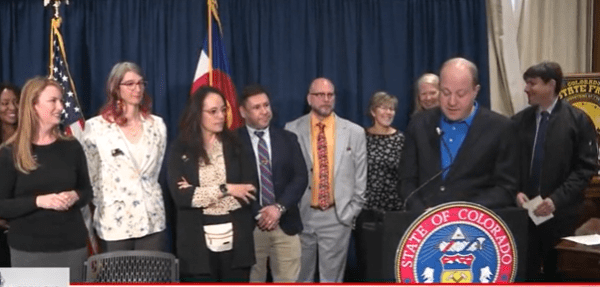
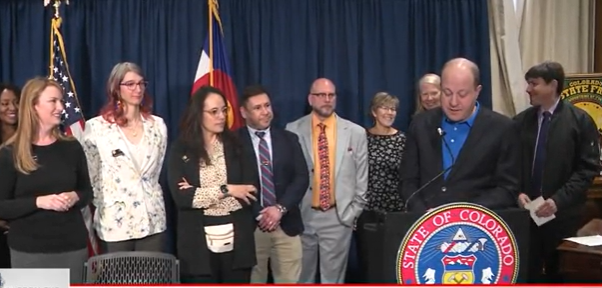
“Colorado is for everyone, no matter who you are or who you love,” Polis said in a press release. “Last November, the voters got rid of outdated language in our constitution that banned same-sex marriage. This is a long overdue step in the right direction and today’s law I’m signing ensures that Coloradans can marry who they love in our Colorado for all.”
“I am personally grateful to Senator Danielson, Representatives Garcia and Titone, and the countless community leaders and advocates whose hard work has made today possible,” Reis said. “This landmark legislation fulfills the hopes and dreams of so many across our LGBTQ+ and allied communities, and affirms that progress hard won is always worth defending, and in the end, love triumphs over all.”
Colorado’s previous same-sex marriage ban had been unenforceable since the U.S. Supreme Court’s 2015 Obergefell v. Hodges decision.
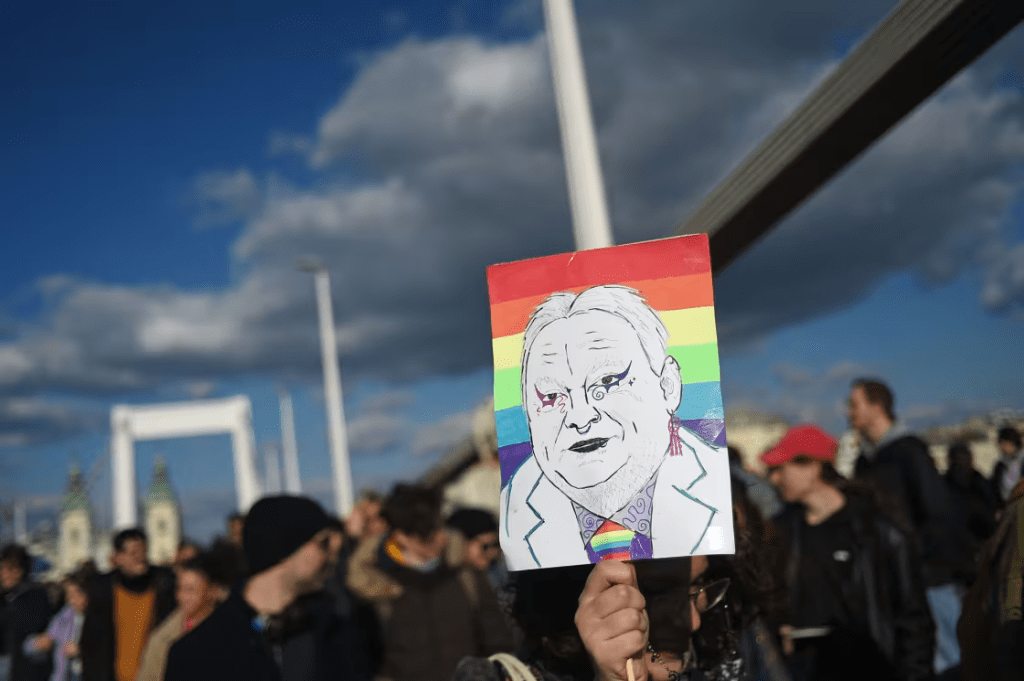
Thousands of protesters rallied for the fourth week in Hungary’s capital on Tuesday, denouncing a new law passed by populist Prime Minister Viktor Orbán’s nationalist government banning LGBTQ Pride events.
The legislation, fast-tracked through parliament in March, prohibits events depicting homosexuality to those under the age of 18 and has drawn comparisons to Russia’s anti-LGBTQ policies. It comes as Orbán’s administration is increasingly accused of democratic backsliding ahead of national elections next year.
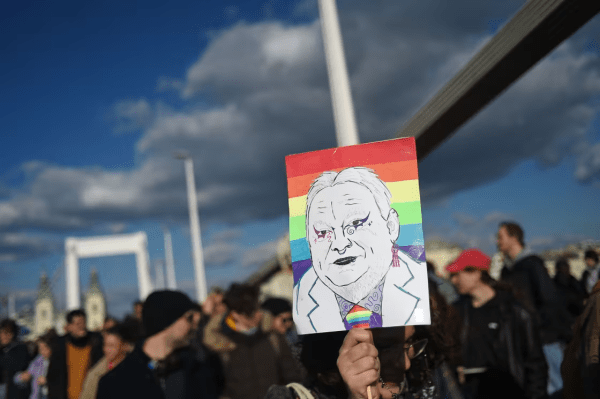
The weekly protests in Budapest have persisted, and on Tuesday, demonstrators filled the Erzsébet Bridge over the Danube, demanding the withdrawal of the law. Some planned to remain on the bridge throughout the night and said there were plans to shut down all five central Danube bridges.
No violence was immediately reported.
The law makes it an offense to hold or attend events such as Pride, which some legal experts and human rights groups say is Orbán’s latest crackdown on Hungary’s LGBTQ community and an arbitrary restriction on the right to assembly.
Viktória Vajda, one of the protesters, said the time for trying to find common ground with Orbán’s government “has passed.”
“If we don’t stand up for the rights of minorities and for our own fundamental rights, then who will when they come for us?” she said. “We’ve reached the point where we have to stand up and say, ‘No more’.”
The protests have defied police orders to disperse from bridges and main thoroughfares in Budapest. And in a rare instance of a street protest outside the Hungarian capital, several hundred demonstrators in the eastern city of Miskolc also protested on Tuesday against the law.
Orbán, who critics say has eroded Hungary’s democracy and overseen widespread corruption, has in recent years taken aim at the country’s LGBTQ community, prohibiting same-sex adoption and — in a 2021 “child protection” law — banning any LGBTQ content including in television, films, advertisements and literature that is available to those under 18.
As part of the new law, authorities may use facial recognition tools to identify those who attend prohibited events — such as the popular Budapest Pride, which draws tens of thousands each year — and can issue fines for violators of up to 200,000 Hungarian forints ($545).
Orbán’s party is pushing for a constitutional amendment next week that will codify the ban on public LGBTQ events. The Hungarian leader has also pledged to introduce new legislation that will ban demonstrators from blocking traffic on bridges and busy roads, arguing the right of assembly and expression cannot override the rights of commuters.
János Stummer, a member of the opposition Momentum party who was at the protest, said that while the ban on Pride was harmful to members of the LGBTQ community, the law is also about “Orbán unilaterally, arbitrarily deciding which events can be held in this country and which cannot.”
Orbán’s government argues that it’s protecting children from “sexual propaganda.”
But with Orbán’s party lagging in polls, critics views the legislation as part of a broader effort to scapegoat sexual minorities and mobilize his conservative base.
A couple of social media postings over the weekend struck a chord with many people. They both addressed good places for gay guys to live in the US — especially if hotspots such as New York City are out of their budget.
On Threads, user @justintycarey asked, “Where are you all moving to gay/queer Americans? I live in Philadelphia after nearly 7 years in New York. It’s fine for now and it’s more affordable (I live alone) but I don’t think it’s my vibe at all. I used to live in Portland, ME which was progressive and beautiful. Walkable too! But I realized it wasn’t my thing culturally.
“Now I’m stuck! I don’t know what’s good. I want a quiet life but I also want access to New York and other metro areas.” He also wanted a good arts scene.
Fans of Philadelphia told him not to give up on the city – especially if, as indicated later, he arrived during the chilly winter months.
“I moved to Philly from New York and spent the first year or two planning my escape, but it grew on me,” said one. “It’s a place that takes some time to find your people and neighborhood. I’ve been here for 10 years now and can’t picture myself anywhere else.”
Others praised parts of New Jersey.
“Have you considered the suburbs? I’m in south jersey and while I miss the city ‘vibe’, my community feels much tighter and, as a whole, more progressive. I can get to NYC in an hour or Philly in 20 mins. It’s not for everyone but walkable and quiet with access to city.”
Another pointed to the Jersey coast.
“Asbury Park, NJ! Yes, it’s a shore town, but most people are residential there. Very queer-friendly with a quiet town vibe. Access to the train is right in Long branch — it’s under 1.5 hours to NYC by NJ transit. Art scene is pretty good too with lots of potential for growth.”
Other suggestions within commuting distance of New York City came flocking in.
“Northampton, Massachusetts, springs to mind, depending on how far from NYC you want. If you want closer to NYC, then Warwick, NY or New Paltz, or if closer, then Montclair, NJ. All are walkable, gay friendly, progressive, pretty, stuff to do, not huge cities.”
Others wanted to know why the poster wasn’t keen on Portland. He said he highly rated the place but was used to cities that are more ethnically diverse, even if the Maine location was slowly increasing in diversity.
Boston
Over on X, user @fruitsnacks42 was also pondering locations to live… in a more snappy fashion. He said he was “Too poor to be an NYC gay, too dumb to be a DC gay, too ugly to be an LA gay, too fat to be a SF gay, too lib to be a Miami gay … just damaged enough to be a Boston gay.”
The tweet received over 44k likes.
In the replies, commentators urged him to consider cities such as Atlanta, Seattle, Chicago or Austin. Bostonites also defended their city.
Others pointed to San Francisco’s thriving bear scene, suggesting the “too fat for SF” was out of line. A few also suggested it was wrong to assume all the gay men in DC are smart.
Best gay-friendly cities
Obviously, on social media, people are likely to praise their home cities… but where are the best places to live if you’re queer?
In 2023, real estate data company Clever composed a ranking of the 15 top LGBTQ-friendly cities. It looked at whether cities scored well on the Human Rights Campaigns equality tally, and such factors as the size of the queer population, the number of gay bars and the numer of local Pride events. The top 15 were as follows:
15. Milwaukee, Wisconsin
14. Baltimore, Maryland
13. Pittsburgh, Pennsylvania
12. Richmond, Virginia
11. San Jose, California
10. New Orleans, Louisiana
9. Chicago, Illinois
8. Sacramento, California
7. San Diego, California
6. Los Angeles, California
5. Denver, Colorado
4. Portland, Oregon
3. Las Vegas, Nevada
2. Hartford, Connecticut
1. San Francisco, California
It should be noted that this ranking was from 2023 and some factors may have changed, particularly regarding anti-trans laws.
If you’re older and thinking about your later years, Life Care Retirement recently merged date on LGBTQ-friendly cities with retirement hotspots. It came up with the following top ten locations for seniors.
Five days after President Donald Trumpdeclared “gender ideology” to be “one of the most prevalent forms of child abuse,” Montana’s Republican-controlled House of Representatives killed a bill that would have enshrined much the same idea into state law by criminalizing parents and medical providers.
Montana Senate Bill 164 would have made it a felony for any adult to help transgender children under 16 to gain access to gender-affirming medical care—including hormones, puberty blockers, and surgeries—classifying such help as child endangerment. On Tuesday, House lawmakers voted 58-40 to reject the proposed law, with 17 Republicans joining Democrats to block it from advancing to its final reading.
“I think it’s overly broad,” the lone Republican to speak against the bill, Rep. Brad Barker, said Tuesday. Barker said that while he generally opposes gender-affirming care for trans youth, SB164 was “the wrong approach.”
“I don’t like the thought of criminalizing parents,” Barker added, entreating fellow Republicans to “vote with your conscience.”
The bill carried penalties of up to five years in prison and $10,000 in fines for any adults, including parents and doctors, who provided children with surgery, puberty blockers, or hormone replacement therapy for the purpose of “altering the appearance” of the child or affirming the child’s gender. If “serious bodily injury” occurred, the maximum punishment was 10 years imprisonment and $25,000 in fines.
“Turning parents and doctors into felons is absolutely not the approach that best serves this state,” Democratic Rep. SJ Howell, the first non-binary person to be elected to the Montana legislature, said on the House floor.
The bill cleared the Senate in February, 30-20, with two Republicans voting against it. In that floor debate, the legislation’s sponsor, Republican Sen. John Fuller, called it a “simple bill” to protect Montana’s children. “The state does have a compelling interest, a very compelling interest, to avoid the sterilization and sexual mutilation of children,” he said. In 2023, Fuller sponsored a law that threatened medical providers’ licensing if they offered gender-affirming care to minors, a law that courtshave blocked while litigation proceeds.
“This bill is not about politics, it’s about safeguarding the health and innocence of Montana youth,” one of SB164’s House supporters, Republican Rep. Braxton Mitchell, said Tuesday. But more than a quarter of members of his own party disagreed, suggesting a potential turning point for the Montana legislature, at least on trans issues.
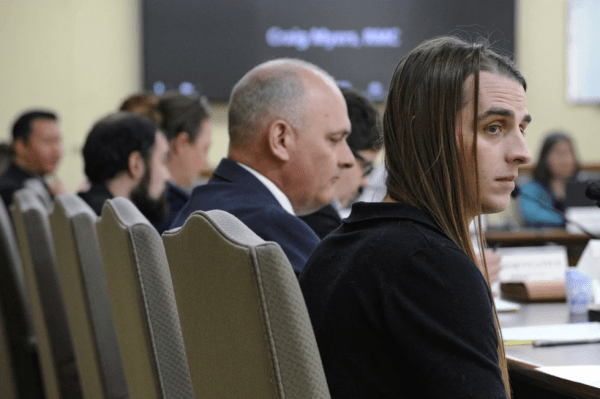
Tuesday’s vote was the second time this year a large swath of Republicans crossed party lines to block an anti-trans bill. Last year, Montana’s first openly transgender lawmaker, Rep. Zooey Zephyr, said her Republican colleagues often privately bemoan the transphobic culture wars and apologize to her for their votes on anti-LGBTQ legislation.
Even so, Republican Gov. Greg Gianforte signed two anti-trans bills into law last month—a bathroom ban and a law prohibiting trans girls and women from playing on women’s sports teams from kindergarten through college. The bathroom ban has been temporarily blocked. A state law that prohibited trans women from participating in female collegiate sports was ruled unconstitutional in 2022.
The right to privacy is enshrined in the Montana constitution, and state courts have strongly affirmed its application to healthcare laws. Last December, the Montana Supreme Court upheld a lower court’s preliminary injunction on a law that would have made gender-affirming medical care providers vulnerable to licensing board disciplinary proceedings. And last summer, it ruled that a parental consent law for minors seeking abortion was unconstitutional. (In January, Montana Attorney General Austin Knudsen asked the U.S. Supreme Court to declare that ruling an unconstitutional infringement on parental rights. The Supreme Court has not decided whether to hear the case.)
If it had passed, SB164 would have become the first law in the country defining gender-affirming care as a form of felony child endangerment. (Child endangerment and abuse fall under different statutes, but both evoke the same myth that gender-affirming care is dangerous for youth.)
Montana, however, wouldn’t have been the first state to direct child welfare workers to investigate families of trans children. In 2022, Texas Republican Gov. Greg Abbott ordered the state’s Department of Family and Protective Services to open child abuse investigations into parents who seek gender-affirming care for their children. That directive remains partially blocked after families of trans children and the LGBTQ advocacy group PFLAG sued.
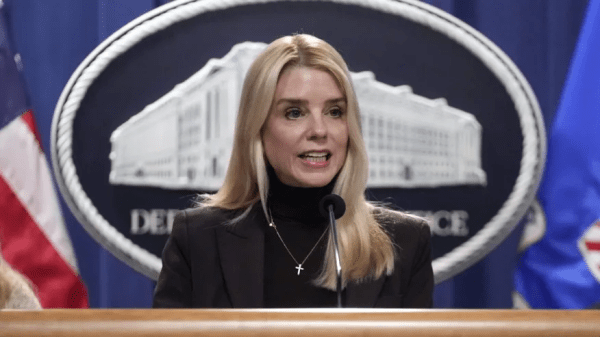
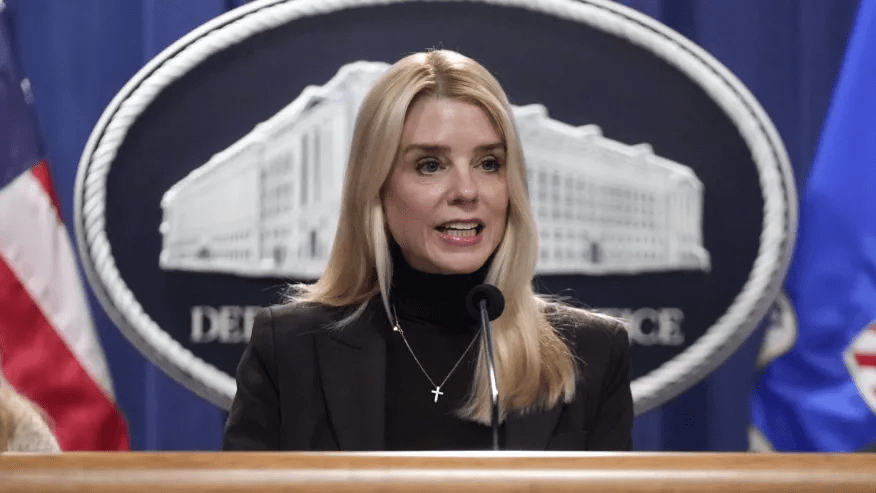
The Justice Department revoked funding for the Maine Department of Corrections over the state’s placement of a transgender woman in a women’s prison, Attorney General Pam Bondi said Tuesday.
Bondi made the announcement during an interview with Fox News, saying the department pulled all “nonessential” funding from the state corrections department on Monday after federal officials learned “a guy” was serving time in one of the state’s two women’s facilities. Bondi said the inmate was convicted of murder.
The loss in funding for the department totaled upward of $1.5 million, according to Fox News. The Justice Department did not return a request for comment.
In a news release, Maine’s corrections department said it received formal notice from the Department of Justice on Monday that certain federal grants “are being terminated because they ‘no longer effectuate the program goals or agency priorities.’” The cuts will impact state-run initiatives related to substance abuse treatment and support for children with incarcerated parents, the corrections department said.
The notice from the Justice Department, a copy of which was obtained by The Hill, does not mention transgender inmates. “While the Department is aware of related public statements by the United States Attorney General, the notice is the only communication that has been received by the Department,” Maine’s corrections department said.
The move by the Justice Department is the latest development in a monthlong battle between the Trump administration and Maine over the state’s refusal to ban transgender student-athletes from girls’ and women’s sports as ordered by the president.
Another Trump executive order directs transgender women in federal women’s prisons to be moved to men’s facilities. A federal judge temporarily blocked the administration from enforcing that order in February.
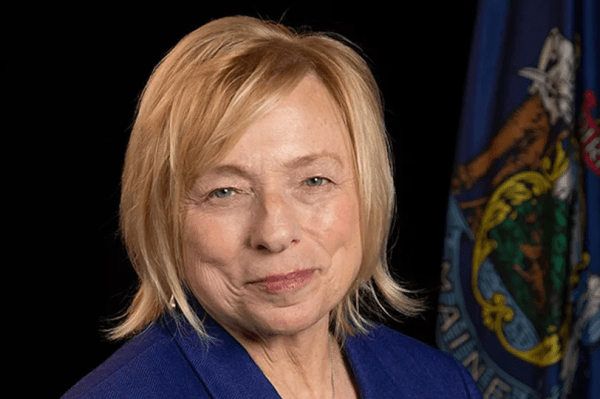
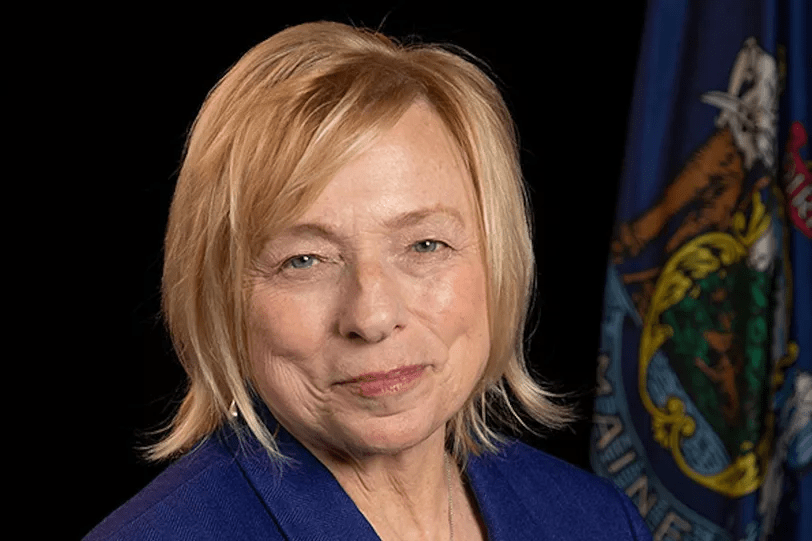
When Maine Gov. Janet Mills (D) told President Donald Trump, “See you in court,” she meant it.
On Monday, Maine sued the U.S. Department of Agriculture (USDA) and Secretary of Agriculture Brooke Rollins over the department’s halt on federal funding for education programs in the state in retaliation for its refusal to ban transgender women and girls from school sports.
As Reuters notes, Rollins announced the funding freeze in an April 2 letter to Mills, saying that the decision was “only the beginning” but that the governor could “end it at any time by protecting women and girls in compliance with federal law.” The funding freeze jeopardizes programs that provide free or reduced-price meals to children in Maine schools, childcare centers, and after-school programs.
Mills has publicly clashed with the administration, and with Trump specifically, over its assertion that allowing transgender women and girls to participate in women’s and girls’ sports violates Title IX, the federal civil rights law that prohibits discrimination on the basis of sex in schools that receive federal funding.
In February, the Maine Principals Association announced that it would not comply with Trump’s February 5 executive order banning transgender student-athletes from participating in girls’ and women’s sports. After Trump threatened to cut off the state’s funding, Mills and Maine Attorney General Aaron Frey accused the president of using school children “as pawns in advancing his political agenda” and vowed to “take all appropriate and necessary legal action to restore that funding and the academic opportunity it provides.”
“The State of Maine will not be intimidated by the president’s threats,” Mills said.
During a February 21 meeting with Democratic and Republican governors at the White House, Trump singled out Mills, asking whether she planned to comply with his anti-trans executive order. Mills said that her state was “complying with the state and federal laws.” When Trump continued to petulantly insist that Mills comply with his order, the governor told the president she would see him in court.
In its lawsuit, Maine calls the USDA’s funding freeze a “blatantly unlawful action” in violation of the Administrative Procedures Act. Rollins, the state argues, “took this action without following any of the statutory and regulatory requirements that must be complied with when terminating federal funds based on alleged violations of Title IX.”
The state argues that Rollins provided no legal basis for her assertion that by allowing trans students to participate in women’s and girls’ sports, Maine is in violation of Title IX and that her interpretation of the law is wrong. “Indeed, several federal courts have held that Title IX and the Equal Protection Clause require schools to permit transgender girls and women to play on girls’ and women’s teams,” the complaint reads.
However, the state is not asking the court to interpret Title IX. It merely asks the court to vacate Rollins’s “arbitrary, capricious” funding freeze for failing to meet the “statutory and regulatory requirements that the federal government must comply with before it may freeze federal funds owed to a state.”
In a statement, Frey said that Trump “and his cabinet secretaries do not make the law, and they are not above the law, and this action is necessary to remind the president that Maine will not be bullied into violating the law.”
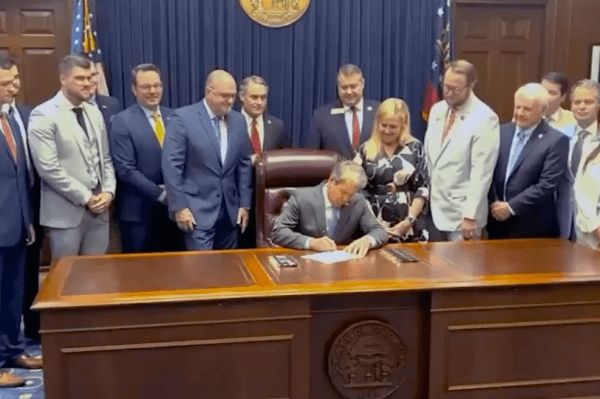
Nine years after similar legislation ignited a firestorm of protest from business and civic leaders in Georgia, state Gov. Brian Kemp (R) recently signed a new bill aimed at protecting “religious freedom.”
Modeled on the federal Religious Freedom Restoration Act (RFRA) of 1993, the bill’s sponsors say it will prevent government agents from impeding individuals’ religious rights and enforcing laws that conflict with religious expression. The Republican-led state House approved the bill in a 96-70 vote.
In previous years, state legislators failed to pass a so-called RFRA amid fierce opposition. Like those versions, the current bill is framed as an expansion and protection of religious rights.
Critics say just like earlier versions, the new bill will be used to deny the civil rights of LGBTQ+ people and other minorities. They also worry the RFRA will be cited as a basis for passing anti-LGBTQ+ laws, further restricting reproductive rights, allowing business owners to discriminate at their own discretion, and controlling educational materials in schools.
Opponents of the RFRA include state House Rep. Ruwa Romman (D), who believes that without an underlying civil rights law explicitly prohibiting discrimination, the bill will give people a license to discriminate against people or lifestyles they don’t like. Georgia doesn’t have comprehensive state civil rights protections.
“Because at the end of the day, those who will bear the brunt of this are not those in the majority. It’ll be us, people in the religious minority,” said Romman, who spoke of her own Christian faith while denouncing the bill.
Gov. Kemp disagreed with Romman’s take, telling reporters, “I don’t buy that. I don’t think we’ve seen that in other states, and I think our record speaks for ourselves here in Georgia.”
Georgia still remains a state where there is no place for hate, and I can assure all Georgians of that today,” he said at the RFRA’s Friday signing ceremony. At least 29 states have similar “religious freedom” laws.
The bill recalls highly contested legislation that former Gov. Nathan Deal (R) vetoed in 2016 amid widespread protests and concerns from Georgia’s business community that it would hurt their ability to attract employees and tourists. The Metro Atlanta Chamber once again expressed opposition to the new religious freedom legislation.
The bill’s sponsor Sen. Ed Setzler (R) said the new bill, designed in part by Gov. Kemp’s staff, is less extreme than the 2016 version.
Pro-business lawmakers took pains to distinguish this year’s bill from previous efforts, saying the new law would not override local civil rights protections in place in several Georgia municipalities.
“Every Georgian should be free to exercise their faith without unfair federal, state and local government intrusion,” Setzler said at a news conference last week. He said the bill “protects ordinary people from unfair state and local government intrusion.”
“This is not a license of private citizens to discriminate against private citizens,” said Republican Rep. Tyler Paul Smith, who presented the bill in the House. “This prohibits the government from burning religious exercise in our state.”
Republican state Rep. Deborah Silcox failed in her effort to add an anti-discrimination clause to the bill before it passed the House on Wednesday. She was one of two House Republicans to vote against it.
Examples of “unfair state and local government intrusion” were absent, however, in testimony about the legislation.
Pressed during a House Judiciary committee meeting, Setzler couldn’t name a case where someone’s religious liberties were violated in a way that would require the bill’s protections.
“We are swatting at imaginary flies, and I’m sick of it,” Atlanta state Rep. Stacey Evans (D) said last Wednesday after the state House vote approving the bill.
The top administrative court in Greece, the Council of State, has overturned a 2022 decision by the nation’s Health Ministry that lifted the ban on gay men donating blood. As such, the ban – which Greece originally instated during the height of the HIV/AIDS epidemic in the 1980s – has effectively been reinstated.
The court ruled that the ministry did not provide scientific evidence to support its decision and did not follow the recommendations of two health advisory panels that suggested deferral periods for high-risk donors, reported Athens-based publication Kathimerini.
Greece is often considered to be at the forefront of progressive legislation moving LGBTQ+ rights, but lately it seems to be making moves to the contrary. In addition to reinstating the donation ban, the country’s justice minister recently said that proposed changes to Greece’s civil code will clarify that only women will be able to start a family through surrogacy, preventing single straight men, single gay men, and same-sex male couples from benefiting from the procedure.
“We are now clarifying unequivocally that the concept of inability to carry a pregnancy does not refer to an inability arising from one’s gender,” Giorgos Floridis told reporters.
In 2017, the Greek Parliament passed the Legal Gender Recognition Law, which allows transgender people to change their legal gender without needing prior medical interventions or tests.
The United States loosened its own blood donation restrictions in 2023, mostly benefiting monogamous men who aren’t taking any HIV treatment or HIV prevention medications.
The new FDA guidelines focus on specific criteria rather than anyone’s gender or the genders of their partners. They require a three-month pre-donation celibacy period for anyone who has had sex with a new sexual partner, more than one sexual partner, or anal sex, as well as for anyone taking pre-exposure prophylaxis (PrEP) medication. A two-year abstinence period is required for users of injectable PrEP, which can mask the presence of HIV in blood.
The policies are meant to reduce the likelihood of donations by people with new or recent HIV infections, the FDA said. Blood donation organizations test all donated blood for transfusion-transmitted infections, including HIV, hepatitis B, and hepatitis C.
A judge on Wednesday temporarily blocked a Montana law that restricts transgender people’s use of bathrooms in public buildings.
The measure, which Republican Gov. Greg Gianforte signed into effect last week, threatened to deprive transgender people of their constitutional right to equal protection under the law, Montana District Court Judge Shane Vannatta ruled. The law prevents people from using restrooms in public buildings that do not align with the sex they were assigned at birth.
The five people who sued over the law were likely to prevail, Vannatta added in his ruling.
The new law “is motivated by animus and supported by no evidence that its restrictions advance its purported purpose to protect women’s safety and privacy,” Vannatta wrote.
The judge’s order will be in effect at least until an April 21 hearing on whether it should continue to be blocked while the lawsuit moves ahead.
Gianforte spokesperson Kaitlin Price said the governor will defend the law “and the privacy and safety of women and girls.”
“We’re not surprised to see far-left activists run to the courts to stop this common sense law,” Price said in an emailed statement. “A man shouldn’t be in a women’s restroom, shouldn’t be in a women’s shower room and shouldn’t be housed in a women’s prison.”
The American Civil Liberties Union praised the ruling.
“Today’s ruling provides enormous relief to trans Montanans across the state. The state’s relentless attacks on trans and Two Spirit people cannot withstand constitutional scrutiny by the courts,” said a statement by Alex Rate, ACLU of Montana’s legal director.
The law passed this year despite opposition from Democrats who worried it would complicate daily life for two fellow lawmakers who are transgender and nonbinary. They included Rep. Zooey Zephyr, a Missoula Democrat who in 2023 was silenced and sanctioned by her Republican colleagues for comments she made on the House floor.
The law would require public buildings including the state Capitol, schools, jails, prisons, libraries and state-funded domestic violence shelters to provide separate spaces for men and women. It defines the sexes based on a person’s chromosomes and reproductive biology, despite a recent state court ruling that declared the definitions unconstitutional.
The order wasn’t unexpected, bill sponsor Republican Rep. Kerri Seekins-Crowe said in an emailed statement.
“I am thankful that there is a team of Montanans devoted to protecting women’s spaces from men who desire to invade them,” said Seekins-Crowe.
At least a dozen other states already have variations of bathroom bans on the books, many directed at schools. Even more states, including Montana, have passed laws to ban gender-affirming medical care for transgender children and keep trans girls out of girls sports.
Montana’s law allows people to sue a facility if it does not prevent people from using restrooms or changing rooms that do not align with their sex assigned at birth. They can recover nominal damages, generally $1, and the entity could be required to pay the plaintiff’s legal fees.
A transgender college student declared “I am here to break the law” before entering a women’s restroom at the Florida State Capitol and being led out in handcuffs by police. Civil rights attorneys say the arrest of Marcy Rheintgen last month is the first they know of for violating transgender bathroom restrictions passed by numerous state legislatures across the country.
Capitol police had been alerted and were waiting for Rheintgen, 20, when she entered the building in Tallahassee March 19. They told her she would receive a trespass warning once she entered the women’s restroom to wash her hands and pray the rosary, but she was later placed under arrest when she refused to leave, according to an arrest affidavit.
Rheintgen faces a misdemeanor trespassing charge punishable by up to 60 days in jail and is due to appear in court in May.
“I wanted people to see the absurdity of this law in practice,” Rheintgen told The Associated Press. “If I’m a criminal, it’s going to be so hard for me to live a normal life, all because I washed my hands. Like, that’s so insane.”
At least 14 states have adopted laws barring transgender women from entering women’s bathrooms at public schools and, in some cases, other government buildings. Only two — Florida and Utah — criminalize the act. A judge on Wednesday temporarily blocked Montana’s new bathroom law.
Rheintgen’s arrest in Florida is the first that American Civil Liberties Union attorneys are aware of in any state with a criminal ban, senior staff attorney Jon Davidson said.
Rheintgen was in town visiting her grandparents when she decided to pen a letter to each of Florida’s 160 state lawmakers informing them of her plan to enter a public restroom inconsistent with her sex assigned at birth. The Illinois resident said her act of civil disobedience was fueled by anger at seeing a place she loves and visits regularly grow hostile toward trans people.





 fleeredstates.blog
You must be logged in to post a comment.