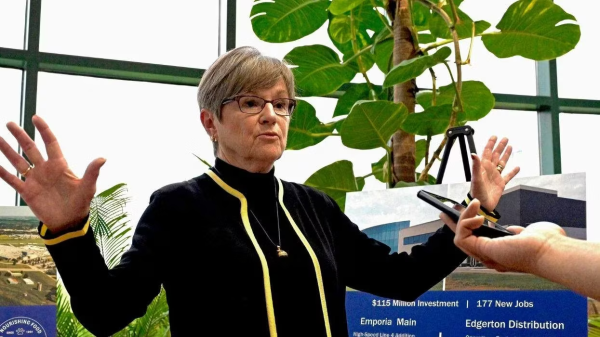
Republican lawmakers in Kansas overrode Gov. Laura Kelly’s (D) veto of an extreme bathroom bill that Democrats say will ban people from visiting loved ones in hospitals, nursing homes, and dorms if they aren’t of the same sex.
“As I said in my veto statement, this is a poorly drafted bill with significant, far-reaching consequences,” Kelly said in a statement. “Not only will this bill keep brothers from visiting sisters’ dorms and husbands from wives’ shared hospital rooms, it will cost Kansas taxpayers millions of dollars to comply with this very vague legislation.”
Kelly vetoed S.B. 244 last Friday. But, because Republicans have supermajorities in both chambers of the legislature, they were able to override her veto in a party-line vote. The Kansas House of Representatives voted 87-37 in favor of overriding her veto, and the state Senate voted 31-9 in favor. Both votes occurred in the last 24 hours.
“Kansas Democrats are for They/Them,” Senate President Ty Masterson (R) said in a statement. “I will continue to fight for you, and protect women and girls across our state.”
Republicans in the state legislature passed S.B. 244 last month. The bill was originally about gender markers on drivers’ licenses, but Republicans used a sneaky maneuver called “gut-and-go” to hold hearings on the drivers’ license part of the bill and then change the text to include bathroom provisions, without holding hearings on those bathroom provisions.
The bathroom provisions will ban trans people from using facilities that do not align with their sex assigned at birth in government buildings.
The law “obviously discriminates against transgender people in ways that make our lives exponentially more difficult and dangerous,” said state Rep. Abi Boatman (D), who is transgender.
Democrats stressed that the bathroom provisions were poorly written and would affect any situation where people are being housed in shared living spaces, like dorms, nursing homes, and hospitals.
“If your grandfather is in a nursing home in a shared room, as a granddaughter, you would not be able to visit him. If your sister is living in a dorm at K-State, as a brother, you would not be able to visit her in her room,” Kelly said in a statement when vetoing the bill. “I believe the Legislature should stay out of the business of telling Kansans how to go to the bathroom and instead stay focused on how to make life more affordable for Kansans.”
“If you feel you have to accompany your nine-year-old daughter to the restroom at a sporting event, as a father, you would have to either enter the women’s restroom with her or let her use the restroom alone.”
State Sen. Kellie Warren (R) said that the unintended consequences won’t happen because, she told CJ Online, they’re “not the subject of the bill.”
The bill will also ban trans people from getting the gender markers updated on their driver’s licenses. The Kansas Department of Revenue will have to invalidate licenses where the gender marker has been corrected, and the same applies to birth certificates.
The European Parliament agreed to a resolution that says that trans women are women last Wednesday.
The resolution was to adopt recommendations concerning the European Union’s priorities for the 70th session of the U.N. Commission on the Status of Women, which is set to take place next month in New York. The U.N. Commission on the Status of Women is charged with promoting gender equality across the globe.
Citing the U.N. Convention on the Elimination of All Forms of Discrimination against Women, as well as several other international proclamations, the council set a list of recommendations for the E.U. to pursue at the convention, including: “emphasize the importance of the full recognition of trans women as women, noting that their inclusion is essential for the effectiveness of any gender-equality and anti-violence policies; call for recognition of and equal access for trans women to protection and support services.”
The resolution also mentioned LGBTQ+ people in several other places, including in the statement about needing a “comprehensive tool to monitor and counter democratic backsliding and backsliding in women’s rights” and citing “attacks by anti-gender and anti-rights movements” that “undermine democracy and target women’s and LGBTIQ+ rights.”
The section on funding cuts to non-governmental organizations included “LGBTIQ+ organizations” as needing support. The section on sexual and reproductive health and rights (SRHR) mentioned “access to gender-sensitive mental health services for young women and LGBTIQ+ people.” And a section about the E.U. commitment to foreign policy stressed the need to prioritize “the needs of women and LGBTIQ+ human rights defenders.”
The resolution was adopted in a 340-141 vote, with 68 abstentions.
Independent journalist Erin Reen notes that this now puts the E.U. “on a direct collision course with the United States,” which will also be at the session, a reference to the current presidential administration’s stated policy that trans people’s existence must be denied by the federal government.
While the European Parliament’s recommendations aren’t binding, they are expected to have significant influence on the E.U.’s positions at the forum.
Kansas Gov. Laura Kelly has vetoed what LGBTQ+ advocates are calling an anti-transgender “bathroom bounty” bill.
Kelly, a Democrat in a heavily Republican state, Friday vetoed Senate Bill 244, passed by legislators in January along party lines, Republicans for, Democrats against. It would have required trans people to restrooms and other single-sex facilities in government buildings according to their sex assigned at birth, not their gender identity. It further would have required the state to reissue any driver’s licenses or birth certificates that reflected a trans person’s gender identity, replacing that gender marker with one for the sex assigned at birth. It further would have banned multi-occupancy gender-neutral restrooms in government buildings.
It would have imposed a fine on individuals of $1,000 for a second violation of the law and would allow those “aggrieved” by the presence of a trans person to sue for damages of $1,000 or the amount of actual damages. The government entity would be fined $25,000 for the first violation and $125,000 for any subsequent violation. The lawsuit provision is not limited to government buildings.
In her veto message, Kelly called the bill “poorly drafted.”
“This poorly drafted bill will have numerous and significant consequences far beyond the intent to limit the right for trans people to use the appropriate bathroom,” she wrote. “Under this bill: If your grandfather is in a nursing home in a shared room, as a granddaughter, you would not be able to visit him. If your wife is in a shared hospital room, as a husband, you would not be able to visit her. If your sister is living in a dorm at K-State, as a brother, you would not be able to visit her in her room. … I believe the Legislature should stay out of the business of telling Kansans how to go to the bathroom and instead stay focused on how to make life more affordable for Kansans.”
The legislation is known as a “gut and go” bill because it started out with an altogether different purpose. SB 244 originated as a bill to regulate bail bond companies. A House committee deleted those contents and replaced them with the anti-trans language. The gender marker provisions had a public hearing, but not the bathroom provisions.
“Procedurally, it is the absolute worst bill I have ever heard in the Kansas legislature,” Democratic Rep. Dan Osman said during debate on the measure, according to the Kansas Reflector. “It was done with one purpose and one purpose only — to ensure that the absolute least number of people were available as opponents to this bill and that they were unaware that there would even be a hearing.”
Rep. Abi Boatman, the only trans person currently serving in the legislature, said she felt the bill was aimed at her, the Reflector reports. “I have sat here for five and a half hours and listened to this entire room debate my humanity and my ability to participate in the most basic functions of society,” Boatman, a Democrat who was appointed in January to fill a vacancy, said as the debate ended. “From the bottom of my heart, I hope none of you have to ever sit through something like that.” Another Democrat, Rep. Susan Ruiz, said the legislation “spits on basic human decency.”
Democratic Rep. Alexis Simmons said it’s sexism, not trans women, that is a threat to women’s safety. “Here in this building, as an intern, as a committee assistant, as staff and as a legislator, I have been sexually harassed more than you would believe,” she said, according to the Reflector. “If we’re going to talk about women’s safety, we should address the real trauma, which is how women are treated, not putting the spotlight on one new member of our legislature.”
House Minority Leader Brandon Woodard predicted that if the bill became law, it would be struck down in court. Attorney General Kris Kobach, a Republican, lost a court case dealing with gender markers, he noted. “As long as Kris Kobach’s our attorney general, I think he’s going to continue to lose in court,” Woodard said.
The legislation “would cut directly against the inclusive workplace policies many Kansas cities have already adopted,” a Human Rights Campaignpress release notes, and its “broad restrictions across public buildings, including schools, universities, airports, and government offices, would affect large numbers of public-sector employees and contribute to a chilling effect at work.”
Senate President Ty Masterson and House Speaker Dan Hawkins, both Republicans, vowed overrides, The Topeka Capital-Journalreports. “I never thought I’d see the day when our state’s own governor would turn her back on women by forcing them to use bathrooms in public buildings with biological men,” said a statement from Masterson. “Sadly, our governor has decided she will side with they/them over simple, scientific truth. Kansans need not worry — the Kansas Senate will restore sanity and override her veto.”
LGBTQ+ groups, meanwhile, are praising Kelly’s veto. HRC President Kelley Robinson issued this statement: “The length that Republican lawmakers will go in attacking the transgender community instead of solving real issues facing Kansans is appalling. SB244 is about invading privacy, forcing people into the wrong bathrooms, stripping transgender Kansans of accurate IDs, and inviting government-sanctioned harassment — all pushed through using cynical procedural tricks to silence public opposition. Shameful policies like this are part and parcel of a national right-wing anti-LGBTQ+ campaign, and they don’t make anyone safer. They green light harassment and violence targeting transgender people while opening the door to invasive gender policing that affects everyone.
“We’re grateful to Governor Laura Kelly and Kansas State Rep. Abi Boatman for continuing to stand up for transgender Kansans. They have been consistent, courageous defenders of dignity, privacy, and freedom for all. HRC will work to ensure the legislature sustains the Governor’s veto and gets back to work on policies that support all Kansas families, instead of discriminating against them.”
“It is impossible to overstate the harms this extremist legislation would visit on transgender Kansans and many others if allowed to take effect,” Omar Gonzalez-Pagan, senior counsel and health care strategist at Lambda Legal, added in a press release. “ SB244 would require transgender Kansans to use public facilities that do not align with who they are and to carry inaccurate and conflicting identity documents that cause confusion and expose them to harassment and abuse, and would put a target on their backs through a bounty system that will encourage extreme violations of their privacy by those seeking financial gain. Make no mistake, the unprecedented and unlawful bounty system in this legislation would expose all Kansans — not just those who are transgender — to intrusive and abusive violations of their privacy.”
Angelina Jolie appears ready to close the chapter on her life in the United States, with her final obstacle to leaving set to be resolved in a few months.
The Eternals star has been waiting for twins Knox and Vivienne to turn 18 in July before making a long-considered move abroad, telling reporters at the San Sebastian Film Festival that while she still “loves” America, she no longer “recognize[s]” it the way she once did.
The comment underscored a shift that has been years in the making for the Academy Award winner, who has increasingly framed the U.S. as just one stop in a much more global life.
Jolie, 50, has been open about that mindset across multiple interviews. Speaking to The Hollywood Reporter in 2024, she described Los Angeles less as a permanent home and more as a practical base for raising her six children. Calling her multi-million dollar home “a place where I raise my children,” she said, before adding that the “humanity that I found across the world is not what I grew up with here.”
That global pull has long competed with the realities of her custody arrangement with ex-husband Brad Pitt. The former couple shares six children—Maddox, 24; Pax, 22; Zahara, 21; Shiloh, 19; and twins Knox and Vivienne, who turn 18 this summer. Until now, Jolie’s ability to relocate has been constrained by the need to remain close to Pitt, 61.
A source close to the star told People that the restriction is finally lifting. The insider said Jolie “never wanted to live in L.A. full-time” and has been quietly preparing for a move once her youngest children reached adulthood. With that milestone approaching, she is now reportedly taking concrete steps—including preparing to sell her Los Feliz estate.
Jolie purchased the $24.5 million home in 2017, a year after filing for divorce from Pitt. At the time, she told Page Six the decision was driven by proximity: she “wanted it to be close to their dad,” who lived just minutes away.
The property—featuring six bedrooms and 10 bathrooms—served as a central base during years of custody negotiations and legal disputes.
Now, that chapter appears to be ending. In a September 2025 interview with Variety, Jolie emphasized that she has “always lived internationally,” pointing to her network of family and friends across the globe.
If there is a frontrunner for her next home, it is Cambodia. Jolie has repeatedly described the country as deeply personal to her, dating back to her time filming 2001’s Lara Croft: Tomb Raider film. It was there that Jolie adopted her eldest son, Maddox, in 2002 and has maintained close ties ever since.
Jolie has repeatedly referenced Cambodia as a place that feels like home “in my heart.”The star said she felt compelled to produce her 2017 film They Killed My Father about the Cambodian genocide after coming to fall “in love with its people,” describing “becoming a part of a Cambodian family” as life-changing.
n a separate interview with People, the actress dove deeper into her connection with Cambodia. Revealing that she and her son Maddox frequently travel back and forth, sometimes spending months there at a time—a reflection of the family’s enduring connection to the country.
The Daily Beast has reached out to Jolie’s team for comment.
Jeremy Carl, President Donald Trump’s nominee to head the Bureau of International Organization Affairs, deleted thousands of social media posts before his nomination. One was a May 2023 post calling for the killing of Randi Weingarten, the lesbian president of the American Federation of Teachers, a major American labor union representing over 1.8 million professionals in education, healthcare, and public service.
In a May 2023 post, Carl wrote, “If the U.S. were a serious nation, Weingarten would be tried for crimes against America’s children and would get the death penalty.”
Right-wing critics hate Weingarten (who is a Democrat) for supporting school closures during the height of the COVID-19 pandemic, opposing the use of public taxpayer money for private “school choice” voucher programs, and speaking out against so-called “parents’ rights” groups that largely push anti-LGBTQ+ school policies.
Carl deleted this and thousands of other posts, including numerous racist posts saying that white people had “already surrendered” to Black people and ones that pushed the Great Replacement conspiracy theory, an antisemitic and white supremacist conspiracy theory that claims that a cabal of powerful Jewish people want to “replace” white Americans and Westerners with non-white immigrants and people of color (especially Black people and Muslims) to fundamentally change the nation’s racial makeup and political culture.
In a recent Senate hearing, Carl said he believes people of color are “erasing white culture,” but he struggled to define what white culture is. Carl’s nomination may fail, as Sen. John Curtis (R-UT) said he’d vote against him because of his long history of anti-semitic comments.
Tennessee lawmakers have advanced a host of anti-LGBTQ bills that would run counter to U.S. Supreme Court precedent.
Two measures, both proposed by Rep. Gino Bulso, R-Franklin, would challenge landmark cases that legalized same-sex marriage and established protections for discrimination based on sexual orientation or gender identity.
Rep. Gloria Johnson, D-Knoxville, questioned the legality to going against Bostock v. Clayton County, which established that LGBTQ people are protected from discrimination under the Civil Rights Act of 1964.
“We’re talking about federal law that supersedes state law,” Johnson said. “You can’t just ignore the federal law. So, therein is the problem for those of us who believe in our U.S. Constitution.”
Bulso answered, arguing that, “The Civil Rights Act of 1964 does not govern all employers. It only governs employers with more than 15 employees.”
The legislation, Bulso said, would only apply to small businesses — but could jeopardize federal funding by putting the state at odds with federal law.
There’s a similar fiscal note on another of Bulso’s bills that would challenge Obergefell v. Hodges. Bulso argued that the opinion only dictates that public actors must recognize same-sex marriages, not private citizens.
Tom Lee, member of the Board of Directors of the Tennessee Pride Chamber, spoke against the bill, arguing that it could allow discrimination against LGBTQ couples.
“Imagine if under this bill a private employer said, ‘Well, you can’t take family leave because I, as a private citizen, don’t recognize — using the language of the bill — your purported marriage,’” Lee said. “Or a bank says, ‘You’ll pay the higher rate (for unmarried couples). We’re not bound by the 14th Amendment. You’re not married in our eyes.’”
Both measures advanced Wednesday along party lines.
Other measures proposed this year would expand previous bills aimed at LGBTQ Tennesseans. State law that allows teachers to ignore a student’s preferred pronouns would expand to include honorifics like “Mr.” or “Mrs,” and the state’s drag ban would expand the type of businesses that could be penalized under the law.
Marcus Ellsworth with the Tennessee Equality Project said that the legislature wants to consider queer people obscene at a time when all people, regardless of gender or sexuality, are struggling.
“What is actually obscene is that every year we have to watch our state prioritize wasting time, money, and resources, fabricating ways to hurt us,” Ellsworth said.
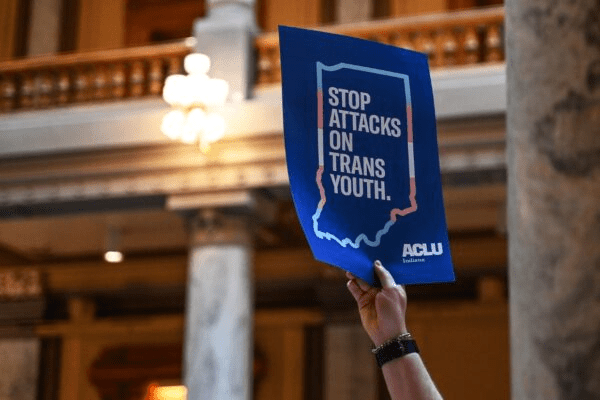
The state of Indiana just banned trans people from updating the gender markers on their driver’s licenses.
Advocate reports that the state’s Bureau of Motor Vehicles added a small statement to its website on Monday saying that it will no longer allow people to change their gender on state IDs, even if they have a court order.
The notice can be found by clicking through several webpages on the state’s BMV website:
Gender Change Rule Update
Effective Feb. 12, 2026, the BMV will no longer provide customers with the option to change their gender on their Indiana credential by using a court ordered gender change or physician statement per Amended Rule 140 Indiana Administrative Code section 7-1.1-3.
Indiana has been rolling back transgender people’s rights for the past few years. In 2014, trans people were allowed to update the gender marker on their birth certificates with a court order. In March 2025, Gov. Mike Braun (R) signed an executive order banning the practice. The ACLU sued to stop the executive order.
In January 2020, the Indiana BMV stopped allowing people to choose an “X” gender marker on their driver’s licenses, after about a year of allowing it. Then-Attorney General Curtis Hill said that the BMV had overstepped its authority in allowing the nonbinary gender markers and said that “only the General Assembly” has the power to decide if nonbinary gender markers are allowed.
In 2023, then-Gov. Eric Holcomb (R) signed a ban on gender-affirming care for trans minors that also forced trans youth in the state to detransition if they were already receiving hormone therapy.
The Movement Advancement Project says that only three states – Texas, Tennessee, and Florida – completely ban trans people from updating the gender marker on state IDs.
Indiana Youth Group, an LGBTQ+ organization in the state, denounced the rule change.
“Denying people the ability to update the gender marker on their identification is not only discriminatory; it is dangerous,” they said in a statement. “In an increasingly hostile climate, mismatched identification can expose individuals to harassment, threats, and violence. It can also create serious barriers to employment, housing, and access to essential services.”
In 2020, a study from Drexel University found that transgender adults with gender-affirming IDs have better mental health than those whose IDs do not match their gender identity.
The study examined data provided by 22,286 trans adults in the 2015 U.S. Transgender Survey and found that those with gender-affirming identification — such as passports and driver’s licenses — were 32% less likely to be classified as seriously psychologically distressed. They were also 22% less likely to have seriously considered suicide within the last year and 25% likely to have made a suicide plan within the last year.
“Having IDs that don’t reflect how you see yourself, and how you present yourself to the world, can be upsetting,” said lead researcher Ayden Scheim. “It can also potentially expose people to harassment, violence, and denial of service.”
“Having accurate identification should be a fundamental human right. While many of us take it for granted, obtaining IDs can be very difficult for trans people. This is an area where tangible and relatively simple policy changes could aid public health.”
If you or someone you know is struggling or in crisis, help is available. Call or text 988 or chat at 988lifeline.org. The Trans Lifeline (1-877-565-8860) is staffed by trans people and will not contact law enforcement. The Trevor Project provides a safe, judgement-free place to talk for youth via chat, text (678-678), or phone (1-866-488-7386). Help is available at all three resources in English and Spanish.
In a precedent-setting decision that could bode well for the legalization of same-sex marriage in the Philippines, the country’s Supreme Court has ruled that same-sex couples can be considered co-owners of property acquired over the course of their relationship.
The ruling came about based on a lesbian couple that is decidedly not interested in getting married, the Philippines Star reported.
The ruling promulgated on February 5 and penned by Associate Justice Jhosep Lopez made its way to the country’s highest court after the two women had lived together for several years. In that time, they purchased a house and lot in Quezon City, and registered it under only one partner’s name.
Then they decided to split.
The two women initially agreed to sell the property and divide the proceeds equally. Knowing they wouldn’t benefit from community property laws afforded to married couples, the partner who officially owned the house and lot signed an “acknowledgment” confirming that the other had paid for roughly 50% of the purchase and renovation costs of the property.
Then she reneged on the deal.
After she denied the other woman’s co-ownership and refused to sell, the scorned partner went to court, filing a case based on the signed acknowledgement.
A back-and-forth over culpability, damages, and lack of proof ensued across two courts and appeals before the case landed at the nation’s highest court.
A case pitting a similar but married plaintiff and defendant would normally fall under Article 147 of the Philippines Family Code. That article applies to couples who are legally eligible to marry and “presumes” joint ownership of property acquired during cohabitation, the high court explained.
But because the Family Code limits marriage to a union between a man and a woman, the high court held that the case of the battling lesbian couple necessarily fell under Article 148, which applies to those prohibited from marriage and requires proof of actual contribution for a property to be considered common.
That signed “acknowledgement” provided the proof.
“Having admitted the actual contribution of petitioner, their corresponding shares are prima facie presumed equal. Thus, with Article 148 of the Family Code and the Acknowledgement executed by respondent, petitioner is a co-owner to the extent of 50% share of the subject property,” the ruling read.
“Considering that there is co-ownership between petitioner and respondent, then each co-owner may demand at any time the partition of the thing owned in common, insofar as her share is concerned. Having rightful interest over the subject property, petitioner has the right to demand the division of the subject property,” Judge Lopez added.
Legislation legalizing civil unions or full marriage equality for same-sex couples in the Philippines has been stalled in the country’s Congress over multiple sessions.
Concurring opinions in the case noted the gap between public opinion, which is generally supportive of LGBTQ+ rights in the Philippines, and legislative action.
Justice Lazaro‑Javier recognized “the prevailing values in modern society as well as the glaring yet unjustified difference in the treatment of heterosexual couples vis-à-vis their homosexual counterparts,” while the majority ruling called on Congress to address the issue at the core of the case more broadly.
“Mostly, public reason needs to be first shaped through the crucible of campaigns and advocacies within our political forums before it is sharpened for judicial fiat,” the court said.
New Hampshire Gov. Kelly Ayotte (R) vetoed an anti-transgender bathroom and sports bill last Friday. Republicans in the state legislature won’t likely have enough votes to override her veto.
The bill, S.B. 268, sought to carve out exceptions to the state’s 2018 anti-discrimination laws (which protect people from discrimination on the basis of “gender identity”) and ban trans people from accessing any restrooms, locker rooms, prisons, detention centers, and non-voluntary treatment centers that match their gender identity. Furthermore, the bill sought to ban trans women from any “athletic or sporting events or competitions” in which “biological males” have physical advantages.
“There are certain limited circumstances in which classification of persons based on biological sex is proper because such classification serves the compelling state interests of protecting the privacy rights and physical safety of such persons and others,” the bill stated, echoing right-wing rhetoric about trans people being a risk to other people’s safety, especially in locker rooms and toilets.
The broadly written bill neither explained how the law would be enforced nor provided any special penalties for violating it. As such, enforcement would have likely depended on individuals filing complaints if they shared a facility with a trans person, leaving state legal authorities to investigate and prosecute such claims.
“I vetoed a nearly identical bill to this one last year,” said Gov. Ayotte, according to The New Hampshire Bulletin. “I made it clear this issue needed to be addressed in a thoughtful, narrow way that protects the privacy, safety, and rights of all Granite Staters. Unfortunately, there is minimal difference between Senate Bill 268 and the bill I vetoed last year, which [Republican] Governor [Chris] Sununu vetoed the year prior.”
When Gov. Ayotte vetoed a similar bill last year, she said, “I believe there are important and legitimate privacy and safety concerns raised by biological males using places such as female locker rooms and being placed in female correctional facilities. At the same time, I see that [this bill] is overly broad and impractical to enforce, potentially creating an exclusionary environment for some of our citizens.”
It’s unlikely that Republican state legislators will have the votes they need to override Gov. Ayotte’s veto in both chambers. New Hampshire state law requires a two-thirds majority vote in both the House of Representatives and the Senate to override a governor’s veto. While the 16 Republicans in the state’s 24-member Senate could reach that threshold, the 222 Republican legislators in the state’s 400-member House could not.
“This is a huge relief for every transgender or gender nonconforming person in New Hampshire,” said Aimee Terravechia, executive director of the statewide LGBTQ+ organization 603 Equality. “In a time of unrelenting legislative attacks and misinformation campaigns around transgender people and their rights, Gov. Ayotte’s veto affirms the basic rights and dignity for all Granite Staters. Transgender and gender nonconforming people deserve safe access to public spaces as they go about living, working, and contributing to our communities. Bathroom bans simply have no place in New Hampshire.”
Heidi Carrington Heath, executive director of NH Outright, said, “This veto is a win for the Granite State, and sends a much-needed message to LGBTQ+ youth and families that they are welcomed and valued members of our communities. Today, Governor Ayotte stood in a long tradition of New Hampshire values protecting freedom and individual liberty. Like all youth, our LGBTQ+ young people deserve access to all of the spaces and places they need to thrive, and this veto helps ensure they can continue to do just that.”
Chris Erchull, senior staff attorney at GLAD Law, said,“We’re pleased with Governor Ayotte’s veto of S.B. 268, which keeps the bipartisan nondiscrimination law passed in 2018 intact and ensures all Granite Staters – including our transgender friends, neighbors, and co-workers – continue to have fair and safe access to our public spaces. Though S.B. 268 will not be the last politically motivated attack on LGBTQ+ people we have to confront in this legislative session, this is a moment worth celebrating – and an opportunity for more Granite Staters to come together in support of fairness, dignity, and freedom for all.”
Virginia Gov. Abigail Spanberger (D) signed legislation that sent several potential state constitutional amendments to voters this past Friday, including a measure that would remove the state’s ban on same-sex marriage from the state constitution, which was originally passed in 2006.
While the state’s ban on marriage equality has not been enforced since the 2015 Obergefell v. Hodges Supreme Court decision, which legalized marriage equality in all 50 states, advocates for its removal say that it is discriminatory and could be enforced if Obergefell were ever overturned.
“We want to make sure that Virginia families know that here in Virginia, it is not just a Supreme Court decision that protects them, but it is also our state constitution,” Spanberger said in comments during the signing ceremony. “It’ll be a big step for Virginia to ensure that every family knows that Virginia is a place that welcomes them, appreciates them, and sees them for the wonderful family and Virginians that they are.”
“So before I get too emotional on that one, I will start signing.”
LGBTQ+ issues played a large role in the 2025 Virginia gubernatorial campaign, with Republican candidate Winsome Earle-Sears running ads throughout the election season that accused Spanberger of wanting “boys to play sports and share locker rooms with little girls” and letting “children change genders without telling their parents.”
At a debate later in the year, Spanberger pointed out Earle-Sears’ opposition to anti-discrimination laws and her opposition to marriage equality. Earle-Sears blurted out, “That’s not discrimination!” when Spanberger brought up how Earle-Sears believes “it’s OK for someone to be fired from their job for being gay.”
LGBTQ+ advocates hailed the marriage ballot initiative measure.
“Twenty years after banning marriage equality, it’s time for our commonwealth to fully complete our evolution – and finish the job on protecting marriage equality for all,” said Equality Virginia Executive Director Narissa Rahaman in a statement. “It’s up to all of us to vote on November 3, 2026 to safeguard marriage for all Virginians and remove the stain that exists in our constitution. We have come too far over the past 20 years to have any doubt that Virginia voters will support love and dignity for all couples this November.”
Spanberger also signed a bill that will send a reproductive rights amendment to voters in the fall. The proposed amendment would give Virginians a right to reproductive health care and include IVF, contraception, and abortion.
“This amendment protects families’ entire scope of reproductive needs,” said state Sen. Jennifer Boysko (D), who introduced it in the Virginia Senate.
“I look forward to spending ample time in advance of the 2026 elections campaigning to make sure that people understand the importance of this constitutional amendment,” Gov. Spanberger said last year, according to the Virginia Mercury.
Spanberger sent two other constitutional amendments to voters on Friday. One would automatically restore voting rights for convicted felons who finished their prison sentences (they currently have to appeal to the governer after their sentences are over to get their voting rights back), and the other would allow the state’s General Assembly to change the state’s congressional district map in the middle of decades in order to respond to other states doing the same, according to WOBC.














 fleeredstates.blog
You must be logged in to post a comment.