Germany sees anti-Pride events and restricts rainbow flags ahead of LGBTQ+ parties

Read more at NPR.

The tree-lined neighborhood near Nollendorfplatz square in central Berlin is as gay today as it was a century ago.

It’s where Christopher Isherwood wrote novels chronicling the rise of the Nazis amid the city’s rich queer nightlife that inspired the musical Cabaret.

Every summer, the neighborhood throws its own smaller-scale LGBTQ+ Pride event separate from the city’s main annual parade taking place this weekend.

It’s just one of more than 200 Pride events taking place in Germany this year. But with far-right extremist groups staging anti-Pride protests, many Pride attendees fear for their safety.

Sipping on a cocktail as the street party gets underway, 62-year-old Georg Schmidt says he’s relieved that this event is a relaxed affair. He says he attended a different local pride parade last month across town in the district of Marzahn and the mood there was tense.

“There was a massive police presence to shield us from anti-Pride protests. We only felt safe because the police kept us apart,” Schmidt says.

The counter demonstration was organized by far-right groups designated by Germany’s domestic intelligence agency as violent and extremist. It’s one of 17 extreme-right anti-Pride demonstrations that have taken place so far this year, according to the Center for Monitoring, Analysis and Strategy — an organization that monitors extremism. Some cities have even canceled pride because of threats.

Sabine Volk, a researcher at the Institute for Research on Far Right Extremism at the University of Tübingen, says these groups attract young men who promote what they call traditional family values — a kind of pride that has little to do with rainbow flags.

“The key slogan is that the German flag and Germany itself is already colorful enough,” Volk says. “And the overall message is that queer life does not have a place in Germany.”

But it’s not just far-right extremists who are exacting about flags.

The new president of the German parliament, Julia Klöckner — who is a member of Chancellor Friedrich Merz’s conservative party — says the rainbow flag will no longer be raised on top of the legislature building during Pride month, which runs every year in Germany from June 28 until July 27. She has also prohibited parliamentary public servants from attending Pride in an official capacity and lawmakers have been asked to take down rainbow flags and stickers from office doors.

Speaking on public broadcaster ARD, Merz signaled his support for the rule at Germany’s parliament, the Bundestag, with the words, “the Bundestag is not a circus tent” — a remark to which many have taken umbrage.

Merz backs his colleague’s argument that the lower house must maintain neutrality and cannot support events with a political agenda.

Opposition Green Party lawmaker Nyke Slawik criticized the move. “Declaring the rainbow a political symbol is highly problematic” stressing that “queer people are not an ideology; they are people!” Slawik told public broadcaster ZDF.

Slawik argues they are people increasingly in need of protection. Germany’s federal police report an almost tenfold increase in reported queerphobic hate crimes since 2010 and they believe the majority of cases go unreported.

The issue is not divided by party political lines; criticism of Merz’s choice of words has come from within his own party. Sönke Siegmann, the chair of the Christian Democrats’ LGBTQ+ Association, says some within his party are still catching up on terminology.

“If you say queer in my party, most people take a deep breath and say: ‘Oh, that’s a left-wing term,’ ” Siegmann observes. He says he has spoken with Merz since he made his “circus tent” comments.

“We explained to him what queer really means and two days later when asked in Parliament about LBGTQ+ hate crimes and what his government will do about them, Merz actually used the term queer,” Siegmann says.

Back in the Nollendorfplatz area, rainbow flags fly every month of the year. But local resident Chris Kelly says the mood here is not as “live and let live” as it once was. He recently opened a boutique that sells high-end garments made from industrial strength rubber. He says business is good and he has a broad customer base, but it was almost impossible trying to find premises for the boutique.

“We found plenty of suitable spaces to rent and our finances are solid, but a lot of landlords rejected us, saying they didn’t want people like us,” Kelly remembers. “Real estate agents had warned us, but I was flabbergasted to encounter such prejudice in Berlin’s queerest, gayest neighborhood.”

Kelly’s store is located just down the street from Romeo and Romeo, a gay bar whose owner was attacked last month. Kelly says he too gets more verbal abuse than he used to and he hears again and again of attacks on members of the LGBTQ+ community.

“I’m almost 40 and have seen so much progress like equal marriage,” Kelly says. “But something is changing. Hatred towards people like me is becoming mainstream again.”

Kelly points out that a few doors down in the other direction is where the legendary nightclub Eldorado stood until the Nazis closed it down in 1933, eventually sending its queer clientele to concentration camps.

As preparations for Berlin’s main Pride parade get underway, the city police say they’ve received a permit request for a counterdemonstration protesting “against Pride terror and identity disorders.”

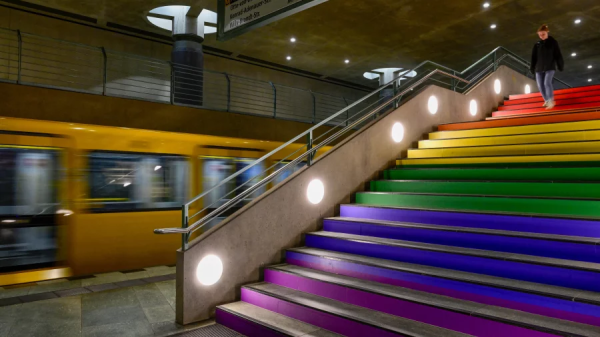
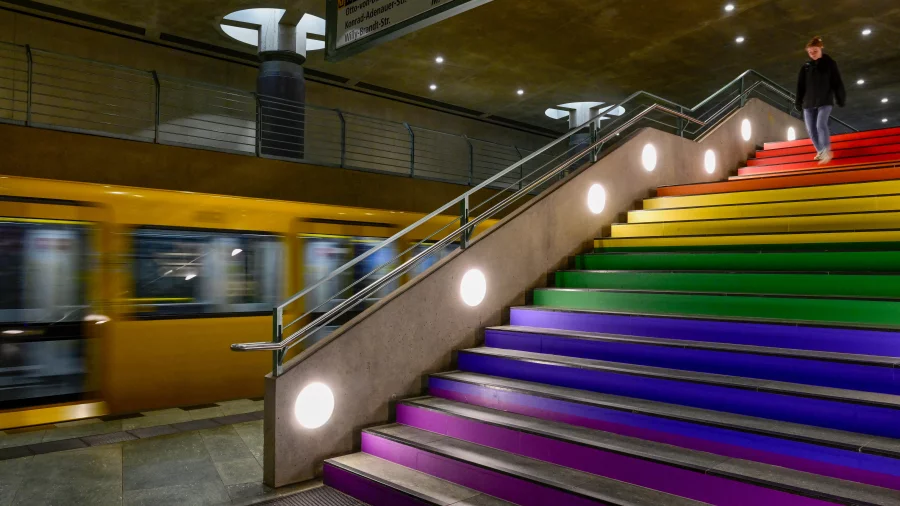
In reaction to the Bundestag president’s decision not to fly the rainbow flag on top of parliament this year, Berlin’s transport authority has decorated its Bundestag subway station stop in rainbow colors, writing on Instagram: “So our Bundestag is ready for Pride.”

Kelly urges people to attend Pride and stand up to a new generation of the far-right. He has no desire to say Goodbye to Berlin and the neighborhood around Nollendorfplatz, as Isherwood was forced to do.
Bozeman MT sidesteps new state law, adopts Pride flag

Read more on Montana Free Press.

The rainbow Pride flag can once again fly over Bozeman City Hall after commissioners voted Tuesday night to make it an official city flag, sidestepping a Montana state law targeting the controversial symbol. 

Four out of five of Bozeman’s commissioners supported the Pride flag, with the lone vote of dissent made by Commissioner Douglas Fischer, who argued that the flag was divisive and threatened to “drive a wedge” into the community. 

Bozeman Mayor Terry Cunningham spoke to the commission after hearing more than five hours of intense public comment on the issue, both for and against the resolution. Cunningham said it was clear to him that Bozeman had a responsibility to stand for a “safe, welcoming and diverse community,” and adopting the Pride flag sends that signal.

“Everyone is welcome in Bozeman, and they are welcome under that flag,” Cunningham said. 

The resolution declares “the Pride flag and its variants to be official flags of the city of Bozeman” and allows the mayor and city manager to choose when and where to fly the flags on city property. The resolution does not alter or replace the current city flag.

Public comment stretched late into the night as commissioners heard more than 70 people voice their opinions on the issue, with a relatively even split in opposition or support of the flag. City officials reported receiving more than 585 emails on the topic.

Rowan Larson addressed the commission as a new Bozeman resident, the rector of St. James Episcopal Church, and a member of the queer community. Larson said they moved to Bozeman in 2023 and “attitudes have gotten progressively worse,” to the point that the church can no longer fly Pride flags out of fear of retribution.

“We can no longer safely fly the Pride flag at our church because it is a danger to me, personally,” Larson said.

In contrast, openly gay, military veteran Andrew Jefferis said he’d called Bozeman home for 10 years and has never felt targeted for his sexual orientation while in the city. 

“I feel like the implementation of this flag would only exist as evidence that the city of Bozeman needs to prove how good it is to its people, when it doesn’t have to,” Jefferis said. “The city is inherently welcoming.”

Ultimately, commissioners chose to support the Pride flag, with Commissioner Emma Bode saying state lawmakers had brought the fight to the city when they targeted the well-known symbol of gay rights, not the other way around. 

“We did not start this,” Bode said. “The Legislature has pushed us.”

House Bill 819, passed by Montana’s Legislature in May and signed by Gov. Greg Gianforte, restricts “politically charged symbols on state property,” citing problems with enforcement, legal challenges, divisiveness and problems with neutrality and inclusivity in government.

However, opponents of the bill say it was specifically written to target municipalities that chose to fly the Pride flag in support of Montana’s queer community.

During Tuesday’s meeting, Bozeman City Attorney Greg Sullivan clarified that when the Pride flag was originally flown over city hall in 2021, it was protected as “government speech” under state law, but he added that the law had changed when the Legislature passed HB 819.  

In a memorandum to the city commission, Bozeman’s city manager, Chuck Winn, outlined several fiscal concerns related to adopting the flag, writing: “Adopting the Pride flag may draw increased attention to the City’s diversity, equity, and inclusion initiatives and related executive orders. This could invite legal challenges or public scrutiny, leading to unplanned legal costs and additional staff time to respond. The increased attention could also lead to closer examination of other City initiatives, potentially complicating federal grant processes if concerns are raised about compliance with executive orders.”

Commissioner Jennifer Madgic asked the city manager to elaborate on the potential political fallout.

“We do not know what effects adopting the Pride flag or flying the Pride flag will have on those opportunities,” Winn answered, adding that Bozeman has applied for federal grants for housing, law enforcement and the fire department, and those grants could be affected by the adoption of the flag.

However, Winn went on to say that he wasn’t aware of any retaliatory measures taken by the state or federal governments against cities, including Missoula, Butte, Boise, and Salt Lake City, that have adopted the Pride flag. 

Deputy Mayor Joey Morrison said he suspects lawmakers who have targeted the Pride flag are seeing their suppression efforts thwarted because local governments can easily bypass the legislation.

“This is no workaround; this is complying with the law,” Morrison said. “The law says cities can adopt official flags. Here is the procedure where we can adopt an official flag.”

For Jason Baide, who chairs the civic group Queer Bozeman, Tuesday’s decision to adopt the Pride flag was a big win, but also a defensive act for the community he represents.

“I am surprised by the level of opposition to our existence and some of the hateful comments that came through in this,” Baide told Montana Free Press after the meeting. “There was some harm done to folks,” during the hours of debate heard by the commission, but “we’re going to rally together and celebrate this.”

A school district just banned rainbow flags. It may soon remove protections for LGBTQ+ students too.

Read more at LGBTQ Nation.

The school board of Johnston County, North Carolina, voted 4-2 to ban district schools from displaying rainbow Pride flags on Tuesday. The ban is just the latest in a long line of conservative efforts to ban the LGBTQ+ flag from schools and government property.

According to The Raleigh News & Observer, the newly approved policy states: “Principals and teachers shall limit displays in the classrooms, school buildings, ball fields, school grounds, and buses, such as signs and flags, to materials that represent the United States, the state of North Carolina, Johnston County, the school name, mascot, post-secondary institutions, school-sponsored events, sponsorships, military flags, family photos, student art and/or the approved curriculum.”

One board member who voted against the measure, Kay Carroll, said, “It’s important that they know when they see somebody wear a human rights pin or a rainbow pin, the message is that this is a safe place for people in the LGBTQ+ community…. It’s comforting to see these symbols of acceptance and tolerance. When they see these symbols — which are signals — they know they are safe to be their authentic selves. We’re just treating human beings decently.”

The school board claimed that it will continue to support “all students and school employees.” However, the board is currently considering removing sexual orientation and gender identity from its anti-bullying and anti-discrimination policies. The board will re-vote on the removal soon after failing to advance the measure in a 3-3 tie vote last Tuesday.

Numerous school districts nationwide have banned the display of Pride flags, with conservative school board members claiming that the flags are a “divisive” form of “indoctrination.”

However, recent polling by the Trevor Project suggests that LGBTQ+ students may benefit from visible displays of support, considering that 39% of LGBTQ+ young people and 46% of trans and nonbinary young people reported attempting suicide in the past year, and 49% of respondents between ages 13 to 17 said they experienced bullying in the past year. Young people who were bullied were also significantly more likely to have attempted suicide in the past year.

Earlier this year, both Utah and Idaho became the first U.S. states to pass laws restricting the flying of Pride flags in schools and on government property. The move led the capital city governments of Salt Lake City, Utah, and Boise, Idaho, to designate the Pride flags as official city flags, so they can still fly them under the bans.

Boise City Council approves resolution adopting pride flag as official flag amid state law tensions

*This is reported by KTVB.

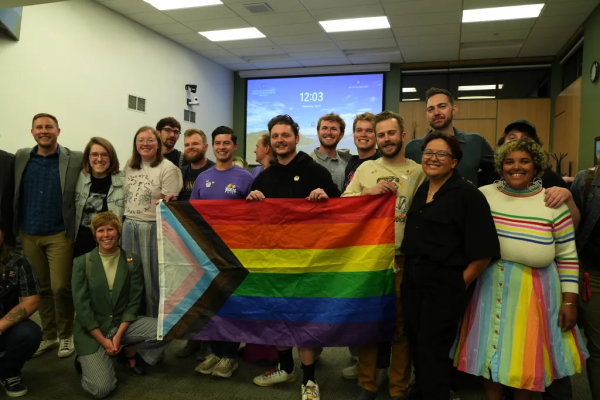
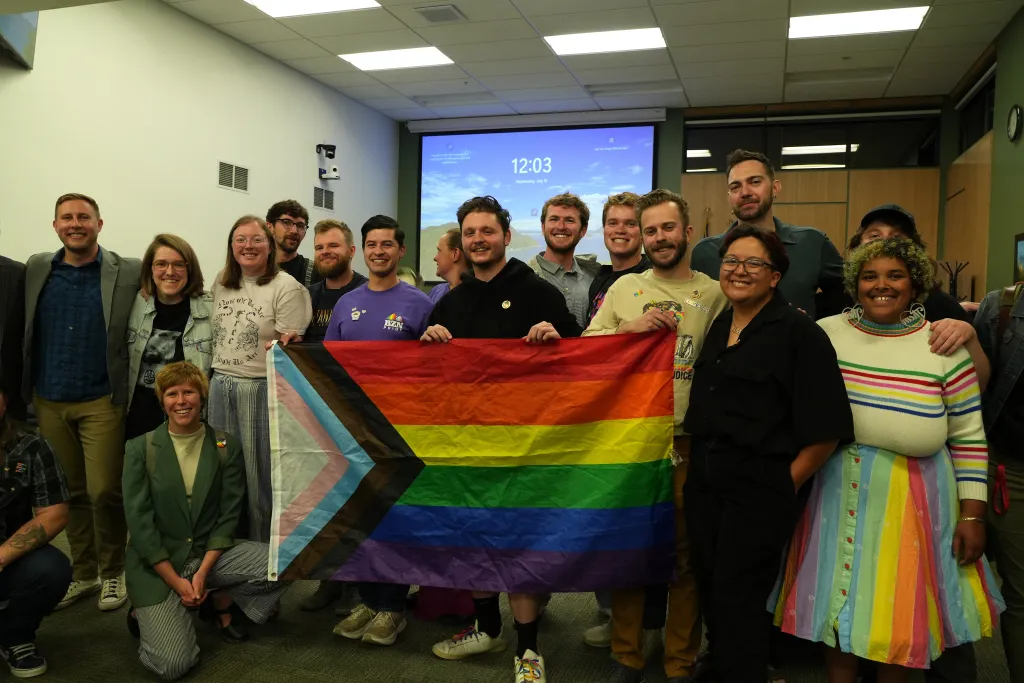
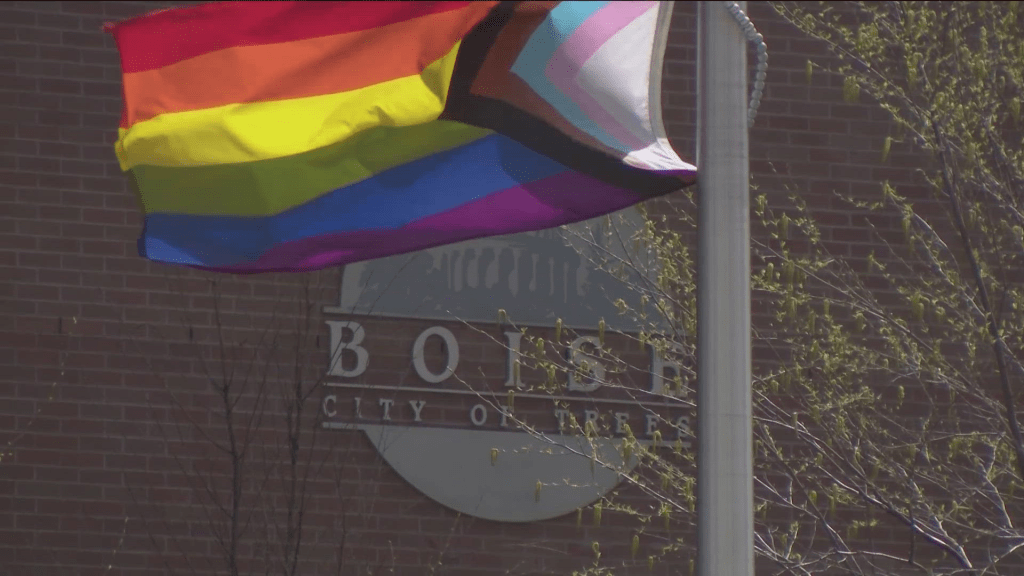
On Tuesday, Boise City Council members approved a resolution designating three flags, including the Pride flag, as official flags of the City of Trees.

The vote comes amid ongoing tensions between Boise Mayor Lauren McLean and the Idaho Attorney General over a new state law, House Bill 96, which regulates which flags local governments can display.

“A city should be able to put up flags at various times for whatever reason the community might want,” community member Patti Raino said, “and this is a community that supports, certainly pride. Has always supported pride.” 

Hundreds of people showed up to rally in support of the city before the meeting started. About a dozen of those were protestors against the resolution — including Robert Coggins. 

“I’m just a native Idahoan,” he said. “I feel like I do not have a voice, and this mayor does not let me have a voice. I think [the flag is] exclusionary. It doesn’t represent me.” 

Council President Colin Nash, who sponsored the resolution, said it would help “memorialize” flags the city flies and ensure compliance with state law.

“It’s important for us, not only to communicate to any law enforcement that might be interested, but also to the public that we’re doing this out of a sense of duty, rather than defiance of the state legislature,” Nash said before the vote.

Nash added the flags represent the city’s values and responsibilities. 

“This is our lawful expression of our dedication to ensuring all members of our community feel seen, respected, and welcome,” he said. “I think there is an expectation among the opponents of it, that the government should remain neutral in issues like this. I’m not neutral on defending marginalized neighbors.”

The resolution includes not only the Pride flag but also designates the blue City of Boise flag and the white organ donor flag honoring National Donate Life Month as official city flags.

City officials say the resolution acknowledges and formally ratifies that flags flown at Boise City Hall comply with Idaho state law.

The council meeting did not include public testimony on the resolution. During the council discussion, McLean reminded the public in attendance they could not speak after several members of the audience made comments towards the council. 

The city announced last week, attorneys from Holland & Hart have volunteered to represent Boise pro bono if any legal action is taken against the city regarding this matter. The volunteer legal team includes Erik Stidham, Jennifer Jensen, Alex Grande and Anne Haws.

Blog at WordPress.com.

Up ↑