In a bid to attract high-value global investors and reduce its reliance on tourism, the Maldives has launched its first-ever investor visa program, allowing foreign nationals to secure long-term residency through investment in premium real estate.
The agreement to establish the program was signed with Henley & Partners during the Maldives–Singapore Business Forum 2025, held on Sentosa Island. It aligns with President Dr. Mohamed Muizzu’s Vision 2040 strategy to build a resilient and diversified economy.
Real estate at the core of the new residency route
Under the new scheme, investors will be granted long-term residence in return for investment in approved real estate projects. The program will be backed by a strict due diligence process to ensure only reputable and eligible applicants are accepted, with final approvals resting with the Maldivian government.
Henley & Partners, which has designed similar programs globally, will advise the government on policy structure, compliance, and implementation. The firm has facilitated over USD 15 billion in foreign direct investment worldwide.
“The residence by investment program will provide state-of-the-art properties with the utmost privacy and exclusivity,” said Philippe Amarante, Managing Partner and Head of Government Advisory EMEA at Henley & Partners. “As a safe, stable, and peaceful island nation, the Maldives presents the ultimate hedge against geopolitical conflict or global pandemics.”
Government aims for long-term economic impact
Economic Development and Trade Minister Mohamed Saeed said the program aims to position the Maldives not only as a top-tier travel destination but also as a long-term investment hub.
“With this program, we aim to extend that legacy to discerning global investors who see value in our people, our potential, and our future,” said Saeed.
The government expects the initiative to stimulate growth in hospitality, services, and infrastructure, while supporting job creation and financial stability.
Henley & Partners will help finalise the policy framework and real estate listings. The program is expected to launch once regulatory approvals are in place.
What happens when real estate meets resistance, advocacy, and identity? In this candid conversation, LGBTQ+ real estate professionals Callen Jones, Bob McCranie, Kimber Fox, and Leslie Wilson sit down to discuss the evolving challenges of being openly queer in an industry—and a country—facing political pushback.
🏳️🌈 Topics covered include: How anti-LGBTQ+ legislation affects clients and agents The role of advocacy in real estate Why “just doing business” isn’t neutral anymore Personal stories from the frontlines of inclusion in housing
📍 Whether you’re an agent, ally, or advocate, this video unpacks the real stakes of LGBTQ+ visibility in today’s market.
Are you a real estate agent in a politically unstable or conservative state? Discover why smart REALTORS® are getting licensed in multiple states to protect their careers from sudden political shifts, discrimination, or licensing denial. In this video, we explain:
✅ Why holding real estate licenses in multiple states is crucial in 2025
✅ How anti-LGBTQ+ laws and political agendas are threatening professionals
✅ Steps to apply for additional real estate licenses quickly and affordably
✅ Best states to consider for backup licensure
✅ Real stories from agents facing political backlash
Real estate license reciprocity allows licensed agents to obtain a license in another state without completing all standard pre-licensing education requirements. Reciprocity agreements vary by state, with some offering full reciprocity to all states and others providing partial or no reciprocity. Below is a summary of reciprocity agreements and the associated education requirements for select states:
Alabama Reciprocity: Full reciprocity with all states. Requirements: Complete a 6-hour course in Alabama real estate law and pass the Alabama portion of the licensing exam.
Colorado Reciprocity: Full reciprocity with all states. Requirements: Pass the Colorado state portion of the real estate exam.
Florida Reciprocity: Mutual recognition agreements with Alabama, Arkansas, Connecticut, Georgia, Illinois, Kentucky, Mississippi, Nebraska, Rhode Island, and West Virginia. Requirements: Pass a 40-question Florida-specific real estate law exam with a score of at least 30.
Georgia Reciprocity: Full reciprocity with all states. Requirements: Hold a current, active license in another state and pass the Georgia state portion of the licensing exam. Illinois Reciprocity: Reciprocity agreements with Colorado, Connecticut, Florida, Georgia, Indiana, Iowa, Nebraska, and Wisconsin. Requirements: Pass the Illinois state portion of the licensing exam.
Mississippi Reciprocity: Full reciprocity with all states. Requirements: Pass the Mississippi state portion of the licensing exam.
Virginia Reciprocity: Full reciprocity with all states. Requirements: Complete a 60-hour “Principles of Real Estate” course and pass the Virginia state portion of the licensing exam.
Wisconsin Reciprocity: Reciprocity agreements with Illinois and Indiana. Requirements: Agents from these states are exempt from Wisconsin’s education requirement; agents from other states must complete a 13-hour education requirement.
It’s important to note that many states without formal reciprocity agreements may still allow experienced agents to waive certain requirements, such as the national portion of the licensing exam or pre-licensing education. However, they often require completion of state-specific education or examinations. For example:
Iowa: Offers reciprocity with Arkansas, Georgia, Louisiana, Massachusetts, Minnesota, Mississippi, and North Dakota. Applicants must prove they took the real estate exam in another state, submit their certificate and license history, and undergo a criminal background check.
Kentucky: Offers reciprocity with Ohio, Tennessee, and West Virginia. Requirements vary based on the state and license type but generally include completing a 40-hour reciprocal license course and submitting to a background check.
South Carolina: Extends reciprocity to licenses from other states held within six months before applying. Brokers must have been active for at least three years. Additional requirements include passing the state portion of the exam and submitting certification(s) of licensure from any jurisdictions in which you’ve held a license in the last five years. For the most accurate and up-to-date information, it’s advisable to consult the real estate commission or regulatory authority of the state where you seek licensure.
I recently returned from cruising through the Caribbean, just in time to experience the last vestiges of a snowstorm and 15-degree weather, coupled with a plethora of angry people wearing red hats, absent-mindedly riding around in circles on the Metro. No matter – I still have that post-vacation glow.
The Caribbean, a diverse region of 13 independent countries, 12 dependencies, and seven overseas territories, has long been a dream destination for travelers, retirees, and investors alike. With its crystal-clear waters, pristine beaches, and relaxed lifestyle, it’s no wonder that many people are drawn to the idea of owning property in this tropical paradise.
Buying real estate in the Caribbean requires careful planning, research, and an understanding of the unique challenges and opportunities that come with investing in a foreign market. Selecting the right island and community is a critical step in the buying process.
Consider such factors as:
Accessibility: Proximity to major airports and ease of travel
Infrastructure: Availability of roads, utilities, and amenities such as internet and streaming services
Safety and security: Crime rates and political stability
Climate and weather risks: Susceptibility to hurricanes and natural disasters
Healthcare: Quality and availability of medical services
Property prices and inventory vary widely across the region. Each Caribbean nation has its own rules regarding foreign ownership of property. Some countries have relatively open markets where foreigners can buy land freely. Others, such as the Bahamas, require special permits for non-residents purchasing property above a certain value.
It is essential to work with a reputable local attorney to navigate the legal requirements, including landownership laws and restrictions, residency and citizenship options, property taxes and fees, and title searches and due diligence.
Some islands, like Barbados and the Cayman Islands, offer residency permits for property owners who meet specific financial criteria. These programs can provide tax benefits, visa-free travel, long-term residency rights, and in some cases, top-tier medical facilities, including private hospitals and specialized care centers.
Moreover, Antigua & Barbuda, Dominica, Grenada, St. Kitts, and St. Lucia offer a Citizenship by Investment (CBI) program for property buyers: In some cases, citizenship will grant you visa-free access to more than 150 countries. While the costs fluctuate depending on the country, the process can be completed in as little as 7-12 months.
As you can imagine, there has been a surge of inquiries from the U.S. since last fall, so it would be wise to confirm the most recent amount and type of minimum investment required. You can find helpful information from the company La Vida at goldenvisas.com.
Many buyers in the Caribbean look to generate income through vacation rentals or long-term leasing. Islands with strong tourism demand, such as Aruba, the Bahamas, and St. Lucia, offer excellent rental potential.
Working with a reputable property management company can help maximize rental income and ensure smooth operations; however, investors should consider seasonal fluctuations in tourism, property management costs, and local regulations on short-term rentals in determining their return on investment before committing to a purchase.
As in the U.S., buying property in the Caribbean comes with additional costs beyond the purchase price. These may include legal fees (typically 1-3% of the purchase price), stamp duties and transfer taxes that vary by country, real estate agent compensation, property insurance, and maintenance costs.
Financing can be a challenge for foreign buyers, as many Caribbean banks require substantial down payments or have stringent lending criteria. Some investors choose to secure financing from their home country or pay in cash.
Nonetheless, expatriates living in the Caribbean often benefit from a lower cost of living, warm climate, and relaxed lifestyle. Many islands have well-established expat communities, making it easier to adjust to life abroad. As you begin your journey, it is recommended that you secure health insurance that covers medical treatment in both the Caribbean and your home country.
To successfully purchase property in the Caribbean, research and choose your preferred island based on your budget, lifestyle, and investment goals. Work with a local real estate agent who understands the market and legal requirements and, if applicable, speaks the appropriate language. Hire an attorney to conduct a title search, review contracts, and ensure compliance with local laws. Negotiate the purchase price and sign a sales agreement. Secure financing (if needed) and transfer funds.
Once you have completed additional legal requirements such as obtaining permits, paying taxes, and registering the property, you might consider rental or management options if you are not living there full-time.
But if the Caribbean is to be your home away from home for at least a few years, turn off the news, stick an umbrella in your favorite frothy adult beverage, and lean into island living.
The U.S. has always been a difficult country to “age in place”—seniors who can’t find lodging with a loved one are often relegated to nursing homes, if they can afford the fees. The situation gets even more precarious for LGBTQIA+ seniors, who commonly see bias in the rental application process, and get turned down for apartments at high rates.
Things are especially dire in Texas, where state law doesn’t protect individuals from housing discrimination based on their sexual orientation, although LGBTQIA+ individuals are still protected under the federal Fair Housing Act. This exacerbates the problem and puts even more people at risk of poverty and social isolation.
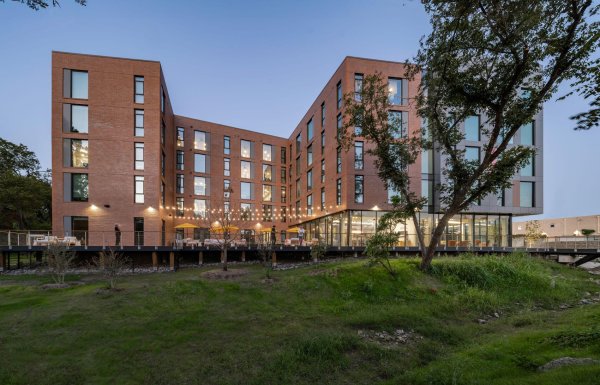
Perkins&Will’s Dallas studio recently completed a new affordable housing project to help combat this public health crisis. Today, Oak Lawn Place in Dallas represents north Texas’s first affordable housing development of its kind, the architects shared. It offers 100 percent affordable housing for LGBTQIA+ seniors, 55 years of age and older.
Karen Chen of Sunshine Studios created a bespoke mural on every floor of the building. (James Steinkamp)
The Dallas neighborhood of Oak Lawn has been the beating heart of north Texas’s LGBTQIA+ community for decades. Oak Lawn Place was built with the developer Matthews Southwest, Volunteers of America, and Resource Center, one of the largest LGBTQIA+ community centers in the country and a key north Texas HIV/AIDS service organization.
“I’m seeing Oak Lawn Place transform people’s lives,” Resource Center CEO Cece Cox said in a press statement. “A project like this elevates everyone and makes Dallas a better place.”
In plan, Oak Lawn Place is shaped like a C. This was meant to increase natural light exposure within every unit; this feature also provides a protective wing that surrounds an outdoor deck, hidden from public view. The deck has great views of the site’s sloping topography and a nearby creek.
Mural by Karen Chen of Sunshine Studios (James Steinkamp)
Karen Chen of Sunshine Studios created a bespoke mural on every floor of the building, which helps with wayfinding. Oak Lawn Place was designed with maximum accessibility in mind—everything from the hallway seatings, elevator lobbies, to wheelchair-friendly doorways are meant to provide a positive user experience.
The design of Oak Lawn Place is economical and efficient, yet still manages to have splashes of color here and there; the facade has a rainbow flag to signify all are welcome. The 80,000-square-foot building has a total 84 units. It’s within walking distance of public transit options and Resource Center’s Community Center.
The building has a shared kitchen and other community-building amenities. (James Steinkamp)
“Oak Lawn Place helps make Dallas a more inclusive, inviting city—for those considering moving here and for those wondering, as a queer person, ‘Will I truly feel welcome? Are there spaces in Dallas for me?’ We are honored and proud to bring this project to life,’” Cox continued.
A new healthcare facility, Resource Center Health, will open across the street from Oak Lawn Place later this year.
Join Connor Kobilarcsik, an experienced real estate agent with deep roots in the Ohio market, as he takes you through a detailed look at the Cleveland real estate landscape. In this video, you’ll learn:
Current Market Trends: Stay up-to-date on home prices, interest rates, and available inventory.
Hot Neighborhoods: Discover the most sought-after areas in Cleveland and what makes them unique.
Investment Opportunities: Get insights into potential investment strategies and whether now is the right time to buy.
Expert Tips for Buyers and Sellers: Navigate the real estate process with advice from a seasoned professional.
Whether you’re a first-time homebuyer, a seasoned investor, or just curious about Cleveland’s market, this video is packed with valuable insights from a local expert. Don’t miss out!
In this segment of the webinar, Jimmy Mackin explores the strategies that not only defined but also revolutionized the real estate landscape in Q4 of 2023, resulting in an impressive acquisition of 8,000 listings.
Envision 2024 as an expansive terrain of opportunities, where you, as the architect of your success, possess the ability to shape the outcomes. This mega webinar transcends being merely an event; it serves as your guiding compass for navigating the intricacies of the upcoming year.
Join me and a formidable roster of real estate experts for this Mega Webinar on Launching BIG in 2024! We’ll be revealing tried-and-true marketing strategies, methods to attract additional listings, tips on enhancing your mental resilience, and practices to keep you at the forefront with the latest industry insights.
Embark on more than just a fleeting glimpse into success; immerse yourself in an in-depth exploration of the core principles that have the potential to mold and redefine your entire business trajectory throughout the entirety of 2024.
This unique opportunity provides a comprehensive understanding of the strategic foundations and key insights that can position your business for unparalleled growth and achievement in the upcoming year.
As we delve into these fundamental principles, you’ll not only gain valuable knowledge but also equip yourself with the tools and strategies necessary to navigate the dynamic landscape of the real estate industry successfully.
his immersive experience goes beyond the surface, offering a profound exploration of the principles that will be instrumental in steering your business towards unprecedented success and prosperity in the evolving market conditions of 2024.
In the realm of real estate, achievement isn’t spontaneous; it’s carefully crafted, strategically executed, and firmly grounded in meticulous planning.
Envision 2024 as an expansive terrain of possibilities, where you, as the mastermind of your success, wield the ability to mold outcomes. This monumental webinar isn’t merely an occasion; it serves as your guiding tool for navigating the intricacies of the upcoming year.
Participate alongside me and an exceptional lineup of real estate specialists in this Mega Webinar on Launching BIG in 2024! 🔥 We’ll be unveiling established marketing strategies, techniques to draw in more listings, methods for boosting mental resilience, and practices to keep you ahead with the most current industry insights.













 fleeredstates.blog
You must be logged in to post a comment.