
This blog originally appeared at POLITICO.
The Republican governor’s school choice programs may serve as a model for other GOP-leaning states across the country.
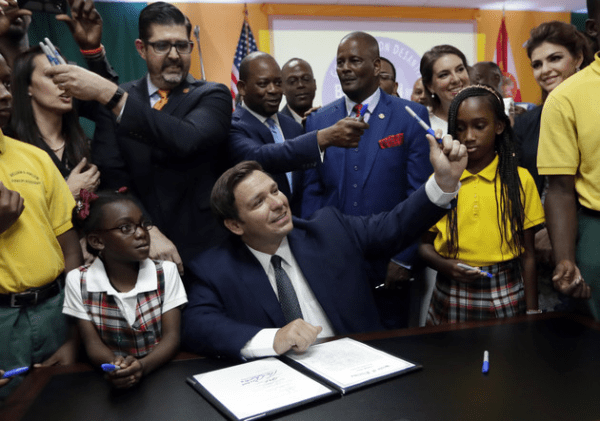
Governor Ron DeSantis and Florida Republicans have dedicated years to transforming the state into a stronghold for school choice. Their efforts have paid off significantly, with tens of thousands more children now attending private or charter schools, or being homeschooled.
As these programs expand, some of Florida’s largest school districts are experiencing significant enrollment declines. This shift is forcing them to confront the possibility of campus closures as funding follows the growing number of parents moving away from traditional public schools.
The emphasis on these programs has been central to Governor DeSantis’ goals of reshaping the Florida education system, and they are set for another year of growth. DeSantis’ school policies are already influencing other GOP-leaning states, many of which have pursued similar voucher programs. Florida has also served as a conservative testing ground for a variety of other policies, including attacks on public- and private-sector diversity programs and challenges to the Biden administration on immigration.
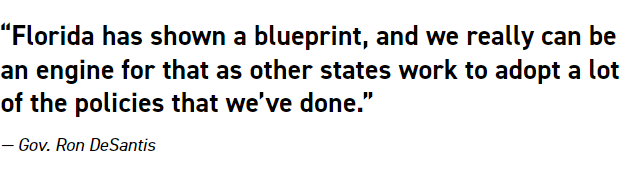
“We need some big changes throughout the country,” DeSantis said Thursday evening at the Florida Homeschool Convention in Kissimmee. “Florida has shown a blueprint, and we really can be an engine for that as other states work to adopt a lot of the policies that we’ve done.”
Education officials in some of the state’s largest counties are now looking to cut costs by repurposing or closing campuses, including in Broward, Duval, and Miami-Dade counties. Despite some communities rallying to save their local public schools, traditional public schools are left with empty seats and budget shortfalls.
Since the 2019-20 school year, when the pandemic disrupted education, approximately 53,000 students have left traditional public schools in these counties. This significant decline is pushing school leaders to consider closing campuses that have been integral parts of local communities for years.
In Broward County, Florida’s second-largest school district, officials have proposed plans to close up to 42 campuses over the next few years, moves that would have a ripple effect across Fort Lauderdale and Hollywood.
The district has lost more than 20,000 students over the past five years, a decline coinciding with substantial growth in charter schools in the area. According to Broward school officials, enrollment in charter schools, which are public schools operating under performance contracts that free them from many state regulations, has increased by nearly 27,000 students since 2010.
Broward County Public Schools reports having more than 49,000 empty classroom seats this year, a number that “closely matches” the 49,833 students attending charter schools in the area, according to an enrollment overview by officials.
These shifts in enrollment are compelling Broward leaders to consider combining and condensing dozens of schools to save on major operating costs. However, some of these proposals are encountering significant resistance.
One proposal to convert a popular Fort Lauderdale magnet school focused on the Montessori teaching method into a neighborhood school brought nearly 200 people in opposition to a recent town hall. Dozens of audience members, wearing blue “VSY” shirts representing Virginia Shuman Young elementary, argued that the plan would cause an unnecessary “disruption” for a top-rated school.
“You are trying to create school communities that attract families,” Erin Gohl, the PTA president at VSY, said during the May 6 town hall. “Look at what you have before you—replicate, don’t dismantle and destroy this incredible school community.”
The strong opposition to school closures prompted Broward Superintendent Howard Hepburn to back away from the idea for the upcoming school year. However, school board members directed Hepburn to develop a plan to close eight schools in 2025 or 2026, believing it to be a difficult but necessary decision.
“If you want us to offer great education to your children and create the Broward County of tomorrow, you want us to close campuses,” school board member Allen Zeman said during a May 14 meeting. “And you want us to spend that money educating your students.”
Where Students Are Going
The enrollment declines in Broward, Duval, and Miami coincide with the COVID-19 pandemic, which led parents to seek new education choices for their children. School choice advocates note that how traditional public schools handled the pandemic, along with disagreements over curriculum and subject matter, have contributed to parents leaving.
“If your product is better, you’ll be fine. The problem is, they are a relic of the past—a monopolized system where you have one option,” said Chris Moya, a Florida lobbyist representing charter schools and the state’s top voucher administering organization, about traditional public schools. “And when parents have options, they vote with their feet.”
Statewide, charter school enrollment has increased by more than 68,000 students from 2019-20 to this school year, according to the Florida Department of Education. Over a third of that increase occurred in Broward, Duval, and Miami counties alone.
Private school enrollment across Florida rose by 47,000 students to 445,000 from 2019-20 to 2022-23, based on the latest data from the state. Much of this growth comes from newly enrolled kindergartners, with only a small fraction of these students previously enrolled in public schools, according to Step Up for Students, the leading administrator of state-sponsored scholarships in Florida.
Additionally, a growing number of families chose to homeschool their children during this period, with the homeschooling population increasing by nearly 50,000 students between 2019-20 and 2022-23, totaling 154,000 students in the latest Florida Department of Education data.
As all of these choice options rise, enrollment in traditional public schools across the state has decreased by 55,000 students from 2019-20 to this year, according to state data. However, enrollment isn’t down everywhere. While Duval County has lost thousands of students, enrollment has increased by more than 7,700 students in neighboring St. John’s County, the state’s top-ranked school district.
“The money follows the student and the family. It’s not embedded in a certain system or a certain framework,” DeSantis said in April when asked about potential school closures in Duval. “And so, the student and the family will be making those decisions.”
In Miami-Dade, nearly 15,000 new students are expected to receive state funding for education this fall. However, all of that growth is directed towards private and charter schools, leaving Miami-Dade Public Schools preparing for a decline of more than 4,000 students next year.
What may appear to be a “great story” for a school district on paper actually represents a significant enrollment dip, Ron Steiger, Chief Financial Officer for Miami-Dade Public Schools, told school board members during a May 22 workshop.
“Those students are not ours,” he said.
The state’s scholarship program is expected to expand, potentially leading to more students leaving traditional public schools. While most new scholarship recipients previously attended private schools, there is room for an additional 82,000 statewide—nearly 217,000 total—to attend private schools or opt for other schooling options at state expense next school year.
Additionally, projections from state economists indicate there will be 22,000 more scholarships available for families choosing homeschooling—up to 40,000—and 16,000 more for students with special needs.
School Districts Grapple with Enrollment Decline
While school leaders in Miami are not currently considering school closures amid declining enrollment, the district is preparing to repurpose several campuses. These plans have already stirred concern among parents who are uncertain about what changes may come to their children’s schools.
In Duval County, the growth of school choice programs is a significant factor contributing to a budget crisis affecting the school district, according to school officials.
According to Dana Kriznar, interim superintendent of Duval County Public Schools, traditional public schools in the area are projected to enroll 10,000 fewer students in 2024-25 compared to five years ago.
Similar to Broward County, school leaders in Duval County are advocating for consolidating and closing schools due to declining enrollment, while also preparing to eliminate over 700 positions. The district is also expected to exhaust federal COVID-19 relief funds and is grappling with escalated construction costs for previously planned projects, exacerbating financial strains.
Local communities are mobilizing to prevent cuts. Situated near Florida’s Atlantic Coast amidst palm trees, Atlantic Beach Elementary has been a cornerstone of the area just north of Jacksonville since 1939, known for its distinctive art-deco style. However, it is among many schools at risk of closure in Duval County, prompting Atlantic Beach city commissioners to pass a resolution to preserve their beloved “little pink school.”
Even if the Duval school board decides to spare Atlantic Beach Elementary or if Broward County steps back from closing Virginia Shuman Young elementary, changes and closures remain inevitable at traditional public schools in these regions.
“It’s a financial decision that we are making, but we are also approaching it with empathy and involving the community,” emphasized Duval County school board member Charlotte Joyce during a recent workshop meeting. “If we don’t address this issue, it could spell the end of traditional public education in Duval County.”
 fleeredstates.blog
You must be logged in to post a comment.