
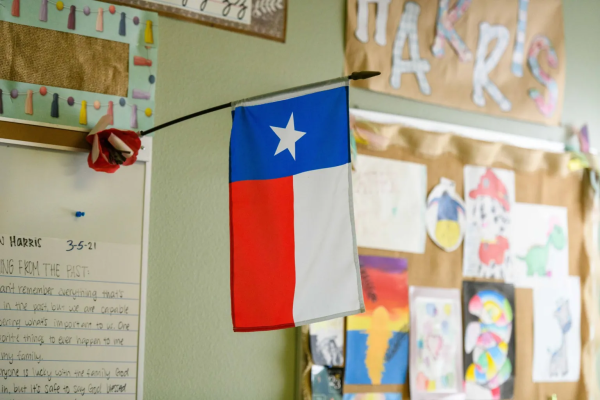
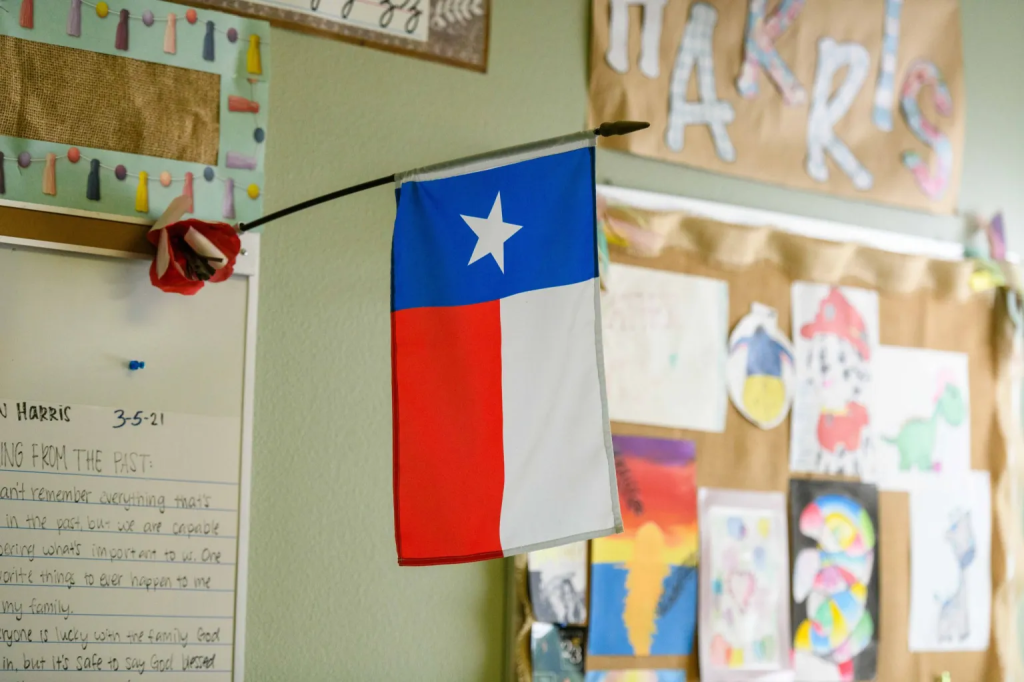
Read more at Texas Tribune.
The Texas State Board of Education is reshaping how public schools will teach social studies for years to come, but its recent selection of the panelists who will advise members during the process is causing concern among educators, historians and both Democrats and Republicans, who say the panel’s composition is further indication that the state wants to prioritize hard-right conservative viewpoints.
The Republican-dominated education board earlier this year officially launched the process of redesigning Texas’ social studies standards, which outline in detail what students should know by the time of graduation. The group, which will meet again in mid-November, is aiming to finalize the standards by next summer, with classroom implementation expected in 2030.
The 15 members in September agreed on the instructional framework schools will use in each grade to teach social studies, already marking a drastic shift away from Texas’ current approach. The board settled on a plan with a heavy focus on Texas and U.S. history and less emphasis on world history, geography and cultures. Conservative groups like Texas Public Policy Foundation and the Heritage Foundation championed the framework, while educators largely opposed it.
In the weeks that followed, the board selected a panel of nine advisers who will offer feedback and recommendations during the process. The panel appears to include only one person currently working in a Texas public school district and has at least three people associated with far-right conservative activism. That includes individuals who have criticized diversity efforts, questioned school lessons highlighting the historical contributions of people of color, and promoted beliefs debunked by historians that America was founded as a Christian nation.
That group includes David Barton, a far-right conservative Christian activist who gained national prominence arguing against common interpretations of the First Amendment’s establishment clause, which prevents the government from endorsing or promoting a religion. Barton believes that America was founded as a Christian nation, which many historians have disproven.
Critics of Barton’s work have pointed to his lack of formal historical training and a book he authored over a decade ago, “The Jefferson Lies,” that was pulled from the shelves due to historical details “that were not adequately supported.” Brandon Hall, an Aledo Republican who co-appointed Barton, has defended the decision, saying it reflected the perspectives and priorities of his district.
Another panelist is Jordan Adams, a self-described independent education consultant who holds degrees from Hillsdale College, a Michigan-based campus known nationally for its hard-right political advocacy and efforts to shape classroom instruction in a conservative Christian vision. Adams’ desire to flip school boards and overhaul social studies instruction in other states has drawn community backlash over recommendations on books and curriculum that many felt reflected his political bias.
Adams has proclaimed that “there is no such thing” as expertise, describing it as a label to “shut down any type of dialogue and pretend that you can’t use your own brain to figure things out.” He has called on school boards to craft policies to eliminate student surveys, diversity efforts and what he considers “critical race theory,” a college-level academic and legal framework examining how racism is embedded in laws, policies and institutions. Critical race theory is not taught in K-12 public schools but has become a shorthand for conservative criticism of how schools teach children about race.
In an emailed response to questions from The Texas Tribune, Adams pointed to his earlier career experience as a teacher and said he understands “what constitutes quality teaching.” Adams also said he wants to ensure “Texan students are taught using the best history and civics standards in America” and that he views the purpose of social studies as forming “wise and virtuous citizens who know and love their country.”
“Every teacher in America falls somewhere along the political spectrum, and all are expected to set their personal views aside when teaching. The same goes for myself and my fellow content advisors,” Adams said. “Of course, given that this is public education, any efforts must support the U.S. Constitution and Texas Constitution, principles of the American founding, and the perpetuation of the American experiment in free self-government.”
Republicans Aaron Kinsey and LJ Francis, who co-appointed Adams, could not be reached for interviews.
David Randall, executive director of the Civics Alliance and research director of the National Association of Scholars, was also appointed a content adviser. He has criticized standards he felt were “animated by a radical identity-politics ideology” and hostile to America and “groups such as whites, men, and Christians.” Randall has written that vocabulary emphasizing “systemic racism, power, bias, and diversity” cannot coexist with “inquiry into truth — much less affection for America.” He has called the exclusion of the Bible and Christianity in social studies instruction “bizarre,” adding that no one “should find anything controversial” about teaching the role of “Judeo-Christian values” in colonial North America.
Randall told the Tribune in an email that his goal is to advise Texas “as best I can.” He did not respond to questions about his expertise and how he would work to ensure his personal beliefs do not bleed into the social studies revisions.
Randall was appointed by Republican board members Evelyn Brooks and Audrey Young, both of whom told the Tribune that they chose him not because of his political views but because of his national expertise in history and civics, which they think can help Texas improve social studies instruction.
“I really can’t sit here and say that I agree with everything he has said. I don’t even know everything that he has said.” Brooks said. “What I can say is that I can refer to his work. I can say that he emphasizes integrating civics.”
The advisory panel also consists of a social studies curriculum coordinator in the Prosper school district and university professors with expertise ranging from philosophy to military studies. The group notably includes Kate Rogers, former president of the Alamo Trust, who recently resigned from her San Antonio post after Lt. Gov. Dan Patrick criticized her over views she expressed in a doctoral dissertation suggesting she disagreed with state laws restricting classroom instruction on race and slavery.
Seven of the content advisers were selected by two State Board of Education members each, while Texas’ Commissioner of Higher Education Wynn Rosser chose the two other panelists. Board member Tiffany Clark, a Democrat, did not appoint an adviser, and she told the Tribune that she plans to hold a press conference during the board’s November meeting to address what happened.
Staci Childs, a Democrat from Houston serving on the State Board of Education, said she had anticipated that the content advisory group would include “extremely conservative people.” But her colleagues’ choices, she said, make her feel like “kids are not at the forefront right now.”
Pam Little, who is the board’s vice chair, is one of two members who appear to have chosen the only content adviser with active experience working in a Texas K-12 public school district. The Fairview Republican called the makeup of the advisory panel “disappointing.”
“I think it signals that we’re going in a direction where we teach students what we want them to know, rather than what really happened,” Little said.
The board’s recent decisions show that some members are more focused “on promoting political agendas rather than teaching the truth,” said Rocío Fierro-Pérez, political director of the Texas Freedom Network, a progressive advocacy organization that monitors the State Board of Education’s decisions.
“Whether your political beliefs are conservative, liberal, or middle of the road really shouldn’t disqualify you from participating in the process to overhaul these social studies standards,” Fierro-Pérez said. “But it’s wildly inappropriate to appoint unqualified political activists and professional advocates with their own agendas, in leading roles and guiding what millions of Texas kids are going to be learning in classrooms.”
Other board members and content advisers insist that it is too early in the process to make such judgments. They say those discussions should wait until the actual writing of the standards takes place, which is when the board can directly address concerns about the new framework.
They also note that while content advisers play an integral role in offering guidance, the process will include groups of educators who help write the standards. State Board of Education members will then make final decisions. Recent years have shown that even those within the board’s 10-member Republican majority often disagree with one another, making the final result of the social studies revisions difficult to predict.
Donald Frazier, a Texas historian at Schreiner University in Kerrville and chair of Texas’ 1836 Project advisory committee, who was also appointed a content adviser, said that based on the panelists’ conversations so far, “I think that there’s a lot more there than may meet the eye.”
“There’s people that have thought about things like pedagogy and how children learn and educational theory, all the way through this panel,” Frazier said. “There’s always going to be hand-wringing and pearl-clutching and double-guessing and second-guessing. We’ve got to keep our eye on the students of Texas and what we want these kids to be able to do when they graduate to become functioning members of our society.”
The makeup of the advisory panel and the Texas-heavy instructional framework approved in September is the latest sign of frustration among conservative Republicans who often criticize how public schools approach topics like race and gender. They have passed laws in recent years placing restrictions on how educators can discuss those topics and pushed for instruction to more heavily emphasize American patriotism and exceptionalism.
Under the new framework, kindergarteners through second graders will learn about the key people, places and events throughout Texas and U.S. history. The plan will weave together in chronological order lessons on the development of Western civilization, the U.S., and Texas during grades 3-8, with significant attention on Texas and the U.S. after fifth grade. Eighth-grade instruction will prioritize Texas, as opposed to the broader focus on national history that currently exists. The framework also eliminates the sixth-grade world cultures course.
When lessons across all grades are combined, Texas will by far receive the most attention, while world history will receive the least.
During a public comment period for the plan, educators criticized its lack of attention to geography and cultures outside of America. They opposed how it divides instruction on Texas, U.S. and world history into percentages every school year, as opposed to providing students an entire grade to fully grasp one or two social studies concepts at a time. They said the plan’s strict chronological structure could disrupt how kids identify historical trends and cause-and-effect relationships, which can happen more effectively through a thematic instructional approach.
But that criticism did not travel far with some Republicans, who argue that drastic changes in education will almost always prompt negative responses from educators accustomed to teaching a certain way. They point to standardized test results showing less than half of Texas students performing at grade level in social studies as evidence that the current instructional approach is not working. They also believe the politicization of education began long before the social studies overhaul, but in a way that prioritizes left-leaning perspectives.
“Unfortunately, I think it boils down to this: What’s the alternative?” said Matthew McCormick, education director of the conservative Texas Public Policy Foundation. “It always seems to come down to, if it’s not maximally left-wing, then it’s conservative indoctrination. That’s my perspective. What is the alternative to the political and policymaking process? Is it to let teachers do whatever they want? Is it to let the side that lost the elections do what they want? I’m not sure. There’s going to be judgments about these sorts of things.”
This is not the first time the board has garnered attention for its efforts to reshape social studies instruction. The group in 2022 delayed revisions to the standards after pressure from Republican lawmakers who complained that they downplayed Texan and American exceptionalism and amounted to far-left indoctrination. Texas was also in the national spotlight roughly a dozen years prior for the board’s approval of standards that reflected conservative viewpoints on topics like religion and economics.
Social studies teachers share the sentiment that Texas can do a better job equipping students with knowledge about history, geography, economics and civics, but many push back on the notion that they’re training children to adhere to a particular belief system. With challenges like budget shortfalls and increased class sizes, they say it is shortsighted to blame Texas’ academic shortcomings on educators or the current learning standards — not to mention that social studies instruction often takes a backseat to subjects like reading and math.
“I think we’re giving a lot more credit to this idea that we’re using some sort of political motivation to teach. We teach the standards. The standards are there. That’s what we teach,” said Courtney Williamson, an eighth-grade social studies teacher at a school district northwest of Austin.
When students graduate, some will compete for global jobs. Others may go to colleges across the U.S. or even internationally. That highlights the importance, educators say, of providing students with a broad understanding of the world around them and teaching them how to think critically.
But with the recent moves requiring a significant overhaul of current instruction — a process that will likely prove labor-intensive and costly — some educators suspect that Texas leaders’ end goal is to establish a public education system heavily reliant on state-developed curricula and training. That’s the only way some can make sense of the new teaching framework or the makeup of the content advisory panel.
“I’m really starting to notice an atmosphere of fear from a lot of people in education, both teachers and, I think, people higher up in districts,” said Amy Ceritelli-Plouff, a sixth-grade world cultures teacher in North Texas. “When you study history, you look at prior conflicts and times in our history when there has been extremism and maybe too much government control or involvement in things; it starts with censoring and controlling education.”




 fleeredstates.blog
You must be logged in to post a comment.