The announcement comes almost four years after the agency first moved to take over the district.
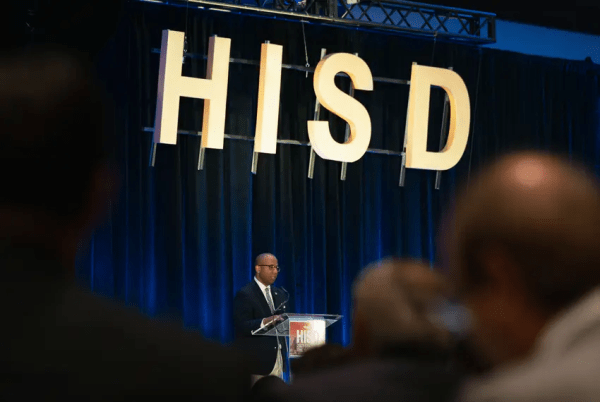
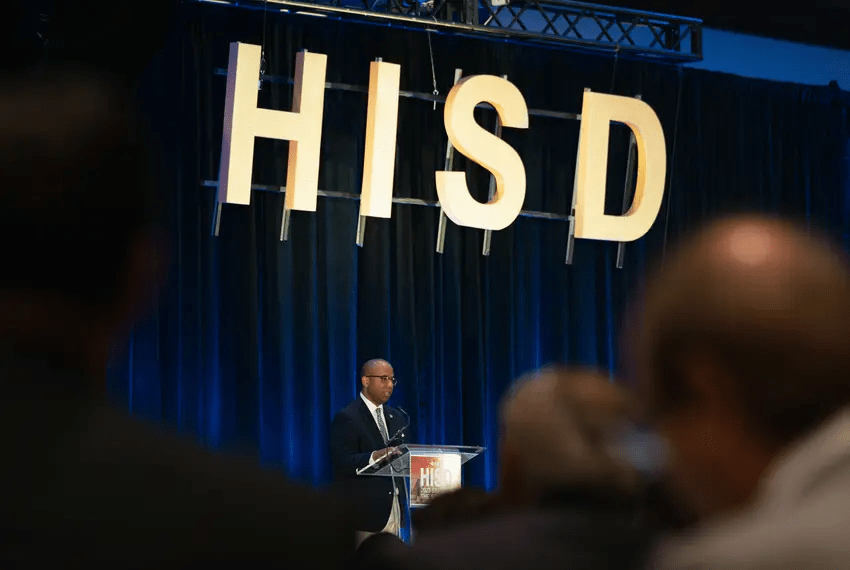
Millard House II, superintendent of the Houston Independent School District, delivers the HISD State of the Schools Address in Houston on March 3, 2023. The Texas Education Agency will replace House and the district’s school board as part of a state takeover. Credit: Joseph Bui for The Texas Tribune.
Sign up for The Brief, The Texas Tribune’s daily newsletter that keeps readers up to speed on the most essential Texas news.
After a prolonged legal battle and weeks of speculation, the Texas Education Agency on Wednesday confirmed it’s removing Houston Independent School District’s democratically elected school board and superintendent, effectively putting the state in charge of its largest school district.
Houston ISD, with 276 schools and an enrollment of nearly 200,000 students, will now be the largest district the agency has taken over since 2000, when it first intervened in a struggling school district.
Superintendent Millard House II and the current school board will finish out the school year, but the TEA will replace them after June 1 with “a board of managers.”
The Texas Tribune thanks its sponsors. Become one.
The TEA commissioner decides how long the board is in place. Usually, this sort of takeover has lasted two to six years.
The agency will host community meetings in the coming weeks to explain how the takeover will take place.
The move is in response to years of poor academic outcomes at a single campus in the district, Phillis Wheatley High School, and allegations of misconduct from school board members. TEA Commissioner Mike Morath said state law requires his agency to either close that campus or appoint a new board to oversee the district.
Texas passed a law in 2015 mandating a state takeover if a school district or one of its campuses receives failing grades from the TEA for five consecutive years. Phillis Wheatley reached that threshold in 2019.
Catch up on education news with our weekly newsletter
Catch up on education news with our weekly newsletter
Morath and the agency moved to force out the district’s school board that same year. The district pushed back and sued, but the Texas Supreme Court ruled in January that the agency could move forward with its plan to take over the district.
“Even with a delay of three full years caused by legal proceedings, systemic problems in Houston ISD continue to impact students most in need of our collective support,”Morath wrote in a letter to district leaders Wednesday.
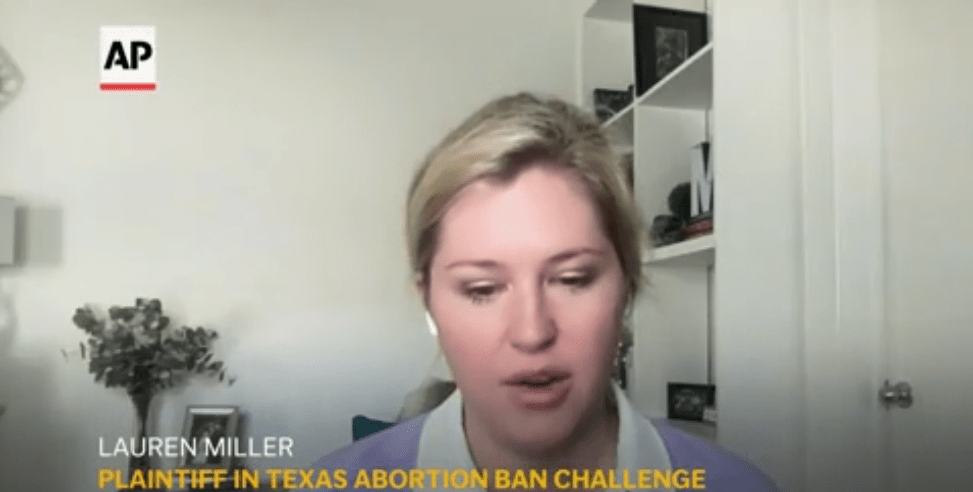
AUSTIN, Texas (AP) — The Texas Supreme Court on Friday rejected a closely watched challenge to the state’s restrictive abortion ban, ruling against a group of women who had serious pregnancy complications and became the first in the U.S. to testify in court about being denied abortions since Roe v. Wade was overturned.
In a unanimous ruling, the all-Republican court upheld the Texas law that opponents say is too vague when it comes to when medically necessary exceptions are allowed. The same issue was at the center of a separate lawsuit brought last year by Kate Cox, a mother of two from Dallas, who sought court permission to obtain an abortion after her fetus developed a fatal condition during a pregnancy that resulted in multiple trips to an emergency room.
Abortion rights activists have struggled to stem the tide of restrictions that have taken effect in most Republican-led states since the U.S. Supreme Court in 2022 overturned Roe vs Wade, which for nearly 50 years had affirmed the constitutional right to an abortion.
The court said the law’s exceptions, as written, are broad enough and that doctors would be misinterpreting the law if they declined to perform an abortion when the mother’s life is in danger.
“Texas law permits a life-saving abortion,” the court wrote in the order signed by Justice Jane Bland.
The decision appeared to close, at least for now, another pathway for opponents who have sought to force the state to provide more clarity about when exceptions are allowed. Last year, plaintiffs in the lawsuit gave emotional accounts in an Austin courtroom over how they carried babies they knew would not survive and continued pregnancies that put their health in worsening danger.
“Now we know the courthouse doors are closed to them,” said Molly Duane, a staff attorney for the Center for Reproductive Rights, which represented the Texas women. “It seems Texans have nowhere to go but the voting booth, in terms of what comes next.”
Local Bar Introduces Special Promotion in Celebration of ‘Heterosexual Awesomeness Month’
The Old State Saloon, nestled in Eagle, Idaho, has ignited a buzz by proclaiming June as “Heterosexual Awesomeness Month.” The establishment took to social media to announce its plans, promising special offers including discounts, complimentary brews, and even hosting a “straight male clothing” competition.
“Join us throughout the month to honor heterosexuals, whose existence is fundamental to us all!” proclaimed the bar in a Facebook post. “Every Monday, dubbed Hetero Male Monday, any heterosexual gentleman dressed in attire befitting his heterosexuality will be treated to a complimentary draft beer. Wednesdays are reserved for Heterosexual Couples Day, with all couples enjoying a 15% discount on their tab.”
Further, Thursdays were designated for all-day happy hour pricing exclusively for heterosexual women.
However, the event triggered a wave of criticism online, with many expressing disapproval of the bar’s stance. Among the dissenting voices was an op-ed published by the Idaho Statesman, condemning the event as a veiled promotion of intolerance.
Responding defiantly, the Old State Saloon stood firm in its position. “1) We cherish our LGBTQ+ patrons! 2) We stand resolute and will not yield to those responding with hostility. 3) ALL are welcome to commemorate heterosexuality with us in June!” declared the establishment.
Despite the backlash, the bar refused to retract its declaration, citing its right to celebrate heterosexuality. The controversy coincided with Pride Month, established in 1970 to celebrate and honor the LGBTQ+ community.
While criticism abounded, there was also notable support for the promotion. The original post garnered over 2,500 comments, with subsequent discussions generating up to 1,000 additional comments.
“Since announcing Hetero Awesomeness Month, we’ve faced significant backlash: theft, vendors refusing service, wedding catering cancellations, and even baseless accusations against the owner,” lamented the bar. “Yet, amidst the chaos, we’ve also received overwhelming support from individuals who appreciate our celebration of ‘Heterosexual Awesomeness Month’ as an expression of freedom and personal values.”
“I hope it stands as a beacon for the rest of the state and the entire country.”
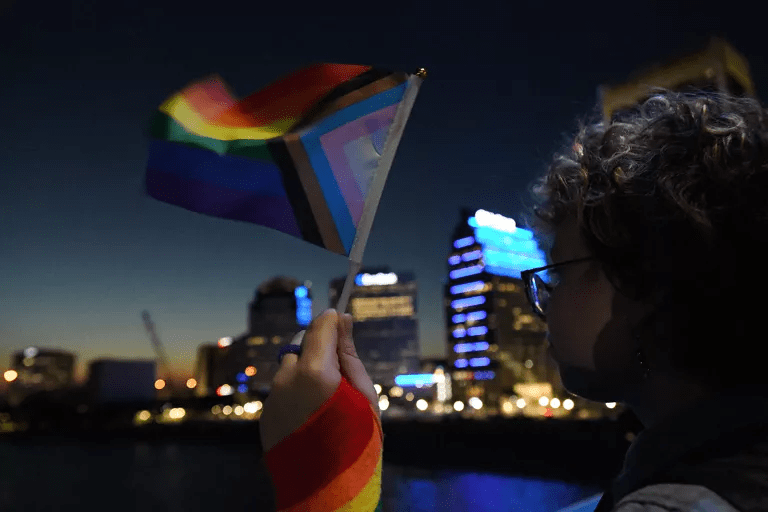
After Florida Republicans tried unsuccessfully to pass a law banning government buildings from flying Pride flags earlier this year, several cities around the state hoisted the rainbow stripes over the weekend to mark the start of Pride Month.
Late last year, state Rep. David Borrero (R) introduced legislation aimed at banning flags “that represent a political viewpoint, including, but not limited to, a politically partisan, racial, sexual orientation and gender, or political ideology viewpoint.” House Bill 901 would have prohibited such flags from being displayed not only at schools but also above government buildings and universities.
But the bill died during the most recent legislative session, leaving local governments free to fly Pride flags this month.
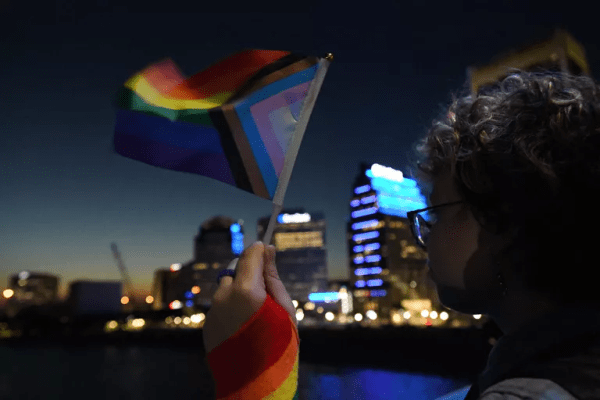
On Friday, the city of St. Petersburg got an early start to Pride Month by raising the Progress Pride flag at City Hall. U.S. Rep. Kathy Castor (D-FL), state Reps. Lindsay Cross (D) and Michele Rayner (D), Mayor Ken Welch (D), and the St. Petersburg City Council attended the flag-raising ceremony.
“Together, by raising the Pride flag at City Hall, our city boldly and unapologetically acts on its commitment to inclusivity, the celebration of diversity, and the simple but profound idea that people should have the freedom to love who they love,” Cross said. “This is in stark contrast to attempts at the state level to stifle our celebrations and to dim the light of beautiful members of our community.”
Cross noted the proposed flag ban and her vote against it. “Gratefully, due to the loud and proud voices that opposed the bill, it did not pass,” she said. “So, this year, as we stand under this Pride flag, we celebrate this small but important victory. Because we should not live in fear of repercussions from safe self-expression.”
“This marks the beginning of a celebration for equal rights for all across St. Petersburg, and I hope it stands as a beacon for the rest of the state and the entire country,” Castor told the crowd.
On Saturday morning, nearly 100 people gathered to see the Progress Pride flag hoisted above the Gulfport Public Library in the city of Gulfport, Pinellas County. The ceremony was attended by Vice Mayor and City Council member Ian O’Hara, members of the city council, Pinellas County Commissioner Charlie Justice, Pinellas County School Board member Caprice Edmond, Gecko Queen Robert Daunch, and candidates for Florida’s 13th Congressional District Whitney Fox and John Liccione.
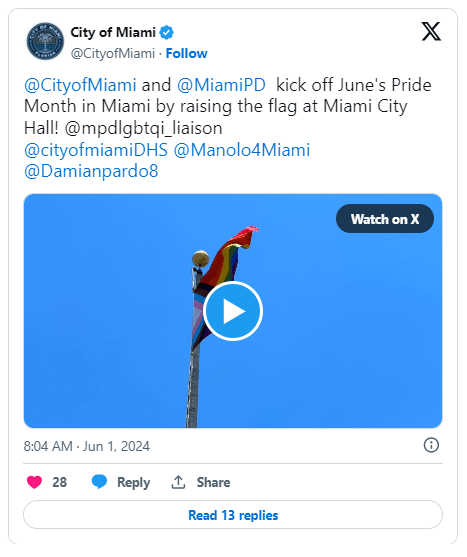
The same day, the City of Miami raised the Progress Pride flag over its City Hall. “It’s important to understand that it’s a celebration because of how far the LGBTQ community has come,” Commissioner Damian Pardo said in a video posted to the City of Miami’s official X account. “It’s incredibly important to thank the city of Miami for creating a safe space for us in the LGBTQ community.”
The flag-raisings continued on Monday in Tampa and Orlando.
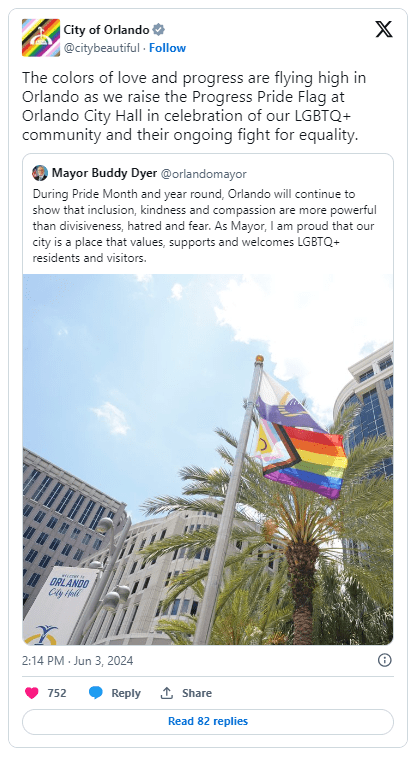
“During Pride Month and year-round, Orlando will continue to show that inclusion, kindness, and compassion are more powerful than divisiveness, hatred, and fear,” Orlando Mayor Buddy Dyer wrote in an X post, along with a photo of the intersex-inclusive Progress Pride flag flying over City Hall. “As Mayor, I am proud that our city is a place that values, supports, and welcomes LGBTQ+ residents and visitors.”
“The colors of love and progress are flying high in Orlando as we raise the Progress Pride Flag at Orlando City Hall in celebration of our LGBTQ+ community and their ongoing fight for equality,” read a post on the city’s official X account.
In Tampa on Monday morning, Mayor Jane Castor (D) gave a brief history of the original rainbow Pride flag’s origins before raising the rainbow-striped flag above the city’s Old City Hall.
“It really is a wonderful definition and proclamation of our community and the pride that we have,” Castor said of the flag. Members of Tampa’s LGBTQ+ community “are our police officers, our firefighters, our paramedics, the individuals that protect our country down at MacDill Air Force Base, they are our teachers, our nurses. They are our neighbors, our friends, and our family. It is our community, and we’re very, very proud of that.”
Castor also called on those gathered to “continue to stay focused on ensuring that everyone is treated with dignity and respect” in the face of the recent rise in anti-LGBTQ+ rhetoric in Florida and across the nation.
On Tuesday morning, Miami-Dade County Mayor Daniella Levine Cava (D), County Commissioner Eileen Higgins, and other local leaders will raise the Pride flag about the city’s Stephen P. Clark Government Center. According to a press release, this will mark the fourth consecutive year that the Miami-Dade County government has raised the Pride flag “to reaffirm our commitment to making Miami-Dade an inclusive, welcoming County that celebrates our rich diversity.”
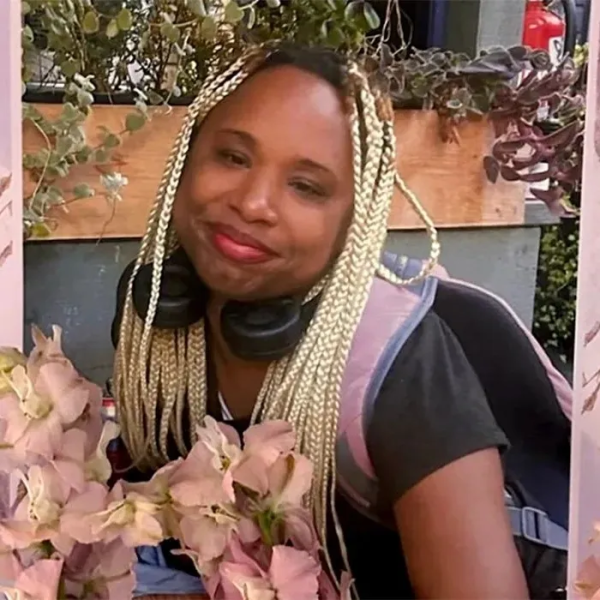
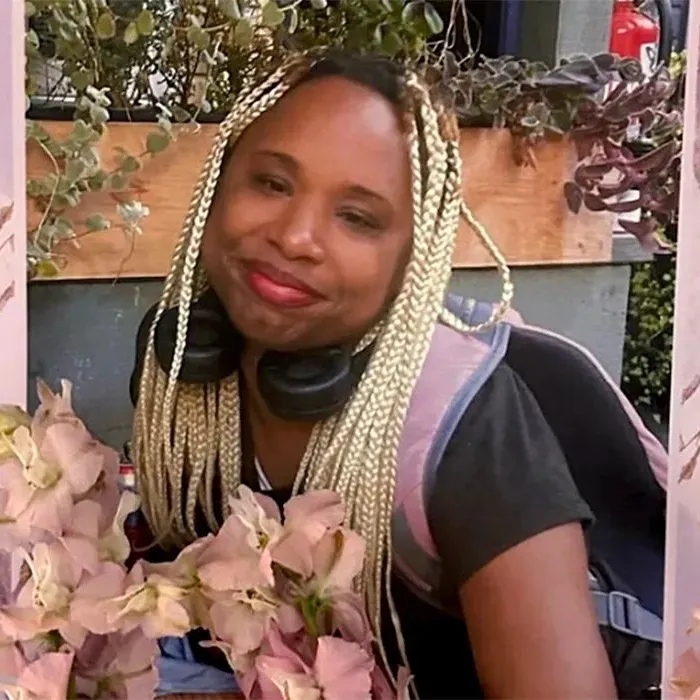
Michelle Henry, a beacon in San Francisco’s transgender community, tragically lost her life.
The San Francisco LGBTQ+ community is grieving the loss of a transgender woman who was killed on May 15th.
“Michelle’s passing is an immense loss for our community,” said Rebecca Rolfe, executive director of the organization, in an email statement. “There are no words to express the depth of our collective grief right now. We extend our gratitude to those who cherished Michelle, and our thoughts are with everyone who had the privilege of truly knowing, loving, and caring for her.”
On Tuesday, friends and family gathered to honor Henry at a memorial vigil held at San Francisco’s bar, Mother. The LGBT Center is currently creating an altar to honor her memory.
Veronica Pritipaul, a navigation specialist at the LGBT Center, described Henry as a “beacon of light in our community” who dedicated her life to transgender liberation. “With her passing, we have not only lost a beloved sister, but also a mentor and steadfast advocate for the trans community,” Pritipaul told the Reporter.
Jackson Asher, a close friend, remembered Henry as “incredibly loving” and a constant source of support over the years. “She was there for me at my lowest points, especially during my struggles with addiction,” Asher recalled. “Her love was unwavering, and her vibrant energy drew people to her.”
Friends suspect that Henry’s death may have been a hate crime targeting a transgender person. However, the San Francisco Police Department is currently not investigating the incident as a bias-motivated killing. “At this time, we do not have evidence indicating that this incident is hate-related,” police stated in a release.
Authorities have arrested 33-year-old Raymani Yuhashi, who faces charges of murder with premeditation, according to the Reporter. As of May 21, Yuhashi’s name did not appear in the county jail’s online records.
Henry’s death has been classified as a homicide, confirmed by David Serrano Sewell, executive director of the city’s Office of the Chief Medical Examiner, according to the Reporter.
A spokesperson for the San Francisco District Attorney’s office stated that the investigation is ongoing. “The police had sufficient cause to make an arrest based on evidence gathered at the scene. However, further investigation is necessary to make informed decisions about criminal charges,” the representative informed the Reporter. “Once the investigation concludes, all evidence will be thoroughly evaluated. If we determine we can meet the burden of proof, appropriate charges will be filed.”
The district attorney’s office extended condolences to Henry’s family and friends, offering support through their Victim Services Division as they navigate this difficult time.
Henry is at least the 15th trans or gender nonconforming person killed this year due to violent incidents, as reported by the Human Rights Campaign (HRC). The HRC’s current database, which lists 14 individuals, has yet to be updated to include Henry’s death. Nearly four out of five of those killed this year have been people of color, with almost a third being Black trans women. The majority of these deaths involved firearms.
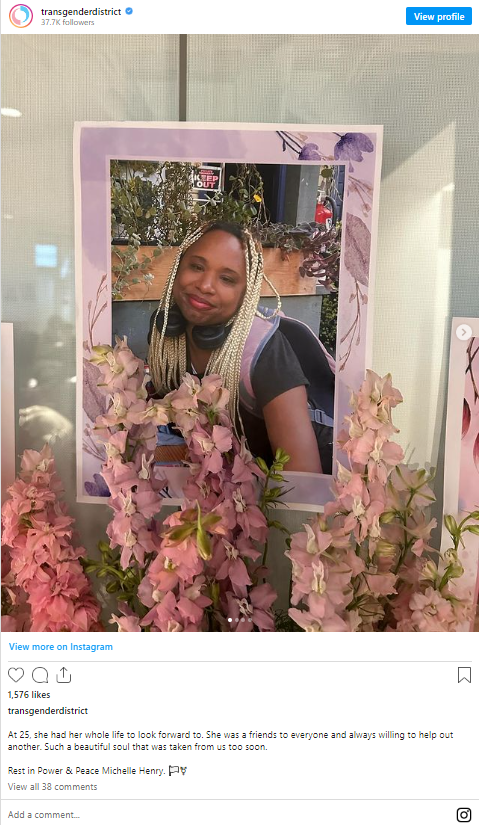
As the LGBTQ+ community grieves another tragic loss, San Francisco’s Transgender District honored Henry in an Instagram post, describing her as a “beautiful soul taken from us too soon.” “At 25, she had her whole life ahead of her,” the post reads. “She was a friend to everyone and always ready to lend a helping hand.”
Honey Mahogany, recently named director of the city’s Office of Transgender Initiatives, described Henry as a “beloved member of our community.” Mahogany emphasized that her tragic death serves as a stark reminder that, even in San Francisco, ongoing advocacy is crucial to ensure the safety and welfare of all transgender individuals.
A recent report from PEN America claims that there was a “unprecedented” spike in book bans in the second half of 2023.
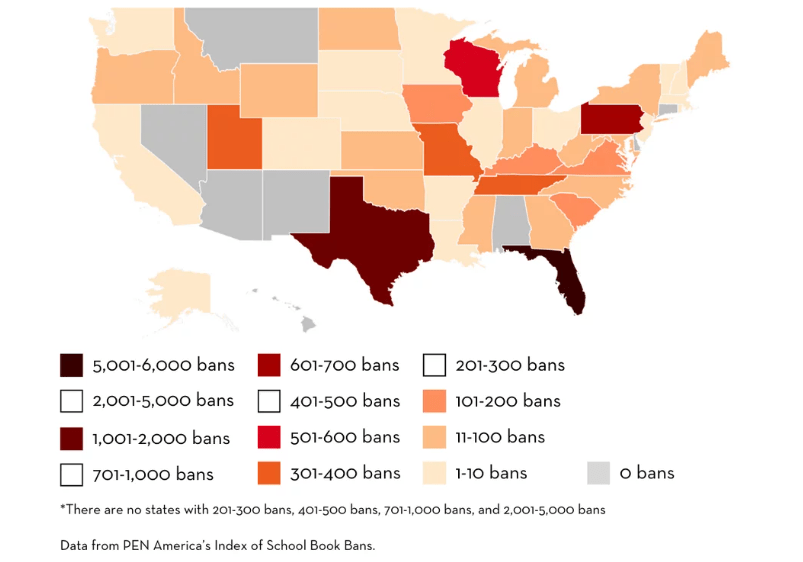
According to the free expression organization, 4,349 book bans occurred in 52 public school districts and 23 states between July and December of last year. According to the research, over those six months, more books were prohibited than during the entire 2022–2023 school year.
The source of PEN America’s ban data is allegedly “publicly available data on district or school websites, news sources, public records requests, and school board minutes.”
Key lessons learned include:
With 3,135 prohibitions spread among 11 of the state’s school districts, Florida accounted for the great bulk of school book bans. An NPR representative for the Florida Department of Education declined to comment.
Book bans are frequently started by a small group of individuals. A Wisconsin school district temporarily banned 444 books after receiving challenges from a single parent.
According to the research, those who advocate for book bans frequently use to “obscenity laws and hyperbolic rhetoric about ‘porn in schools’ to justify banning books about sexual violence and LGBTQ+ topics (and in particular, trans identities).”
The research claims that there has been a comparable upsurge in opposition to the bans. Students, writers, and others are “fighting back in powerful and creative ways.”
Who is enforcing the ban?
According to a survey published in The Washington Post, “Just 11 people were responsible for filing 60 percent” of book challenges in 2021–2022.
Advocates for free speech from across the nation who joined PEN America today to address prohibitions spoke at a news conference about the ostensibly enormous influence of a small but vociferous minority.
Quinlen Schachle, a senior in high school and the president of the Alaska Association of Student Governments, expressed his dismay at attending school board meetings, saying, “It’s, like, [the same] one adult that comes up every day and challenges a new book. It’s not a concerned group of parents coming in droves to these meetings.”
According to Texas Freedom to Read Project Co-Director Laney Hawes, books are frequently prohibited due to “a handful of lists that are being circulated to different school districts” rather than “a parent whose child finds the book and they have a problem with it.”
PEN America describes a book ban as “any action taken against a book based on its content…that leads to a previously accessible book being either completely removed from availability to students, or where access to a book is restricted or diminished.”
The American Enterprise Institute, a conservative think tank, expressed disapproval of PEN America’s April 2022 report on banned literature. “Almost three-quarters of the books that PEN listed as banned were still available in school libraries in the same districts from which PEN claimed they had been banned,” the Education Freedom Institute (AEI) reported in a report.
The sentiment echoed by the student resonates with the experiences of many: officials at Owasso High School turn a blind eye to bullying.
Just over two months following the tragic passing of Nex Benedict, a transgender teenager, the Human Rights Campaign (HRC) has unveiled a new advertisement. In it, an alum of Owasso High School recounts firsthand the culture of anti-LGBTQ+ bullying she encountered at the same school Benedict attended.
Benedict’s passing on February 8 occurred shortly after a violent altercation with three fellow students in an Owasso High School bathroom. While ruled a likely suicide by the Oklahoma state medical examiner, the incident has sparked national attention to the challenges faced by LGBTQ+ students within the Owasso school district and across Oklahoma. Benedict, described by friends as identifying as transgender and predominantly using he/him pronouns, had reported being targeted by the three students, who allegedly assaulted him because of his gender identity until he lost consciousness.
LGBTQ+ advocacy groups have condemned both the school and the Owasso Police Department for their handling of the altercation preceding Nex Benedict’s tragic passing, as well as the pervasive culture of anti-LGBTQ+ bullying reported by current and former students. In February, Human Rights Campaign (HRC) President Kelley Robinson urged Attorney General Merrick Garland to initiate a Department of Justice investigation into Benedict’s death. Robinson also reached out to U.S. Secretary of Education Miguel Cardona, urging the department to utilize its enforcement tools to prevent similar tragedies in the future. In March, the U.S. Department of Education announced an investigation into the Owasso Public School District.
The HRC advertisement, unveiled on Monday, features Marley H., a 2022 Owasso graduate, who sheds light on school officials’ neglect in addressing anti-LGBTQ+ bullying. Recounting an incident on a school trip, Marley describes a teacher’s refusal to intervene when another student repeatedly used derogatory language targeting her and her peers.
“It’s painful to realize that not only do your teachers fail to support you personally, but if a student bullies, harasses, or belittles you, they won’t take action,” she shares. “It fosters an environment where reporting issues feels futile.”
Addressing teachers who turn a blind eye to bullying and harassment, Marley emphasizes, “Consider the consequences faced by students like Nex Benedict. That’s the severity of the situation. That’s the result when you witness something and remain silent.”
Marley’s testimony echoes the sentiments of other current and former Owasso students who participated in a walkout in late February. Despite Owasso Public Schools’ official prohibition of bullying in its student conduct code, students told NBC News they were unaware of the district’s bullying policies and doubted the school’s willingness to address complaints.
“Even if an incident occurs, there’s no incentive to approach administrators or teachers because nothing will change,” remarked Ally, a senior at Owasso and a friend of Benedict’s. “I’ve witnessed this repeatedly with my friends.”
Marley points out a “trickle-down effect,” wherein students are exposed to anti-LGBTQ+ rhetoric from their parents, who, in turn, hear similar rhetoric from Oklahoma Republicans advocating anti-LGBTQ+ legislation. “These children hear their parents’ words. And these children go to school. The rhetoric passed down from elected officials to parents to children then impacts entire school districts.”
At the forefront of these elected officials is Oklahoma’s Superintendent of Public Instruction, Ryan Walters (R), known for his anti-LGBTQ+ stance. Even prior to Benedict’s tragic passing gaining national attention, Walters faced criticism from both Republican and Democratic state lawmakers for appointing Chaya Raichik, the figure behind the anti-LGBTQ+ platform “Libs of TikTok,” to Oklahoma’s library advisory committee in January.
Following Benedict’s death, a letter dated February 28 addressed to the Oklahoma state legislature, signed by over 350 public figures and LGBTQ+ rights groups, called for Walters’ removal. Additionally, in March, the Human Rights Campaign (HRC) initiated “Walters Watch,” a campaign aimed at holding Walters accountable for what the organization perceives as his “extremist rhetoric and mismanagement of Oklahoma schools,” contributing to a climate of anti-LGBTQ+ bullying and harassment.
Kelley Robinson, in a statement, acknowledged the courage of students from Owasso and elsewhere in Oklahoma who have spoken out against bullying and harassment perpetuated by figures like Ryan Walters. Robinson emphasized Marley’s story as both heartbreaking and enraging, asserting that there is a path forward. She emphasized the importance of speaking out against injustices, making it harder for the truth to be ignored. Robinson concluded that the first step towards healing is for Ryan Walters to step down.
For those in crisis or in need of support, assistance is available. You can call or text 988, or chat at 988lifeline.org. The Trans Lifeline (1-877-565-8860) offers support staffed by transgender individuals without involving law enforcement. The Trevor Project provides a safe and judgment-free platform for youth to chat, text (678-678), or call (1-866-488-7386). Support is offered in both English and Spanish at all three resources.
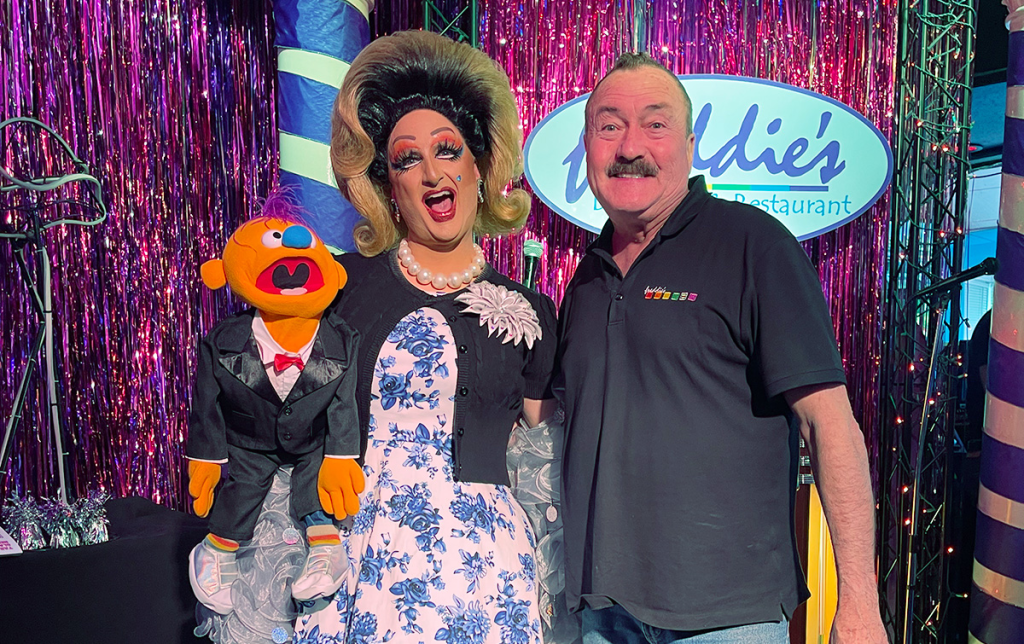
The event at Freddie’s Beach Bar resumed following a thorough search by police and a bomb-sniffing dog. After ensuring the safety of the premises, the event continued without further interruption.
During a Drag Story Hour event at Freddie’s Beach Bar, a popular gay bar and restaurant in Arlington, Virginia, attendees were unexpectedly evacuated due to a bomb threat received via email on April 6. Parents and children participating in the event were ushered into the rear outdoor seating area and parking lot while law enforcement, including a bomb-sniffing dog, conducted a thorough search of the premises. Fortunately, no explosives were found.
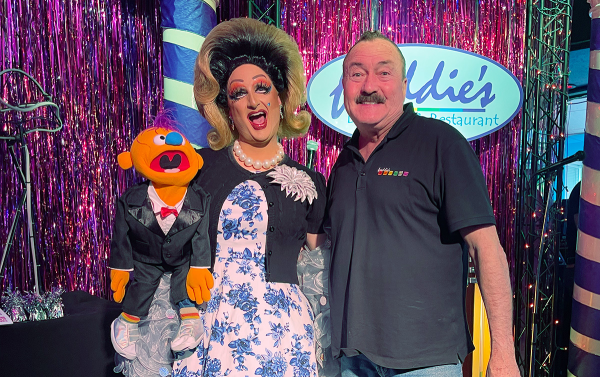
Freddie Lutz, the owner of Freddie’s Beach Bar situated in Crystal City, South Arlington, disclosed that the threatening email arrived during the inaugural Drag Story Hour event. This event, where drag performers read children’s stories to accompanied families, had drawn a sizable crowd of neighborhood residents, including kids, babies, and even a grandmother. Despite the disruption, attendees patiently waited until authorities gave the all-clear signal before returning inside.
During the Drag Story Hour event at Freddie’s Beach Bar, two protesters made their presence known outside the venue. Freddie Lutz revealed that prior to the event, drag performer Tara Hoot had warned him about potential disruptions, as some of her previous Drag Story Hour events had faced bomb threats and protests.
“We were somewhat prepared, mentally at least,” Lutz commented. “As anticipated, we received an unsettling email threatening both the bar and me personally at my residence, although thankfully nothing was found there,” he added, referring to his nearby South Arlington home.
Arlington police responded to the bomb threat report, conducting a thorough search of the premises and finding no evidence of criminal activity. The investigation remains ongoing.
Tara Hoot, who has been organizing Drag Story Hour events in the D.C. area for over a year, revealed that several of her past events have encountered hostile protests or bomb threats, with no actual explosives ever discovered. At the Freddie’s event, two protesters, a man and a woman, invoked religious reasons for opposing the Drag Story Hour, spreading messages of intolerance and attempting to shame parents for attending with their children.
Despite such opposition, Hoot’s performances cater to children’s interests with songs, readings from books like “The Very Hungry Caterpillar,” which promotes positive themes like bravery, and engaging activities like blowing bubbles and using rainbow ribbons. She describes the atmosphere as one of fun, love, and joy.
Originating in San Francisco in 2015 under the auspices of an organization named Drag Story Hour, these events have spread nationwide, occurring in various settings including libraries, bookstores, restaurants, and bars. The organization aims to create spaces where children can witness individuals defying conventional gender norms, fostering a vision of a world where everyone can express their true selves freely.
Three sitting judges, boasting almost a century of collective experience in criminal law, became casualties of Paxton’s retaliatory political campaign following their ruling against the attorney general in a 2021 voter fraud case.
On Tuesday, three incumbent judges on Texas’ highest criminal court failed in their reelection bids after Attorney General Ken Paxton focused his attention on these Republicans due to a 2021 ruling that nullified the attorney general’s authority to independently prosecute voter fraud.
According to the Associated Press, David Schenck, Gina Parker, and Lee Finley emerged victorious in their races, defeating Judges Sharon Keller, Barbara Hervey, and Michelle Slaughter respectively. Presiding Judge Keller has held her position since 1994.
Paxton singled out these judges as part of a broader political vendetta, aiming to remove Texas House members who had voted to impeach him in May.
In 2021, Keller, Hervey, and Slaughter aligned with five other Republican judges on the Court of Criminal Appeals in a voter fraud case. Their 8-1 decision determined that the Office of the Attorney General had breached the separation of powers outlined in the Texas Constitution by attempting to prosecute election cases without authorization from a local prosecutor.
However, in various media appearances and primary advertisements, Paxton portrayed the three incumbents as renegade Republicans who curtailed the attorney general’s authority to pursue voter fraud—a political issue significant to the modern GOP, especially given former President Donald Trump’s unsubstantiated claims of election interference.
Combined, the trio of incumbents boasted nearly a century of experience in criminal law, having served as prosecutors and judges. The Court of Criminal Appeals, Texas’ highest criminal court, comprises nine judges, while civil cases are heard by the Texas Supreme Court.
While the Texas attorney general holds the position of the state’s chief lawyer, the prosecution of crimes, including voter fraud, falls under the jurisdiction of locally elected county attorneys and district attorneys.
Despite Keller, Hervey, and Slaughter no longer serving on the bench, there remain five judges on the court whom Paxton previously targeted for removal due to their opposition to him in 2021. Among them, David Newell and Bert Richardson could seek reelection in 2026, should they decide to run. Kevin Patrick Yeary, the lone pro-Paxton vote, will also face reelection in the same year.
In a statement issued by Paxton late Tuesday evening, the attorney general hailed the defeat of the incumbents as a triumph for democratic ideals.
“To those who attempt to impede justice or subvert our legal system, take heed: The people of Texas will not stand for it,” Paxton asserted in his statement. “Your days of judicial overreach are numbered, and Texans are prepared to demand accountability.”
The all-Republican court is expected to continue under GOP control, given that the three elections are open to voters across the state. It has been thirty years since a Democrat secured victory in a statewide election.
The involvement of school board trustees in apologizing suggests a recognition of responsibility for the incident involving Evangelische Omroep (EO) filming students. Their apologies likely aim to address any concerns or distress caused by the filming and to reassure the community that steps will be taken to prevent similar incidents in the future. The apologies may also reflect a commitment to transparency and accountability in addressing the situation.
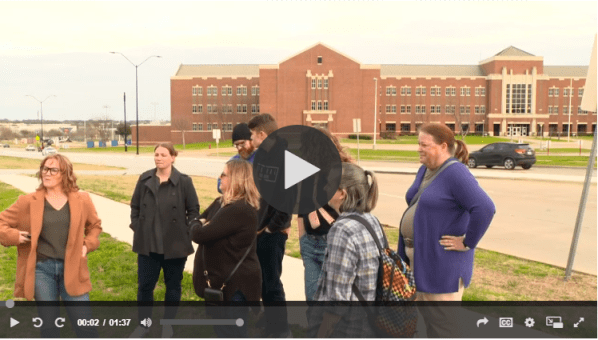
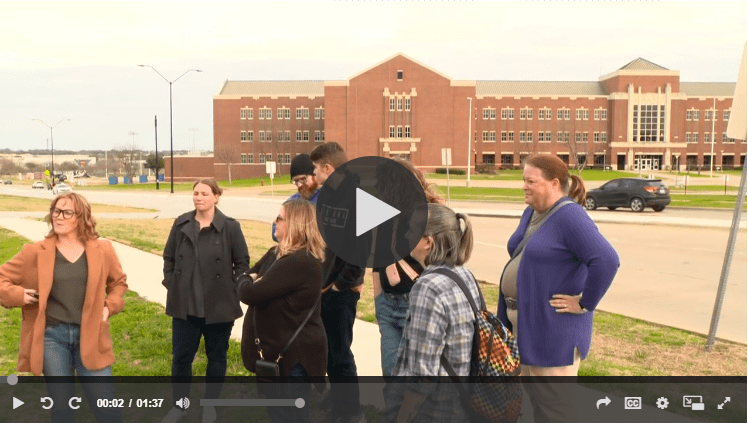
The gathering of parents near Keller ISD’s Central High School likely signifies a unified response to a specific issue or concern within the school district. Their anger and frustration suggest that they feel strongly about the matter and are seeking to voice their discontent publicly. This kind of collective action often serves as a way for community members to express their grievances and advocate for change within educational institutions.
“I’m livid,” said Laney Hawes, a parent whose child attends Central HS. “Our rights and our kids rights have been violated.”
The district’s confirmation of events on February 9 likely brought to light an incident or situation that has caused significant distress among the parents. The specificity of the date suggests that something notable occurred on that day, prompting the parents’ reaction.
The involvement of school board trustees in bringing an Evangelical-based film crew into the high school without obtaining consent from students and parents is likely the source of the anger and frustration expressed by the group of parents near Keller ISD’s Central High School. This breach of privacy and potential violation of consent rights could have serious implications for the trustees involved and has understandably elicited strong reactions from the community.
It seems there might be some confusion. Evangelische Omroep (EO) is indeed a Netherlands-based Evangelical broadcast television network, but there is no known documentary titled “God, Jesus, Trump” produced by EO. It’s possible that another production company or network created such a documentary. However, it’s essential to verify the accuracy of the information before drawing conclusions about the involvement of EO or any other organization in specific documentary productions.
“We don’t want politics in our kids schools,” Hawes said. “If kids wanna bring God into schools, beautiful, but it cannot be the administration. There is a separation of church and state.”
Thank you for providing additional context. Elliot Mullaney’s eyewitness account sheds light on the situation at Central High School.
“It’s an invasion of privacy,” said Mullaney. “I think that it’ll be used to spread hate and spread untrue opinions.”
It’s crucial to address such incidents transparently and responsibly, especially given the concerns raised by parents and students.
alker apologized in a post, saying: “I recently participated in a foreign documentary focused on public schools in Texas. Some filming took place while students were present. I take safety and privacy of our students seriously. I apologize for allowing students to be captured on film.”
Young, who said he “briefly assisted my colleague in an interview about Texas public schools,” said in a Facebook post: “I regret if any students were captured on film. My understanding is the District has been assured by the crew that no student will appear in the footage. The safety and privacy of our students is of utmost importance to me.”
Parents rightfully expect accountability from school officials, particularly when their actions compromise student privacy and well-being.
The absence of the principal on the day of the incident underscores the need for clear protocols and supervision to ensure that such breaches of student privacy do not occur in the future.
“If they’re bypassing certain rules, it’s time that they need to resign,” Mullaney said.
Friday evening, Keller ISD Superintendent Dr. Tracy Johnson sent a letter to Central HS parents. In the letter, Johnson confirmed that a production company from the Netherlands visited the campus to film an interview with trustees Walker and Young. Johnson confirmed the crew toured the school and talked to some students and employees.
According to Johnson, “the district and the board were not aware of the scheduled interview.”
Despite district officials’ saying they weren’t aware of the scheduled interview, the film crew said in a statement to WFAA that it “obtained permission to record at the school in advance.”
“The Evangelical Broadcasting, a channel that broadcasts on National Television in the Netherlands, has recorded at Central High School, part of Keller ISD, for a program called ‘God, Jesus, Trump!’. This program is a neutral journalistic program that examines Christian culture in the USA,” the statement from the film crew read. “The film crew obtained permission to record at the school in advance. The film crew went through all standard registration and administration procedures upon entering the building, and the crew was warmly welcomed by the staff that day. As stated prior, all children will be unrecognizable, and all ethical and journalistic guidelines were applied during the recording and will be applied in the process of making this program.”
Johnson’s letter said the matter is under review and that the district is “taking proactive steps to safeguard the privacy and security of our students. KISD administrators have been in contact with the film company who have assured us that no students or teachers would be visible in the video they are producing.”
Hawes said she spoke about the incident with the school’s principal, Liz Russo.
“Russo apologized. She let me know that policies were broken and this wasn’t done with permission, and it would’ve never been allowed,” Hawes said.
It’s concerning that the school board members and the principal did not respond to inquiries about the incident. Transparency and accountability are essential in addressing such breaches of protocol and maintaining trust within the school community.
It’s distressing to hear that a parent’s request for privacy was seemingly disregarded by the district, especially considering the circumstances they described. Respecting the privacy and safety of students should be a top priority for schools, and any failure to uphold such requests erodes trust and can have serious consequences for individuals’ well-being.
“It’s sickening, the parent said. “It’s very concerning. Now she’s being exposed. “It’s already tough enough trying to make sure our kids are safe, and if you can’t trust the people in the school building are gonna keep your kids safe, who can?”
It’s understandable that parents would demand accountability from the trustees involved and seek to address the situation through official channels such as filing grievances with the district. Trust in school leadership is crucial for maintaining a safe and respectful learning environment, and actions that undermine this trust must be addressed promptly and transparently.











You must be logged in to post a comment.