A couple of social media postings over the weekend struck a chord with many people. They both addressed good places for gay guys to live in the US — especially if hotspots such as New York City are out of their budget.
On Threads, user @justintycarey asked, “Where are you all moving to gay/queer Americans? I live in Philadelphia after nearly 7 years in New York. It’s fine for now and it’s more affordable (I live alone) but I don’t think it’s my vibe at all. I used to live in Portland, ME which was progressive and beautiful. Walkable too! But I realized it wasn’t my thing culturally.
“Now I’m stuck! I don’t know what’s good. I want a quiet life but I also want access to New York and other metro areas.” He also wanted a good arts scene.
Fans of Philadelphia told him not to give up on the city – especially if, as indicated later, he arrived during the chilly winter months.
“I moved to Philly from New York and spent the first year or two planning my escape, but it grew on me,” said one. “It’s a place that takes some time to find your people and neighborhood. I’ve been here for 10 years now and can’t picture myself anywhere else.”
Others praised parts of New Jersey.
“Have you considered the suburbs? I’m in south jersey and while I miss the city ‘vibe’, my community feels much tighter and, as a whole, more progressive. I can get to NYC in an hour or Philly in 20 mins. It’s not for everyone but walkable and quiet with access to city.”
Another pointed to the Jersey coast.
“Asbury Park, NJ! Yes, it’s a shore town, but most people are residential there. Very queer-friendly with a quiet town vibe. Access to the train is right in Long branch — it’s under 1.5 hours to NYC by NJ transit. Art scene is pretty good too with lots of potential for growth.”
Other suggestions within commuting distance of New York City came flocking in.
“Northampton, Massachusetts, springs to mind, depending on how far from NYC you want. If you want closer to NYC, then Warwick, NY or New Paltz, or if closer, then Montclair, NJ. All are walkable, gay friendly, progressive, pretty, stuff to do, not huge cities.”
Others wanted to know why the poster wasn’t keen on Portland. He said he highly rated the place but was used to cities that are more ethnically diverse, even if the Maine location was slowly increasing in diversity.
Boston
Over on X, user @fruitsnacks42 was also pondering locations to live… in a more snappy fashion. He said he was “Too poor to be an NYC gay, too dumb to be a DC gay, too ugly to be an LA gay, too fat to be a SF gay, too lib to be a Miami gay … just damaged enough to be a Boston gay.”
The tweet received over 44k likes.
In the replies, commentators urged him to consider cities such as Atlanta, Seattle, Chicago or Austin. Bostonites also defended their city.
Others pointed to San Francisco’s thriving bear scene, suggesting the “too fat for SF” was out of line. A few also suggested it was wrong to assume all the gay men in DC are smart.
Best gay-friendly cities
Obviously, on social media, people are likely to praise their home cities… but where are the best places to live if you’re queer?
In 2023, real estate data company Clever composed a ranking of the 15 top LGBTQ-friendly cities. It looked at whether cities scored well on the Human Rights Campaigns equality tally, and such factors as the size of the queer population, the number of gay bars and the numer of local Pride events. The top 15 were as follows:
15. Milwaukee, Wisconsin
14. Baltimore, Maryland
13. Pittsburgh, Pennsylvania
12. Richmond, Virginia
11. San Jose, California
10. New Orleans, Louisiana
9. Chicago, Illinois
8. Sacramento, California
7. San Diego, California
6. Los Angeles, California
5. Denver, Colorado
4. Portland, Oregon
3. Las Vegas, Nevada
2. Hartford, Connecticut
1. San Francisco, California
It should be noted that this ranking was from 2023 and some factors may have changed, particularly regarding anti-trans laws.
If you’re older and thinking about your later years, Life Care Retirement recently merged date on LGBTQ-friendly cities with retirement hotspots. It came up with the following top ten locations for seniors.
English teacher Rosia Sandri was left “heartbroken” after submitting her resignation on March 31 following a campaign of hate against her that followed a TikTok video she posted highlighting her experience as a trans woman in education. That video was shared by transphobes, who called for her to be fired.
Sandri came out as a trans woman seven years ago and taught English for three years at Red Oak High School in Ellis County, Texas. Sandri said her colleagues at the Red Oak Independent School District (ROISD) supported her, and she didn’t directly come out to her class but instead started dressing differently.
Students who noticed asked if they should call her by a different name or use certain pronouns; she told them they could call her “whatever they were comfortable with” but preferred she/her pronouns.
Sandri also has a TikTok account where she posts informative videos educating people on what it is like to be trans, and she filmed some videos after hours in her classroom.
Many of her former students follow her on that account and express their support in comment section, writing “best teacher ever” and “We miss you, stay strong. Lovely makeup.”
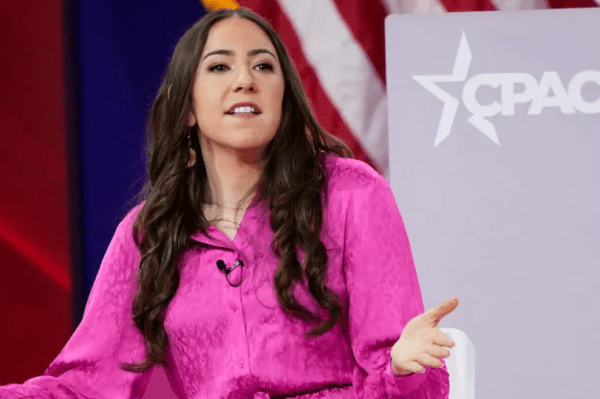
These videos, unfortunately, caught the attention of anti-trans influencer Chaya Raichik, who runs LibsOfTikTok. Raichik reposted one of Sandri’s videos, deadnaming and misgendering her. In the clip, Sandri talked about her pupils being supportive of her journey.
“They call me ‘ma’am. ’ They call me ‘miss,’” she said. “They use my correct pronouns and know my correct name, and it’s incredibly affirming.”
Raichik asked her over 4 million followers, “Would you feel comfortable with this person teaching your kid?”
Raichik is notorious for using her social media following to single out LGBTQ+ people and allies, presenting their innocuous interactions with children as “grooming.” Her followers harass and threaten businesses and institutions that support LGBTQ+ people, some going as far as to send bomb threats to children’s hospitals for providing gender treatment to trans youth. Schools targeted by Libs of TikTok faced similar repercussions.
Sandri was out sick when Libs of TikTok reposted her video but stated that she started receiving threats and harassment on her personal and school email. The human resources department at ROISD and the deputy superintendent reported that they have also received threats and have placed Sandri on administrative leave for two days while the school launches an investigation.
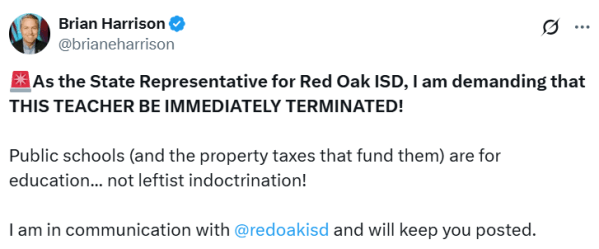
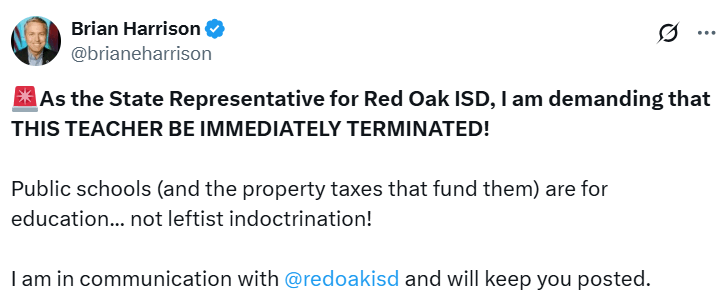
Texas state Rep. Brian Harrison (R) shared the Libs of TikTok post and called for Sandri to be fired.
“As the State Representative for Red Oak ISD, I am demanding that THIS TEACHER BE IMMEDIATELY TERMINATED!” Harrison tweeted.
On Monday, Sandri agreed with the school that she would resign.
“When I signed that resignation, it felt like my dream was being taken away from me,” Sandri told NBC. “I’m not going to get hired again as a teacher in Texas, and that hurts. It hurts I have to leave my students in the middle of the year…they keep on messaging me and asking if it’s illegal to be a trans teacher.”
Harrison later told NBC News that he was proud to have helped remove Sandri from her job.
“Any teacher who claims to get gender euphoria from their minor students and teaches them that boys can become girls should be terminated immediately,” Harrison said.
Despite this, Sandri has stated that she still wants to be a teacher and hopes to find a way.
For seven months, Red Oak ISD was a sanctuary for Rosalyn Sandri. She described it as a place where she pursued her lifelong dream of being a teacher.
But today, she’s no longer in the classroom.
Sandri, an English teacher, shared a video on TikTok talking about how her students had embraced her pronouns and showed respect by addressing her as “ma’am.”
“When I told them I changed my pronouns, they jumped right into it,” she said on Tuesday.
But Sandri said when the post was reposted on X, formerly known as Twitter, by the account Libs of TikTok, it went viral, racking up 3.2 million views.
That’s when the backlash began.
Sandri said she began receiving death threats and hateful emails, even through her school email account.
“I got a notice that told me to eat a bullet,” she said.
The video also caught the attention of Texas State Representative Brian Harrison, who publicly called for her resignation.
“Schools are for education, not indoctrination,” Harrison said over Zoom on Tuesday.
“Teaching children, minors, that boys can become girls, and girls can become boys is at odds with objective reality. And the biological reality is that there are only two sexes,” said Harrison.
In a statement to WFAA, Red Oak ISD confirmed that Sandri resigned effective immediately on Monday, March 31.
“In light of recent attention, Red Oak High School English teacher Sandri has resigned, effective March 31, 2025. Any other information is a personnel matter, and we are not at liberty to discuss.”
Sandri said she felt she had no choice but to step away for her safety and the safety of the school and students.
“When I resigned, I felt like I was signing away my ability to teach in the state of Texas. I don’t know that another school will touch me now,” she said.
“Being a teacher is all I ever wanted to do since I was five years old,” she said.
Karma Yoakum had been part of a community of political activists in Texas for years. However, as the relentless tide of anti-trans legislation kept rising, it became clear that it was time for them to relocate, recover their energies, and take on a different role in the larger fight.
Finding a new home in the Pacific Northwest, Karma was able to do just that. But the road wasn’t without its challenges, and finding their new community required intention and perseverance once they had recovered a little bit of who they were by living in a state that wasn’t trying to persecute them for their existence.
As anti-trans sentiment and legislation have been on the rise across the United States in recent years, many trans and nonbinary people have made the difficult decision to flee red states. In moving to a bluer state, trans people are making a choice based on safety, but that doesn’t make it an easy choice. It means leaving behind a home and community you have built over years or your whole life because of the machinations of people who hate you. While a new state can fix a lot of problems, building a new community doesn’t happen overnight. The president’s re-election and the introduction of federal anti-trans bills have created a flashpoint for even more trans people to seek safer pastures in states that might protect them.
I wanted to understand the challenges and opportunities that trans people face when starting over and building a new community in a blue state. I spoke with four trans and nonbinary people who have relocated in the last six to twelve months. They shared the challenges, the successes, and advice for others who are considering relocating to a sanctuary state.
Why trans people are leaving their red state communities
Major relocations often happen around an institution, such as going to college or starting a new job. But moves like those come with some built-in community-building support.
Relocating as a refugee from a red state can be a more lonely affair. Most of the people I spoke with found that building a new community felt like work exacerbated by not having the same connections and support systems they had in the communities they left behind.
Clark Roman had been well-established in St. Louis. Both Clark and his boyfriend had owned their own houses and had a strong community of friends and chosen family in the city. But he says he saw the writing on the wall in 2023 when the Missouri attorney general enacted a de facto ban on trans hormones and trans healthcare that included adults. While his emergency rule was blocked by a judge and then withdrawn, the legislature went on to pass a gender-affirming care ban for trans youth. It was clear where things were headed, and Clark moved to Minneapolis a few months later.
Leaving behind a large community, both queer-centric and otherwise, Clark has found it hard to make more connections in his new city. At the center of it is the challenge of the modern age: balancing work and social life. “The honest truth is I have a very, very stressful job and I have not had the space in my life to build community the way I want.” He noted that it felt like he had to “treat building a new community as a second job.”
Karma also struggled to make connections when they first relocated from Texas to Washington state. After living in Texas for years, they reached a point where they found themselves saying, “I’m feeling scared and trapped and there’s absolutely nothing keeping me in Texas anymore.”
Karma moved 2,000 miles to Seattle but found a problem when they arrived. While their new home was more welcoming to the gender diverse, there was still culture shock to get over. “Where is everybody? I heard it was this wonderful panacea, a place where I would be welcomed. So, I looked around and I learned what the Seattle chill was. And it’s not a horrible thing, it’s just a difference in culture, because I’m used to southern culture.”
Chris (his name has been changed to protect his privacy) echoed Karma’s frustrations over Washington state’s laid-back attitude to building community. Like Clark, Chris was living in St. Louis, saw the anti-trans legislation in Missouri in 2023, and concluded that “living in Missouri as a trans human, [he] was at risk.” He made the move to Washington state in 2024 while watching the coming election without much hope.
While St. Louis had its flaws, Chris was leaving behind a lot of queer community and resources. He had worked with the St. Louis Metro Trans Umbrella Group for nearly 20 years, enjoyed events and meetups, and collected queer friends through meets at clubs, bars, and drag shows. But the same culture shock that Karma experienced has made it hard to build new connections: “It’s been honestly a huge struggle, much more than I anticipated.”
While it’s important to know that people are struggling with finding new communities in their new states, it’s not all doom and gloom. Clark and Chris have both been able to stay in touch with parts of their communities from before their moves through travel and online communication. While that’s not always the same, it’s a nice option to have. I also spoke with Mira Lazine – an LGBTQ Nation contributor – who relocated from Cincinnati to Minneapolis and had a different sort of experience.
While the Ohio governor vetoed HB 68, which banned gender-affirming care for minors, he then introduced care guidelines for the state. “These rules were basically going to amount to a total care ban for all adults in Ohio,” explained Mira. “And it even would include some aspects of conversion therapy and mental health treatment.”
It was time to relocate, and someone recommended Minneapolis. For Mira, finding a new community in this queer-friendly space came a lot easier.
“Within the first week of moving here, I went to a few coffee shops, and everyone, like the baristas, were trans, and they were recommending me support groups to join, discord servers I can join, like the whole nine yards. And it’s just been way easier to meet people and meet other queer people and form connections here.”
While Karma and Chris suffered from culture shock, Mira found herself among other transplants to the state who had their relocation in common: “Probably like 80% of the queer people I’ve met aren’t originally from Minnesota, so we’re all like, yeah, we need community, let’s build one.”
Finding new communities in blue states
All of the people that I spoke with had been in their new homes for less than a year. While there have been struggles, they have been able to find resources and spaces to start that community-building process and are in different places in their journeys.
Clark noted that his struggle to find community in Minneapolis is probably the biggest dissatisfaction in his life right now. But he can see a light at the end of the tunnel through some of the community spaces that he is attending. “The synagogue I go to is very open and trans-friendly. So that was helpful.” Clark is also looking at getting more involved with Transplants, a group for LGBTQ+ people who have relocated to Minneapolis and St. Paul.
Chris has found that his work at a university in Washington provides some space for community building. “Their DEI office held a holiday event for, I guess, everyone, but the folks who showed up to that event were primarily queer folks and persons of color. And that was fantastic.”
Chris still faces challenges, even at the events. He told me that he has been going to meet-up groups, Portland Pride, the Ingersoll Gender Center, and more, but he wasn’t satisfied with the results. Chris suggested that part of that problem might be visibility: “I am stealth, so at my workplace, I’m not fully out [as trans]. Where I landed is sort of a purple city in a blue state. I’m typically able to pass as male and not be questioned at all, which is, is nice, but at the same time, it’s hard because I think visibility might help me connect with more queer people.”
For Karma, their initial struggles with community-building in Seattle began to bear fruit around the one-year mark. “I did the things that I’ve tried before, and I figured, if they’ve worked everywhere else, they ought to work here. Maybe it just takes a little longer. And yeah, that was it. It takes a little longer.”
Karma found that organizations were the key. They found like-minded people when they returned to playing music with the local band that is part of the LGBTQ+ band organization, Pride Bands Alliance, an international group that Karma has worked with since the 1990s. Similarly, local chapters of a national support network have provided success in community building: “PFLAG, all you have to do is show up to a meeting. There are people there that if you need a hug, they are instant family. And people that aren’t instant family are there because they want support.”
Karma also reached into her past in political activism and found that, post-move, they had the energy to continue in their new home. “The third place that I decided to get involved was the Gender Justice League. Dealing with legislation, dealing with victims of violence here in the Seattle area. So, supporting our community, advocating like crazy.” After months of struggling to find their people, Karma now finds that barely a day on their calendar doesn’t include a community event, a catch-up, or a coffee meet.
No regrets
Everyone’s experience with relocating to a bluer state will be unique. However, there was one ringing agreement amongst all the people that I spoke with: no regrets. When asked what advice they had for someone considering a move, Clark, Chris, Mira, and Karma all urged people to relocate if they felt it might help.
Clark grieves what he left behind but recognizes that it was the right call for him, and he’s going to keep trying to find his new community. “I think it’s dissatisfying at first. But it’s important to [show] up repeatedly because I think that repeated showing up [is] how I made my community originally in St. Louis.”
Chris echoed those sentiments, noting that he has no regrets and that it has been “completely worth it.” Watching recent election results come in wouldn’t have been fun anywhere, but he was glad to be in a safe space for it all “despite challenges and some loneliness.”
Karma isn’t even considering going back. “I would say do it. The relief that I felt by at least being in a community where I know that I’d no longer have to deal with local politics.”
“In Texas, the local politics were against me,” they said. “At least here, I know locally and statewide, my representatives really do represent everybody, and they have my back. And that has made so much a difference in my life.”
Texas Attorney General Ken Paxton announced in a press release today (Monday, March 31) that his office has filed a legal petition to “conduct depositions on key Dallas Independent School District officials as part of an ongoing investigation to ensure that the district is not violating Texas law by permitting biological males to participate in girls’ sports.”
In February, Paxton demanded that Dallas ISD turn over “extensive records … related to alarming evidence that the District had implemented an unwritten policy of encouraging students to alter their birth certificates to play sports in violation of the Texas law prohibiting a student from competing in interscholastic athletic competitions designated for the opposite biological sex.”
“Biological sex,” by the way, is the catchphrase that certain political elements living on the extreme right of the political spectrum to give a scientific-sounding cover for their basic transphobia. As Psychology Today notes: “What is biological sex? It seems like a question with an obvious answer: male and female, of course. You might point to internal or external sex organs, or sex chromosomes (XX for females, XY for males), or genes (such as SRY, the maestro responsible for kicking off male development).
“These answers are only part of the story — and they work well enough for most humans. But for all humans? Not quite. And when it comes to the rest of the biological world, those explanations crumble like sandcastles under the tide of nature’s diversity.”
But back to Paxton’s attack of the day: The AG’s press release says the list of individuals he intends to depose includes Dallas ISD Superintendent Stephanie Elizalde, LGBT Youth Program Coordinator Mahoganie Gaston and the members of the Board of Trustees.
Paxton claims that “Gaston has been filmed telling a parent that a male student would be allowed to participate in girls’ sports if the parent changed the birth certificate of their son to ‘female,’” that the district “find[s] the loopholes in everything” and that she is “willing to go to jail for defying Texas law.”
A statement attributed to Paxton in the press release declares, “School districts must follow the law, keep our children safe and end these insane ‘gender theory’ policies that ignore reality and encourage illegal actions. ISD officials who have participated in this madness will be held accountable.
“The systematic effort by Dallas ISD officials to circumvent Texas law will be exposed and stopped.”
Dallas Voice has reached out to Dallas ISD officials for comment.
(P.S. This press release came from the AG’s office on the same day Paxton sent a press release explaining how his office is going to make certain local district attorneys report to him so he can make sure they are doing things his way. We’re still waiting on a comment from Dallas District Attorney John Creuzot’s office for some sort of official response, but a quick Google search indicates that Ken Paxton has no supervisory authority of local DAs who, by the way, are themselves public officials elected by the public, same as Paxton.)
UNT System Chancellor Michael Williams sent a directive on March 28 to the presidents of each university campus, informing them of a pause on any drag performances on campus or any state-funded facilities, effective immediately.
The directive states that the pause is supported by the Board of Regents to comply with state and federal laws and executive orders.
“As a public university it is our responsibility to comply with all applicable federal and state laws and executive orders while balancing our duty to carry out our core missions of teaching, learning and research,” Williams said in the directive.
The directive says the university will “wait on a definitive ruling on litigation against other Texas universities” before providing “necessary guidance.”
Nicole King, the Student Government Association’s director of advocacy, said Elizabeth With, senior vice president for Student Affair had reached out to the GLAD Queer Alliance – a student organization aimed at representing the needs and concerns of the queer community – and the Sigma Lambda Gammas – a sorority focused on empowerment for women of all cultural backgrounds – to “inform them about this new decision.”
The two student organizations at the university had previously planned drag shows for April.
The GLAD Queer Alliance was planning to hold the GLAD Queer Alliance UNT Drag Show 2025 on April 10 in the Emerald Ballroom in the University Union.
UNT Gammas Drag Night with the Gammas was slated to be held on April 11 in the Lyceum Theatre in the University Union.
The Daily could not confirm whether the two events will be moved off-campus at the time of writing.
Other Texas universities have enforced drag bans in the previous months in what they say is a response to President Donald Trump’s January 20 Executive Order “defending women from gender ideology extremism” and Gov. Greg Abbott’s letter stating that Texas “recognizes only two sexes,” though neither reference drag specifically.
The Texas A&M Board of Regents voted to ban drag shows on its campus on Feb. 28, according to an article from The Battalion. Following the ban, the Texas A&M Queer Empowerment Council retained legal counsel from the Foundation for Individual Rights and Expression and filed a lawsuit against the Board of Regents on March 24.
The court granted a preliminary injunction – which preserves the status quo until a final judgment can be made – that barred the board from enforcing its ban, allowing the QEC to hold its annual “Draggieland” on campus on March 27.
The University of Texas System Board of Regents announced on March 18 that UT will no longer be permitted to fund or host drag shows on campus, according to an article from The Daily Texan.
“All activities at UT institutions are expected to comply with all applicable federal, state and local laws and executive orders, including any restrictions on the use of public funds,” Board Chairman Kevin Eltife said in a statement. “Our public university facilities, supported by taxpayers, will not serve as venues for drag shows.”
The ban followed a letter Tarrant County Judge Tim O’Hare sent to UT Board of Regents Chairman Kevin Eltife urging him to ban drag shows on UT System campuses. In the letter, O’Hare cites President Trump’s Executive Order and Gov. Greg Abbott’s letter urging compliance as reasons for his request.
“Rather than promoting anything to do with education, drag shows and related events denigrate women,” O’Hare said in the letter. “Drag shows highlight men reducing the perception of women to stereotypes and body parts. I would be encouraged to see the UT System focus on fostering environments of learning and not use resources to prop up sexually-oriented events.”
The most recent pause on drag performances mirrors last year’s cancellation of the University Program Council’s Drag Show because of governmental scrutiny.
Last May, the UPC Drag Show and University Libraries’ Campus Pride Week were canceled by the UNT System’s Office of General Counsel due to Senate Bill 17.
SB 17, signed into law by Gov. Greg Abbott in 2023, prohibits Texas public institutions of higher education from undertaking diversity, equity and inclusion efforts and from requiring employees to participate in DEI training or make DEI statements.
GLAD, being a student organization and therefore exempt from SB17, took over the show’s planning and hosted the event in the University Union.
The university’s chapter of the Young Democratic Socialists of America posted about the recently announced pause on drag on its Instagram page after being made aware of the directive by King.
“THIS IS BLATANT FACISM,” YDSA said in a post on Instagram.“UNT CONTINUES TO PRIORITIZE GOVERNMENT FUNDING OVER THE RIGHTS OF THEIR STUDENTS.”
YDSA said in a direct message to the Daily that they “absolutely condemn” the university’s decision.
“The UNT administration’s capitulation to the Abbott and Trump administrations show they do not care about the wellbeing of their students, and the principles of their university,” YDSA said.“Drag will always exist, no matter what legislator or administrator has to say about it.”
The Daily reached out to the university communications team but did not receive a response in time for publication.
A state lawmaker is calling on the Legislature to “completely” defund the University of Texas if it doesn’t shutter its Women’s, Gender and Sexuality Studies Department and LGBTQ studies program, which he has decried as liberal indoctrination that taxpayers should not fund.
The demand by Rep. Brian Harrison on Wednesday comes after a barrage of posts on X from the Republican lawmaker from Midlothian that draw attention to public universities’ LGBTQ+ and gender-related course offerings, despite no law barring such curriculum.
After an “undercover” visit to the UT campus Tuesday, Harrison criticized the university’s exhibit on “Black queer ecstasy,” which showcases art that has often been excluded from historical representation; Pride flags flying around campus; books on gender, transgender issues and queerness; and event flyers for roundtables on Black feminism, transgender people’s well-being and multiple resource posters for LGBTQ+ people.
In doing so, Harrison has amassed 45,500 followers on X whom he calls “liberty bots” — more than triple the followers Texas House Speaker Dustin Burrows has accumulated.
In its recently approved budget proposal, the Senate does not call to defund UT.
In an interview Wednesday, Harrison told the American-Statesman that his impromptu visit to UT was spurred by an event hosted by the Department of Women’s Gender and Sexuality Studies on disparities in health outcomes and gender-affirming care for transgender and nonbinary people of color.
“The voters of Texas do not want their money spent on gender ideology,” Harrison said. “It’s a very visible embarrassment. The state of Texas is supposedly run by all the Republicans down here. We can’t do the basics.”
UT and the head of the LGBTQ studies program declined to comment. The chair of the Women’s and Gender Studies Department did not return Statesman requests for comment.
But queer organizations doubt Harrison’s threat has standing.
Brad Pritchett, interim CEO of Equality Texas, the largest LGBTQ+ advocacy organization in the state, said government intervention in what universities can teach could constitute viewpoint discrimination, a violation of the First Amendment. It would also infringe on the academic freedom that makes UT “top of their class,” he said.
“Freedom requires that we allow ideas that are different from our own, ideas that might even make us uncomfortable,” Pritchett said in a statement to the Statesman. “Harrison wants conformity, but Texans believe in Freedom at all costs.”
Harrison said painting his demands as government censorship is “absurd,” saying anyone can study anything as long as taxpayers aren’t funding the material.
“This is scary for my community, absolutely, but for the Republican Party because they’re showing their hand,” Adeeko said. “It’s telling us that state officials, people who are passing laws, don’t understand who we are, and they’re using that lack of understanding as their primary basis to deny us the right to have well-being and our needs” met.
Harrison and other lawmakers should talk to queer students and organizing groups if they want to understand what being transgender and being queer in Texas means, Adeeko said. Until then, LGBTQ+ people will continue fighting against legislative threats.
“This isn’t like the power boss (go) girl slay he thinks it is. It’s worn out,” Adeeko said of Harrison’s crusade. “It’s really just trying to dog pile all this hopelessness onto the people they go after, and it’s not working.”
Adeeko said Harrison has a duty to serve queer and transgender Texans as a state representative, and the queer community will continue supporting one another until then.
Harrison: ‘Past time the Republican Government of Texas grows a backbone’
Harrison’s visit to UT, according to his X thread, included entering inside buildings, sneaking into a conference and stealing a pamphlet on nonmedical gender transition resources that he called “one of the most disturbing things I’ve ever read.”
UT is a public university, but there are rules on who can access its buildings for security purposes. According to the university’s emergency management website, “with few exceptions such as museums, libraries and during certain events, university-owned buildings and facilities are not considered open to the public.”
When asked if he had legislative support to cut UT’s budget if the programs remain, Harrison criticized state elected members from the Republican Party for not publicly supporting his demands and said that many lawmakers privately agree with him. He said he will continue demanding that public money not be used to fund LGBTQ+ studies and will look to find support.
“The voters of Texas do not want their money spent on DEI, they do not want their money spent on liberal gender ideology,” Harrison said. “It’s past time the Republican government of Texas grows a backbone.”
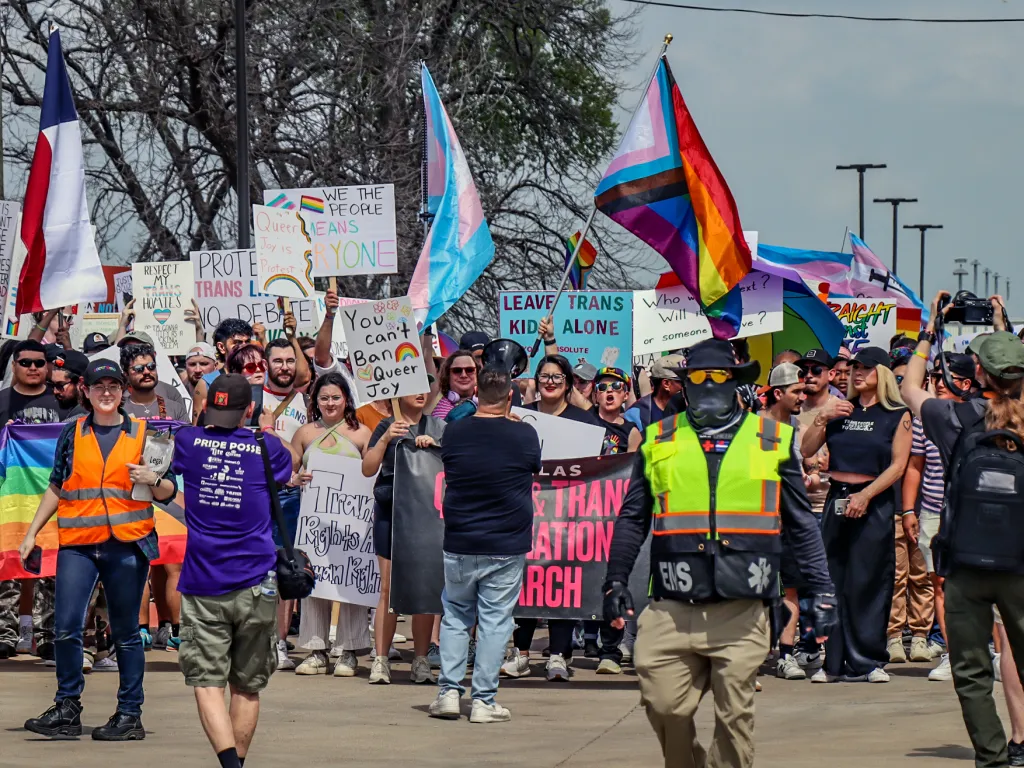
Several hundred people crowded into the parking lot between Cathedral of Hope and Resource Center on Sunday afternoon for a short rally before pouring out onto Cedar Springs Road and marching to The Crossroads.
The March for Queer & Trans Liberation, organized by a coalition of more than 20 local organizations with GLAAD’s Texas representative and communications director for Texas Latino Pride Jacob Reyes, was held in response to the ongoing wave of anti-LGBTQ legislation and policies coming out of Washington, D.C., and state Capitols around the country, including Austin where Texas lawmakers this session have introduced a record number — 205 — of anti-LGBTQ bills, especially focusing on anti-trans efforts.
In explaining the reasons last week for the march, Cece Cox, CEO for Resource Center which was one of the organizations behind the march said, “The Queer & Trans Liberation March sends a message to all in Dallas and across Texas that when we stand up and show up for our communities, we move closer to reclaiming justice.’
The state of Texas collected information on transgender residents who have changed the sex listed on their identification documents.
According to internal agency documents provided to The Texas Newsroom, employees with the Department of Public Safety recorded each time a driver requested to change the sex listed on their license. The employee scanned and saved the driver’s information, the records show, and sent it to an internal email account created for collecting these data.
At least 42 such attempts, including instances where people asked for guidance about state policies during calls or in-person appointments, have been reported in the last five months, the records show.
It’s unclear why the state is gathering this information, with whom it is sharing it and whether the effort is ongoing.
The data collection occurred as state officials and lawmakers continue to erode LGBTQ rights, bolstered by the Trump administration’s policy rejecting the existence of transgender people.
On Friday, Paxton said it is unlawful for transgender Texans to change the sex listed on their state IDs. In an opinion that does not hold the force of law, he added that any documents that have been updated must be changed back.
Paxton’s agency and the Department of Public Safety did not respond to requests for comment for this story.
The Texas Newsroom spoke with one driver who was flagged by the agency. A transgender man who asked not to be named out of privacy concerns for himself and his child, he said he would not have asked the agency for help updating his license if he knew his information would be reported to the internal agency email account.
“Absolutely not,” he said. “I would not have emailed because now that’s further putting me and my business at risk. …It makes me uneasy.”
Policy change, data collection
For years, transgender people in Texas could update their state IDs to match their gender identity by obtaining a court order and then submitting this document to the state agencies that issue driver’s licenses and birth certificates.
Last fall, the Department of Public Safety said it would no longer let Texans change the sex on their licenses unless it is to fix a clerical error. In announcing the policy change, agency officials also directed employees to record anytime such a change was requested and send the information to an internal email address with the subject line “Sex Change Court Order.”
At first, LGBTQ activists spammed the email address with subscriptions to gay pornography blogs and adult toy companies, copies of the “Bee Movie” script and personal pleas to leave transgender Texans alone.
But The Texas Newsroom has learned that after the outcry died down, the department continued to use the email for its original purpose — to collect information from drivers who tried to change the sex listed on their driver’s license.
According to more than 100 pages of records obtained through an open records request, driver’s license division employees reported dozens of cases of drivers attempting to change the sex on their licenses in the last six months.
How people were treated and what information was collected varied by location and who dealt with their file, the records showed.
Some employees allowed the drivers to change the name listed on their licenses, but rejected their requests to update their sex. Others were declined on both fronts. Some new residents presented out-of-state or federal documents that matched their gender identity but were still denied a matching Texas license.
The records showed that some state employees also reported people who called the department or walked into a driver’s license office with questions about how to make these changes — even if they did not file a formal request to change their ID.
The Texas Newsroom reached out to the agency, as well as state leaders including Paxton and Gov. Greg Abbott, about the data collection. None answered questions about how the information was being used or how long the effort would last.
This isn’t the first time that state officials have expressed interest in tracking transgender Texans. In 2022, Paxton asked the Department of Public Safety to send his office data about drivers who may be transgender, according to the Washington Post.
At the time, the department said it did not track this exact information and no records were provided to Paxton.
This year, state lawmakers have proposed dozens of bills to whittle away at the rights of lesbian, gay, bisexual and transgender Texans. One proposes jailing anyone whose sex on state documents does not match that assigned to them at birth.
Transgender driver flagged
Most of the drivers’ names were redacted from the records released to The Texas Newsroom.
The aforementioned driver was identified using other information in the documents. In an interview, he said he was not aware that the state was no longer allowing people to change the sex on their IDs when he reached out to the department for help updating his license in October.
He had already updated his passport to match his gender identity, he said, and then went to update his license. But an employee at a local driver’s license office said he needed to contact the state directly and provide more documentation, the driver told The Texas Newsroom.
That’s when he sent a copy of his passport to the Department of Public Safety, he said.
“Hello, I’ve attached my passport in case you need it,” he wrote in an email, which was included in the records released to The Texas Newsroom. “Thanks in advance for your help.”
His email was then forwarded to the special address collecting information about transgender drivers, the records showed.
The driver said the request to change his license was then rejected. He is relieved that he has a passport and social security card that do match this gender identity. In February, the Trump administration stopped allowing transgender people to change the sex on their federal document; the policy change is being challenged in court.
“I feel at peace, honestly, just because I was able to get it done. But that doesn’t mean I don’t sympathize or empathize with the people that were unable to get the change,” he said. “I should be OK to live a normal life without being bothered or harassed.”
Friday was the bill filing deadline for Texas’ 2025 legislative session, and Equality Texas’ Interim Executive Director Brad Pritchett today issued a fundraising message warning the state’s LGBTQ community that “we have reached a grim milestone:”
As of Monday, March 15, 205 anti-LGBTQIA+ bills have been filed in the Texas legislature, Pritchett noted. That is, he said, the highest number ever recorded in Texas, surpassing the previous record of 141 bills filed in 2023.
“This is a distinction no Texan should be proud of,” Pritchett wrote. “These bills target our community’s basic rights and freedoms, from healthcare access to education to simply being able to live our lives with dignity. They aim to marginalize LGBTQIA+ Texans and erase our existence from public life.”
Pritchett pointed to Equality Texas’ efforts so far in 2025 which include hosting 30 advocacy training sessions across the state and training more than 1,000 advocates to mobilize at the Capitol, launching the largest pro-transgender TV ad campaign in Texas history, conducting more than 30 issue briefings on LGBTQ rights with legislators and stakeholders and organizing the “largest LGBTQIA+ advocacy day in Texas history.”
Pritchett said that while Equality Texas knows such strategies work, “we need your support to implement them, effectively … . The sheer volume of anti-LGBTQIA+ legislation means we must redouble our efforts.”








You must be logged in to post a comment.